PASADENA, CALIF. — “Everybody needs beauty as well as bread, places to play in and pray in, where nature may heal and give strength to body and soul alike.” During the early Twentieth Century, when pioneer conservationist and writer John Muir expressed this sentiment, his fellow transplants to California William Bragdon (1884–1959) and William S. Rice (1873–1963) were celebrating the state’s scenic beauty and healthy, outdoor lifestyle in their art. A shared passion for California’s splendor permeates the companion exhibitions “Of Cottages and Castles: The Art of California Faience” and “The Nature of William S. Rice: Arts and Crafts Painter and Printmaker.” Organized by the Crocker Art Museum in Sacramento, these offerings are currently on view at the Pasadena Museum of California Art until April 3.
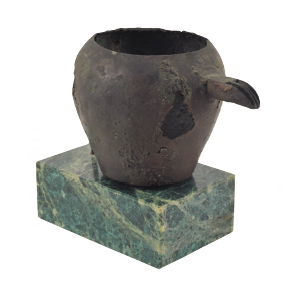
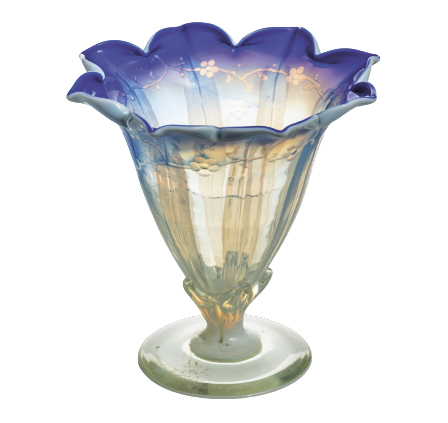
The exhibition on Bragdon’s company California Faience, the first mounted solely on this pottery, showcases more than 120 examples of tiles, vessels, lamps and figurines. The presentation on Rice includes more than 50 watercolors and block prints, some never before on display in the southern part of the state.
Intriguingly, both shows are family affairs. Kirby William Brown, PhD, guest curator of the California Faience exhibition, is very proud to be named after his grandfather William Bragdon, a founding partner of the pottery. Marie-Clare Treseder Gorham, guest curator of the Rice exhibition, is the great-granddaughter of William S. Rice. William Braezeale, curator of European art, and Diana L. Daniels, curator of contemporary art, served as the organizing curators at the Crocker Museum for the California Faience and the William S. Rice exhibitions respectively.
As an introduction to California Faience, Brown told how the title “Of Cottages and Castles” refers to the installation of the firm’s tiles in structures ranging from fairly modest bungalows to William Randolph Hearst’s extraordinary castle complex at San Simeon. This small pottery operated in Berkeley from 1915 to 1959. The ceramicist Chauncey Thomas had established its precursor, the Tile Shop, in 1913. William Bragdon joined him two years later. Both men had attended the New York State School of Clay Working and Ceramics at Alfred, and Bragdon had recently relocated to Oakland in order to teach at the California School of Arts and Crafts.
Soon after forming their partnership, Bragdon and Thomas changed the company’s name to California Faience. According to Brown, the strong attachment the two resettled Easterners felt for the Golden State is reflected in the pottery’s rechristening.
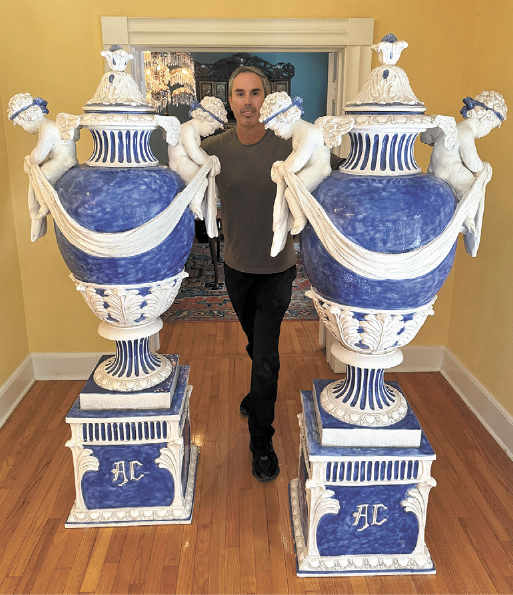
California Faience is best known for hand pressed and hand decorated tiles. The use of architectural tiles suited California’s climate and was integrally tied to the popularity of the Spanish Colonial and Persian Revivals in the area. Braezeale noted that “the founders of California Faience knew their art history very well” as they drew upon Islamic, Ottoman and early Spanish antecedents as well as the more recent Art Nouveau and Arts and Crafts styles.
During the 1920s, the company’s most consuming commission was Hearst’s San Simeon. Bragdon, Thomas and their coworkers created nearly 100,000 tiles as ordered, and sometimes individually designed, by architect Julia Morgan. Beginning in the late 1920s, California Faience also made “California Porcelain” in collaboration with West Coast Porcelain Manufacturers in Millbrae.
About 1930, work slowed down at San Simeon and elsewhere as the Depression took hold. California Faience continued to produce a limited amount of wares, but turned into a studio space for ceramicists of varying levels of accomplishment, including young students. As Brown put it, “California Faience was a vibrant and collegial place. Many artists used it as a studio and were mentored by my grandfather.”
Brown recounted how he grew up in his grandfather’s household and visited the ceramics shop as a child. “This was the inspiration for a long-term project” coupled with the fact that Brown, an entomologist by training, is a self-admitted “congenital collector.” He expressed several aims for the exhibition, including his desire “to establish the place of California Faience within the California and American Arts and Crafts Movements and to show its influence on other potters, especially in California.” He also wanted to declare these ceramics as art. “The Arts and Crafts Movement wanted to elevate craft to the level of art and I wanted to do the same here.”
Brown explained how his sumptuously illustrated, 275-page California Faience: Ceramics for Cottages and Castles, published in 2015 by Norfolk Press, relates to the exhibition. “I met Scott Shield from the Crocker and we got the idea for the exhibition about eight or ten years ago. This provided me with the incentive to work on the book — and a deadline! The book goes beyond the traditional catalog. It contains many pieces not in the exhibition. I like to think of it as the definitive work on the pottery. … I had an advantage because, with my family connection, my mother kept photographs and a great deal of documentation of the sort that does not survive for other potteries. And it was a privilege and a thrill to meet and interview artists who worked there in the 1940s.”
Apropos of the appreciation of California Faience in collecting circles, Brown shared, “The market is strongest on the West Coast but I am seeing interest increasing across the country. … In the marketplace, California Faience is pretty scarce. Through eBay and some auction houses, mind-blowing pieces have come out of the woodwork and they opened up a larger market. That said, prices have not recovered to the levels they were in the early 2000s. At any one time on eBay you can see three to six pieces, so they are there.”
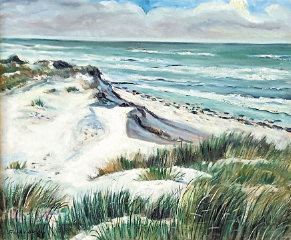
According to Gorham, the title of her exhibition, “The Nature of William S. Rice,” is a play on words, referring to both the overarching theme of his work — the natural world largely unoccupied by humans — as well as Rice’s characteristics as an artist, including his particular focus on craft.
Prior to moving West, Rice studied art at multiple institutions, including the Pennsylvania School of Industrial Art, where he met Frederick H. Meyer. Meyer, who is perhaps best known for founding the School of the California Guild of Arts and Crafts, encouraged Rice to come to northern California. There Rice taught art and worked for Sunset Magazine while pursuing his own artistic vision. He later authored the textbooks Block Printing in the Schools (1929) and Block Prints: How To Make Them (1941).
San Francisco’s 1915 Panama-Pacific International Exposition influenced many artists, including Rice. The nation of Japan’s display of ukiyo-e and related prints by the likes of Hiroshige, Hokusai and others made an impact upon Rice’s art, particularly in the realm of technique. Gorham, a working artist, summarized Rice’s approach. After carving the blocks — one for each color — he wielded a brush to apply the inks so that he could further manipulate them before making the print impression.
Surprisingly, Rice exploited the capabilities of printmaking as a way to create individual works of art. Uniform replication and large print runs were not part of his mindset. He sometimes made only 15 copies of a particular print. In addition, the prints he made from one set of blocks did not always resemble one another closely. This is especially true in his “day and night” and seasonal scenes where Rice used the same blocks but inked them in different colors. Daniels considers Rice’s choice to pursue printmaking a bold one considering the market for California views at the time. During her curatorial career, she has seen many more early California landscape paintings than prints.
As for the current appreciation of Rice’s art, Gorham perceived that “the market for his work has expanded considerably in recent years, in no small part due to the popularity of his works in the forms of books, calendars and note cards published by Pomegranate.” The aforementioned books are Ellen Treseder Sexauer’s William S. Rice: Art and Life (2013) and Roberta Rice Treseder’s William S. Rice: California Block Prints (2009).
Asked about why these exhibitions were appropriate for Pasadena audiences, PMCA Executive Director Jenkins Shannon said, “Pasadena was and still is considered the epicenter of the Arts and Crafts Movement on the West Coast. In the past, the PMCA has highlighted the work of Arts and Crafts artists who settled in Pasadena during the turn of the Twentieth Century, mounting exhibitions on Greene & Greene and Frances Gearhart. In keeping with our mission to present the breadth of California art and design, we are proud to present two more Arts and Crafts exhibitions, bringing more works from this significant movement to audiences in its West Coast capital.”
Braezeale underscored the importance of both printmaking and ceramics within the history of California art. He explained that the California Society of Printmakers is the longest-lived, still active print artists’ association in the United States, with its origins dating to 1912 through one of its two parent organizations, the California Society of Etchers. He also pointed to the state’s strong ceramics tradition, calling out the work of Robert Arneson and Beatrice Wood as examples.
The similarities between the lives and artistic careers of Bragdon and Rice are striking and include their mutual belief in California’s landscape and flora as a wellspring of inspiration. Undoubtedly both would have concurred with Muir’s poetic observation that “nature’s sources never fail. Like a generous host, she offers her brimming cups in endless variety … decorated with glorious paintings and enlivened with bands of music ever playing.”
The Pasadena Museum of California Art is at 490 East Union Street. For further information, 626-568-3665 or www.pmcaonline.org.