Tea gown, 1887, maker unknown, embroidered. Palais Galliera: Musée de la Mode de la Ville de Paris. Photo: Europeana.
By Laura Layfer
NEW YORK CITY — Gilded Age Fashion: More than 50 Iconic Looks and the Stories Behind Them is a new book, hot off the press this spring season, with a cool approach to styles of old. It offers a glimpse behind the scenes to the discussions and often drama of the elaborate “getting ready” process for elite women of the time. The 144-page hardcover was released March 31 by Hardie Grant North America.
It’s a fitting topic that the author, art and cultural historian Dr Elizabeth L. Block, seems to have perfected in her impressive roster of publications, each offering an intimate look at the meticulously crafted appearances of late Nineteenth Century influential women. By day, Block is senior editor in the publications and editorial department at The Metropolitan Museum of Art, but in recent years, she has also added a trio of books to her own credit. The previous titles include, Dressing Up: The Women who Influenced French Fashion and Beyond Vanity: The History and Power of Hairdressing. Now, in her latest manuscript, she chronicles a selection of high fashions dating from 1870-1900, to offer a day in the life of upper-class women aware that their every move, and material choice, was not only meant to be a privilege but a superpower.
Writer Mark Twain was the one who initially coined the term, “The Gilded Age,” to define this period in American society. Today, it is the subject of a popular HBO cable television series of the same name (created by Julian Fellowes of Downton Abbey fame) and currently heading into its fourth season. The glitter and glamour, social structures, industrialization and innovation have taken on a renewed spirit with the show yet Block, for one, is far from surprised in the fanfare that has developed. “There was so much on the line for these women,” she says, “the decisions they made in their fashions should not be overshadowed for frivolousness and rather recognized as important taste-making pursuits that established them as equal contributors to society.”

This theme has always been at the forefront of Block’s research and professional endeavors. She holds a bachelor of arts degree in English from The George Washington University, a master of arts degree in American studies from Columbia University and a PhD in art history from The Graduate Center, City University of New York. Her education in fine art was very traditional, as she tells it, and therefore her understanding of paintings often focused solely on the relationships between artist and figure. She continually found herself wanting to know more about the clothing depicted on canvas. “It’s both the attention to every detail and the collaboration between maker and wearer that sparked my curiosity — the idea of couturiers that made these incredible garments and the fact that there were customers who desired to wear them.”
The enormous wealth gaps, political divides and government tariffs (in Dressing Up there was an entire section devoted to this topic) that prevailed over a century ago somehow feel not so far from contemporary news in 2026. As Block comments, “We see both ends of the spectrum from the tycoons of the railroad, steel, petroleum and mining industries of the late 1800s, similar to the billionaire class today, when the majority of the population is just trying to get by.” The decisions made on what to wear were an opportunity to delight in dress as well as to display a knowledge of etiquette and simultaneously create customs that across the pond were once reserved exclusively for royalty.

Evening dress, House of Worth (French, 1858-1956), circa 1890, satin brocade. Western Reserve Historical Society, Cleveland (67.26.11). Photo © 2026 Shayla Oliver-Tuma.
Chapters in the book move from “Modish Mornings” and “Genteel Afternoons” to sections on “Elegant Evenings” and “Luxury and Legacy,” as each page offers imagery and information and begins by setting an interior scene. For example, Block features an example of the 20-piece Tiffany & Company silver vanity set, monogrammed of course, that would have been similar to those used for a lady’s routine morning grooming in her bedroom. “These pieces were made to be heirlooms,” says Block, citing another way that building traditions was at the forefront of even the most mundane activities. This would then be followed by putting on a dressing or “tea gown,” as they were often referred to, such as the one of aubergine velvet with tulip embroidery, dating to 1887, of a slightly looser silhouette to offer more daytime comfort. A typical look for ladies with last names of Astor or Vanderbilt, and worn to receive their guests more casually at home.
By contrast, for fancier affairs women would have donned a corset and bustle similar to the navy blue beaded bodice and green draped gown by couturier Charles Frederic Worth and believed to have belonged to one of the Hewitt sisters of New York. Their family home, now known as the Cooper Hewitt, Smithsonian Design Museum, was and is a treasure trove of decorative arts. The long sleeves were de rigueur for walking outside as women were expected to have covered arms, while the fringe trim along the hem may be a more playful homage to the intriguing relationship between fashion and furnishings — an appreciation for aesthetics that the Englishman Worth (with a salon on the rue de la Paix in Paris) would have known about his patron and her lineage.
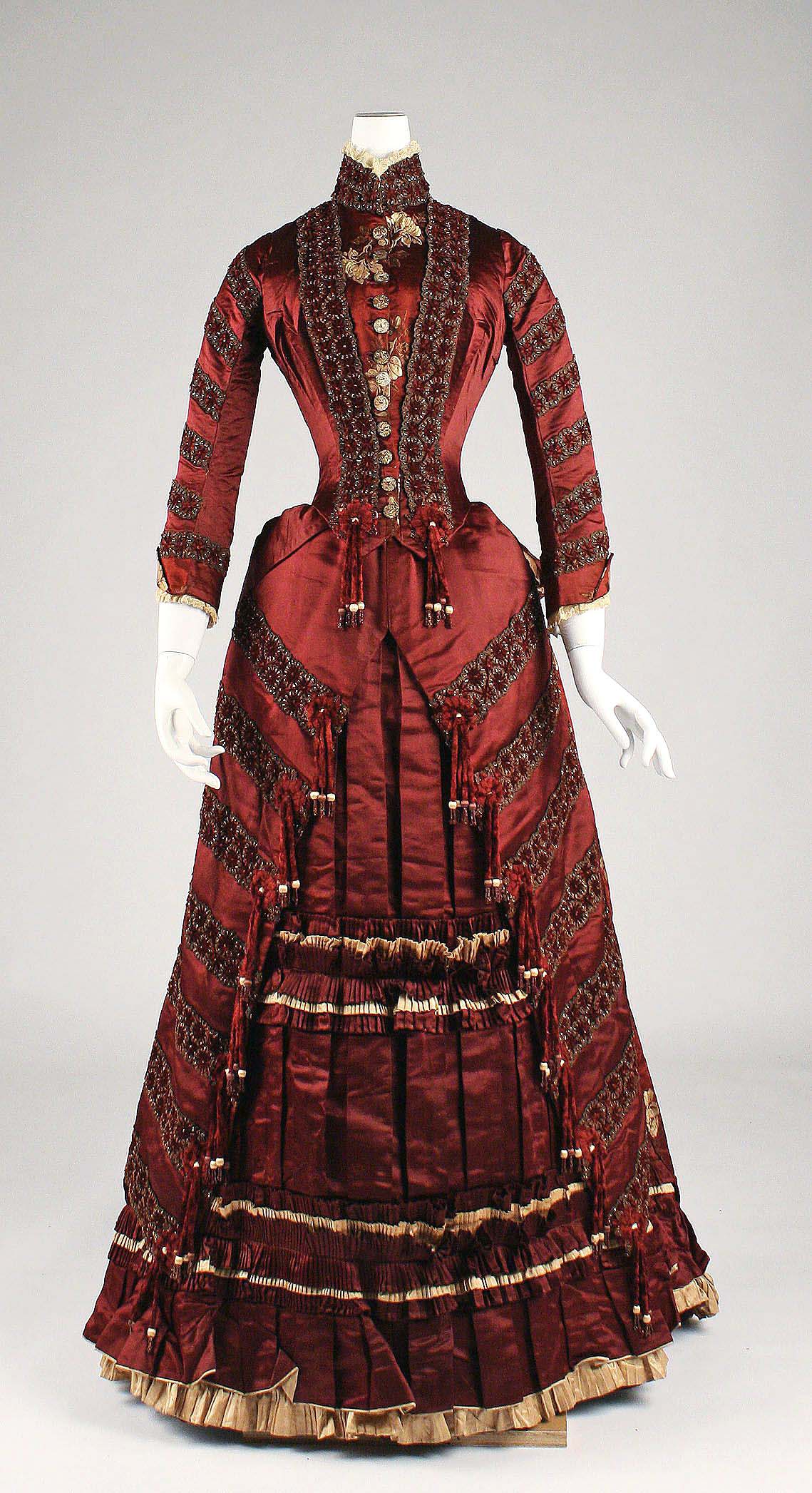
Afternoon dress, 1879, French, silk and glass. The Metropolitan Museum of Art, New York City, gift of Mr George A. Douglas, 1951 (C.I.51.23.1a-c). Photo © 2026 The Metropolitan Museum of Art.
“I really wanted to include showstopper dresses and accessories from major collections in the United States and Europe as well as represent beautiful historical pieces from underfunded institutions,” said Block of her research. The wives and daughters of industrialists along the East Coast and throughout the Midwest were strategic in their international purchases and they knew purchases abroad were a symbol of strength and status not only for themselves, but for the health and wealth of their country. The holdings of the Western Reserve Historical Society in Cleveland feature pieces by Worth in addition to an exquisite burgundy color brocade dinner dress with intricate beading from Maison Levillon and likely worn by Sarah Jane Wilcox Hitchcock and purchased when she traveled abroad to Paris.
Block writes about the seasonal calendars, as Chicago’s Opera House and Cincinnati’s Music Hall, were often dictated by dress and decorum. “When the final curtain fell, opera gowns began their second act.” A black velvet winter cape with rosette accents, point lace and a satin tie bow at center was more daring than deceptively demure as it is lined in red silk damask that would have certainly made a statement when taken off or put back on. Block continues writing in the book, “Artful outerwear benefited from extended display as opera goers wrapped a cape, or dolman, around their shoulders and slowly descended from box to foyer and eventually into a horse drawn carriage.”

Dolman, Madame Drugeon (nationality unknown), circa 1880-85, silk with ostrich feathers. Rijksmuseum, Amsterdam, E.M. Heijman-Salomonson bequest (BK-14687). Photo © 2026 Rijksmuseum, Amsterdam.
Weddings, too, serve as a source for elegant imported haute couture and well-documented narratives as many dresses were frequently donated from local families. The pristine provenance, however, may include some less welcome press and publicity as Consuelo Vanderbilt found out when her marriage to the Ninth Duke of Marlborough was featured in Vogue magazine. The full-page spread not only shared a drawing of the bridal gown by French couturier Doucet but exposed embarrassing details of her undergarments in explicit detail. Though some of the Belgian lace trains were likely longer in measurement than the days of not so blissful nuptials, as Block cheekily notes, the celebrations were carefully orchestrated by clothing to import a pomp and circumstance. Beige and ivory bridal ensembles were taken from Queen Victoria who wore white to marry Prince Albert in 1840. Other gowns were often more practical when selected in a color, even red or brown or gray, and could then be worn again during the honeymoon.
The accoutrements of handbags, shoes, fans, parasols and, without question, fine jewels were part and parcel to any female form of dress, day or night. It will not be surprising for readers to learn that the House of Cartier was located on the same Parisian street as the French couturiers — for a customer’s easy access and convenience. “My hope for this book is that it will enter living rooms and be displayed on coffee tables in homes and spark continued conversations,” comments Block, “perhaps it can be a gift exchanged between mothers and daughters or friends and fans of the show eagerly awaiting new episodes.”
In a short section of the manuscript titled “Behind the Fitting Room Curtain: Recollections from Couture Patrons,” there is an excerpt from a letter by photographer and well-known Washington, DC, hostess Mary “Clover” Hooper Adams, then married to a descendant of President John Adams. Clover recalls her recent shopping trip to Europe and reveals both the excitement of receiving her purchase and the value attributed to each hand-sewn stitch: “My Worth gown has come home and not only fills my small soul but seals it hermetically…What doesn’t show is as good as what does, so that when the right side is quite worn out I shall simply wear the wrong side out.”
For information and to order the book for $28, www.elizabethlblock.com.
[metaslider id=”1000497869″]