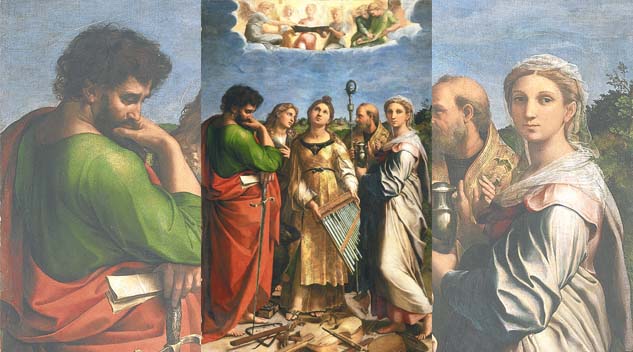
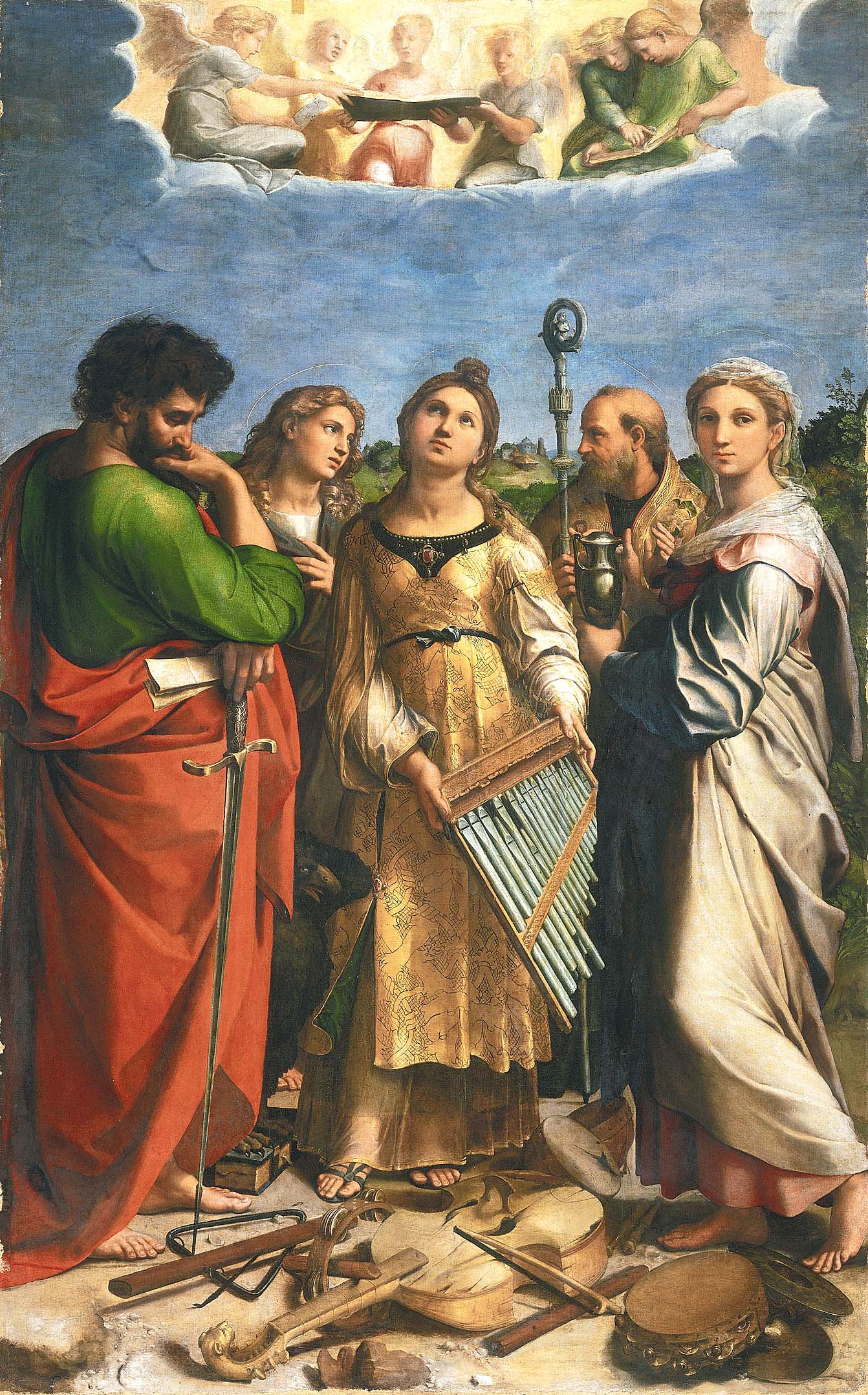
“The Ecstasy of Saint Cecilia with Saints Paul, John the Evangelist, Augustine and Mary Magdalene” by Raphael (Raffaello di Giovanni Santi) (Italian, 1483-1520), circa 1515-16, oil on canvas (transferred from wood). Polo Museale dell’Emilia Romagna, Pinacoteca Nazionale, Bologna (577). Image courtesy Scala / Art Resource, NY.
By James D. Balestrieri
NEW YORK CITY — These days, Leonardo da Vinci and Michelangelo sit atop the pantheon of Italian Renaissance artists while Raphael sits in third place. However, this wasn’t always the case. For centuries, Raphael was first, reigning over all others, including the painters of the “Mona Lisa” and “Sistine Chapel.”
Indeed, it was Raphael who was seen as an inflection point. After all, one of the most important art movements of the Nineteenth Century is the Pre-Raphaelite movement. “Raphael: Sublime Poetry,” on view March 29-June 28 at the Metropolitan Museum of Art, is a comprehensive, chronological, cradle-to-grave, influences-to-legacy exhibition. Featuring more than 200 works on loan from dozens of museums, and with an accompanying catalog that is certain to become a standard reference in Renaissance studies, the exhibition just might upend the current rankings. In his brief life, Raphael made an enormous impact on the practice and business of art, excelling in portraiture, devotional art, fresco, architecture, tapestry and banner design. “Raphael: Sublime Poetry” is more than a compendium of existing theories and conclusions about the artist, as the exhibition includes new research and insights.

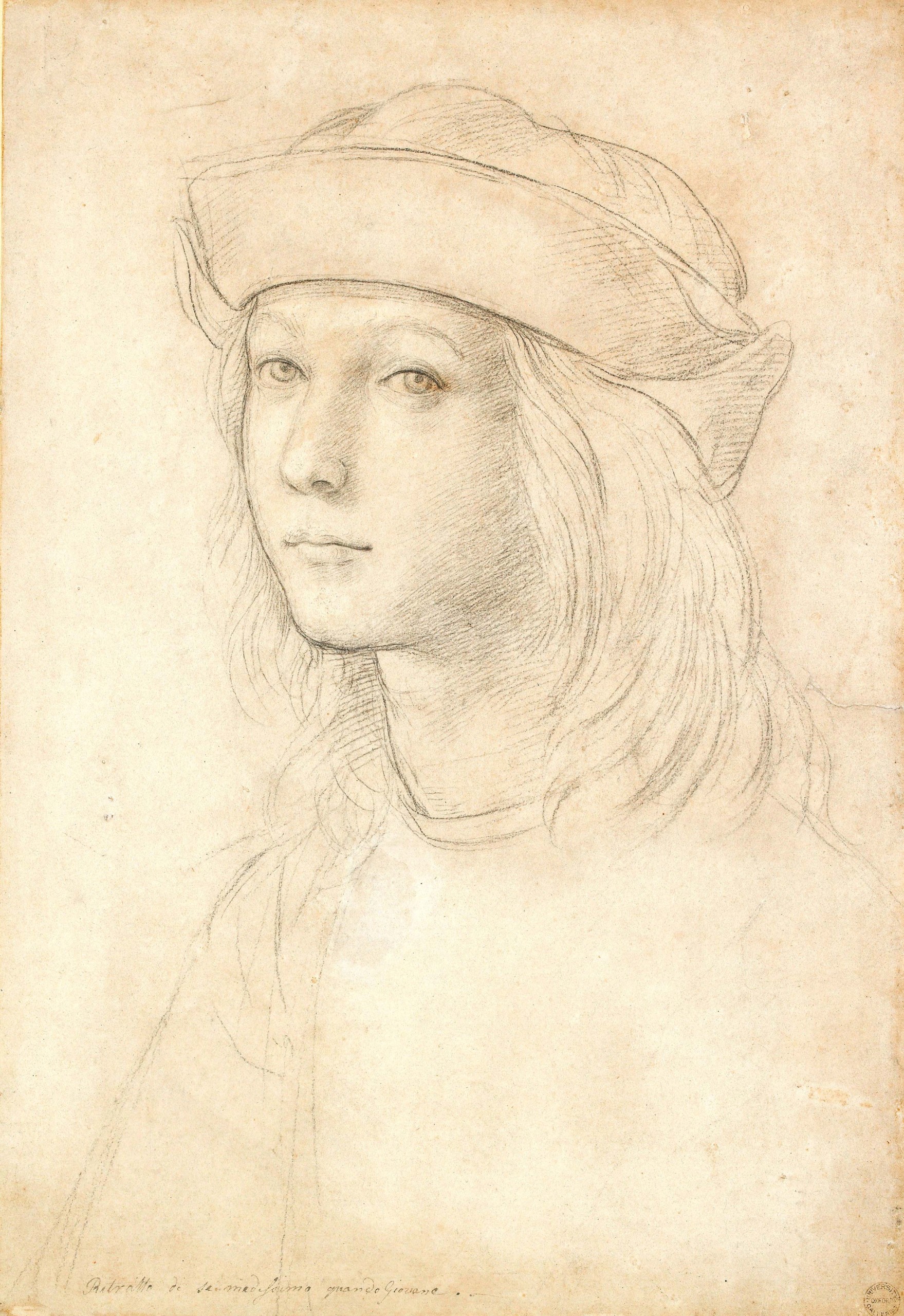
“Portrait of a Young Boy (Presumed to be a Self-Portrait)” by Raphael (Raffaello di Giovanni Santi) (Italian, 1483-1520), Rome, circa 1500. grayish black chalk, highlighted with white (now lost), on laid paper, 15 by 10¼ inches. Ashmolean Museum, Oxford, presented by a Body of Subscribers in 1846 (WA1846.158). Image © Ashmolean Museum, University of Oxford.
Urbino, the city where Rafaello Santi was born in 1483, lay at some distance from the more celebrated city-states of Florence, Venice, Rome and Siena. Federico da Montefeltro, who died a year before Raphael was born, had been an active, learned ruler — a keen mathematician and architect — while Raphael’s father, Giovanni Santi, who died when his son was 11, became the most prominent painter and poet in the Montefeltro court. Because of this, Raphael nevertheless found himself growing up in the thick of the intellectual and artistic ferment that gave rise to the constellation of makers and thinkers who found fresh ideas in a new appraisal of and appreciation for antiquity, for classical Greece and Rome.
Raphael’s early life is less well known than the lives of Leonardo and Michelangelo, who were inveterate writers. Vasari’s biography of the artist — which Vasari himself had cause to revise — tells us that Raphael was apprenticed to Perugino at an early age. Perugino was perhaps the most admired painter of his generation and his influence on the young artist is evident.
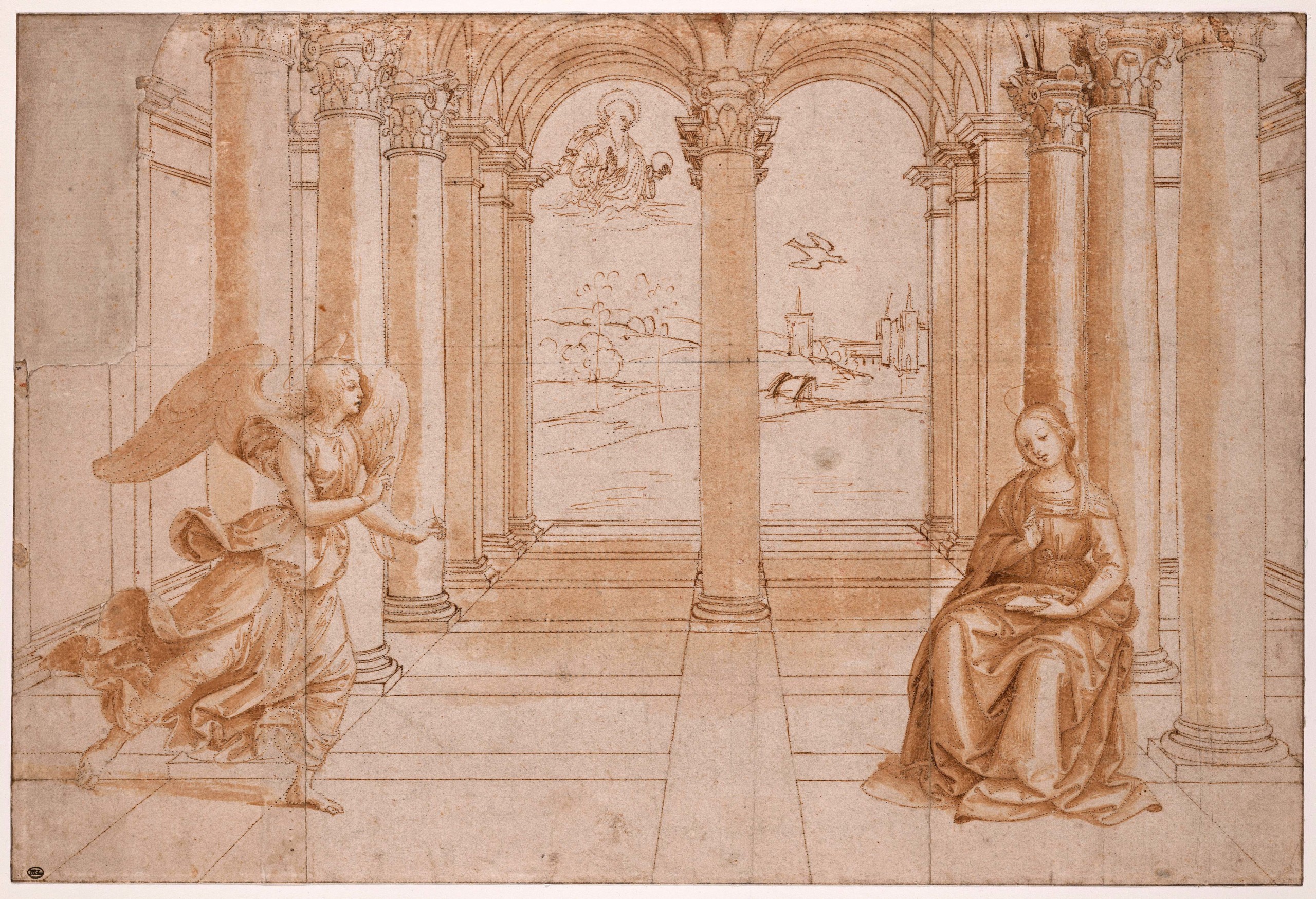
By 18, Raphael was listed on contracts as “magister,” or “master.” In 1504, at the age of 21, Raphael traveled to Florence to embark on his own career. There, in works like the “Oddi Altarpiece,” the artist steps out from Perugino’s shadow. In his studies for “The Adoration of the Magi” and “The Annunciation,” Raphael transcends the late medieval mannerist aloofness characteristic of Perugino’s facture, making these drawings and the altarpiece itself quick and busy with life. This is evident in the crowd scene that he makes of the Adoration. You can hear the buzz among the onlookers. But, the way the angel runs to meet the pensive Mary in “The Annunciation” and our vista through the portico, out into the wider world — a world on the verge of being forever changed — invests the drawing with an energy that wouldn’t be there if the room were enclosed.

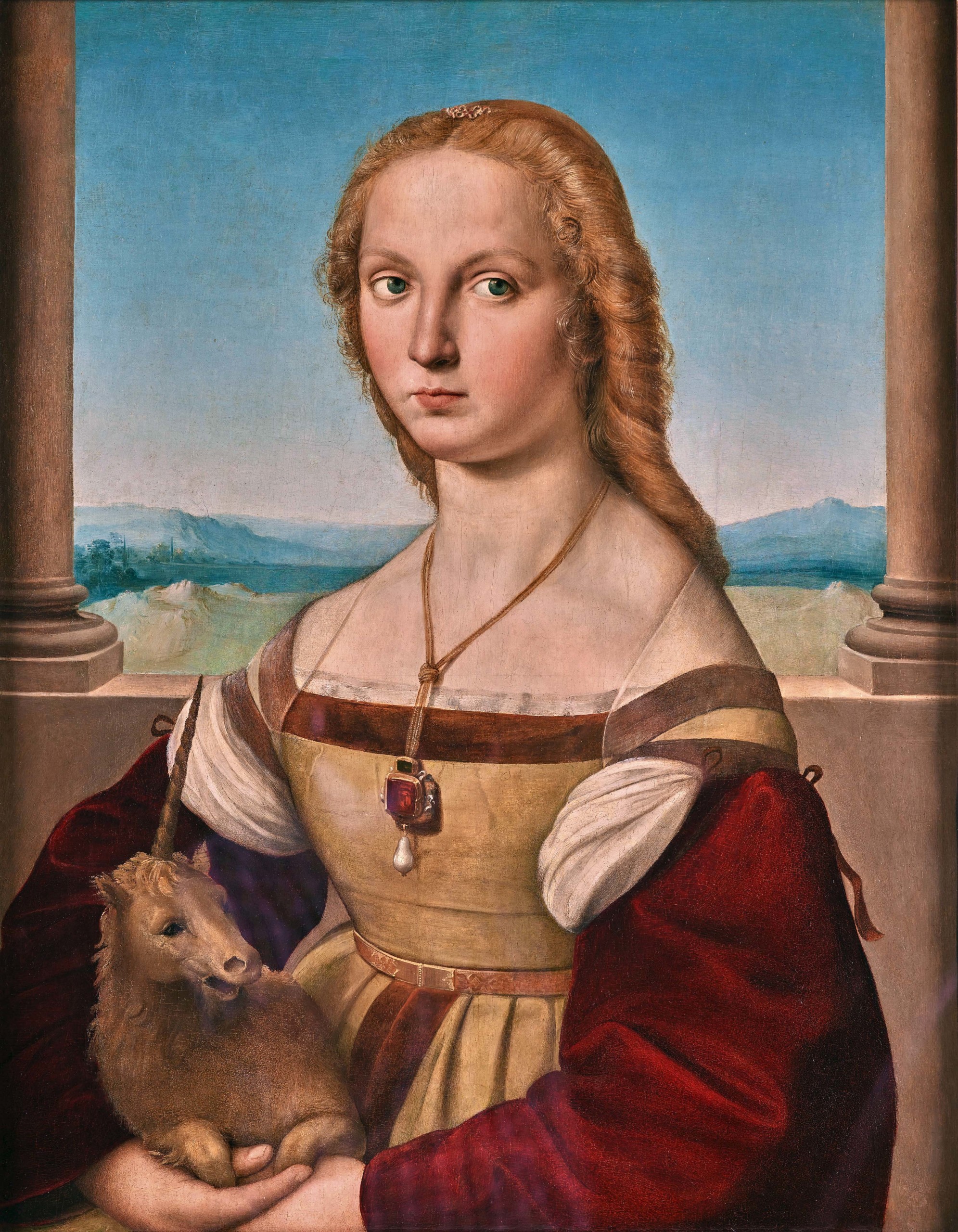
“Portrait of a Lady with a Unicorn” by Raphael (Raffaello di Giovanni Santi) (Italian, 1483-1520), 1505-06, oil on canvas, transferred from wood. Galleria Borghese, Rome (371). Image © Galleria Borghese, photo by Mauro Coen.
In “Portrait of a Lady with a Unicorn,” Raphael adopted new ideals of feminine beauty from Dante, Petrarch and Boccaccio. Beauty, virtue, perfection and, perhaps, a touch of untouchability marked these ideals. Earlier scholars asserted that Raphael first painted a dog in the woman’s lap. New imaging of the painting reveals that the artist always intended the animal the Lady holds to be a unicorn. Is the unicorn a heraldic symbol of the woman’s family? Or is it that, as an essay in the catalog hints, “The literate population of Raphael’s time would have been acquainted with late antique and medieval bestiaries, which feature the unicorn as an ambiguous symbol of sacred and profane chastity,” attracted to virgins and liable to fall asleep in their laps. Is it meant to be a living unicorn, in miniature, or is it a toy of some sort? In any event, the presence of the unicorn injects human individuality into the feminine ideal.
The following year, Pope Julius II summoned Raphael to Rome. Julius, Christian Rome’s greatest patron of the arts, would keep Raphael busy there for the rest of his life — he would die at the age of 37. In Rome, Raphael would create the frescoes for the Stanza della Segnatura in the Vatican. On one wall, Plato, Aristotle and ancients like Pythagoras and Diogenes argue in “The School of Athens.” Opposite, in “The Disputa,” saints, Old Testament prophets and the Trinity watch over earthly scholars and poets, including Dante, as they debate the thorny question of transubstantiation. This visual dialogue between the classical past and the Christian tradition embodies the humanist project of the Renaissance, a project Raphael would throw himself into for the remainder of his life.
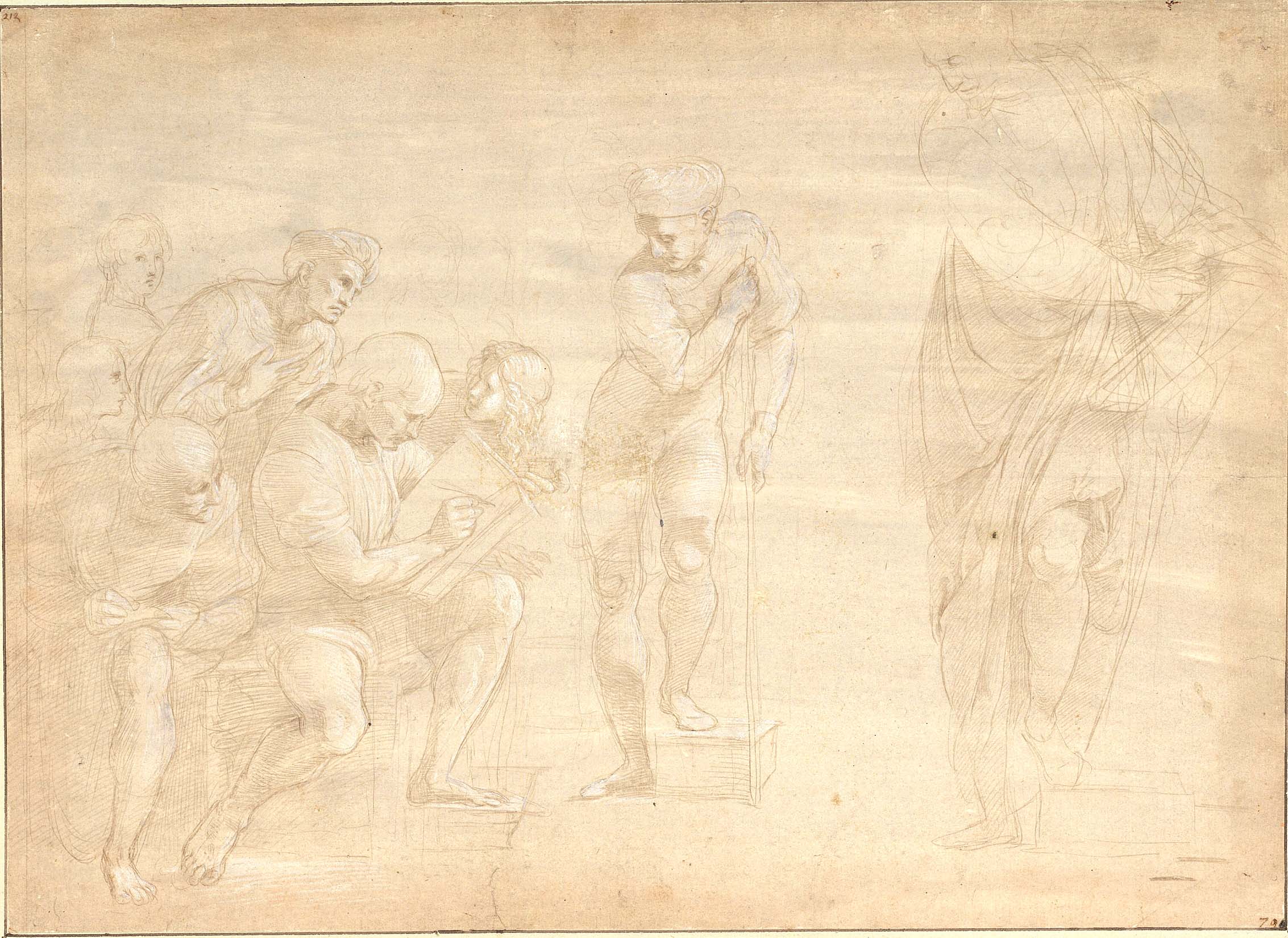
“Rome Study for Diogenes in The School of Athens, Stanza de la Segnatura” by Raphael (Raffaello di Giovanni Santi) (Italian, 1483-1520), circa 1508-10, metalpoint (silverpoint?), on paper pink, 9⅝ by 11-3/16 inches. Städel Museum, Frankfurt am Main (380). Image courtesy Städel Museum, Frankfurt am Main.
“The Virgin and Child with Infant Saint John the Baptist in a Landscape,” also known as “The Alba Madonna,” painted circa 1509-11, possibly at the behest of Pope Julius, is certainly one of the most recognized and reproduced images of Mary with Jesus and Saint John. Adopting the perfection of the circle, or tondo form, this thoroughly devotional painting is, at the same time, profoundly humanistic, a work in which Raphael melds Roman antiquity and the Italian present to the New Testament. The background, for example, is Italian pastoral while the “Virgin’s sandal is of an archaeologically precise Roman style, comparable to Early Imperial exemplars, which speaks to the antiquarian tastes of the artist and patron.” The scene itself echoes these yearnings for historical continuity. The boys are sacred — this much we can glean from the halo and crucifix. They are also very much boys, very human boys. And Mary is an all too human mother. Jesus, on Mary’s lap, squirms to grab the cross from the infant Saint John. Mary stares John down with a stern, maternal look. Her finger holds her place in her book — all she wants to do is sit outside on this beautiful day and read her book — but these two divine little devils won’t let her. Humanism humanized everything, even the realms of the divine and sacred, at the same time as it united the pagan and Christian worlds. Schisms and outright wars arose from this idea as it threatened to erase the line between the human and the divine.
One of Raphael’s closest friends was the famed humanist Baldassare Castiglione whose Book of the Courtier, with its rich descriptions of aristocratic life and ideals of courtly behavior still offers great insight into the virtues of malleability and affability in the turbulence of the myriad Italian courts, a virtue he called sprezzatura, which, loosely translated, means the projection of artless grace, and a quality Raphael seemed to exude.

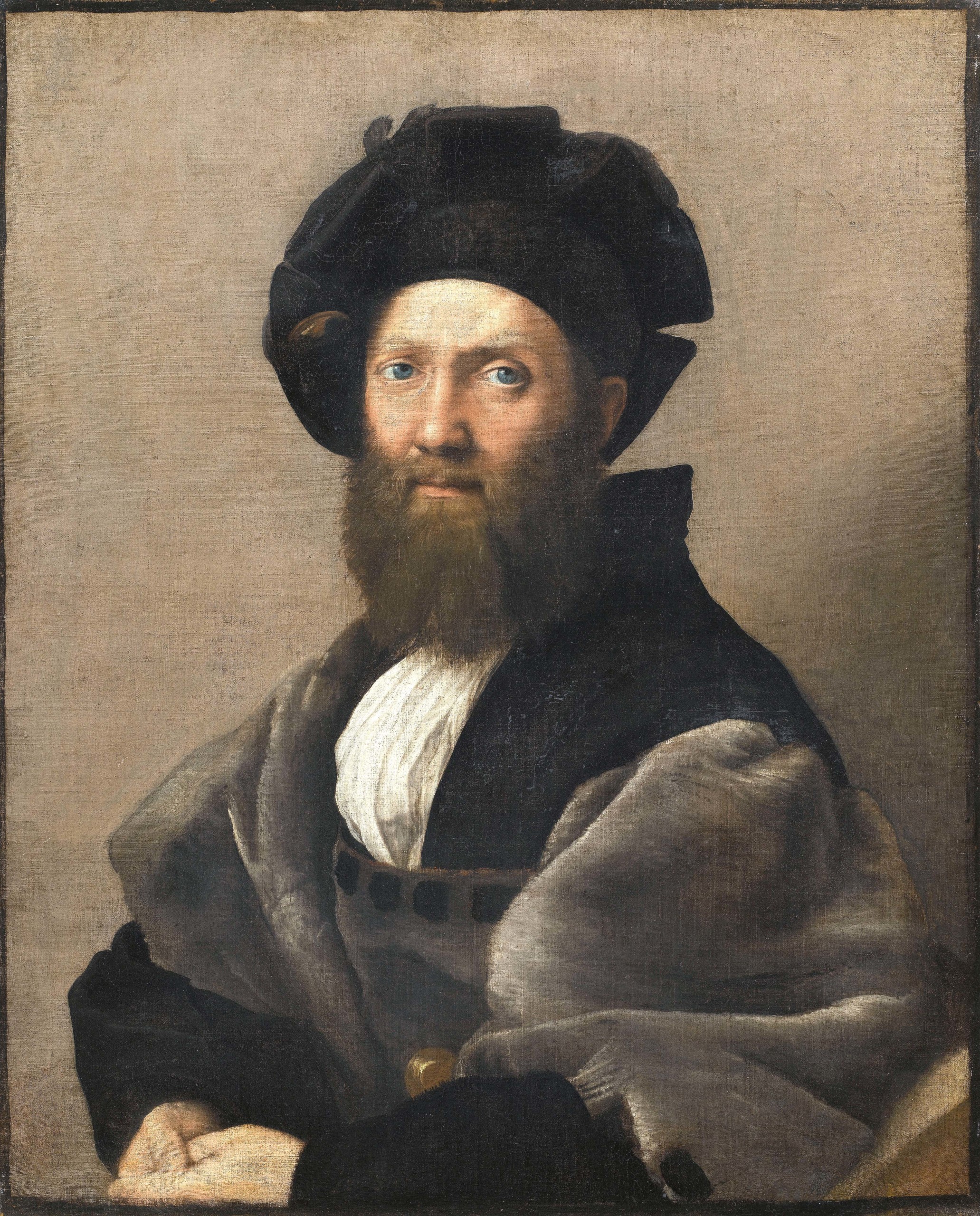
“Portrait of Baldassarre Castiglione” by Raphael (Raffaello di Giovanni Santi) (Italian, 1483-1520), 1514-16, oil on canvas. Musée du Louvre, Paris, département des Peintures (611 [MR 437]). Image © RMN-Grand Palais / Art Resource, NY.
Castiglione had spent time in Urbino and befriended the young artist. From 1514-16, Raphael painted his portrait, which now hangs in the Louvre. If you notice a resemblance between Castiglione’s pose and the pose of Leonardo’s “Mona Lisa,” give yourself high marks — Leonardo’s masterpiece was “in Rome between 1513-16” and Raphael knew it well. But a look at the differences tells us a great deal about Raphael’s interest in greater naturalism in portraiture. “Here, however, as if to correct any prolixity on Leonardo’s part, Raphael constructed a sober, more orderly composition that omits all details of setting. He articulated the author’s figure as a compact pyramidal form lit by a single source at the upper left, attaining a powerful sense of sculptural monumentality against the plain brownish background. Castiglione casts only a subtle, evocative shadow in the background at right. The close cropping of the figure at half-length, with no details of setting to create distance or distract from the subject, fosters intimacy and warmth.” As well, Castiglione’s eyes and mouth indicate a smile that engages the viewer (this was an important attribute in courtly life). Taken all in all, we see the naturalistic line between Raphael and later portraitists such as Hans Holbein and Peter Paul Rubens.
At the end of his life, Raphael would be put in charge of not only the archaeological excavation and restoration of the ancient city Rome; he would be tasked with making the classical past harmonize with the architecture — old and new — of Christian Rome. He did not live to see it through, but it would have been a work of sublime poetry.
Sublime was yang to beauty’s yin long before Edmund Burke’s 1757 A Philosophical Enquiry into the Origin of our Ideas of the Sublime and Beautiful. It remains a critical concept word in aesthetics. Sublime means, literally, “up to the threshold.” Unlike beauty, which is about harmony and balance in form, the sublime refers to phenomena we cannot quite get our senses around — the vast, the prodigious, the vertiginous — and the sensation that we might just want to hurl ourselves into them or, at least, give ourselves over to them. Poetry comes from the Greek word poiesis — meaning making or creating something new — giving birth, if you will. Through talent, imagination and sheer energy and will, Raphael created a prodigious body of work, one we still, after all these centuries, can’t quite get our senses around, though I urge you to give it a try when you visit “Raphael: Sublime Poetry.”
The Metropolitan Museum of Art is at 1000 Fifth Avenue. For information, www.metmuseum.org or 212-535-7710.