NEW YORK CITY — “This commission marks Arabella Worsham’s moment of transformation as she establishes herself as a woman of taste.” Excited in the telling, Alice Cooney Frelinghuysen underscored the significance of Worsham’s selection of George A. Schastey to reimagine her Manhattan mansion as an Aesthetic-style showplace in 1881. This event is central to the three-part exhibition “Artistic Furniture of the Gilded Age,” which opened at the Metropolitan Museum of Art on December 15. The concept of “transformation” runs as a leit motif with relevance to the patron, the cabinetmaker-decorator and others involved with these luxurious furnishings and even to certain of these interiors themselves.
Not the least of those transformed is George A. Schastey (1839–1894), whose artistic reputation has risen exponentially. Having fallen into obscurity until resurrected through this initiative, Schastey has now assumed a place in the pantheon of American Aestheticism alongside Herter Brothers and Pottier & Stymus.
Frelinghuysen, the Anthony W. and Lulu C. Wang curator of American decorative arts, and Nicholas C. Vincent, manager of collections planning — with support from research assistant Moira Gallagher — co-curated this dazzling exhibition. Its centerpiece is the newly installed and conserved Worsham-Rockefeller Dressing Room, originally part of Schastey’s interior design campaign for the 4 West 54th Street mansion. Miraculously squeezed into a redundant stairwell, the dressing room joins the chronologically arranged period rooms on permanent display in the American Wing. It stands as testament to the project team’s research, conservation and restoration accomplishments.
Richly ornamented in satinwood, purpleheart (amaranth), mother-of-pearl and silver and gold leaf, the intimate Worsham-Rockefeller Dressing Room absorbs only 12 by 18 feet of floor space. As Frelinghuysen noted, the form of the room was inspired by an Italian Renaissance studiolo, or scholar’s study. There is seriousness in the Renaissance- and Mannerist-inspired carving and marquetry on cabinetry doors and drawers. In counterpoint, on the door frames feminine accoutrements, including a hand mirror, comb, scissors, an étui and various pieces of jewelry, are rendered as marquetried trophies highlighted by mother-of-pearl insets. One can imagine putti flying off the room’s painted canvas frieze and plucking the dainty tools and personal ornaments from the door frames in rococo-winged flurry to assist Worsham at her toilet.
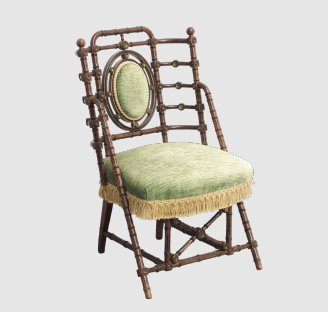
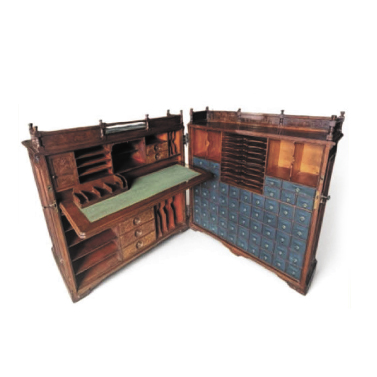
Until May 1, this prize historic interior will be set off by two companion gallery exhibitions featuring more than three dozen gems of American Aesthetic design. The first spotlights the furnishings Schastey’s firm executed for other rooms in the Worsham mansion and for the other projects. Nearly all of these tour-de-force objets d’art are new to public view or newly attributed to Schastey. As Vincent observed, “This is truly art furniture, exquisite in its conception and execution.”
To document and more fully explain what they have discovered about the history, artistic output and impact of Schastey and his firm, Frelinghuysen and Vincent — who are perhaps better known in the field as Nonnie and Nick — have co-authored a beautifully illustrated, scholarly essay. The February 2016 issue of The Metropolitan Museum of Art Bulletin is devoted to it.
The adjoining gallery showcases furniture Herter Brothers created for the William H. Vanderbilt House in 1882. The opulent dwelling once stood on Fifth Avenue between 51st and 52nd Streets. The commission’s temporal and geographical proximity to Schastey’s reimagining of the Worsham mansion makes for fertile comparison. The Vanderbilt project is considered Herter Brothers’ crowning achievement and the Met now owns more objects from it than any other museum.
But back to the dressing room and the 4 West 54th Street mansion. Short sketches of the decorator Schastey and patron Worsham are in order. George A. Schastey emigrated from present-day Germany as a youth and was apprenticed to a New York upholstery firm. He labored for various cabinetmaking and decorating companies, including Pottier & Stymus and Herter Brothers.
In the early 1870s, he started his own business in Manhattan. Over the years, his company worked as both a subcontractor and a project lead. Founders of the Central Pacific Railroad in the San Francisco area numbered among its clients.
During the 1880s, the firm executed projects in La Salle and Chicago, Ill., Newark, N.J., and New York City. In 1890, Schastey diversified by establishing a factory in Springfield, Mass., that specialized in Colonial Revival- and Arts and Crafts-style furniture aimed at a lower price-point.
But all was not smooth sailing. With high-end interior decoration a notoriously difficult business to manage from a financial perspective, the firm was also buffeted by swift changes in taste. On top of this, Schastey’s factory in Manhattan burned down in 1893 and Schastey died the following year. The company went out of business soon after.
The life of Arabella Duval Yarrington Worsham (circa 1850–1924) reads like a novel and indeed she both shrouded and enhanced her actual circumstances through the fictions she wove. It seems that she met Central Pacific Railroad tycoon Collis P. Huntington (1821–1900) when she was still a teenager, probably in her hometown of Richmond, Va. He was married and 30 years her senior. She became his mistress before or after she settled in New York City, where she referred to herself as Mrs John A. Worsham. In 1870, she bore a son named Archer who may have been fathered by Huntington. Directly or indirectly, Huntington provided her the wherewithal to purchase the house at 4 West 54th Street in 1877.
Huntington also likely introduced the patron and decorator to each other, Schastey having recently worked for Huntington and his wife, Elizabeth. In regard to this massive redesign of 1881–82, Frelinghuysen considers it “Schastey at his most inventive with decorations racing.”
But the story of 4 West 54th Street did not end there. Elizabeth Huntington died in 1883 and the following year Huntington married Worsham. The new Mrs Huntington no longer needed her own place. Through a series of transactions, John D. Rockefeller of Standard Oil fame acquired the mansion and furnishings from her. Rockefeller’s new digs demonstrated his arrival as an American captain of industry, although it is a bit hard to imagine members of this Baptist family known for their personal austerity settling into this lavish abode with ease. Witness another transformation as Rockefeller moves his primary residence from Cleveland to this super-posh Manhattan neighborhood.
Upon his father’s death in 1937, John D. Rockefeller Jr decided to tear down the house at 4 West 54th Street but not before documenting the interiors and removing the furnishings and some of the interior architectural features. In another moment of transformation, the property became the location of the Museum of Modern Art, of which JDR Jr’s wife Abby was a founder. He donated three rooms with furnishings to the Museum of the City of New York (MCNY ) in 1937. One of these, the Moorish Reception Room, was transferred shortly afterward to the Brooklyn Museum. These private, albeit splendid, living spaces were thus transformed into museum period rooms. What did not survive was knowledge that George A. Schastey was responsible for their creation.
In 2006, decisionmakers at MCNY determined that they no longer wanted to present the Worsham-Rockefeller rooms and contents. Three years later, MCNY gave the dressing room to the Metropolitan and the master bedroom to the Virginia Museum of Fine Arts. A program of intense research, investigation, preservation and re-creation ensued at the Met.
As logistical plans for conserving and reinstalling the room took shape, Frelinghuysen was also attempting to figure out, once and for all, the identity of its virtuoso maker. And who better to tackle this thorny question than Frelinghuysen, whose curatorial and scholarly contributions in this area are major? They include serving as solo, lead or contributing author of In Pursuit of Beauty: Americans and the Aesthetic Movement (1986), Splendid Legacy: The Havemeyer Collection (1993), Herter Brothers: Furniture and Interiors for a Gilded Age (1994), Louis Comfort Tiffany at The Metropolitan Museum of Art (1999), The Lamps of Louis Comfort Tiffany (2005) and Louis Comfort Tiffany and Laurelton Hall, An Artist’s Country Estate (2006).
In conversation, Frelinghuysen told how attributions had swirled around for years even though then-MCNY curator of decorative arts Margaret Sterns had located some documentation in the 1970s. Twice in 1884, Schastey had written to John D. Rockefeller stating, in so many words, that his firm was responsible for the Worsham mansion interiors and that he was offering his services should they be needed. The indefatigable researcher Frelinghuysen used these letters in conjunction with a key object with a demonstrable connection to Schastey to seal his authorship.
Dominating the center of the gallery devoted to Schastey is the linchpin object. Surprisingly, this Steinway piano with Schastey-made art case was not created for Worsham, but rather for thread merchant William Clark. Frelinghuysen referred to it as “the holy grail.”
By tracking the work’s serial number in Steinway & Sons’ records, it was discovered that the piano could be tied directly to Schastey and also to Clark. Its ornate case offered tons of clues concerning Schastey’s preferred vocabulary of materials, styles, craft techniques and motifs. During an examination of the object, Frelinghuysen called attention to Schastey’s reliance on satinwood and purpleheart as well as a favored combination of Renaissance Revival and British Design Reform styles. In the eyes of his contemporaries, furniture by Schastey possessed “a modern look in a Classical idiom.”
It is true that Schastey’s forceful objects are not for the faint of heart. They are ostentatious, riotous and complicated. Furnishings fashioned during the era of “Art for Art’s Sake” could really roar. The Aesthetic style may be the antithesis of currently reigning Modernism, yet exhibition visitors will be hard pressed not to appreciate the supreme quality of the design, materials and craftsmanship inherent in these brilliant works. Modernism lovers, take a joy ride. You might end up transformed.
“Artistic Furniture of the Gilded Age: Worsham-Rockefeller Dressing Room” is on permanent view. The temporary exhibitions “Artistic Furniture of the Gilded Age: George A. Schastey” and “Artistic Furniture of the Gilded Age: Herter Brothers and the William H. Vanderbilt House” are on view until May 1.
The Metropolitan Museum of Art is at 1000 Fifth Avenue (at 82nd Street). For information, 212-535-7710 or www.metmuseum.org.