Article and Photos by R. Scudder Smith
Allentown, Penn. — “I know each and every piece by heart, and each one has its own story,” the collector said, but those stories are really only a preview to the interesting and fascinating life of David Bausch. A lifelong resident of Allentown, he still lives in the house in which he was born (“I was born in the middle bedroom upstairs”), the son of Dr and Mrs Elmer Bausch, a very prominent and busy general practitioner in those early days and a very caring mother.
Dave was the son of Elmer’s second wife, Winifred, and he had one brother and one stepbrother, both now deceased. The first Mrs Bausch, her daughter and one son were killed in a tragic accident on October 25, 1925, when gas leaking from the street found its way into their home and exploded, completely destroying the house, a circa 1890 Victorian frame building, and the one next to it. Another son, Jimmy, was thrown from the house into the branches of a tree, puncturing both ear drums. Dr Bausch was in the house at the time and was hospitalized for several months after the accident. Two gas servicemen were in the basement at the time and both survived. The strength of the explosion blew out windows in several of the surrounding homes.
Dr Bausch built a new home in 1926 on the same site, remarried and started a second family. “My parents were great people, kind to everyone and always there with a helping hand. My mother loved to cook and we always seemed to have someone at the door for a handout, while my father was adored by all of his patients and saw people at all hours of the day and night, often as many as 40 to 50 per day,” Dave said. Toward the end of his career, Dr Bausch worked from a wheelchair, but he would never give in to an electric one. “Just the good old-fashioned one was all he ever wanted,” Dave said.
As a youngster, Dave accompanied his father on many house calls and on one particular day, while his father was treating a patient, he saw an old car, a 1889 Nadig that was made in Allentown, parked in a shed on the property. Some years later the shed had fallen in, the car was rusting apart, but it still came to Dave as a present from the owner. “It was beyond restoring, but well worth keeping as it was an Allentown original,” Dave said. After some research, he learned that the tires were made by a firm in West Chester, Penn., and now new tires lean against the frame, presently on loan to the America On Wheels Museum in Allentown.
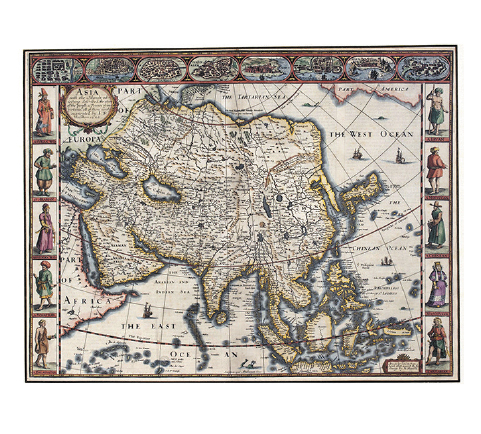
Dave mentioned one rule of the house that was never broken, “We all had dinner together, the time depending on when my father was ready,” he said. He also noted that there was a large map in the dining room and every evening, during the war years, father would place a tack indicating the movement of troops and which side had the advantage.
The dining room was sort of the hub of day-to-day life for the family, and many stories can be told. One concerns the evening Elmer Jr showed up at dinner with a rifle and was quickly asked by his father if the gun was loaded. The answer was “No,” upon which father took the gun and tapped it on the floor, stock first. When it hit, the gun went off, with the bullet lodging in the ceiling. “The hole has never been fixed,” Dave said, pointing it out over the table.
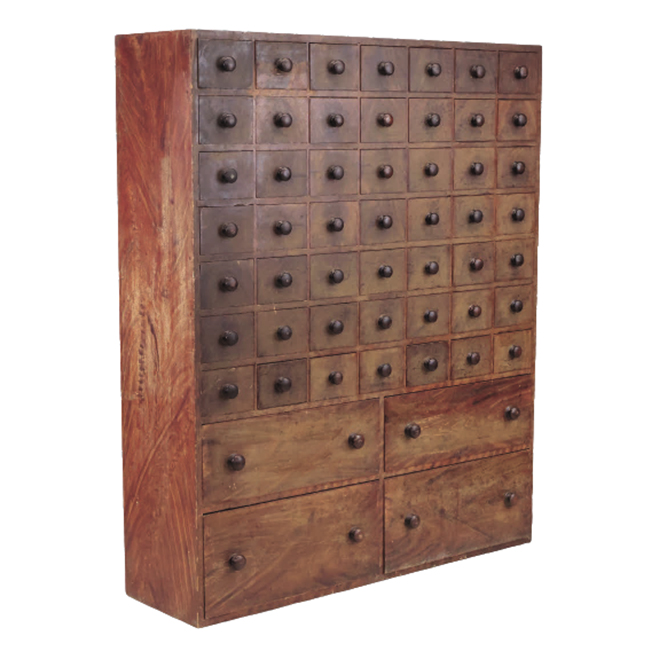
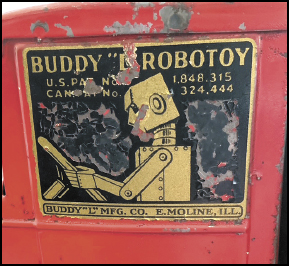
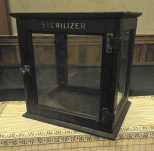
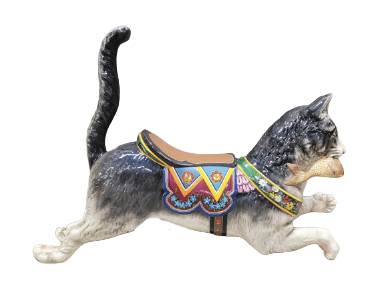
There is a growing sentiment for a house when it is the place you were born that stays with you through the growing years and well into adulthood, with little change to either the interior or the exterior. Elmer Bausch built his home with brick on the outside and 27 rooms inside. Over the years those rooms, once serving his medical practice as waiting rooms, examining rooms and operating rooms, eventually became very adaptable for Dave to display countless toys, banks, posters, auto memorabilia, early radios, phonographs and most anything you can name. Medical cabinets once filled with pills and equipment now overflow with tin and cast iron toys, and a pinball machine made in Allentown in 1800, at a firm just two blocks away from the house, now sits diagonally across a waiting room that once was occupied by patients in need.
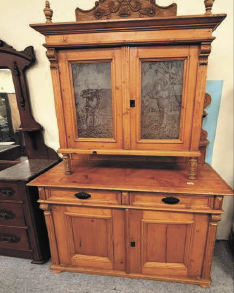
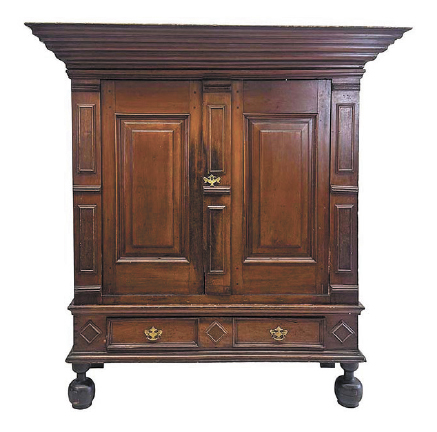
The same wooden cabinets that once held canned goods are still in the kitchen, the refrigerator and freezer are built into the wall, and the same drop leaf kitchen table is there for convenience and to hold things such as salt and pepper shakers, napkins and the daily paper. Across the hall is the dining room, complete with sideboard, chairs, a corner cupboard and a large table with lace cloth. “The only things that were not here when I was growing up are the TV in the corner and that glass door cabinet that I bought a couple of weeks ago,” Dave noted. He added, “At first I did not know what to put in the new cabinet, but it did not take long to find things, including the grouping of copper luster that came to my father as part of a medical payment.” Dave actually bought two of the cabinets at auction and they are placed back to back, with one of the never-used doors into the room between. The second one is also now chucked full.
In addition to the kitchen and dining room, the family enjoyed the expansive second floor, where the rooms were a bit larger than those on ground level, providing very pleasant bedrooms. Most of the rooms serve the same purpose today, but all are also filled with cars and toys, leaving just enough room for the bed, a chair and side table. The house was built to fit the needs of a busy doctor, but also with a couple of conveniences such as a built-in vacuum system and laundry chute.
A beautiful and large room, also on the second floor, spans the width of the front of the house and provides room for comfortable seating, some of it arranged in front of a fireplace at the east end of the room. Against the front of the room stands a tall Christmas tree, fully decorated with old ornaments with not a vacant limb. The tree sparkles with tinsel and silver glass, eliminating any need for lights. “The tree is up all year long,” Dave said, “as I have found that the more you hang the ornaments and then take them down and pack away for next year, the more you break.” At the entrance to the room stands a full coat of armor and a tall case clock that was made on the family farm by Peter Miller, a Pennsylvania clockmaker. “Peter was a fine cabinetmaker and his clocks are highly sought after,” Dave noted, and the works are English with cement weights instead of iron which, at the time, was hard to come by and expensive.
“I went to a restaurant one evening and there was piano music coming into the dining room, and it sounded wonderful,” Dave said. After the meal was over he went out to tell the pianist how much he enjoyed his playing and found that the restaurant had only a player piano. He had given away his baby grand that was in the large room on the second floor, and after hearing the player piano decided he needed a Yamaha and went out and bought one. He told the salesman that the piano had to go to the second floor, and that there had been one there in the past, so the firm came out for a look and agreed to deliver it as requested. “They sure struggled to get that piano up the stairs, even though it was in several pieces and still crated, and when it was finally in place I remembered that I neglected to tell the movers that we got the first one up by taking out a bay window,” Dave recalled.
Dave remembers this room in the house as a playroom for his brothers and friends in the early years, and it was also probably well remembered by some of the patients on the first floor waiting rooms. Dave said that all too often his father, at the dinner table, would mention the noise and “wonder if the ceiling were coming down.”
Playing was, however, not a major pastime while growing up. He paid attention to studies and worked as a youngster in the local drug store, where he got more than his fill of ice cream. “I was also the ‘gofer’ there and was often sent upstairs with a peach basket to find things needed in the store,” he said. For each trip he was paid five cents.
Summers were spent working on the family farm, a 140-acre site 18 miles from home, and he grew up wanting to be a farmer. “I found the farm to be a great place to store some of the things I was collecting, such as cars, and when the farm was sold I had a real moving job on my hands,” he recalls.
His very first purchase was a Royal Dalton plate with an automobile on it, satisfying his interest in cars and works of art and, at the age of 9, he again satisfied his wants by buying an early Victrola with a large, decorated horn that played auto songs. “The Victrola was in a shop window that I passed every day, but it was $15 and I did not have enough,” Dave said. After some negotiations with his father, and an allowance advance, the purchase was made and it is still in working condition today.
In addition to room after room filled with toys, including horse-drawn vehicles, cars of every vintage and an assortment of boxed games, each in cast iron, lithographed tin or paper, there are train layouts complete with mountains, lakes, all sorts of buildings, people, cars and trucks, foliage and scenic backgrounds through which the trains run. In one particular room there is space for only about four people to stand to be fascinated by the villages and countless objects that seem to spring to life when the street and building lights come on all over this U-shaped layout.
While touring this collection, certain things pop out and receive more attention, such as the glass dome-covered music box that plays a tune while birds fly about and peck for food on the ground, and the collection of different colored vases designed to hold flowers in special cars. A calendar advertising Firestone tires shows only November, December and January of 1918–1919, posted near a gas pump, about 3 feet tall, with Amos and Andy sitting in a car that plays music.
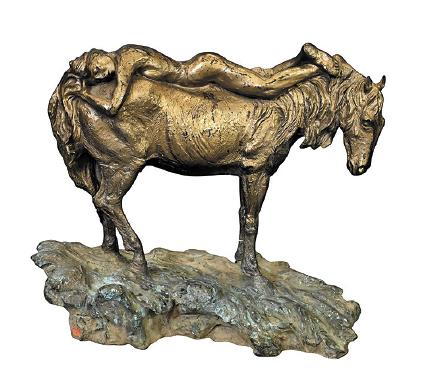
A recent purchase on eBay was a wooden carved car designed to hold cigarettes that came, for $15 shipping, from Hungary, and a bronze sculpture depicts a 1904 Winton, the first car to be driven across the United States. A felt banner once belonged to Douglas “Wrong Way” Corrigan, who flew to Ireland after filing for a flight to California, the actual model of the diving machine that was used in Twenty Thousand Leagues Under The Sea, the 1954 film starring Kirk Douglas, and Wizzie Lizzie in a rocket-driven car, all draw immediate attention. A Roly-Poly Santa dominated one shelf, and standing among a collection of cars is a Roly-Poly chauffer, “The only one I have ever seen,” Dave notes.
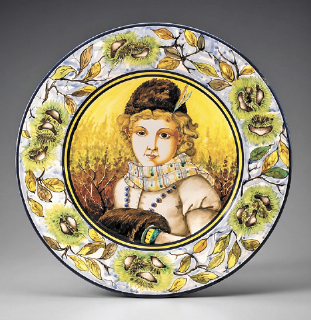
Early postcard and slide projectors inhabit one large shelf, a good number of the steins that take up the major space of one wall depict automobiles, an early driver’s license is dated 1910–1919, and a collection of pocket watches includes many with automobiles engraved on the case. Royal Dalton, a favorite of the family, is well represented by a series of dinner plates depicting airplanes, golfers and, of course, automobiles. A Red Riding Hood puzzle hangs framed on the hallway wall in the company of many large vintage posters, some by French artists, depicting Dave’s varied interests in collecting.
Half the fun is the search for things, what is just around the next corner, and an experience in Paris remains fresh in Dave’s memory. It was at the end of a trip he was taking, the rain was coming down, so he visited a French flea market and found, to his great surprise, a vase that had been made for an auto show. Out of funds, he borrowed from an American Express office and made the purchase, had it boxed, and carried it back home on his lap in a 727. “The young lady in the seat in front of me was not able to tip her chair backwards because the box took up all of my lap space,” Dave recalled. He also mentioned a friend who liked early radios, so he gave him one for Christmas, a single tube Crosley. “The friend knew we shared an interest in old radios and the Crosley came back to me a number of years later through the man’s will,” Dave said.
By count, the items already mentioned are like drops of water in a rain storm. This vast collection, which Dave does not catalog but knows where every piece is placed, demonstrates the popularity of the automobile for designers and manufacturers who produce items picturing them such as souvenir spoons, match boxes, playing cards, shot glasses, candy boxes, pins and rings, buttons, calendars, fans, rugs, wallpaper, belts and china plates, to list a few examples in the collection.
Another strong interest is the work of John Rogers (1829–1904), who created close to 100 sculptures of clay and plaster that reflected various occupations and ways of life during the time he worked, 1859–1892. Naturally, some of the pieces relate to the medical profession and are shown with dozens of others throughout the house. “I have a couple in storage and just bought three more in early October at an auction in Kansas,” Dave said. He mentioned that he left bids on 12, but got only the three.
When it comes to his life-size cars, Dave has a weakness for Franklins. A 1926, that he drives frequently, is housed in his attached garage, while in his storage garage there are two more, a 1918 and a 1927 that is in perfect condition and also sees some time on the roads. Other vehicles include a 1914 Ford convertible, an orange 1948 Olds, a 1995 Lincoln Town Car and a couple of Model T’s.
At present, three more of his cars are on display at the America On Wheels Museum in Allentown, including a 1924 Model T that was converted into a coupe-pickup, a prime example of American ingenuity, and a 1922 Detroit electric car that was made by The Detroit Electric Car Company, formerly Anderson Electric Car Co. Shown in a prominent place in the museum is the Nadig, the Allentown car that was given to Dave a good number of years ago. This vehicle was made in a local machine shop in 1889 by brothers Henry and Philip Nadig, with a one-cylinder gas engine small enough to power a carriage. By 1891 Henry had created a working auto that he drove from Allentown to Coopersburg, a nine-mile distance, and two years later Henry’s sons, Charles and Lawrence, made a Nadig with two cylinder engine and rubber tires. Despite their success, the Nadigs never continued making automobiles.
“When we have wedding receptions here at the museum, which we like to do, the bride seems to gravitate to the Detroit electric car to have her picture taken,” Linda Merkel, the museum’s executive director, said. And when conversation turned to Dave Bausch, Linda burst forth with, “He is so great, I love him, he is so kind-hearted and really always wants to help people.” She mention that Dave was on the board of the museum, always willing to lend things and assist with exhibits and programs, adding, “He is a second dad for me.”
Linda’s comments about Dave Bausch are shared by many. He serves on a board that handles funding for nonprofit organizations, he is a 55-year member of Rotary and he meets almost daily with a half-dozen friends for breakfast, “a time when we tell lies to each other,” Dave said.
He walked to grammar school, attended the local high school, never took part in sports, and went on to Penn State to study agriculture. He joined the Air Force, studied administration and was assigned to a military hospital in Georgia. “I wanted to move on and do other things, but the commander would not let me go,” Dave said. After retiring from the Air Force, he studied at Muhlenberg College, his father’s alma mater, located only 15 blocks from home. He did some postgraduate work at University of Pittsburgh, Philadelphia branch, and later became an administrator at the hospital in Easton, Penn. He was also elected the first county executive, a position he held for 15 years, and put in some time at Andrew’s Hospital in Washington, D.C. “I did all kinds of jobs as an administrator, and I never let politics influence me or get involved in hospital policies,” Dave said.
You would think that, by now, he would be completely retired. But no, there seems to be something going on all of the time. Eighteen years ago he read an ad in the paper about a student exchange program that had lost housing for a student coming to Allentown. Dave answered the ad, took in the young student from Germany, who is now a representative to NATO and his wife has an important job with Bayer. At present he is hosting a high school junior from Spain, a young man interested in art and working hard. “I am still in touch with most of the students who have lived here and some even come by for a visit, bringing the family and staying for a few days,” Dave said, expressing the pleasure he has received from this part of his life.
Today Dave Bausch is known as the popular manager of a couple of special events, the fast approaching Allentown Toy Show, which is held yearly at the Allentown Fairgrounds on the first Saturday in November. This year, on November 7, between 125 and 150 dealers in old toys and related things will set up in Agricultural Hall, marking the 37th year for the show. There is early buying on Friday, the 6th, when dealers are moving in, for a $50 fee, and the show opens on Saturday at 9 am, $5 per person. “We have between 1,200 and 1,500 people generally attending the show on Saturday,” Dave said.
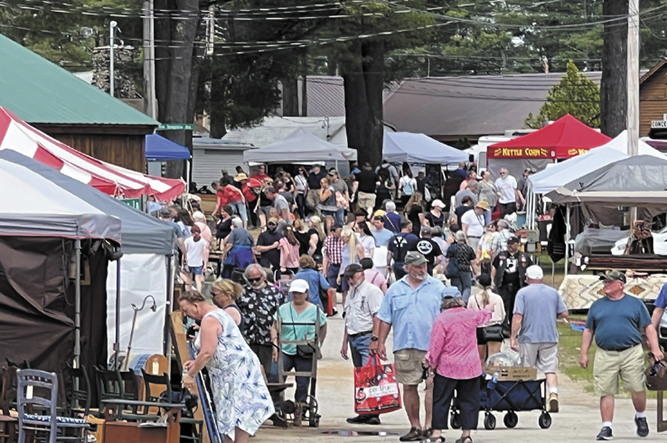
He is also involved in Das Awkscht Fescht, an annual event staged at the Macungie Memorial Park in Macungie, Penn., where all kinds of events and programs take place the first Saturday in August. “It is a huge community event that draws up to 9,000 people and I have helped manage it from the start,” Dave said. Now in its 52nd year, the fair once had both horse and dog shows, “but now there is no room for them as the event attracts about 1,200 vehicles for the car show,” Dave said. In addition, there are arts and crafts, a flea market with 120 exhibitors both under cover and outside, music in a bandstand and food tents. “We have come a long way over the past half-century and I remember back to the days when I did everything, including cleaning the toilets,” Dave recalled.
Not only does Dave manage these two events, but he regularly becomes a very good customer at them. As he once said, “There are times when all of the toys do not fit in the car going home.” And it is easy to wonder where the next selection of toys and things will fit into the house.
After completing our tour of the collection and trying to absorb the countless treasures we had seen on three floors, Dave quietly says, “That’s all there is.” It is hard to imagine that there could be any more, but the best bet is there will be.