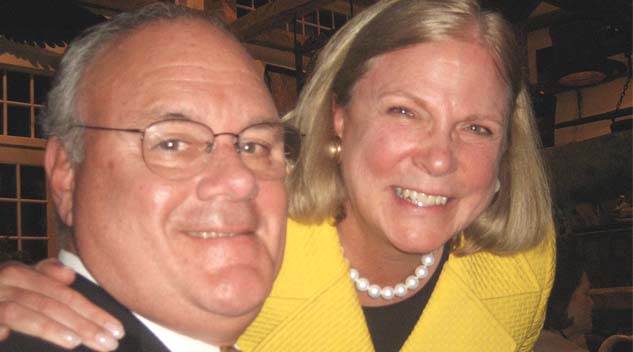
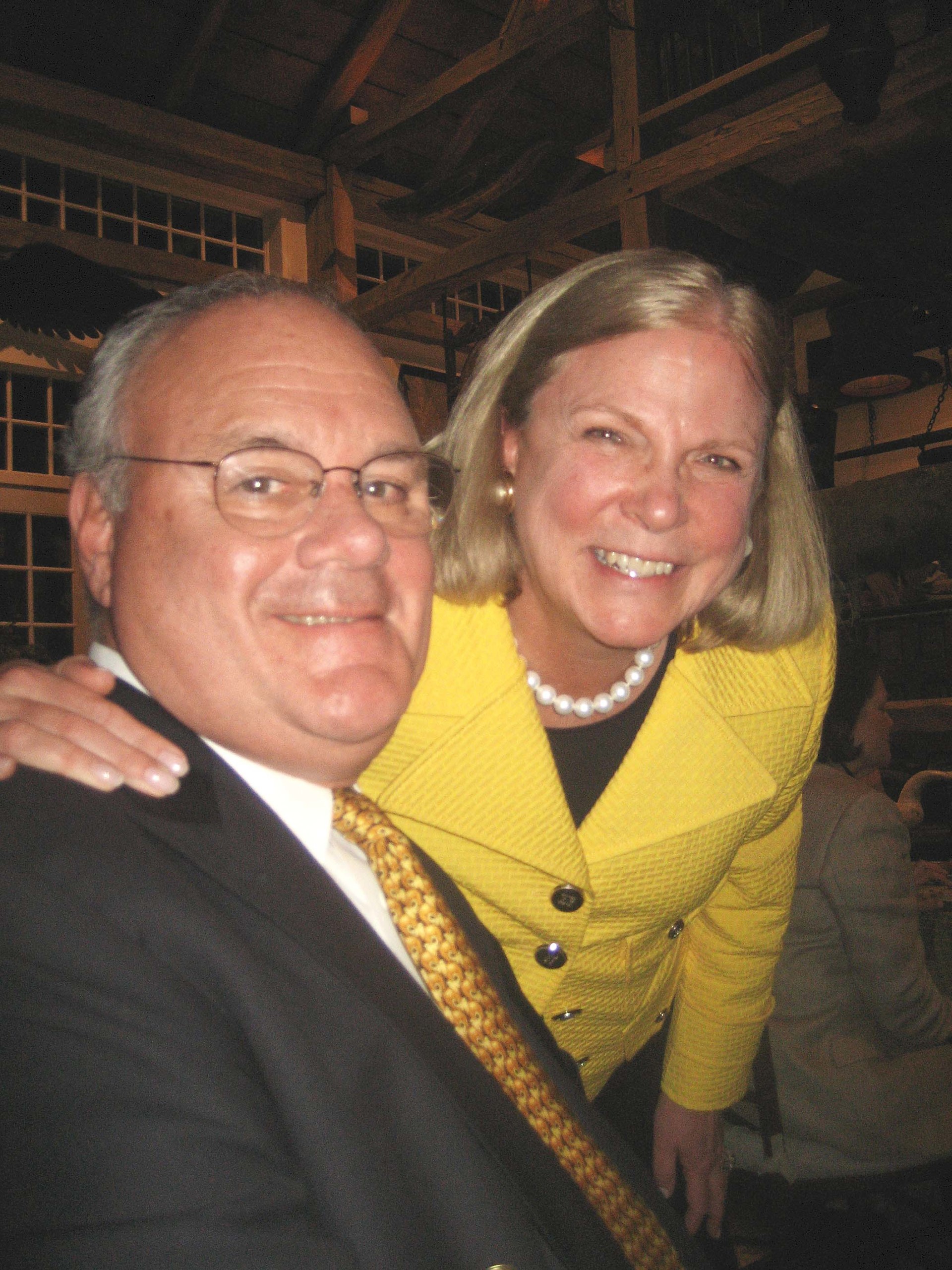
Bob and Kathy Booth. Photo courtesy Lisa Minardi.
By Andrea Valluzzo, Editor
GLADWYNE, PENN. — It’s impossible to sum up a life in a few words. Many more than can fit in the headline above are needed to aptly describe Robert Emrey Booth, Jr, MD, who passed away January 15, 2026. To our readers, he is perhaps best known as a passionate collector of Americana, but several of his friends reached out recently to let us know he was so much more: a family man, devoted friend, teacher, poet at heart, scholar, mentor and prankster.
Born on March 26, 1945, at Pennsylvania Hospital in Philadelphia, he grew up in Haddonfield, N.J. He attended Princeton University (Class of 1967) and received his medical degree from the University of Pennsylvania in 1972. He was a renowned orthopedic surgeon, performing more total knee arthroplasty surgeries than anyone else in the United States (50,000+). As such, he will receive The Knee Society’s Lifetime Achievement Award posthumously.
Bob and his wife, Kathy, raised three children: Courtney (Gus Christensen) of Weston, Conn.; Robert (Jessica) of Brielle, N.J.; and Thomas (Erin) of Portland, Maine, and he was the proud grandfather of Robert, Taylor, Natalie, Eleanor, Catherine and Sam. Kathy and Bob met in 1969 at a wedding where she grew up a friend of the bride and he was friends with the groom and fellow students at Princeton. They married in August 1972 and lived for some time in Philadelphia before settling in Haddonfield, N.J., and then in the late 1980s moved to Gladwyne, Penn., where their children grew up.
Bob and his parents began summering in Lovell, Maine, by Lake Kezar when he was 11, so it was fitting he and Kathy continued that tradition with their children, who now continue that with their children.
How did antiques come into the picture? Kathy said early in their marriage, they were converting a garage into a dining room, which led them to their first antiques purchase. They had been eating off a dining table that Bob made from a door while in college, but the wood had shrunk and if your legs kicked the table’s legs, dinner could end up on the floor or in one’s lap. She told Bob how she loved the look of a trestle table and it didn’t have any annoying legs to get in the way and that Shakers made the best tables. “And he said, ‘What do you want that old stuff for? A reproduction is just as good,’” she recalled. “By the time we were finished furnishing that dining room, he was totally hooked on antiques, and he became far more obsessed with acquiring more antiques than I was to the point where it eventually became his number one passion outside of his family and professional life.”
Kathy had no reason to complain though, as she said collecting antiques opened them both up to contacts who became “dear friends.” One of those friends, Ron Pook, shared remembrances, recalling the time he was celebrating his 60th birthday in a villa in Italy with a group of friends. The Booths had been invited but had to give their regrets. “We had invited 20 people to join us and Bob and Kathy could not make it, but then, all of a sudden, they popped in one night. It was a huge surprise,” he said.
Not only was Ron a friend and source of antiques for Bob to buy but he was a former patient, one of many to whom Bob gave back the freedom of movement. “He replaced both my knees [20-some years ago],” Pook added.
“He was a wonderful, generous man and I want people to know he was more than a collector. He was so much more than that,” he said. “He shared everything: his knowledge, and his antiques. You could call him up and say my son-in-law in Chicago blah blah and he would say this is the doctor you want to talk to.”
Bob and Kathy, whose shared passion first for Shaker and then folk art in general was a focal point in their marriage, lent their collections to many exhibitions. He enjoyed both the written word and getting people to think about antiques in new ways, so he often wrote about antiques and objects. The Booths curated five loan exhibitions at the Philadelphia Antiques Show over the years on Shaker, children’s toys, tall case clocks, historical fire material and portrait miniatures. Not only did he and Kathy loan items from their collections but Bob helped design the exhibitions, going as far as to build mockups out of balsa wood so organizers could see how he envisioned it.
Not many people know that he once harbored hopes of being an English professor and studied English language and literature while at Princeton before turning his attention fully towards medicine. His thesis was on poet William Butler Yeats. Likely, it was a telegram that came around this time from his father, also a doctor, that gave him a push towards his eventual career. Succinct, it was exactly three lines long:
“The money’s run out
You need to learn a trade
I suggest medicine.”
Bob was a devoted friend, and if you made it into his inner circle, you were in for good. Fellow Americana collector Joan Johnson said, “If he was your friend, he was a good friend. There was nothing in between. He was fabulous and really fun to be with.”
Asked to share a funny story, she recalled how she met Bob in the late 1970s. She was helping organize a loan exhibit for the University of Pennsylvania antiques show. “I wanted a show on Shaker, and everybody said he was the man to go to. I didn’t know New Jersey at all, so my husband drove me and we rang the doorbell and this guy opened the door with a newborn baby on his shoulder and a plunger for the toilet in his hand and that’s how I met him.”
As a surgeon, time was likely in short supply, but Bob always made time for his family, coaching his kids’ teams, being involved in their education and an active, present dad.
“One thing I would say about my dad is that in all aspects of his life, he accomplished more — in the various realms in medicine or in the antiques and arts collecting world, as a parent, as a husband and as a grandfather — he accomplished more in all of those areas than most people do if they are only focusing on one of those areas,” Courtney said. “What was sort of astounding was the amount of time he put into being a surgeon and the amount of time he put into being an art and antiques collector — we as children never felt that it compromised his time with all of us. He was unbelievably present as a father and family man.”
Perhaps that was largely true because family time and family vacations often involved lots of side trips to museums, historical sites and antiques shops. Each summer’s long pilgrimage from Gladwyne to Maine became longer when Bob found antiques shops and the like worth stopping for en route, Kathy recalled, explaining the kids had a nickname for these stores. Remembering this instantly, Courtney interjected with “Mom/Dad, do we have to stop at another ‘dirty store’?” the same phrase she and her brothers used to say upon visiting stores full of furniture covered in dust.
Bob had a wicked sense of humor but never crossed the line, always in good fun. He collected objects, people and jokes. He also was famous for his good-natured pranks, and likely many antiques dealers reading this who knew Bob can attest to falling prey to one of these pranks at one time or another.
“He played pranks on virtually everyone he ever met, and it was a sign of affection,” Courtney noted. The plaque that still hangs on their front door in Gladwyne is perhaps a good example, Kathy said with a laugh. It reads, “Dog is harmless, beware of woman.”
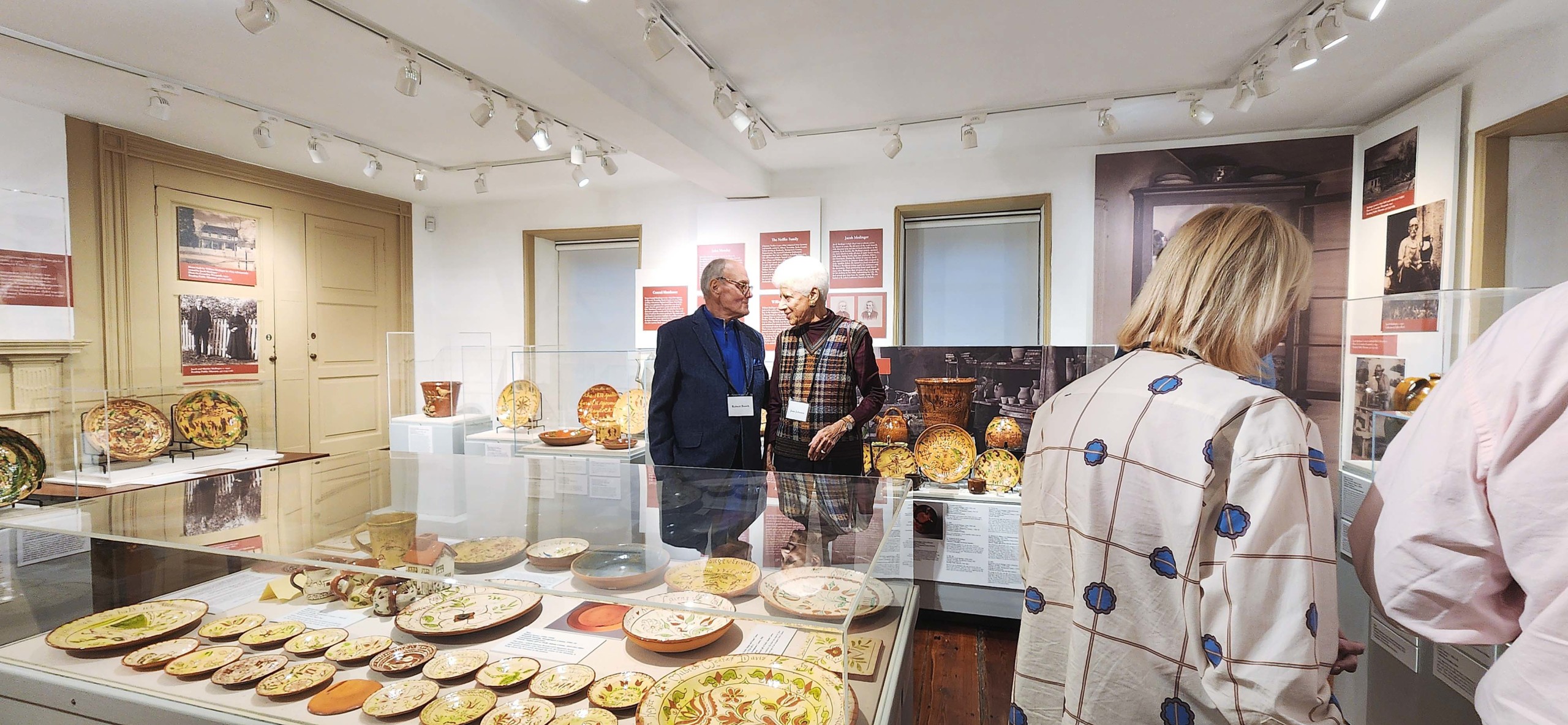
Bob Booth and Joan Johnson chat while looking over redware. Photo courtesy Lisa Minardi.
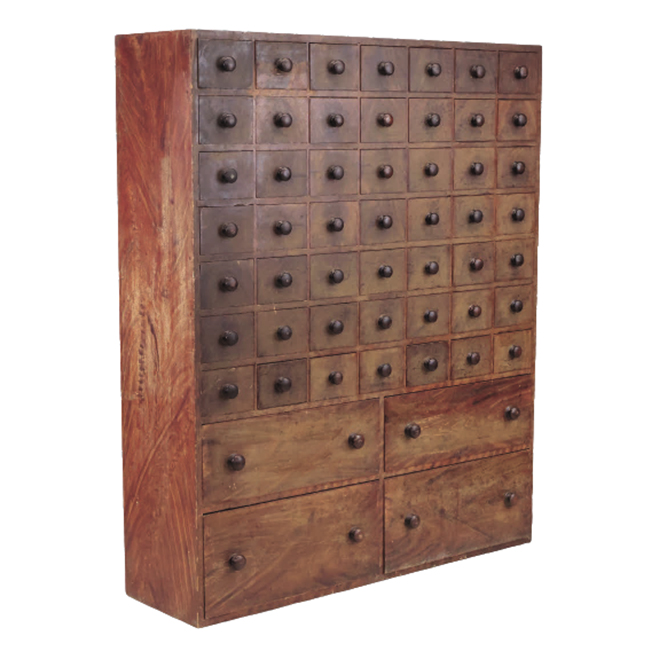
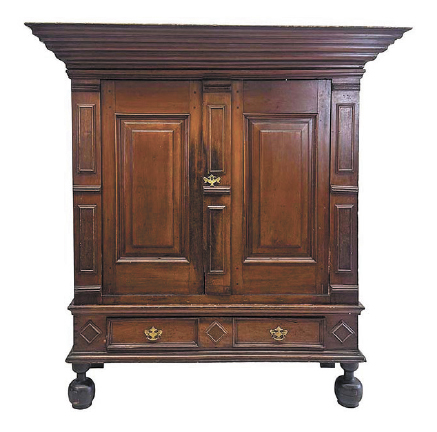
And lest we forget, Bob had a keen eye for Americana and a hearty appetite for beautiful, well-made objects that not only had original surface but graceful proportions. He and Kathy first amassed a wonderful collection of Shaker furnishings before turning attention to American decorative arts, Pennsylvania German decorated furniture and redware, cast iron penny banks, fire-related material and folk art. He was a prolific buyer, filling their home and the barn and still buying right up to the end. He even made an appearance at the Historic Trappe exhibition on redware last fall, taking the time to admire the items on display and chat with old and new friends.
A private memorial celebration is planned for this spring. In lieu of flowers, donations may be made in Bob’s name to Operation Walk Denver, www.operationwalkdenver.org.
ROBERT E. BOOTH (1945-2026) IN MEMORIAM
Remembering Bob
I first “met” Bob and Kathy Booth in January of 1984 in that month’s edition of The Magazine Antiques, Suzanne and I advertised “A ShakerClassic,” the iconic Hancock, Mass., cherry tailoring counter that two years later was included in the landmark exhibition, “Shaker Design,” at the Whitney Museum of American Art in New York City.
The first phone call on the ad came from Bob. We had already sold the piece prior to publication, but we talked for awhile anyway. Bob’s passion for Shaker resonated with me and so began a relationship that grew and flourished over the course of the next four decades.
Many of my fondest memories of Bob occurred during the run of the annual Philadelphia Antiques Show, which was then held at the 33rd Street Armory. Our first time exhibiting there was in April 1987. When the show opened on preview night, Bob and Kathy were the first patrons to enter our booth. By then, we had become friends, and they greeted us warmly. Before very long, they had snapped up a classic Enfield, N.H., Shaker armed rocker in original bittersweet paint and an untouched Hancock Shaker trestle dining table in flame birch that we had bought in a Pittsfield house two weeks previously.
When the preview was over, we along with our fellow exhibitors climbed into a Philadelphia trolley that Bob and Kathy had hired to escort us to their home in Haddonfield, N.J. There we treated to a lavish reception held in our honor, Suzanne’s and mine. The renowned Booth kindness and generosity was on full display that night!
At the 1991 Philadelphia Antiques Show, the Booths installed and curated “Divine Design, A Shaker Legacy,” a loan exhibit that artfully showcased a wide range of extraordinary Shaker objects, mostly from their collection, and much of it bought from us. As luck would have it, that year we had assembled a particularly large group of Shaker objects to bring to the show, and the loan exhibit factored nicely into our success.
When Bob and Kathy moved to Gladwyne, they hosted an annual dinner party at their new home, which they had furnished with their collection of world-class American antiques. The dinners were legendary, and an invitation was highly prized. Every year, before we broke bread, Bob toasted us, expressing gratitude, not only for helping the couple amass their stunning collection, but also for being among their most valued friends. His words were spoken from his heart. We all felt it.
Bob was both charismatic and genuine. Those qualities endeared him to everyone whose lives he impacted, both personally and professionally. In his career as an orthopedic surgeon, Dr Booth performed literally tens of thousands of knee replacement procedures. His patients revered him. Kathy once told me that after the 5,000th procedure, a celebration was held to commemorate the milestone. All 5,000 patients were invited to attend.
At the time, it was thought that perhaps a couple hundred or so might make it. For one thing, most of the surgeries had been performed on the elderly, and, so it was assumed, many of them had either died or were too infirm to attend, even if they were so inclined. Instead, on the day of the celebration, some 3,500 of Bob’s 5,000 showed up, lined up around the block, waiting patiently for the chance to thank the man who had given them back their mobility and, in the process, their freedom.
The value of Bob’s friendship and loyalty to me personally was never more manifest than when Suzanne was battling breast cancer. When we were exhibiting at the Philadelphia Show in 2001, she had just finished the fourth round of her chemotherapy regimen. As we lucky invitees sat at their dinner table that year, Bob and Kathy raised their glasses in praise of Suzanne for her courage and spirit. It was a treasured moment for her.
When, 14 years later, the cancer returned, Bob was wonderful to us. He supported me as she was declining, and especially later as I struggled to cope with losing her. That was the kind of man Bob Booth was. Knowing him enriched my life. I will always miss him, but I take comfort in and am grateful for that.
Bob Wilkins
Yarmouth Port, Mass.
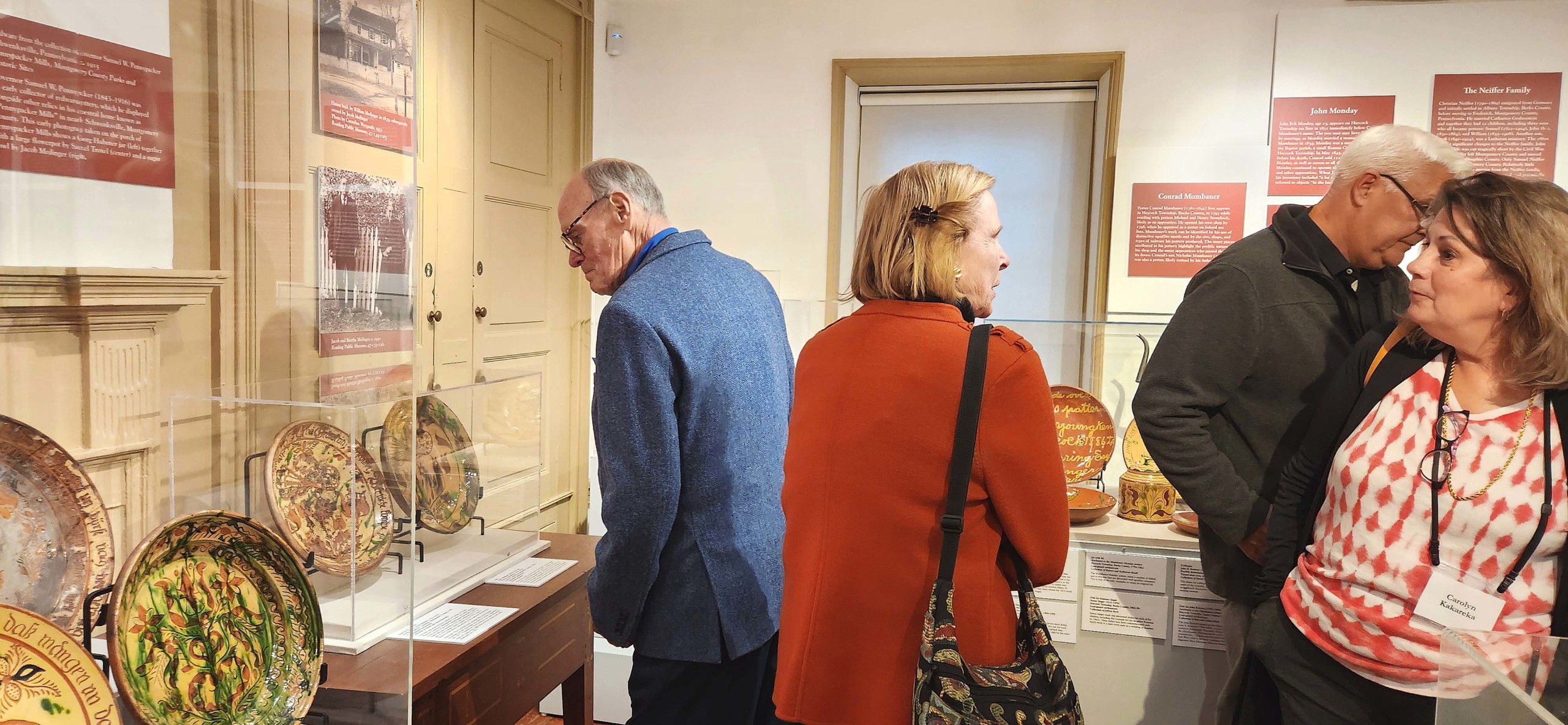
Bob Booth, at left, examines the pieces on display at the opening of Historic Trappe’s redware exhibition in November 2025. Photo courtesy Lisa Minardi.
A Great Friend
With a fierce sense of humor and generous spirit, Bob Booth was one of the finest people I have known. We first crossed paths over 20 years ago when I was just graduating from the Winterthur program and beginning research for the museum’s Pennsylvania furniture exhibition. Bob and Kathy welcomed me into their home to see their collection, and I was immediately smitten with both them and the extraordinary folk art they had gathered over a lifetime of collecting together.
Bob was an excellent tour guide, intimately familiar with details about what makes a great fire bucket or how to distinguish one Shaker chair from another. His deep passion for the objects throughout their home was evident to all who visited. One time, when the Walpole Society wanted to tour the house but Bob and Kathy were away, their daughter Courtney and I gave the tour. I boned up on as much as I could in advance, but the sheer breadth of their collection astounded me, and I left even more impressed than before.
Bob treated me like I was his fourth child, always greeting me with a warm smile and hug at antiques shows and exhibit openings. He was the first person to call when news broke that my late husband Philip Bradley was diagnosed with lymphoma, and he called often to check in and offer his support. After Philip died, Bob encouraged me to carry on doing what I loved. I saved the voicemail he left me that day to remember his kind words. Bob wasn’t just a great collector, he was a great friend too.
Over the past two years, as I dove into research on Pennsylvania German redware in preparation for Historic Trappe’s current exhibition on this topic, I spent a lot of time at the Booth home. Dismantle the living room for a photo shoot that would run late into the night? No problem! Bring a bus tour group and let them stay for lunch? Of course! Bob never said no. Still, when I sat down with him and Kathy last summer to ask whether they would lend some of their best redware to our exhibition, I was nervous. Yet barely had I finished asking before Bob said that I could borrow anything I wanted. Knowing how much he loved redware, I made sure to get an advance copy of the book from the printer and hand delivered it so Bob could read it cover to cover. It was a joy to have Bob and Kathy attend the opening reception of the exhibition in November and be able to share that very special experience with them and other redware enthusiasts.
As I think about Bob’s legacy and all that he has meant to me and the Americana field, I know that Bob is with us in spirit. The forthcoming March/April issue of The Magazine Antiques, which I have the distinct honor of guest editing, includes an article on the Booth collection written by two of my colleagues. At the preview party for the upcoming Pennsylvania Antiques Show in April, we will celebrate Bob’s life. I, for one, will raise a glass to him, remembering his joyful nature, and then go shopping. There was no place Bob Booth liked more than the floor of an antiques show, hunting for yet another treasure to add to his collection!
Lisa Minardi
Executive director, Historic Trappe