SAN FRANCISCO, CALIF. — “Emperors’ Treasures: Chinese Art from the National Palace Museum, Taipei” brings to the new world an opulent, thought-provoking exhibition spanning 800 years. On view at the Asian Art Museum through September 18, it showcases approximately 150 masterworks, most never before exhibited in the United States. While Chinese art aficionados have been drawn to this collection since the National Palace Museum opened in Taiwan in 1965, the last traveling display offering a glimpse into its collections was in 1995.
Asian Art Museum director Jay Xu was a young research fellow at New York’s Metropolitan Museum of Art when the last show was organized. He has been working for nearly a decade behind the scenes with the National Palace Museum to bring these masterworks to San Francisco for the Asian Art Museum’s 50th anniversary.
“These pieces describe what ‘Chineseness’ has meant, means and maybe what it will mean. More narrowly, the exhibition helps to teach us about what defines enduring value in Chinese art as well as what makes Chinese art cutting edge,” he said.
Xu continued, “What I’m hoping the viewer will come away with is an awareness that there is a core of consistency across certain media, like the consistent use of jades and ceramics, that spans 800 years. Yet each generation had its own contemporary take on these materials. Each piece featured in the show, even if it is in what we would call a traditional medium, was the most cutting-edge art of its time and place.”
The exhibition unfolds chronologically through four galleries, beginning with the Song dynasty and ending with the Qianlong emperor, known as the “Old Man of Ten Perfections,” and finally, the Empress Dowager Cixi.
Cixi, a Manchu concubine who rose to become the last ruler in the Qing period, championed female artists in her “Studio of Great Elegance.” She called upon them to design porcelains and embroidery patterns. Her death in 1908 presaged the end of the imperial era, which officially came with the Xinhai Revolution in 1911.
Unlike European rulers, who saw their treasures as signifiers of power and status, Chinese imperial rulers collected these works for personal edification and inspiration, hiding them away in Beijing’s Forbidden City. About 600,000 items were removed to Taiwan after the Chinese Civil War. With the opening of the National Palace Museum, Taipei, in 1965, they became accessible to the public and in recent years have become a major tourist attraction.
Throughout the centuries, the impulse to make art in this culture began with the calligrapher’s brush. Calligraphy was considered the most prestigious of all the arts. It was the vehicle by which the written word transmitted the guiding precepts of the Chinese foundational thinkers, yet becoming a master calligrapher was a feat few achieved.
He Li, the Asian Art Museum’s associate curator of Chinese art and a curator of the exhibition, as well as a co-editor of the show’s lavish catalog, offered some insights into this process. “From personal experience with calligraphy, I can say that it is very difficult to achieve what looks like a natural line or flow. It is all about control and endurance. Your forearms actually become very strong because of the kind of endurance it takes.”
She continued, “I would liken it to dance. As in ballet, where you first practice the basic positions, in calligraphy you must first master individual strokes. You start with single strokes before combining two together and adding later, and you practice each stroke thousands of times. It is extremely difficult to master the stroke and make each look the same, so it is a very long process. It involves patience and control, as well as fundamental knowledge on the nature of ink, brush, paper and technique.”
The Emperor Huisong of the Song dynasty was an outstanding exception to this rule, becoming a great master of this art form known for his distinctive “slender-gold” style. This period, known for its order, harmony and craftsmanship, was arguably the most creative period in Chinese history. Huisong’s extensive patronage of court painting, settings and objects for rituals, interior decoration and architectural projects influenced Chinese court arts for centuries.
Calligraphy and painting generally went hand in hand. The same brush strokes, which reflected the artist’s life force, also are visible, for instance, in a painter’s depiction of nature in the Qing dynasty piece “White Falcon” by Lang Shining.
Poems were paired frequently with dramatic landscapes, while other works, such as the charming Shen Du’s “Ode on a Painting of Qilin,” whose subject is the rare giraffe Ming emperor Yongle received as a gift from what is now Bangladesh.
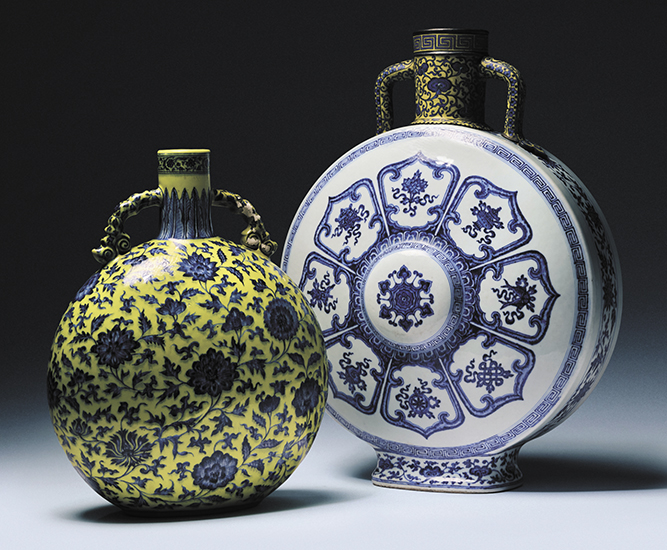
If the Song period (960–1279) served as an aesthetic reference point for the rest of Chinese history, the Ming period ushered in major advances in porcelain. Over time, as rulers collected art, commissioned new works and personally created, another Chinese characteristic came into play.
“Imitation really was the sincerest form of flattery. You have Ming artists copying Song artists, later dynasties copying previous dynasties, not just for inspiration and practice, but because they enjoyed it,” He Li said.
Imperial rulers judged jade culled from the Xinjiang region by its cleanliness, color and by the size of individual stones. Artisans handcarved jade into exquisite ornaments, using fine tools to suggest running water and natural phenomena. One labor-intensive technique involved rubbing jade with a paste made of the dust of special stones such as diamonds, He Li said.
Among many other virtuosic examples of craftsmanship is a 20-piece Ming-era jade belt buckle carved with a dragon with five-claws, a motif reserved for emperors. A jade belt plaque of approximately 1300–1400 is made of pure white nephrite. It features the imperial dragon, this time surrounded by a radiating flower.
Chinese lacquer ware craftsmanship reached its apex during the Yongle court (1403–24). With its polished cutting and meticulously carved floral designs, a red lacquer vase of this era is a foremost example of its kind.
By the Qing dynasty (1644–1911), a dozen imperial workshops scrambled to fulfill the Forbidden City’s boundless appetite for lacquers, enamels and carved jade. A remarkable piece from that period is a hibiscus-shaped bowl from the early 1700s, sculpted from a single piece of agate.
Two works stand out for their oddity, as least to this Westerner’s eyes. One is a carved slab of jasper made to resemble a slab of pork belly. In a process known as “smart carving,” jasper was made to resemble a popular dish calling for a soy marinade. To create the Qing dynasty piece, the artist drilled tiny holes into the stone’s surface to prepare it for dyeing. In its final form, the stone version of the succulent dish dongpo rou, named after the famous poet Su Shi, rests on a golden platter.
“Artisans didn’t set out with an image of pork at the beginning, but studied the natural characteristics and enhanced them,” He Li explained.
The second curiosity purports to be what must have been the world’s most uncomfortable pillow, a high-fired glazed ceramic figure of a recumbent boy dating from the Northern Song dynasty. Scholars have long debated whether an imperial ruler would actually have slept on such a piece. The general conclusion is yes. This work was believed to have been produced and fired at the Ding kilns in Hebei Province.
He Li said it is difficult to place a value on some of these works, though Sotheby’s recently sold a bowl similar to a Ming dynasty wine cup in this exhibition for $36 million. The curator noted, “The Ru pottery pieces have always been rare, but for American audiences many of the paintings are really exceptional because of their size. They are floor to ceiling and that is not something you typically see outside of Asia. Visitors will be surprised by this scale.”
Following its close at the Asian Art Museum, “Emperors’ Treasures: Chinese Art from the National Museum, Taipei” travels to the Museum of Art, Houston, where it will be on view from October 23 to January 22, 2017.
The accompanying catalog is edited by Jay Xu and He Li and includes their contributions as well as others by Fung Ming-chu, Ho Chuan-hsin, Alfreda Murck, Tianlong Jiao and curators from the National Palace Museum, Taipei, and the Asian Art Museum of San Francisco.