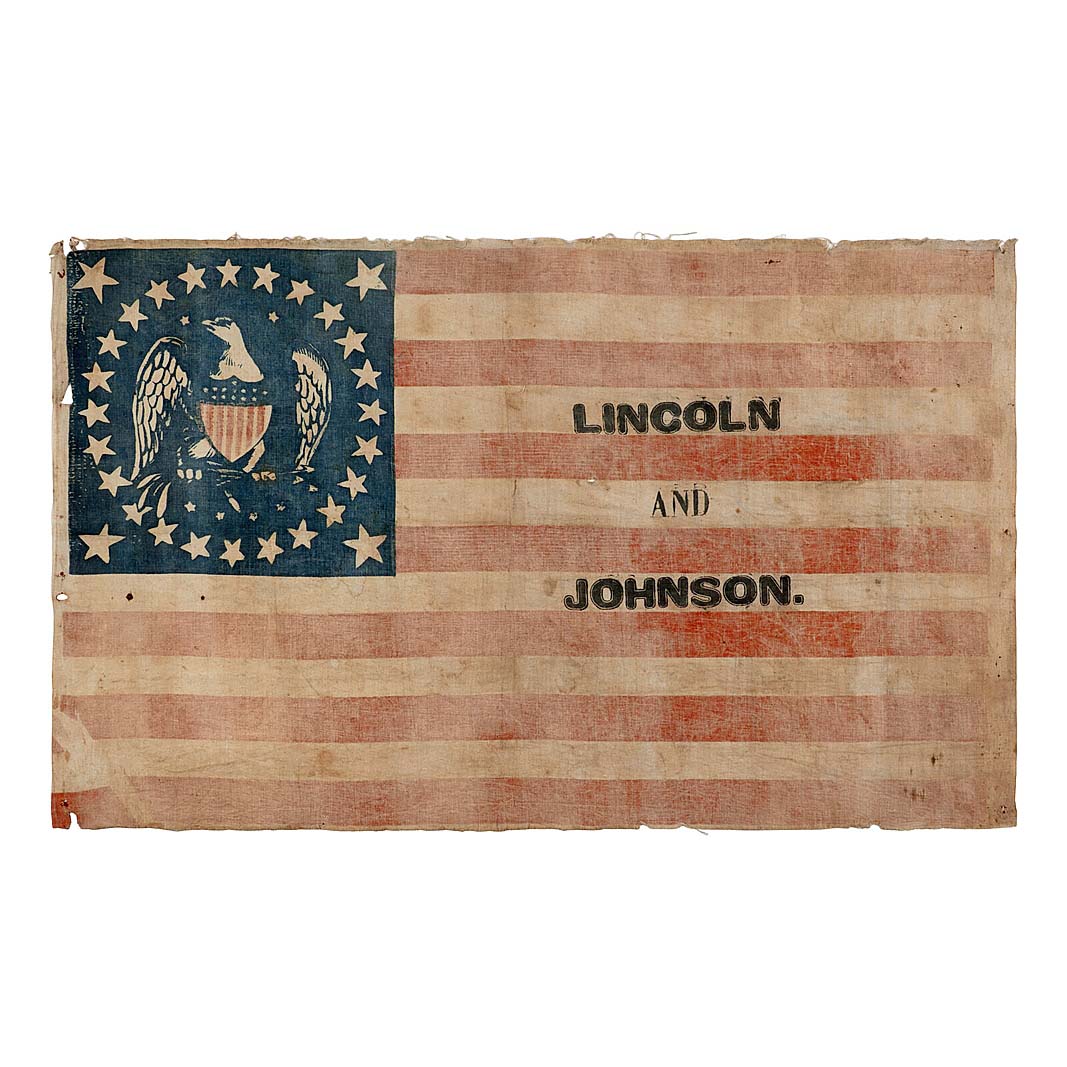
Achieving a new auction record, this 34-star eagle parade flag from the 1864 Lincoln-Johnson campaign, circa 1863-64, paint-printed on cotton, 25¾ by 16½ inches, sold to Jeff R. Bridgman for $281,600, the sale’s highest price ($50/100,000).
Review by Kiersten Busch
CHICAGO — As America’s 250th anniversary quickly approaches, many auction houses have taken to offering specialized sales geared towards American political memorabilia. One such case was Freeman’s March 26 auction, The Fathers and Saviors of Our Country: A Presidential Sale, which, according to the firm’s website, took its title “from the iconic Currier & Ives print depicting George Washington as the ‘Father’ and Abraham Lincoln as the ‘Savior’ of the nation.”
Christopher Brink, Freeman’s senior specialist in books & manuscripts, shared a bit about the successful auction. “The sale achieved $1.5 million — more than double its low estimate — with an exceptional 97 percent sell-through rate, underscoring both the strength and depth of demand in the current Americana market. Participation was driven largely by private collectors within the United States, with notable engagement from new buyers, who comprised 17 percent of registrants.”
The 188-lot sale was led by memorabilia of the “Savior,” namely a 34-star eagle parade flag from the 1864 Lincoln and Johnson campaign, which achieved a new auction record. Made circa 1863-64 and considered “exceedingly rare” due to the limited amount of campaign material from Lincoln’s second run, the flag was paint-printed on cotton and depicted a wreath surrounding a large eagle and colored shield as well as the words “Lincoln and Johnson.” Surpassing its $50/100,000 estimate, the flag flew for $281,600 and was purchased by flag collector and antiques businessowner Jeff R. Bridgman.
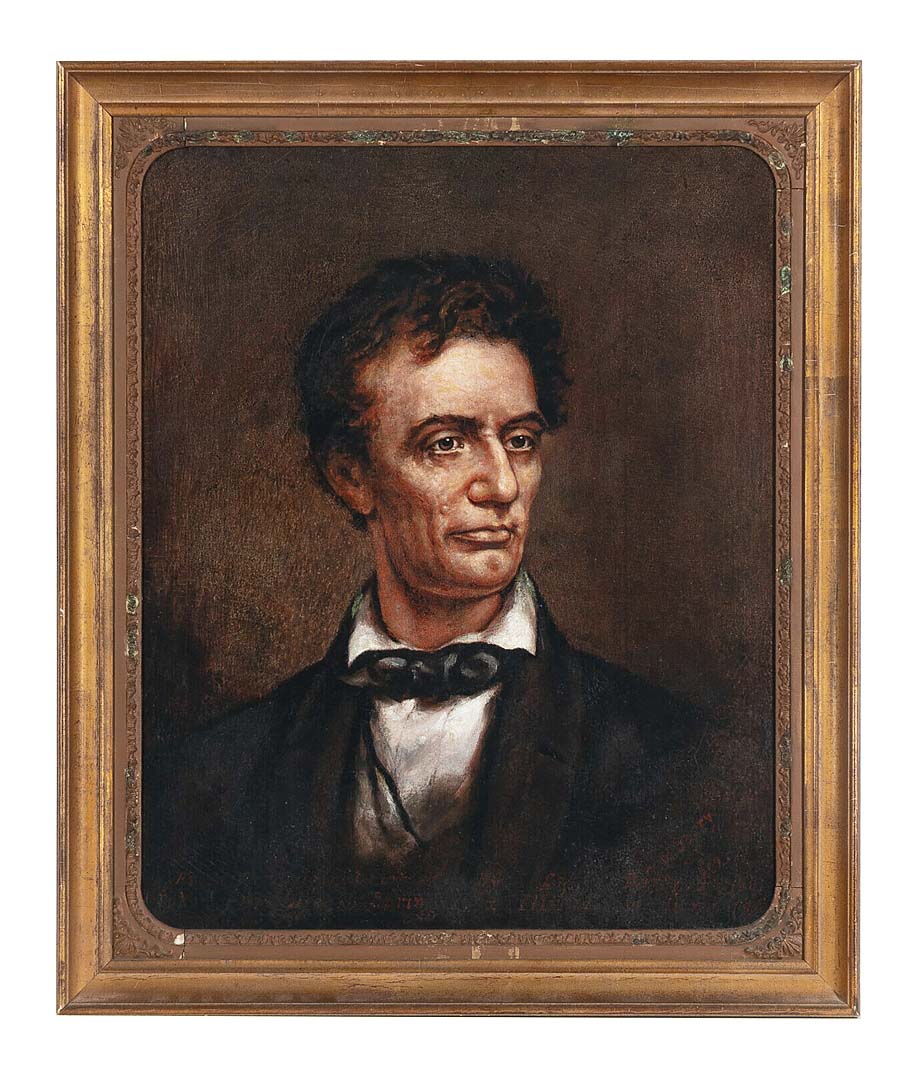
“Abraham Lincoln: The Greek God” by Charles Alfred Barry (American, 1830-1892), oil on canvas, 32 by 26¾ inches framed, signed “C.A. Barry, N.Y.,” surpassed its $60/80,000 estimate to make $102,400.
Commenting on his purchase, Bridgman shared, “I have owned more than 50 Lincoln campaign flags, but I have never owned this one, which survives among the greatest known to exist. Many years ago, I did acquire and sell a Lincoln Johnson campaign flag (1864), also with an eagle, and the only one I know of in that style. It was much smaller, however, and far less graphically impactful. I am thrilled to be the new owner of this example, likewise the only one of its kind, and — unless I have forgotten some tucked away specimen in a museum collection — the only Lincoln flag from 1860 with an eagle in the canton.”
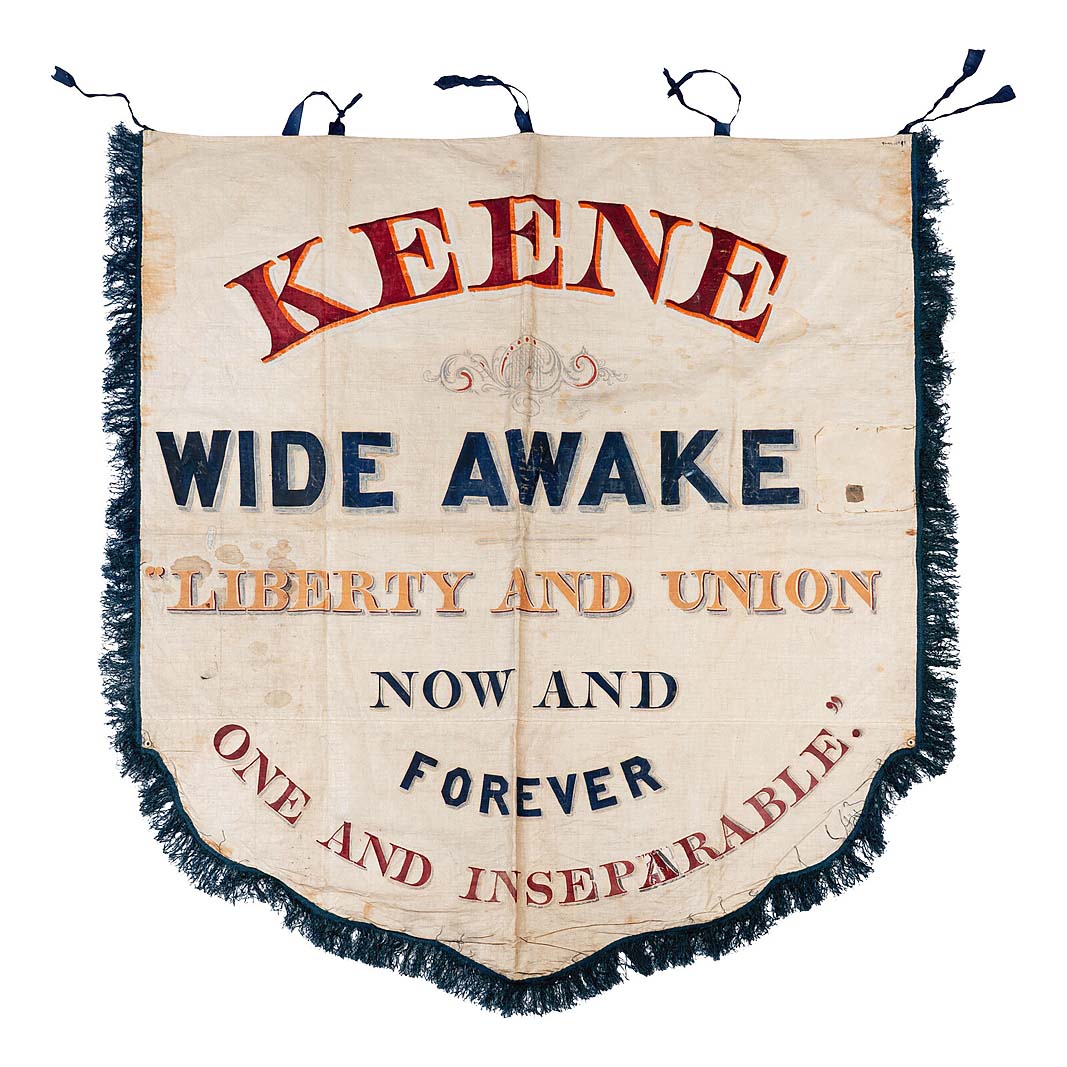
Bridgman was also the lucky winner of a Lincoln-Hamlin campaign banner from the New Hampshire Wide Awakes circa March of 1860. “The Wide Awakes were a grassroots Republican phenomenon that emerged during the presidential campaign of 1860, giving public and highly visible expression to Northern opposition to the expansion of slavery,” catalog notes explained. The 47-by-42-inch shield-shaped silk banner was hand-painted and double-sided, with blue fringe around its edges and silk ties and eyelets on its top edge at the corners. The obverse of the banner read “Keene Wide Awake. ‘Liberty and Union Now and Forever One and Inseparable,’” while the reverse read “‘Let Us Have Faith that Right Makes Might.’ A. Lincoln.,” taken from Lincoln’s 1860 Cooper Union Address.
Bridgman claimed the banner for $54,400, just inside of its $50/100,000 estimate. He commented, “The Wide Awakes banner is, plain and simple, one of the most beautiful and profound mid Nineteenth Century political textiles of its kind. Colorful, in more ways than one, I would invoke the latter adjective, due to its unique, intriguing story. It was lost in a wager between two neighboring Wide Awakes chapters, each of whom put their own banners up against one another, as spoils, in a competition to see whose town could raise the most votes for Lincoln in 1860. This is how the Kenne Wide Awakes lost what was undoubtedly their most prized possession to the Wide Awakes of Claremont. Because pretty much all the young men in Wide Awakes organizations went on to enlist in Union regiments, most chapters evaporated with the onset of war.”
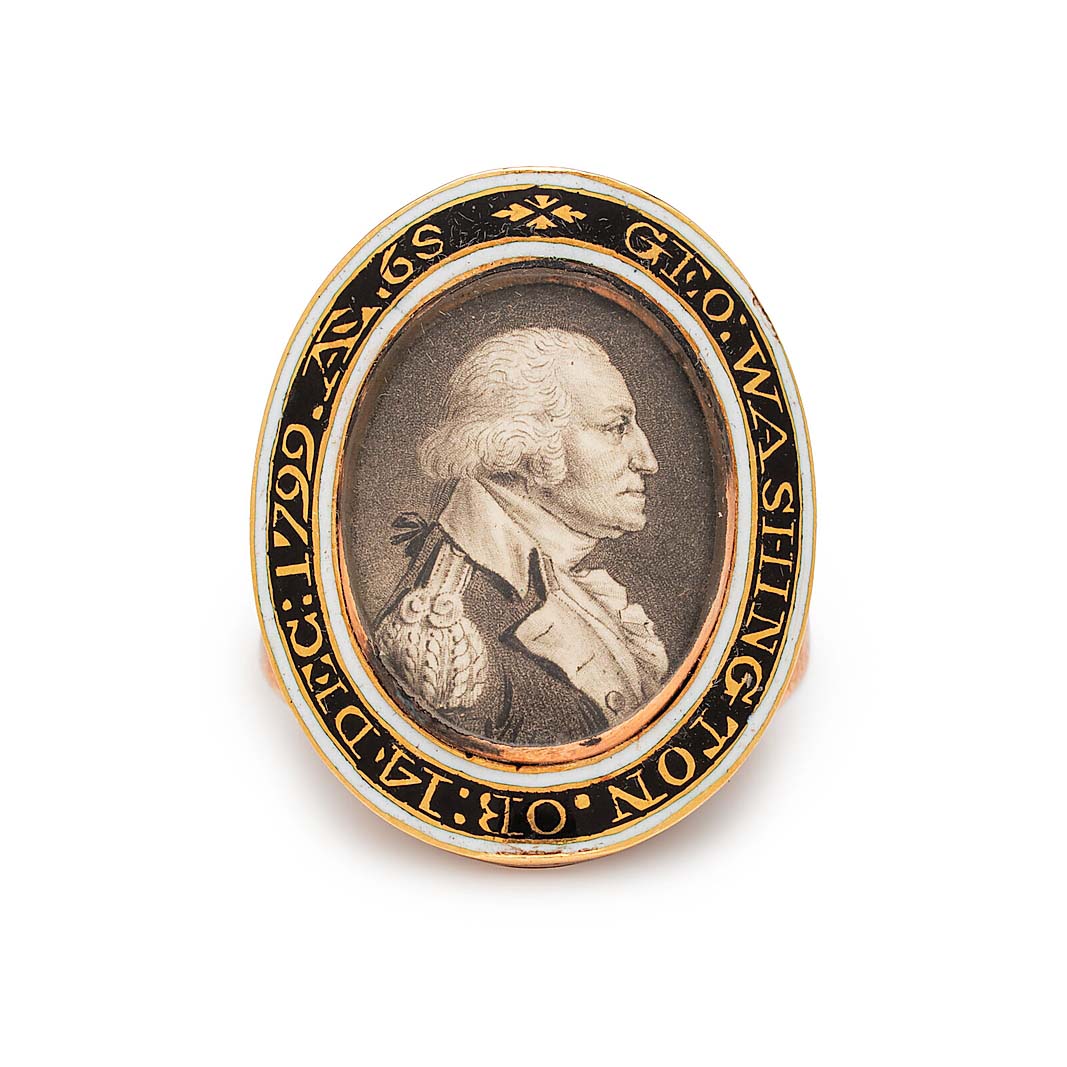
This circa 1800 gold alloy and enamel mourning ring contained an oval glazed bevel featuring an image of George Washington in profile by Charles Balthazar Julien Févret de Saint-Mémin (1770-1852) and may be one of five rings bequeathed in the first president’s last will and testament. It achieved a new auction record at $70,400 ($15/20,000).
Another auction record was earned at $70,400 by a gold alloy and enamel mourning ring with an image of George Washington in profile by Charles Balthazar Julien Févret de Saint-Mémin set in the bevel, which was purportedly one of five bequeathed in Washington’s last will and testament. The ring’s portrait, “the last and perhaps most accurate contemporaneous image of Washington,” according to catalog notes, was framed by a black enamel border and encircled by a black and white champlevé enamel inscription which read, “Geo: Washington / Ob: 14.Dec. 1799 / AE: 68.” It had provenance to Annie S. King of Baltimore, American historian and Washington scholar and collector Dr Joseph E. Fields and the Gerald Peterson collection.
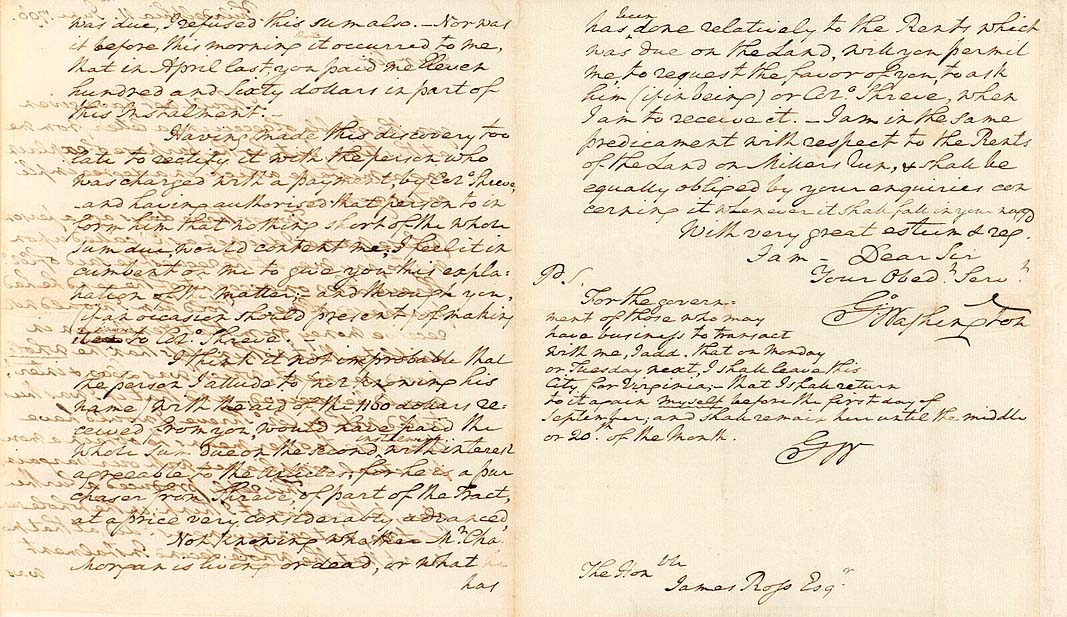
One more lot in the top 15 best-selling of the day was related to Washington: an autographed letter to Pennsylvania Senator James Ross, from Philadelphia on June 11, 1796. Signed twice, once “G: Washington” and once “GW,” the letter found Washington asking for overdue payment from Ross concerning land sold to a Colonel Israel Shreve in August of 1795. The letter was written up for $35,200, falling within its $30/40,000 estimate.
Most of the additional top lots in the sale were associated with Lincoln, including “Abraham Lincoln: The Greek God,” an oil on canvas by Charles Alfred Barry, which earned the second-highest price of the sale at $102,400. With the subtitle “From the original portrait taken from life by Charles A. Barry of Boston in Springfield, Illinois, June 1860,” the work had extensive provenance by descent in the artist’s family, as well as exhibition history at the Abraham Lincoln School in Boston. It was accompanied by several letters and a steel engraving of Lincoln.
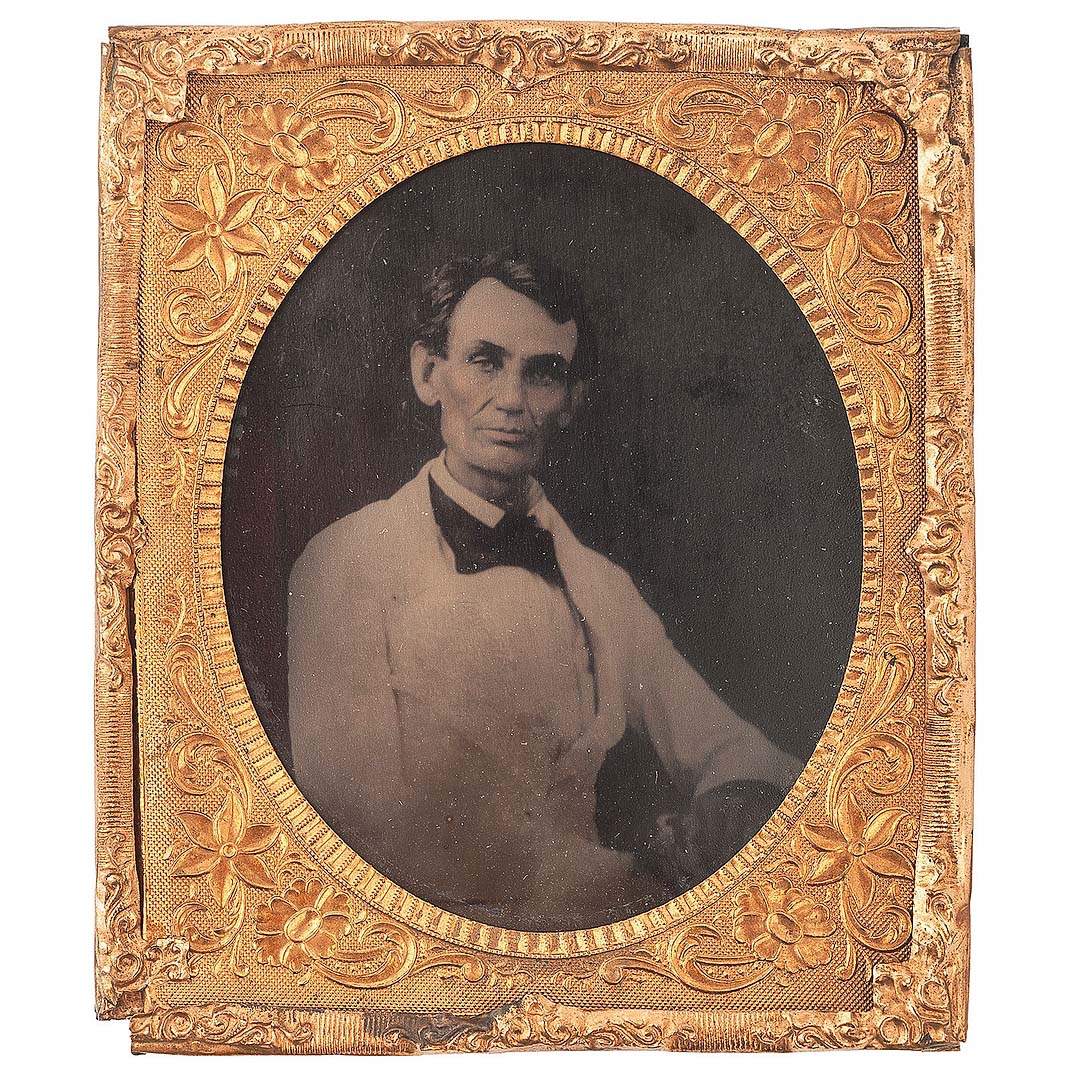
This rare period sixth plate tintype of lawyer Abraham Lincoln by Abraham Byers, 3½ by 3 inches, circa 1860, was referred to as the “Beardstown Portrait” and was bid to $76,800 ($15/20,000).
Following Barry’s portrait was a sixth-plate tintype referred to as “one of the finest and most important Lincoln tintypes extant” in the auction catalog: the “Beardstown Portrait,” done May 7, 1858. Eighteen-year-old photographer Abraham Byers captured this shot of the beardless lawyer Lincoln in his studio in Beardstown, Ill., and the original — a quarter-plate ambrotype — was curated at the University of Nebraska. According to catalog notes, this tintype is “the only known extant period copy of this important sitting,” which may have helped raise its sale price far past its $15/20,000 estimate to $76,800.
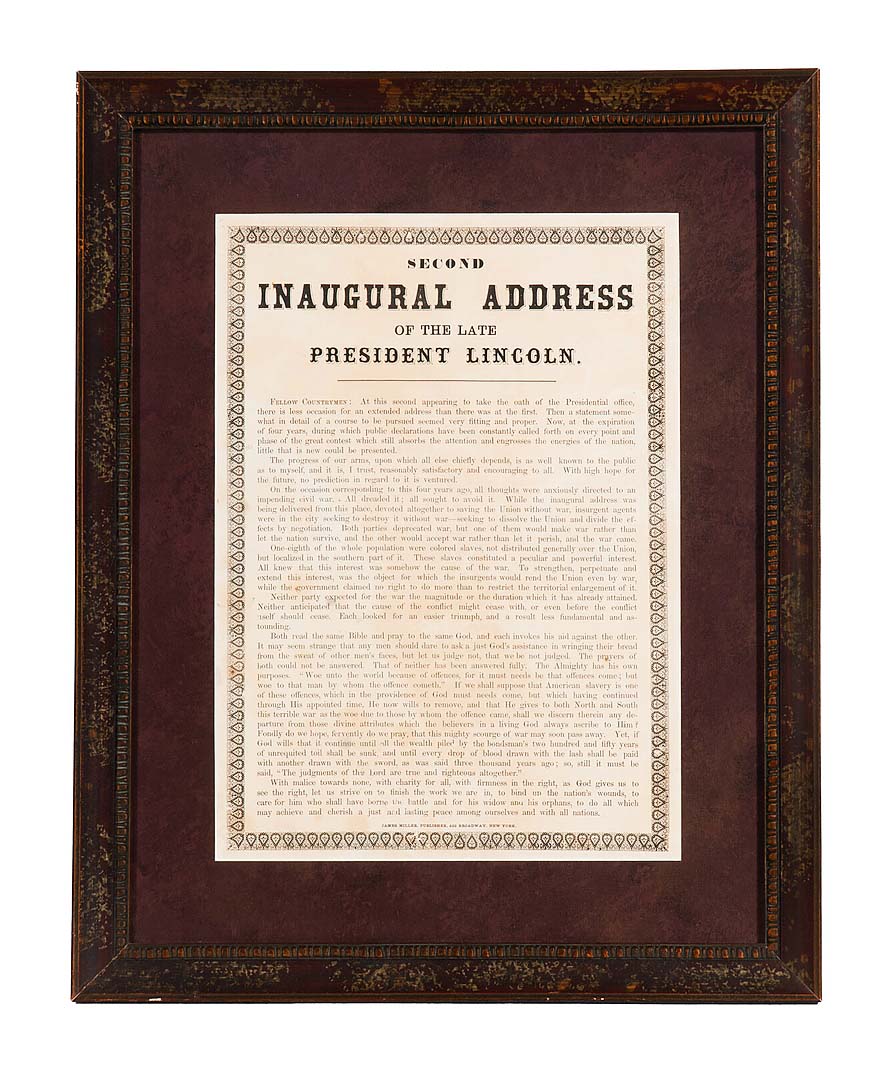
An engraved broadside of the “Second Inaugural Address of the Late President Lincoln,” printed by James Miller (New York City) in 1865, also made waves with bidders, as Brink noted. “Additional surprises reinforced the market’s competitiveness, including a modestly estimated lot that realized $70,400 against a $2/3,000 estimate. Strong bidding activity was concentrated across phone and online platforms, reflecting an engaged and highly motivated domestic audience.”
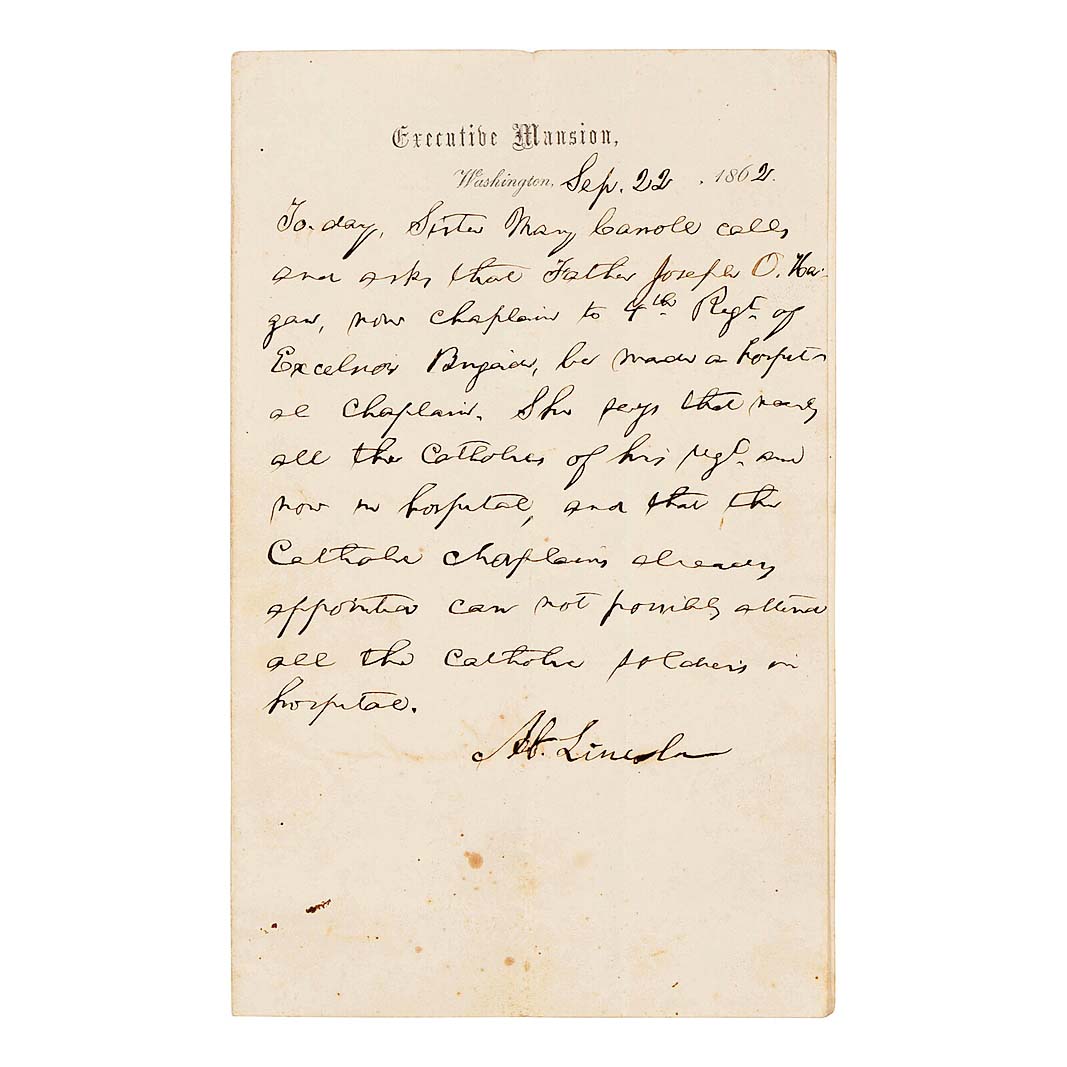
A few autographed Lincoln documents also drew bidder attention, including an unpublished memorandum on Executive Mansion stationary dated from Washington, DC, on September 22, 1862 ($38,400); a document concerning a loan dated to Springfield, Ill., on August 11, 1854 ($17,920); a legal document from the case of Mary Fahnestock dated to Springfield, Ill., on July 20, 1857 ($17,920) and a legal document concerning Columbus Machine Manufacturing Co. et al. v. E.R. Ulrich et al., which was dated to Springfield, Ill., on February 13, 1860 ($16,640).
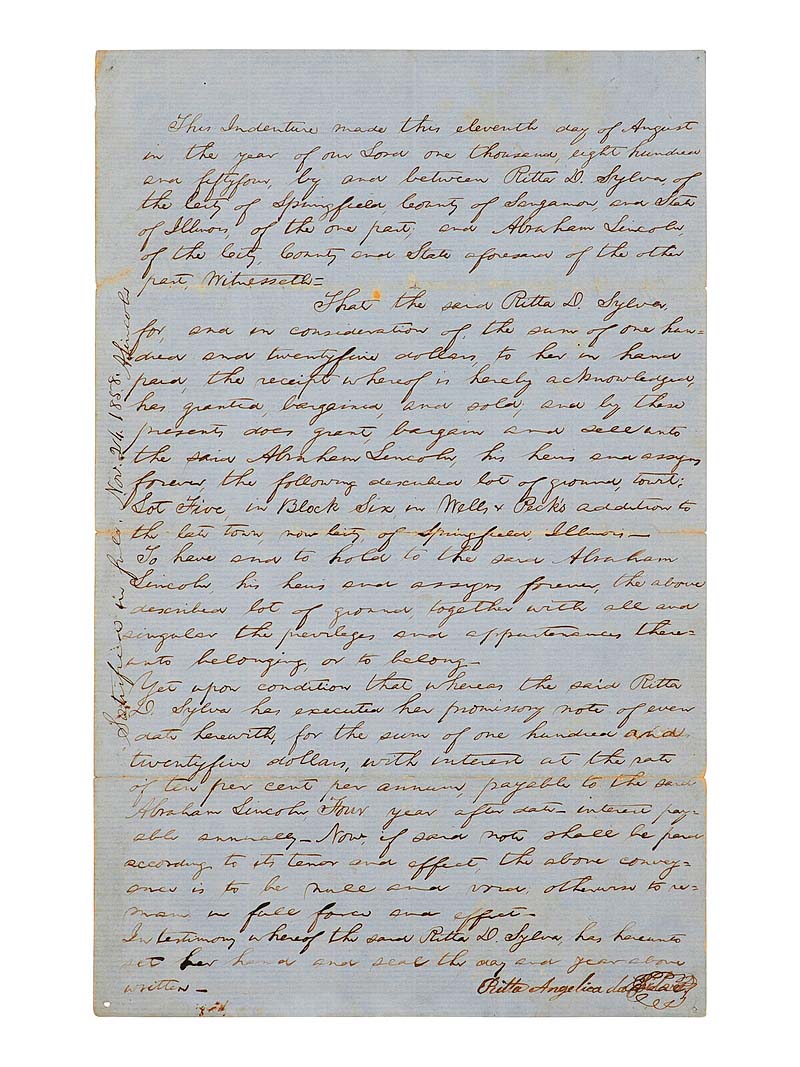
Realizing $17,920 against a $5/8,000 estimate was this autographed document endorsed “A. Lincoln” and dated to Springfield, Ill., on August 11, 1854.
Brink also pointed out another lot which fell outside of the top 15 highest earning, but which had equal importance. “One particularly telling result was lot 111 — the print that inspired the title of the sale — which far exceeded expectations, achieving $7,500 against a typical market value of a few hundred dollars. Its performance speaks to a broader collecting impulse: bidders were not only competing for rarity, but also for objects that carried symbolic and narrative weight within the context of the sale itself.”
To conclude, Brink said, “As we approach the 250th anniversary of the nation’s founding, this sale reflects a market responding with renewed urgency to acquire material that speaks to the origins and evolution of American identity.”
Freeman’s will offer The Library of Stephen J. Farber on May 14, followed by How History Unfolds on Paper: Important Americana from the Eric C. Caren Collection on June 30, which will serve as the capstone of the firm’s 250th anniversary programming.
Prices quoted include buyer’s premium as reported by the auction house. For information, 312-280-1212 or www.freemansauction.com.