By Jill Fenichell
NEW YORK CITY — “From Sèvres to Fifth Avenue: French Porcelain at The Frick Collection” is a small, beautiful show offering visitors the chance to admire rarely displayed pieces from the museum’s collections. Organized by decorative arts curator Charlotte Vignon, the presentation, on view in the Frick’s sun-filled Portico Gallery, features pieces amassed by Henry Clay Frick.
In a story now well known, the Pittsburgh coal magnate and his wife, Adelaide, commissioned Thomas Hastings to design and build them a mansion on Manhattan’s Upper East Side between 1912 and 1914. Like J.P. Morgan and Andrew Carnegie, the Fricks worked with the dealer Joseph Duveen (1869–1939) to acquire an art collection, including remarkable Sèvres porcelain for the mansion’s main floor public rooms. Delicate, gold-tinged bleu celeste groupings were for Adelaide’s private use in her very feminine boudoir.
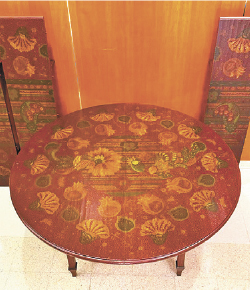
Four vitrines in the Portico Gallery hold highly decorated Sèvres porcelain wares, including vases, potpourris, two water jug and washbasin sets, and dessert sets and teaware. On an opposing wall, an unusual Chinese-influenced vase Japonais sits alone in a vitrine, with a tripod-table inset with porcelain plaques painted with flowers nearby.
Sèvres porcelain is not for those whose taste runs to simplicity. The factory received the official patronage of Louis XV of France and Madame de Pompadour, his first mistress, in 1753. By 1756, the king gave the factory protection from competition. No other factory in France could make wares as luxurious as those from Sèvres, because Sèvres was the only factory allowed to use gold in the decorating atelier. The manufactory received royal commissions each year from the king, another formidable blow to smaller factories scattered throughout the country.
Meissen’s reputation was based on the staggering menagerie of large white porcelain animals modeled by Johann Joachim Kaendler between 1730 and 1736. By contrast, Vienna’s fame lay with its tea and coffee wares decorated with intricate enamels and paste-gold designs on color grounds, made in the 1740s and later. The most famous designs at Sèvres combine unique and fanciful forms with elaborate ground colors and complex decorative motifs. Of these, the best known are the baluster-form vases issuing elephant trunks (vase á tête d’eléphant) and the boat-form potpourri vases (vaisseaux à mât) designed by Jean-Claude Chambullan Duplessis (1699–1774).
The show reminds viewers that America’s Gilded Age industrialists earned enough money to treat themselves to the treasure once reserved for regents. Frick purchased most of the Sèvres on display just prior to World War I. The most remarkable purchase took place in June 1916, when Duveen acquired for Frick a vaseau à mât and a pair of vases à orielles (ear-shaped vases) with the same decoration. The price for the three items was enormous for the time: $100,000. This trio of items is exhibited in the first showcase in the Portico Gallery. A rococo goldsmith, sculptor and modeler (1699–1774), Duplessis made both sculptural forms.
The vaseau à mât is one of only ten examples known to exist. Madame du Pompadour owned two examples of this form and the Prince de Condé owned one. All of the others now reside in remarkable public or private collections. The vaseau à mat is particularly extravagant. The pair of vases à Oreilles is modeled with delicately drooping foliage from the serrated mouth. All three items are painted lusciously with two ground colors — apple green and deep blue — and decorated with caillouté gilding, which resembles a knitted mesh of irregular cells. The fronts are painted with birds by Louis-Denis Armand l’aine (active 1745–1788). Making such large, sculptural objects took enormous effort.
Vignon chose more intimate objects for the second showcase. Items from Mrs Frick’s boudoir fill the cabinet. They are painted with the gold-based bleu céleste ground color, a unique shade of turquoise developed at Sèvres by the chemist Jean Hellot. Duveen purchased a pair of small vases Duplessis, but also a pair of vase Duplessis à enfants, modeled with figures of two seasons on each vase. François Boucher drawings served as the inspiration for the figures of the seasons. Two remarkable water jug and washbasin sets sit at the bottom of the showcase. The first of these was painted in 1776 with delicate floral bouquets by Cyprien-Julien Hirel de Choisy, while the second example was painted in 1781 with a sensitive depiction of boats at low tide by Jean-Louis Morin. Helen Clay Frick gave both of these items to the Frick Collection on her death in 1934.
The third vitrine includes several dishes from a dessert service widely acknowledged to have some later-decorated elements, which is a strange choice for a show otherwise loaded with very pretty and major objects. Many public collections have later-decorated or enhanced Sèvres, as well as copies of Sèvres, but most do not include them in a display. Unfortunately, there is no image of the plates as issued from the factory, so there is little to be learned from this part of the exhibit.
The lower part of this showcase displays items from a wonderful bleu céleste dejeuner, or tea set, of 1767, painted with birds by Antoine-Joseph Chappuis (active 1756–1787). Chappuis copied his birds from The Natural History of Birds and Gleaning of the Natural History by English naturalist and diplomat George Edwards. No less a personage than the Duke of Richmond presented his personal copy of Edwards’ book to the factory for this express purpose.
The last vitrine holds another trio of impressive articles, three potpourris feuille de mirte or à feuillage, dating to 1762. The form derives from silverworks done in the 1750s to designs by sculptor and metalsmith Jean-Claude Duplessis le Père. The name refers to myrtle leaves, an essential ingredient of potpourri. Flemish peasant scenes on the vase fronts derive from David Teniers the Younger and François Boucher, painted by an unknown artist. The ground color of the vases is a stunning pink with blue scrolls and gold highlights, painted in a complex, marbled effect.
If Vignon’s sole purpose was to display a handful of extraordinary objects that decorated the private rooms of the Frick Mansion, she has done a fine job. However, “From Sèvres To Fifth Avenue” lacks much else that would have made it meaningful and enriching. Whether the curator was constrained by the physical limitations or simply wished to create a small exhibit with a simple focus is not known.
“From Sèvres To Fifth Avenue” continues through April 24 at 1 East 70th Street. For information, 212-288-0700 or www.frick.org.