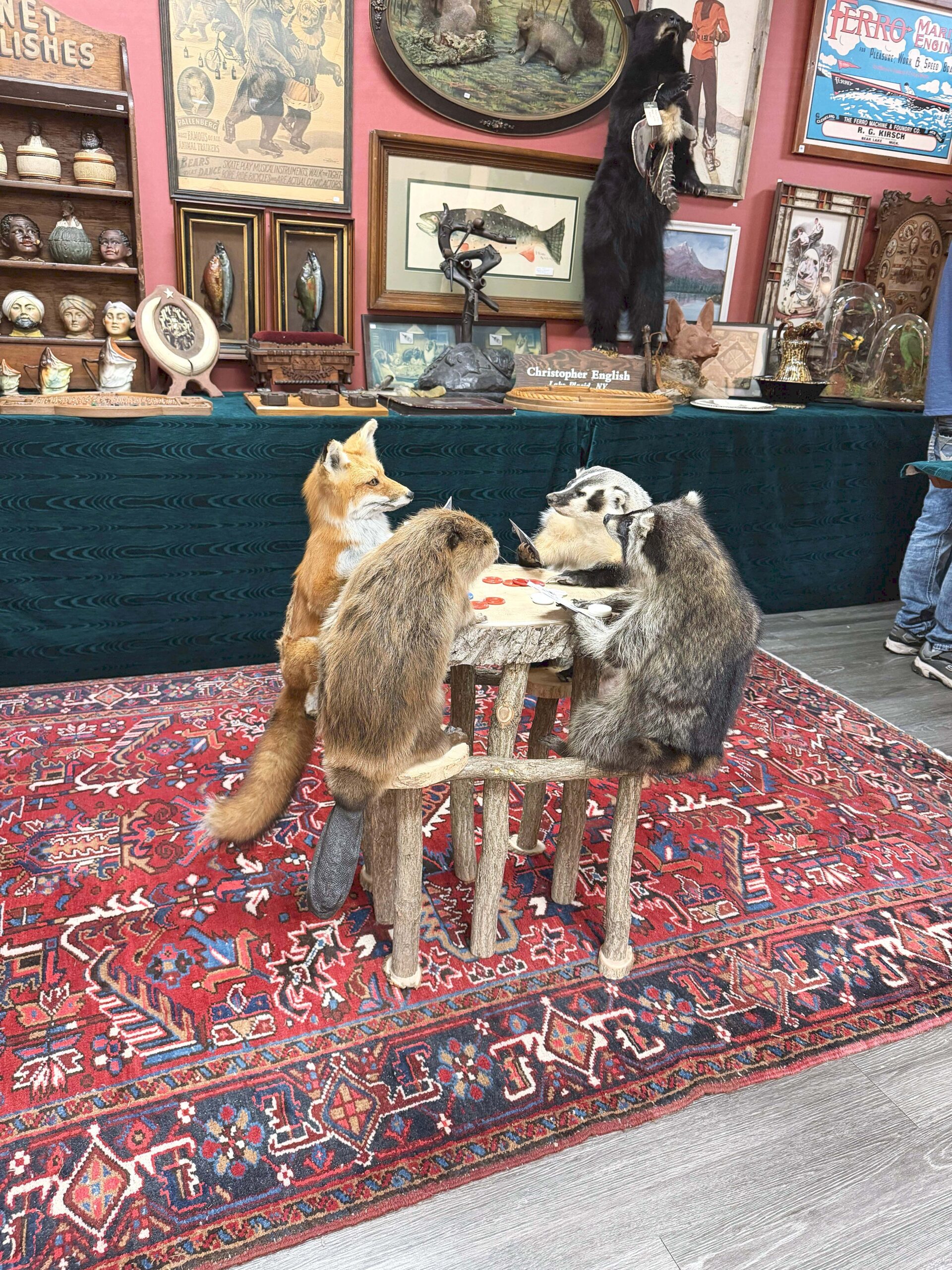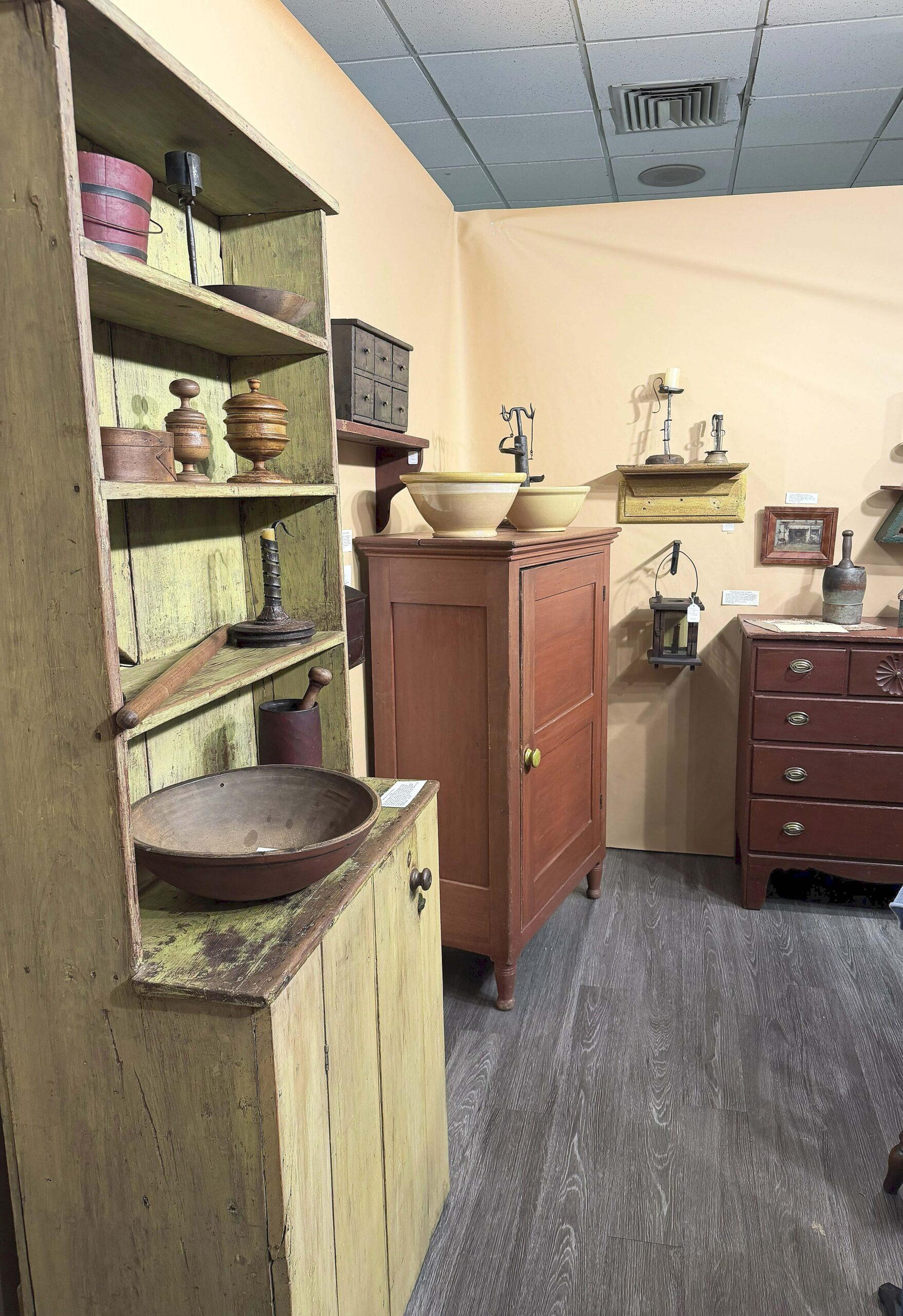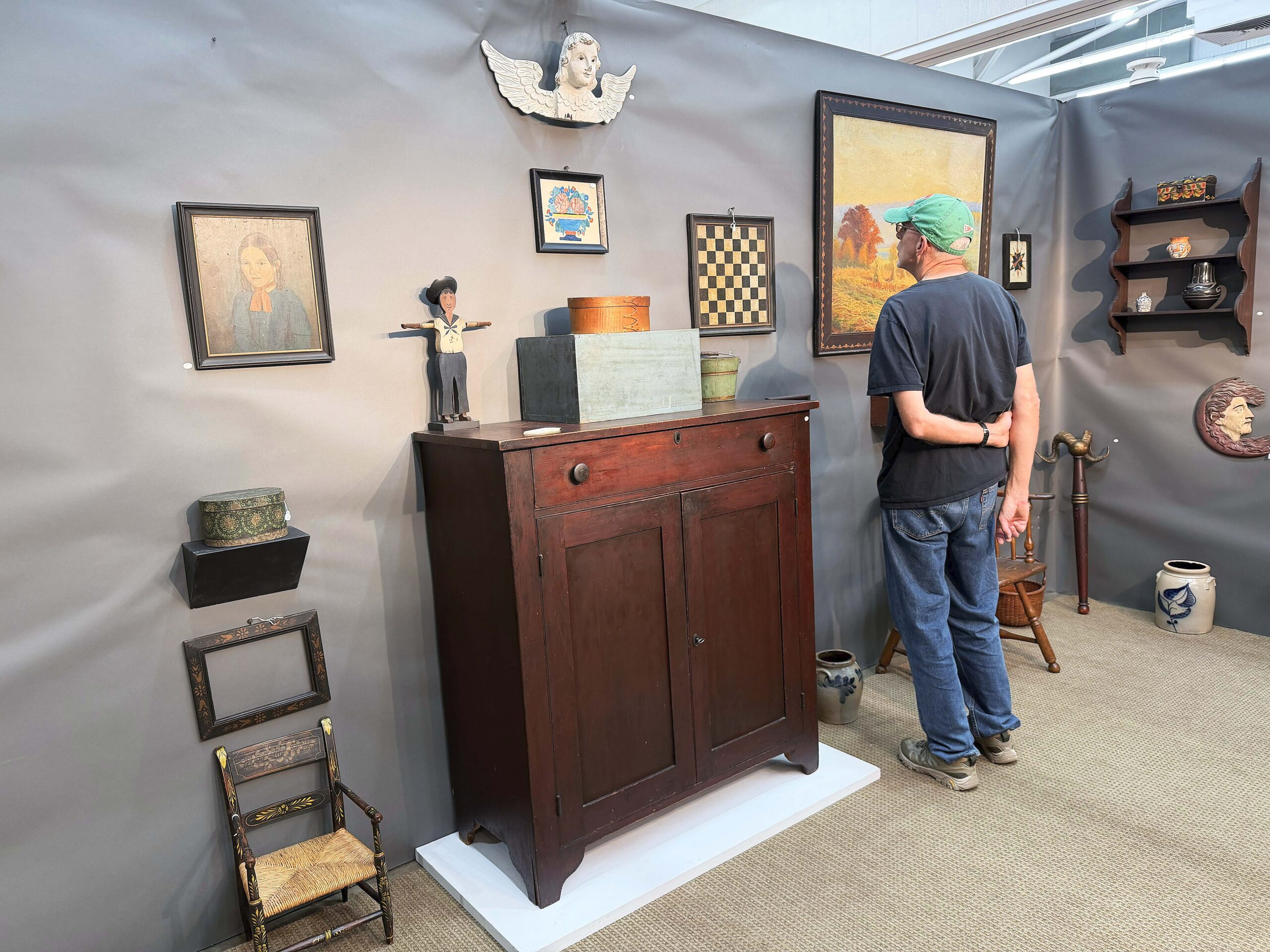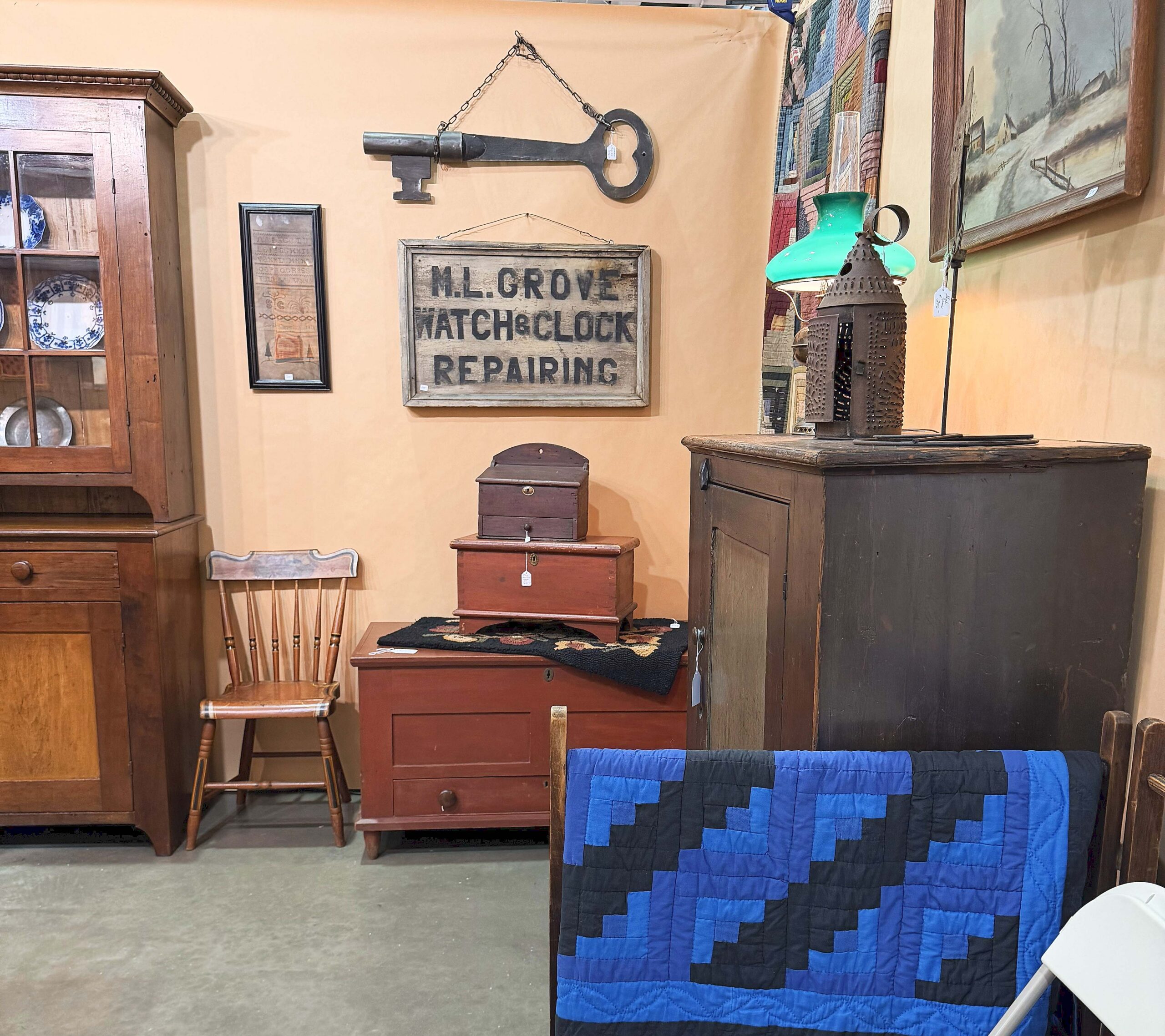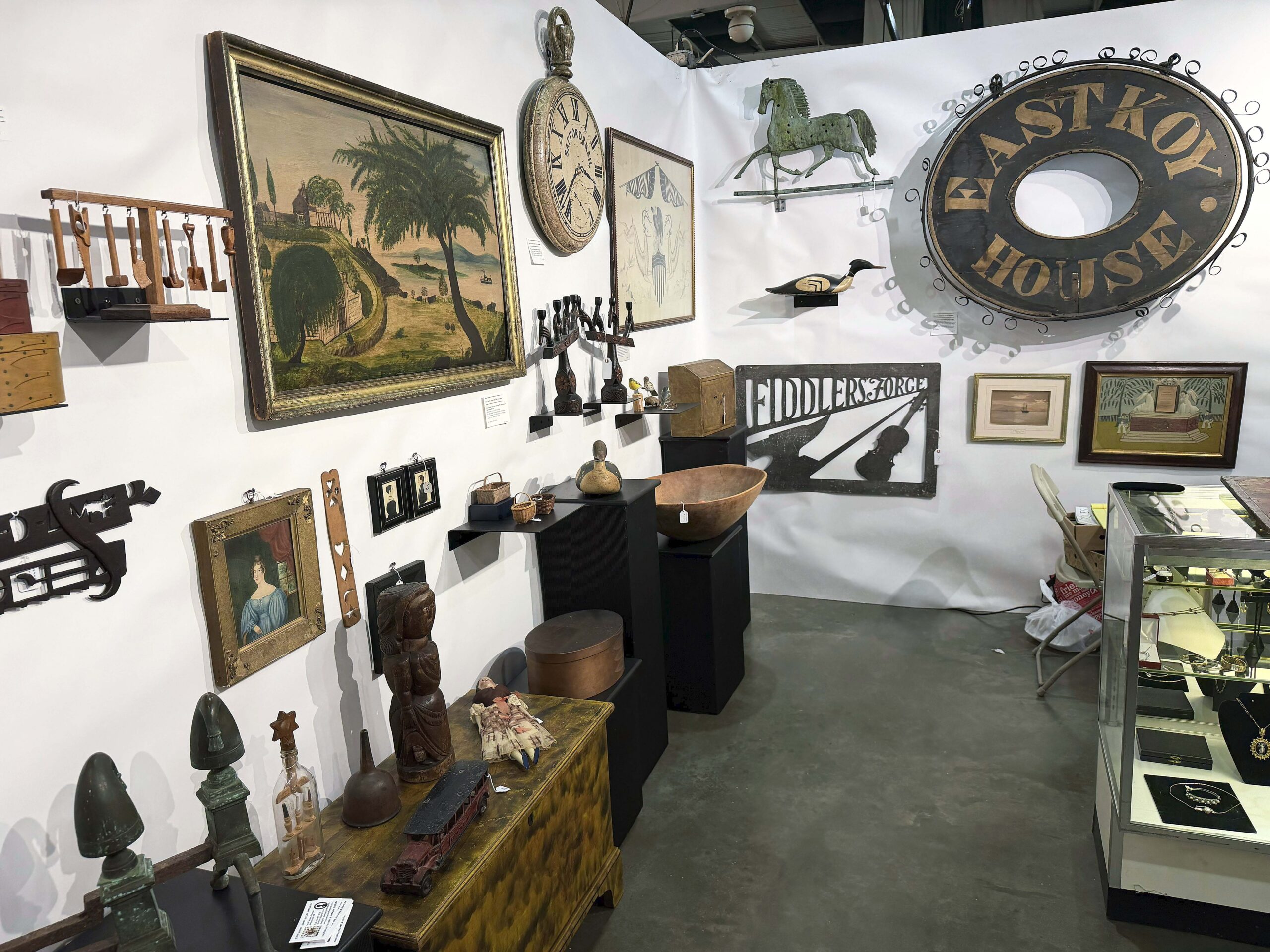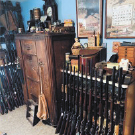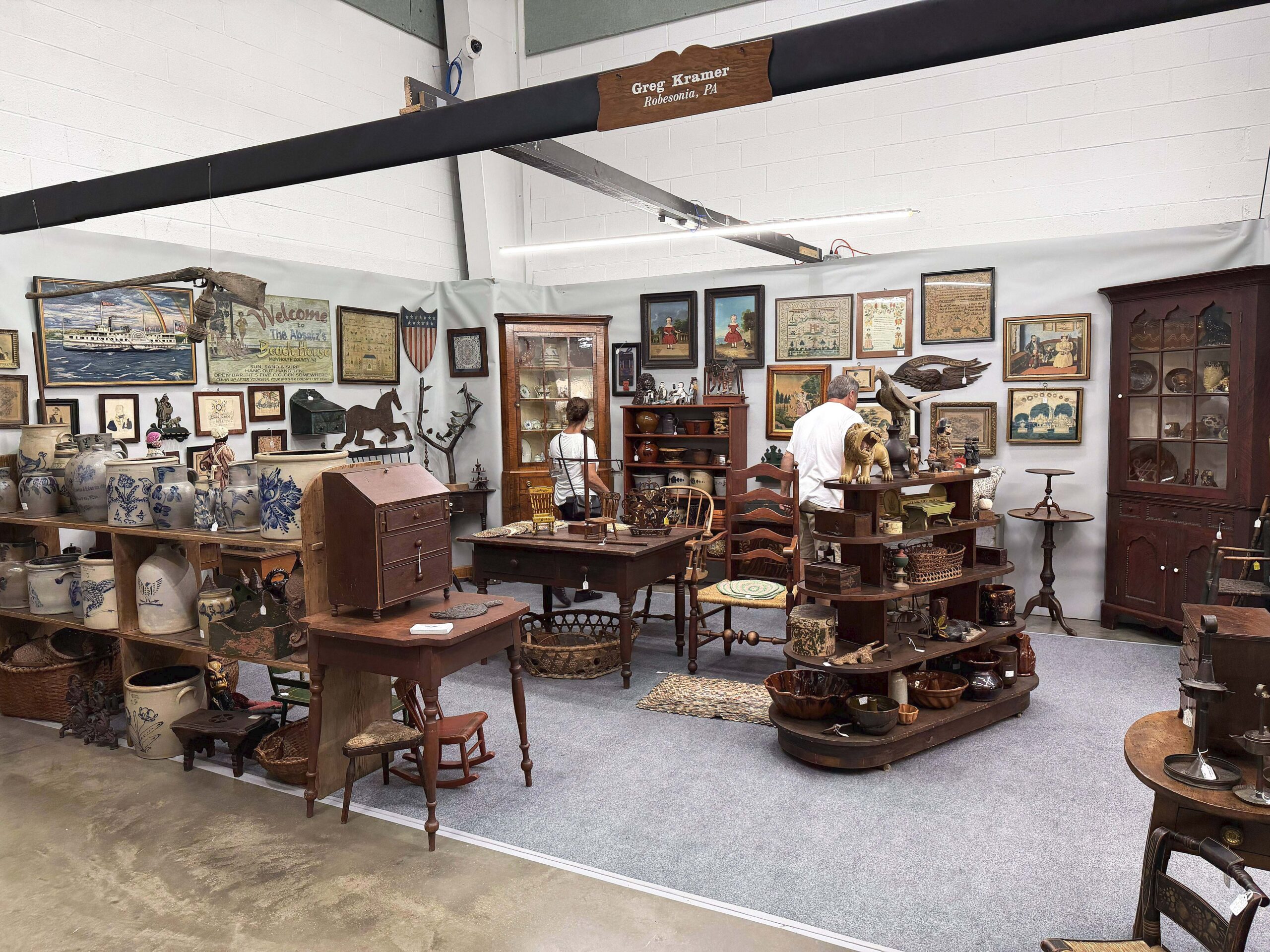
The always-stocked, ever-popular booth of Greg Kramer, Robesonia, Penn.
Review & Onsite Photos by Kiersten Busch
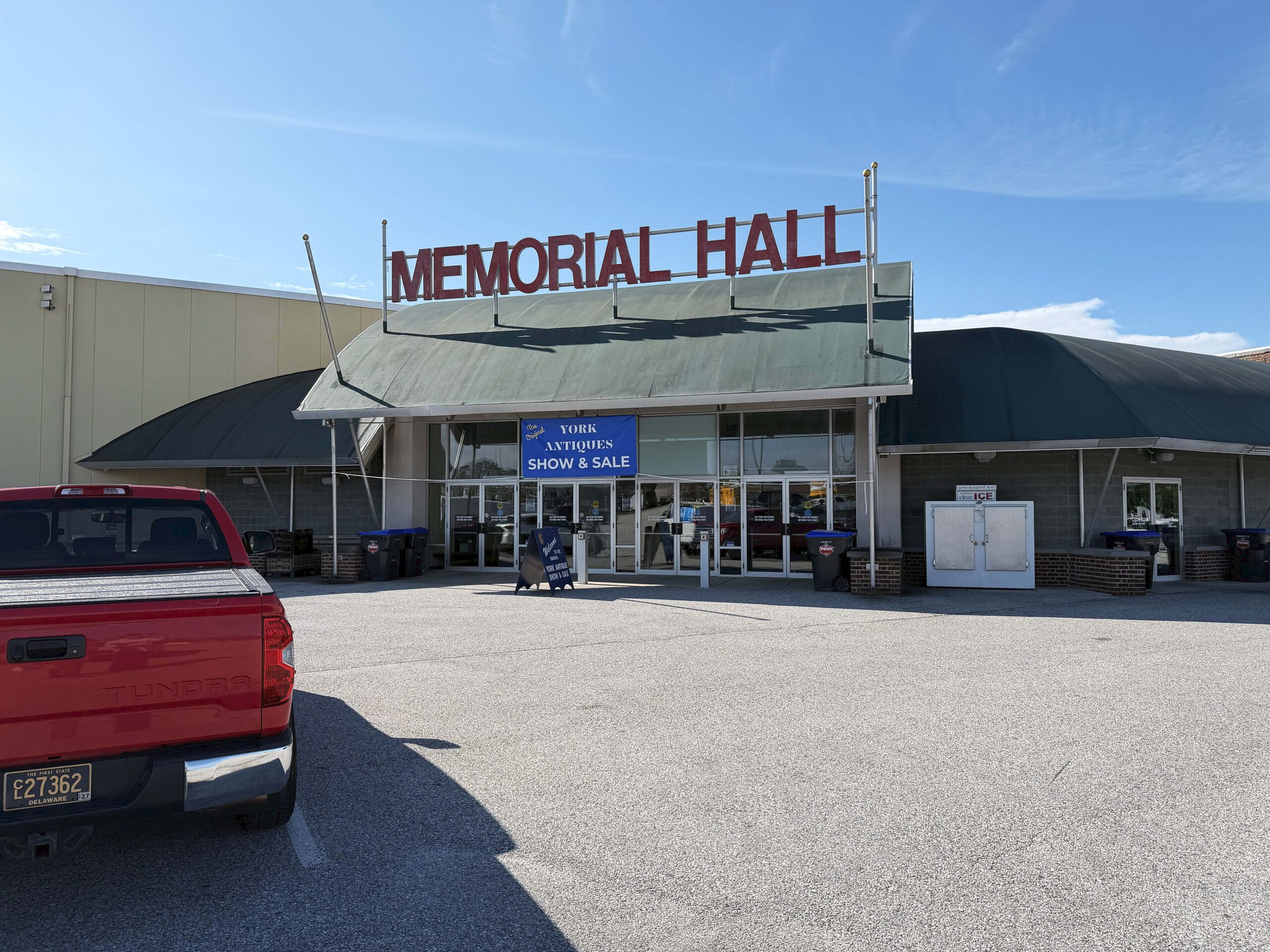
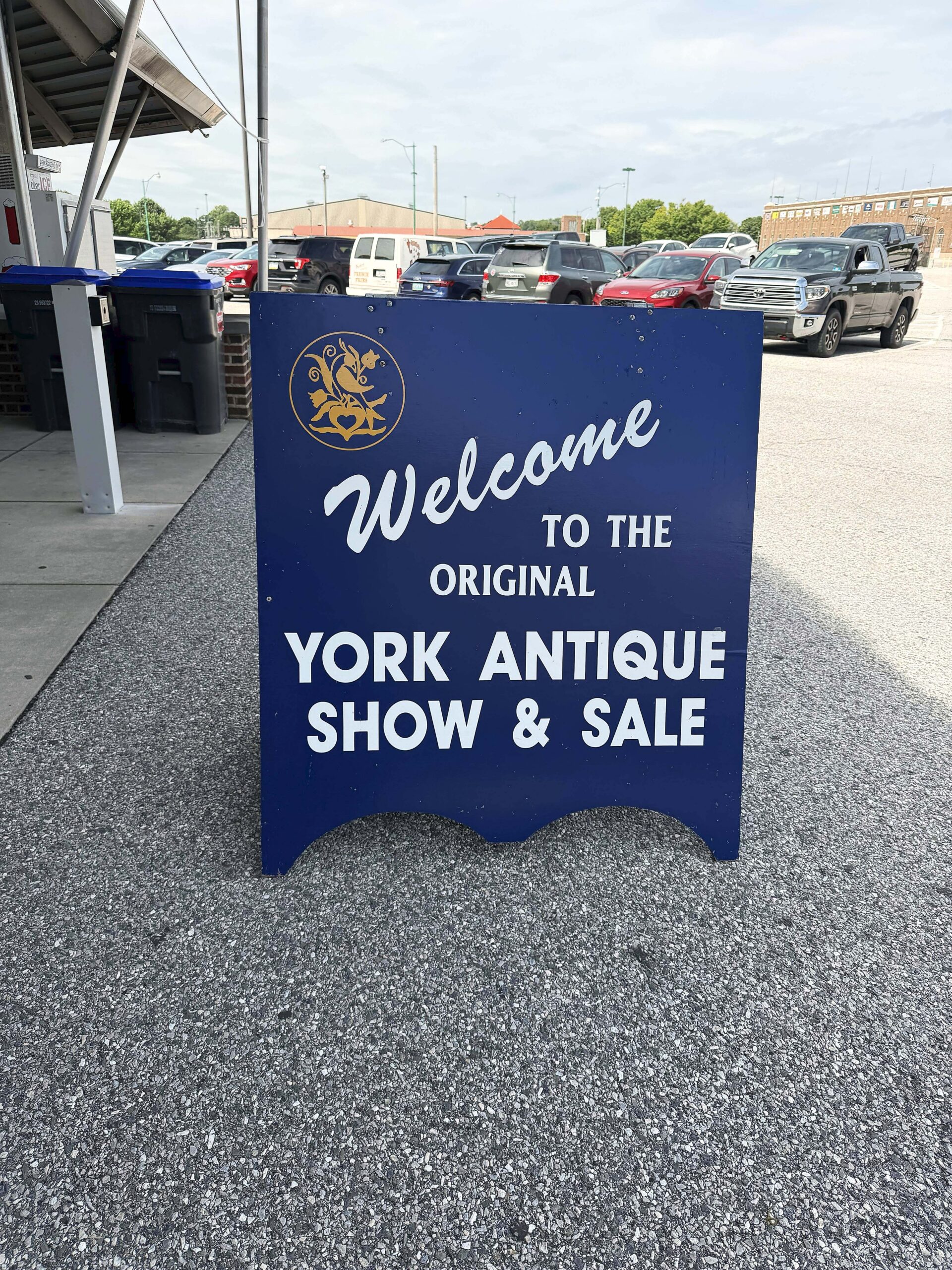
YORK, PENN. — Biannually, Americana and primitive enthusiasts make the trek to York, Penn., where The Original Semi-Annual York Antiques Show & Sale goes up at the York Fairgrounds and Convention Center. Filling Memorial Hall East with approximately 60 select exhibitors, show manager Melvin L. Arion hosted a plethora of enthusiastic buyers for the show’s 187th iteration spanning September 18 and 19.
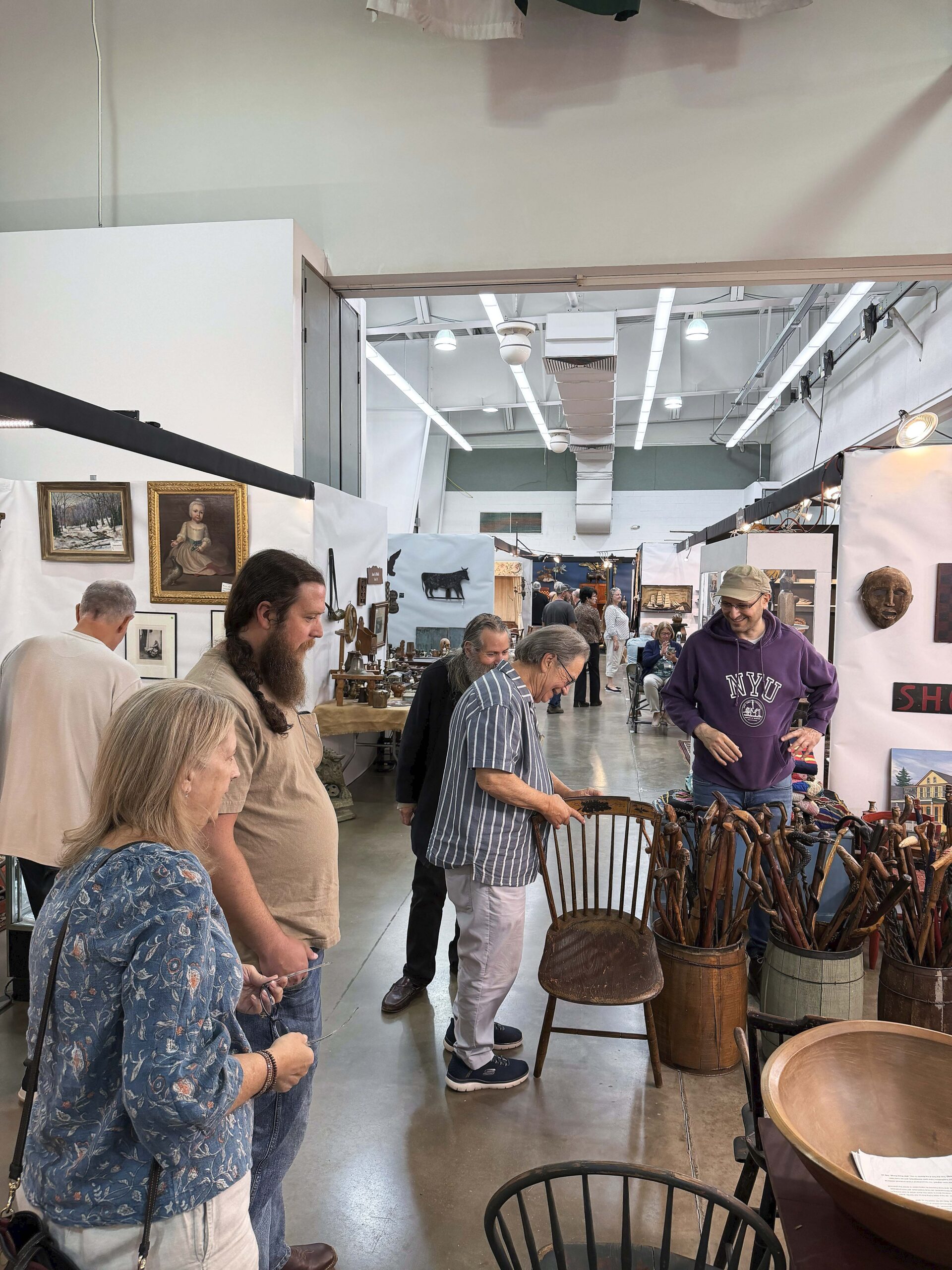
With several additional perks marketed, including free parking, a smoke-free building, credit card accessible payments and good food, buyers beat the end-of-summer heat to peruse several aisles of established dealers’ wares. According to several dealers, while Friday, the first day of the show, seemed to attract more of the “serious buyers” — dedicated and longtime clients, as well as industry professionals — Antiques and The Arts Weekly observed a robust crowd of curious and knowledgeable buyers on the second and final day as well.
Entering the first room of the show, an intimate, roundabout room showcasing only a few dealers, Rick Fleshman of Fleshman’s Antiques was stationed in his usual booth right in the front. When asked how his first day went, he replied, “Not bad! There was a good crowd yesterday, mostly the non-working crowd.” He reported selling an Empire sideboard, a Dutch cupboard and another chest on Friday, and hoped for similar success on Saturday. “I’ve had a lot of interest,” he continued. “A lot of mothers trying to convince their daughters to buy something. They don’t want to go to Ikea!”
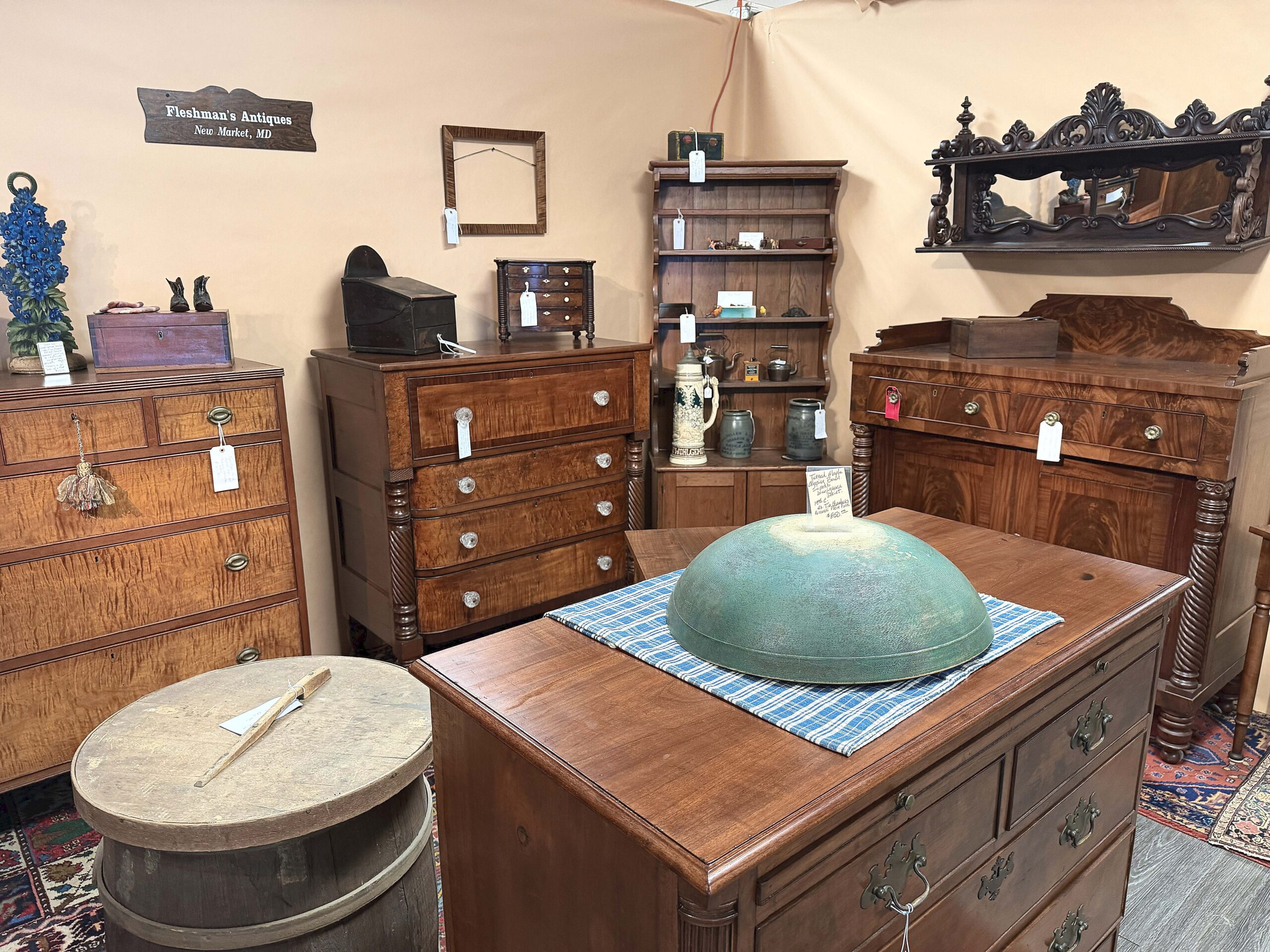
Rick Fleshman was happy to report a lot of returning customers and sales, including the Empire sideboard with the red tag in the far right of this image. Fleshman’s Antiques, New Market, Md.
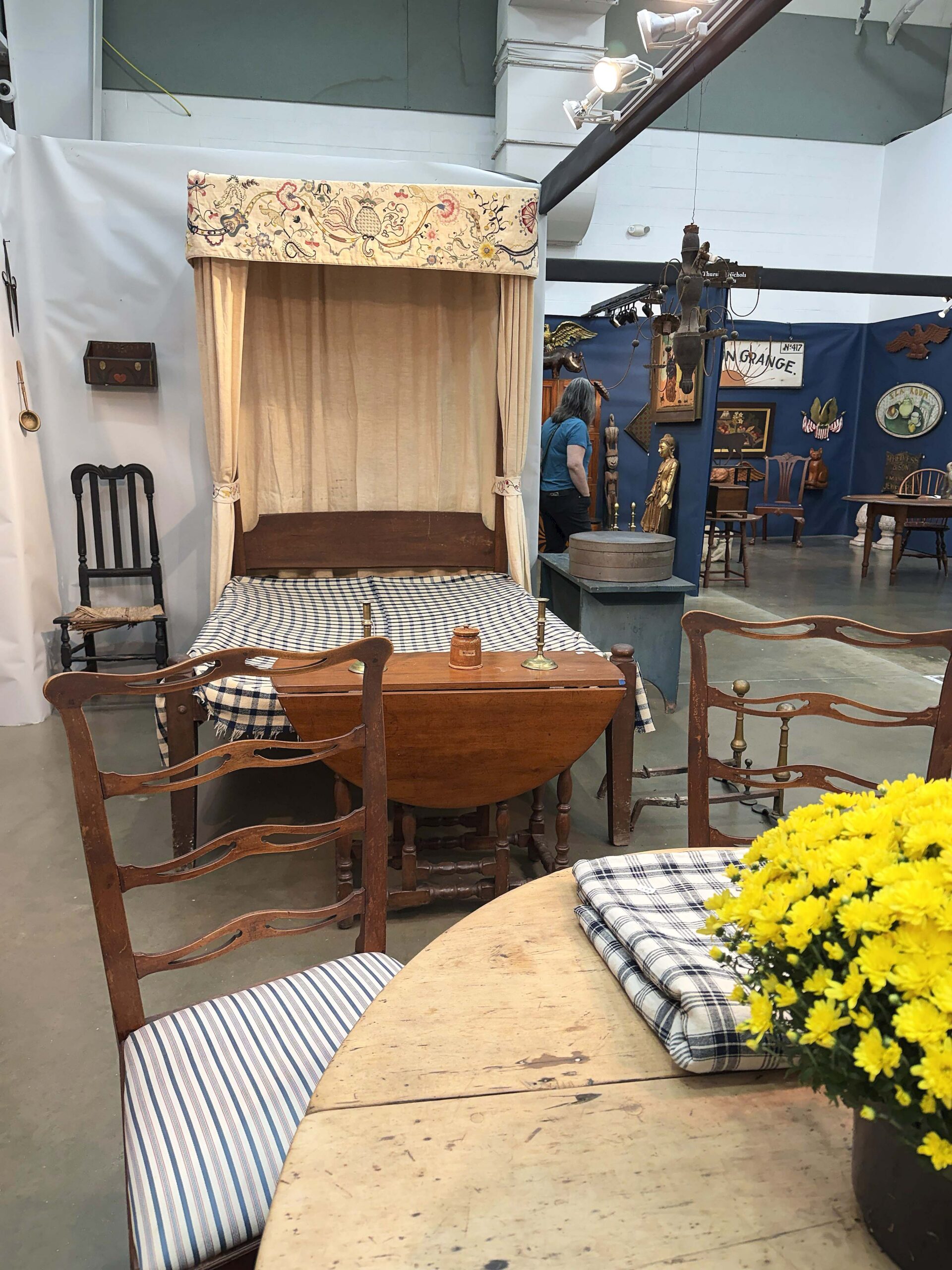
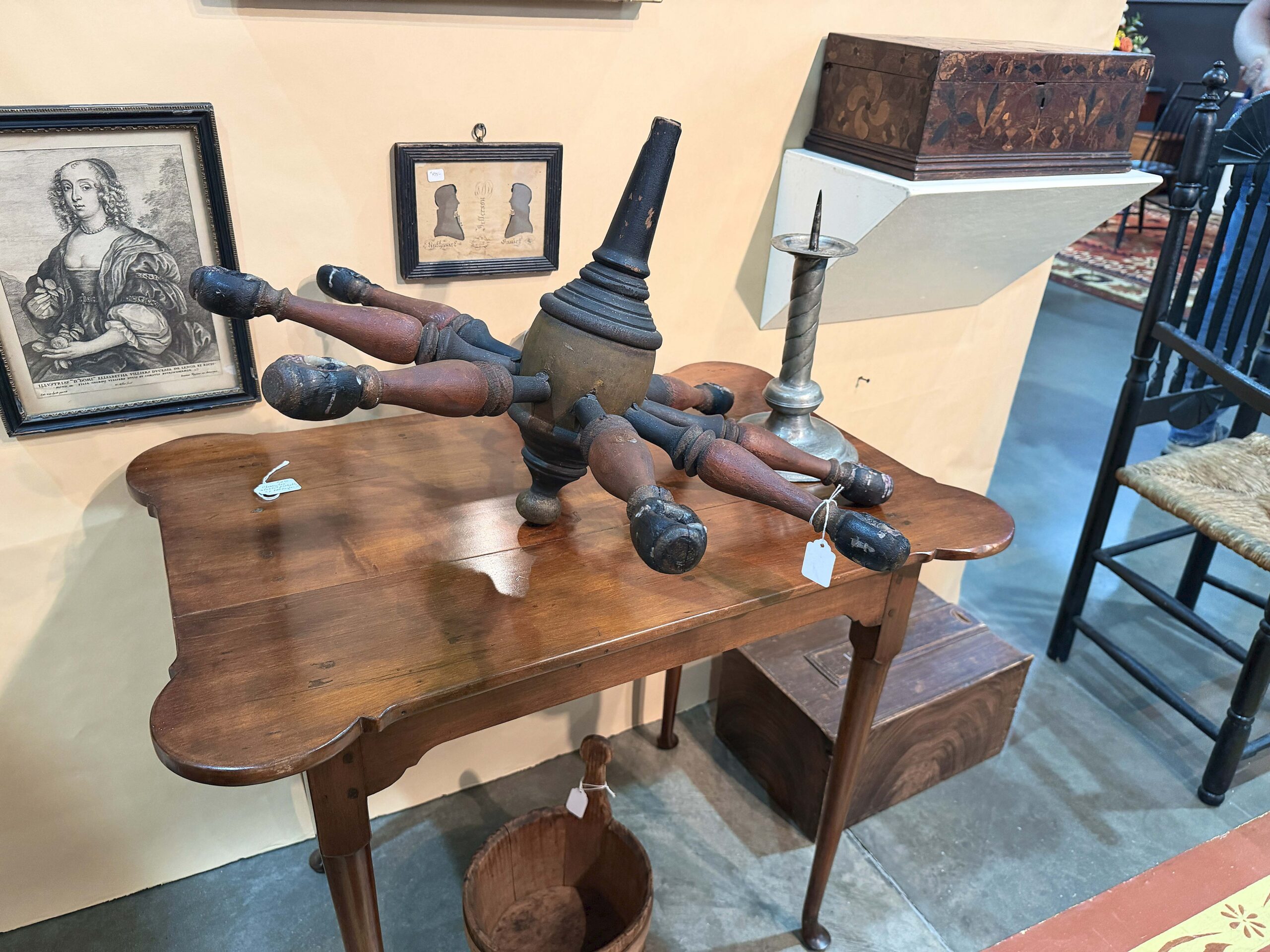
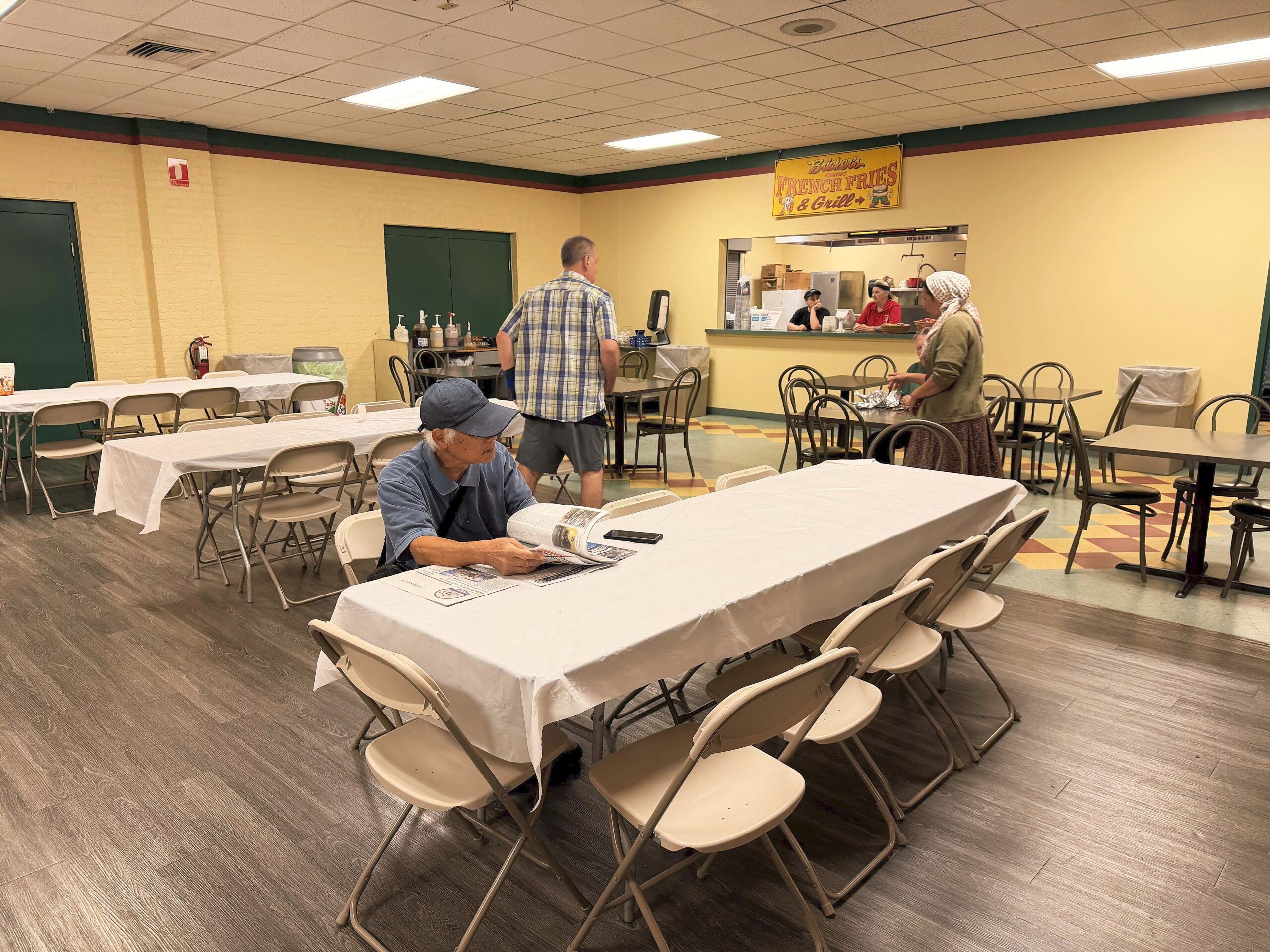
Around the corner was the booth of H & L Antiques of Princeton, N.J., where owner Helen Bryan reported a “good” first day, with a small table and cupboard selling. She has kept this spot in the first room for a while, touting that there is “lots of space to set up” and that because of the cafeteria and accompanying seating conveniently located near her booth, “everyone winds up back here anyway!” The company’s specialty is furniture and early lighting, of which there were multitudes. Bryan pointed out a few early grease lights made between the 1700-1800s, as well as a kettle light, which she explained was used onboard ships.
Behind Bryan’s booth was fellow show veteran Judith Lesser, who owns Antiques From Home based in Bethesda, Md. She also has a vending space in the Lee, Mass.-based Galleries at Knollwood Antiques, which she happily shared was another great place to display her findings and connect with clients. Specializing in gardenalia, ceramics and textiles, Lesser separated her booth down the middle between her interests, with a gardenalia display on the left and a ceramics and textiles setup on the right. Of her garden wares, she explained, “I had a nice rooster, but sold it!” Instead, she chose to highlight a stone planter in the shape of the bottom half of a woman’s face, which housed a live, yellow ornamental pepper.
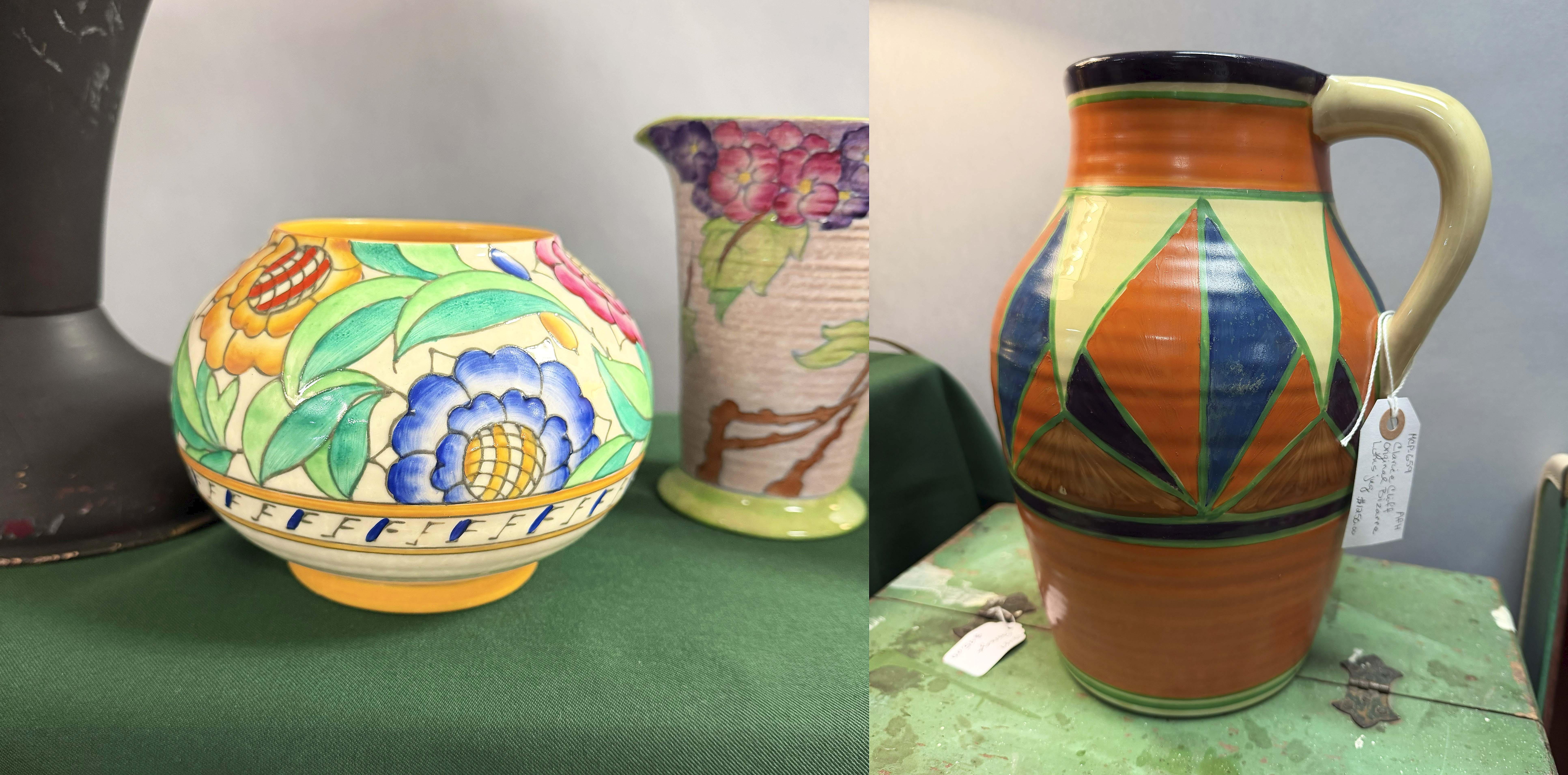
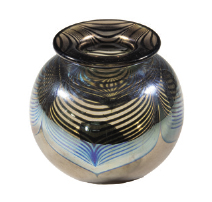
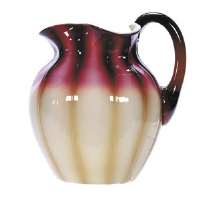
Ceramics are one of Judith Lesser’s specialties, and she was happy to show off a colorful Charlotte Rhead pot she imported from England (left) as well as an original Clarice Cliff “lotus jug” she bought from someone in her neighborhood (right). Antiques From Home, Bethesda, Md.
For ceramic offerings, Lesser was proud to show off a colorful pot by “a famous English potter” named Clarice Cliff, which she purchased from a neighbor, as well as a “lotus jug” by English female designer Charlotte Rhead, which Lesser imported from across the pond. “It got a lot of traffic from my web store,” she added. While she does not update it extremely frequently, Lesser expounded that the web store helps some of the items she sells in person get more traction before live shows and events, which she finds advantageous.
The intimate feel of the Memorial Hall’s first room is quickly forgotten when entering the double doors into the main exhibition hall, where the majority of the dealers are housed. Booths double or triple in size, and the bright, cool-toned lighting makes sure that even the smallest of smalls on offer are illuminated for attendees and buyers to spot. Also positioned near the entryway is a booth manned by the dedicated staff at Historic Trappe, led by executive director Lisa Minardi. On display, Historic Trappe offered some of their newest additions, including the latest volumes of Ceramics in America and Americana Insights, along with various other informational pamphlets, and several copies of author Emily Sneff’s latest novel, When the Declaration of Independence Was News, which was published in April to coincide with the nation’s semiquincentennial.
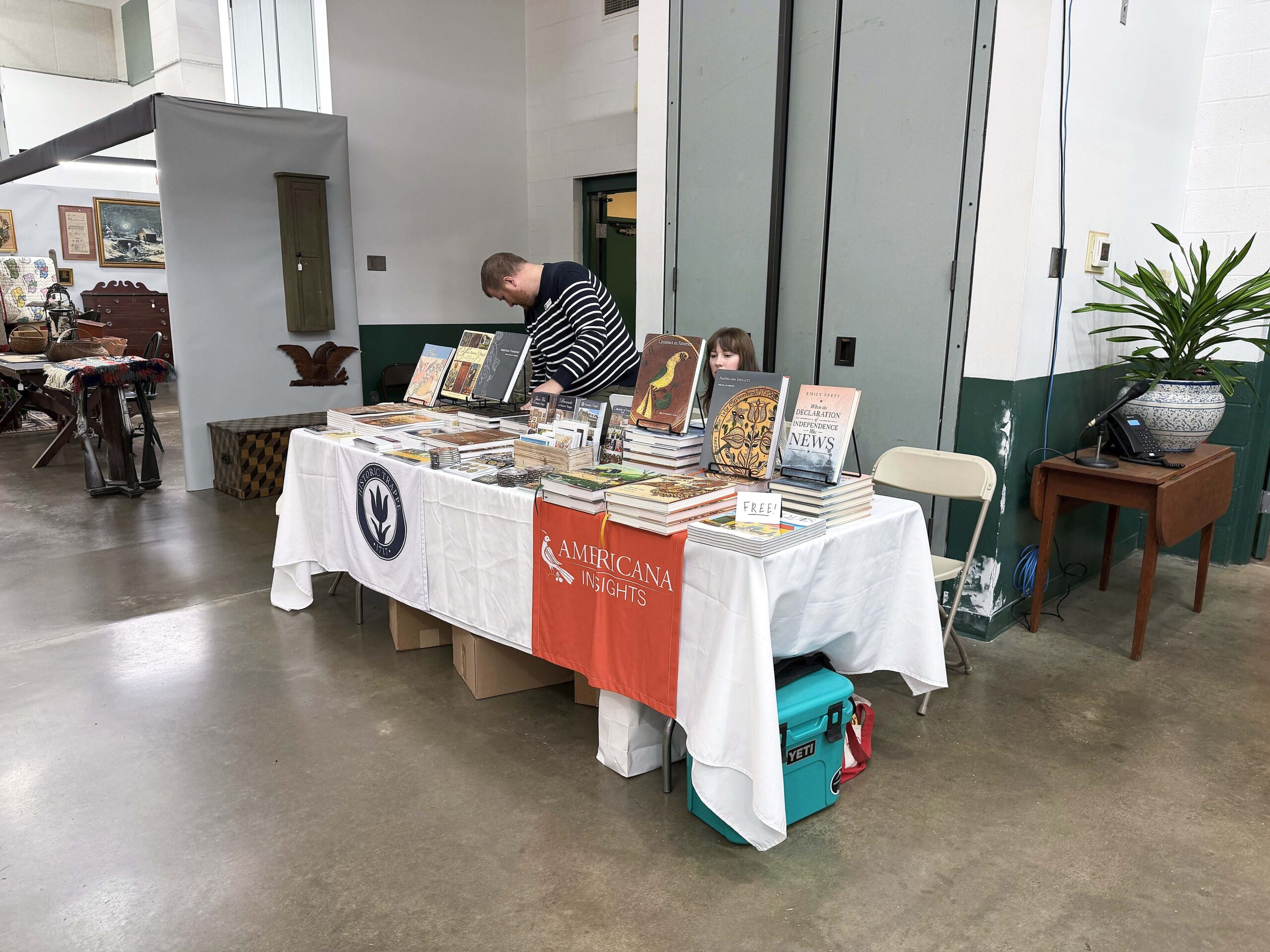
Always in attendance with a booth in the main exhibition hall is Historic Trappe, showing off the latest volumes of Ceramics in America and Americana Insights, alongside Emily Sneff’s novel When the Declaration of Independence Was News and various other titles. Trappe, Penn.
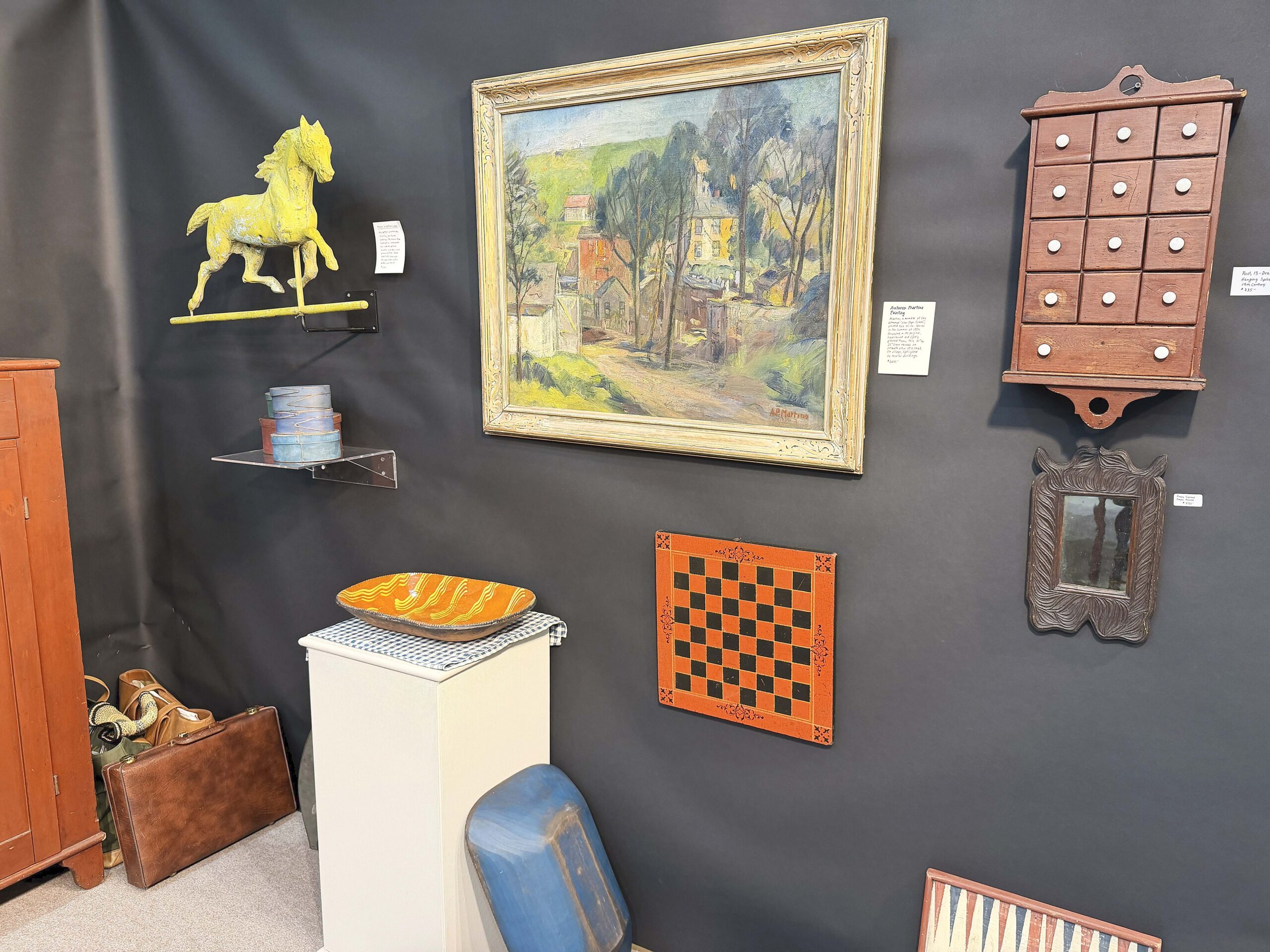
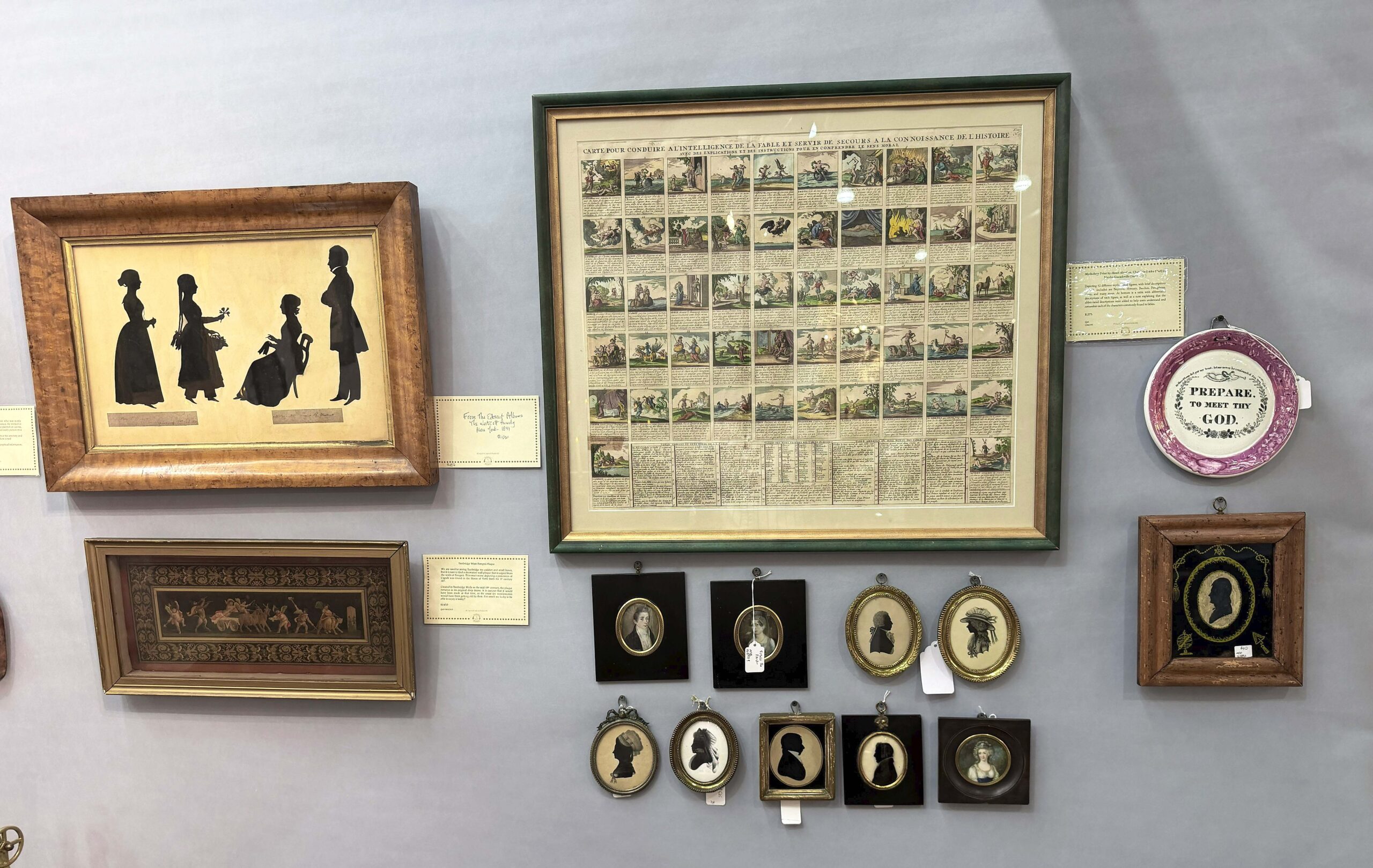
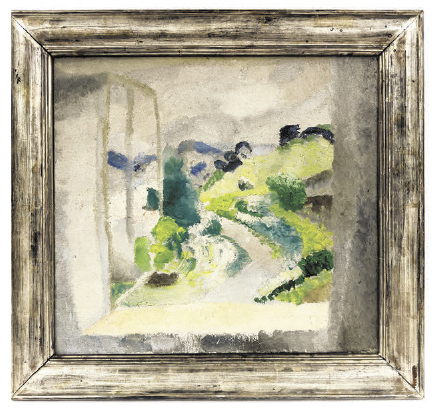
“It was a fun day!” exclaimed Joseph J. Lodge of the first day of the show when we approached his booth to talk. “In addition to the regular faces, there were some new ones from out of state. I had good sales, keeping pace with my usual,” he continued. Lodge offered a wide variety of objects — from weathervanes to Shaker boxes to antique game boards — but the true highlight of his booth, according to him, was a 1930 painting of “an intimate view of a small, Pennsylvania village, highlighted by colorful buildings” by New Hope School artist Antonio Martino. The work measured 30 by 25 inches in its original, hand-carved and lightly painted frame.
Bob Haneberg of The Hanebergs Antiques is based in East Lyme, Conn., and specializes in American antiques and furniture, weathervanes and what Haneberg described as “good paintings.” His favorite offerings in his booth were the weathervanes, which included an eagle example with “great surface,” attributed to a “Harris” and measured 14½ inches tall by 17 inches long. “The sculptural aspects [of weathervanes] are what I really like. Their surfaces are also so important,” Haneberg further explained. As for Friday, he reported that it was a “good” day, and sold furniture, silver, rugs and some Chinese porcelain.
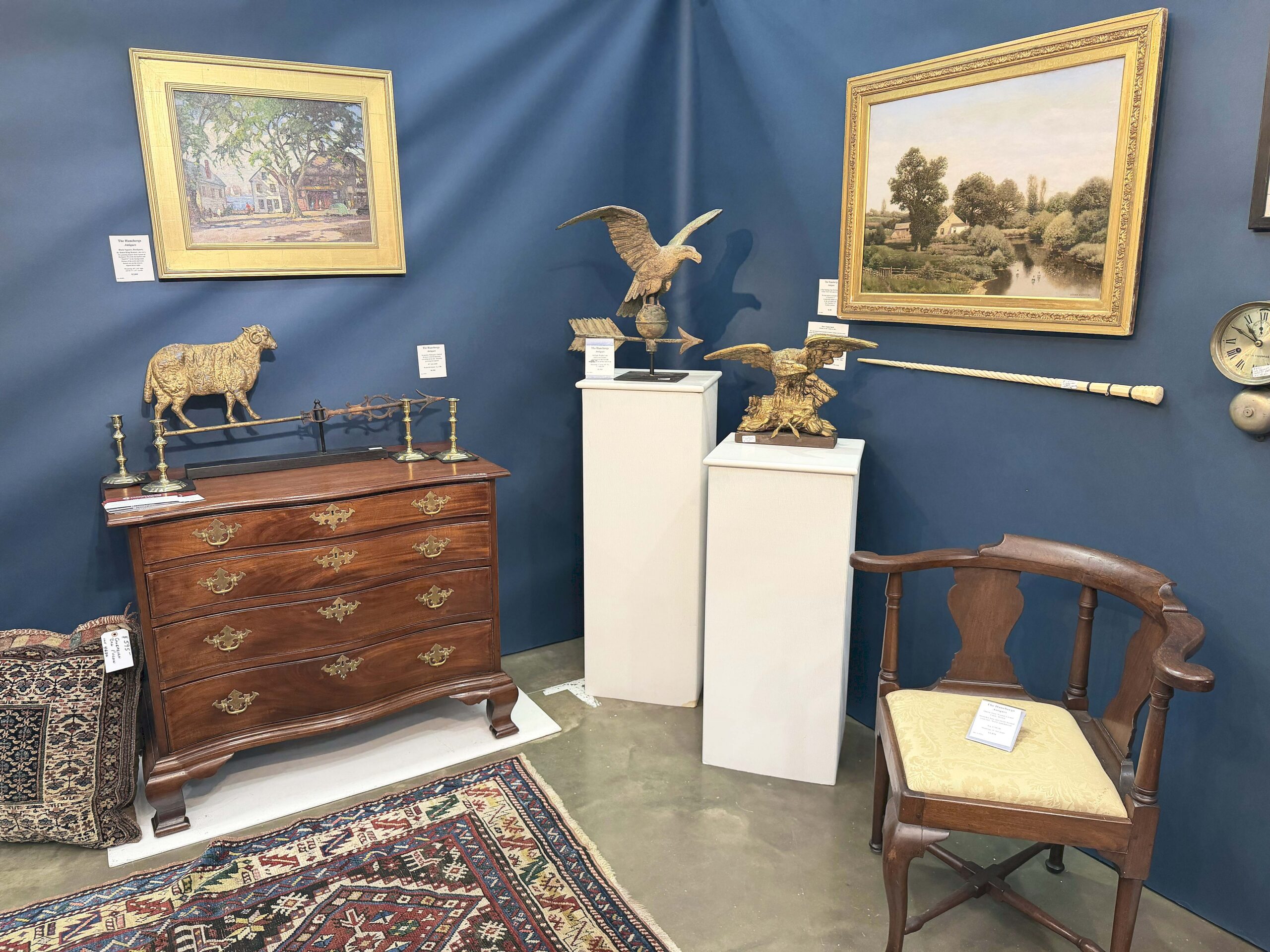
Hailing from East Lyme, Conn., Bob Haneberg of The Hanebergs Antiques, offered a mix of his specialties — American antiques and furniture, weathervanes and “good” paintings — including an eagle weathervane attributed to “Harris” (center), a circa 1790 gilt eagle ornament (right of center) and, hanging to the right, a signed painting of a homestead in Waterford, Conn., by Henry Pember Smith (1854-1907).
Hailing from Bethlehem, Penn., is dealer Thurston Nichols, whose booth at York is oftentimes packed to the gills with curious customers asking questions about his selection of Eighteenth and Nineteenth Century furniture, decorative and folk art and other wares. On Saturday morning, we were able to catch him in a lull and asked how Friday had gone for him. “It was excellent! Yesterday I sold five pieces of furniture, which is very unusual for me. I haven’t sold that many in one day in a long time, and it was nice to see.”
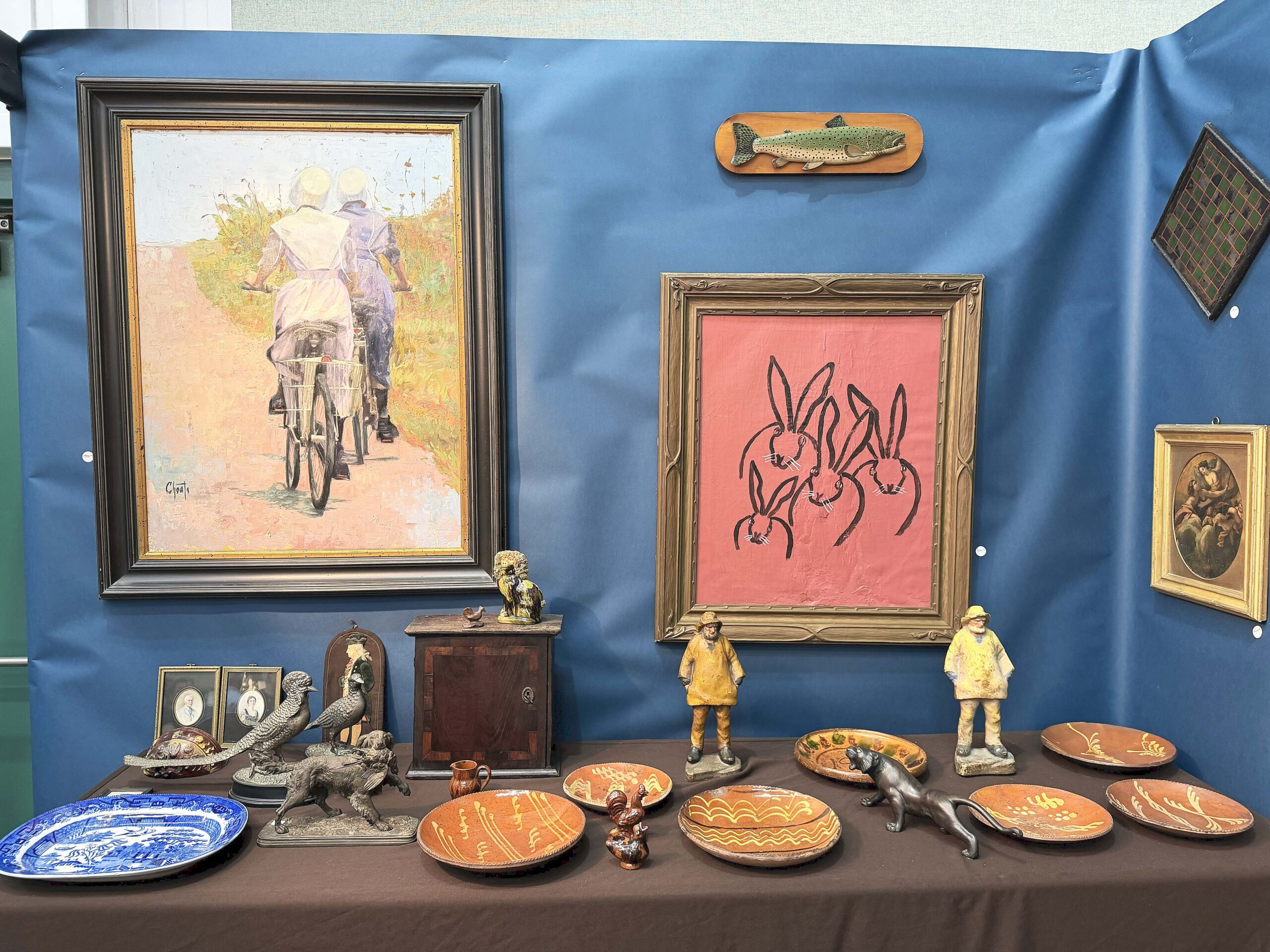
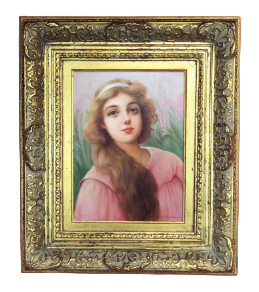
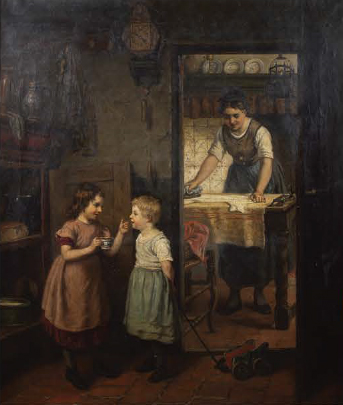
Nichols explained that while he does have a specialty, noted above, he buys anything that catches his eye. “I like it to be a little eclectic!” he added with a laugh. To show off his diverse taste, he led us around his booth to highlight a sold birch dining table made in the 1840s, along with a painting of two Amish children by a contemporary Lancaster, Penn., artist and a bold, colorful painting of rabbits by Hunt Slonem.
“I’m retiring; I’ve been in the business for 50 years. This might be my last show!” were the introductory words from Jon S. Mehl, a local of York, whose specialty is period furniture. Despite an emphasis on furniture, Mehl chose to feature a small case full of handheld weapons, including a wooden club, an axe and a knife with a hand-carved handle, which Mehl assumed was “most likely American” due to it being unsigned. “The Europeans seemed to sign all of their stuff,” he added, for some additional context on his analysis.
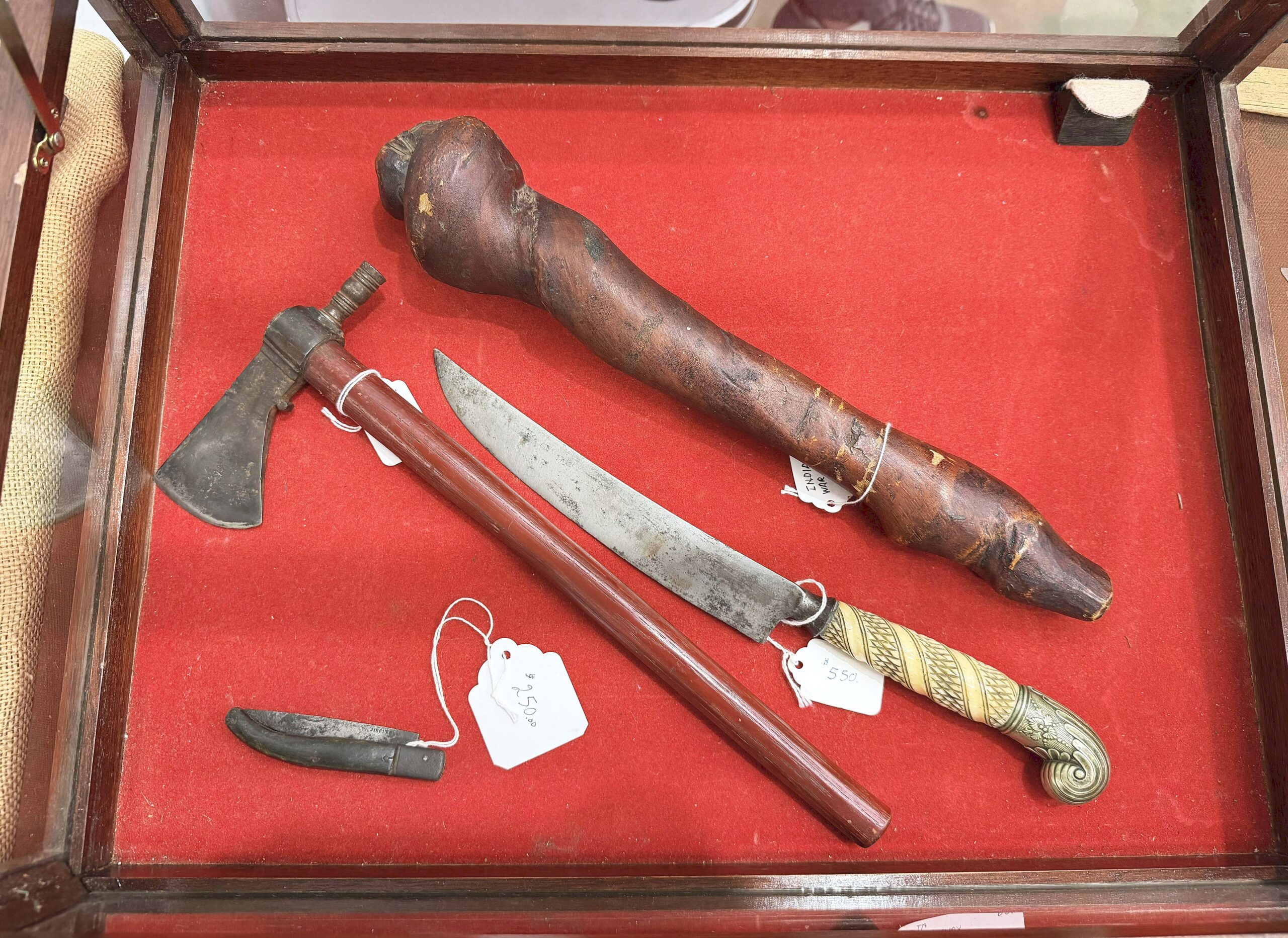
In what is possibly his last show after 50 years in the business, Jon Mehl offered a wide variety of items from period furniture to the weapons in this case, including the unsigned knife in the middle which was “most likely American,” according to Mehl. York, Penn.
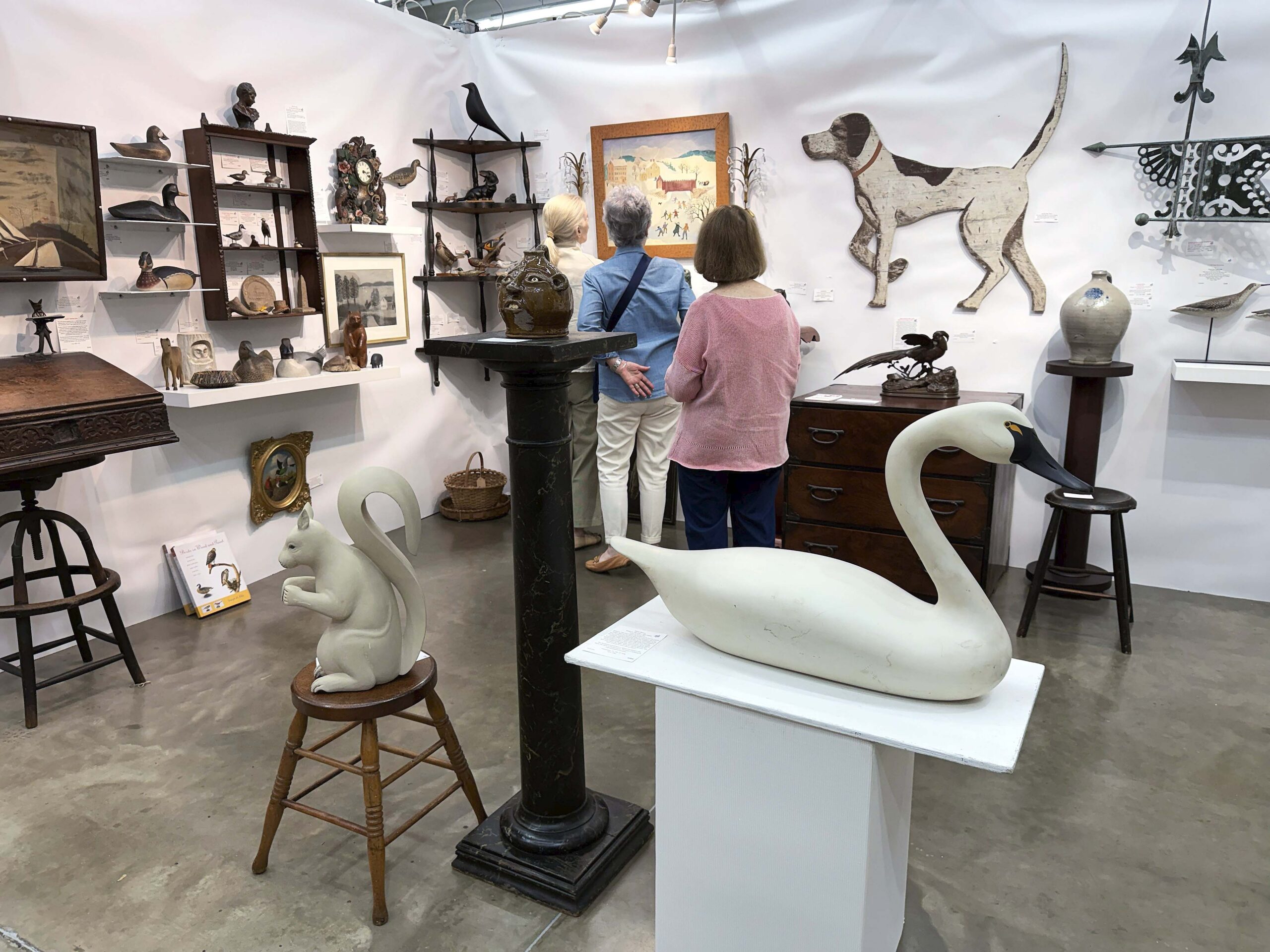
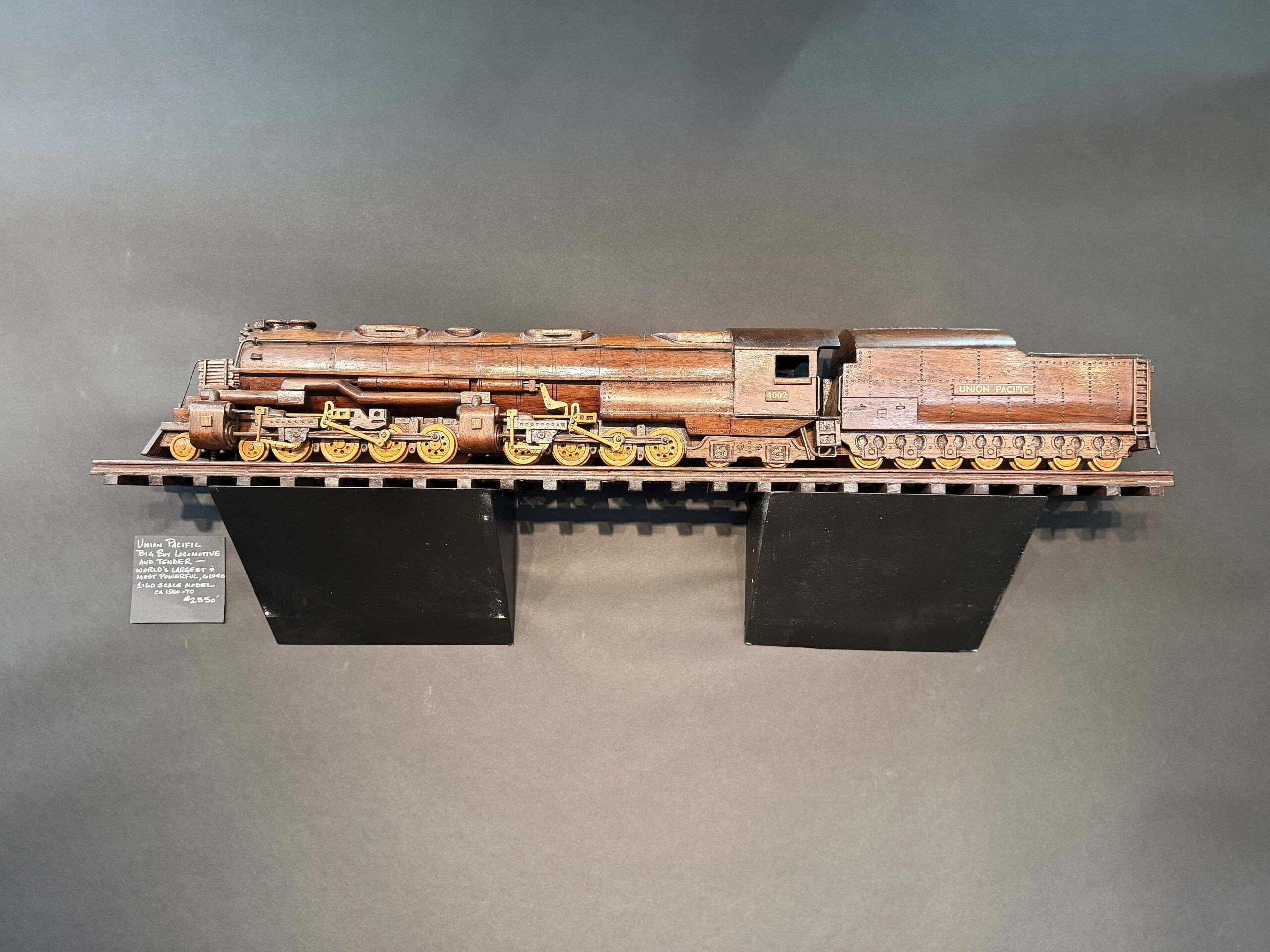
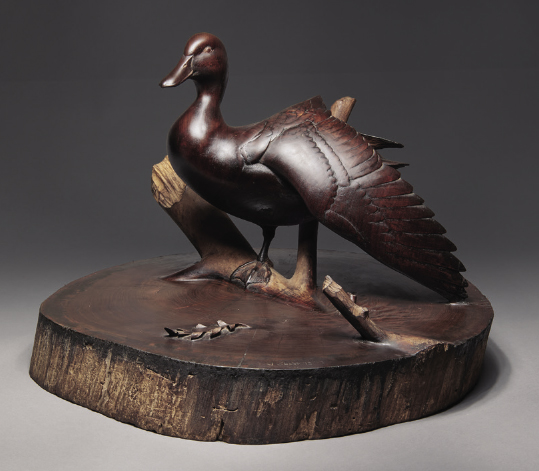
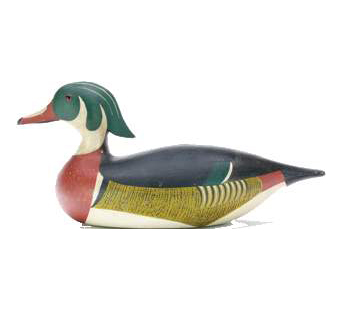
Nancy and Gene Pratt of Victor, N.Y., were happy to get up and lead us around their booth while telling us about Friday’s activity. “We had a very good day,” reported Gene. “We sold a carved eagle, a cherry Chippendale chest of drawers, duck decoys and pottery.” Nancy chimed in with a smile, “Also smalls… That’s the ticket!” However, the most unique item in the Pratts’ booth hadn’t sold just yet. Displayed on a floating shelf in the back of the booth was a wooden 1:60 scale model of the Union Pacific “Big Boy” locomotive, which, according to Gene, was “the world’s largest and most powerful” train circa 1940. This circa 1960-70 model was all hand-carved, down to the individual coals showing at the top of the coal car. “It’s really a beautiful thing,” added Gene.
Also with success across the board on Friday were Christopher and Bernadette Evans from Waynesboro, Penn. Christopher reported sales in stoneware, pottery and American folk art, all of which are his specialty. A standout item that he was hopeful an interested buyer would close on was a folky circa 1840 mahogany mirror with an eglomise panel of a yellow bird in a nest. “It’s a great little size and a good surface,” explained Chris. “The bird is almost certainly unique, as usually the panel depicts houses or churches.” Bernadette also pointed out two separate items which were paired together to sell, also matching the avian theme: an early Twentieth Century bird carving and a tramp art frame, both of which were almost the exact same shade of robin’s egg blue.
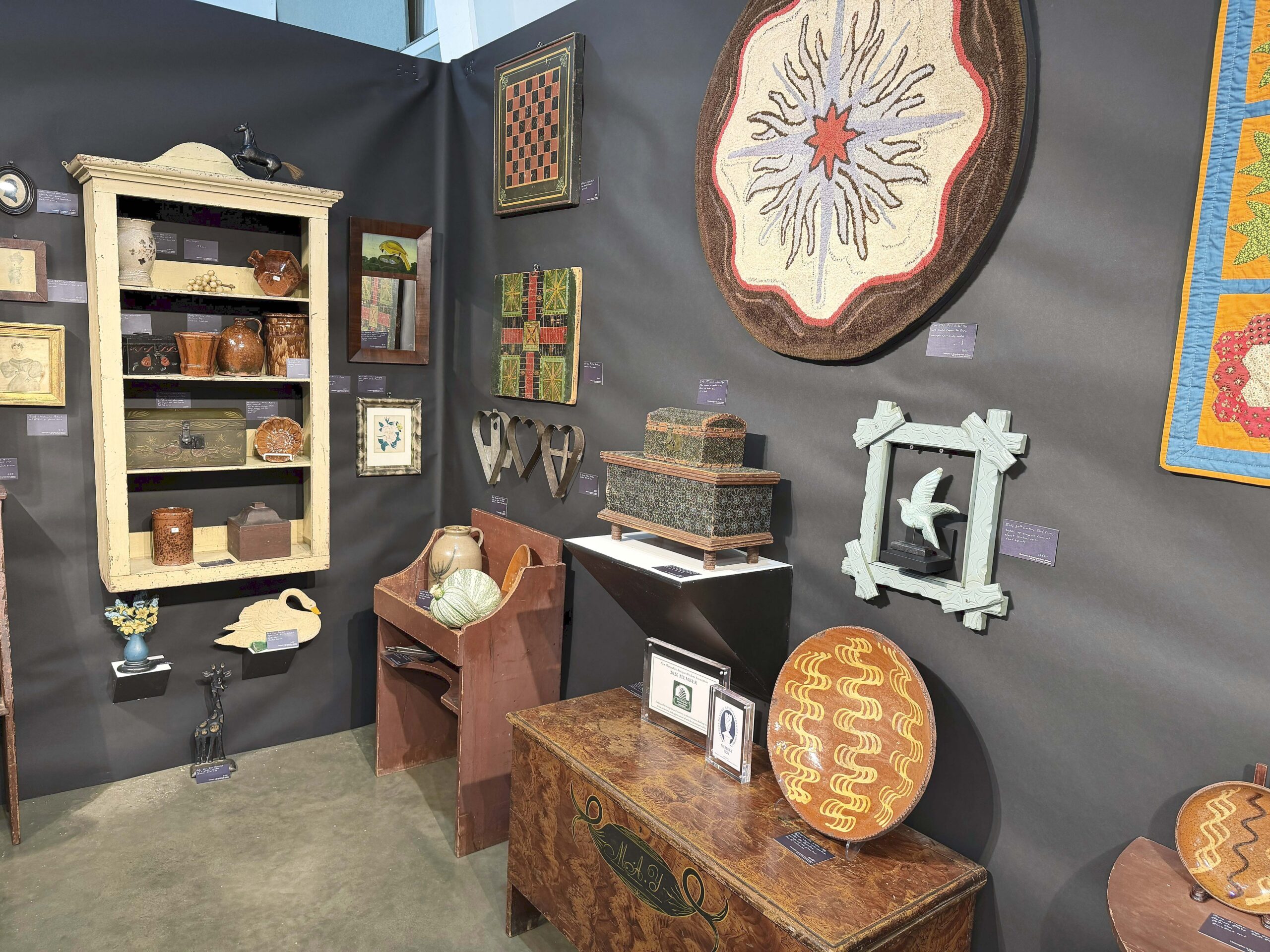
Christopher and Bernadette Evans sold well across the board on their first day and were most likely closing a sale on the “almost certainly unique” circa 1840 mahogany mirror with an eglomise panel depicting a yellow bird in a nest, on the lefthand wall toward the center of this image. Christopher & Bernadette Evans Antiques, Waynesboro, Penn.
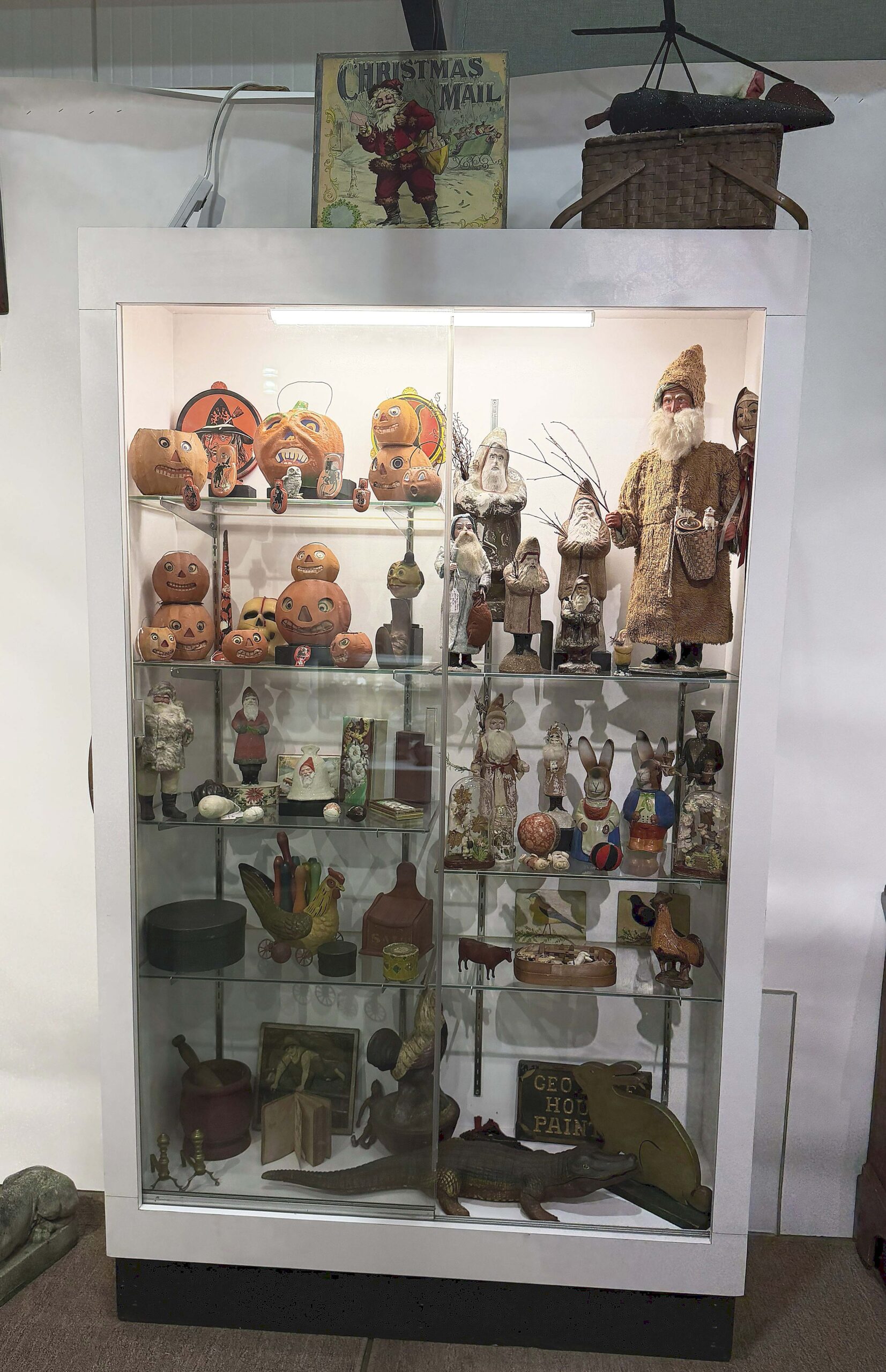
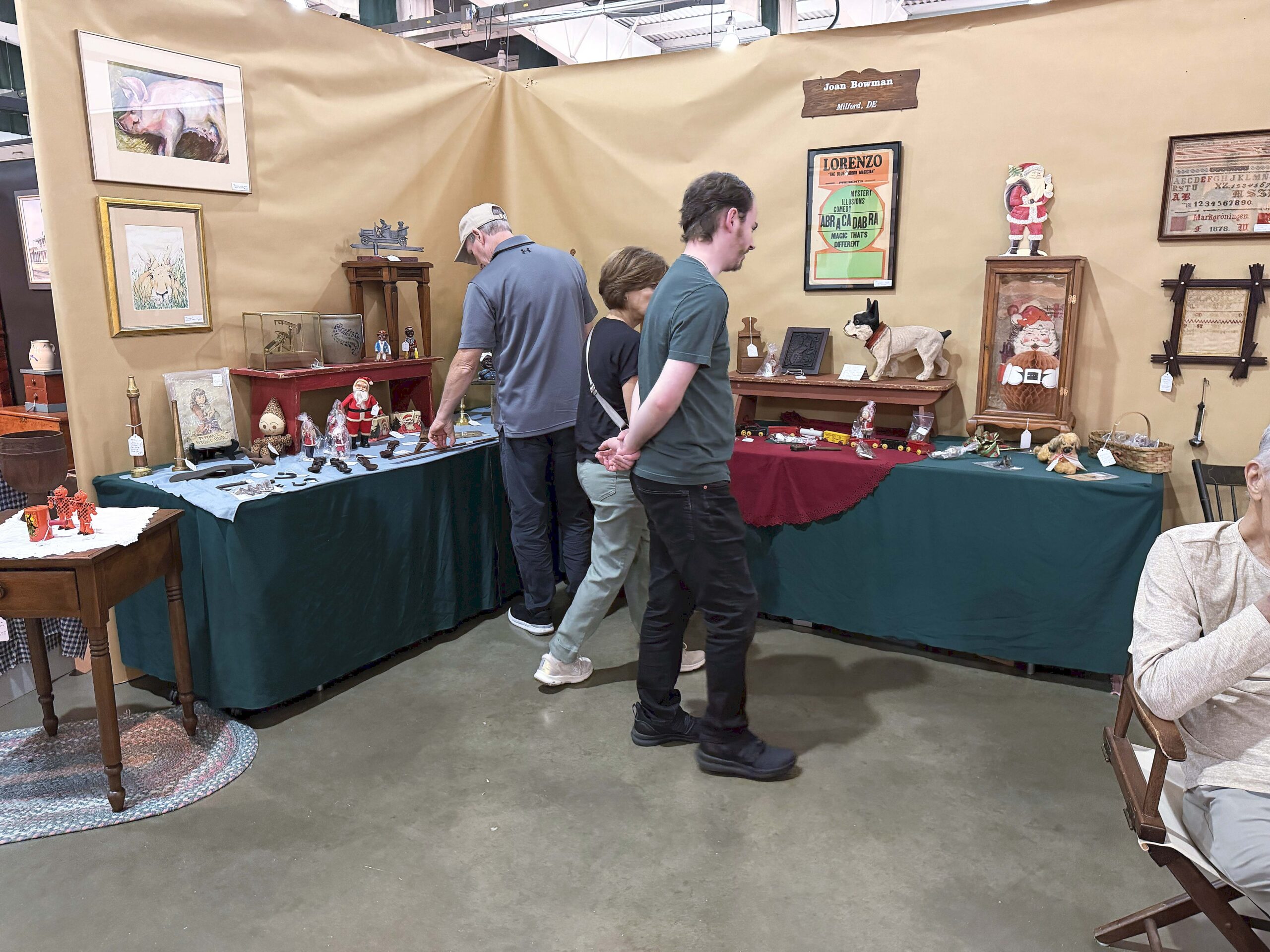
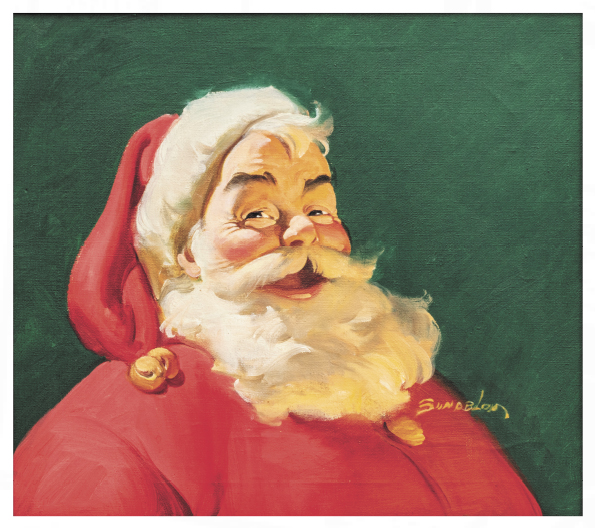
While inspecting a filled-to-the-brim display case full of vintage Christmas and Halloween items in the booth of Jewett-Berdan Antiques, co-owner Tom Jewett approached to share a few words: “We’ve been doing very good! We’ve been doing the show for more than 20 years, and we do it two times a year. We’ve also sold some things already, and it’s been a nice crowd.” Alongside the Christmas and Halloween material, which was very appropriately offered for the impending holiday season, Jewett shared that the company also specializes in folk art and decorated furniture, both of which were also offered in their booth.
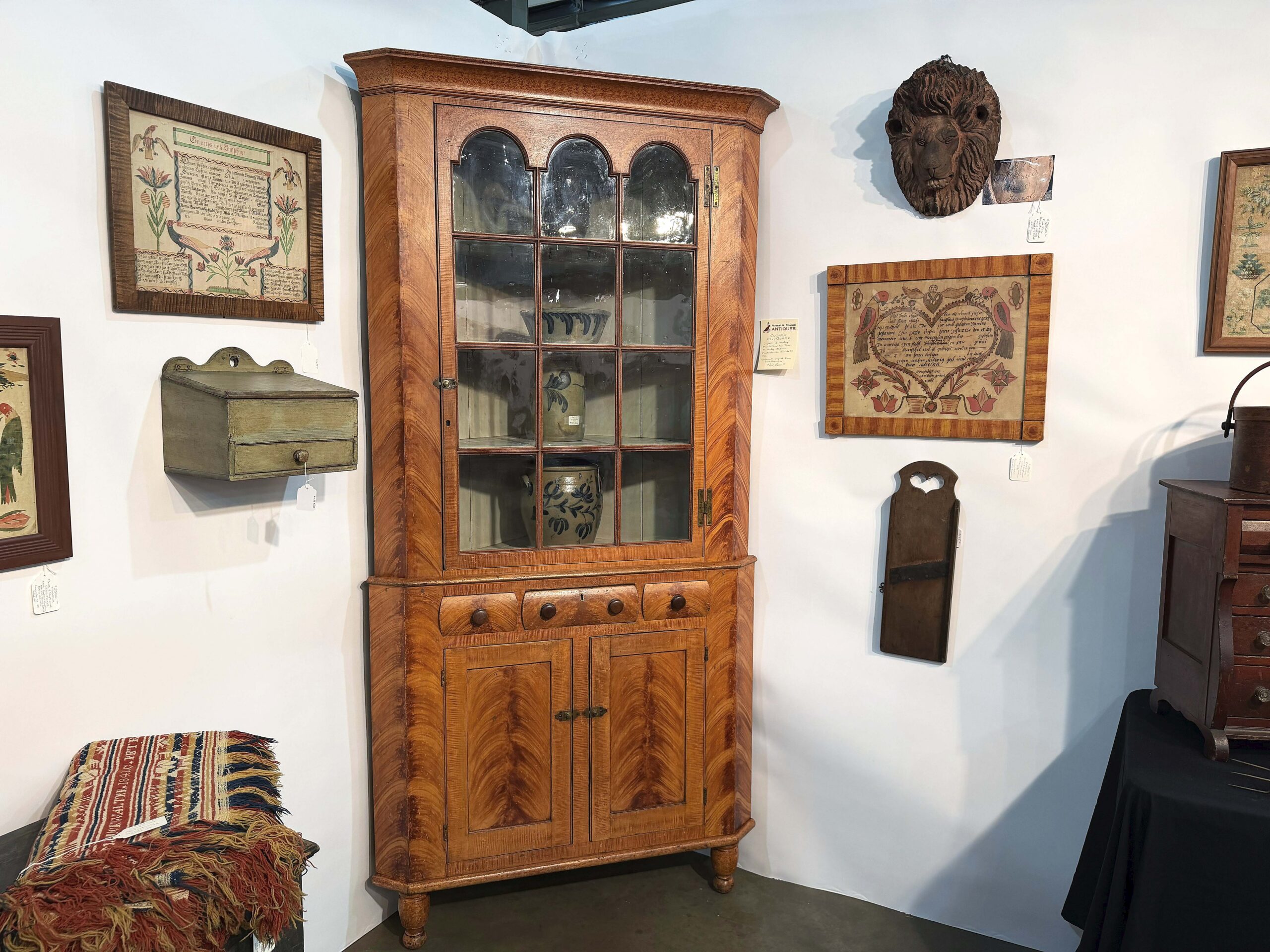
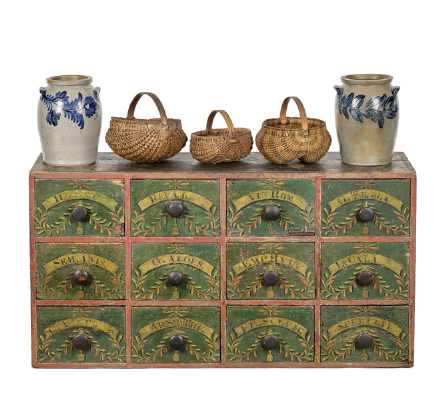
Specializing in fraktur, country furniture and folk art is Robert M. Conrad of Yeagertown, Penn. Conrad was particularly enthusiastic to tell us about a corner cupboard signed “J. Harley” after manufacturer Jonas M. Harley of Juniata, Penn. “He was a really great decorator, so it gives [the cupboard] that punch and exuberance,” he explained of its original paint decoration. In the fraktur department, this reporter was enraptured by a large-sized, heart-shaped birth and baptismal watercolor fraktur with angel and bird decorations made for Johannes Stitzer in 1751 which was signed by the artist, Christian Grunewald.
Our last stop in the main hall was at the booth of Daniel and Karen Olson of Newburgh, N.Y. Karen immediately jumped into a conversation with us about a safe basket with its original royal blue paint, which was “purchased in America, but is unique in that it is the only object here not made in America: it was actually made in Norway!” She also pointed out a chair-table — a table whose surface flips up to reveal a chair as its “base” and “legs” — which had a 60-inch diameter and all original surface.
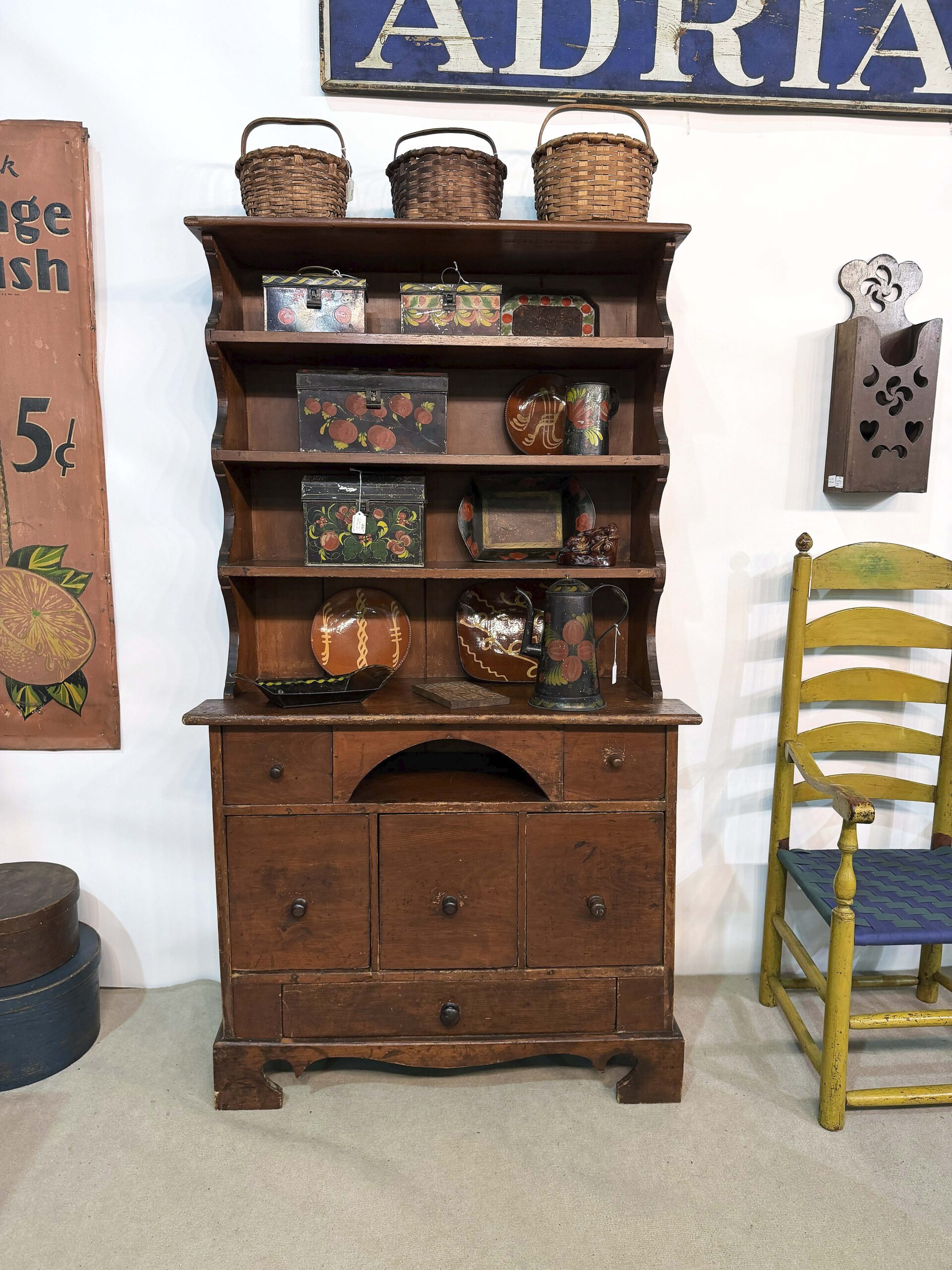
“I was hoping it wouldn’t sell!” said Karen Olson of this cupboard, which was flagged as “unusual” due to its built-in pie shelf and multiple drawers. It paired nicely with the hand-painted tins decorating its shelves, which were dated from 1800-60. Daniel & Karen Olson, Newburgh, N.Y.
As for the previous day’s happenings, Karen reported that things were “good!” That good fortune bled into Saturday, where she had already sold a cupboard, a few tables and a royal blue wall shelf. Of the cupboard, Olson said that it was unique in that it contained not only a built-in pie shelf, but that its bottom half included several handled drawers, instead of the typical two-doored cabinet. “I was hoping it wouldn’t sell! I had plans for it in my house,” she confessed, with a laugh. “Oh well, I’ll have a check instead!” The cupboard was paired nicely with an array of hand-painted tin boxes, which were all made between 1800-1860.
The dates for the 188th Semi-Annual York Antiques Show & Sale in January are forthcoming. For information, www.theoriginalyorkantiquesshow.com or 302-542-3286.