PORTSMOUTH, N.H. — The most ambitious display of Edmund C. Tarbell’s work in a decade runs through June 3, filling the first floor of Discover Portsmouth’s Academy Gallery in a beautifully restored 1810-era building. “Illuminating Tarbell: Life and Art on the Piscataqua” is a unique two-part show, with the largest local gathering of Tarbell’s original work, plus a companion gallery featuring the work of six contemporary artists painting in the Tarbell style. The dual exhibit also includes a lecture series, a 72-page color catalog and a re-creation of Tarbell’s seaside New Castle, N.H., studio.
The show features nearly 60 works from the artist’s 30 years of living in New England and along the Piscataqua River. Many works depict Tarbell’s family and home, their friends, clients, even horses, as well as the river and the surrounding landscape. The exhibit and accompanying catalog also document Tarbell’s life and art with family photographs, personal letters and ephemera. A meticulous reconstruction of his studio includes family furniture and studio props.
The exhibit is based on new research into the holdings of the Tarbell Charitable Trust and other sources. The trust has the largest single collection of Tarbell’s works, several of which it has loaned to various museums. The exhibit includes several of Tarbell’s most important paintings, some of which have never been published, and the exhibit displays four works that were received too late to be included in the catalog. Jeremy Fogg, an art conservator based in York, Maine, is the curator of the exhibit. Both he and artist Christopher Volpe contributed to the catalog of this exhibit.
Alistair Dacey, a painter who had rented an apartment in what had been the Tarbell home in nearby New Castle, prepared the catalog entries for “Legacy in Action,” devoted to the six contemporary artists who might be called members of the “modern Tarbell School.” (Dacey lost many of his personal belongings when the home in which Tarbell and his family lived for more than 30 years was destroyed by fire on January 23, 2016.) Fogg’s experience conserving several of Tarbell’s paintings provided him with particular insight into Tarbell’s techniques and the materials he used.
Edmund Tarbell (1862–1938), was an American Impressionist painter and a leader of what came to be known as the “Boston School.” His works hang in Boston’s Museum of Fine Arts, the National Gallery of Art, the Corcoran Gallery, Worcester Art Museum and numerous other public and private collections. He studied at the School of the Museum of Fine Arts, Boston, beginning in 1879 and later, in 1883, in Paris. In 1884 and 1885 he made a Grand Tour trip through Europe, including Italy, Belgium and Germany, among other countries.
He returned to Boston in 1886 and began his career as an illustrator and portrait painter. In 1889, Tarbell became an instructor at the School of the Museum of Fine Arts, where he had been a student. He was a popular teacher, influencing a group of young painters who became known as the “Tarbellites.” Tarbell and friends Frank Weston Benson and William McGregor Paxton developed their own style of painting, which became known as the above-mentioned Boston School. All three men had been trained in Paris and all three taught at School of the Museum of Fine Arts.
Although classified as American Impressionists, they synthesized their own regional style, combining Impressionism with a more conservative approach to figure painting. Major influences on this group included John Singer Sargent, Claude Monet and Jan Vermeer. Their subject matter of choice included portraits, landscapes and genteel young women posing in well-appointed interiors. Many of Tarbell’s works reflect these themes. This style of painting remained popular for the first three decades of the Twentieth Century.
He married in 1888 and for several years rented summer cottages along the New England coast. In 1905, he and his wife, Emeline, bought the home in New Castle where he would work for the next 30 years and where they raised their family. The home was expanded over the years, and outbuildings, such as a stable, were added. Tarbell was a proponent of the Colonial Revival movement and collected American antiques along with Chinese ceramics and Japanese prints.
He also salvaged, and used, architectural remnants from nearby homes, including a Georgian mantelpiece attributed to one of Portsmouth’s best known early carvers, Ebenezer Dearing. Many of these objects were used as props in his paintings, and several objects from his collections are included in this exhibit. Tarbell built his studio on the banks of the Piscataqua River and, through a wall of glass in the studio, was able to sketch sailboats and other activity in the busy waterway, with ships heading between Portsmouth and the ocean.
Tarbell’s studio is re-created in this exhibit. The exact date in which the studio was built is uncertain, but it was established by 1907, two years after the Tarbells bought the property. It was a basic building with bare, exposed walls and only a small woodstove for heat. When the home became the family’s year-round residence, the studio was in use in all seasons, save for the times when it was too cold to paint. Surviving letters to Tarbell’s daughter, Josephine, sometimes noted that it was “too cold to paint in the studio today” and that he had to take his work up to the house. The studio re-creation features bare walls, a late Nineteenth Century easel with a portrait of his daughter, “Mary Tarbell in A Black Hat,” a large sketch of horses and props the artist had collected, including a Sheraton settee.
Judy Loto, the Portsmouth Historical Society’s director of development, said, “I love the studio set-up. It brings you deeper into the artist’s world and provides context for the man and his work.” It was in this studio that Tarbell painted some of his most renowned paintings and commissions. The artist remained active up to the time of his death, in 1938, leaving several unfinished works when he passed away.
In addition to the finished paintings on display, this exhibit includes several sketches and studies the artist prepared before starting on what would become the final work, including a group of three oil studies that have never been on display before. Having descended in the artist’s family, they had been found, rolled up along with two others, in the artist’s studio after his death. They were conserved and prepared specifically for this exhibit. These studies were done in preparation for a portrait of Mr and Mrs Frederick Prince of Newport, R.I., in which Mr Prince is depicted seated atop his favorite horse and his wife stands beside him.
The studies, together with photographs used by Tarbell, provide a glimpse of the artist’s process from concept to completion. The painting, purportedly 125 by 141 inches, was probably the largest portrait Tarbell ever did. The present whereabouts of the painting, known only through photographs, is unknown.
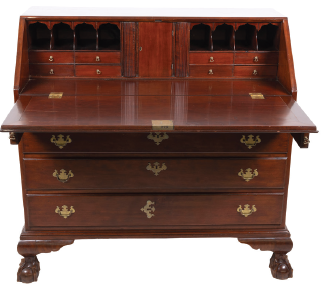
Tarbell often took photographs of his subjects, which he used as aids while he was painting, and several are on display. Also on display are personal letters, along with several items he collected, including a serpentine, claw and ball foot desk and an early drop leaf table, along with his spectacles, a traveling paint box, brushes and other items.
As Tarbell matured, his style of painting began to shift away from the early en plein air Impressionistic manner toward Realism and a focus on the domestic interior. His compositions were likely influenced by the Dutch painters of the Seventeenth Century whose works he had been exposed to when traveling in Europe. These later works were inspired by his family, home and coastal surroundings.
During his career, he received portrait commissions from some of the wealthiest and most influential men of his day, including Henry Clay Frick, Woodrow Wilson, Calvin Coolidge and Herbert Hoover, among many others. He received $2,500, a handsome sum in those days, for his 1908 portrait of neurosurgeon Dr Harvey Cushing. The Cushing family summered in nearby Little Boar’s Head, and it is likely the two men knew each other. For this portrait, Tarbell relied heavily on photographs taken during one of Cushing’s studio sittings.
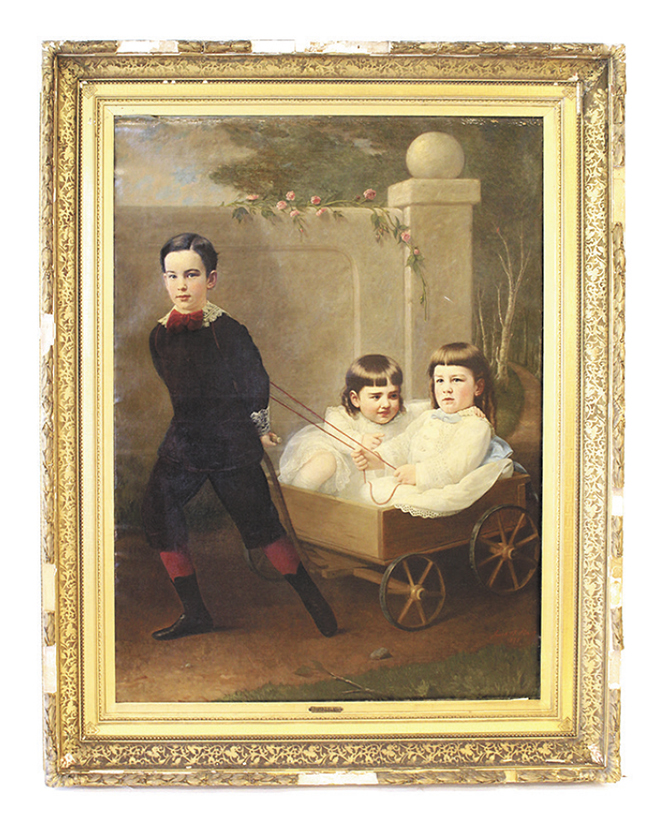
An 1891 portrait of Tarbell’s 19-year-old sister-in-law, Lydia Brooke Souther, illustrates Tarbell’s early Impressionistic style. The painting was titled “An Opal, A Study of Yellow and White Light.” Tarbell explained that the “picture was painted for the study of different kinds of light.” Emeline and Lydia were two of Tarbell’s more frequently used models. He painted a portrait of Emeline in a garden, sometime between 1884 and 1888, and she appears in “My Family at Cotuit,” circa 1900, along with the couple’s four young children. Josephine, the oldest daughter, recalls, “We often posed for father and enjoyed doing this for him because he was so good to us and we wanted to show our appreciation.”
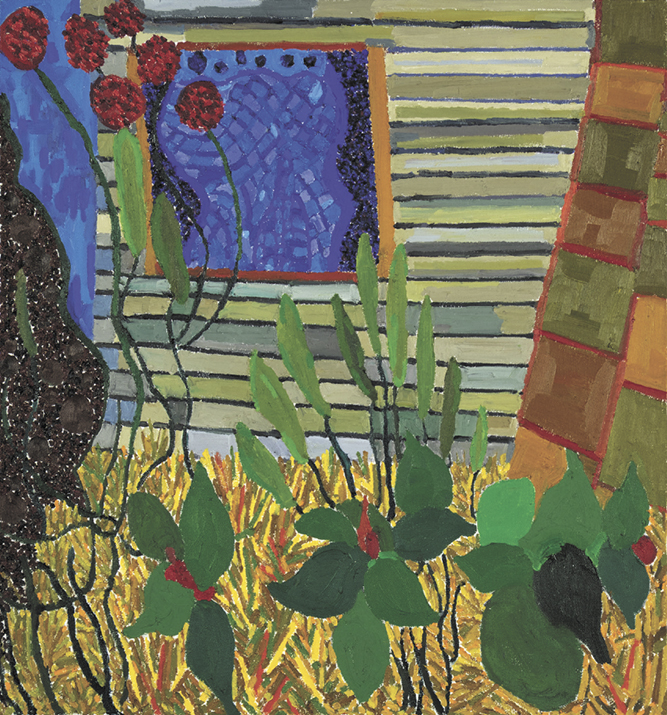
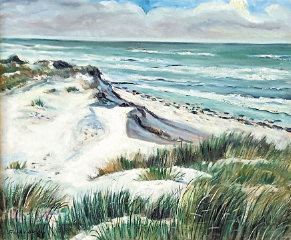
The second part of the exhibit, “Legacy in Action,” showcases close to 50 works of six contemporary artists who have been influenced by Tarbell — Don Demers, Paul Ingbretson, Jean Lightman, Mary Minifie, Colin Page and Alastair Dacey. Each is a nationally recognized artist and each works in the Piscataqua region today. The catalog includes biographies of the artists and an essay by Dacey, making the case for Tarbell’s ongoing influence as a painter and teacher.
With regard to how the exhibit came about, guest curator Fogg said, “I’ve been a conservator for about 12 years, and I’ve worked on a number of Tarbells during that period. When Daniel Tarbell, the artist’s grandson, died in 2003, his will set up the Tarbell Charitable Trust. He had several paintings, family photographs and other memorabilia, most of which had never been seen by the public, and he gave everything to the trust. The trust was set up to promote the Tarbell legacy and is actually sort of a lending library for the paintings. Some of the things Daniel had ended up with me for conservation and that gave me the idea for doing a small show, concentrating on the New Castle years.
“I mentioned the idea to Richard Candee — past president of the Portsmouth Historical Society — and he gave me the go-ahead,” Fogg continued. “I contacted the trust and they were very supportive, lending several paintings, photographs and personal things, and they agreed to fund the catalog as well. I tried to track down the large Prince portrait but was not able to locate it, which is unfortunate. We contacted a number of private collectors who had works by Tarbell and all agreed to lend their paintings. So it just sort of grew and grew. I wanted to do more than just show the paintings. I wanted to convey a feeling of the man, the family and how he worked. I think we’ve done that. I was able to use longer descriptive panels than are normally used when museums do exhibitions, and that really let us tell more of the story. Working with the trust and family members to uncover bits and pieces was really a lot of fun for me.”
A future exhibit, now in the planning stages, will be called “Odd and Elegant” and will showcase selected objects from the collection of the Portsmouth Historical Society, which operates Discover Portsmouth and the 1758 John Paul Jones house, the society’s museum of Portsmouth history.
A fully illustrated catalog, published by the organization’s Portsmouth Marine Society Press, contains essays by curators Fogg and Dacey and features an introduction by Susan Strickler, director of the Currier Museum of Art in Manchester, N.H., and a new study of Tarbell’s life in New Castle by artist Christopher Volpe. Illuminating Tarbell, available from the Portsmouth Historical Society, is 8¼ by 9 inches, 79 pages, with 111 color and black and white illustrations. It sells for $29.95.
Discover Portsmouth Center is at 10 Middle Street. For information, 603-436-8433 or www.portsmouthhistory.org.