By Stephen May
SAN FRANCISCO, CALIF. — The 1906 earthquake and resulting fires that devastated San Francisco did not derail the city’s plans, begun in 1904, to host a World’s Fair that would showcase American and European art and celebrate the projected completion of the Panama Canal.
Held in 1915, the event was formally called the Panama-Pacific International Exposition (PPIE). The onset of World War I presented challenges for many European nations, which, with the notable exception of France, were forced to bow out. Nevertheless, the fair was described as “a stunning success.”
A new exhibition revisiting the exposition on the occasion of its 100th anniversary, “Jewel City: Art From San Francisco’s Panama-Pacific International Exposition,” was organized by the Fine Arts Museums of San Francisco under the leadership of curator James A. Ganz. It is on view at the de Young Museum through January 10.
The artistic goals of the PPIE were ambitious and wide ranging, featuring an array of public murals spread throughout the grounds; the Palace of Fine Arts and its nearby Annex, which together comprised 150 galleries of paintings, sculptures and prints; and the French Pavilion devoted to French and Belgian art.
An impressive 19 million visitors visited PPIE, which featured more than 10,000 works of art that ranged from the classically beautiful to the shockingly modern.
PPIE’s 635 acres of colorful attractions celebrated science, technology, industry, culture and education, and included a grand display of architectural and horticultural splendors. They were described as “dazzling, color-coordinated” — and were marketed as the “Jewel City.” In addition to artworks selected by the exposition’s regional juries, the Palace of Fine Arts surveyed American painting from the Eighteenth Century to 1915.
The official poster by Perham William Nahl shows “The Thirteenth Labor of Hercules,” a color lithograph in which Hercules appears to muscle apart two solid rocks, opening up a view of the distant PPIE.
The centerpiece of the buildings on the grounds was the Palace of Fine Arts, designed by California architect Bernard Maybank on the edge of a lagoon. The massive octagonal rotunda was flanked by two huge, detached colonnades and was particularly spectacular when lit at night. The domed structure was festooned with sculptured niches, Roman urns and Corinthian columns. The structure cost a then-astounding $15 million.
The crowded galleries were installed salon style, in part due to an overabundance of domestic art accepted when it appeared that European participation might not materialize because of the war.
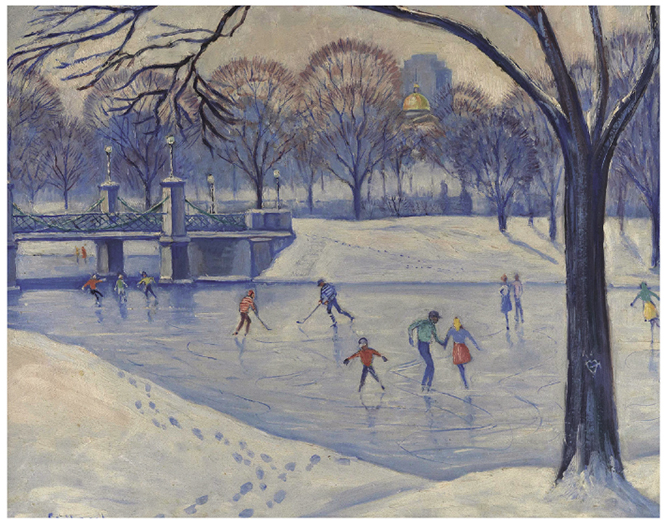
Impressionism reigned supreme in PPIE’s American galleries, reflecting its popularity nationwide. The work emphasized color, light and broken brushwork, with significant individual and regional variations. At the time, Impressionism was practiced in most major cities, as well as smaller art colonies across the nation from Old Lyme, Conn., to the Monterey Peninsula in California.
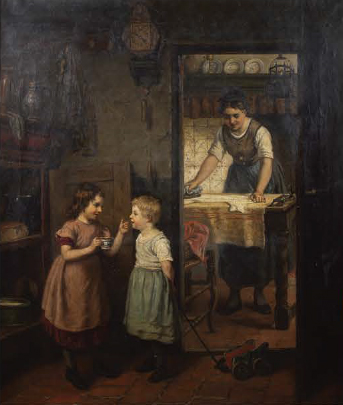
Many established leaders of the American art world, including William Merritt Chase, Frank Duveneck, Winslow Homer, George Inness, William Keith, Edward W. Redfield, Augustus Saint-Gaudens, John Singer Sargent and John Henry Twachtman, were allocated solo galleries to display their work. Seven of Cecelia Beaux’s paintings were exhibited in the “women’s gallery.” Sargent’s “Reconnoitering (Portrait of Ambrogio Raffele)” and “The Sketchers” attracted a lot of attention. The American galleries were a colorful feast for the eyes, with interesting juxtapositions underscoring the richness and vitality of the domestic art scene.
Also significantly represented were Impressionist paintings by Americans living abroad, including those who spent time in Giverny, forming an expatriate art colony, and Americans who sought guidance from the world’s leading Impressionist painter, Claude Monet. Theodore Robinson, who was close to Monet, weighed in with a panoramic view from a hillside, where a young woman reads a book, in “The Valley of Arconville.”
Most medals were awarded to American Impressionists, as was the grand prize for painting, which went to Frederick Carl Frieseke, who spent considerable time in Giverny.
Although the fair sought to promote the economic and cultural vitally of the far West, the selection of works in the Palace of Fine Arts in general reflected the prevailing taste of the East Coast establishment. Arthur Mathews, Francis McComas and Arthur Putnam were among the few California artists represented by a significant number of works.
The absence of a separate California gallery looked to some in the local art community as a rejection of their work by PPIE’s organizers and led to their organizing an alternative exhibition at the Memorial Museum (today’s de Young Museum) in Golden Gate Park. A few leading San Francisco artists, such as Charles Rollo Peters, shunned the Palace of Fine Arts exhibition and displayed works only at the Memorial Museum.
Positioned alongside carefully selected works that represented a broad spectrum of traditional American art were paintings expressing a healthy brand of Modernism. Arthur B. Carles, William Glackens and John Sloan were cited as exemplars of modern trends or, as one critic wrote, the “independents and extremists in American art.” In spite of the fact that these works were painted in academic and Impressionist manners, one gallery was described by an observer as a “Chamber of Horrors.” This kind of derogatory language served to strengthen a sense of national pride by drawing attention to American artists whose bold experiments could hold their own alongside those of Europeans.
Following precedents set in previous World’s Fairs, PPIE organizers assigned photography to the more broadly inclusive Liberal Arts section rather than to the Palace of Fine Arts. This decision was based in part on the prevailing view that the technologically based medium of photography was less valid as an art form than painting, sculpture and prints. This snub rankled influential photographers, such as champion of fine art photography Alfred Stieglitz, who declined to participate. Nevertheless, the Pictorial Gallery displayed a strong cross-section of recent American work, particularly by West Coast cameramen and women.
According to curator Ganz, the PPIE “offered an overwhelming variety of educational, technological, scientific and commercial applications of photography, a microcosm of a medium well on its way to becoming a universal aspect of modern life, while it also stubbornly asserted photography’s place in the art world.”
The crowded gallery included 148 photos by 47 artists, among them William Edward Dassonville’s poetic “Figure Study,” showing a black-clad woman gazing intently at a large pearl that she cradles in her hand. Among other photographers represented were Alfred Langdon Coburn, Imogen Cunningham, Edward Weston and Clarence H. White. Winner of the grand prize was Oakland photographer Anne Brigman, already a nationally acclaimed figure.
Undeterred by the war, France organized a generous array of artistic treasures that sought to document the supremacy of French art on the world stage. Within the Palace of Fine Arts, French work was shown in a suite of seven galleries devoted to the official French section — 300 contemporary artworks chosen by a jury in Paris. Additional works were displayed in the French Pavilion, a replica of the Palais de la Legion d’Honneur in Paris, and one of the most sumptuous foreign buildings. Its galleries contained some 90 paintings and sculptures from the Musee du Luxembourg..
San Francisco patron of the arts Alma de Bretteville Spreckels loaned several Augustus Rodin sculptures, including “The Thinker.” The French Pavilion inspired Spreckels to create a permanent museum, the Legion of Honor, to house her Rodin collection and other works.
To accommodate the rejuvenated international section, an additional two-story Annex with 30 more galleries was hastily constructed near the Palace of Fine Arts. As exhibition organizers observed, the Annex “gave fairgoers strolling over from the Palace of Fine Arts a jolt.” Compared to the relative conservatism of the offerings next door, the Annex contained what was called “an eyeful of challenging contemporary art that was unfamiliar to most Americans,” notably Austrian Expressionism, Hungarian Modernism and especially Italian Futurism.
In the century between PPIE and today, the ambitious and successful fair has gradually slipped into the shadows, rarely mentioned in art histories. It is largely recognized for the significant boost it gave to San Francisco’s cultural life. That may be reward enough, but in hindsight it seems clear that PPIE’s artwork contained stunning, even iconic, paintings that have stood the test of time. Kudos to the organizers of “Jewel City” for reminding us of the enduring importance of PPIE to the advancement of American art and promoting San Francisco as the hub of West Coast art.
The lavishly illustrated exhibition catalog, containing useful essays by Ganz and other scholars, will serve as the authoritative text on the PPIE for many years. Published by the Fine Arts Museums of San Francisco and the University of California Press, it sells for $75, hardcover, and $49.95, softcover.
The de Young Museum is at 50 Hagiwara Tea Garden Drive in Golden Gate Park. For additional information, www.deyoungmuseum.org/jewelcity or 415-75-3600.