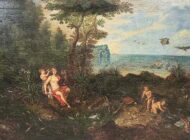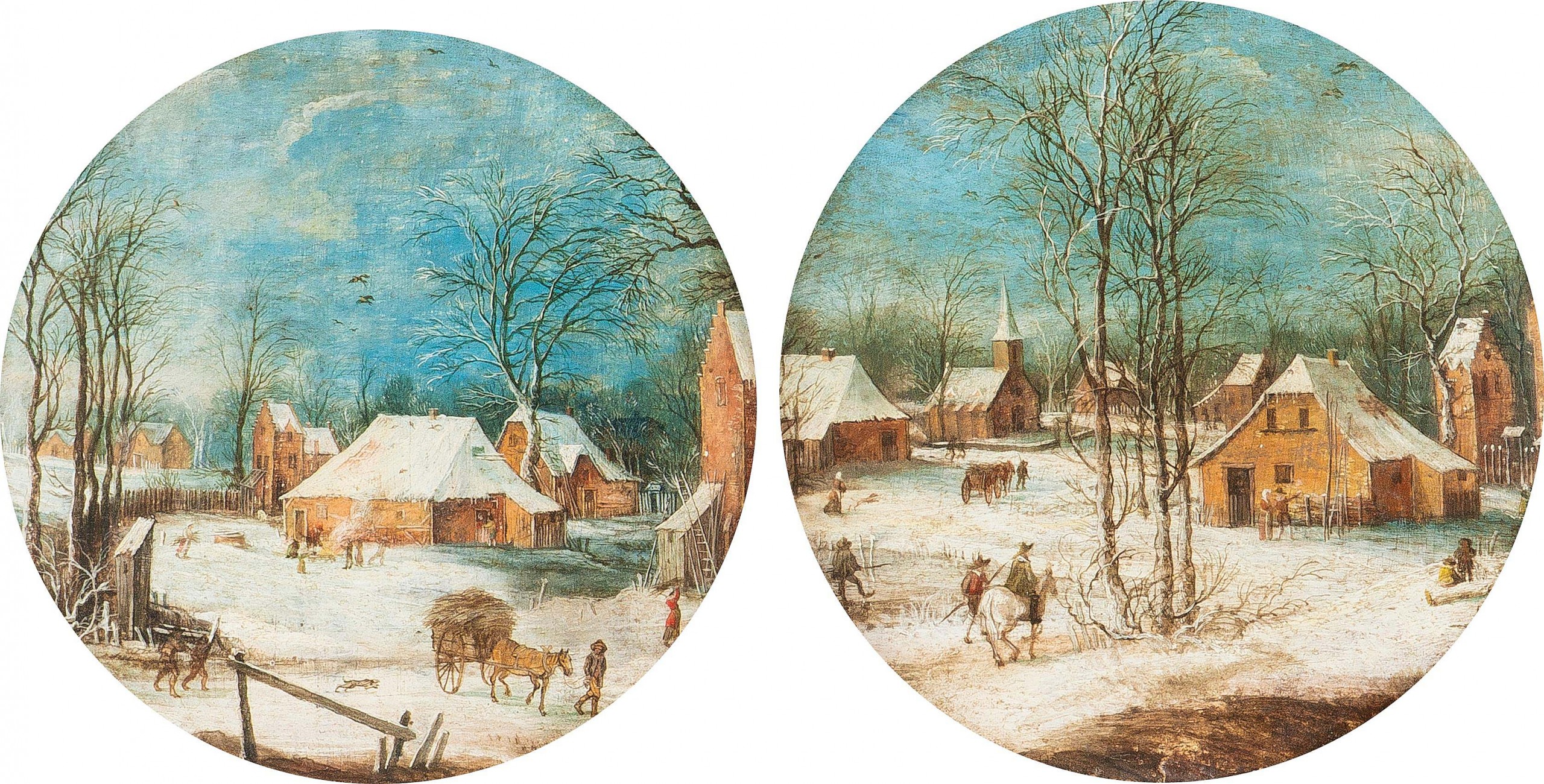
This pair of winter village landscapes framed in tondo, attributed to Joos de Momper the Younger and Jan Brueghel the Younger, oil on canvas, about 5¾ inches in diameter, earned top-lot status at $22,035, heading home with an Austrian internet bidder (€500-€1,000).
Review by Kiersten Busch
DÜSSELDORF, GERMANY — Hargesheimer Kunstauktionen Düsseldorf conducted its Sculptures | Old Master Paintings auction on March 14, offering 626 lots spanning various artistic categories, including sculpture, painting, prints, drawings, books and manuscripts and furniture.
Leading the day and besting its high estimate of about $1,148 was a pair of oil on copper plate paintings of winter village landscapes framed in tondo, attributed to both Joos de Momper the Younger and Jan Brueghel the Younger. Both depicting rural activities, the paintings were reminiscent of other examples of the two artists’ work due to their “calm, balanced composition, in which the pictorial space is led into the distance by staggered buildings and groups of trees,” according to catalog notes. With provenance to a private collection in Hesse, Germany, the pair were won by an Austrian buyer bidding online, who collected the paintings for $22,035.
The second-highest price of the sale went to “La Belle Ferronnière,” an oil on canvas portrait of a woman attributed to a follower of Leonardo Da Vinci, most likely from the Seventeenth or Eighteenth Century, which sold to an internet buyer from Switzerland for $16,217. In addition to provenance to a Rhenish private collection, affixed to the reverse of the work was an old paper inventory label marked “Wallraf-Richartz-Museum, Gemälde-Inventar 1925 No. 694” for a museum located in Cologne, Germany.
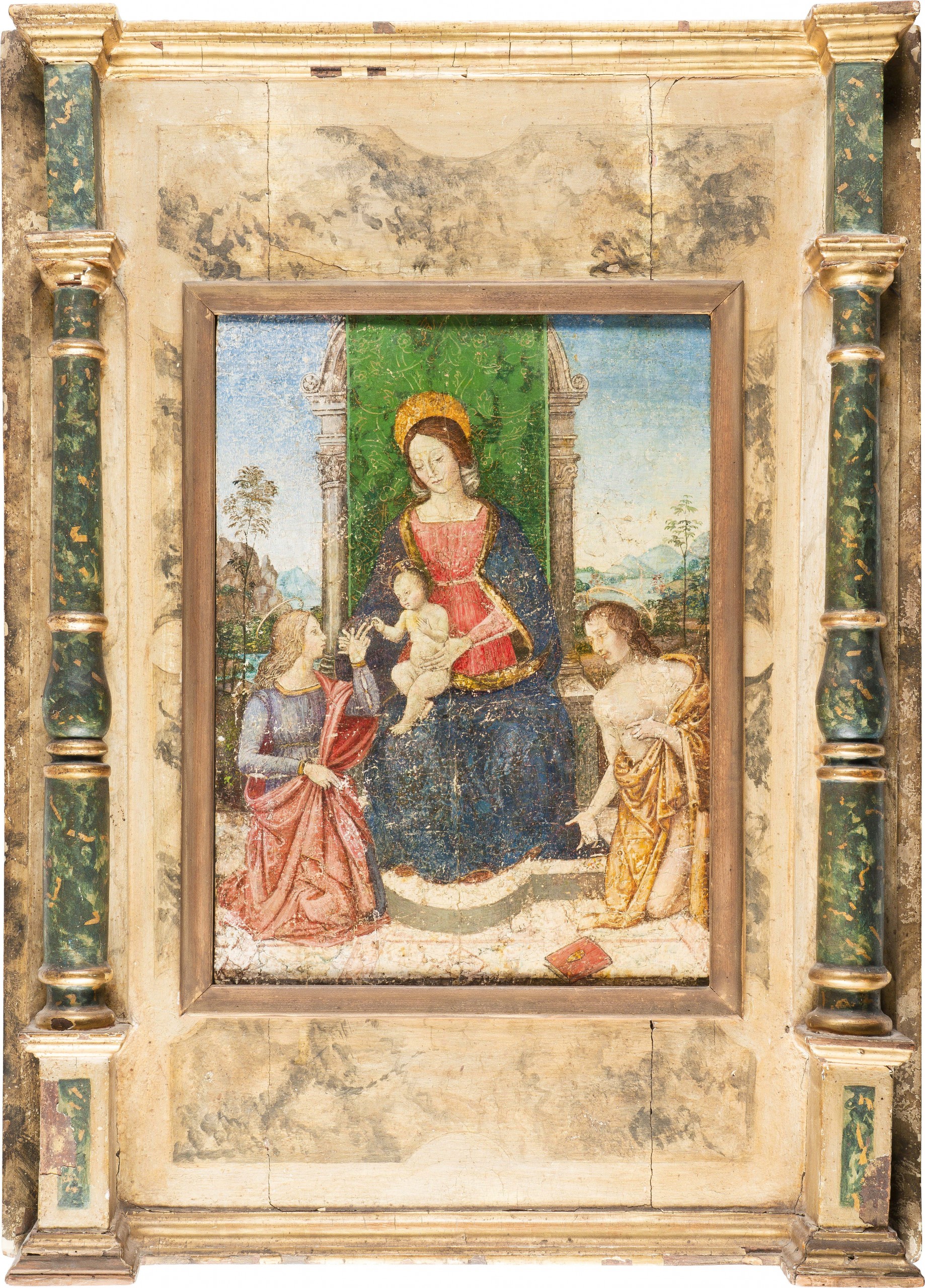
Attributed to Pietro Perugino or his circle was this tempera on poplar panel portrait of the Madonna and Child flanked by John the Baptist and St Catherine, 87½ by 65 centimeters, which sold to an Austrian buyer online for $16,217 (€8/16,000).
Next was a tempera on poplar panel portrait of the Madonna and Child, flanked on the right by John the Baptist and on the left by St Catherine. The auction catalog described the work as thus: “The gently idealized faces, Mary’s lowered gaze, as well as the harmonious colors and clear arrangement of the figures are closely stylistically related to the Umbrian-Florentine Early Renaissance and, in particular, to the work of Pietro Perugino and his circle. The painting conveys a timeless, contemplative devotion and follows the classical type of Sacra Conversazione, in which Catherine of Alexandria, as a symbol of her spiritual bond with God, offers a ring to the Christ Child or receives one from him.” Like the top lot, this painting also sold to an internet buyer from Austria, realizing $16,217, landing near the higher end of its estimate (€8/16,000).
Two works from the Flemish School both sold separately for the same price — $11,794. The first, a triptych titled “The Crucifixion, The Carrying of The Cross and The Resurrection of Christ,” was done in oil on oak and also had provenance to the Wallraf-Richartz Museum in Cologne, similar to “La Belle Ferronnière.” It will be heading to the Netherlands, thanks to a written-bid buyer. The second work also sold via written bid and will head off to Spain. Depicting The Nativity of Christ, the oil on oak panel was done sometime in the Sixteenth Century and contained a metal plaque on the front of its frame that read “Maerten v. Heemskerk 1498-1575,” signifying the painter’s identity. On the back of the frame, an old paper label described the artist and his numerous works in more detail. An excerpt from the label explained, “Heemskerk, Marten Jacobsz. (1498-1574), Dutch painter, sometimes called Van Veen, was born at Heemskerk in Holland in 1498, and apprenticed by his father, a small farmer, to Cornelisz Williamsz, a painter at Haarlem.”
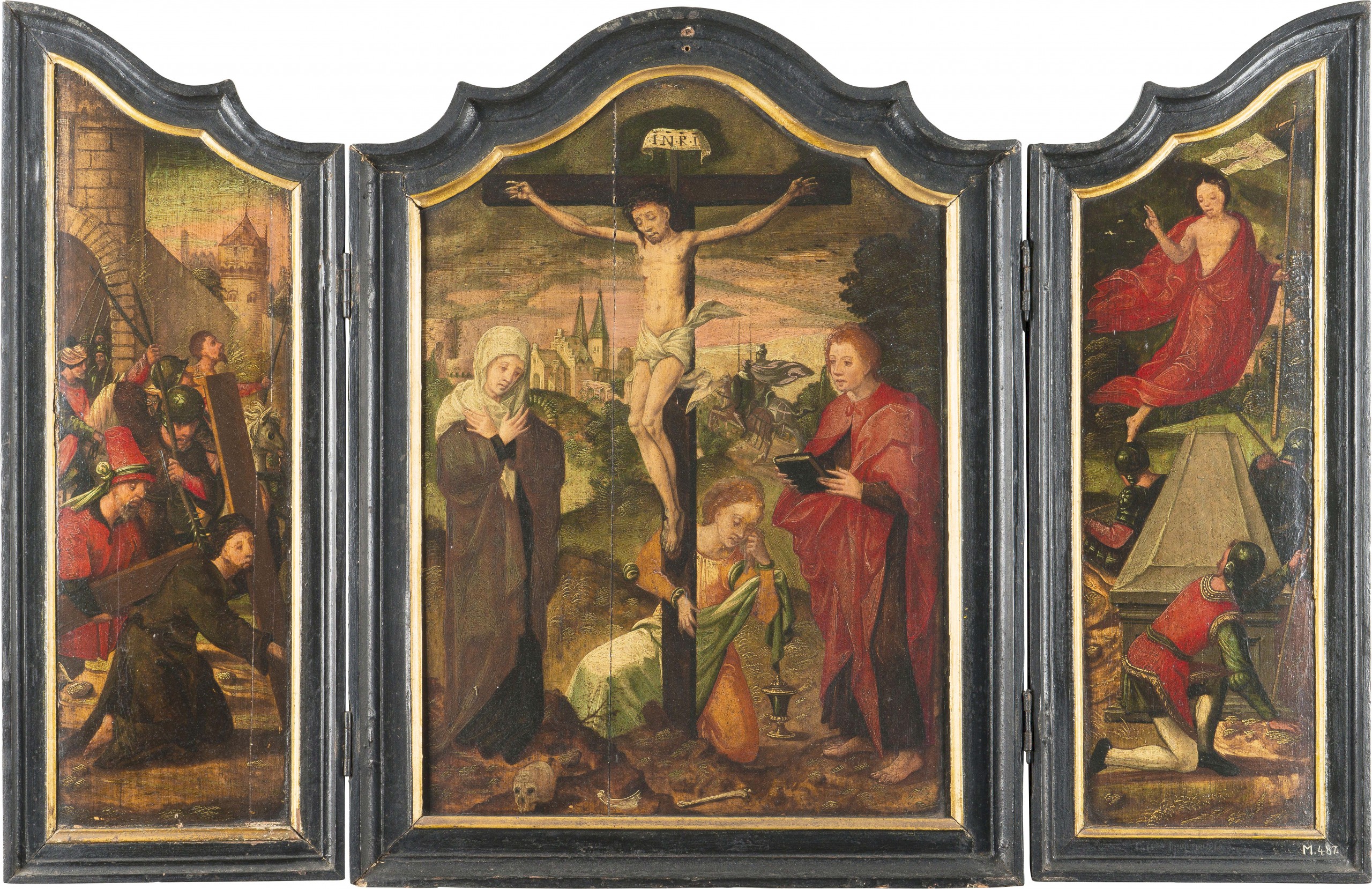
Measuring about 25⅜ by 39 inches fully opened, this oil on oak triptych by a member of the Flemish School, titled “The Crucifixion, The Carrying of The Cross and The Resurrection of Christ,” landed within estimate for $11,794 (€7/14,000).
A pair of portraits by an artist in the Southern German School of the Eighteenth Century will remain in Germany thanks to a telephone bidder who paid $7,371. The two counterparts, “Allegory of Spring” and “Allegory of Autumn” were completed circa 1760-80 and made with gouache on paper. They were identically framed in their original frames and had provenance to a private collection from Rhineland and a September 2008 Koller Auctions Zurich sale titled Old Master Drawings.
Sculpture was led by “Little Owl (Käuzchen)” by Max Esser, a 21-centimeter-tall bronze statue of an owl with dark patina and chased plumage perched on a round plinth and marble base. It was signed “M. Esser” and had its foundry mark for “Guss Rich. Barth, Bln Mariendorf” on its reverse. Catalog notes explained that this example of Esser’s work was “a very rare version of one of Max Esser’s well-known little owl motifs, this one of particularly high quality with meticulously engraved plumage.” It was also featured in the guide Max Esser, Animal Sculptures, Exhibition at the Galerie Verein Berliner Künstler (1974). It will stay in Germany, snatched up by a telephone bidder for $7,371.
Following “Little Owl” was “Memento Mori ‘Death with Bow and Arrow,’” sculpted in either Southern Germany or Austria, most likely in the second half of the Nineteenth Century. Made from sculpted wood and polychrome painted and gilded, the sculpture’s subject was an allegorical representation of Death with a bow and arrow, with half of his body appearing as a skeleton and half flesh covered. It had provenance to a private collection in Bavaria, and will travel overseas to the US, purchased by an internet bidder for $6,634.
Prices quoted include the buyer’s premium as reported by the auction house and have been converted from Euros to USD based on the exchange rate on the day of the auction.
For information, www.kunstauktionen-duesseldorf.de/en.