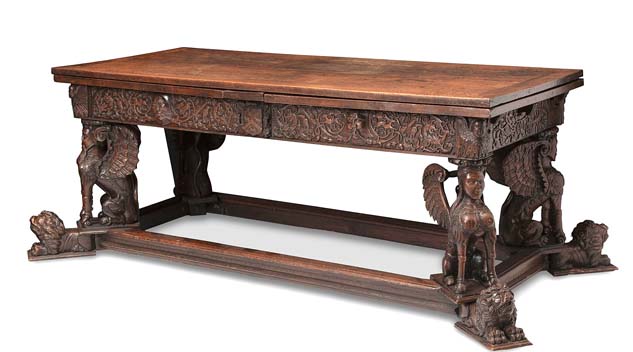
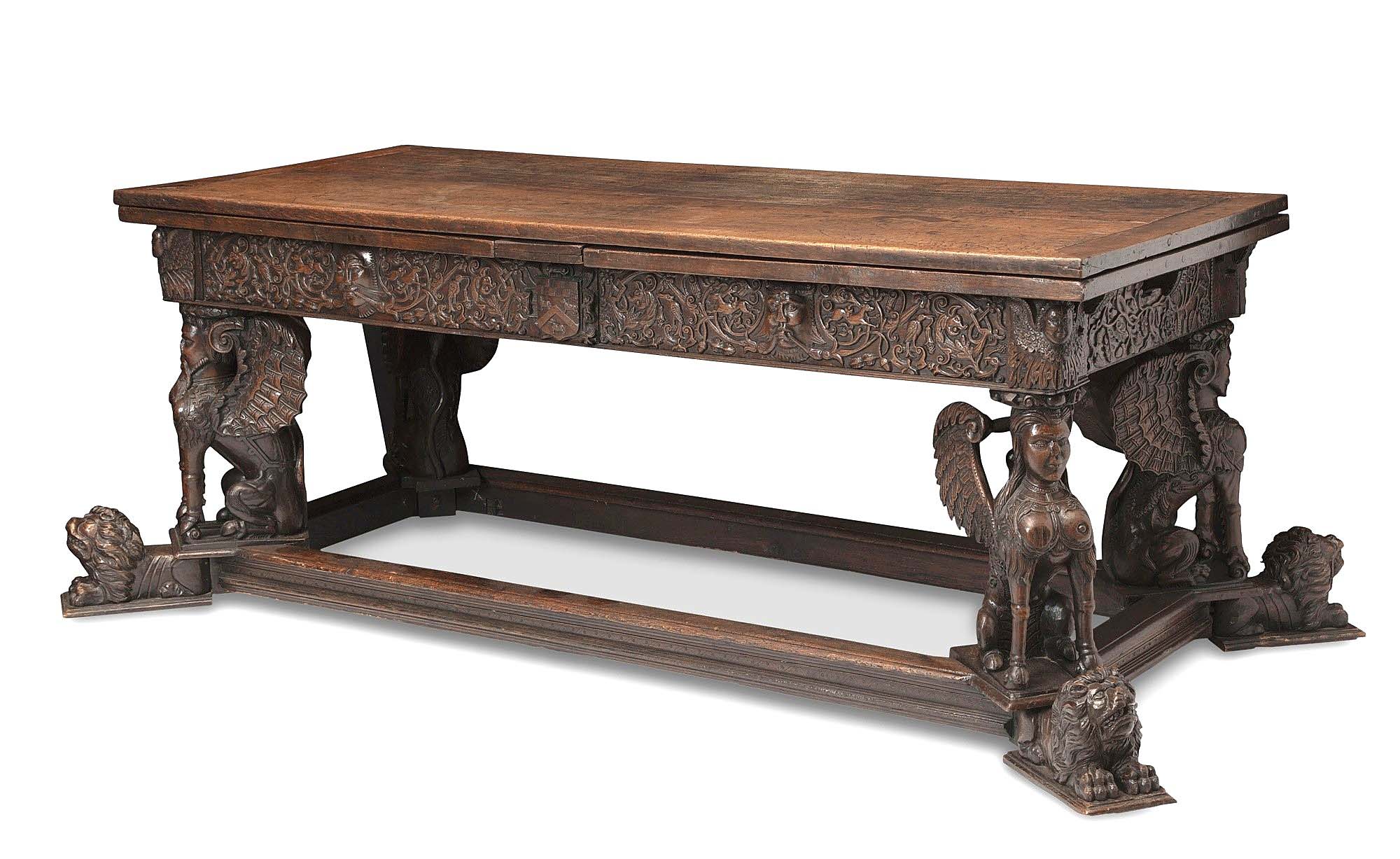
The Lambert Table, an Elizabeth I carved oak draw-leaf form measuring approximately 13 feet long when fully extended, led the two-day sale at $168,843 (£100/150,000).
Review by Carly Timpson
SALISBURY, UK — Woolley & Wallis was entrusted with the more than 700-lot collection of Paul Fitzsimmons, who is considered “one of the most distinctive and intellectually rigorous collections of early furniture and sculpture formed in recent decades,” according to the catalog’s writeup. Spanning March 10-11, in an auction titled Paul Fitzsimmons: A Life in Oak, the firm dispersed the significant collection, realizing more than $1,378,000 and exceeding the sale’s top estimate. With more than 1,000 registered bidders bringing international interest, including 10 percent from the United States, the auction’s sell-through rate was 95 percent.
“The sale went extremely well, lots of viewing, lots of people in the saleroom (which is a novelty these days), lots of new buyers from around the world, strong bidding and a phenomenal sell through rate,” said Mark Yuan-Richards, associate director and furniture specialist. “The sale generated a lot of interest with private collectors, and I think they liked the ‘house sale’ feel what with the beautiful photography of the interiors. It was a tremendous sale, and I think it will give the oak market a real boost. The success was a testament to Paul Fitzsimmons’s knowledge, eye and enthusiasm for early furniture.”
Fitzsimmons, proprietor of Marhamchurch Antiques in Devon, England, is as one of the UK’s leading specialists in early oak furniture and works of art, with a particular focus on the Tudor and early Stuart periods. For his introduction to the auction catalog, oak consultant David Houlston wrote, “Paul is unlike anyone in the ‘oak world’ I have ever met. His insatiable enthusiasm, curiosity and drive are unparallelled; he has been likened to a bloodhound in his approach. This talent, and dedication to the hunt, has led to his making several remarkable discoveries, to give items back the significance and visibility they deserve.”
Those lucky enough to get their hands on the catalog for this auction were essentially granted a tour through Fitzsimmons’ curated abode, as the sale was sold in sections by room, beginning with The Oratory, moving into The Solar, The Hall, Bedchambers, The Henry VII Bedchamber and ending with The Buttery & Larder on day one. Day two presented The Sherry Room, The Withdrawing Room, The Grand Staircase & Landing, The Lower Scullery, The Parlour, The Library and The Cellar.
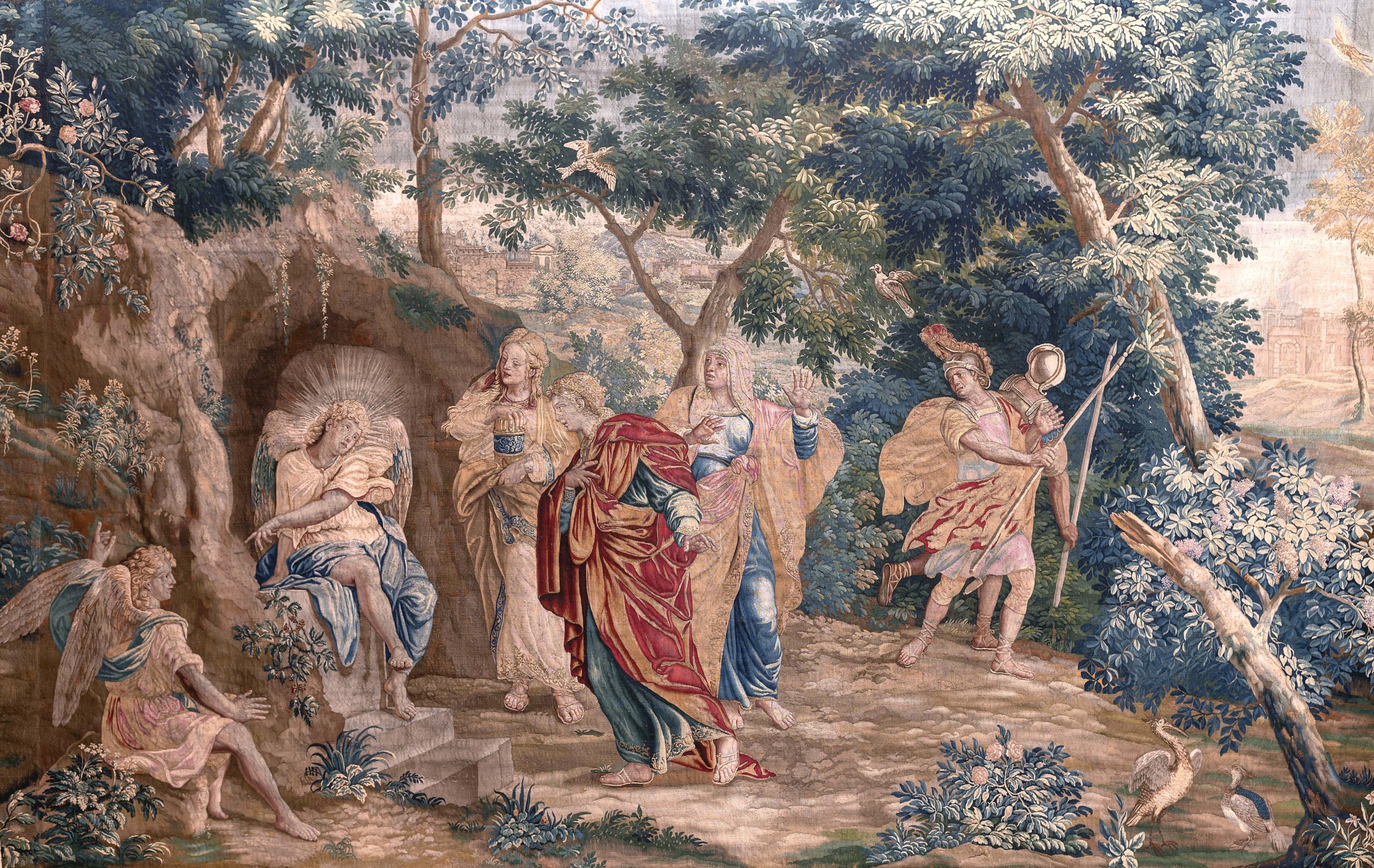
Interpreted from Mark 16:1, this circa 1650 tapestry, “The Three Marys at the Tomb, Brussels,” wool and silk, about 9 by 13⅞ feet, hung for $37,469 (£6/8,000).
Elaborate, fantastical and exquisitely carved, the Lambert Table, an important Elizabeth I oak table, was the top lot of the auction. This circa 1575-1600 table which Houlston identified as “the finest example of Elizabethan furniture, unsurpassed in the UK auction market for decades,” was highlighted by its unique leg designs, each carved with an upright sphinx with a human face and griffin wings, seated above a recumbent lion. Additional details included a highly detailed frieze apron and long draw-leaf top. Almost certainly commissioned by John Lambert (1522-1593), of Calton-in-Craven, Yorkshire, UK, the table had Lambert family coats of arms carved into the long sides of the frieze rails, centered along panels with scrolling foliate detail featuring animals and birds and two large green men masks. At each corner, the panels were joined with winged angel masks. Similar forms are seen in the circa 1570 Sea-Dog Table at Hardwick Hall, Derbyshire, UK, and other designs published around 1560 by Jacques Androuet du Cereau (1515-1584).
Aside from its highly intricate form, bidding was driven by its extensive publication history and in-depth research, as well as its additional provenance to Sir Archibald Edmonstone (1867-1954), Fifth Baronet of Duntreath, Strathblane, near Glasgow; Sam Wolsey of 71 Buckingham Gate, London; Arthur Davidson, London, circa 1972; and the Bartlett Burnap collection, Florida, US. After much spirited competition, the table sold to a UK-based private bidder for $167,638, finishing within its estimated range of around $133,000 to $200,000.
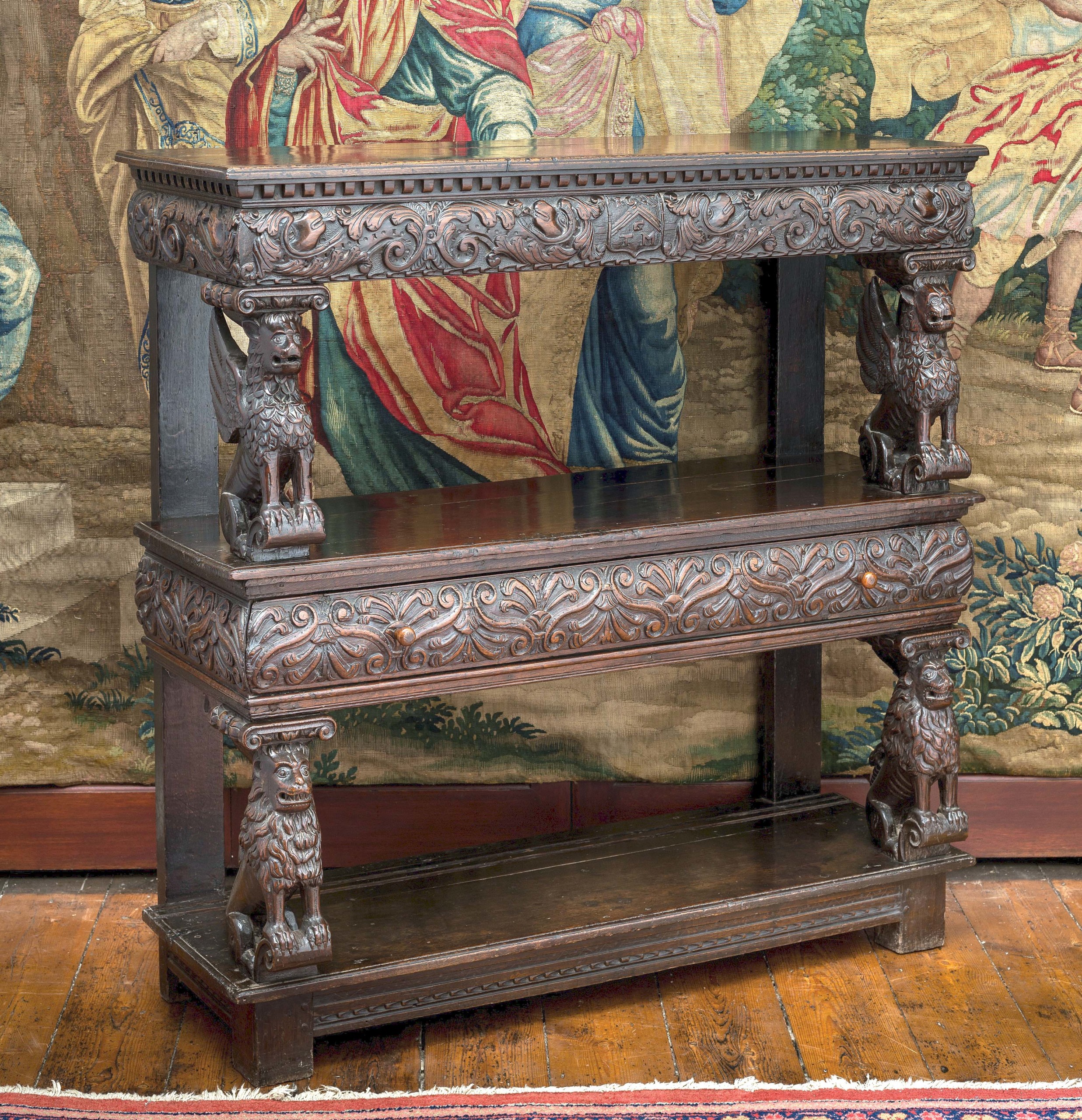
More than doubling its estimate to bring $28,974 was this Elizabeth I joined tiered court cupboard, possibly Gloucestershire or Home Counties, circa 1580-1600, 4 feet tall by 4 feet wide by 1½ feet deep (£8/12,000).
Selling early on day one and maintaining its high position to finish second overall was a set of four Fifteenth Century figural corbels. These, made of oak and with polychrome decoration, were from East Anglia and each depicted a saint: James the Greater, Andrew, John the Evangelist and Lawrence. Each was carved in half-length relief, paired with his recognizable symbols such as St John the Evangelist’s chalice, which held a serpent. Likely created to be used architecturally within a sacred space, the survival of these four together as a complete set is what contributed to their allure, as the catalog noted, “most English Gothic sculpture was lost or defaced during the Reformation and subsequent iconoclasm of the Sixteenth and Seventeenth Centuries.” Nearly tripling their high estimate, the corbels commanded a $47,614 result.
A pair of mid Seventeenth Century tapestries depicting religious scenes also performed well beyond their high estimates of about $10,660. Woven in wool and silk, the circa 1650 tapestries exhibited characteristics of weavings from Brussels of the time, including careful modelling of the figures with expressive drapery and the harmonious balance of colors. The catalog entry for “The Three Marys at the Tomb,” interpreting the scene from Mark 16:1, indicated that the use of silk threads added radiance and vibrancy, “demonstrating the technical mastery for which Flemish weaving of this period was renowned.” This example sold to a private buyer for $37,469. The other, Luke 24:13-35’s “On the Road to Emmaus,” brought $27,269, also from a private client.
Leading items from The Sherry Room was a Fifteenth Century iron-bound, dome-lid chest. Cataloged as English or possibly Low Countries, this medieval chest represented “the pinnacle of the Gothic armored chest tradition of Northern Europe during the Fifteenth Century.” Constructed from a carcass encased in wrought iron strapwork and fixed with large rivets, the chest had massive forged side handles and was meant to be carried by two men. Retaining its original lock plates and hasps, inferences could be made about its use, as the arrangement of these subsidiary seals was used in ecclesiastical and civic statutes that required multiple keyholders. However, only one could present the key at auction, and the winning bidder, a private buyer, claimed the prize for $33,983.
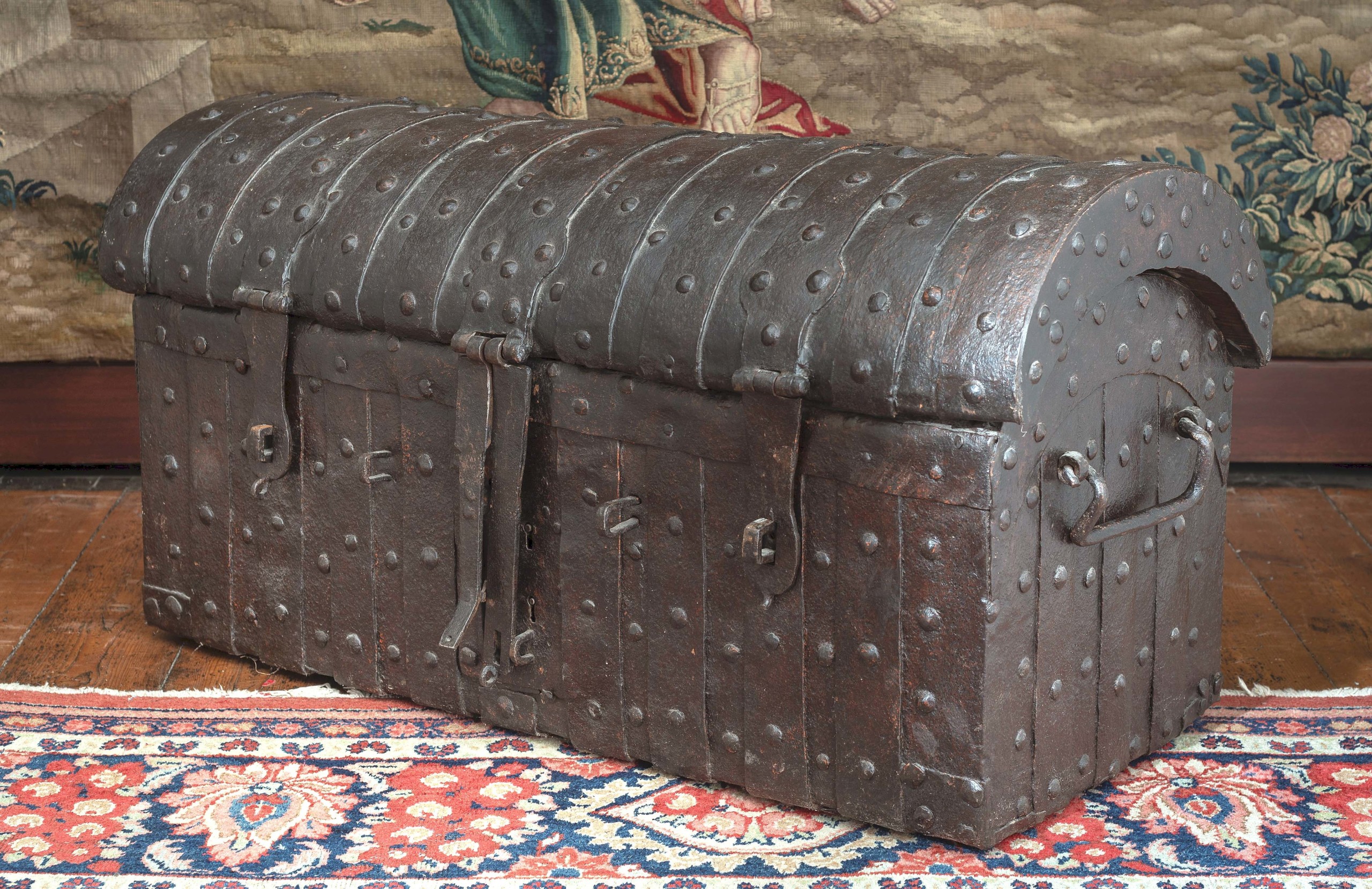
Iron-bound and with a dome lid, this English or Low Countries chest from the second half of the Fifteenth Century, 1⅞ feet tall by 3¾ feet wide by 1½ feet deep, finished for $33,983 (£10/15,000).
Many cupboards and other related storage pieces were included, topped by an Elizabeth I/James I oak cup-board. Different from a “cupboard,” “This form belongs to a group of open ‘cup-boards’ made in the Sixteenth Century, as a transition between medieval side tables and the enclosed court cupboards of the early Seventeenth Century.” Made circa 1590-1610, this example sold for $31,530, more than three times its high estimate.
Following closely behind was an Elizabeth I court cupboard, possibly from Gloucestershire or Home Counties. The two-tier piece featured lion supports on the lower half and winged griffons on the upper, with a central drawer between the two levels. Though the cupboard was made circa 1580-1600, a carved shield centered on the top apron was carved with the year “1628” and the initials “TGM,” almost certainly added later and likely commemorating an event or marriage. It joined its new buyer for $28,974.
“Some of the items were within expectations, but what surprised me were the prices for items in the cellar and buttery — these really did very well,” noted Yuan-Richards.
The leading lot from the cellar was an imposing Elizabeth I joined oak open armchair, circa 1580-1600, that finished within estimate to achieve $3,398. Other notable results, all with high estimates that did not exceed £800 (about $1,066), were a joined oak cupboard, circa 1650 and later ($2,719); an early Seventeenth Century oak caquetoire open armchair ($2,294); a Charles I joined oak open armchair, circa 1630 ($1,869); three English glass ‘onion’ wine bottles, circa 1700-20 ($1,615); a Chondzoresk rug, South Caucasus, circa 1900 ($1,615); a Charles II joined oak panel-back open armchair, circa 1680 ($1,359); and a well-matched pair of brass pricket candlesticks, circa 1600-50 ($1,359).
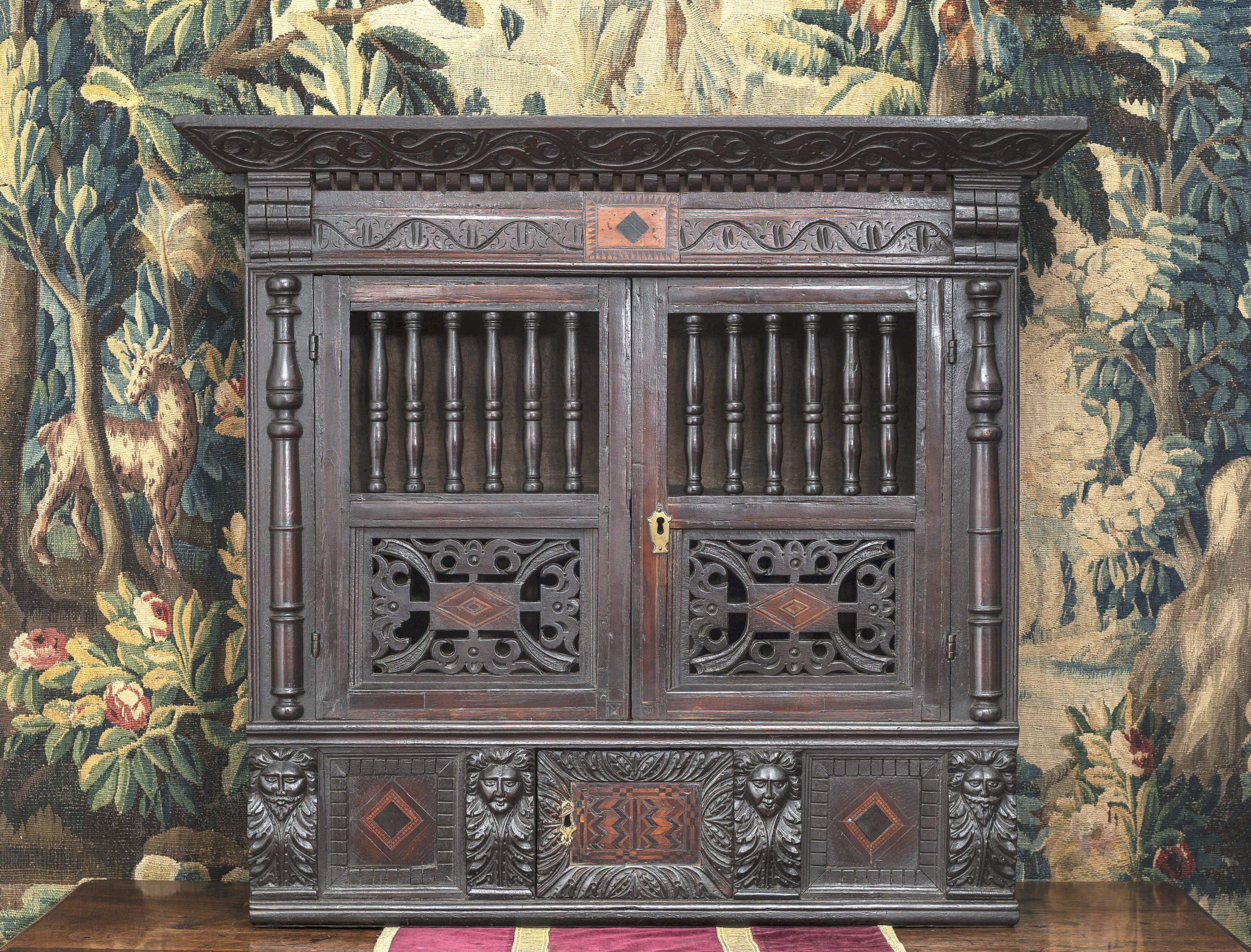
Measuring 35¼ inches tall by 38¾ inches wide by 12½ inches deep, this James I oak and inlaid mural cupboard, West Country, circa 1615-25, went out at $14,487 (£6/8,000).
Among highlights from the buttery were a rare, small, japanned-gilt tavern clock from Devon, circa 1750 ($5,454); a set of Twentieth Century crewelwork-style tester bed hangings ($3,409); a mid Seventeenth Century Dutch oak folding center table, circa 1640 ($1,875); and a set of three early Seventeeth Century carved oak panels, West Country, circa 1610-30 ($1,704).
In closing, Houlston reported, “The sale was testament to the hard work of the vendor and his advisor, myself. If you are willing to give an auction all that you’ve got, great results can be achieved…but you do need great items too, which Paul had in abundance.”
Woolley & Wallis will conduct an auction of Fine and Important Glass on April 14, followed by Design on April 15.
Prices quoted include the buyer’s premium as reported by the auction house and have been converted from GBP to USD based on the exchange rate on the day of the auction. For information, www.woolleyandwallis.co.uk.