MIAMI, FLA. — Steeped in opulence and mythology, Vizcaya is a glimpse into a bygone era when Gilded Age millionaires built mansions to entertain their friends in lavish style while proclaiming their social standing to the world. Vizcaya is one such place, built as a winter home by industrialist James Deering upon his retirement from Chicago’s International Harvester Company. Hidden within a rockland hammock, a now endangered ecosystem, the house seems to magically appear out of a subtropical forest at the end of a long driveway flanked by tall hardwood trees.
Deering chose well this location and deliberately set his house amid the forest at the edges of Biscayne Bay so as to create privacy as well as inspire awe from visitors arriving by car. The baroque mansion looks, upon first glance, to be very old, perhaps lifted from an Italian villa and transported, stone by stone, to Miami. Though that was the very goal when it was designed, the house is a unique blending of European styles, including the many antiques and art mostly sourced from France and Italy, together with American craftsmanship and materials and wrapped up in a distinctive Miami flair.
A bundle of contradictions between antique elements and contemporary craftsmanship as well as Old World and New World tastes, the 38,000-square-foot home was designed as more of a garden pavilion rather than a house with attached gardens. The 54-room main building (34 decorated rooms are open to the public) is centered by a three-story-tall interior courtyard that in Deering’s day was open to the elements (a glass skylight to prevent the art and antiques inside from humidity damage was added later). Most of the 200,000-plus guests who visit every year do not realize this “modern” home is mostly made from reinforced concrete.
It also won acclaim in architectural and engineering magazines in its day for incorporating many modern conveniences and technology available to the affluent in the early 1900s, such as burglar alarms, a central vac system, a partly automated laundry room, a dumbwaiter, two elevators (quite the luxury in a home both back then and now) and even a master clock system where all the clocks in the house could be synchronized, thus keeping the staff of 30 on time.
The name Vizcaya has an interesting backstory and, like the estate itself, pays homage to Europe and well as its native America. A province in northern Spain, Vizcaya (conventional spelling also has it as Bizkaia in Basque or Biscay) is thought by most to be the inspiration for the estate as well as Miami’s Biscayne Bay. Deering, who wanted to create the myth that his home was named for an explorer, also wanted Vizcaya to evince South Florida’s history and mythology. He knew that some people were familiar with the Spanish merchant Vizcaino, who reportedly explored the Americas in the early 1600s.
Characteristic of his thoughtful letters, Deering told his artistic director Paul Chalfin, the designer to whom he entrusted the furnishing and decorating of the estate, that he found the name Vizcaya “pretty in itself” and evocative of both Spain and the home’s Biscayne Bay location. The owner of three yachts, Deering was passionate about boating and also remarked that the caravel — a small but very agile sailing ship developed by the Portuguese in the Fifteenth Century during the “Age of Discovery” and associated with exploration — would make a fitting symbol for Vizcaya. Indeed, the caravel and the seahorse became estate emblems. Depictions of both are liberally found both indoors and outdoors here.
Speaking of the outdoors, as incredibly lavish as the house is on the inside, its formal European-inspired gardens — loaded with mature and rare plants, antique statuary, fountains and architectural elements — are equally breathtaking. Deering had many rare ferns, trees and specimens imported from Cuba and around Florida. By situating his house close to the water’s edge instead of razing the rockland hammock growth as so many others in Miami did, he preserved a key ecosystem. The forest is now home to many endangered plants, like the redberry stopper, bitterbush and the brittle maidenhair fern. At Vizcaya, the living collections are managed like the art collections are — plants are cataloged, researched and conserved.
In Deering’s day, the estate comprised 180 acres of hardwood hammock, lagoons, a village, main house and 11 buildings, including orchid greenhouses. Deering was passionate about plant conservation. Today, it is 50 acres, including the main house and gardens, Vizcaya Village and the area occupied by the Patricia and Phillip Frost Museum of Science.
It is likely that a thousand people were involved in Vizcaya’s construction with several hundred employed during the height of the project. The chief architect was F. Burrall Hoffman Jr. Chalfin served as the artistic designer. Credit for the elaborate and breathtaking gardens goes to landscape architect Diego Suarez.
In his 50s and already a millionaire, Deering, whose doctors recommended a dose of Florida sunshine and warmer climate as cure for his pernicious anemia, started buying land here in 1910. That same year, he traveled to Europe with Chalfin on the first of many buying trips to Italy to purchase antiquities for his future home.
Construction on the main house started in 1913 and took nearly three years, with the house officially opening Christmas Day 1916 with an elaborate masquerade party. Deering and his friends arrived by gondolas from Biscayne Bay at the Venetian-inspired dock at what Deering considered the home’s real entrance. Two small cannons offered a booming welcome and, in homage to Italy, he and the guests dressed in Italian peasant costumes.
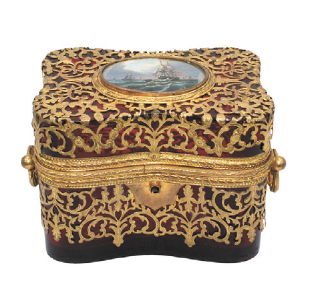
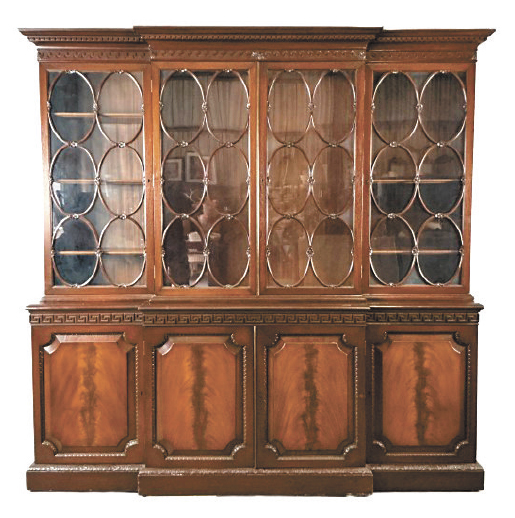
Today, the home, which has more than 2,500 objects and pieces of art, boasts one of the largest public collections of Italian furniture. Chalfin was an expert on Italian furniture and if there was a collector at Vizcaya it was more Chalfin than Deering. The bulk of the estate’s collection was acquired in Italy between 1912 and 1914. Much like Miami’s cosmopolitan nature, Vizcaya has quite an international flavor as its main house and gardens are furnished with items from many cultures and art periods — Renaissance tapestries, ancient Roman sculpture, Seventeenth–Eighteenth statues and garden antiques, Chinese ceramics, rococo and neoclassical furniture and early Twentieth Century paintings.
Sadly, Deering did not get to enjoy his house for very long. He would winter here, usually from the end of November to the middle of April, only for a few years. In September 1925, he died aboard the steamship Paris en route back to the United States. The home was left to his half-brother, Charles, whose daughters, Barbara and Marion, assumed control of the estate, eventually conveying it to Miami-Dade County in 1952. The home was registered as a National Historic Landmark in 1995.
It was common practice among the upper classes to decorate each room in a home in a different historic styles suggesting the home had been lived in for generations. Deering’s bedroom and personal suite, offering striking views of Biscayne Bay, were done in the neoclassical style. Espagnolette, the most lavish of the guest bedrooms with its importance indicated by its location near Deering’s suite, is filled with Venetian furniture. Chalfin named each room. Espagnolette is a nod to the mode of Spanish dress popularized in France by Jean-Antoine Watteau, whose fantasy paintings inspired the bedroom’s décor. The library, a common feature in affluent homes and one that was meant to suggest that the owner was an educated person, is done in the neoclassical style after Scottish architects Robert and James Adam. Every spring, after Deering left Vizcaya for cooler climates, the staff removed each book from the shelves and wrapped it to protect it from humidity during Miami’s warm, wet season.
Of note, the popular audio tour is not just available in English and Spanish, but also French, Portuguese and Haitian Creole, owing to Miami-Dade County’s large Haitian American community. This is the first permanent collection audio tour in Haitian Creole in the United States.
Vizcaya is at 3251 South Miami Avenue in Miami’s Coconut Grove neighborhood. For additional information, www.vizcaya.org or 305-250-9133.