Reyne Hirsch. Photo courtesy Heritage Auctions/ha.com.
On February 5, Heritage Auctions announced that Reyne Hirsch was the firm’s new vice president and managing director of fine & decorative arts and luxury. Hirsch, who is a nationally recognized authority on Twentieth Century design and a respected voice in the world of fine art and collecting, began her duties a little over a month ago, and Antiques and The Arts Weekly made sure to sit down with her to touch base about all things new, old and in-between.
Congratulations on your new position as vice president and managing director of fine & decorative arts and luxury at Heritage! How has the first month been so far?
Straight chaos! [Laughs]. It’s really interesting moving from one auction house to another. Heritage is such a powerhouse and such a large operation. There’s so many moving parts and pieces every single day. Not only that, but you have so many employees, not just in Dallas at our home office, but worldwide. Thankfully we do a lot of Teams meetings, which is helpful for putting a name with a face. It’s taking some time to get settled in, but I greatly enjoy it. Everybody here has been incredibly welcoming.
You decided to close Dallas Auction Gallery, which you acquired in 2023, this year to pursue this opportunity at Heritage. What was your reasoning behind this decision?
I consulted for Heritage in 2006 or 2007. Being given the opportunity to come back 20+ years later to oversee the fine & decorative art department, is such an honor. There are several of my Antiques Roadshow colleagues working here, so in some ways, it’s comfortable walking in the door.
The last time I worked for an employer was in my early twenties. To move away from being an entrepreneur takes some getting used to. I pondered if this was something I could do after being on my own for so long. I’m glad I made the move. I’m going to get to see a lot of things and have a lot of opportunities that I probably would not have had on my own.
In addition to owning an auction gallery, you’ve also been an appraiser for more than two decades. What are some of the main differences between your previous role(s) and your new one?
I’ve also owned a Twentieth Century design gallery in Ohio and art gallery in Dallas. I’ve worked in an array of businesses, but all kind of related. I entered the business as a show dealer. I used to do 30 shows a year. Traveling, packing up, setting up, tearing down, going from show to show, city to city. I started out as a collector, then moved to being a dealer, then to an appraiser and then to gallery and auction house owner. They’ve all been stepping stones to the following role. And the thing is, when you close the door from the one thing to walk through the next door, there are many skills that you take from those other positions you bring with you that give you a more well-rounded skill set.
For example, when you appraise things, the first question you have is, am I appraising something for insurance/replacement value, fair market value or auction value? There’s a lot of different factors between each. My previous experience being an appraiser, dealer, gallery owner and auction house owner means I understand all of parts of the pie.
When working for an auction house, your clients are dealers, collectors, museum curators, art consultants, experts, interior designers… So, each one of them is buying with a different mindset as far as what they feel the value of something is. When talking to them, whether at a meeting, someone’s home, or corporate collection, you have a good perspective of where they’re coming from and what their needs are going to be when you help them to deaccession something.
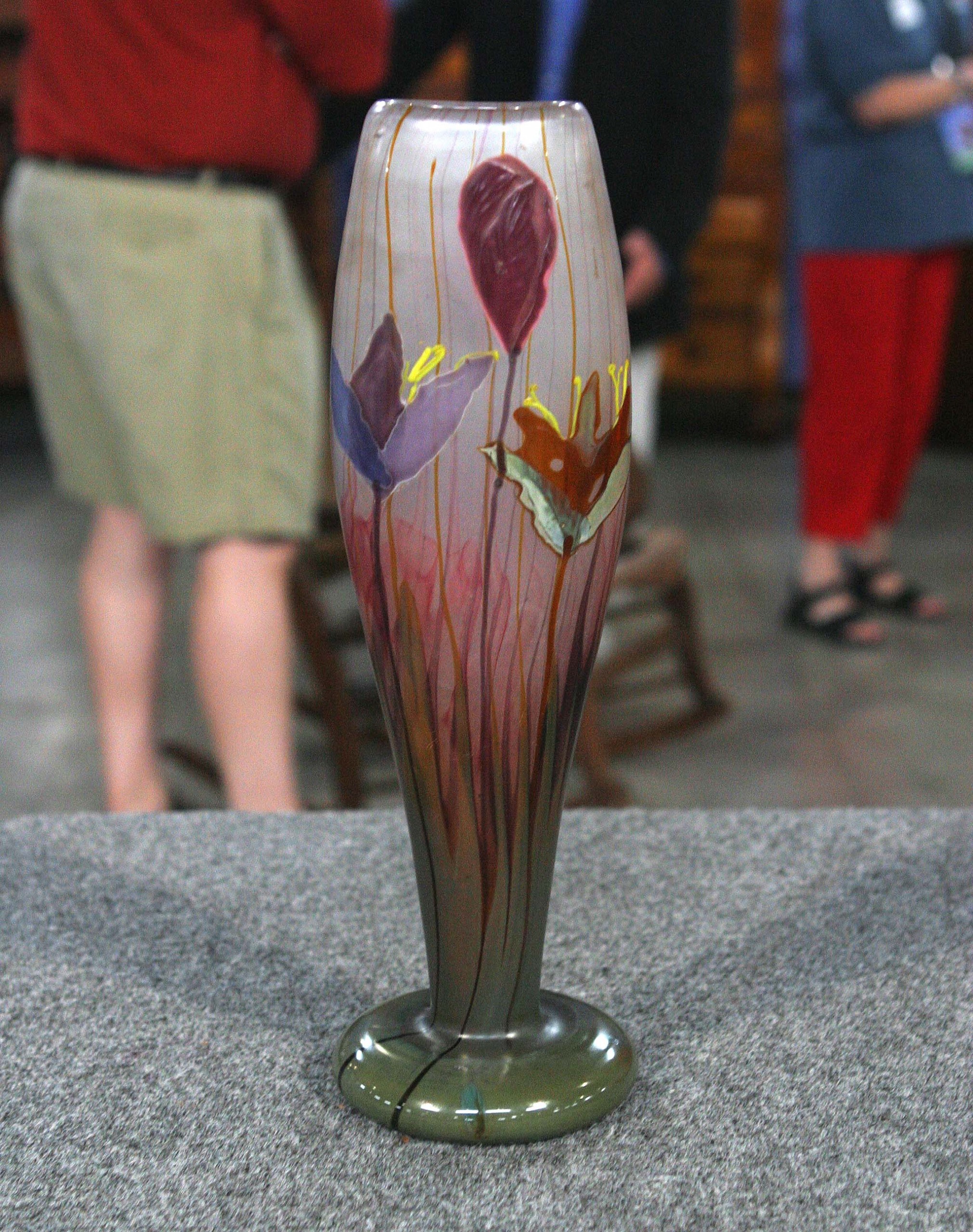
Hirsch appraised this circa 1900 Émile Gallé marquetry vase on a 2003 episode of Antiques Roadshow, then valuing it at $60/80,000.
You also had a 13-season tenure on Antiques Roadshow. What were some of the most memorable items you appraised on the show?
One of the most memorable items personally was something that actually never made it on air. A gentleman that came up to me in St Louis, Mo., had a vase by Émile Gallé, a French glass artist from the Art Nouveau movement. One of the techniques not commonly used was called marquetry. The vase that came in that day was much larger than the normal size you would typically see. Normally they’re six, seven, eight inches, and this was around 13 or 14 inches. On top of that, it was in this beautiful leather and velvet display case. Come to find out, the piece had been made by Émile Gallé for his sister. That provenance made it even more important. It was worth, at the time, about a quarter of a million dollars.
The owners purchased it from a very respected dealer in the industry. They knew who made it and they knew it was made for the sister. With all of those things factored in, it made it hard to take it on air because the only aspect of it you could tell them that they didn’t already know was what the value was at that time. In hindsight, if I had the chance to do it again, I would have pushed to take it on air, mostly to explain why provenance can be so important. If I didn’t learn that the vase, while pretty and in this special box, was made for Gallé’s sister, it would have been worth more than the average piece but not as much without the added provenance.
The following year, we went to Oklahoma City, and a woman walked up to me. She had something wrapped in a towel; she unwrapped it, and it was the same type of glass that I passed on before. It didn’t have the same level of importance as the other one, but it was the same rare technique. I had done the show at that point for several years and had never seen one before and now two had showed up within a year’s time. I did take that one on air and it made TV Guide Magazine’s “Must Watch.” After the fact, the family asked me to sell it for them.
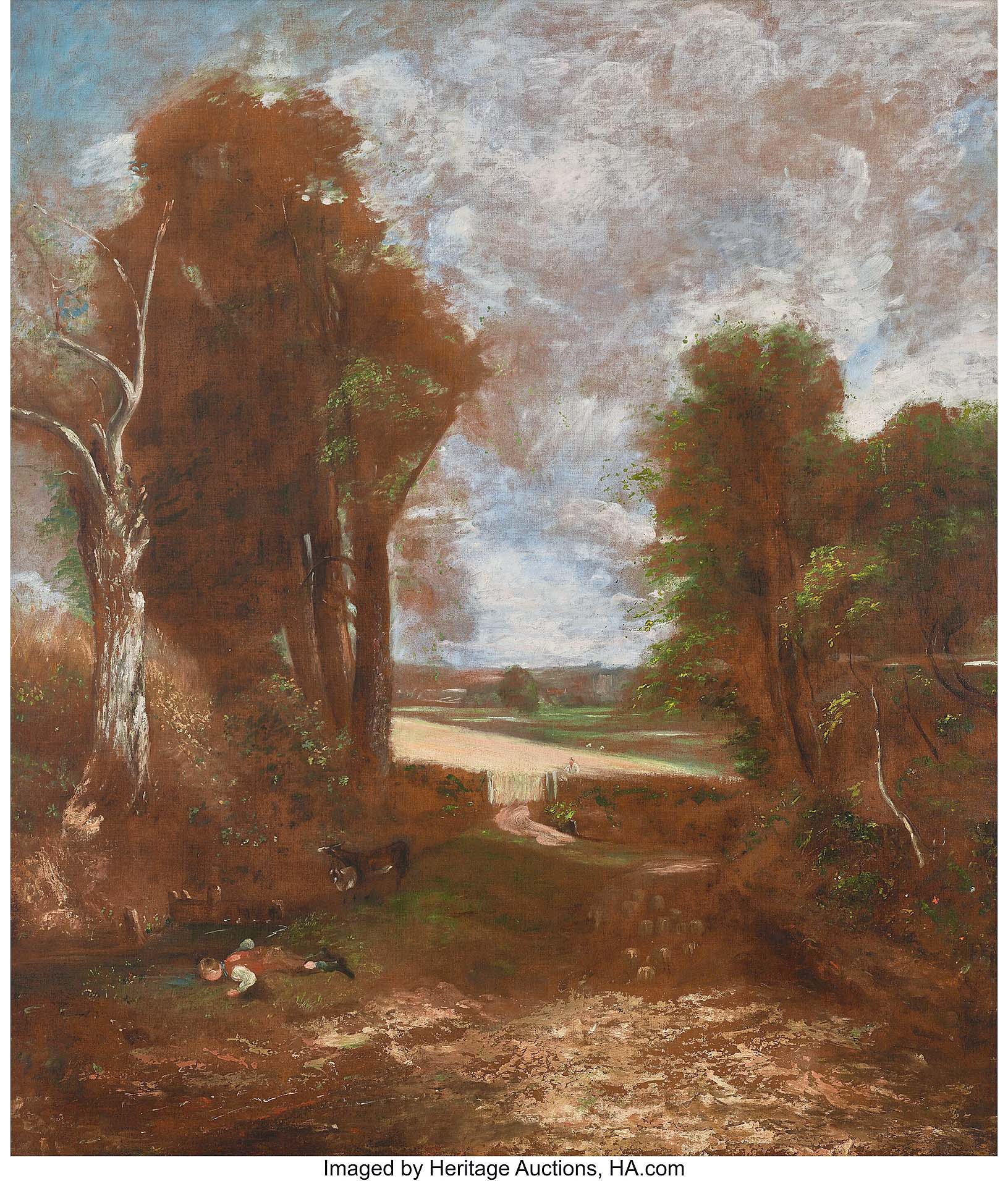
John Constable, study for “The Cornfield” (circa 1820-26). Photo courtesy Heritage Auctions/ha.com.
My true passion has always been Louis Comfort Tiffany — art glass, lamps and bronzes. There was a guest that brought in a collection of artifacts from Tiffany’s home in Long Island, N.Y., Laurelton Hall. Many of the items from Laurelton Hall were taken away after a huge fire and placed in the Winter Park Historical Museum in Florida. The guest, who collected some of the items from that house, picked them up as a high school student. There were a lot of different things that he came in with such as mosaics from the outside of the building, pieces from the inside of the house, even original architectural drawings for the home. The architect for said drawings was Stanford White, a very important architect from New York.
The gentleman was so nervous, he was shaking! He had kept all of these things since high school. He explained that he had lived on Long Island and that summer he was walking the beach and had heard about the house and who used to live in it. He stopped by the house and the person that was helping to restore it at that time let him on the property — he was cleaning it up and told him he could keep anything that he found. He started looking and he found the drawings by Stanford White. He was going to college to be an architect, so he knew that name and he felt like they were important, so he wanted to keep them. I ended up placing many of those items in the Winter Park Museum.
I think a lot of appraisers would tell you some of the things that could be the most memorable for all of us are things that came in that stumped the appraiser. And what I mean by that is when you think about how many people we see in every city, every year, how many items… it’s tens of thousands. Many things that come through the door, you see again and again, and you’re always happy to see them; you could talk about them in your sleep. But when items come in you don’t recognize, your colleagues don’t recognize, it’s a bit exciting. Those pieces resonated with me, mostly because it showed me that after all these years, I have not seen it all. You really do start to think, “Okay, there’s not a whole lot that can surprise me at this point.” I could have seen a million-dollar lamp, and it wouldn’t surprise me. I would be happy to see it, but it wouldn’t stump me.
Some of my favorite moments of people coming to the show were with something common. Say for example, a teacup. What they know is that their grandmother had that cup in their china cabinet, and it only got brought out on Easter or Christmas. Maybe you got to use it once a year, and when your grandmother passed away, she left you that cup, and you treasured it. By anybody else’s standards, that cup is worth $5 to $10, right? But to the person who’s treasured this thing for all of these years, half the time, these people don’t even ask what the price is, because to them, it’s priceless. So many people would come saying they’ve looked and looked, and for whatever reason, they’ve never been able to figure out what that item is. So to stand there, and in five minutes, tell somebody, “Oh, well, this was made by this company, it was made during the 1920s, it was given away as a premium with a box of Tide,” and to watch them stand there and cry and thank you, because they’ve looked for just that little tidbit of information for so long and they’ve never been able to find it… That’s when you’re like, “This is really the reason why I do this show.”

Photo by Jay Marroquin.
What are you looking forward to the most as you delve deeper into this new role at Heritage?
There’s so many things. I look forward to working with the consignment directors, catalogers and trust and estates teams to uncover the next hidden treasure.
Last week, we had an exciting announcement regarding an unknown painting by John Constable, an important Nineteenth Century artist. It’s currently enroute to London for viewing. It was hard to keep that under wraps since arriving here.
I’m still a collector to this day — and most people that collect things will tell you that the acquisition and the ownership of something is just a very, very small piece to why you do what you do, but the storytelling and the thrill of the find is 90-something percent of it all. I’m not a John Constable collector, but the fact that one of these was found, and I’ve gotten to watch it go from the small museum where it was discovered in Texas, to London and then the auction block… I will never get enough of that.
—Kiersten Busch