QUINCY, MASS. — “The signature object at the Quincy House and in Historic New England’s collections overall is the japanned high chest of drawers. It is a great example of mid-Eighteenth Century japanning and its accompanying story puts it over the top.” Nancy Carlisle, senior curator of collections at Historic New England takes a breath and enthusiastically continues. “It was saved from two house fires prior to 1770. We know that because Eliza Susan Quincy, the great-granddaughter of its first owner, was a remarkable historian. She recorded family history in a number of ways, including labeling family objects. Visitors can see the high chest in the bed chamber in which it stood when its original owner died in 1784.”
For the last three years, Carlisle has led a project to research, rethink and reinstall the Quincy House, a flagship property of Historic New England. Emphasis is now placed on Eliza Susan Quincy (1798–1884) and her two sisters, who resided in the structure circa 1880, the period for which the strongest documentation exists. Carlisle says, “The goal was to show the house and its history through Eliza Susan Quincy’s eyes. Because of the family’s role in the region’s and nation’s history, it is a tale worth telling.”
Much is known about the furnishing of Quincy House through the diligent labors of Miss Quincy. Her “Memorandum Relative to Pictures, China, & Furniture &c, &c, &c” of 1879 and the formal photography she directed circa 1880 made the re-creation of the interiors possible. This devoted caretaker of family legacy recorded the provenances of individual possessions, thus making them a valued resource for attribution-building. Quincy also edited published volumes of family correspondence, which gained her the respect of academic historians.
To succinctly answer the question, “Who were the Quincys?,” Carlisle likens them to a Nineteenth Century version of the Kennedys. The prominent dynasty with mercantile beginnings included six civic and community leaders named Josiah. One or more of them held the title of mayor of Boston, president of Harvard, Boston City councilor and member of the House of Representatives, Massachusetts House or Massachusetts Senate. This “Pride of Quincys” was related to another New England familial powerhouse, the Adamses, through Abigail Adams.
The new interpretation of Quincy House, built by Josiah Quincy as a summer home in 1770, focuses on the deeds and circumstances of individual members of this redoubtable clan with fine and decorative arts objects helping to support the story. Like their owners, many of these items are stars in their own right. Since Quincy House contains some of Historic New England’s most important objects, we are speaking about the crème de la crème. In regard to comprehensiveness and documentation, the organization’s New England decorative arts holdings are the best bar none.
Carlisle explains, “The Quincy family was among the most elite of Boston’s families and they had the stuff to go along with it. The collection contained a good percentage of furnishings original to the house, but we also had to fill in gaps with objects that were of a similarly high quality and so the Quincy House collection overall is outstanding. Strengths include Eighteenth and early Nineteenth Century furniture, as well as ceramics, prints and paintings.”
A mahogany and beech Chippendale side chair with elaborate splat made in Boston exemplifies the richness of family possessions. The chair was likely part of a set presented to Josiah Quincy Jr and Abigail Phillips upon their marriage in 1769. Other chairs from the set can be found at the Metropolitan Museum, Winterthur Museum and Tryon Palace in New Bern, N.C.
The painting “The Last of His Tribe Visiting the Hunting Grounds of His Forefathers” falls into the category of the emblematic. It represents the family’s early support of Alvan Fisher (1792–1863). Eliza Susan Quincy credited her beloved father with encouraging Fisher, who had trained initially as a decorative painter, by purchasing two landscapes from him in 1815. One of them, “A Roadside Meeting: Winter” is now in the collection of the Virginia Museum of Fine Arts. Needham-born Fisher used plein air sketches as the basis for his landscape paintings before the Hudson River School’s Thomas Cole made the practice legendary.
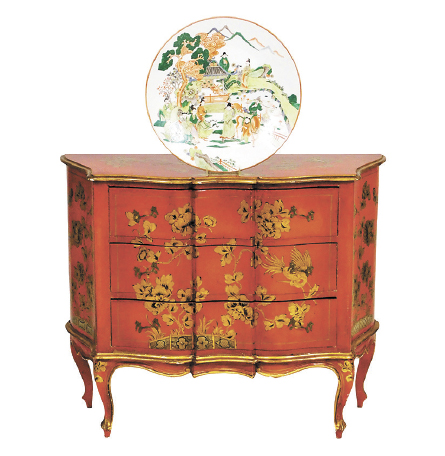
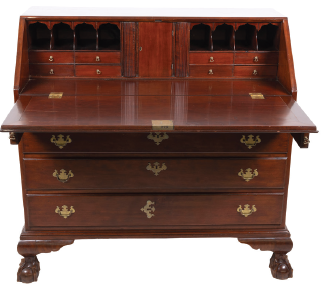
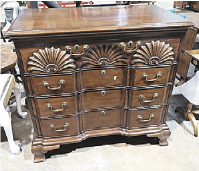
Family possessions have been repatriated as part of the project. While some original furnishings remained in descendants’ hands and were returned to the structure when it became a house museum in 1937, others had not. A case in point is a bombé chest of drawers that surfaced at Christie’s. According to a note inside the chest, it was a gift from a member of the Quincy family to the then-owner’s mother, circa 1881, a provenance known at the time of the Christie’s sale. It was purchased and brought back to Quincy House. Like the Chippendale side chair, the impressive chest of drawers may also have been a wedding gift to Abigail Phillips and Josiah Quincy Jr. Furniture scholar Kemble Widmer has attributed it to the cabinetmaker Thomas Needham Sr of Boston and Salem.
The story of an engraved portrait of family in-law Maria Sophia Kemper Morton by Charles Saint-Mémin is analogous. Carlisle described how Saint-Mémin customarily made a large chalk drawing portrait and then offered a dozen or more engravings after it for the sitter to give to relatives and friends. At Quincy House, both the chalk drawing and one of the engravings were known to have hung together in a second floor hall, but the engraving had vanished. About a year ago, a colleague at Historic New England whom Carlisle termed as “a brilliant eBayer” discovered one of the engraved portraits of Morton for sale online. When the purchase arrived, Carlisle recognized the label on the back as the work of Eliza Susan Quincy. It was the very print that had ornamented the walls of Quincy House long ago.
Asked if there are objects better appreciated in the new installation, Carlisle points to the sword and sash belonging to Josiah Quincy, known as “the Patriot.” She related, “According to tradition, it was with him when he died in 1775 on his return from a voyage to England where he had argued one last time for the colonists’ cause. The sword is an important family relic. He died young and was revered by his descendants. They positioned the sword in a place of prominence in the 1880s.”
Perhaps Carlisle senses a kindred soul in Eliza Susan Quincy. In a similar spirit, Carlisle has spent a good portion of her nearly 30-year career as a curator at Historic New England bringing collection-cataloging projects and associated databases and publications to fruition. At Historic New England, Carlisle watches over approximately 110,000 artifacts in 36 house museums located in five states and representing four centuries of history. (How about that, Eliza Susan Quincy!) Thanks to the efforts of Carlisle and others, the organization’s extensive museum, library and archives collections database can be accessed online at www.historicnewengland.org/collections-archives-exhibitions.
Carlisle, the author of Cherished Possessions, A New England Legacy and co-author of America’s Kitchens, also served on the steering committee of the recent “Four Centuries of Massachusetts Furniture” multi-institution collaborative. Her research on the A.H. Davenport furniture company will be published in New Perspectives on Boston Furniture, 1700–1900, a volume resulting from the project.
As one would expect, this seasoned curator fully appreciates the complexities of exhibiting fine and decorative arts objects. “When you take individual pieces out of a house museum setting and place them in a gallery, you can more easily appreciate design, material and line, but you lose a sense of how they existed for centuries. When you put them in an historic house you can appreciate them as part of a larger cultural survival.”
She concludes, “We want people to experience the Quincy House. They can make a day of it by also going to the Adams National Historic Park, which includes the birthplaces of John Adams and John Quincy Adams as well as the family home at Peace Field, all in the city of Quincy. Visitors will leave understanding the significance of the two families in this region’s history.” These day-trippers will be treated to some marvelous specimens of art and design as well.
Located at 20 Muirhead Street, Quincy House is open to the public the first and third Saturday of the month between June 1 and October 15. Hours are 11 am to 4 pm.
For additional information, www.historicnewengland.org or 617-994-5930.