By Hollie Davis
CINCINNATI, OHIO — Growth spurts often occur as the teenage years approach. That has certainly been the case at the Cincinnati Art Museum, whose Cincinnati Wing recently reopened after being closed for extensive renovations and restructuring.
Amy Dehan, curator of decorative arts and design, and Julie Aronson, curator of American paintings, sculpture and drawings, oversaw the project. Part of a larger institutional plan, the latest phase, Dehan says, “allowed us to turn space that was previously used for back-of-house operations into new galleries and gave us the opportunity to reorient the wing’s earliest galleries so that they lead chronologically into the 13 other galleries for the first time since the Cincinnati Wing opened in 2003.”
As return visitors will observe, the wing’s entrance has been relocated and walls adorned with new color palettes inspired by Eighteenth Century wallpapers. The changes are meant to tell Cincinnati’s tale of growth and evolution in a way, Dehan says, “that is more intuitive and seamless for the visitor.” The curators moved works to create a more linear story and to make way for acquisitions such as a significant selection of silver previously included in the 2014 exhibition “Cincinnati Silver: 1788–1940.” The changes will continue, with more galleries opening on a rolling basis over the next year.
Linear structure aside, Dehan is quick to point out, “There are many narrative themes that feed into this story, that run contiguously throughout the wing, such as the story of Cincinnati’s location on the shifting frontier, the rise of industry and art patronage, the role of art education and the diverse racial, ethnic, religious and gender identities of the people of Cincinnati.”
The story of silver in the Queen City is certainly another of these themes. The earliest object on display is a 1795 spoon by silversmith Isaac Van Nuys, made the year he is believed to have arrived in Cincinnati. A typical frontier silversmith, Van Nuys also engraved printing plates and struck bills for the Northwest Territory. Van Nuys’ spoon illustrates the demand for fine goods on the frontier as well as the scarcity of both materials and means. It is French plate, the result of a plating technique that involves laboriously layering sheets of silver leaf onto a base, in this case copper, a few sheets at a time, then burnishing it to a convincing finish.
The city’s booming silver industry is a force behind the scenes in the creation of a number of other non-silver objects in the exhibition, among them a stoneware storage jug with decoration that Dehan says was “likely inspired by the historic balloon ascent of Cincinnati silver merchant Richard Clayton in his famous voyage in his Star of the West balloon.” On April 8, 1835, Clayton launched from downtown Cincinnati and traveled 350 miles in under ten hours before landing in what is now Clayton, W.Va. He set a world record for hot-air balloon travel.
Clayton’s silver manufacturing fortune allowed him to continue indulging in these flights of fancy for nearly another decade, during which he made, Dehan says, approximately 30 trips. One trip earned him yet another historical entry, that of the first airmail delivery, when, in July 1835, he carried mail on one of his flights from Cincinnati to Waverly, Ohio.
The Kinsey brothers of Cincinnati kept their feet firmly on the ground, no doubt one reason they came to be known as the largest and most important producers of silver in the Midwest in the years immediately preceding the Civil War. The Welsh-born Kinseys exported wares west and south, wares that were often sold and marked by others throughout the region. Dehan places a Kinsey-marked toast rack, a rare form in American silver, among her favorite pieces in the exhibition.
The industrial boom and the wealth of successful manufacturers and retailers of silver and other goods transformed Cincinnati in the first half of the Nineteenth Century. Indirectly, their success created both the objects and the museum. Cincinnati has a rich history of patronage. Patrons, Dehan points out, encouraged the development of art in the city from its earliest years.
She says, “As Cincinnati grew into a large manufacturing city, several key members of the community realized the import of the relationship of arts to industry. It was this type of thinking that led to the founding of the Cincinnati Art Academy and the Cincinnati Art Museum.” The museum itself, Dehan explains, was modeled on the Victoria and Albert Museum, with the purpose of “exposing and teaching manufacturers and designers about the importance of aesthetics and beautiful, well-designed goods.”
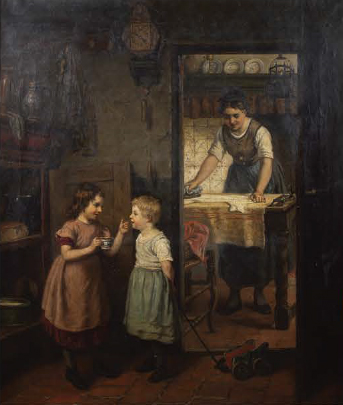
Patronage was of such influence in early Cincinnati that one of the two new galleries focuses on the theme, showcasing and detailing the relationships that led to some of the Queen City’s best-known work. Nicholas Longworth, patriarch of a Cincinnati political and social dynasty, wielded incredible influence as a patron of the arts. His greatest contribution may have simply been his view that, as Dehan says, talent was what mattered most, not race or gender. As a result, he supported and encouraged African American landscape painter Robert Duncanson and Lilly Martin Spencer, known for her domestic genre scenes of women and children.
Longworth not only rooted patronage in Cincinnati, but in his own family, as well. He pioneered the American wine industry, catered profitably to the tastes of Cincinnati’s large Germanic population and, with the resulting fortune, invested shrewdly in real estate. He donated the land on which the Cincinnati Observatory was constructed and his home is now the Taft Museum of Art. Nicholas’s only son, Joseph, and Joseph’s daughter, Maria Longworth Nichols Storer, were also major influences on the arts in Cincinnati.
“They were instrumental in the formation of the Cincinnati Art Museum and the Art Academy of Cincinnati,” Dehan notes. “Joseph also commissioned Henry and William Fry to carve the interior of his home, Rookwood, as well as Maria’s home. These commissions and the attention garnered by them effectively began the Cincinnati art-carved furniture movement. Joseph also provided the financial backing Maria needed to start Rookwood Pottery.” Maria, in turn, underwrote the wages as well as the educational travel and training experiences of a number of the Rookwood Pottery’s artists and designers.
Beyond the history of the museum and its collections, visitors will be delighted to find a number of new acquisitions on display. Among them, Dehan notes, are a tall case clock by Luman Watson, a prominent Ohio clockmaker who produced more than 1,000 wooden movements per year for well over a decade; a storage jar made at the Uzziah Kendall Pottery, which operated in Cincinnati throughout the 1830s and 1840s; a folk art portrait of the prosperous brewer Friedrich Billiods; and a Neoclassical sculpture of a woman by Nathan Flint Baker.
Additional galleries are dedicated to the history and scope of the internationally prominent Rookwood Pottery, which recruited and developed talented artists from all over the world, encouraged young women to pursue artistic careers and created not only traditional pieces but architectural ones, as well, that would adorn some of the city’s finest homes as well as some of the nation’s most iconic spaces.
Another gallery highlights the Cincinnati art-carved furniture movement, which emerged in direct response to the city’s burgeoning industry and in opposition to mass production. The movement is important for its artistic and social contributions. The Frys and their associate Benn Pitman offered carving classes to women, primarily those with the leisure to learn and the desire to engage more directly with the decoration of their homes. Cincinnati soon found women working in a variety of artistic capacities and influencing the conversation about decoration and design at institutions as hallowed as Rookwood.
The refreshed space accomplishes just what Aronson, Dehan and the museum as a whole set out to do, telling an intertwined story about Cincinnati, its art and its history. The Cincinnati Wing is a fitting repository for the crown jewels of the Queen City and a fine tribute to the city’s abiding love and respect for all things beautiful.
The Cincinnati Art Museum is at 953 Eden Park Drive.
For general information, www.cincinnatiartmuseum.org or 513-721-ARTS(2787).