NEW YORK CITY — Art and science combined, that is the special attraction of antique timekeepers. While many collectors focus on the insides of intricate machines, “The Luxury of Time: European Clocks and Watches” at the Metropolitan Museum of Art emphasizes their external beauty. This selection of Sixteenth through Nineteenth Century treasures graces the first-floor Wrightsman Galleries through March 27.
An elegant new book accompanies the show. Together, book and exhibition represent the culmination of 40-plus years of related work by associate curator Clare Vincent, called “the female pope of clocks and watches” in a recent Christie’s auction catalog. Vincent, who arrived at the Met in 1962, co-authored the 278-page hardcover volume with her late husband, Jan Hendrick Leopold, and associate research curator Elizabeth Sullivan, a co-organizer of the exhibition.
Sullivan recently led Jonathan Snellenburg, clock expert at Bonhams in New York, and me on a tour of the show, which consists of 46 objects from the Met’s collection of around 600 European timepieces, most acquired decades ago and rarely out of storage, plus one clock, a circa 1610 automaton from Augsburg, Germany, loaned by Yale University Art Gallery.
In 1917, John Pierpont Morgan (1837–1913) donated about 250 watches and clocks, most of them swept up in his purchases of collections painstakingly built by Carl Heinrich Marfels, Frederick George Hilton Price and others. The American financier gave a total of around 7,000 works of art to the Met during and after his lifetime. Other early donors include Laura Frances Hearn, Mrs Simon Guggenheim, Irwin Untermyer and an anonymous benefactor who, in 1926, bequeathed more than a hundred watches in honor of Lady May Fletcher-Moulton. Mr and Mrs Charles Wrightsman gave clocks and funds for acquisitions.
Vincent organized the 1972 exhibit, “Northern European Clocks in New York Collections,” featuring Met-owned examples, plus others from the collections of Winthrop “Kelly” Edey and Peter Guggenheim. At Christie’s in January 2015, the Met purchased an automaton clock in the form of Urania from the Guggenheim collection for $50,000 hammer. After the Met acquired four major timepieces last year, Sullivan and her colleagues dubbed 2015 “the year of the clock.”
Beyond the two automata already mentioned, there are other clocks in the gallery with moving eyes, body parts and more. Usually from Seventeenth Century Germany, they represented the pinnacle of mechanical and artistic creativity, and were produced for show in aristocratic kunstkammer cabinets of curiosities. Snellenburg termed these demonstrations of Renaissance metalworking “the technology of decorative arts,” requiring amazing artisan skills. Interest in their aesthetic appeal sparked collecting in later centuries, he said, while attention to the hidden mechanical aspects was secondary.
In France, the source of many exhibit highlights, the makers of cases, who frequently signed their work, were more highly respected and better paid than the makers of the geared movements, often unsigned or engraved on the inside.
Incredible skills were also needed to produce porcelain clock cases. Sullivan’s other specialty is ceramics, so she was particularly attentive to these pieces. She noted that, ironically, Europeans struggled to obtain porcelain-making technology from Asia at the same time that Western-made clocks were highly coveted by Chinese and Japanese nobility.
The circa 1735–40 Chantilly Manufactory clock signed “Etienne Le Noir a Paris” boasts intricate and colorful soft-paste porcelain Japanese figures and asymmetric floral motifs along with gilded brass. Two rare features are its wall-hanging, rather than mantel, form and a human figure actually holding the clock bezel. In this instance, the movement carries the same name as the white enamel dial. Le Noir, who became a master clockmaker in 1698, represented one generation of a French clockmaking family.
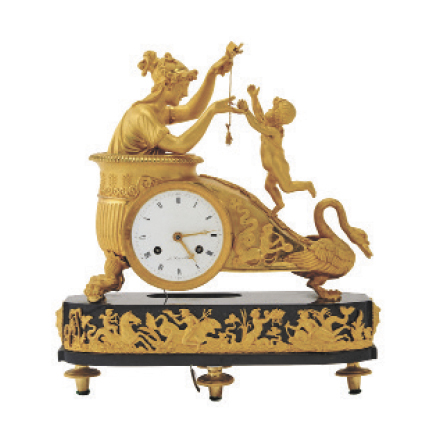
Exotic French clocks with marble, bronze and gilded cases outnumber porcelain examples, both in the exhibit and in the world. The room’s 379-pound centerpiece is a massive figural clock depicting the allegorical theme of the triumph of love over time. The clock’s surfaces are an unusual combination of gloss and matte gold, and copper. I cannot envision a mantel that could support the clock, although perhaps Mr Morgan had one. Jean-Baptiste Lepaute (1727–1802) made this clock and another, donated in 1929 by Ogden Mills, featuring the standing figure of Urania, the muse of astronomy. Lepaute’s wife also played a part. She was an able mathematician whose work on lunar eclipses was connected to the “Avril/1764” chart on the case. Unlike British clocks of the same period with more restrained cases but higher-precision movements, French clocks usually had standardized movements of good quality, with much greater emphasis placed on the case’s decorative appeal.
One French clock — by Jean-Baptiste-André Furet, circa 1784 — is musical. The last-minute addition to the show allows visitors to view from the rear the miniature organ in its base. From the front, the dark bronze bust of a smiling African woman tells the time.
The gallery has limited wall space, so only a small group of longcase clocks are shown. These floor-standing timekeepers became known as “grandfather” clocks only late in the Nineteenth Century. At least one longcase is kept running: the circa 1680–85 walnut veneered British example by Joseph Knibb. A nearby video shows the clock being wound. Most of the clocks and watches are inside display cases and cannot easily be wound, but few museums regularly run their timekeepers anyway. They rightly fear the risks of damage and wear, and they preserve the objects as historical artifacts rather than functioning antique machines. Vincent was featured in an August 6, 2014, Wall Street Journal article recounting her clock-winding rituals at the Met.
Another longcase clock usually stands in the adjacent galleries of the Jack and Belle Linsky Collection. Ferdinand Berthoud’s astronomical regulator, circa 1768–70, is an outstanding example of that famous French maker’s output. Moved to a spot under bright lights, Sullivan saw that polishing its ebony, brass and gilt-bronze case by Balthazar Lieutaud would enhance some old glory. It is one of the few pieces that needed light conservation treatment for the show.
Another 2105 acquisition was a David Roentgen longcase. Its obelisk form and Ben Franklin-inspired movement and dial are rare and distinctive. It needed no conservation, having stood in another recent exhibit, “Extravagant Inventions: The Princely Furniture of the Roentgens.”
Though not in the exhibit, one iconic longcase clock from the Met’s collection may be viewed in Gallery 518. Known as the Graves Tompion, it was donated in 1999 by Marilyn Preston Graves, granddaughter of Henry Graves Jr, whose collection included a Patek Philippe chronograph watch likely to be the most complicated mechanical watch ever produced. Thomas Tompion (1639–1713) is called the father of English clockmaking. The Graves clock is one of his earliest surviving longcases, made before he began numbering them after 1685. The exhibit does include a circa 1696 Tompion ebony-veneered bracket clock, a 1964 Untermyer gift.
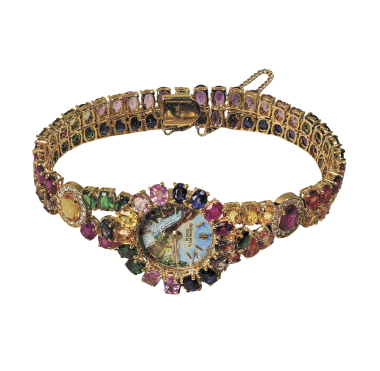
Many of the exhibit objects are pocket watches. They are artfully mounted in innovative, four-sided cases allowing close but uncrowded scrutiny. These Met watches are not typical, gold-filled Walthams or Elgins, but much earlier European ornaments made and decorated with gold, gemstones and painted enamel. Their hinged covers show colorful portraits, classical and Biblical scenes, and complex patterns. Another exhibit video provides closeups, inside and out, of a Daniel Delander pair-case watch, circa 1715–19, portraying the maker’s astounding ability to fabricate perfect, tiny parts. Our attention is drawn to the pink-diamond end stone on the balance cock, an innovation applied to reduce friction and wear.
As Snellenburg, Sullivan and I admired the old watches, we hoped that these would be the “gateway” for affluent young collectors of later wristwatches to begin appreciating their predecessors. Swiss wristwatches by Rolex, Patek Philippe, Jaeger LeCoultre and many other modern firms deserve great respect and the astronomical prices they sometimes reach. Watches made centuries earlier, also to satisfy conspicuous consumption urges, are equally deserving, perhaps more so because they were created over long hours by individual craftsmen, not by modern machinery and technicians working in warm, well-illuminated factories.
For those who cannot attend the exhibit, the new hardcover volume is a fine alternative. It opens with a history of the collection and an excellent overview of horology by Leopold, formerly an assistant keeper at the British Museum. Most of its subsequent pages describe and illustrate 54 Met clocks and watches in great detail, supplying related historical information, known provenance, similar examples, and condition issues.
Even the fine-print sections are extremely useful. Vincent’s two pages of acknowledgments list an entire world of important contacts. The glossary by famed English horologist David Penney covers nearly all relevant terms. The eight-page bibliography represents a lifetime of reading on the subject. Finally, the index appears to be remarkably exhaustive. Overall, the book is a model for any institution seeking to properly document its collections. I can only wish that others with fine timepiece holdings would follow suit. The Met’s collection of American clocks and watches merits a similar effort.
As I was taking a last look around the gallery, a couple, thinking I was a museum employee, motioned me to look at a circa 1645–50 French watch by Jacques Goullons that they assumed was incorrectly labeled. Not realizing that the painted enamel case had two decorated sides, they wondered why a figure described as the Virgin Mary had a beard and mustache. I pointed out that they were looking at St Joseph and that Mary’s image, on the reverse, was not visible. Then they asked the question not welcomed by museums but in many visitors’ minds. “What clock in the room is the most valuable?” As the museum would have perhaps wished, I answered, “They all are priceless.”
The Metropolitan Museum of Art is at 1000 Fifth Avenue at 82nd Street. For information, 212-535-7710 or www.metmuseum.org.