By James D. Balestrieri
NEW YORK CITY — Before the Met Breuer even opened to the press, volumes of expectant words had been written about it in print and on the web. In the days since the press preview, the mountain has grown exponentially, much of it, not unsurprisingly, a kind of piling on of expectations unmet. By the time you read this, so much will have been written that any points to be made might seem moot. Like all worlds, the art world will have moved on to its next meme, its next crisis, its next gotcha moment.
Perhaps, in light of the various aspects of the Met Breuer’s opening (Marcel Breuer’s building; the two inaugural exhibitions — “Unfinished: Thoughts Left Visible” and “Nasreen Mohamedi”; the artists in residence — composer, performer and filmmaker Vijay Iyer and artist Kerry James Marshall; and John Luther Adams’s piece of music, “Soundwalk,” composed especially for the Met Breuer), it might be worthwhile to think about museums: how they came to be, what they are, what they want to be, what they mean. After all, if you are reading this, you probably collect something, which means, in effect, that the place where you live, and perhaps where you work, is a kind of museum — or, at least, a cabinet of curiosities.
What you want to have happen when people (and when you yourself) enter the world you have created is not unlike what the curators of the Met Breuer — or any museum — want to have happen when people step into theirs. You want them to appreciate the artistry of the works, the context and manner of their creation. You want the juxtapositions of objects to inspire new connections that throw bridges across time, over distances and between disparate people. You want to inspire curiosity, but not to sate it entirely. You want them to want more. And so, in a museum that works, everything — the space, the exhibitions, the individual objects, the catalogs, the wall labels, the audio interpretations — should be doors that remain open, with the light of new questions shimmering in the cracks.
This is precisely what the curators of the Met Breuer want to achieve and it is decidedly in the mix as a thinly veiled raison d’etre for the opening exhibition “Unfinished: Thoughts Left Visible” that combines works that were left unfinished at the artist’s death, works artists abandoned because the commission dried up, sketches that were perhaps never meant to be finished, works deliberately left unfinished via the aesthetic of “non finito” that rises out of the late Renaissance in Europe and contemporary works, as well as works such as Andy Warhol’s paint-by-numbers “Violin” that are intentionally unfinished and unfinishable. Though the exhibition takes pains to separate these categories, they blur and overlap (are Turner’s late landscapes finished or not?). Apart from this, the exhibition demonstrates the difficulty that the Met Breuer has, and may continue to have, in yoking two opposing notions.
Sheila Wagstaff, the Leonard A. Lauder chairman of the department of contemporary art, described the challenge in her remarks. Though ostensibly the Met Breuer will concentrate on works from 1900 to the present, it will do so by “telling stories whose sources reach back in time and across boundaries” in order to “disrupt and expand histories as told through the art of our time.”
Having heard this, it should not have been startling to see Leonardo’s “Head of a Woman” (a masterpiece and treat in any setting) or Titian’s genuinely frightening “Flaying of Marsyas” in a museum devoted to the modern. But perhaps a better way to think of the Met Breuer is to imagine it as a museum where ongoing investigations of the origins of modernity, of contemporaneity, will take place.
For modernity, contemporaneity — even the museum — are relatively new ideas in the world, arising after the Renaissance simultaneously, when notions of secular time began to displace the fixed view, in every civilization on earth, on the timelessness of the sacred. As Andre Malraux wrote in his essay “Museum without Walls” from The Voices of Silence, the Classical Greek and Roman sculptor, the makers of Byzantine mosaics, Romanesque arches or Gothic stained glass windows, did not possess — and were not possessed by — our notion of art — “The colors were arranged in a certain order not so as to be a statue, but so as to be the Virgin.”
Now, as artist Kerry James Marshall observed, every artist’s ambition is to see his or her art “in among the works we admire in museums.” The museum that turns the crucifix into a statue becomes an aspirational space for artists, and a holy space for the museumgoer, the art lover — we can say this about the theater and the concert hall as well — so those necessary open ends, those urgent unanswered questions, become, by default, questions of faith for artists as well as the congregation of museumgoers.
One day, in grad school, when we were talking about the great playwright August Wilson, who famously rewrote plays even after they were published, my playwriting instructor, Arthur Giron, observed that no play is ever finished. To which my comrade from the class of 1992, Brad Korbesmeyer, retorted, taking a sensible, healthier line (one that I have adopted ever since), “All works of art are finished. Wherever you get to: a draft, a scene, a line in your journal, you’re finished with it.”
All works of art that hang on museum walls or sit on museum pedestals appear finished. Even those that are deliberately unfinished are finished in the sense that their journeys, their pilgrimages, are complete. To be worthy of the museum is, as Kerry James Marshall would almost certainly agree, to have made it.
Malraux discovers in the modern a fascinating misreading of “primitive art,” and, to give a single example from his essay, “some unfinished Rembrandt etchings,” a misreading that derives from a sensibility “which adjusts its world to perspectives of the dream and the irrational.” Our art, the art that the Met Breuer will concentrate on, is art that wants to get outside art, to be before art, or beyond art, but cannot because it is divorced from practical and spiritual utility, referring to and believing only in itself and in its aspiration to the gallery, the collection, and, at the zenith, to the museum.
The central question for the artist and the museumgoer in regard to the museum thus becomes: is there, among all this greatness, amidst all this achievement, room for me? Instead of asking, “Is this statue worthy of the goddess, worthy of God?” the question now is “Is my art — or, in the case of the potential museumgoer — are my eyes and ideas worthy of the museum?” Many artists, potential museumgoers, critics and bloggers reject museums with a fervor reserved for apostates of religions. This is not a coincidence.
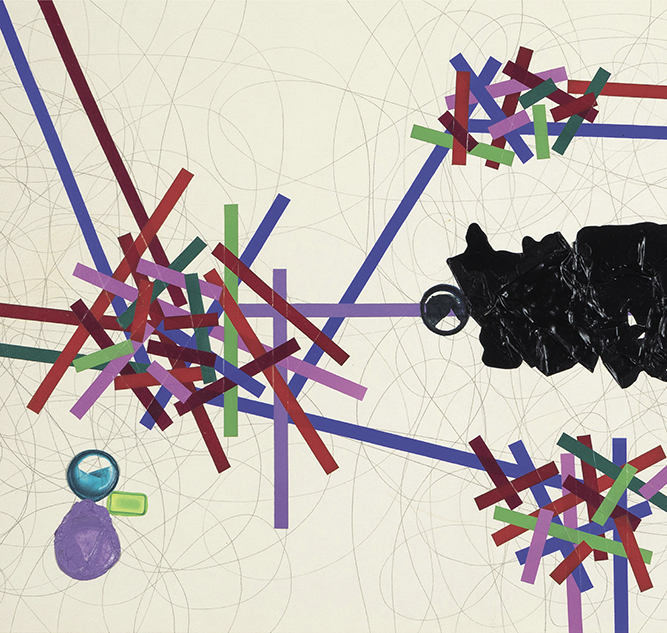
The second of the Met Breuer’s stated aims is to introduce American and New York audiences to underrepresented and unknown artists from across the globe. The museum’s first focus is on the art of India. While both the music and film presented by Vijay Iyer have a 1960s, improvised feel, not at all in a bad way — think McCoy Tyner playing in front of an old travelogue of India recut in novel and interesting ways — they don’t feel exactly contemporary. But the retrospective of the linear abstractions of Indian artist Nasreen Mohamedi are a small revelation. The few examples you see on these pages, when I first saw them, made little impression on me; a gallery full of Mohamedi’s works (as opposed to a gallery full of the works of many other artists) multiplies one’s interest in her practice, which spans Gorky and Malevich, hints at Burchfield, and ultimately takes off in simple, yet otherworldly forms.
Room leads us to space and to a consideration of the building: Marcel Breuer’s Whitney, now Marcel Breuer’s Met, art’s house. A fellow journalist, one I had never met, opened with the following as he looked around, “I don’t know, I’m thinking Whitney.” Director of the Met Thomas Campbell echoed the sentiment, saying, “We treated the building as a work of art,” describing how it had been restored to its original state and glory and remarking that all the gum had been removed from the holes and fissures in the poured concrete walls. Whatever the building had become as the Whitney had grown and changed, the day-to-day history of the place had been erased, making Met Breuer a museum object, an edifice worthy of the world’s architectural museum. As an important product of its time, it is worthy of restoration, but the heavy concrete of the walls rubs against the grain of the Met Breuer’s intentions.
Two things take you outside those Cold War walls. One, a happy holdover from the Whitney, is Charles Simonds’s “Dwellings,” miniature settlements — one tucked inside the museum, the other seen through a window across the street from the museum. I will let you discover their joys on your own. The other is John Luther Adams’s composition from crowd-sourced sounds of the city, “Soundwalk,” which is meant to be listened to as one strolls between the Met and Met Breuer. There is an Uptown version and a Downtown version (I prefer the jackhammers and sirens in Downtown), but both have an eerie, ambient quality, articulating a sonic vision both wonderful and terrifying as if heard through the vacuum tube vantage of 1950s sci-fi. “Soundwalk” seems to get at what the Met Breuer wants to do — look back to see ourselves; look back to look ahead; take advantage of contemporary opportunities, such as crowdsourcing, to create art.
What we collect and why we collect, and how we present our collections to others is worth thinking about. What happens when we make an antique, one which often had a function, into a work of art? What happens when a work of art becomes a commodity with a cultural as well as a monetary value?
In a magnificent speech voiced by Peter O’Toole, the malevolent food critic Anton Ego in the animated film Ratatouille (a performance that should have won O’Toole an Oscar, and a speech that should have won every screenwriting award that year), comes to the realization that being a critic — in the sense of one who finds fault — is easy, venal fun. But the real job of a critic, he concludes, is to seek out the new — “The new needs friends.” The Met Breuer might yet become a museum without walls and a friend to the new. Though those thick walls say otherwise, the doors might be thrown open, not to let the old light out, but to let new light in.
The Met Breuer is on Madison Avenue at 75th Street. For information, www.metmuseum.org or 212-731-1675.