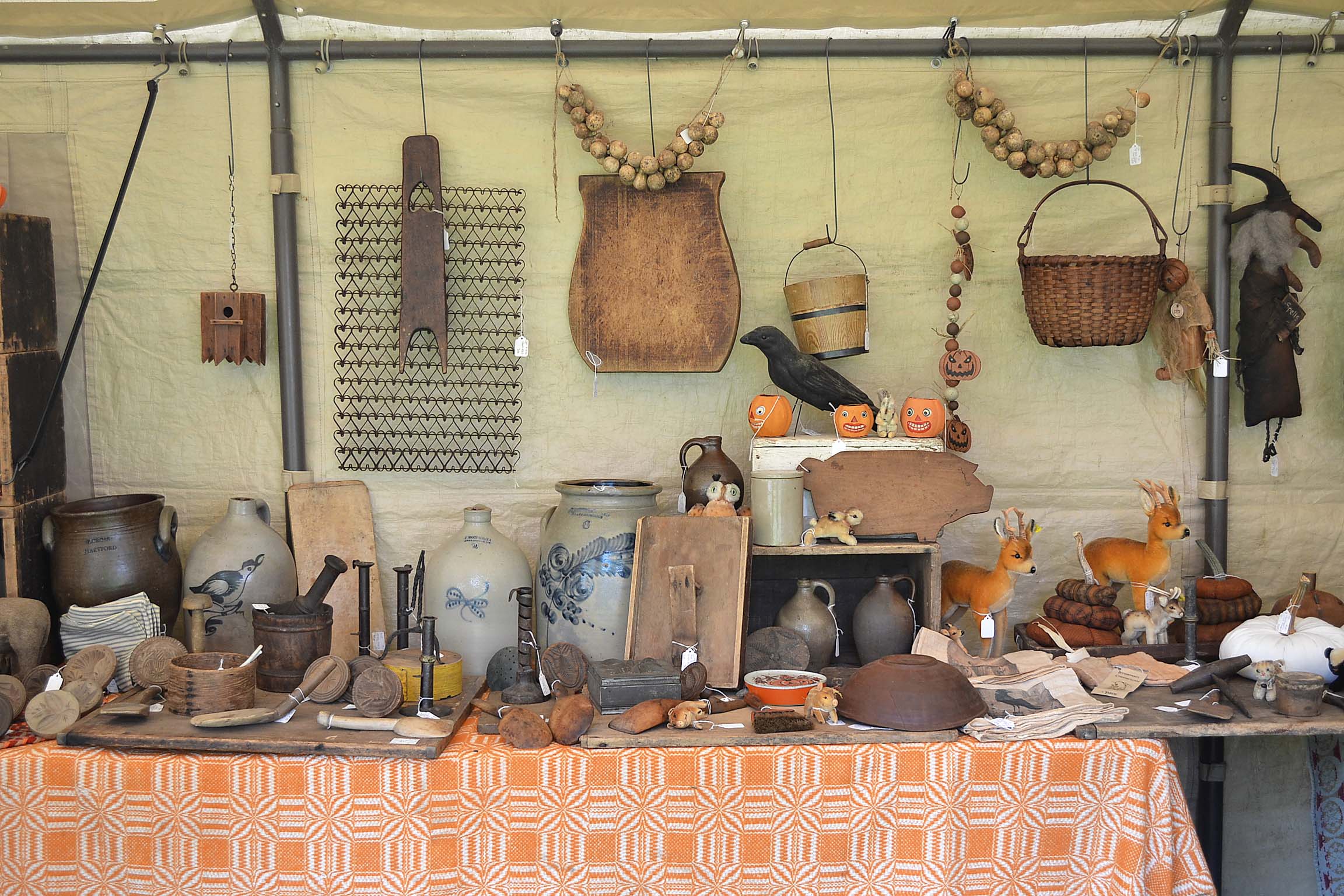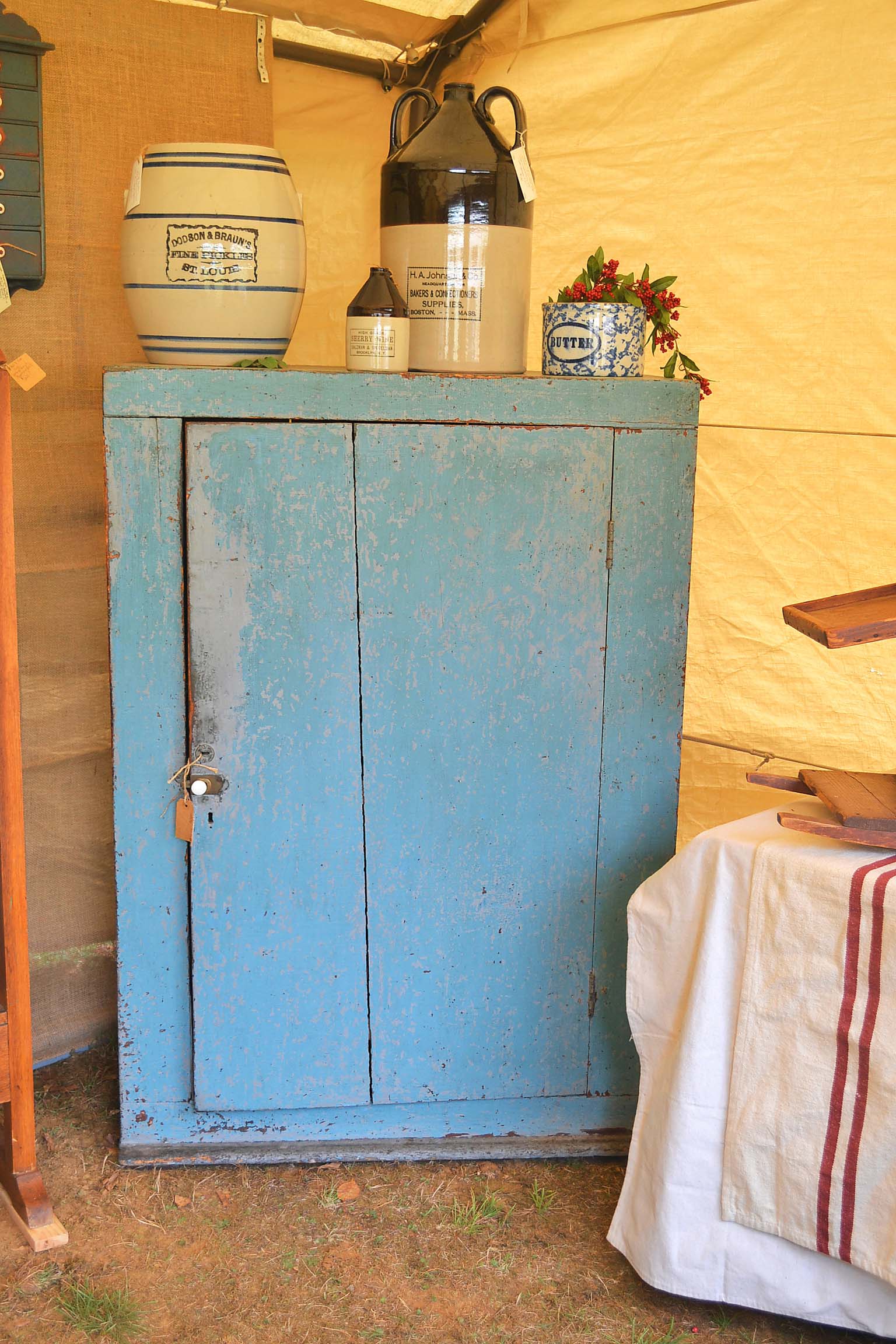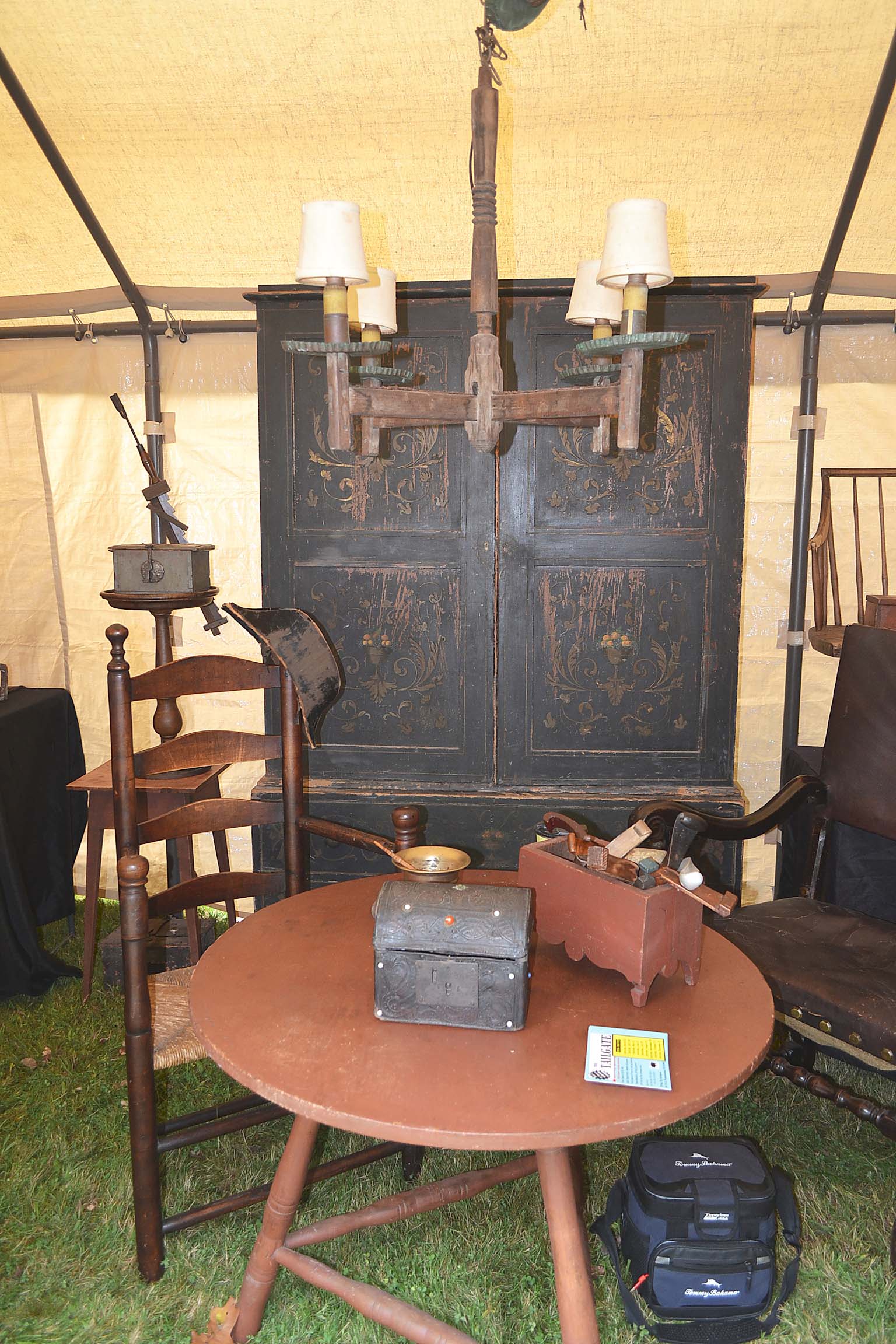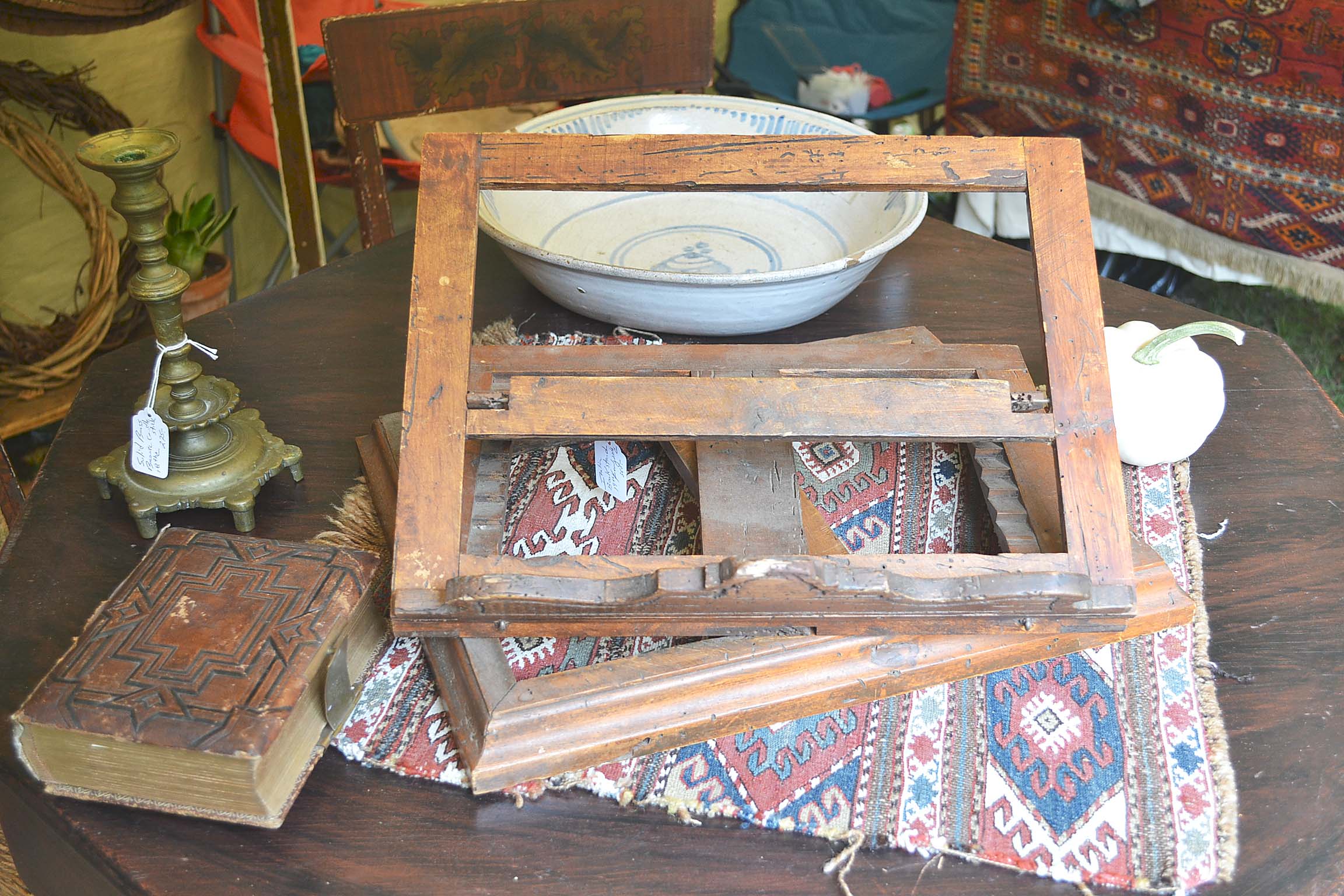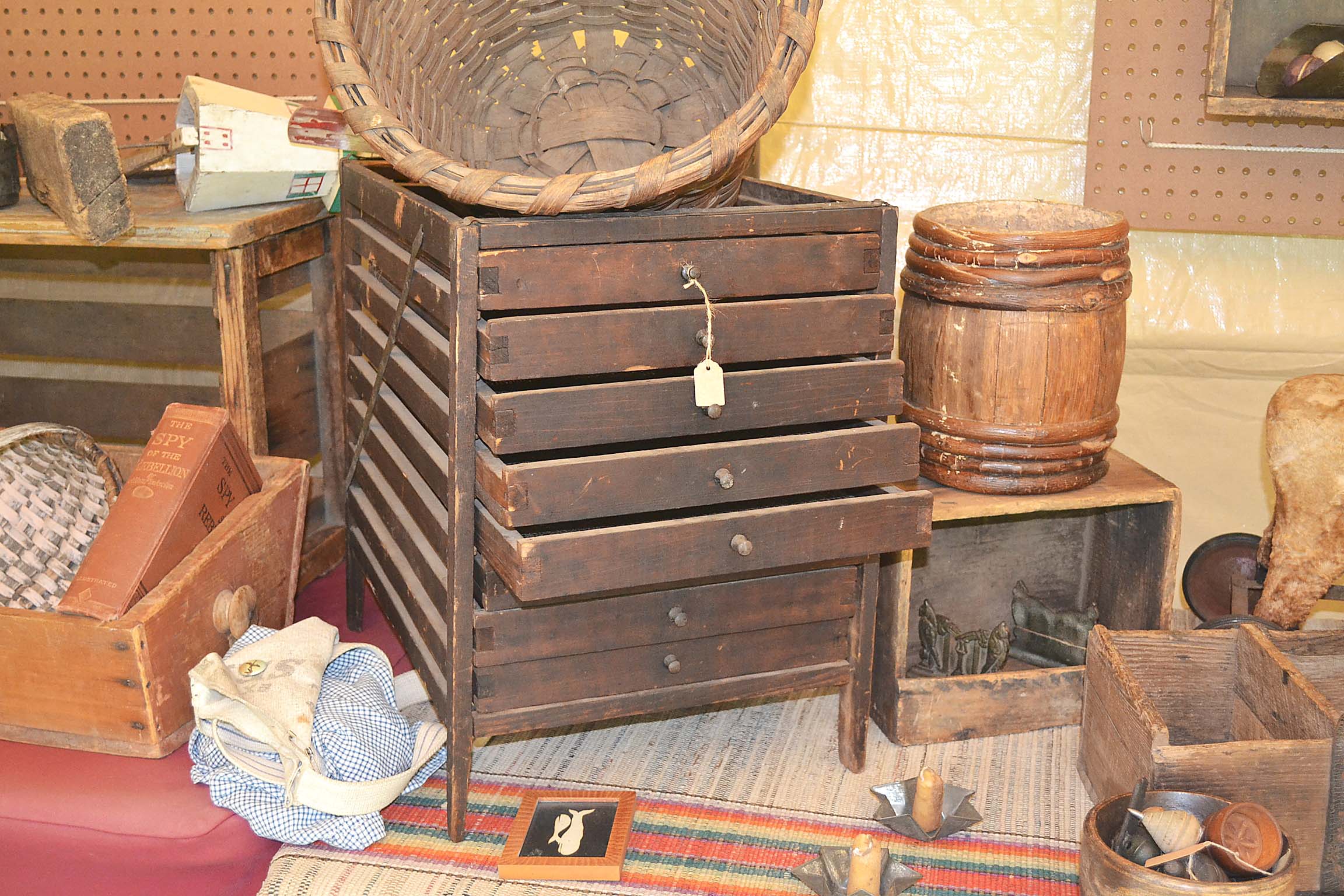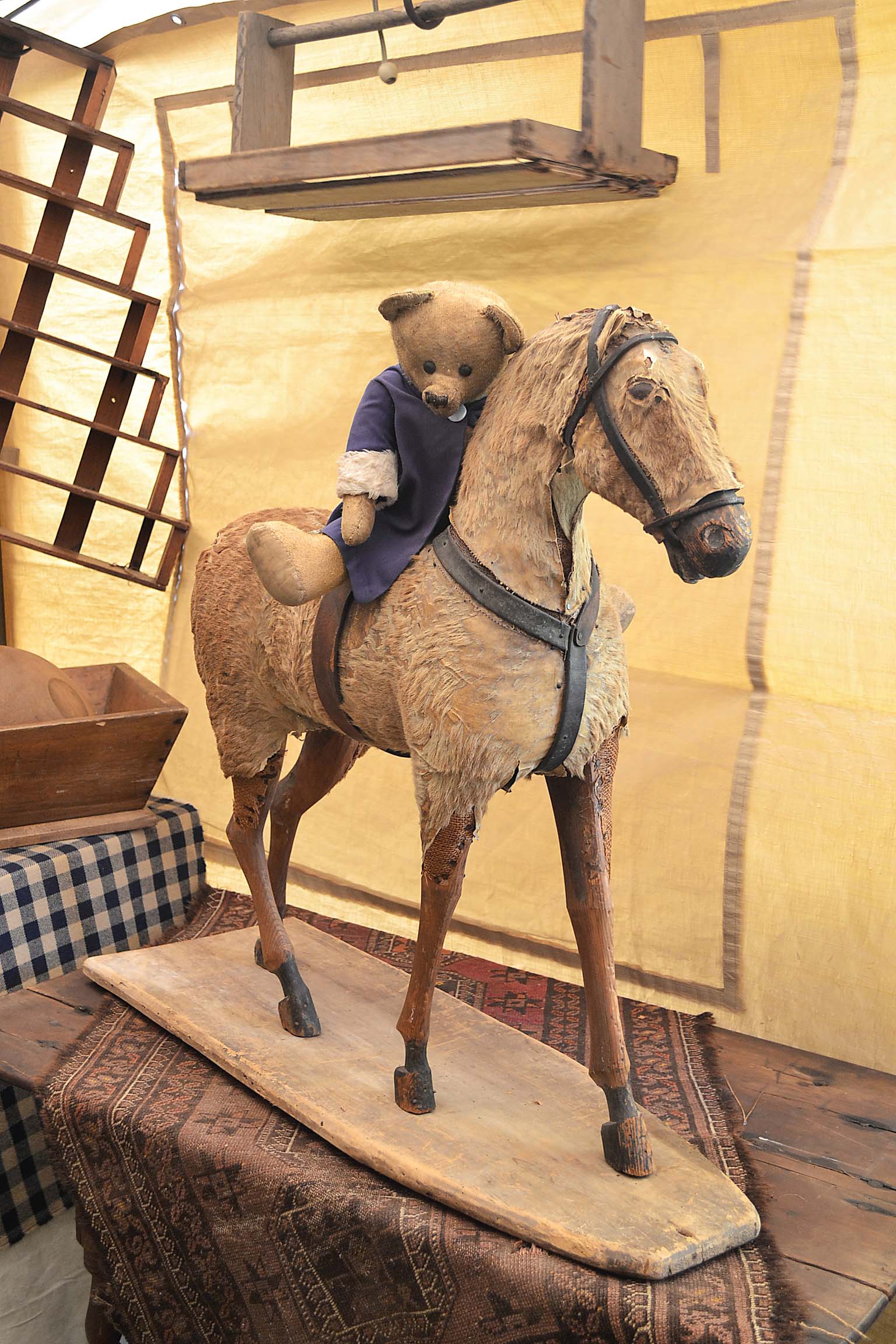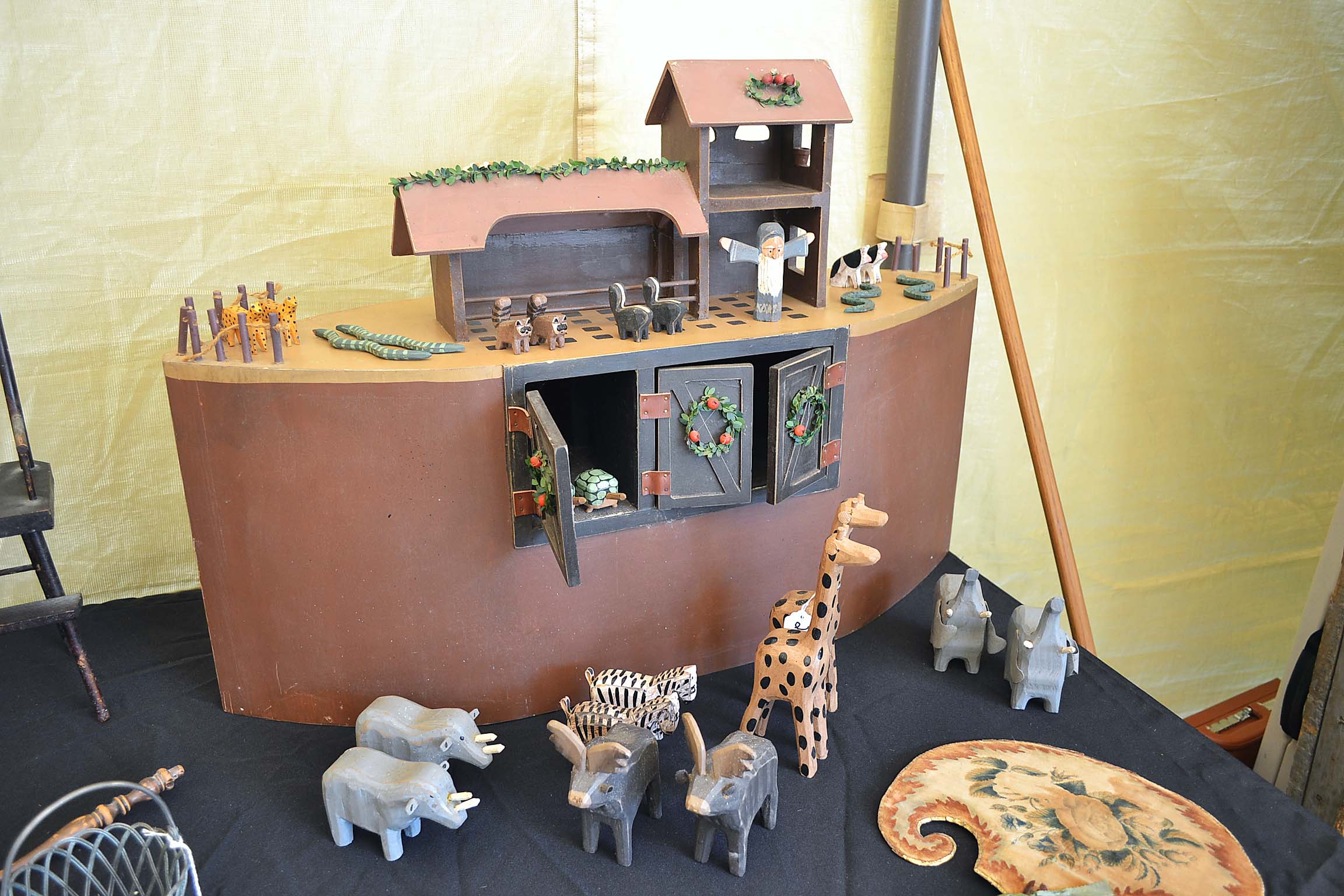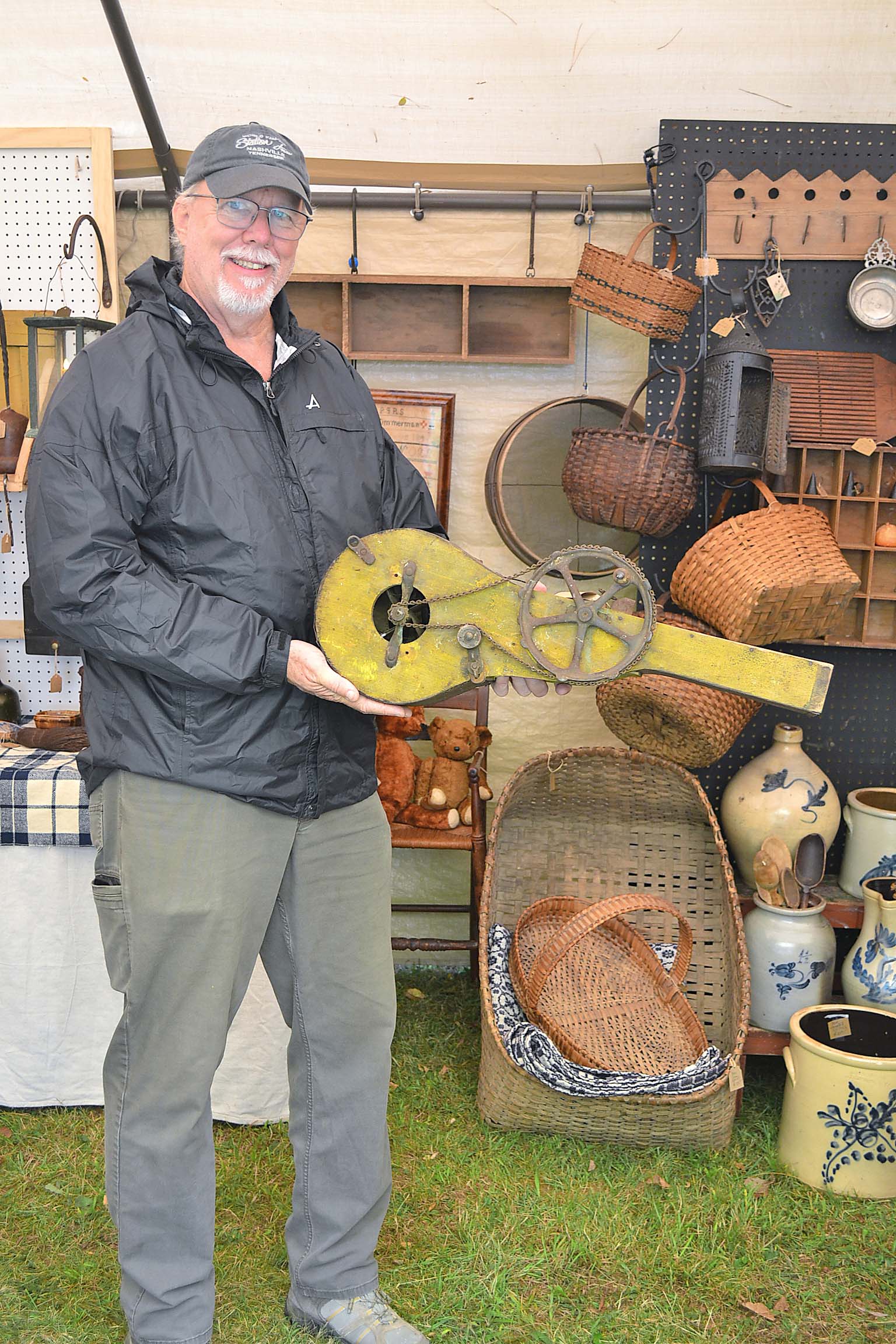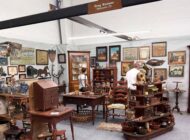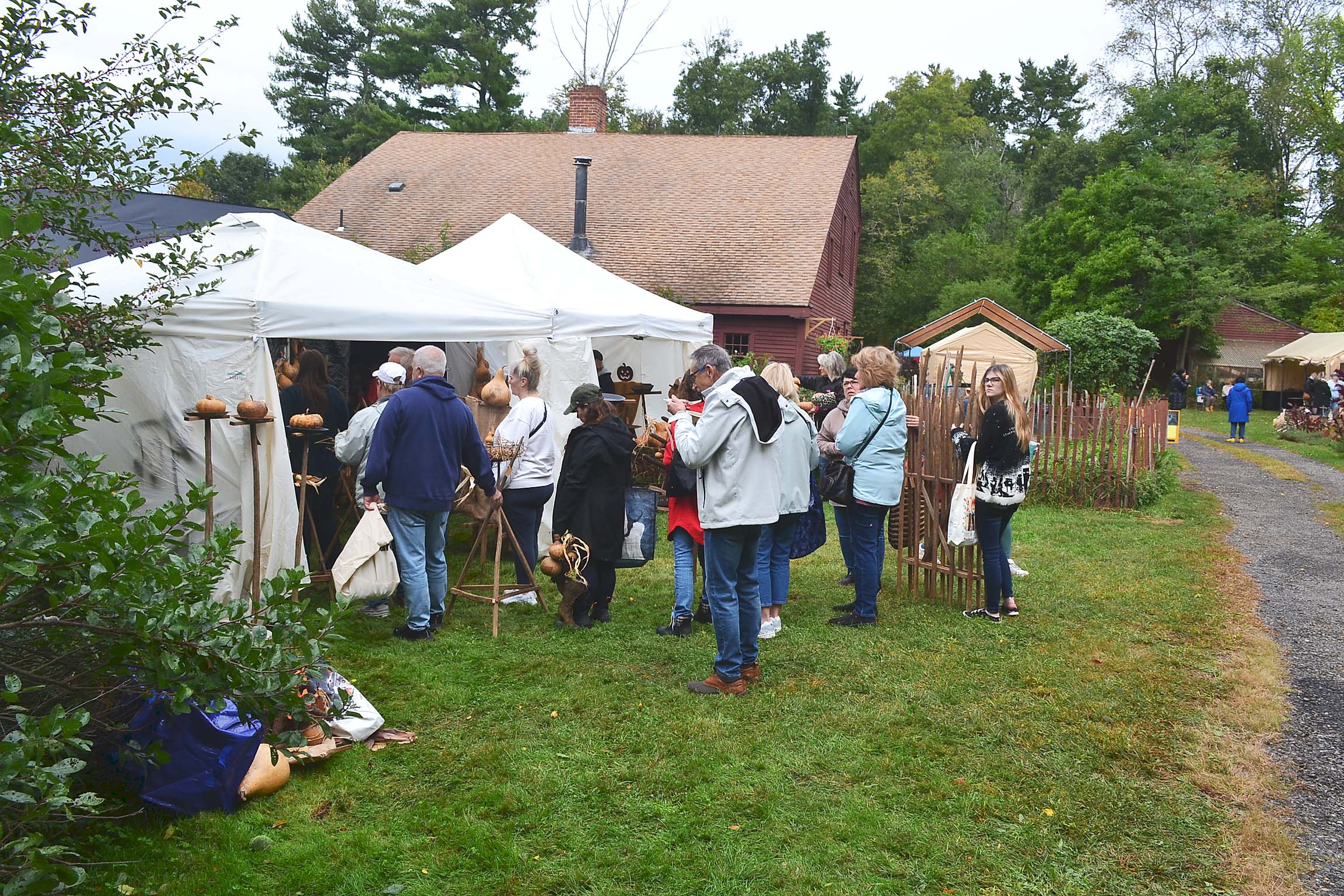
A line formed outside the tent of Milltown Primitives, run by Robin and John Rock. Throughout the morning, a steady stream of collectors queued up purchase X-frame fencing and other primitive landscaping décor. North Stonington, Conn.
Review & Onsite Photos by Jordan J. Estrada
BROOKFIELD, MASS. — At the 1698 Walker Homestead, dealers and collectors gathered to celebrate Walker Homestead’s 17th annual Antiques & Primitive Goods Show on September 26. Set on a picturesque 30-acre property that comprises part of the farm historically owned and operated by generations of the Walker family until the 1850s, present proprietors Kris and Paul Casucci welcome crowds to their home twice a year for an event that showcases early American primitives and rural collectables.
The beautifully kept grounds, rustic gardens, antique farmhouse and patinaed outbuildings were the perfect backdrop to display a plethora of attractive and unique collectibles. In keeping with the aesthetic of the venue, the vendor tents were canvas reproductions. They blended seamlessly into the atmosphere and almost lent a “historical reenactment” air to the event. Some vendors and visitors even wore vintage clothing, and modernity took a backseat during the proceedings.
Nestled a mere 15 minutes from Old Sturbridge Village, the largest outdoor living history museum in New England, the Walker homestead felt like an extension of this cultural and historical tradition — a neighboring property that also resurrects a vision of life in Eighteenth Century America.
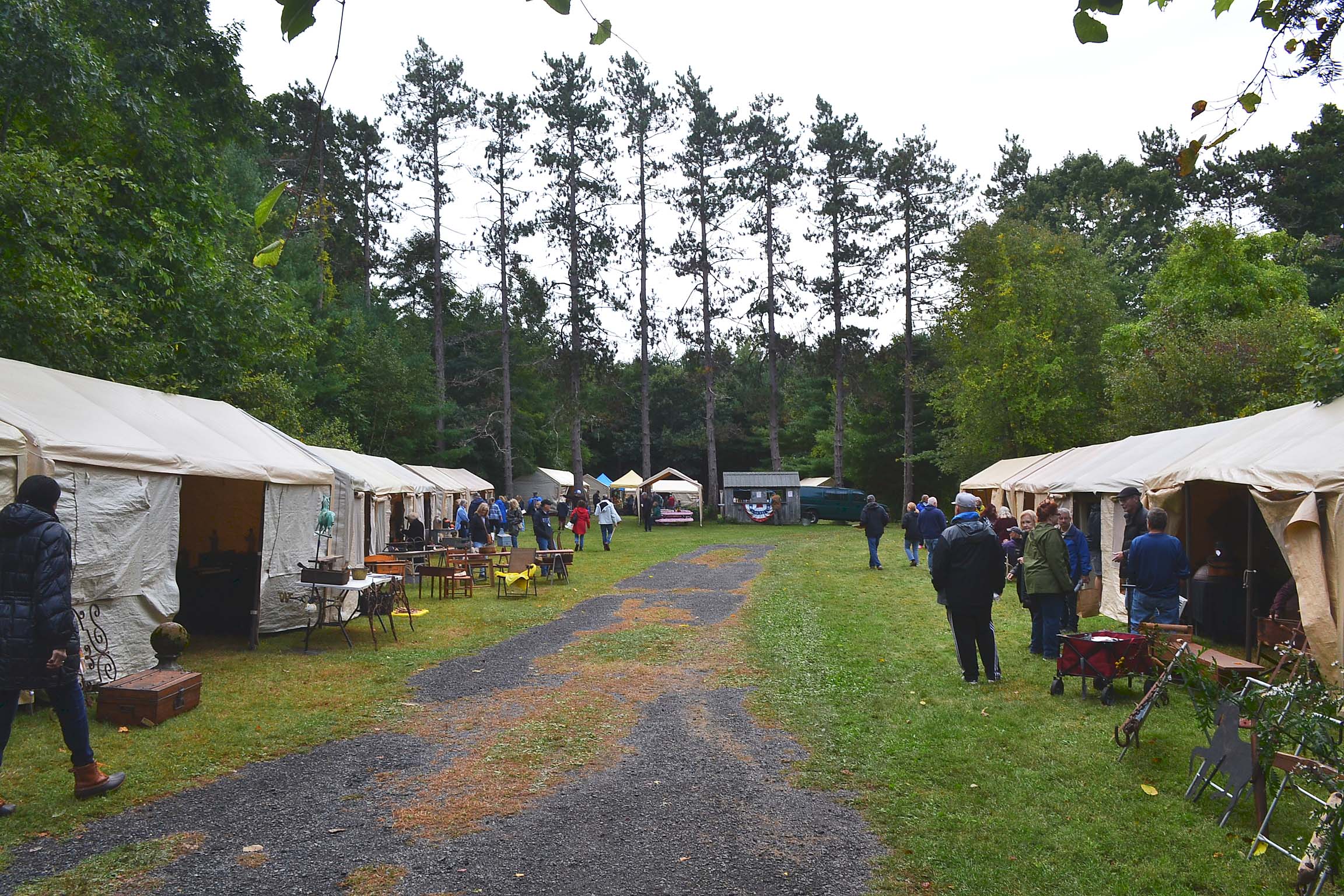
On the beautiful grounds of the 30-acre historical Walker Homestead, canvas vendor tents lent a “historical reenactment” air to the proceedings.
Rising to the challenge and the high standard set by the homestead, 35 vendors brought forth their treasures of bygone everyday life to the show. Each show has its own unique atmosphere, and the combined effect of the Walker Homestead setting and the immersion in historical goods make this event feel like a leap back in time.
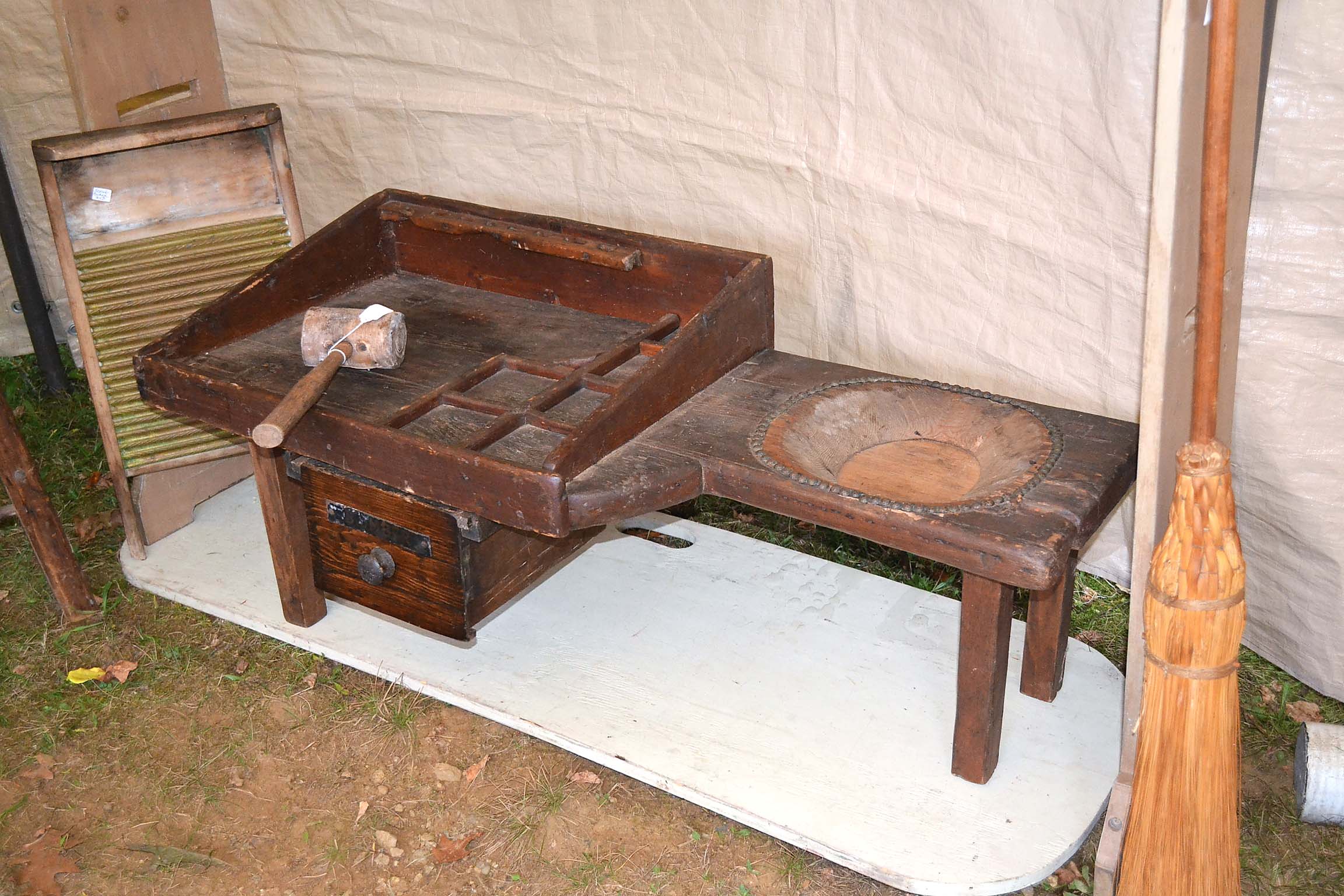
In one tent, Sue Wirth, Union, Conn. displayed a Seventeenth Century cobbler’s bench in excellent condition. The bench, which included a workspace, parts trays, and supplies drawer, also came with a leather seat and a rolled leather hammer. A painted metal nameplate with the name “B. Umber” was nailed to the side of the bench. This potential inclusion of the cobbler’s name makes the bench even more unique — Umber is a rare surname rooted in English history. In some cases, it has evolved as a variant of the location Humber, a tidal estuary on the east coast of Northern England. In other cases, it is derived from the Latin word “umbra,” meaning “shadow” or “shade.” Regardless of the origins, there’s no surviving record of an early American cobbler named B. Umber — meaning this worthy bench could be the last remaining fingerprint of a craftsman’s life and story.
Todd and Katelyn Gerry of Duck Pond Antiques, Shelburne, Mass., brought some unique folk-art pieces, including a hand-carved wooden Tramp art heart, estimated to date back to 1870. This specimen featured original distressed red paint over wood. Created to serve as a centerpiece or display board, this carved heart was unique due to its large size and the uniformity of the hand-carved detailing around the beveled edges.
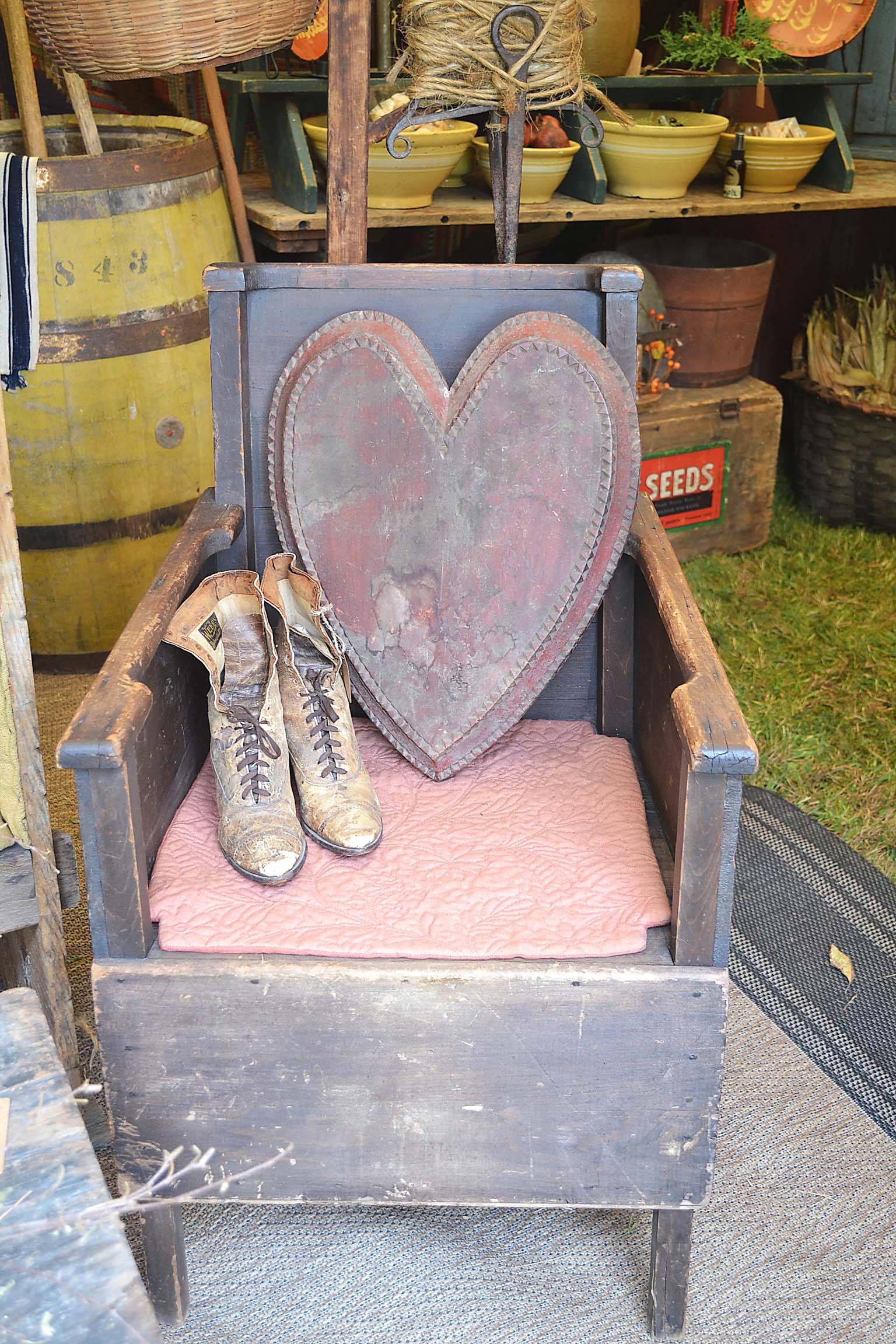
A hand-carved wooden Tramp art heart, estimated to date back to 1870 was offered by Todd and Katelyn Gerry of Duck Pond Antiques, Shelburne, Mass.
Shortly after the show started, a line began to form outside the tent of Milltown Primitives, run by Robin and John Rock of North Stonington, Conn. The couple offered a large collection of X-frame fencing and other primitive landscaping décor. Throughout the morning, a steady stream of collectors queued up with fence sections in hand for purchase, making this one of the most popular booths of the show.
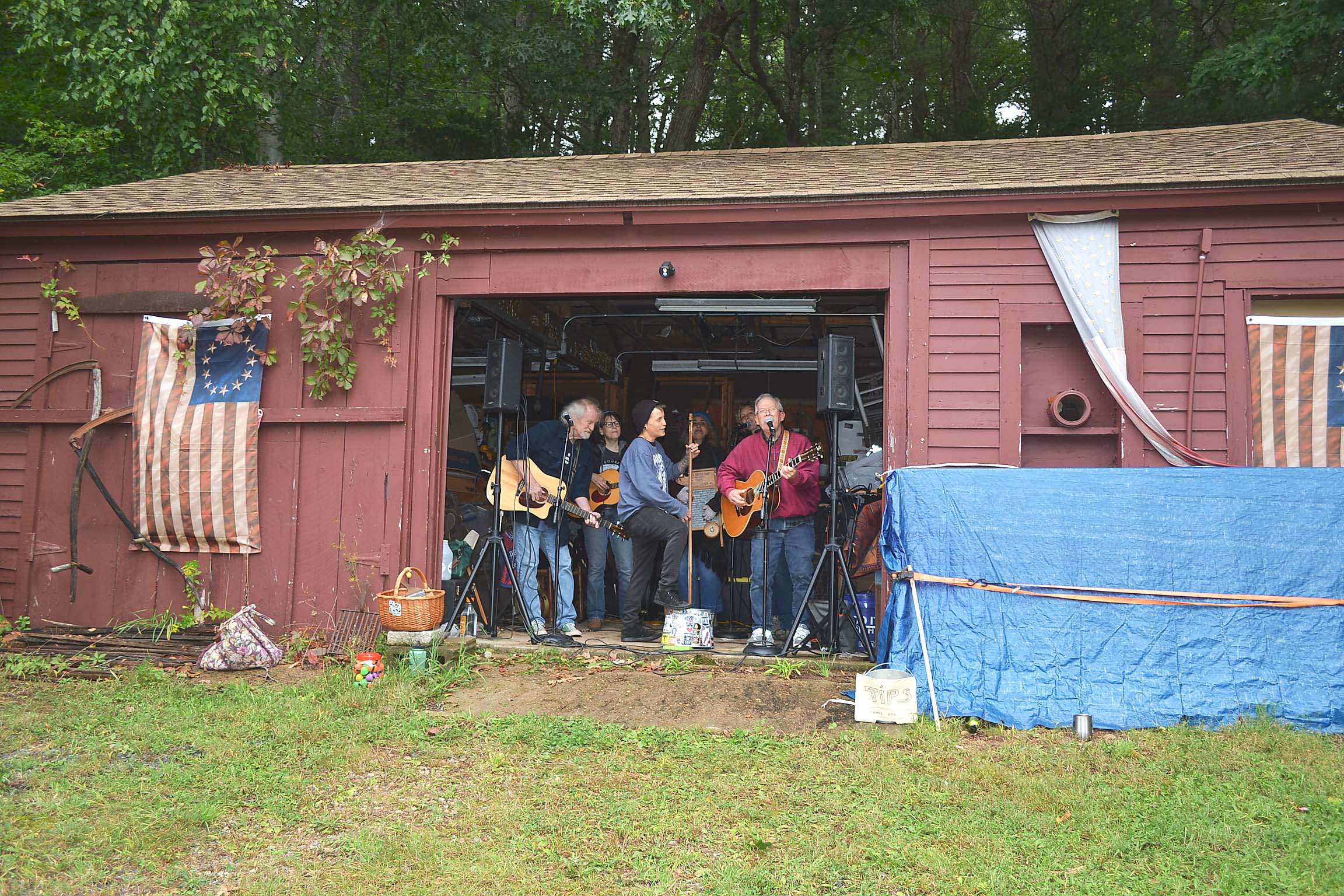
The event also included food and refreshments, with apple crisp and seasonal beverages available at multiple points on the property. Live music was provided by the Wormtown Mugwumps, a “home-grown jug band” from Worcester, Mass. Throughout the day, they entertained the crowds with lively folk tunes from one of the property’s many historic outbuildings.
The Walker Homestead’s Antiques & Primitive Goods Show is advertised as a juried antique show — a type of exhibition where experts review and screen vendors and their items beforehand to ensure high quality, authenticity and adherence to specific historical guidelines. In this case, the standards were early country antiques and handmade primitive goods.
Despite this focus, there was some room for a few modern reproductions that served as a homage to the show’s source material.
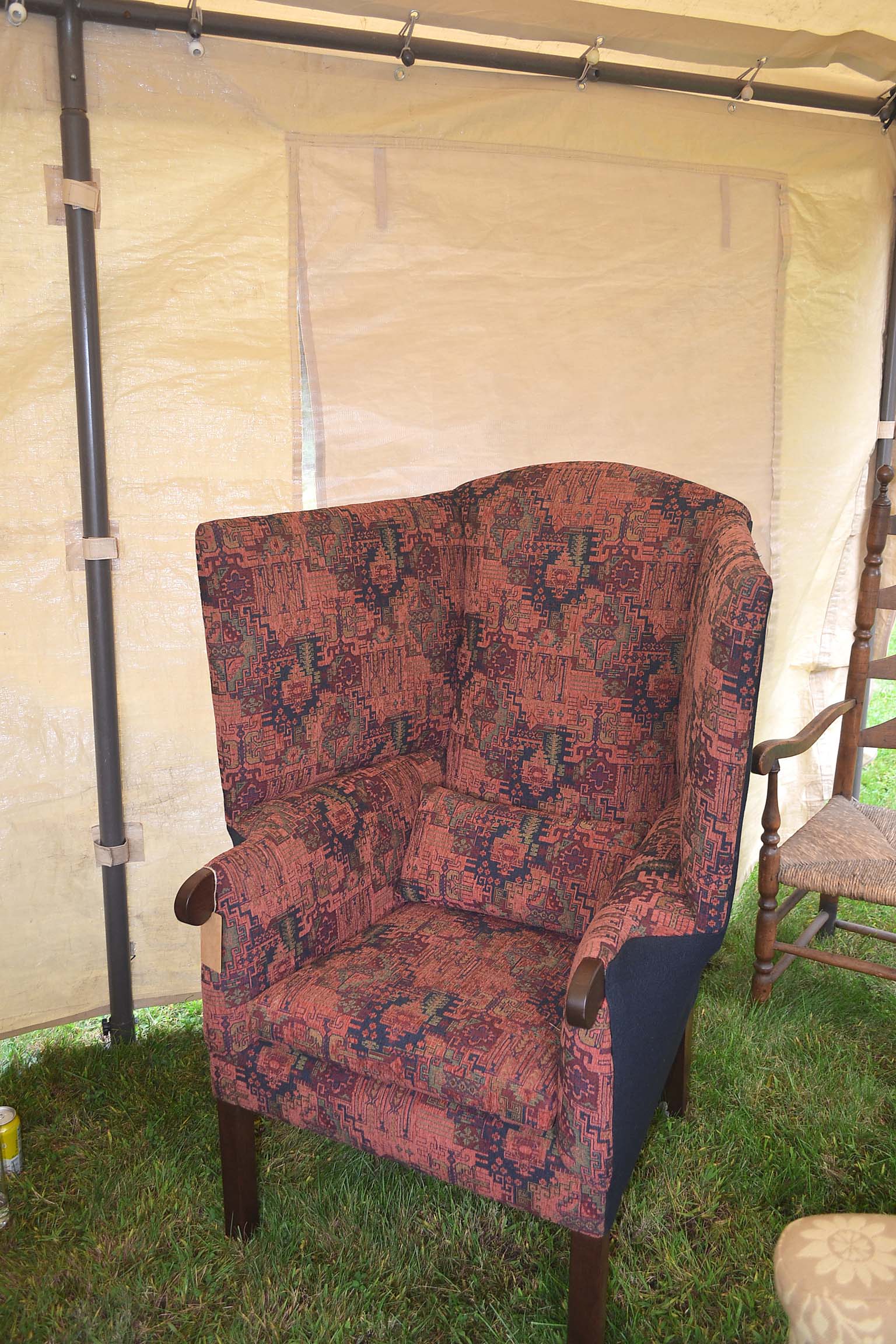
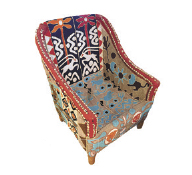
This pristine reproduction of an Eighteenth Century make-do chair was covered with fabric imitating a Tibetan rug pattern brought to the early Americas by a Nantucket whaler. It was created and displayed by Rosalind Blake of Angel House Designs, Brookfield, Mass.
Rosalind Blake of Angel House Designs, Brookfield, Mass., displayed a beautiful collection of reproduction early American chairs. These included classic wingback chairs alongside their close relatives, the make-do variants. Make-do chairs were constructed by adding wings and upholstery to a plain ladder-back chair, allowing lower-income families to DIY their own wingback chairs. For Blake, it isn’t just the function that’s reproduced — she also works meticulously to recreate the color, texture and pattern of each piece. In one case, her chair used a fabric imitating a Tibetan rug pattern brought to the early Americas by a Nantucket whaler and explorer.
Brett Cabral, Salem, N.H., also brought a homage to history with a collection of face jugs hand-made in the Southern United States around the turn of the century. These jugs — which feature grotesque faces in varying expressions — are a preservation and continuation of African American history. Originally created by enslaved potters, it is believed that these jugs were used as grave markers when enslaved peoples were denied tombstones, and to ward off evil spirits and guide souls to heaven.
Through their careful curation of vendors and the use of their historic home as the venue, the Casuccis have cultivated an experience that should be a delight and education for any history lover. However, this year brought an extra bit of suspense to the proceedings as the Casuccis faced weather that dominated local news for at least a week.
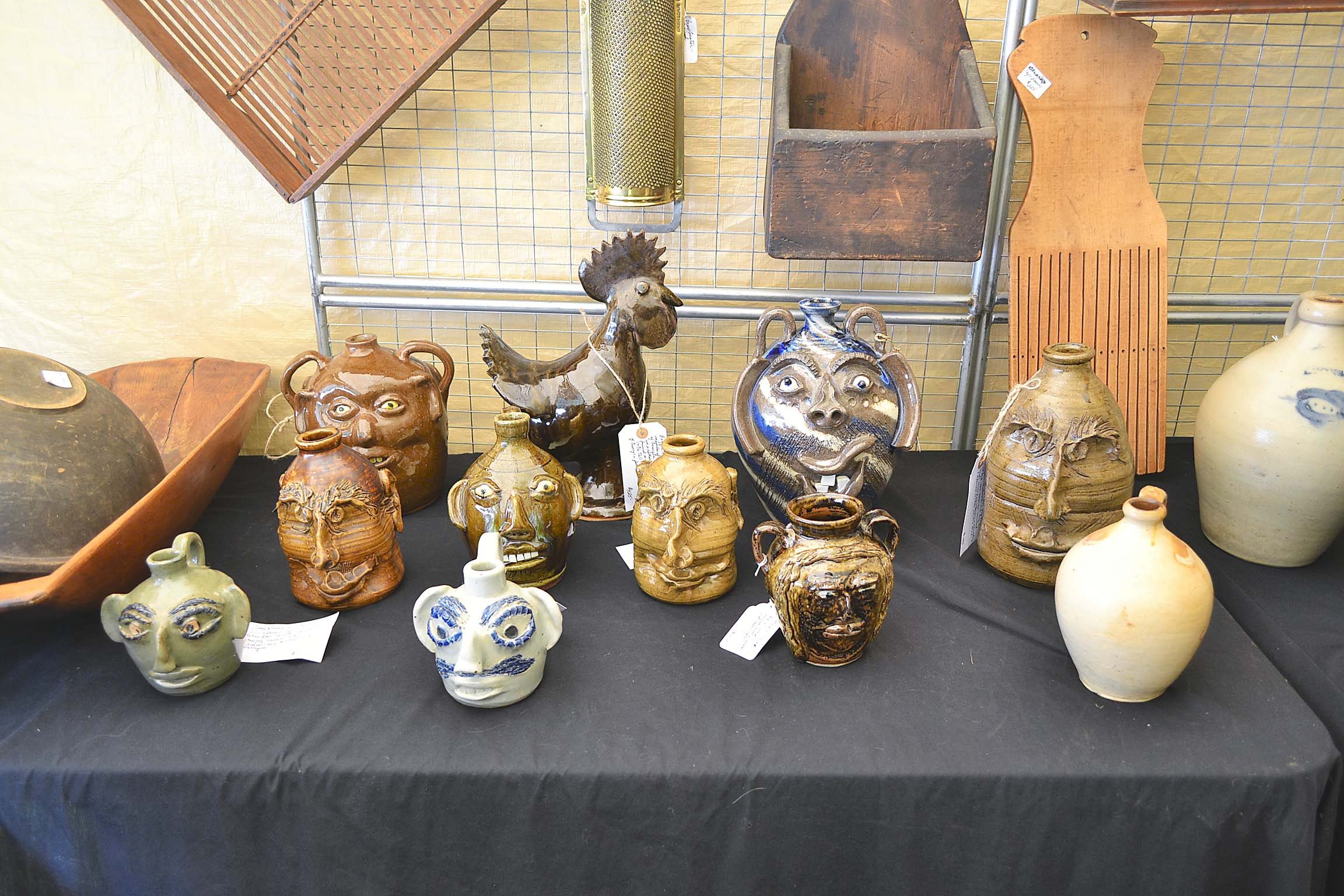
An assortment of face jugs hand-made in the Southern United States in the late 80s and early 2000s, was with Brett Cabral, Salem, N.H.
The show took place on the same weekend as New England’s first fall 2026 Nor’easter, a coastal storm that pummeled the Northeast over the weekend and into Monday. Yet on that Saturday morning, Brookfield experienced relatively quiet, mostly cloudy weather with light rain — in contrast to the 70-mile-per-hour winds, soaking downpours and flooding that were beginning to occur at other places along the coast.
Showgoers were quick to voice their admiration for the Casuccis’ bravery in maintaining the event, despite the forecast. “I’ll tell you what I’m most excited about,” said Paul Wendhiser, a dealer from Ellington, Conn. “We’re sitting here, and it is not pouring rain.”
“She gambled, and she won,” piped up another attendee, complimenting Kris Casucci on her decision not to cancel the show.
Fortunately, the power did not go out at Walker Homestead at any point during the show. But if it had, Jerrilyn Mayhew of Sandwich, Mass., was ready. Mayhew specializes in historic lighting and brought a large collection of primitive fixtures, including a cage candle, a rush light and rat de cave. Using the corkscrew raising-and-lowering method often associated with “courting candles,” this last light’s name is literally translated as “cellar rat.” It was a historic hand-held French candlestick designed for navigating dark wine cellars in the Eighteenth Century.
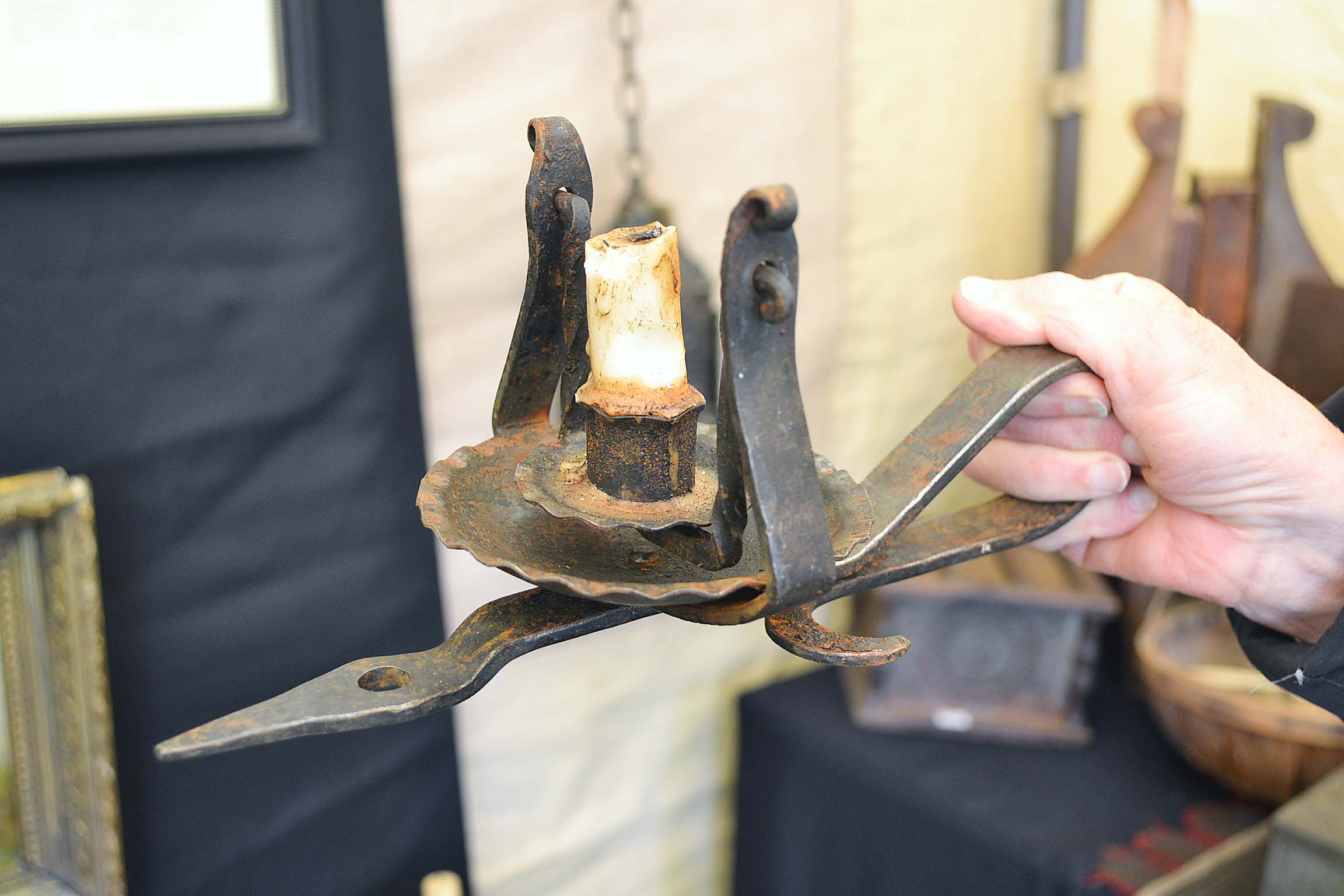
Jerrilyn Mayhew holds a ship’s gimbal candle from the Napoleonic age of sail. Woodsview Antiques, Sandwich, Mass.
Mayhew also demonstrated the use of a ship’s gimbal light from the period of the Napoleonic Wars. This innovative light could be hung as a wall sconce or carried by hand, with the candle mounted on a swiveling base, rotating to orient vertically when switched from the wall to the hand — or with the motion of a ship. All of Mayhew’s collection was well-preserved enough for present-day use — either for ambience, or as a trusty standby in a power outage.
“Happily, despite dire weather predictions, the show was rain-free and a wonderful opportunity for our customers to leisurely stroll the grounds and visit every tent,” said Mayhew afterwards. “The folks who decided to venture out were not disappointed! The offerings of Eighteenth and Nineteenth Century country and primitive antiques were vast and varied, and the selling was brisk. It just goes to show that a little weather will never stop an avid antiquer!”
Kris Casucci agreed: “It went well for everybody, all the dealers were happy, and we never got any rain. Most of the people who came were serious buyers — they were there because they love antiques and were passionate about it. It felt good overall, in spite of the weather.”
The Walker Homestead’s Antiques & Primitive Goods Show will return on June 19, as the spring edition is traditionally held on the Saturday of Father’s Day weekend. For information, www.walker-homestead.com.