PORTLAND, MAINE — “Why have there been no great women artists?”
American art historian Linda Nochlin posed the question 45 years ago in the January 1971 issue of ARTnews. It was deliberately provocative. Nochlin did not believe or argue that no woman artist had ever achieved excellence in her own work. Her point was that the art market and the discipline of art history — including, by implication, museums — had embraced a theory of “greatness” that, with few exceptions, not only favored the work of male artists, but effectively excluded that of women. Although her essay took a broad view of Western art history, going back to classical antiquity, she was keenly aware of the ways in which her own generation, as well as the one immediately preceding it, continued to face the same, centuries-old challenges, despite the promises of expanded freedoms for women and for artists.
The generation preceding Nochlin is the subject of “O’Keeffe, Stettheimer, Torr, Zorach: Women Modernists in New York,” on view at the Portland Museum of Art (PMA) through September 18. Organized by the Norton Museum of Art in West Palm Beach, Fla., where it first appeared, the exhibition, say organizers, invites visitors to explore works by some of the most significant Modernists in American art history: Georgia O’Keeffe, Marguerite Thompson Zorach, Florine Stettheimer and Helen Torr, all painters. And yet of these four — setting aside for a moment the fact that Zorach is widely known and revered in Maine — it is really only O’Keeffe who, historically, has been seen as “most significant” among Modern painters.
O’Keeffe, in fact, is often held up as a rare exception to Nochlin’s rule: a woman artist of undeniable greatness, a standout in a time of revolutionary changes in art that were, seemingly, otherwise dominated by men. But O’Keeffe was not so much the exception or the isolated genius that she may seem. She was far from the only woman making art in the Modernist idiom and participating actively in the machinery of the New York art world. In fact, the four featured artists were part of a community of creative, ambitious people who boldly and permanently redefined the parameters of art in America. As women, O’Keeffe, Stettheimer, Torr and Zorach also redefined — each on her own unique terms — their stake within this brave new art world.
Exhibition curator Ellen Roberts of the Norton notes that this show contributes to the larger discourse about the history of women in art by offering an enhanced focus on one particular time and place: New York between about 1910 and 1935. “The case study model works really well,” she explains, arguing that these artists’ individual — but interrelated — stories collectively reveal some essential truths about how women in art worked and were perceived at the time.
One central idea, Roberts says, is that the gender of these artists, for the most part, had little effect on the subject or appearance of their works, which are as vigorously “modern” as anything from the era. However, “gender does affect the way their art was seen, and that is true of all them in different ways.” The importance of the show, she says, lies in the fact that “if you don’t recognize that and tease out the way their gender affected their initial criticism, then that initial criticism still affects the way their art is seen today.”
Marguerite Zorach, for instance, was often seen as secondary to her husband, William, even though she had effectively introduced him to Modernism during their student years overseas, and her early, kaleidoscopic paintings were every bit as innovative as his. Painted in 1914, “The Garden,” long a mainstay in the PMA’s permanent collection galleries, is an ambitious synthesis of Fauvist color and form with an American setting. Later, Zorach adopted textile arts as a way to better integrate her artistic life with her responsibilities as a parent.
The textiles — represented here by a batik, a coverlet and a colorful and highly stylized handbag embroidered in wool— earned her acclaim and substantial commercial success, making her for a while the family’s primary breadwinner. At the same time they relegated her, in many critics’ eyes, to a “less serious” category of art. Perceiving Marguerite Zorach in this way may require a degree of psychic adjustment for viewers in Maine, where the Zorachs summered and where she has long been collected and celebrated in her own right.
Married to leading Modernist Arthur Dove, Helen Torr experienced similar challenges. Like the Zorachs, Torr and Dove often exhibited together, but Torr was regularly given a smaller, secondary space and correspondingly treated less seriously by the critics. This was persistently true throughout her career, despite the obvious virtuosity of works like “Oyster Stakes” of 1930, which ripples with energy in defiance of its limited palette and otherwise traditional seascape subject.
By all accounts, both Torr and Marguerite Zorach enjoyed happy marriages, and their husbands supported and enthusiastically promoted their work. Yet both, in different ways, put their own careers in deferential positions to those of their husbands. While Zorach took on the primary child-rearing responsibilities for her family, Torr, who did not have children, set aside her own work for a period of time each year in order to help Dove get ready for his annual exhibition. After Dove became seriously ill in 1938, Torr completely curtailed her own professional work and devoted herself fully to taking care of him and promoting his artistic legacy.
Most famously, Georgia O’Keeffe both battled and participated in gendered perceptions of her work. From the moment she entered the scene as a protégée — and, eventually, lover and wife — of photographer/dealer Alfred Stieglitz, her work was cast as fundamentally “female” and by definition sexual. Her early charcoal abstractions were promoted by Stieglitz as the product of O’Keeffe’s womanhood rather than her intellect and thus somehow representative of the art of all women. O’Keeffe was ambivalent about such interpretations but seems to have seen them, to some extent, as the cost of doing business in a male-dominated world of critics, patrons and gallery owners.
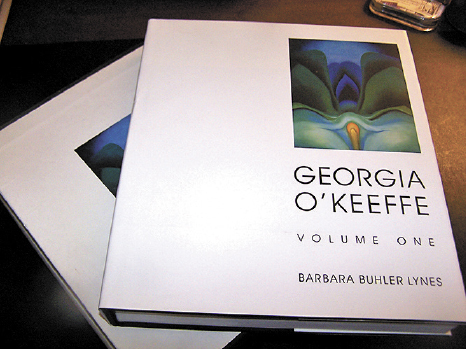
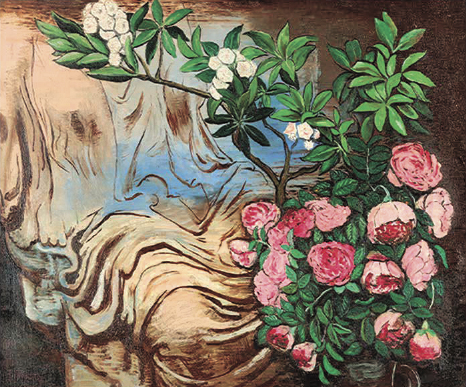
The gendered perception of her work did not lessen as she went on to achieve fame for the intimate closeups of flowers that she herself described as “magnificently vulgar”; her acclaimed Jack-in-the-pulpit series is a defining example.
Of the four, Stettheimer was the only one who did not have a male partner who was also an artist and who was actively involved in her career. Her work also seems very different from the other three. It is, as exemplified by “Spring Sale at Bendel’s,” from 1921, ornate, exuberant and gloriously excessive, with little of the sparseness and angularity often associated with American Modernism. Both Roberts and Jessica May, the PMA’s chief curator, observe that Stettheimer enjoyed freedoms that the other artists in the show did not. She was not only single, but wealthy, which meant that she was not under the same pressure to sell her work. Roberts observes that Stettheimer saw her work more as an outlet for intimate, personal expression and less “a part of that more masculine, public world of art.”
She remained prolific as well as deeply engaged with the scene. Together with her sisters, with whom she was very close, she hosted a salon at which the Zorachs and O’Keeffe were regular attendees. Still, she did not court commercial success. Roberts observes that Stettheimer’s confounding independence has led many critics and scholars to characterize her as “shy” or “timid” — readings that are both partial and gendered and that minimize her real contributions.
Is it still important to host exhibitions dedicated to the work of women artists? That question emerges today as a corollary to Nochlin’s question from 1971. “It’s a key point,” says Roberts, adding that “none of these women [in the present exhibition] wanted to be seen as women artists; they wanted to be seen as artists.” O’Keeffe, for instance, declined to join the New York Society of Women Artists that Zorach had founded — presumably because she had already tired of being set apart by gender. Does including her — and her colleagues — in an exhibition dedicated exclusively to “woman artists” exalt them or exclude them, presenting them as merely a footnote in the larger history of art and Modernism?
In response to this question, both Roberts and May pointed me to a recent interview with Helen Molesworth, chief curator of the Museum of Contemporary Art in Los Angeles, who responded frankly to a similar question from The Art Newspaper. “People always stay ‘still today’ as if something happened to change the patriarchal system that we live under,” she observed. “Unraveling centuries’ worth of discrimination doesn’t happen overnight, or even within decades.”
May agrees, adding that part of the exhibition’s importance lies in “excavating those histories” of women whose work was not fully recognized in their own time, O’Keeffe again being the exception. Forty-five years ago, Nochlin raised an eyebrow at the idea of “rediscovering” greatness in women artists of the past, arguing that the very exercise evades the question of why there were not more of them to begin with. Point taken. But this exhibition powerfully makes the case that the work of these four artists stands on its own in terms of aesthetic value and significance, and that the historical examination of the challenges they faced and the choices they made as both women and artists is central to understanding the history of Modernism itself. In May’s words, the show “marries the social moment with the artistic moment in a way that feels really important.”
“Women Modernists in New York” appears on the scene the same time as at least two other major exhibitions on similar themes, “Revolution in the Making: Abstract Sculpture by Women, 1947–2016,” through September 4 at the new Los Angeles location of Hauser Wirth & Schimmel, and “Women of Abstract Expressionism,” through September 25 at the Denver Art Museum. As a group, these exhibitions challenge the widely held perception that Modernism was, generally speaking, a boys’ club. By chipping away at the foundation of that fallacy while simultaneously shedding new light on works by Zorach, Torr, Stettheimer and O’Keeffe, “Women Modernists in New York” allows for a fresher and fuller view of American Modernism that is embedded in the social history of its time.
The exhibition is accompanied by a 160-page catalog published by the Norton, beautifully illustrated and engagingly written by Roberts, with a chapter dedicated to each artist.
The Portland Museum of Art is at 7 Congress Square. For information, 207-775-6148 or www.portlandmuseum.org.