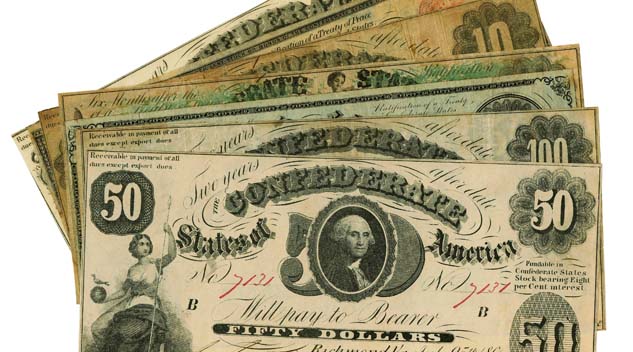
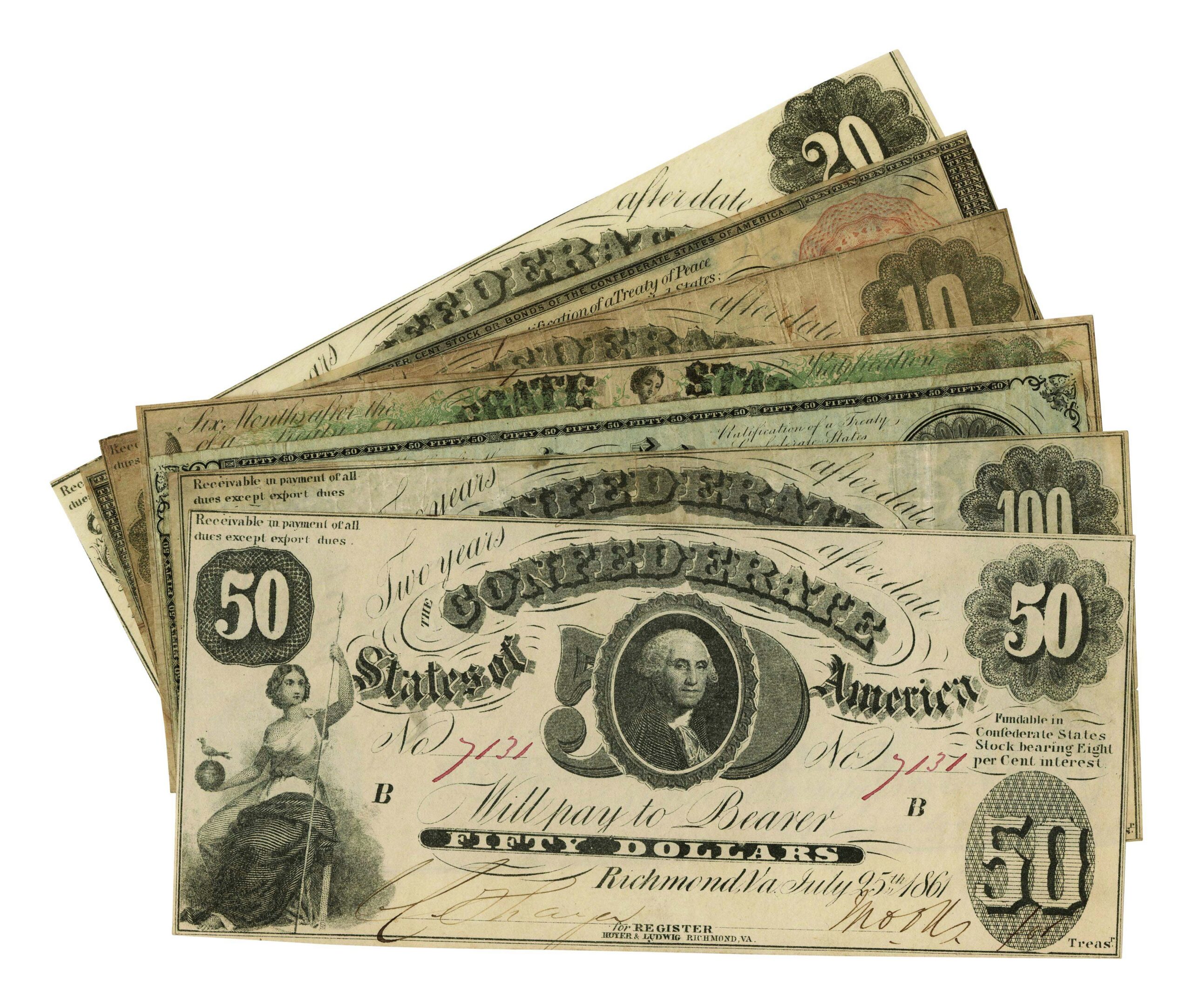
Comprising 57 bills, this lot of Confederate States of America currency, 1861-1864, reached the sale’s highest price of $7,500 ($200/300).
Review by Carly Timpson
PORTSMOUTH, N.H. — Featuring 228 lots of rare books, maps, manuscripts, prints, paintings, historic photographs and more from estates and collections across New England, Bray & Company’s April 25 auction of The Collector’s Cabinet closed as a resounding success. Only two items passed, resulting in a 99 percent sell-through rate with the majority of lots meeting or exceeding their estimates.
“It was a ‘real auction,’ no reserves, and we wanted to make sure the bidders understood that. It did well and exceeded our expectations,” said owner and auctioneer Derin Bray. “I was very pleased with the sale and thought it was strong overall, especially the paper items. And the consignors are pleased too!” A notable figure that Bray was excited to report was that this sale brought in 2,000 new registrants, a fairly large number considering it was only his eighth auction.
Rising well past its original face value, a collection of 57 Confederate States of America notes achieved the auction’s top result. The Civil War-era currency exceeded its $200/300 estimate to achieve $7,500. The bills, printed in Richmond, Va., between the years 1861 and 1864, spanned amounts from one to 100 dollars and were in a variety of designs representing Southern and allegorical themes. According to the catalog description, the 57 notes comprised “a broad and representative range of types from Criswell T-7 through T-72, including early issues, mid-war designs and late-war emissions.”
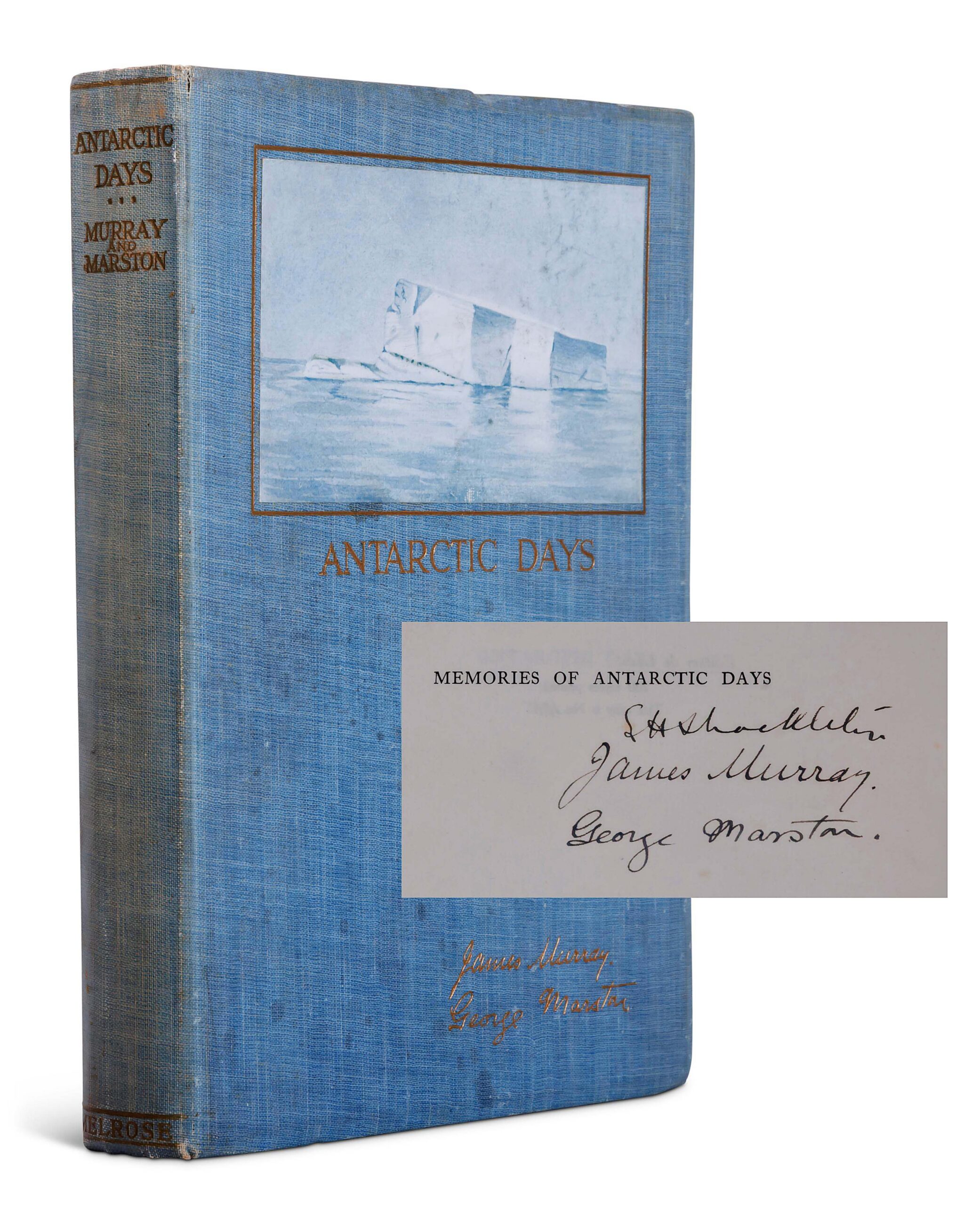
This rare edition of Antarctic Days: Sketches of the Homely Side of Polar Life, by Two of Shackleton’s Men by James Murray and George Marston, London: Andrew Melrose, 1913, was signed by Shackleton and his men. It more than doubled its high estimate to bring $6,875 ($2/3,000).
Collectors had another chance to score, as a set of four Confederate bank notes crossed the block just two lots later and sold for $5,625. The four in this set included three Criswell notes from 1861: a $100 T-5, a $50 T-6 and a $5 T-12. The fourth was a $500 T-64 that featured a round vignette of an equestrian statue of George Washington superimposed over a Confederate flag image to the left and a profile portrait of General Thomas J. “Stonewall” Jackson to the right. Bray reported, “All of the Confederate notes came from one collection assembled midcentury by a federal judge. It came to me how he maintained it. The top two lots went to one private collector.”
Achieving the sale’s second-highest price overall was a signed copy of Antarctic Days: Sketches of the Homely Side of Polar Life, by Two of Shackleton’s Men (London: Andrew Melrose, 1913). Written by James Murray and George Marston, this “Edition de Luxe” was number 105 of 280 copies printed. On the book’s half-title page, it was signed by Ernest Shackleton in addition to Murray and Marston. The rare collector’s item was bid to $6,875.
Bray said there were several lots in the sale that received so much interest before the auction that he knew they were going to do well, with bidding wars beginning ahead of the sale. One such lot was a vintage Hermès Kelly bag in black crocodile. The 1962 purse previously belonged to May Housman, mother of actor and director John Houseman, and was paired with May’s silver cigarette case and a small dish that was engraved “Smith Barney Chairman’s Club / John Houseman / 1984.” From the actor’s estate, the fashionable set topped off at $6,250.
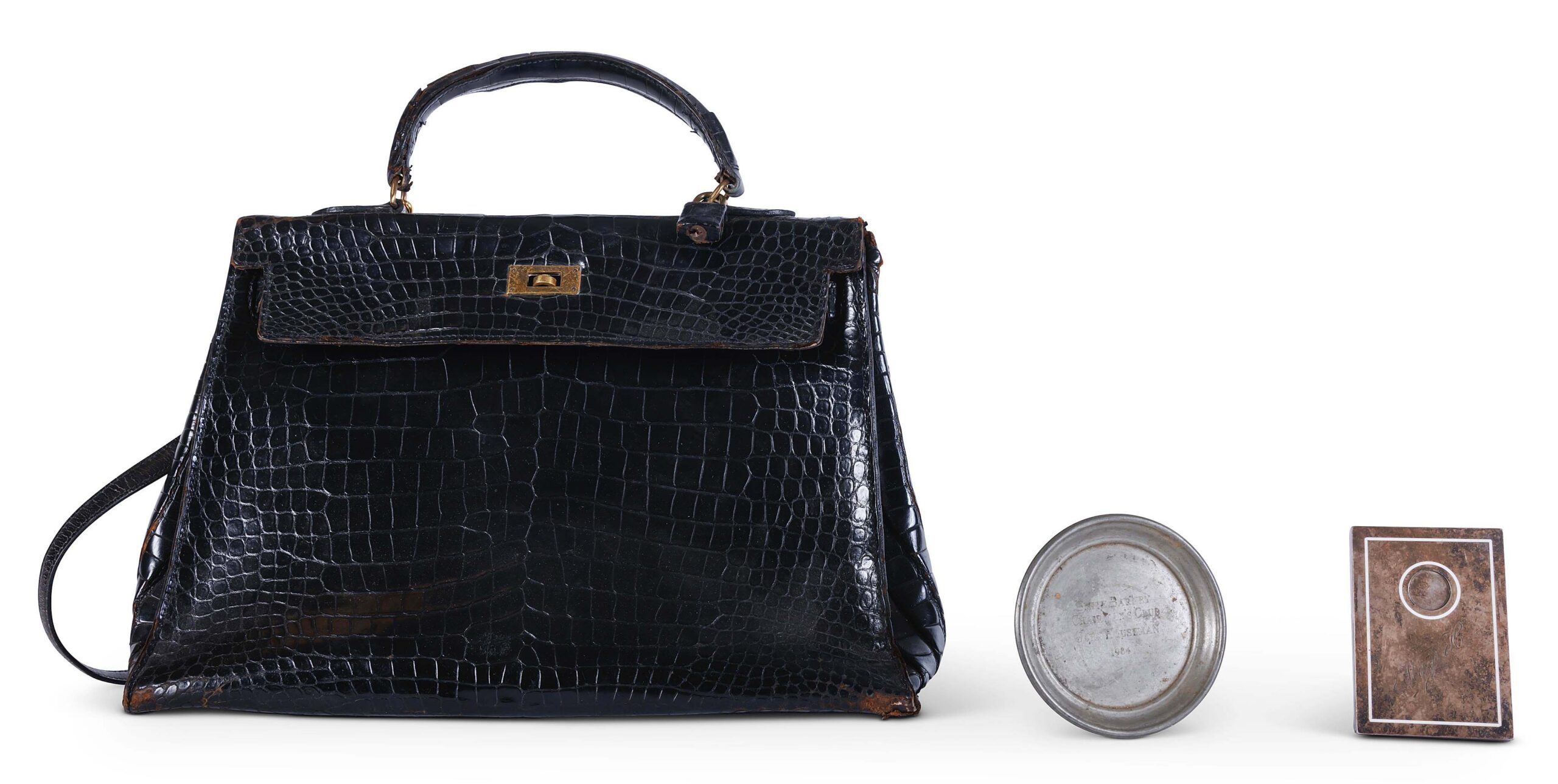
This 1962 Hermès black crocodile Kelly and silver cigarette case belonged to May Housman and came from the estate of her son, John Houseman; a dish of his was also included and together the lot achieved $6,250 ($1/2,000).
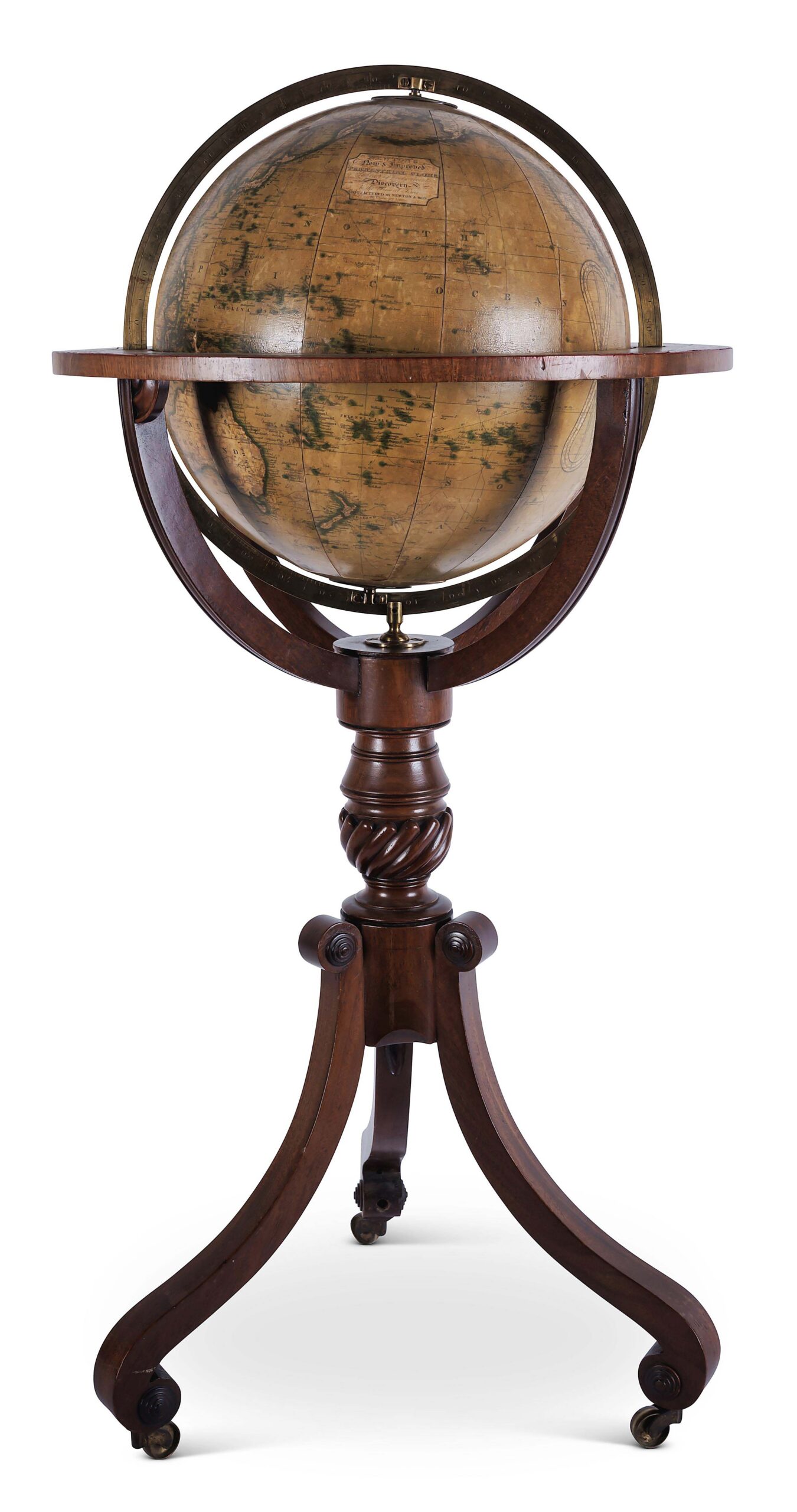
Another was a circa 1820 library globe by London makers Newton & Son. Titled “Newton’s New & Improved Terrestrial Globe” in a cartouche positioned in the North Pacific Ocean, the 17-inch globe was hand-colored in outline, featured a brass hour and meridian circles and was mounted on its original mahogany tripod stand. Though the original compass was not affixed to the stand, it was present with the piece. Bray explained, “The Newton globe descended through an old family. It originated in a collection in England, stayed in the same family and came over with descendants. That piece was exceptional — a beautiful example and it needed just a little TLC. A rare thing for sure.” After much pre-auction bidding and excitement day-of, the globe stopped spinning at $5,313.
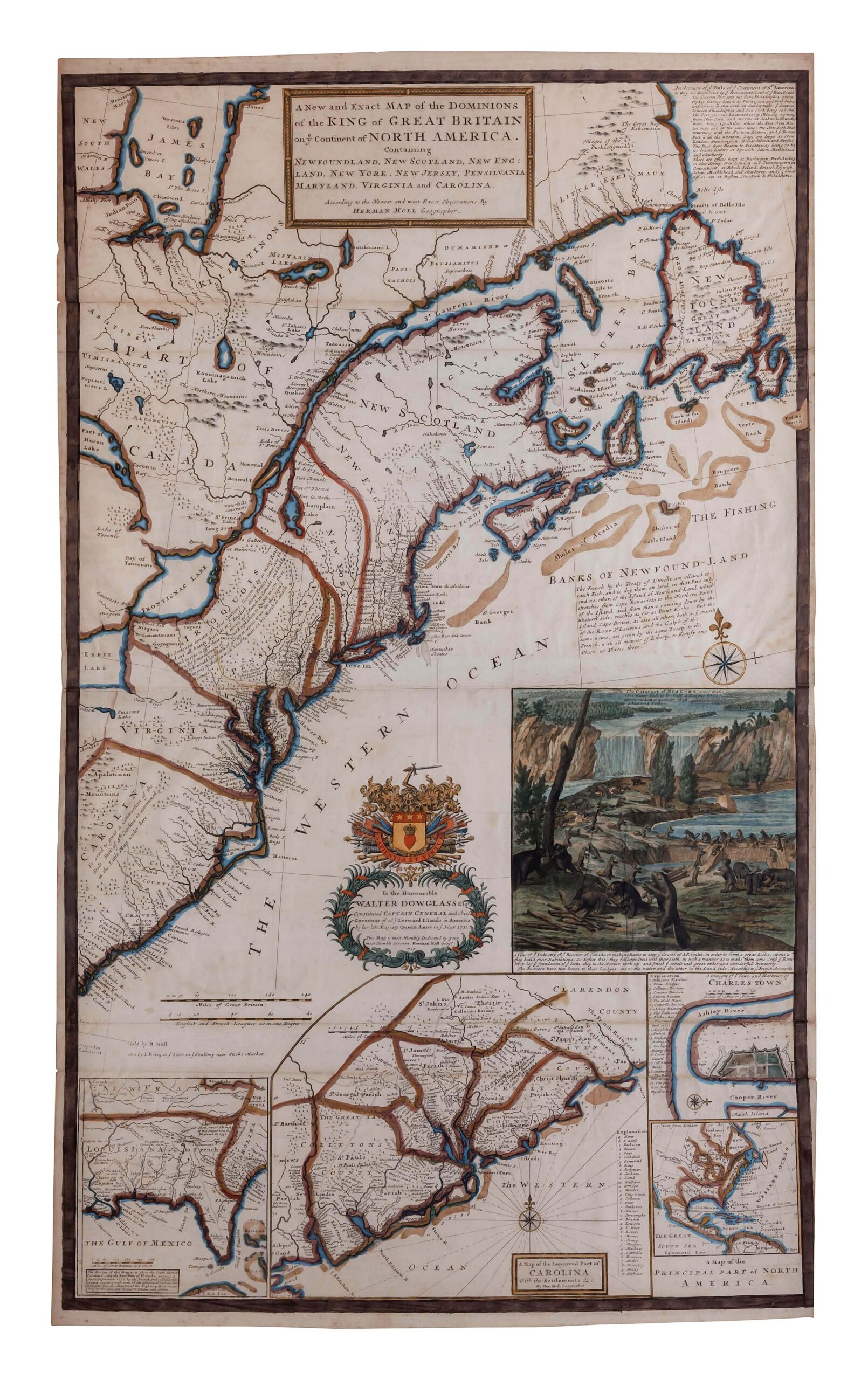
Cartography lovers also pushed a map of North America by Herman Moll to $6,250. Known fondly as Moll’s “Beaver Map,” the official title as written in a box at the top of the map was “A New and Exact Map of the Dominions of the King of Great Britain on ye Continent of North America containing Newfoundland, New Scotland, New England, New York, New Jersey, Pensilvania, Maryland, Virginia and Carolina.” The hand-colored copper-engraved map was printed on two joined sheets and published circa 1730.
For entertainment purposes rather than academic was William Sallis’ circa 1845 Picturesque Round Game of the Geography, Topography, Produce, Manufactures and Natural History of Various Countries of the World. This game included a hand-colored lithograph map and its original 32-page rule booklet, both of which folded into original green cloth covers. Bidders played the game to $3,750.
With a map that measured 20½ by 25 inches, this Picturesque Round Game of the World by William Sallis (1782-1865), London, circa 1845, included its original instruction booklet and realized $3,750 ($300/500).
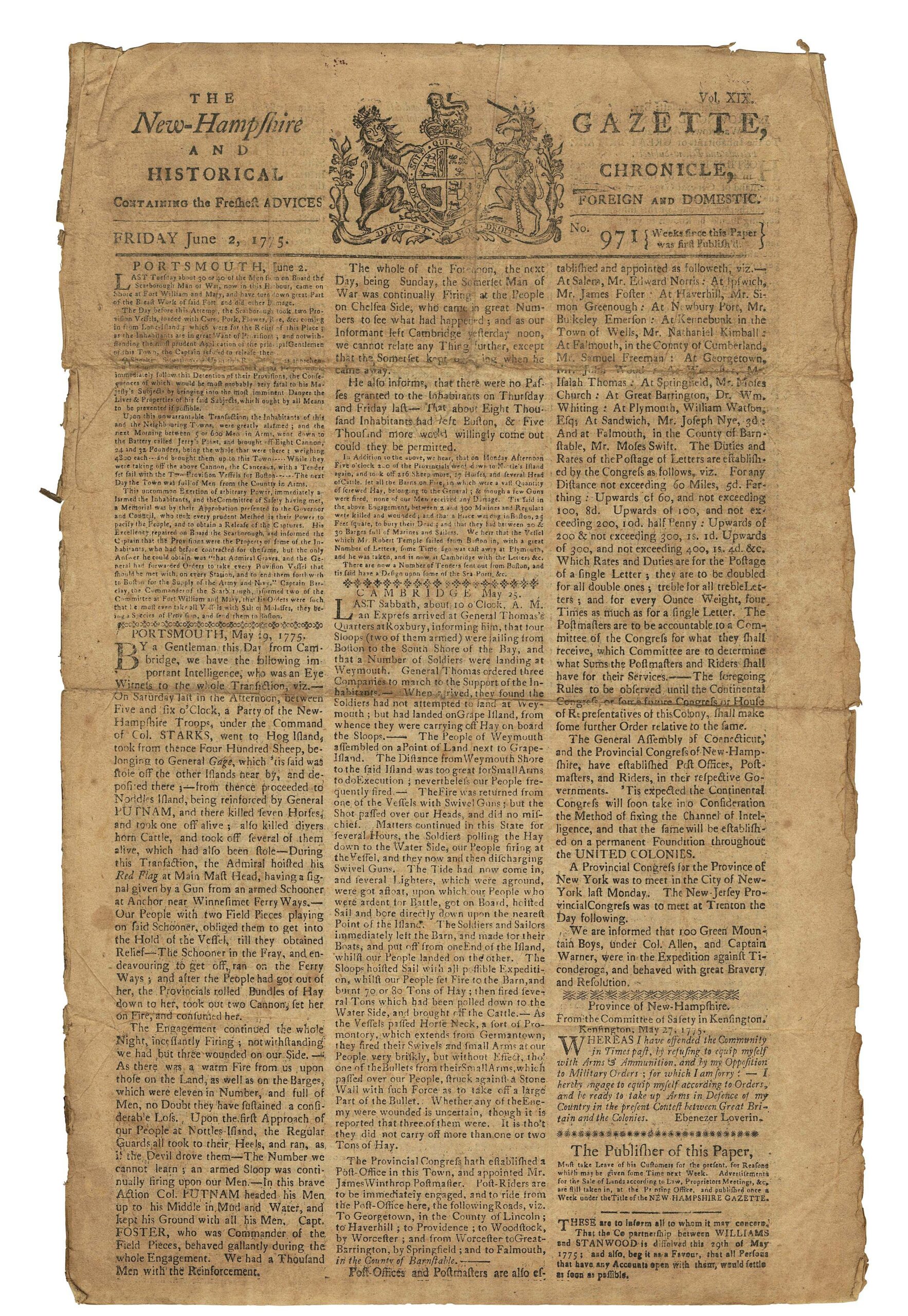
“There were truly good things in the sale, including a Revolutionary-era newspaper,” Bray shared. “That was a really strong performer, I think, because it’s top of mind for collectors because of the anniversary and also, it’s a rare item — good luck finding another!” The June 2, 1775, edition of The New-Hampshire Gazette and Historical Chronicle, published in Portsmouth, N.H., contained reporting on early war news, including accounts from Lexington and Concord. The contemporary coverage of the rapidly escalating conflict was pushed to $4,063.
That war was the subject of another notable lot, an early children’s book, which Bray said, “may be the first children’s book about the American Revolution.” The American Revolution, or National Journal by Robert Rhymer was published circa 1825 and its 12 pages were illustrated with hand-colored plates, including scenes of the Boston Tea Party, Battle of Bunker Hill and more. “It’s very scarce, originally published in Maryland and the Maryland Center for History and Culture bought it — I’m sure they’re going to do something great with it. It was originally owned by a little girl and there’s an inscription inside from the aunt who gave it to her. It was a very cool piece with a great story, and its forever home now is where it’s meant to be.” Bidding for the book closed at $2,460.
Other books included one of albumen prints published by Edgar Cherry & Company in San Francisco, 1884. Redwood and Lumbering in California Forests featured 24 prints mounted on heavy stock and Bray explained that copies of the book are quite desirable. “The photo plates actually vary from book to book, and I’m not sure anyone actually knows the full range of photos in them. I think the interest is driven by particular views.” This edition, which included photos captioned “Evans’ Third Saw,” “Logging Train,” “Logs At The Landing” and “In The Redwoods,” realized $4,375.
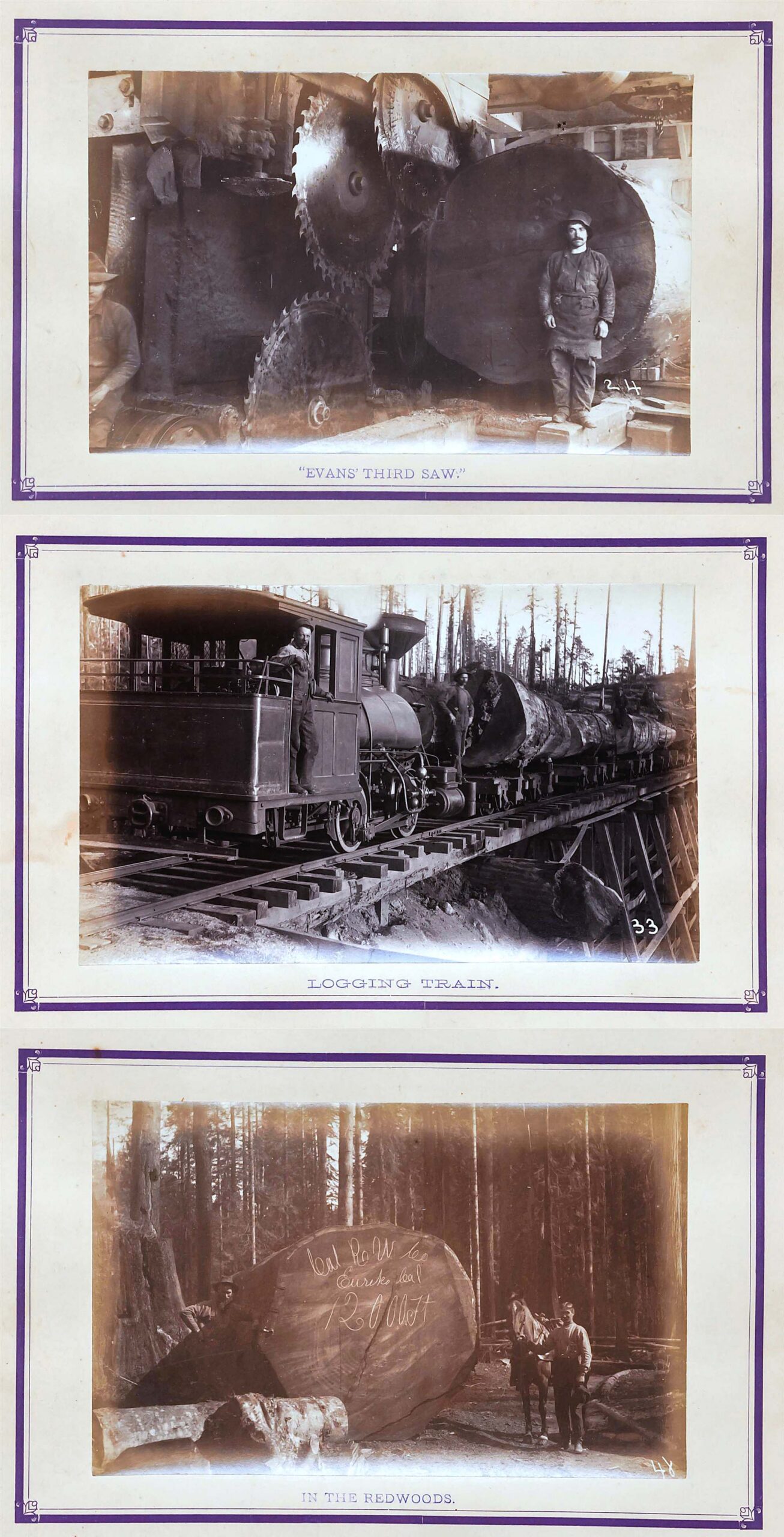
These three albumen prints were just some of 24 from an edition of Redwood and Lumbering in California Forests by Edgar Cherry & Company, San Francisco, 1884, which earned $4,375 ($200/400).
A curious lot was one containing a daguerreotype of US Army surgeon Silas Mayberry, who was stationed at Fort Sullivan, Maine. While the surgeon appeared professional in his Army uniform, there was more to the story that likely intrigued bidders. “The daguerreotype was beautiful, in excellent condition. But what was interesting was it came with all this correspondence that recorded his life from medical school to his career. He even catalogs how many amputations he’d done — how many arms, how many legs and how they were all displayed in his office,” said Bray. The collection, dating from 1839 to 1851, sold to the Maine State Museum for $4,063.
Bray & Company’s next auction will be a tattoo history sale in July, and the firm’s Summer Americana auction, featuring folk art and Shaker material, is scheduled for August 15.
Prices quoted include the buyer’s premium as reported by the auction house. For information, www.brayco.com or 603-427-8281.