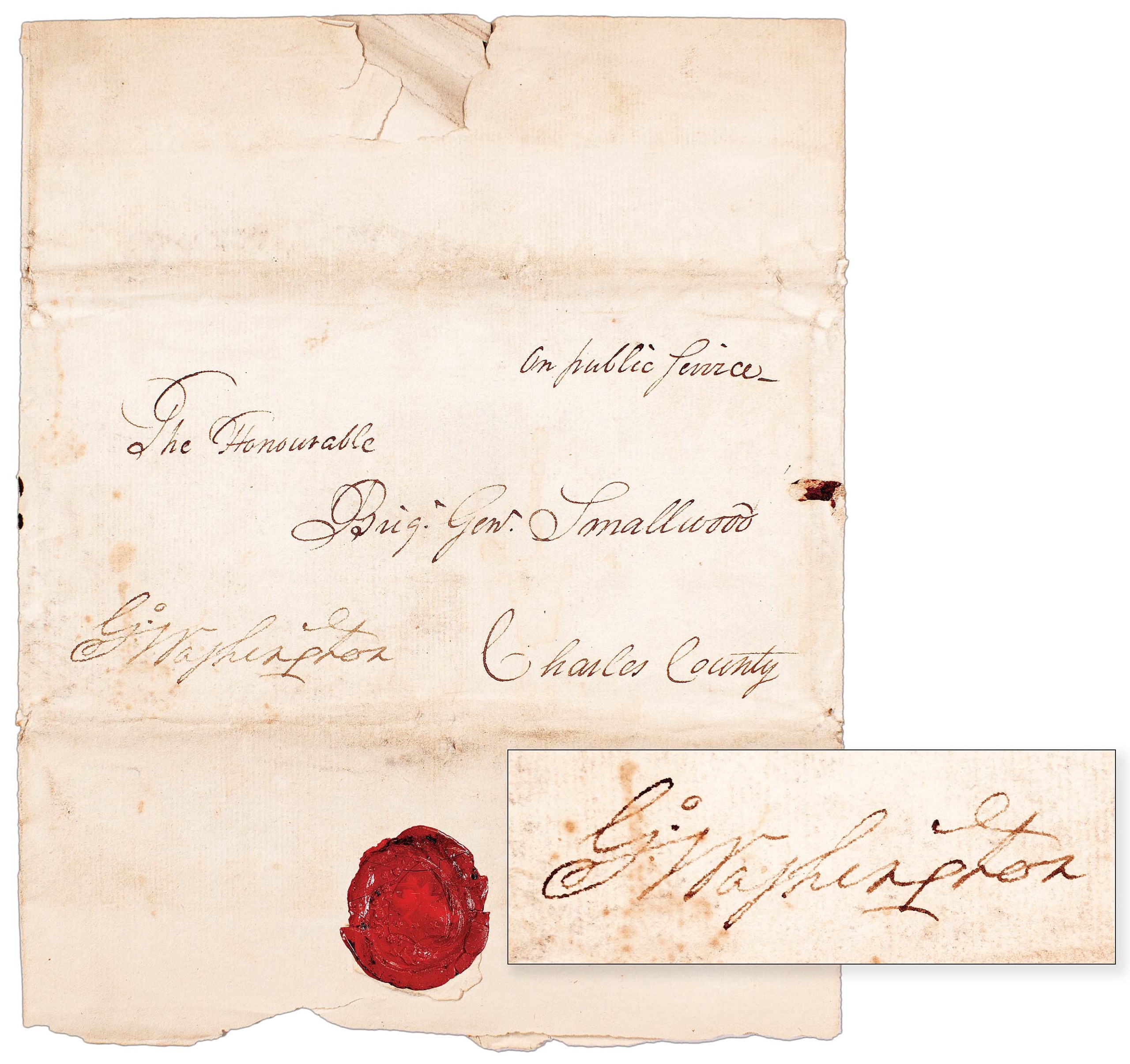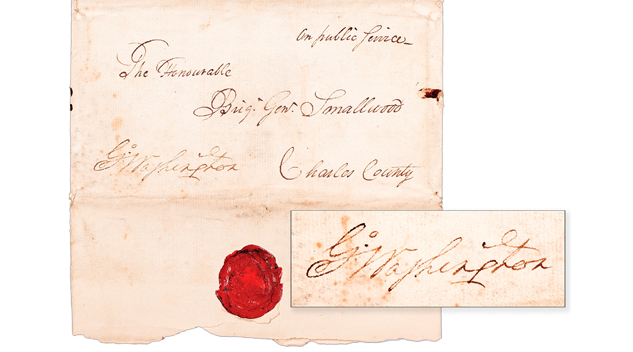
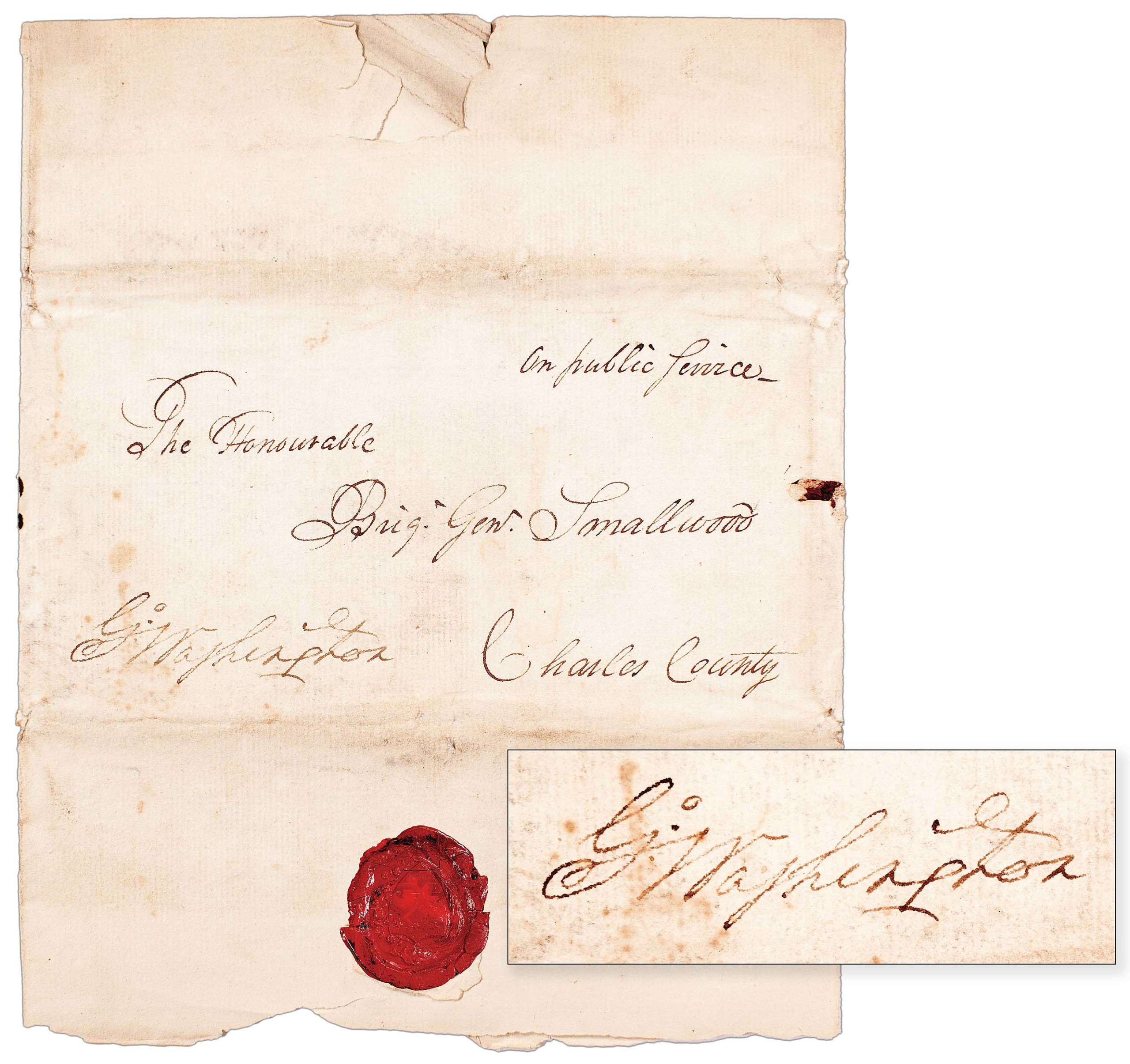
Signed “G. Washington,” this free frank transmittal cover sent to “The Honourable Brig. Gen. Smallwood” and the personal red wax seal of George Washington was finely preserved; it shipped off to a new owner in California for $32,500 ($15/20,000).
Review by Carly Timpson
WINCHESTER, VA. — Despite some technical difficulties that pushed the close of Early American History Auctions’ 199-lot auction to December 27 rather than December 20 as originally planned, owner Dana Linett was pleased with the final results, especially given the added challenge of having to track down registered bidders and let them know the sale was being moved and their previously left bids on the third-party platform would have to be placed again. “The sale did as expected — actually, better than I expected. The more interesting items brought the high estimate or even above. There were several lots where we had very conservative estimates based on people who show up and desire that material, but they really surprised us.”
Featured as the auction’s cover lot, a circa 1777 autographed address sheet signed “G. Washington” rose beyond its $15/20,000 estimate to close at $32,500. Though the free frank transmittal was addressed to “The Honourable Brig. Gen. Smallwood,” endorsed “on public service,” a collector in California became its latest recipient. An especially alluring element was Washington’s personal wax seal. As described in the catalog, “The extraordinary, exceedingly rare original red wax seal of George Washington remains fully intact, exactly positioned located on the back center of the folded transmittal cover. … This Revolutionary War cover was obviously carefully opened to preserve its originality when received by General Smallwood. … The red wax Washington seal remains sharp and clear in detail with some virtually invisible hairline cracks, so that the central shield and three stars and other devices are shown.”
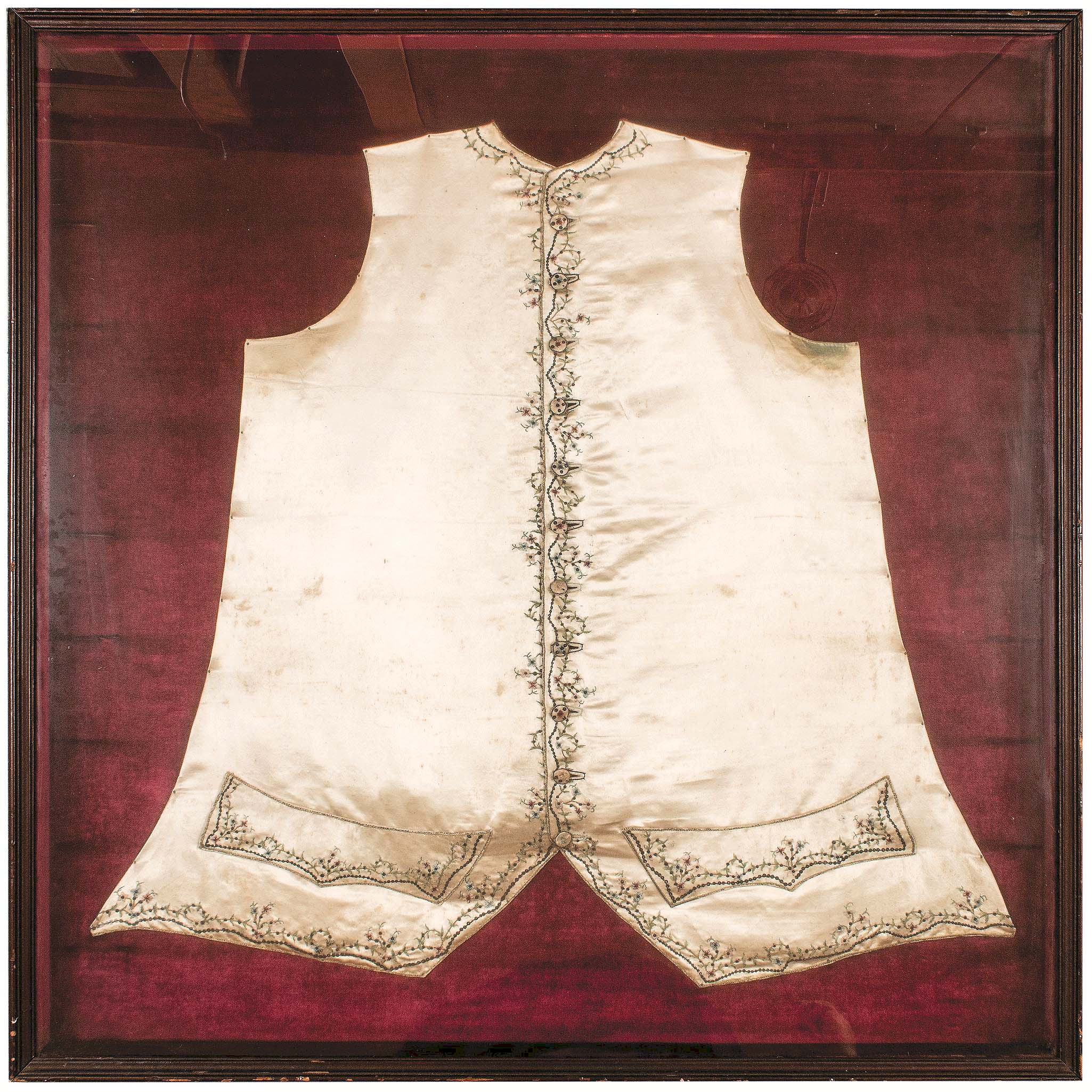
This embroidered silk Revolutionary War-era militia officer’s waistcoat, circa 1778-80, belonged to Dr Samuel Nicoll — courier, possible spy and emissary — was mounted behind glass in a 36-by-36-inch wooden display case. It traded hands for $25,000 ($10/20,000).
Other items relating to the first president continued to bring high prices and tense competition throughout the auction. Washington is always a desirable subject for collectors with an interest in American presidents, military and history in general, but, as Linett shared, “He’s been highly, highly featured in all the buildup to the nation’s 250th. There’s Fox News, which has a new George Washington show, and Ken Burns’s recent American Revolution documentary that points out that without Washington there would be no America because we would have lost the war.”
The second-highest price of the day was for an item less directly linked to Washington but still bearing his influence. Dr Samuel Nicoll (New York, 1754-1796) was documented as being a courier, possible spy and emissary for George Washington’s New York “Spymaster,” Major Benjamin Tallmadge. His Revolutionary War-era waistcoat, which was once mentioned in a letter sent by Tallmadge to Washington, was offered with an estimate of $10/20,000. Whatever secrets may be hiding in its floral embroidery enticed bidders to push it to $25,000. Nicoll’s waistcoat, framed behind glass, was presented to Columbia University (where he studied and taught when it was known as King’s College and later Columbia College) in 1929; a typed tag to the case’s reverse read: “A gift of Mrs Mortimer Lamson Earle (great-great-granddaughter).”
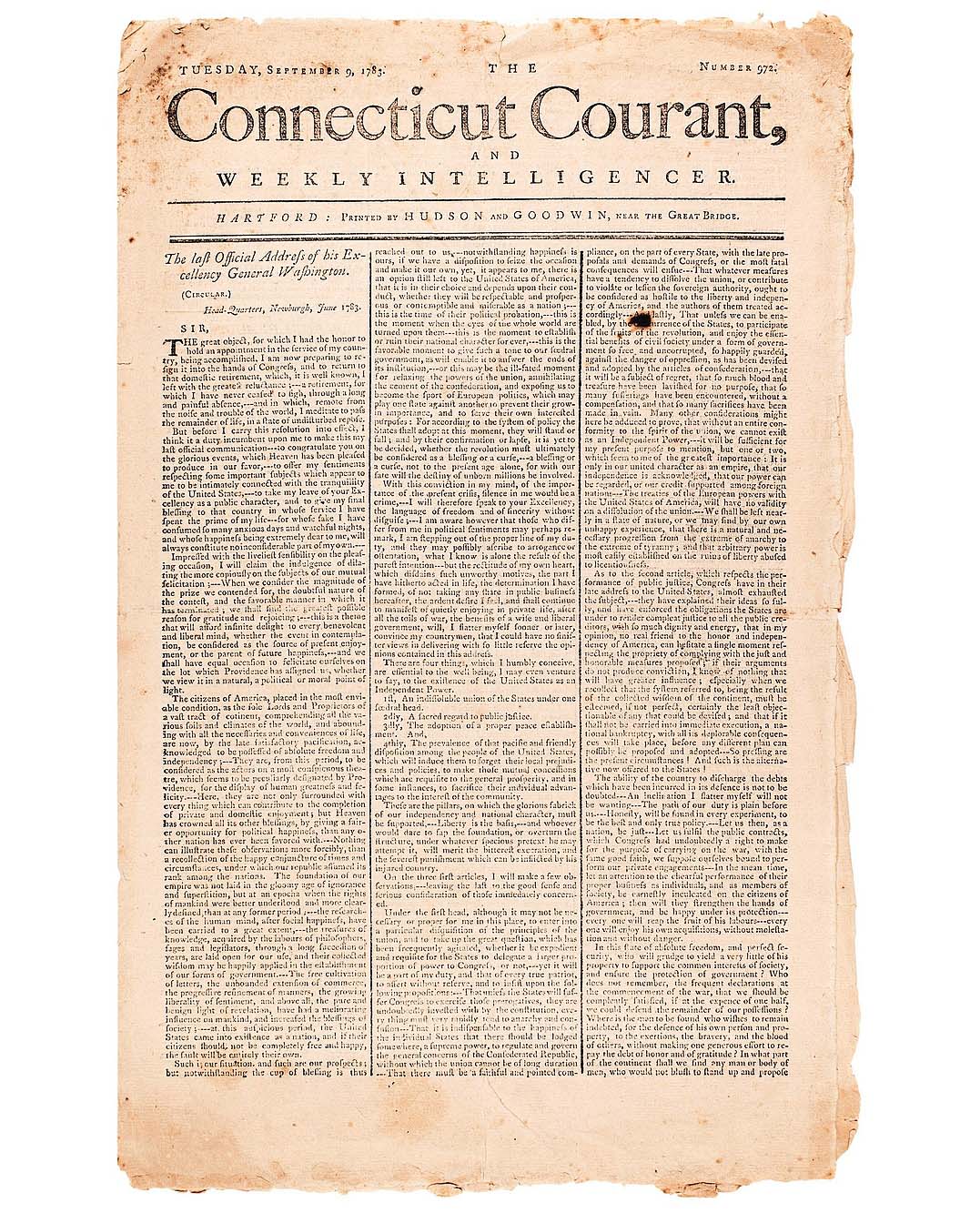
The September 9, 1783, issue of The Connecticut Courant featured “The Last Official Address of his Excellency General Washington…” on its front page. Measuring 17 by 11 inches, this complete four-page original edition realized $13,750 ($4/5,000).
Washington’s final address as Commander-in-Chief of the Continental Army, given in June of 1783, was printed in the September 9, 1783, issue of The Connecticut Courant, and Weekly Intelligencer (Hartford: Printed by Hudson and Goodwin, Near the Great Bridge). As published on the paper’s first page, the letter was titled “The Last Official Address of his Excellency General Washington – Head Quarters, Newburgh, June 1783.” Addressed to the governors of all 13 states, Washington outlined four necessary elements for maintaining America’s independence going forward: a strong, unified federal government; upholding public justice by honoring financial obligations; establishing a suitable defense system; and fostering a spirit of unity among the populace to prioritize the common good over local interests. This complete four-page edition of the Courant retained its full margins and clean pages with only one small burn mark. As such, bidding was hot, and the paper went out at $13,750. The same address was published for the Washington Benevolent Society in an 1812 membership book (Greenfield, Mass.: Denio & Phelps). The personal copy of society member Daniel Smead (1772-1847) was offered in the sale and achieved $2,375 ($600/800).
Another farewell publication, this one to Washington himself, also brought $13,750. Printed alongside the announcement of Boston’s first official public memorial service for the president, to be held on January 9, 1800, an “Order of Performances” detailed the ceremony’s schedule, including a prayer by the Reverend Dr Eckley, a hymn by the Reverend John S. J. Gardner, a eulogy by George Richards Minot, an ode and several musical sections. According to the catalog, there are four examples held in institutional collections and only two auction results, so this example was likely one of five or six known specimens.
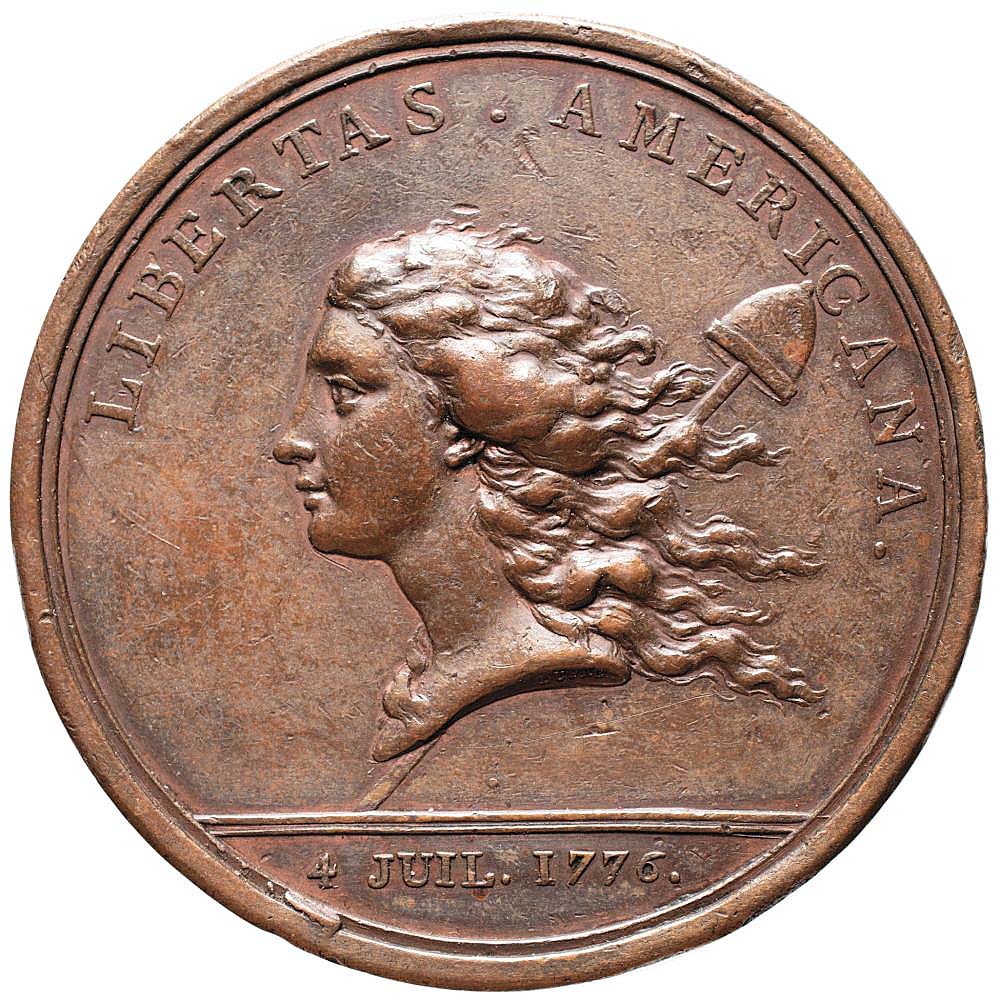
Struck in 1783, this bronze Libertas Americana medal, just less than 2 inches in diameter, was ordered by Benjamin Franklin and designed by Augustin Dupree. It earned $13,750 ($5/10,000).
The Libertas Americana is considered one of the most important historic American medals, and collectors were in luck to find one in this auction. This edition was struck in bronze “by the order and influence of Benjamin Franklin in 1783, being designed and executed by France’s premier sculptor of the time, Augustin Dupree,” according to the catalog note. “Although dated 1781, it was actually struck at the Paris Mint in 1783 to commemorate the American victories at the Battles of Saratoga (1777) and Yorktown (1781), and the subsequent alliance with France.” While earlier dates and finer metals are considered more desirable, bidders still pushed the patriotic piece to $13,750.
Other notable surprises included a 1795 letter written and signed by Joshua Humphreys, the “Father of the US Navy.” In the letter, Humphreys, a ship builder and architect, told Secretary of War Timothy Pickering that his original plans for the frigates were sound, asserting that his associate Josiah Fox had not conformed to the plans as designed and that Pickering should refer only to Humphreys’s plans. Linett said, “He’s one of those people who you don’t hear about in history, but he’s the man who built the blueprints for founding our Navy ships — the USS Constitution and the Constellation were some of them. Some people were very astute in Naval history and knew its importance. “ Not only was the letter’s writer important, but its provenance was too. “It was consigned by Ambassador and Secretary of the Navy, J. William Middendorf. He was proven correct in purchasing this letter back in 1988 at auction. Of course, he had much more knowledge about the Navy than the average collector. I find my association with him to be one of the highlights of my life,” shared Linett. The history and the provenance together took this bold request to $9,375, far exceeding its $2,000 high estimate.
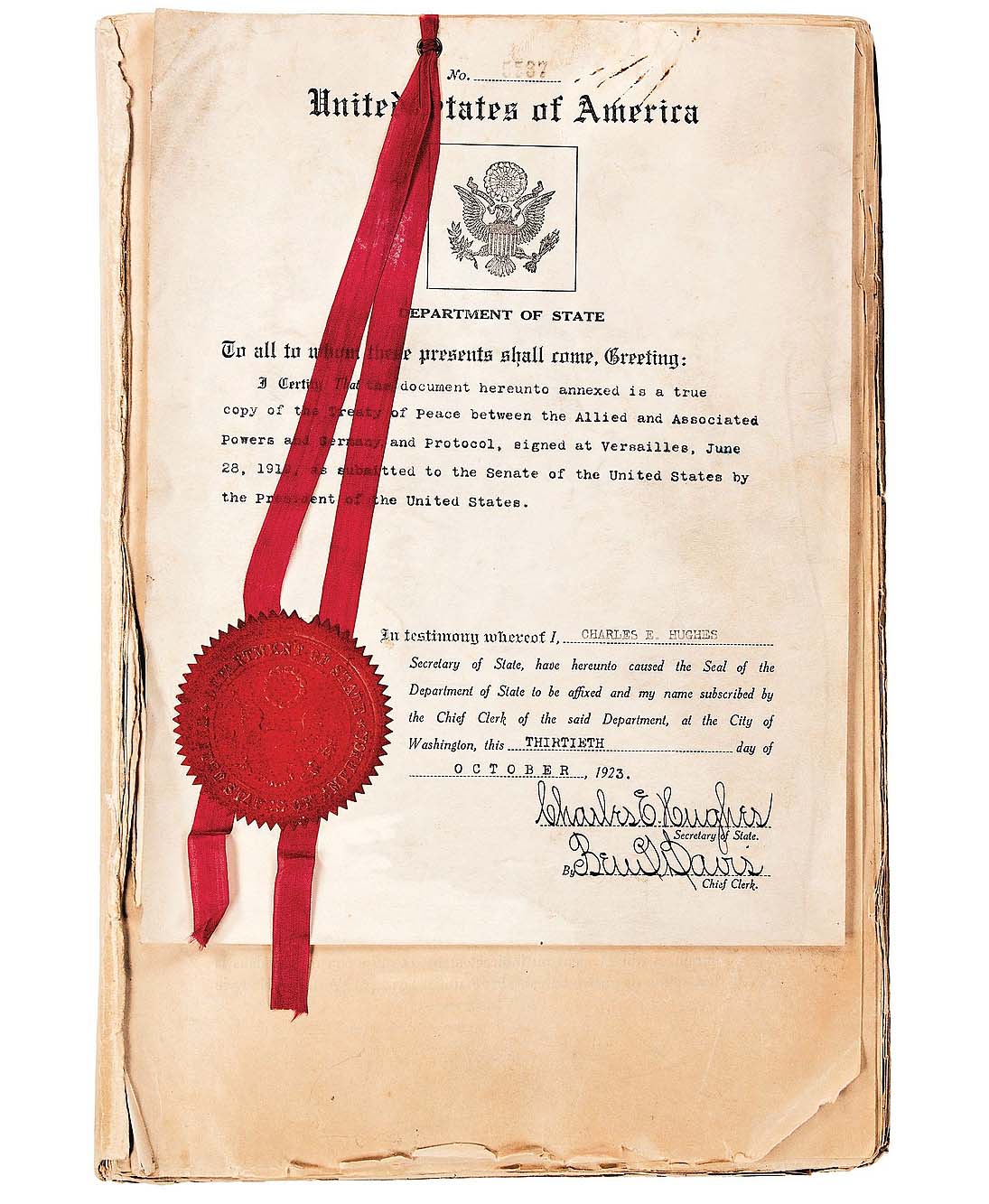
Realizing $8,125, this true copy of the Treaty of Versailles had a cover sheet from Secretary of State Charles E. Hughes dated October 13, 1923 ($5/6,000).
Having an estimate of just $600, a Civil War-era shabraque or saddlecloth stunned Linett when it realized $5,000. “That was a complete surprise! It had its cavalry unit color on it, and apparently that is highly important to at least two bidders who fought for it.” Made for a Union dragoon, as indicated by its orange stripes, this example was previously displayed at the Virginia History Museum.
Linett closed by noting, “Our next auction is tentatively scheduled for February, and this is the time to be a seller of American history because of all the extra enthusiasm surrounding the 250th and the events to come with it.”
Prices quoted include the buyer’s premium as reported by the auction house. For more information, www.earlyamerican.com or 858-759-3290.