Yale University Art Gallery
By Kate Eagen Johnson
NEW HAVEN, CONN. — The Arts and Crafts sage William Morris believed that “the true secret of happiness lies in taking a genuine interest in all the details of daily life.” Patricia E. Kane, the Friends of American Arts at Yale curator of American decorative arts, seemed to have adopted a similar career credo. Her fascination with excellence and detail has given rise to “Art and Industry in Early America: Rhode Island Furniture, 1650–1830,” an exhibition and companion catalog for which she served as the principle organizer.
Kane recollected, “When I first came to Yale in 1968, I loved looking at the Rhode Island furniture. … It was superior to other furniture at Yale in appearance as well as in the skill and care with which it was made.” To her way of thinking, it was not just the fineness of design, but also the meticulousness of craftsmanship that extended to the quality of the dovetailing and to the choice of woods used in the drawer linings.
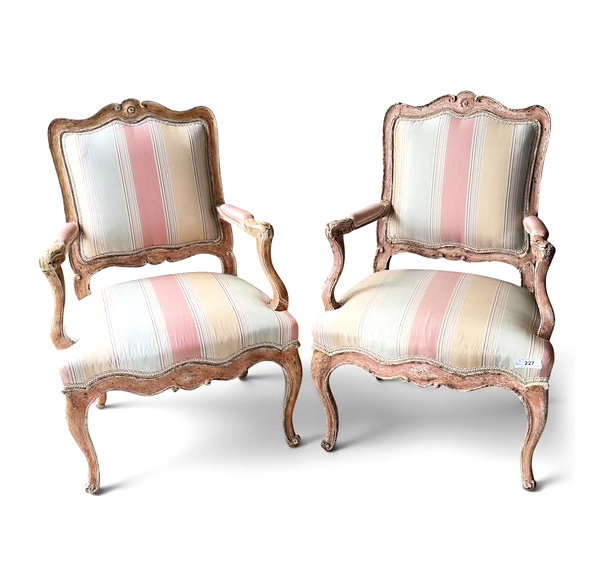
Reminiscent of the motif of richly flowering vines springing forth from a basket seen on embroidered upholstery in “Art and Industry of Early America,” the exhibition and catalog blossomed from the Rhode Island Furniture Archive database, also a brainchild of Kane’s. In 2010, the RIFA website (rifa.art.yale.edu) was launched after almost a decade of data collection. Thanks to the efforts of Kane, former and current students at Yale (in particular Dennis Carr and Jennifer N. Johnson) and associates in the field, RIFA online contains the names of roughly 2,000 woodworkers and information on 4,000 pieces of furniture. The authentic and gracious Kane gives a special shout out to the Antiques & the Arts Weekly community for its help.
Kane, better known to her many friends and admirers in the world of American antiques as Pat, has assembled more than 130 objects for this keenly anticipated exhibition, the first broad offering on Rhode Island furniture since the Rhode Island Historical Society’s John Brown House Loan Exhibition of 1965.
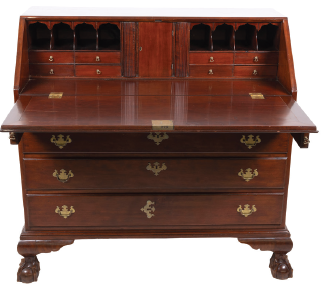
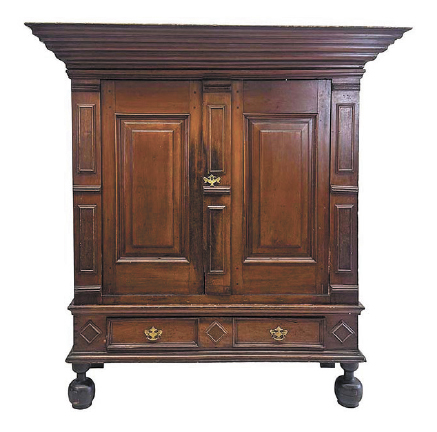
Items on display include not only the magnificent block and shell furniture made in Newport and Providence for which Rhode Island is renown, but also the less flashy and less well-studied furniture created in these and other towns such as Westerly, Warren and Bristol. Select architectural components, paintings, prints and objects of silver round out the picture.
Kane’s approach to the study of American material culture is almost scientific in nature. In a laudably systematic manner, she collects data on makers, dates, places and objects. She then draws upon this cache of information as the basis for further research and scholarly interpretation. Kane used this strategy to bring forth the 1,200-page Colonial Massachusetts Silversmiths and Jewelers: A Biographical Dictionary Based on the Notes of Francis Hill Bigelow and John Marshall Phillips and the complementary exhibition “First Masters of American Silver: The Craft of the Silversmith in Colonial Massachusetts” at Yale in 1996.
In regard to Rhode Island furniture, her deep and impeccable research and analysis has resulted in the discovery of new makers and objects (some of which are masterpieces), the forging of new attributions and the reattribution of some pieces as to maker or place of manufacture. Objects once thought to have originated in Massachusetts, Connecticut, New York or New Hampshire are now the proven products of Rhode Island.
Within the American antiques arena, inherited wisdom is often repeated without question. Kane has stepped in to vet long-held assumptions about Rhode Island furniture. In this alone, she has performed a huge service to the field. In her catalog introduction, she highlights developments and reattributions using a chronological, style-based framework while also discussing the circumstances in and under which these objects were fashioned.
Kane stated, “Our goal was to broaden the understanding of who the makers of furniture in Rhode Island were and what they were making.” As she noted in the catalog, “most scholarship on Rhode Island furniture has focused on the period from 1740 to 1780 — that is, furniture in the Queen Anne and Chippendale styles — with Newport and, to a lesser degree, Providence, receiving the most attention. This era was the golden age of Rhode Island furniture making, led in Newport by the brothers Job and Christopher Townsend and their descendants and apprentices, including John Goddard, an apprentice of Job’s who married one of Job’s daughters, and John Townsend, the son of Christopher.”
Not much was known about furniture makers in the years leading up to the Mid-Eighteenth Century in Newport and Providence. The same was true elsewhere in Rhode Island for the whole of the period under study.
In broad strokes, the story of furniture making in Rhode Island between 1650 and 1830 might be summarized as follows: The amount of furniture made during the Seventeenth Century in the tiny colony was understandably limited. It displayed precious little in regard to a unified regional aesthetic, with 50 or so surviving examples illustrating a variety of English and Dutch influences. In the Eighteenth Century, furniture makers provided items for an active export trade, which reached from Canada to the Caribbean and beyond, and for a growing local population. While woodworkers had established shops in cities and towns throughout the colony, Newport rated as the furniture capital until superseded by Providence during the post-Revolutionary War years. As the Nineteenth Century took hold, Rhode Island cabinetmakers faced stiff competition from furniture shipped in by Boston and New York firms and business declined.
Alas, justice cannot be paid here to the many research breakthroughs shared through the exhibition and catalog. Kane and her project team introduce us to furniture made by James Halyburton, Amos Stafford, Ichabod Cole and other little-known cabinetmakers while also imparting fresh insights and information regarding the oeuvre of the celebrated Townsends and Goddards. Topics range from the nature of the furniture venture cargo business in Providence to the likely production of the so-called “Little Compton” banister back chairs throughout the eastern Rhode Island region and not solely in that town.
One major discovery began with a desk and bookcase possessing a history of ownership by Revolutionary War general Nathaniel Greene in the collection of the High Museum. A colleague told Kane about a 1775 reference to Greene purchasing a mahogany desk and bookcase from a Thomas Spencer. Kane was off to the races. Long story short, Thomas and his brother Daniel— who also was a cabinetmaker — used a distinctive lettering system with slight variations to mark drawers. This feature became an essential clue in attributing objects to them. By the end of this investigatory trail, Kane had linked a sizable group of furniture to the brothers Spencer, including a bureau table at the Museum of Fine Arts, Houston credited to Thomas, and the Jabez Bowen chest on chest at Chipstone Foundation and the John Brown desk and bookcase at Yale ascribed to Daniel.
The catalog is an essential volume for those interested in Colonial and Federal-era furniture. Aside from outstanding essays, it includes thorough object entries with detail as well as overall photography; provenance incorporating extensive genealogical and sale information where available; and transcriptions of inscriptions. The appendix “Cabinetmakers’ Component Marking Codes” illustrates and describes the drawer marks employed by various Rhode Islanders. Containing enough construction and design specifics to delight any furniture connoisseur, the catalog is equally abundant in biographical, cultural, social, economic and geographical context. The perspective is macro as well as micro.
In the exhibition, the innovative display of furniture is enhanced by screen technology. For example, the signed John Townsend chest of drawers is shown in exploded mode with drawers removed. In this way visitors can see how cabinetmakers employed marking systems “to keep work flowing and organized in small shops,” according to Kane. John Townsend’s telltale system included capital letters in script written sequentially on the exterior backs of drawers and elsewhere.
Craftspeople demonstrate relevant woodworking processes via videos. Peter Follansbee makes a replica wainscot chair, Joshua Klein creates a turned “Little Compton” chair using a treadle lathe, and Jeffrey Greene carves a claw and ball foot and constructs a drawer. Through iPad presentations, visitors learn about the interiors of case pieces and also about the silver hardware made by Samuel Casey for the Christopher Townsend desk and bookcase.
In the exhibition, Kane addresses the most commonly asked questions, “How long did it take to make this?” and “How much did it cost?” This teaching curator wants “to reach out to visitors who do not have an abiding interest in the material and offer different ways to look at furniture and so capture their interest and imagination.”
A symposium takes place on September 15 and 16. There, Philip Zimmerman will offer commentary on the past, present and future of American furniture studies in his keynote address, and catalog contributors will lecture on the subjects of their essays. Dennis Carr will converse on Seventeenth and Early Eighteenth Century furniture. Kane will discuss cabinetmaking from 1740 to 1830 with an emphasis on the lives of the cabinetmakers and their business practices. Jennifer Johnson will offer discourse on the upholstery trade during the same era. Nancy Goyne Evans focuses on the topic of Windsor chairs in Rhode Island, in particular who was buying them and how this form of seating was used there. For Gary Sullivan, the topic under discussion will be clocks.
In a field where attributions sometimes appear thin and barely tethered, it is heartening to witness Kane and her team gathering and reviewing data as they scrupulously build cases connecting objects to makers and vice versa. In her modus operandi, Kane keeps in close contact with collectors and dealers, pours over trade publications as well as academic journals and studies objects with both joy and exactitude. Those who love early American decorative arts are among the happy beneficiaries of her winning, detail-oriented approach.
“Art and Industry in Early America: Rhode Island Furniture, 1650–1830” runs from August 19 to January 8 at the Yale University Art Gallery, 1111 Chapel Street.
For additional information, www.artgallery.yale.edu or 203-432-0600.