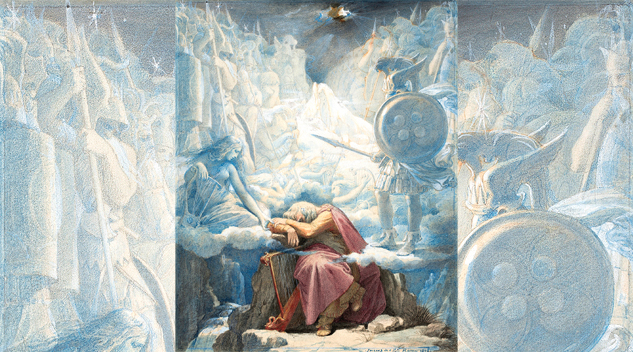
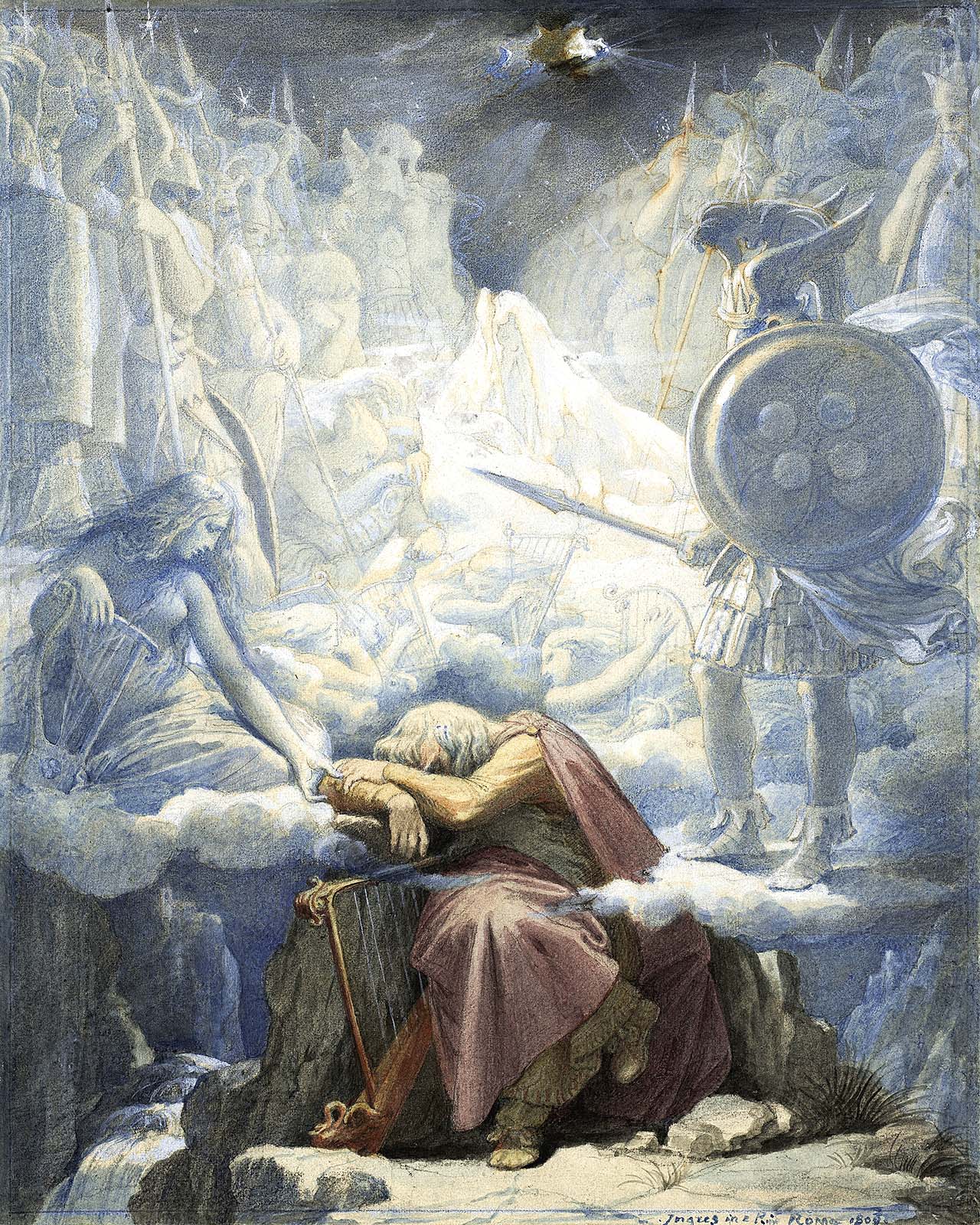
“The Dream of Ossian” by Jean-Auguste-Dominique Ingres, circa 1832-34, watercolor, white gouache and brown ink over graphite and partial stylus outlining on white wove paper, 9¾ by 7⅜ inches. Harvard Art Museums/Fogg Museum, bequest of Grenville L. Winthrop, 1943.376. © President and Fellows of Harvard College.
By James D. Balestrieri
CAMBRIDGE, MASS. — I lived for a year in Aberystwyth, a seaside college town in Wales. I was teaching there, living in a dorm with students from the four corners of the world. On salty, rainy and sunny days alike, I walked the narrow lanes of town, the winding shore, the pier and docks and the ruins of the castle.
Always in the background, in most of my photos of the town, dominating the Welsh present, stands a Celtic hillfort called Pen Dinas — “head of the fort” — or Dinas Maelor, the fort or stronghold of the folklore giant Maelor Gawr. Pen Dinas backs onto Cardigan Bay, and looms above the freshwater rivers, Yswyth and Rheidol, offering an excellent defensive vantage to the west. The remnants of a rampart ring its base. Thought to have been built and occupied sometime around 300 BCE, Pen Dinas remains something of an archaeological mystery. Excavations thus far have revealed little about the people who lived there.
In preparing to write this piece about “Celtic Art Across the Ages,” the new exhibition on view at the Harvard Art Museums through August 2, I realized that in my year there, when I learned enough Welsh to order a pint in a pub and sing the hymns that thundered through the crowds at rugby matches, I lived with, around and in the shadow of the ancient Celts, that their imagery — the crosses with circles, the wavy lines, spirals and complex knots, the standing stones and cromlech cairns and the rhythms of the languages, spoken and written: Welsh, Gaelic, Ogham — was deeply embedded in contemporary life. When I visited relatives in Northern Ireland, I saw similar images and heard the lilts of old tongues in the English colonial dialects.
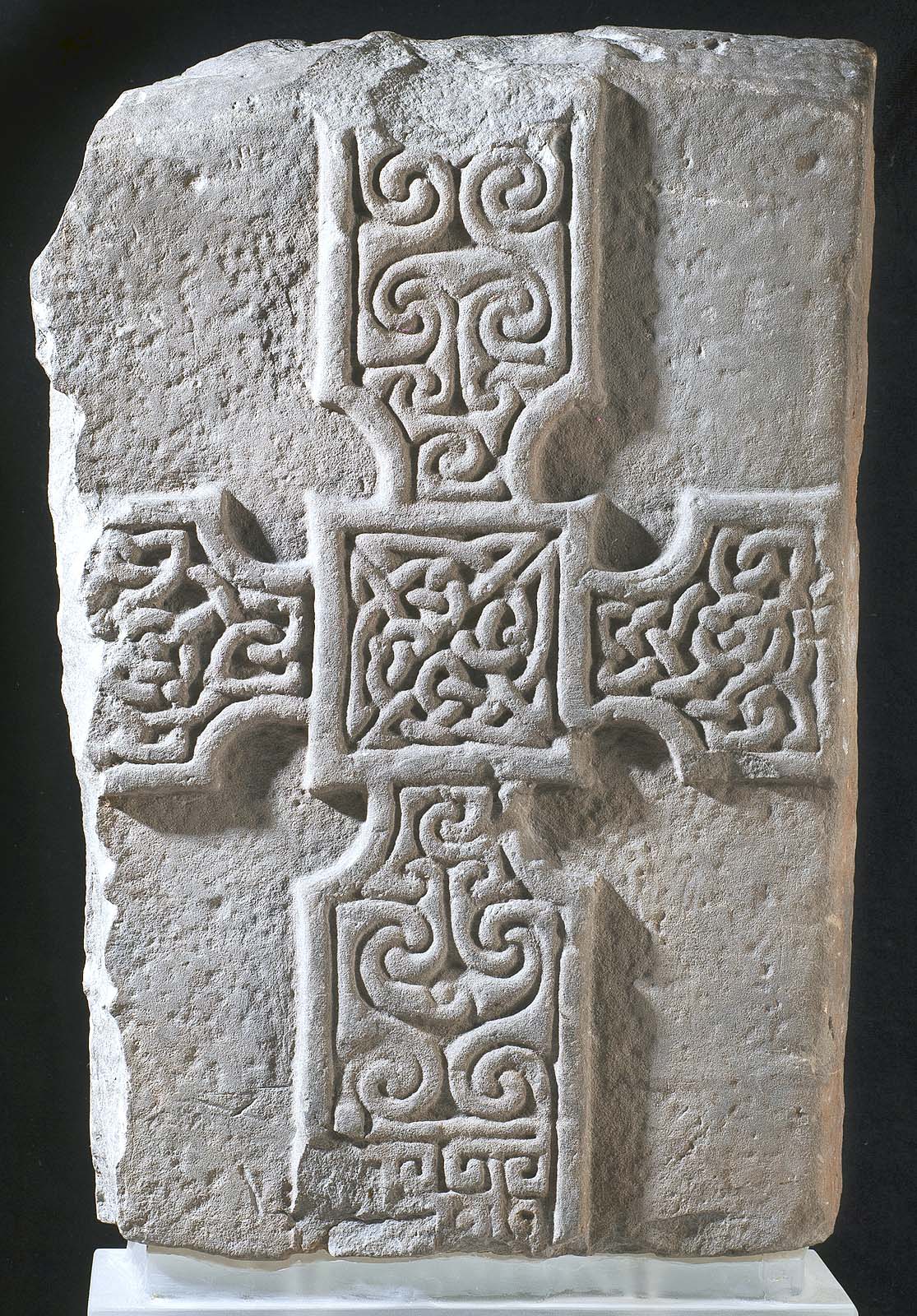
Cross slab, Eighth Century CE, gray sandstone, 44 centimeters tall, from Monifieth, Angus, Scotland. National Museums Scotland, Edinburgh, X.IB 27. © National Museums Scotland.
The truth, as this exhibition reveals, is that we know very little about the meaning of the millions of objects we call Celtic. By the end, visitors to the exhibition will wonder whether the word Celtic means anything at all. And that’s a good thing. Peoples who have been called Celts range from Spain to Northern Italy and Greece, to the Balkans and Turkish Galatians — to whom the apostle Paul addressed one of his epistles — the French Gauls, the Balkan and Danubian tribes and those of the British Isles, Ireland and the Isle of Man. A quick survey of Celtic peoples reveals hundreds of distinct names: Belgites, Helvetii, Parisii and Silures relate to places and concepts we still use; others, like the Volcae, Aedui and Allobroges survive in texts like Julius Caesar’s Gallic Wars, whose famous opening line, “All Gaul is divided into three parts,” seems, in hindsight, to have been a vast understatement.
Because these peoples did not develop written languages until after their contact with Greek and Roman cultures, we know little of their origins. Even after they developed written languages, we still get most of our knowledge of them from classical Greek and Roman sources. Irish, Scottish Gaelic, Manx Gaelic, Welsh, Cornish and Breton are still spoken today, as is Galician in northern Spain and Portugal, and though these languages have commonalities, their differences are profound, far more than, say, the Romance languages, whose antecedents in Latin are readily traced. Yet though we know only parts of their systems of belief, the common aspects of the iconography they created to convey those beliefs is what we have historically used to connect them.
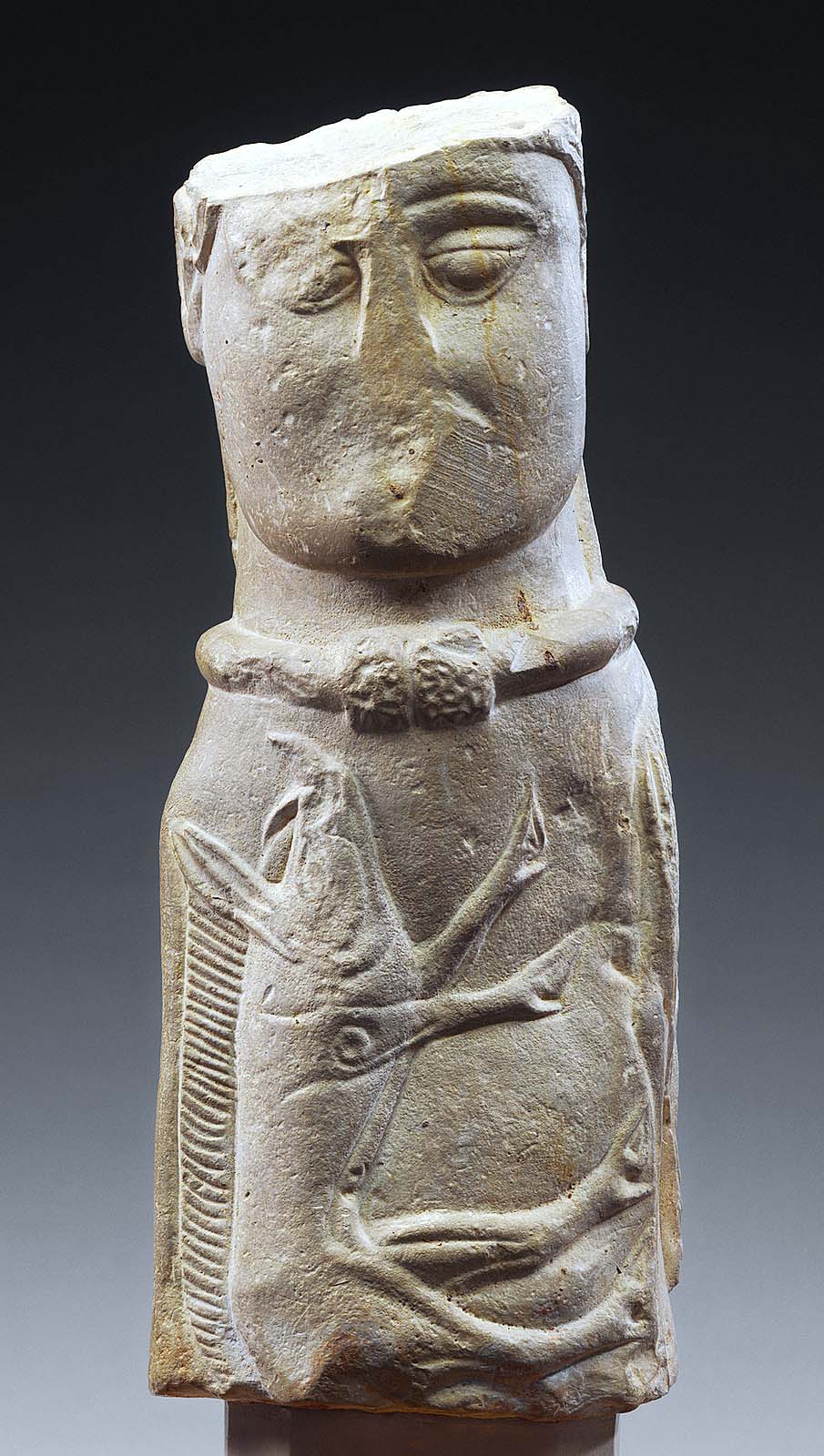
Sculpture depicting a male figure wearing a torque and bearing images of wild animals, First Century BCE, limestone, 30 centimeters tall, from Euffigneix, Haute-Marne, France. Musée d’Archéologie nationale, Saint-Germain-en-Laye, 78243. © RMN-Grand Palais/Art Resource, NY.
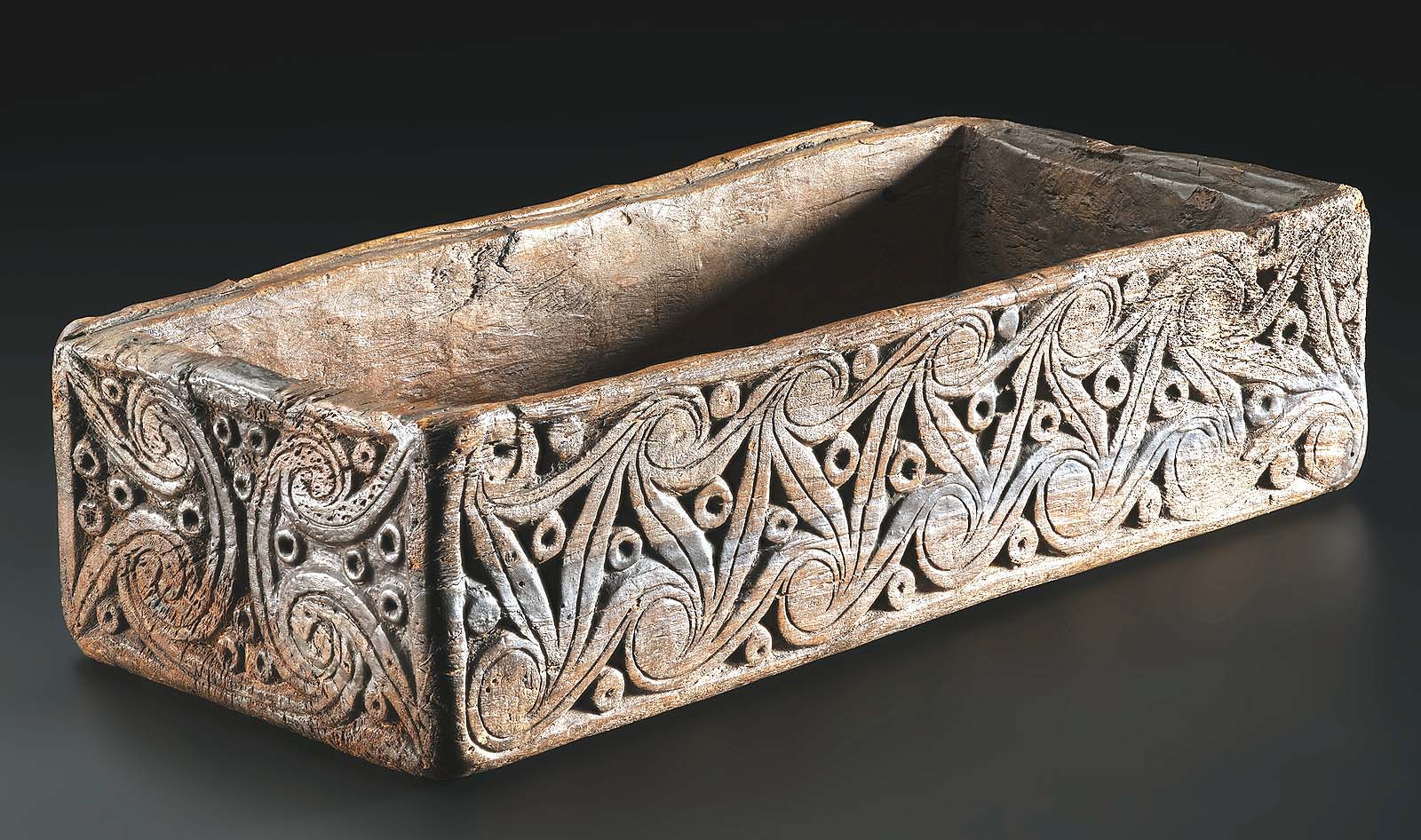
Of course, as with all ancient cultures, only those objects made of durable materials have survived. Stone, bone and metal predominate, though there are some remarkable bog- and salt-preserved wooden items and textiles. Stonehenge, to offer a parallel, has always been there — or seemed so — but only in recent decades have new techniques revealed that an equally important Woodhenge once stood nearby.
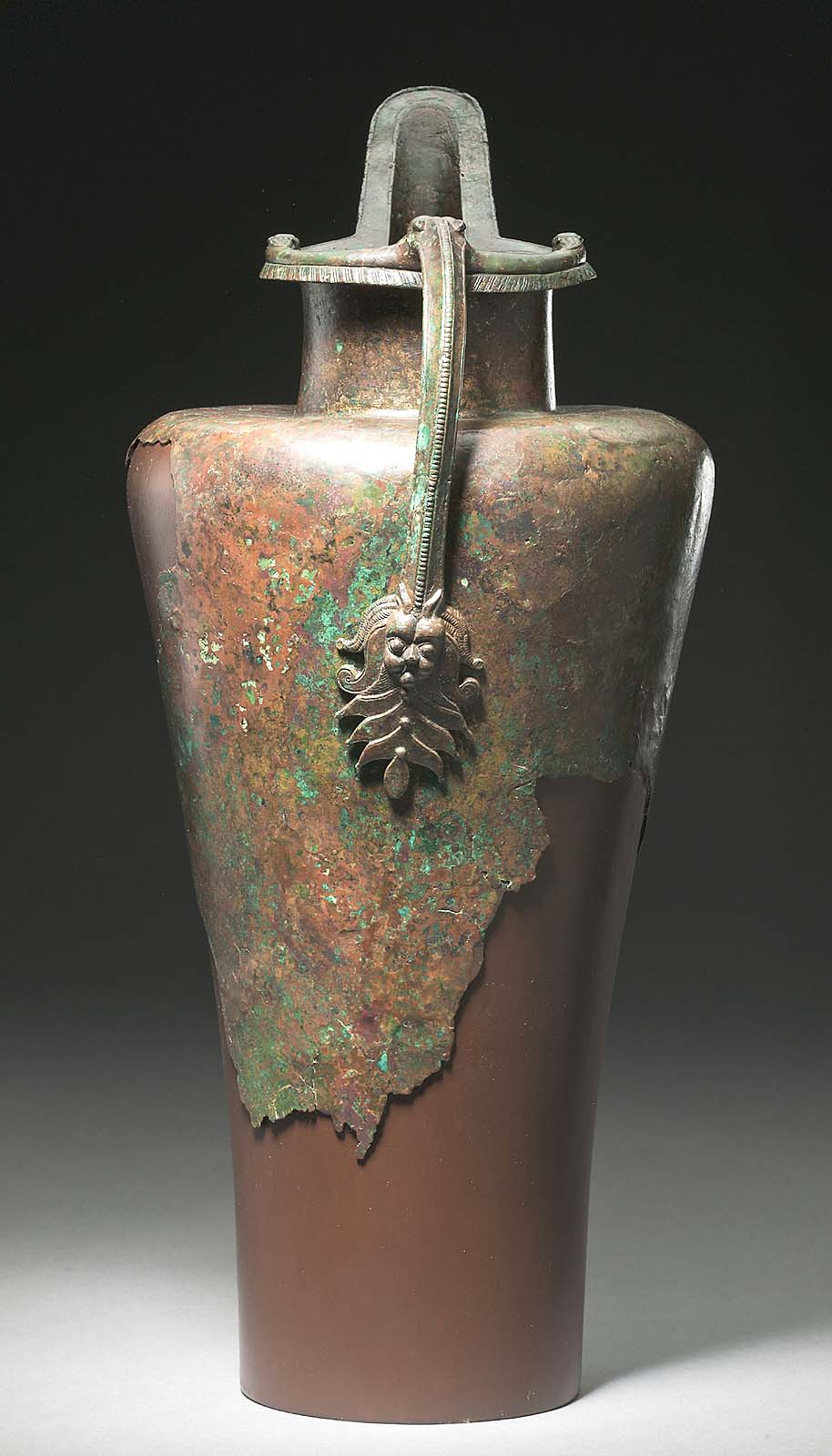
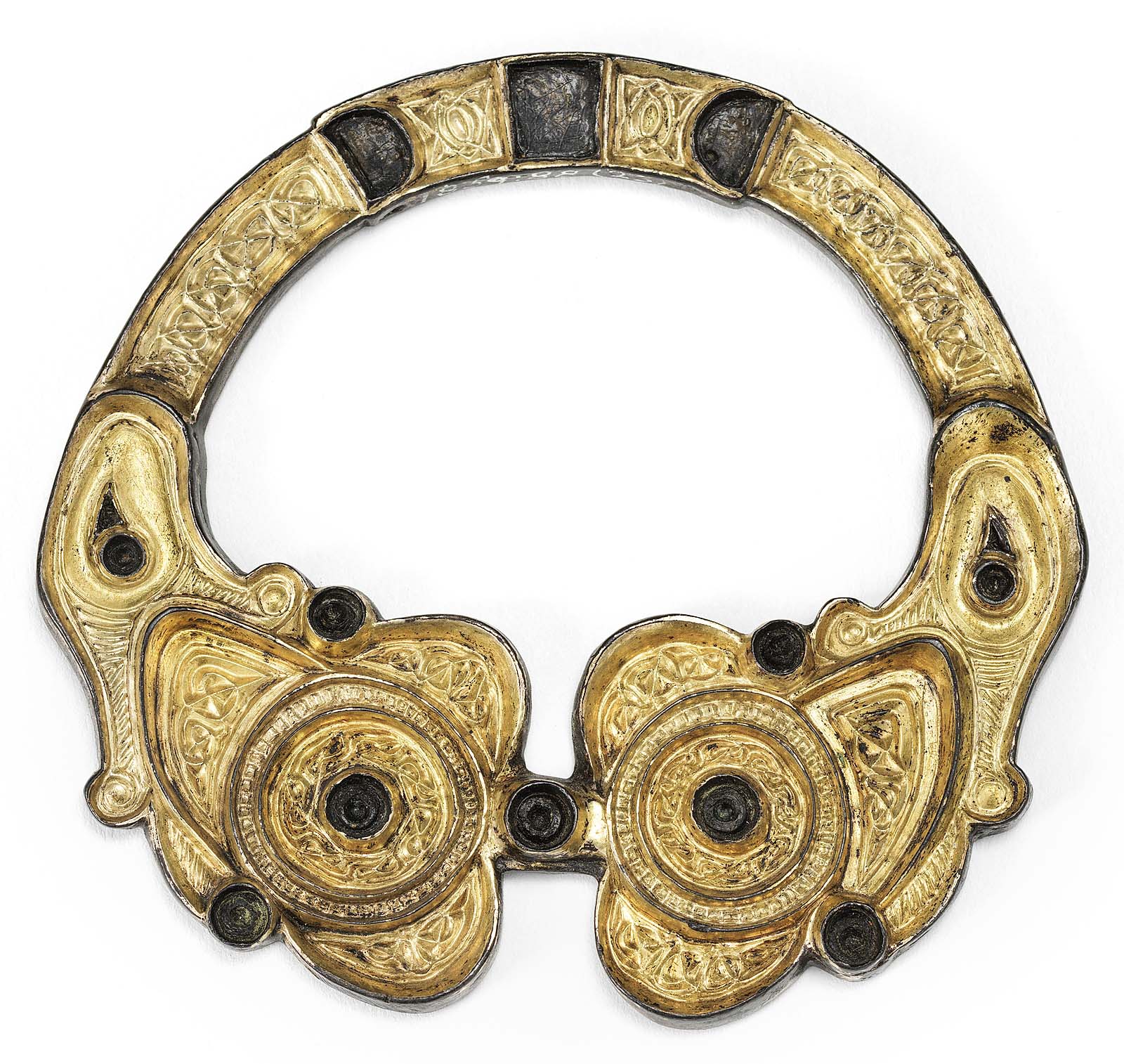
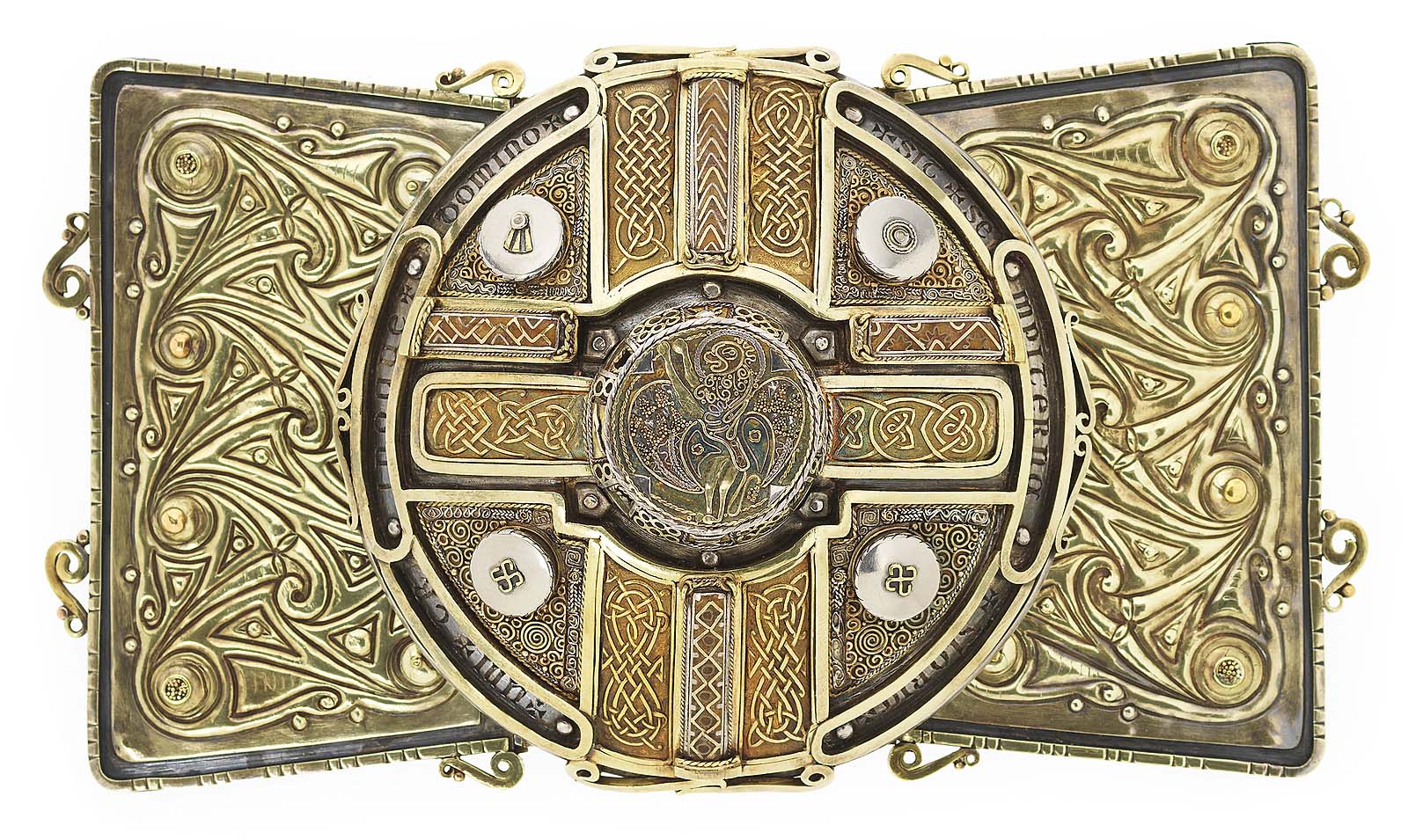
Curator Susanne Ebbinghaus writes in “Celtic Art and Its Interpretations,” her outstanding and very readable catalog essay, “Representations of the human figure, especially on a monumental scale, are rare throughout [Celtic arts]. Instead, Celtic ornaments tend to play out on jewelry and on elaborate — partly ceremonial — versions of objects with a practical function, such as arms and armor, horse trappings, chariot components and feasting equipment crafted out of metal and other materials.”
Because of this, we tend to think of the Celtic arts as ornamental, though they must have meant much more to those who made and made use of them.
An interesting place to begin to look at Celtic design is in their coinage, struck in imitation of the Greek and Roman coins they encountered through conquest and commerce. The Second Century BCE gold “Stater,” struck at a mint in east-central Gaul, for example, indicates, as Laure Marest writes in the catalog, that the engraver was copying a Greek original. Not only could the Apollo profile “pass” as a Philip II original, but the engraver seems to have reproduced a defect on the cheek of the original die (a stamp engraved in the negative used to strike coins).
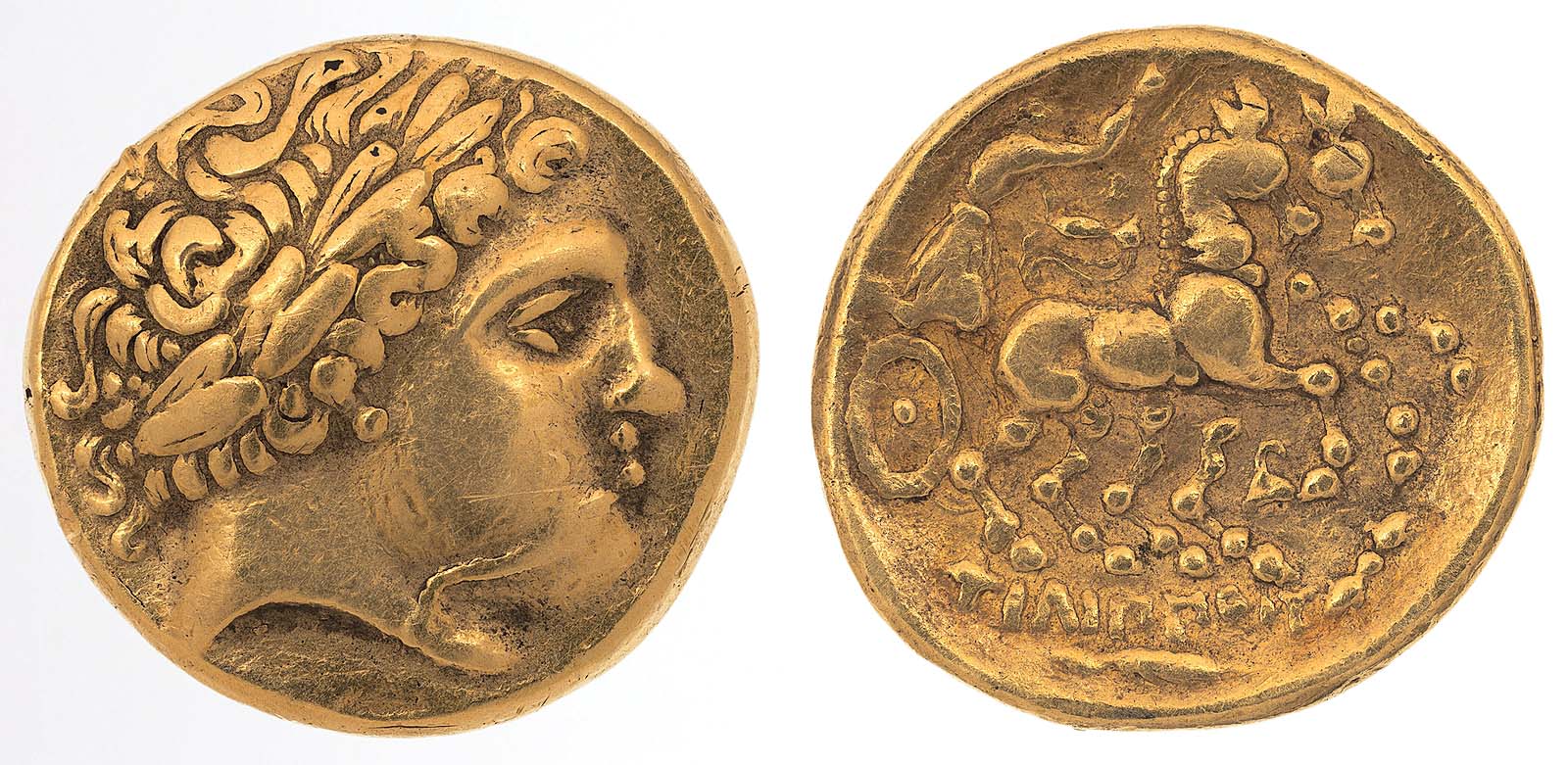
Stater, uncertain mint in east-central Gaul, Second Century BCE, gold, 8.17 grams. Harvard Art Museums/Arthur M. Sackler Museum, Loan from the Trustees of the Arthur Stone Dewing Greek Numismatic Foundation, 1.1965.46. © President and Fellows of Harvard College.
“The reverse, though, shows emancipation from the model with a keen interest in the equine form in movement. The charioteer seems almost perfunctory, while the anatomy of the two horses is deconstructed into stylized body parts and speed is evoked through the duplication of dotted joints,” Marest wrote. In other words, while the Celts — and I am using the term as shorthand here, fully cognizant of its shortcomings — were perfectly capable of mimesis, that is, realistic imitation, they chose and made their own, an iconography that found itself closer to what we would term abstraction, a reduction of forms and their division into curvilinear forms that fit together like puzzle pieces but did not touch. We might say that they built images out of reticulated and parallel shapes.
In fact, it’s hard to avoid words like “cosmic” when you take in the images on these pages. Every form you look at seems to be in a constant state of metamorphosis from the vegetative and geometric to the animal and mythical and back: vine becoming neck, triangle becoming beak, gemstone becoming eye. Even the bronze Third Century BCE pony cap, excavated in Scotland, which seems to be a kind of fanciful, even fun adornment, a helmet Loki lost when he was trying to conquer Earth in The Avengers, begins to swirl and transform as you look at it. The horns taper to dragon heads, the curled vines resolve into elegant, forked tails, something like the tails of whales and the metal straps that bind the horns to the helmet assume the aspect of fish swimming up alongside the bodies of the horns that have become dragons in a zoomorphic design.
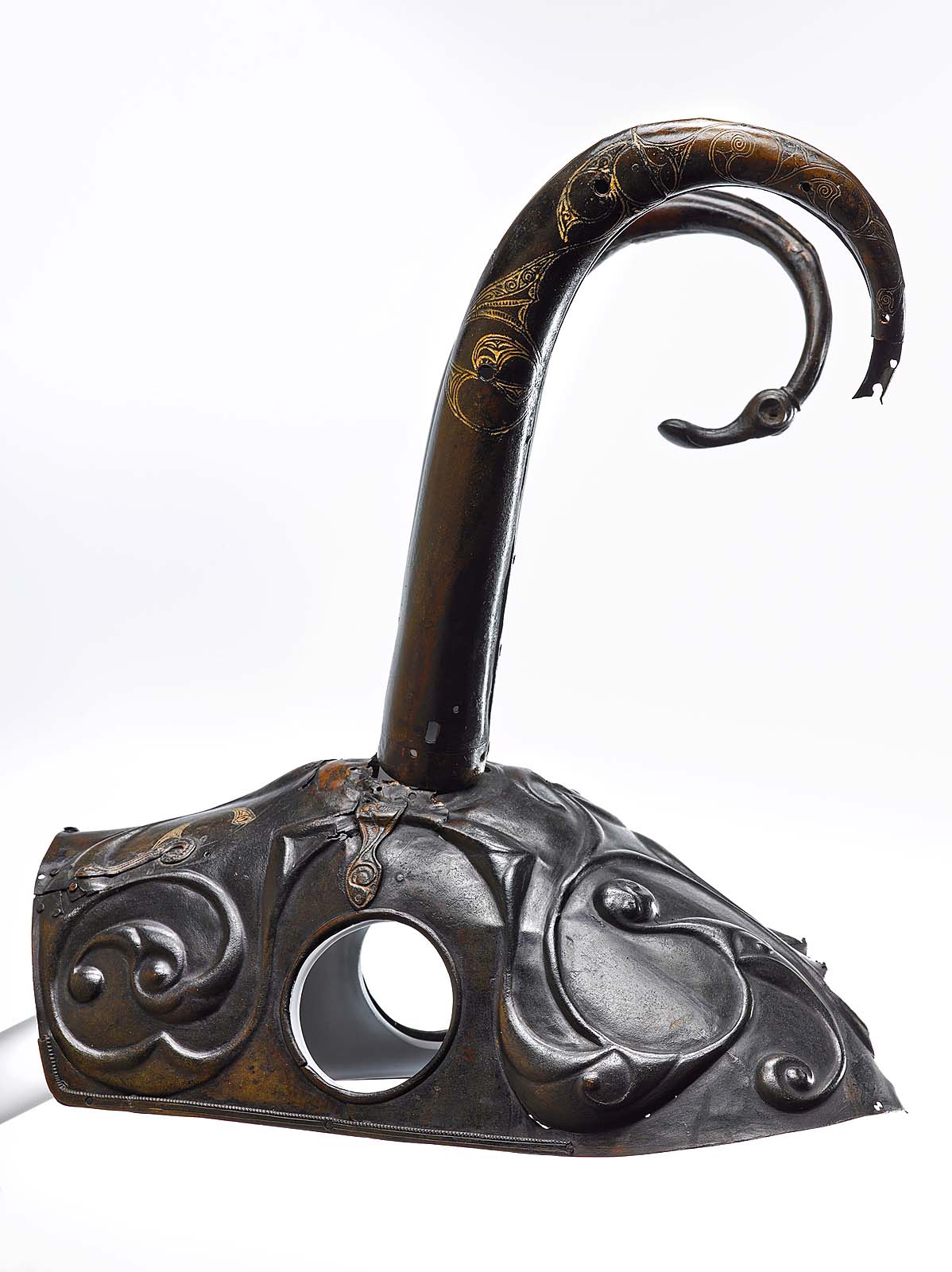
Horse armor, Third to Second Century BCE, bronze, 9-3/16 inches, from Torrs, Dumfries & Galloway, Scotland. National Museums Scotland, Edinburgh, X.FA 72. © National Museums Scotland. The holes are for the pony’s ears, with the animal facing to the right and the horns curving forward.
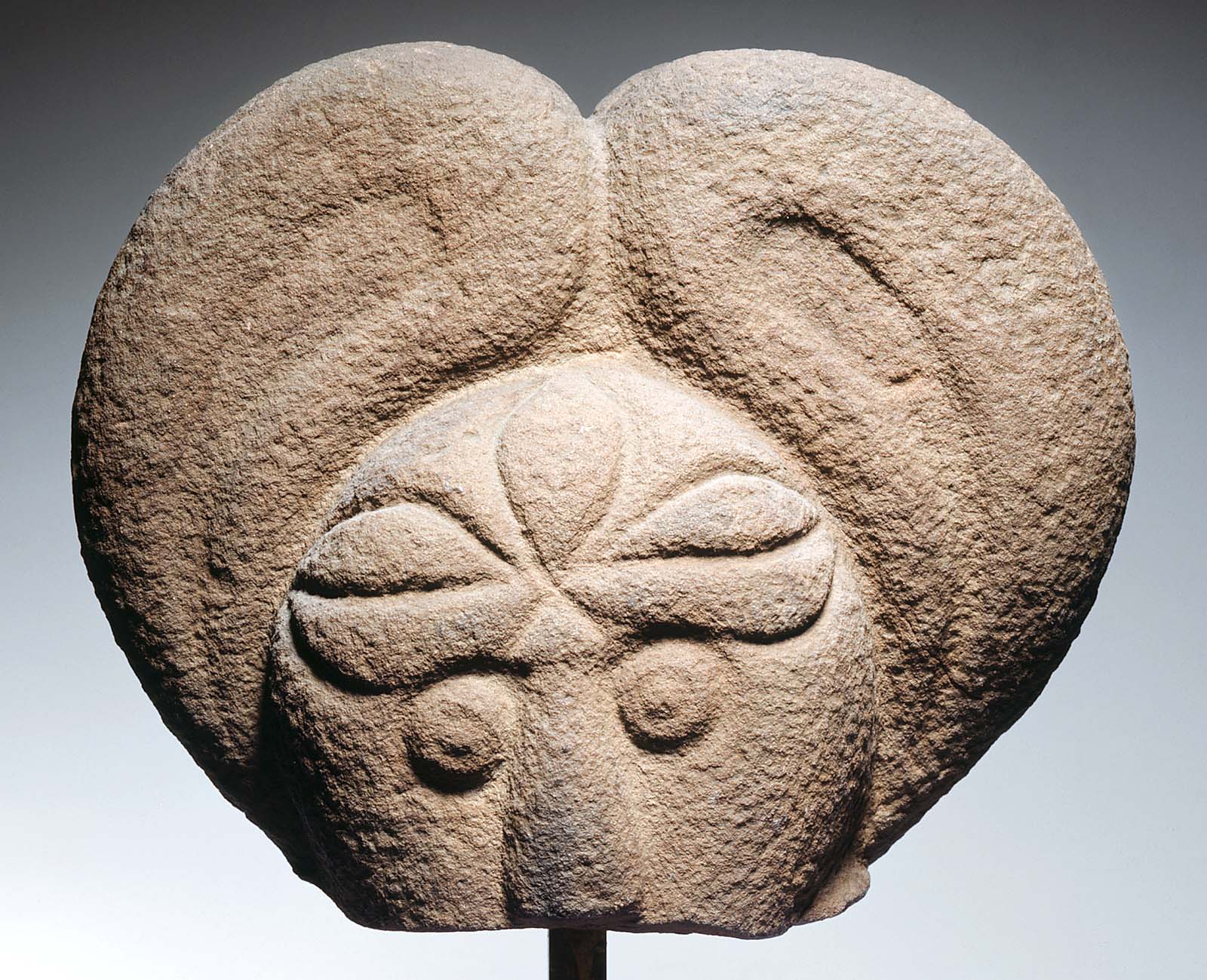
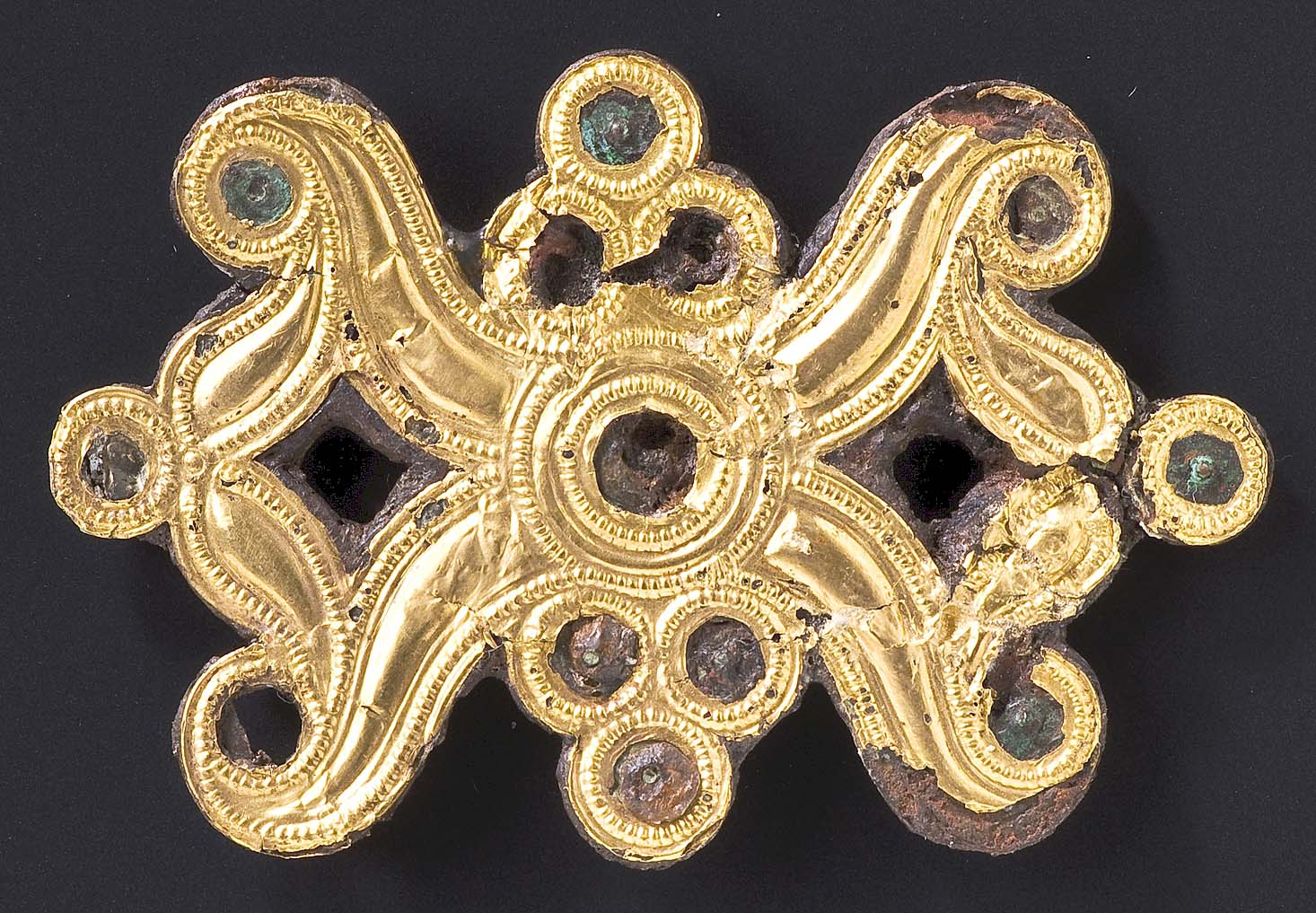
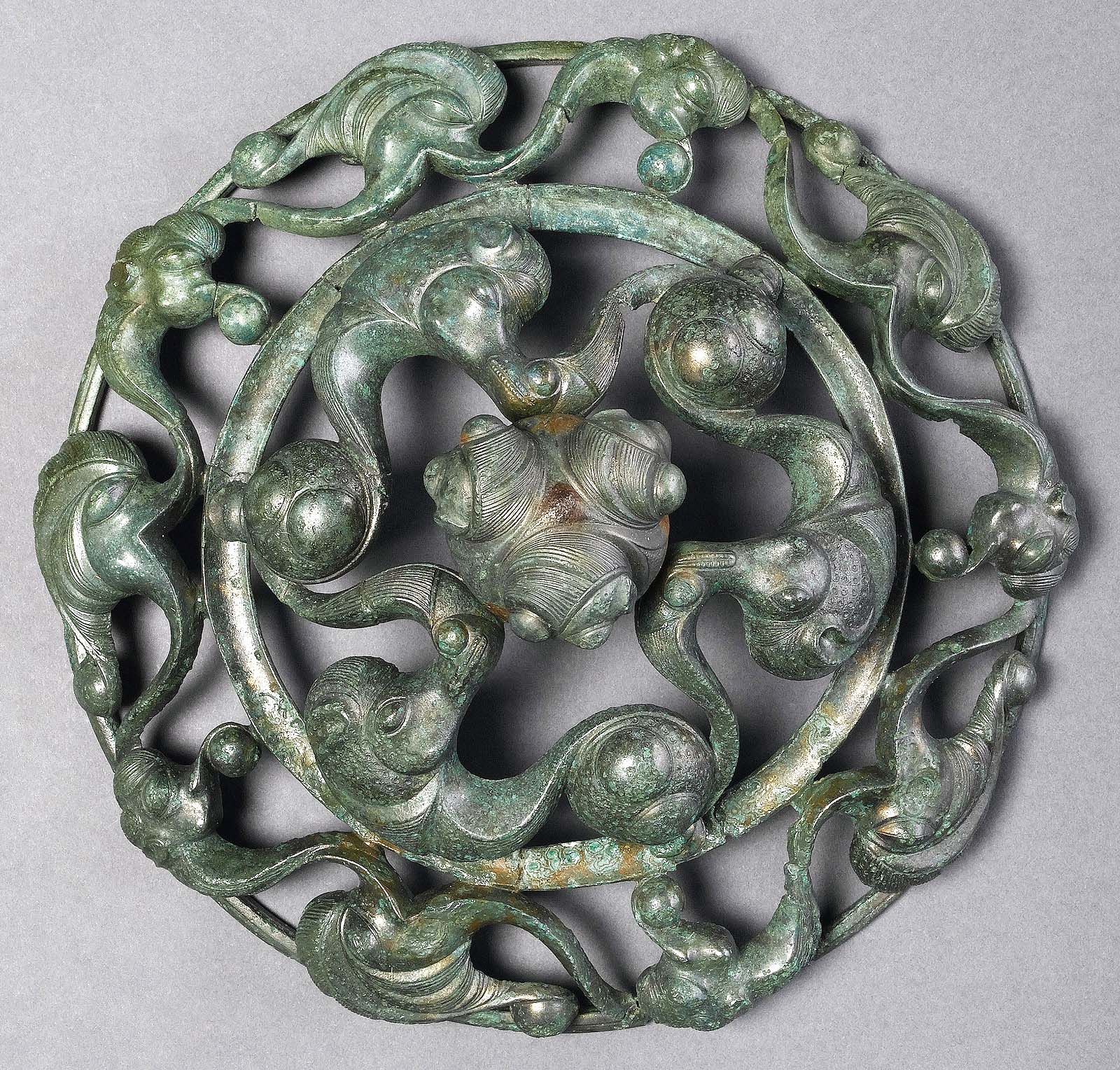
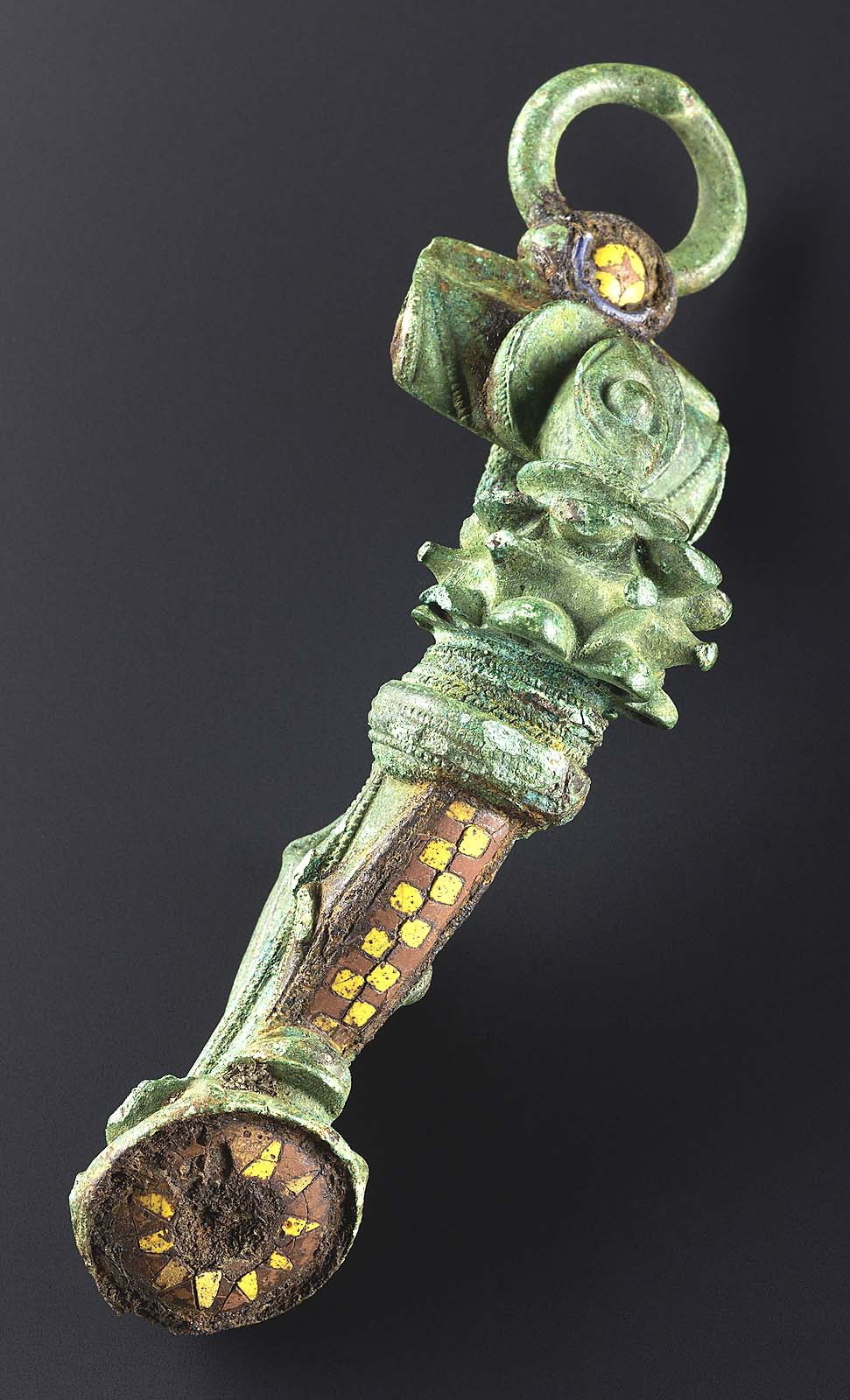
The sandstone head from 450-380 BCE; the gold-plated bronze on iron ornament, circa 430 BCE; and the Third Century BCE dome with dragons all exhibit the common Celtic interest in symmetry, parallelism and repetition of stylized shapes to construct even more complex creations. When you consider how ancient Celtic forms have, over centuries, become the “Celticism” of popular culture — think of leprechauns and other little people, underworld gods and goddesses, ley lines of power, rings of power and, of course the fictions of Tolkien and his many descendants and imitators — it’s tempting but dangerous to graft the popular present onto the distant past and locate these same images and tropes in the ancient Celtic cultures themselves.
Let’s look at Jean-Auguste-Dominique Ingres’ watercolor, “The Dream of Ossian,” painted circa 1832-34 after a wildly popular faux epic composed by Scottish poet James Macpherson in the 1760s. Macpherson claimed he had found the source material for his epic — a wise and highly contemporary move that lent his work an air of legitimacy that, in many ways, created the sensation that swirled around his verse. Ingres’ interpretation of this myth of a myth is the stuff of Celtic cultism, set in an underworld filled with ghosts, druids, harps, goddess with flowing hair and skin-clad warriors. Conan the Barbarian, Kull the Destroyer and Red Sonja would be right at home, as would artist Frank Frazetta and other artists, whose interpretations of interpretations grace pulps, comic books and the entire genre of sword-and-sorcery films that have their roots in our visions of the Celts.
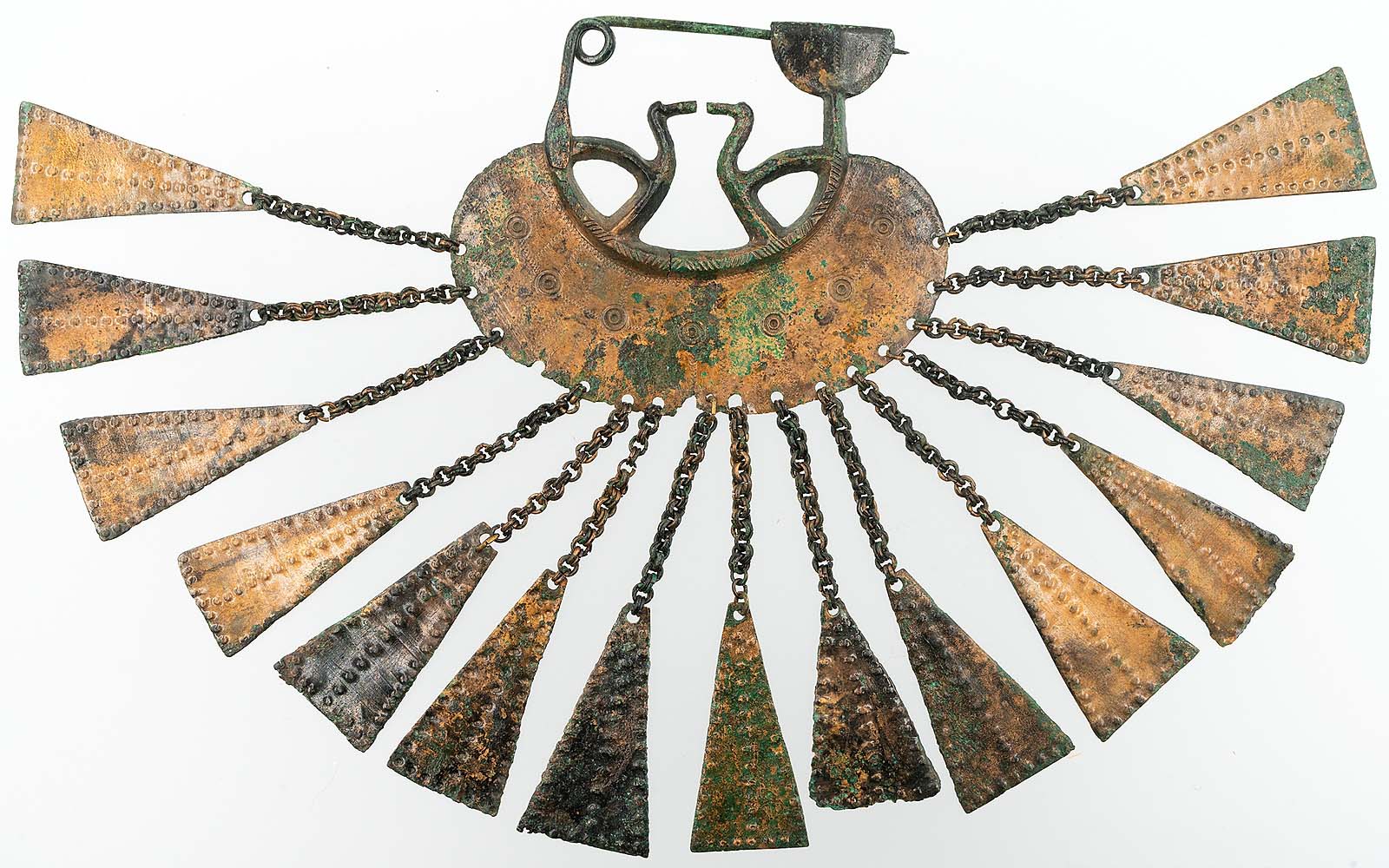
Fibula with two opposed animal foreparts and triangular pendants, circa 600 BCE, bronze, 18½ centimeters tall, from Grave 239 at Hallstatt, Austria. Naturhistorisches Museum, Vienna, 24407. © Naturhistorisches Museum, Vienna. Photo by Benedict Seidl.
As with so many ancient cultures, what we project onto them tells us more, in the end, about ourselves than it does about them. Still, and I felt this in Aberystwyth, wherever we live and make our homes, as long as humans have lived there before, some culture we barely know rises on occasion and reminds us that our world, which seems so solid to us, is little more than a layer, not of bedrock, but of something gossamer, like phyllo dough, that we add to the flaky pastry of human history. It’s a funny metaphor, I admit, but the brevity and fragility of human existence and creativity is worth meditating on, even if it makes you salivate for a croissant, which seems, come to think of it, like a very Gaulish, or Gallic — that is, French Celtic — way to encourage you to visit “Celtic Art Across the Ages.”
The Harvard Art Museums are at 32 Quincy Street. For information, www.harvardartmuseums.org or 617-495-9400.