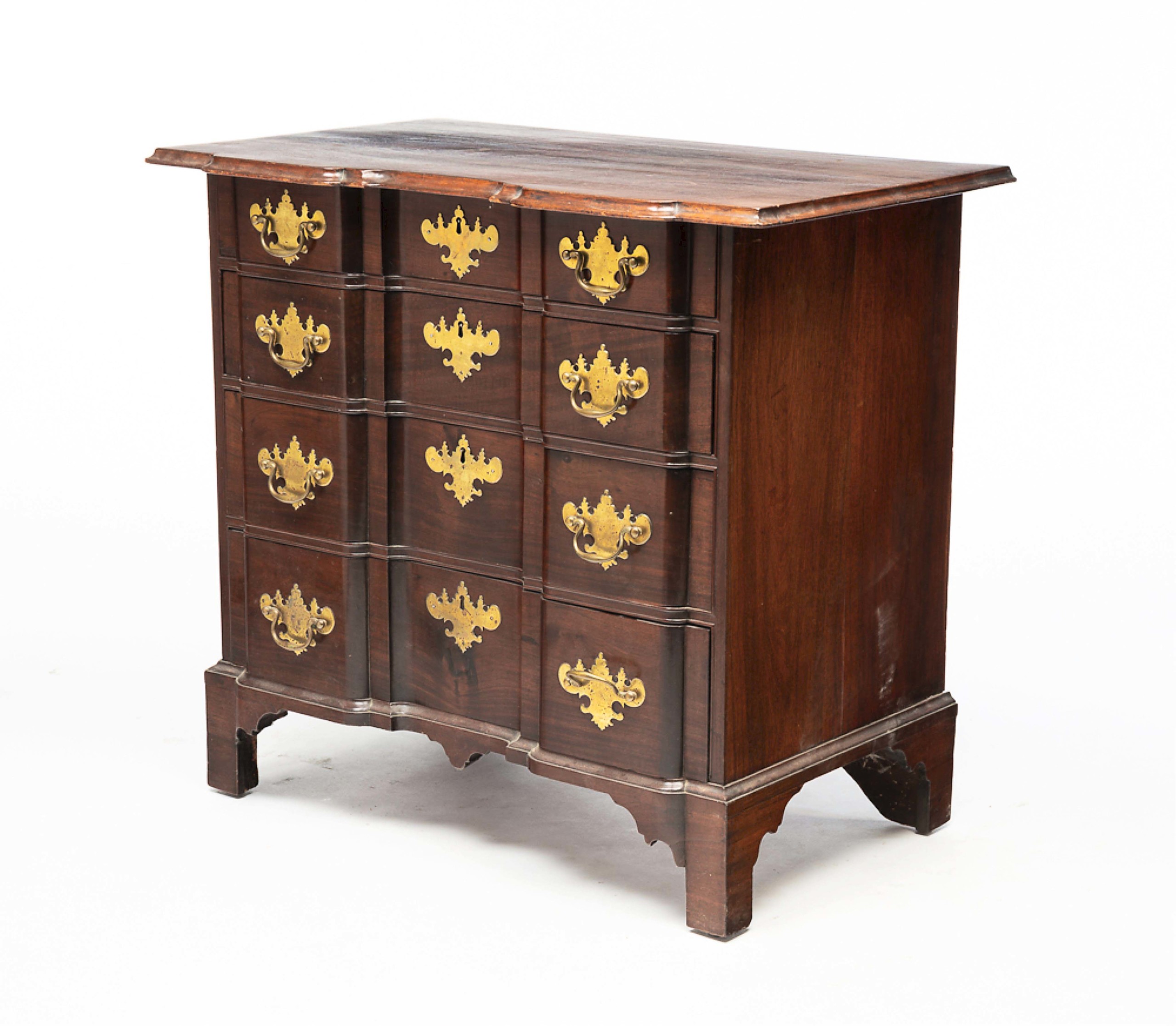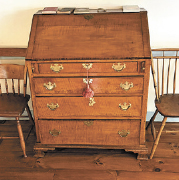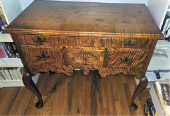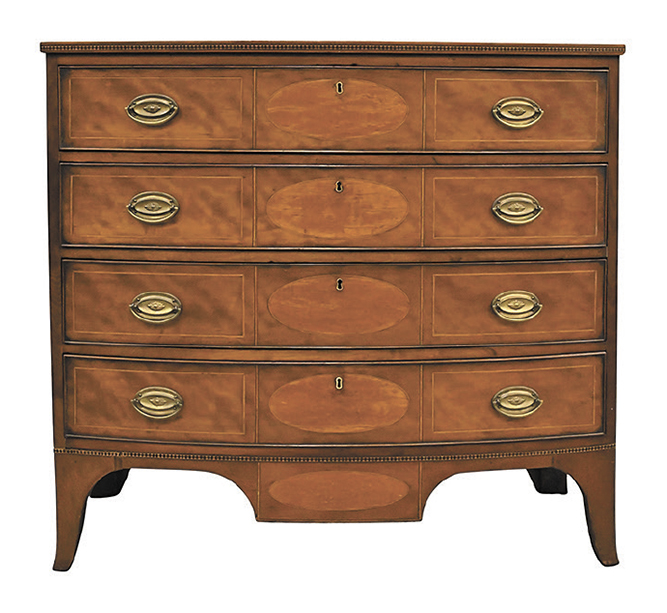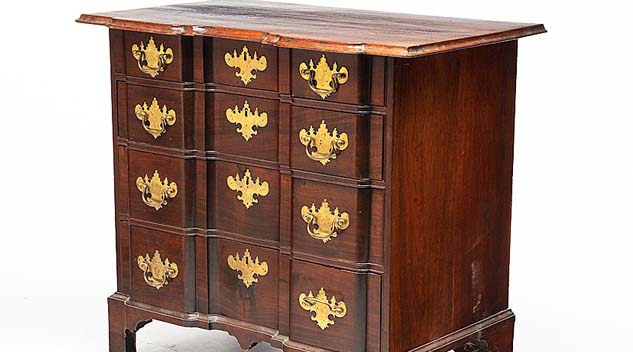
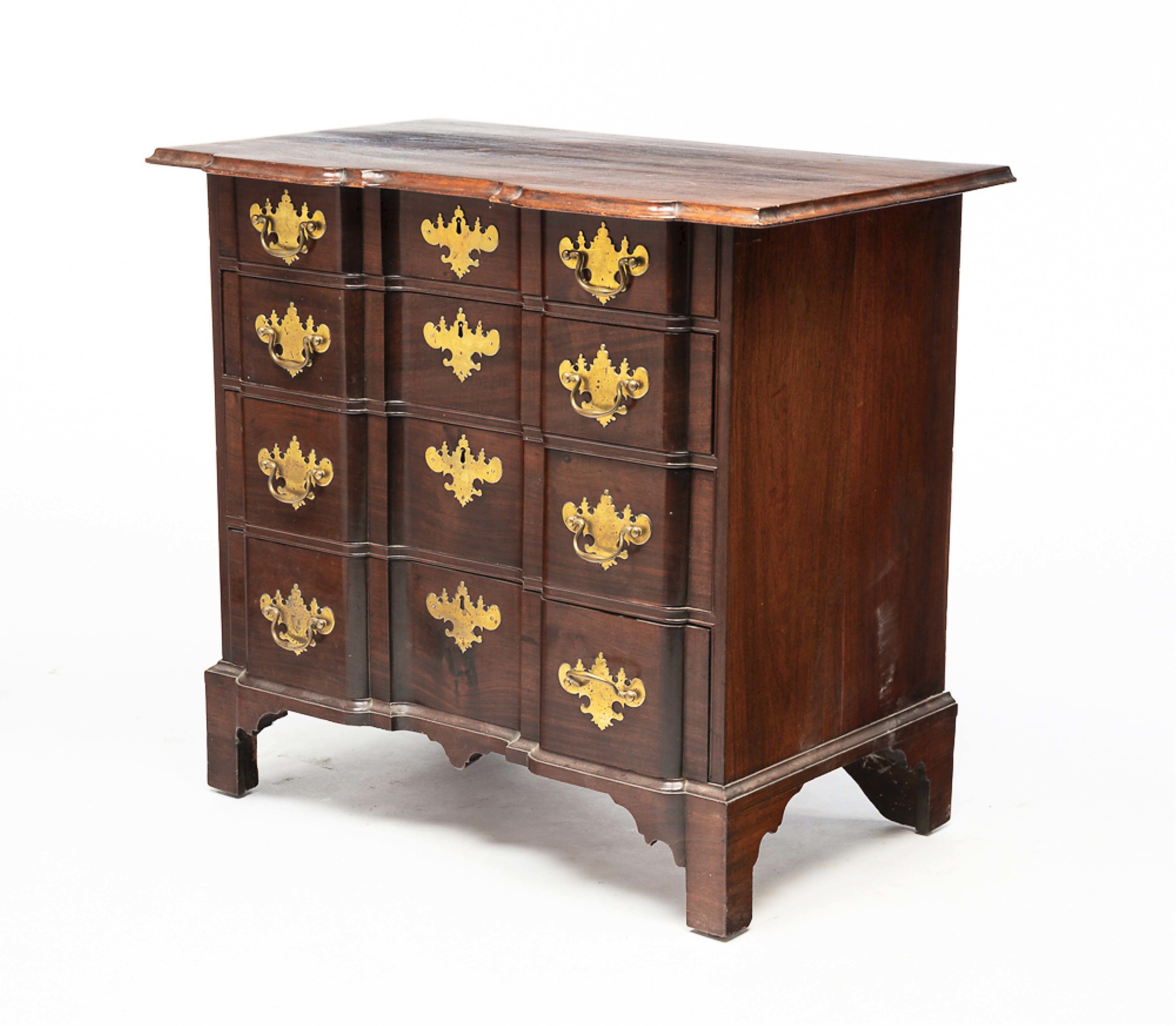
The weekend’s highest price, $24,600, was achieved by this diminutive Honduran mahogany Chippendale four-drawer blockfront chest from Massachusetts, third quarter of the Eighteenth Century, 30½ inches wide by 18½ inches deep ($20/30,000).
Review by Carly Timpson
DELAWARE, OHIO — Black Friday shopping looked a little different for some in Central Ohio who fought leftover tryptophan drowsiness to raise their paddles with gusto. Amelia Jeffers’ Annual Thanksgiving Weekend Americana Auction at the historical Garth’s Auction Barn featured three lifetime collections on November 28-29. Day one featured the first installment of the collections of the late Deborah Fisher of Lebanon, Ohio, and Peggy McClard & Randy Segotta (McClard-Segotta Antiques) of Weare, N.H., and Houston. Day two began with a session comprised of fine and folk art and American furniture from collectors throughout the country and ended with the American history collection of Ken Hanna of Chester, N.J. Altogether, the weekend’s total realized was $1,052,486.
Selling on the second day to achieve the highest price overall was a diminutive Massachusetts Chippendale four-drawer blockfront chest made with Honduran mahogany. Crafted during the third quarter of the Eighteenth Century, the chest was cataloged as being “smaller than average scale with nice proportions” and the top had a “generous overhang.” Its provenance included an important central Ohio collection as well as that of Joanne & Dr David Woodyard (Granville, Ohio) and Florene Maine (Ridgefield, Conn.). A phone bidder took the chest home for the within-estimate price of $24,600.
The second-highest price was achieved 20 lots later and matched in form. This mahogany chest — another diminutive Chippendale-style block front example with four drawers — was made in Boston or the North Shore of Massachusetts, also during the third quarter of the Eighteenth Century. It retained its historic surface and had period brass hardware, aiding its $17,220 result.
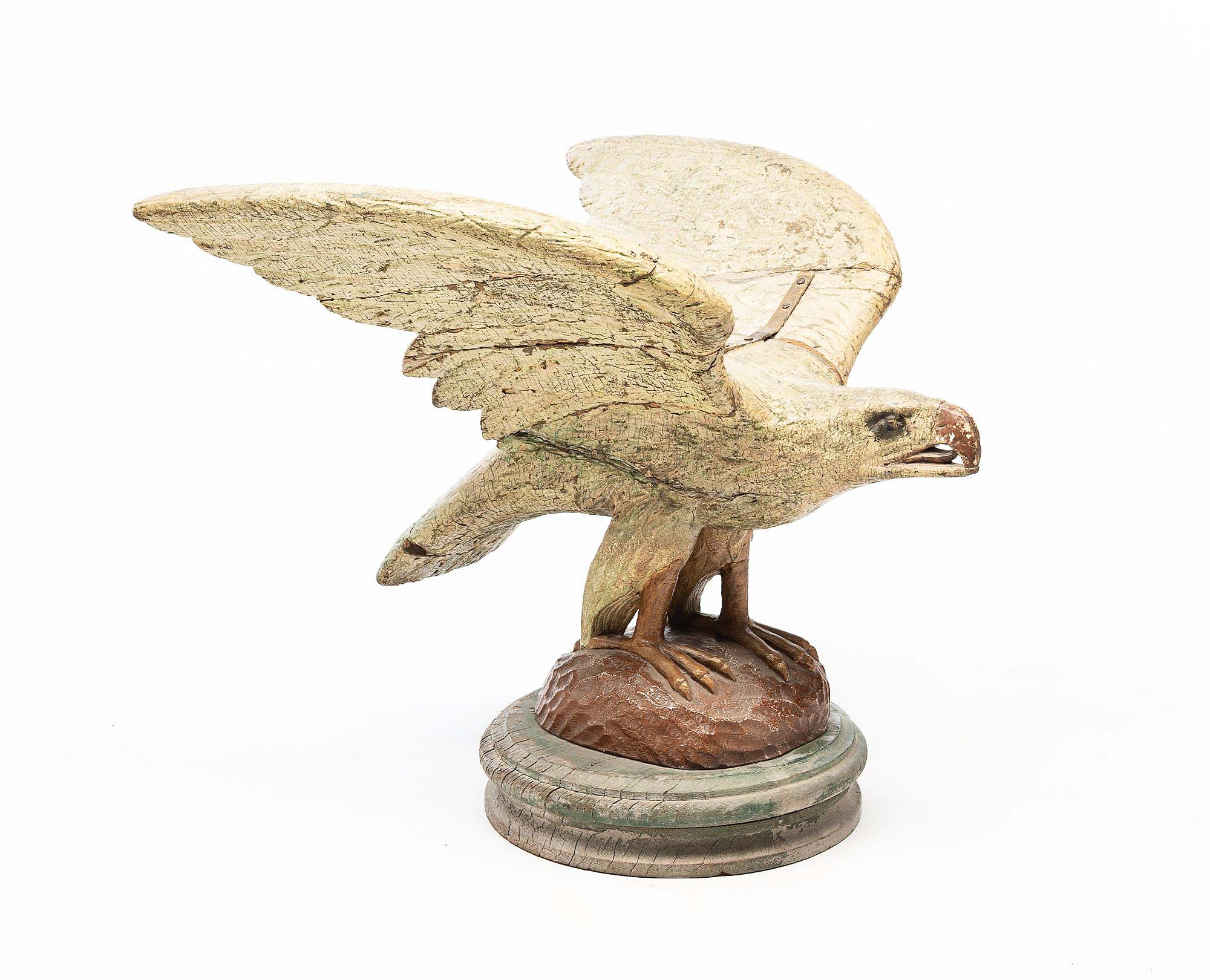
Flying to the top spot on the first day was this Nineteenth Century carved and painted wooden pilot house eagle, 27½ inches high by 29 inches wide by 29½ inches deep; it earned $11,378 ($3/5,000).
Day one was led by an exceptional eagle from the collection of Deb Fisher that also had provenance to the Golden Lamb Inn, Ohio’s oldest hotel. The carved and painted wood eagle was crafted in the Nineteenth Century with spread wings and perched atop a carved mound-form base. With its 29-inch-wide wingspan, the bird flew well past its $5,000 high estimate to find a buyer for $11,378.
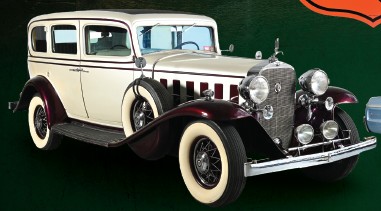
The same collection consigned the day’s second-highest price: Deb’s 1952 MG TD Roadster. The British classic was rebuilt and restored for its American owner — with a left-hand driver’s seat — in Racing Green paint with a checkered flag grille and a Union Jack emblem on either door. In running condition, the car’s milage was just shy of 55,000, and an online buyer placed the winning bid of $10,240.
Folk art collectors know they can find something they fancy in any auction Jeffers conducts, and the Thanksgiving Weekend sale proved fruitful. On the first day, an early Nineteenth Century American School portrait of six children, those of Lieutenant Josiah Hasbrouck, who later became a US Representative, found a new owner for $8,610. The portrait came from the McClard & Segotta collection, last sold by Keno Auctions in New York City in 2011.
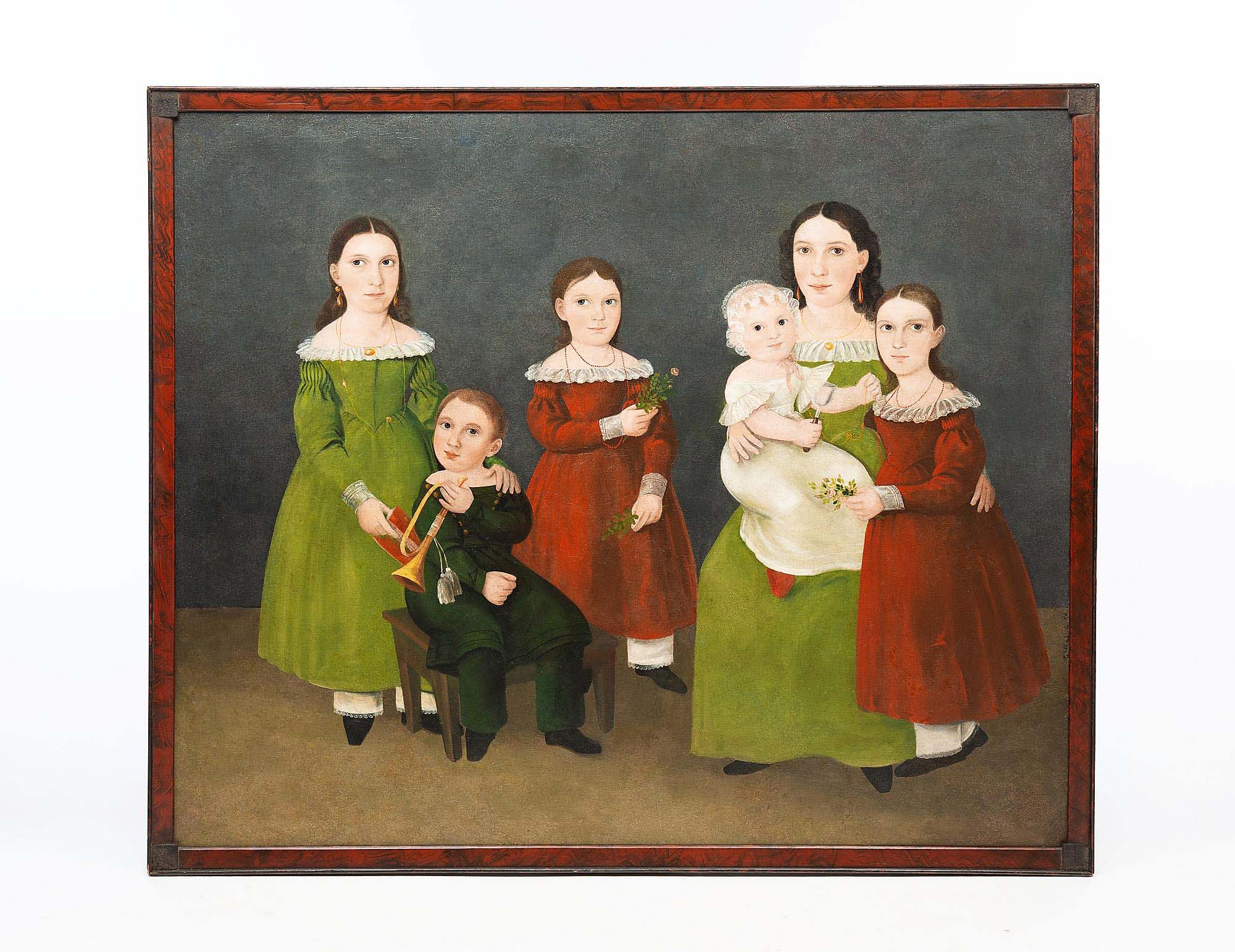
The six children of Lieutenant Josiah Hasbrouck (New Paltz, N.Y., 1755-1821) were depicted in this early Nineteenth Century oil on canvas American School folk art portrait, 56 by 60 inches framed; it was bid to $8,610 ($8/12,000).
A circa 1840 portrait of a young woman by Sturtevant J. Hamblin also impressed bidders, who took her past her $6,000 high estimate to realize $7,380. The sitter was depicted wearing a gold necklace, a lace-trimmed dress and holding a small book in one hand. Also from the McClard & Segotta collection, the work was formerly in the Boston collection of dealer and preservationist Steven Score.
Though American furniture claimed the top two spots from day two, the Hanna collection of Native American objects and militaria remained dominant. The third-highest price overall was a rare blacksmith-forged pipe tomahawk from the last quarter of the Eighteenth Century. The forged head, which was on its original carved and painted ash handle, had incised lip and base-banding at the bowl and a notched return at the back of the blade. The example earned an award in the 1990 Kentucky Rifle Association Show, was illustrated in Tomahawks & Pipe Axes of the American Frontier by John Baldwin (1995) and had extensive provenance prior to Hanna. Ultimately, it was claimed, above estimate, for $16,640.
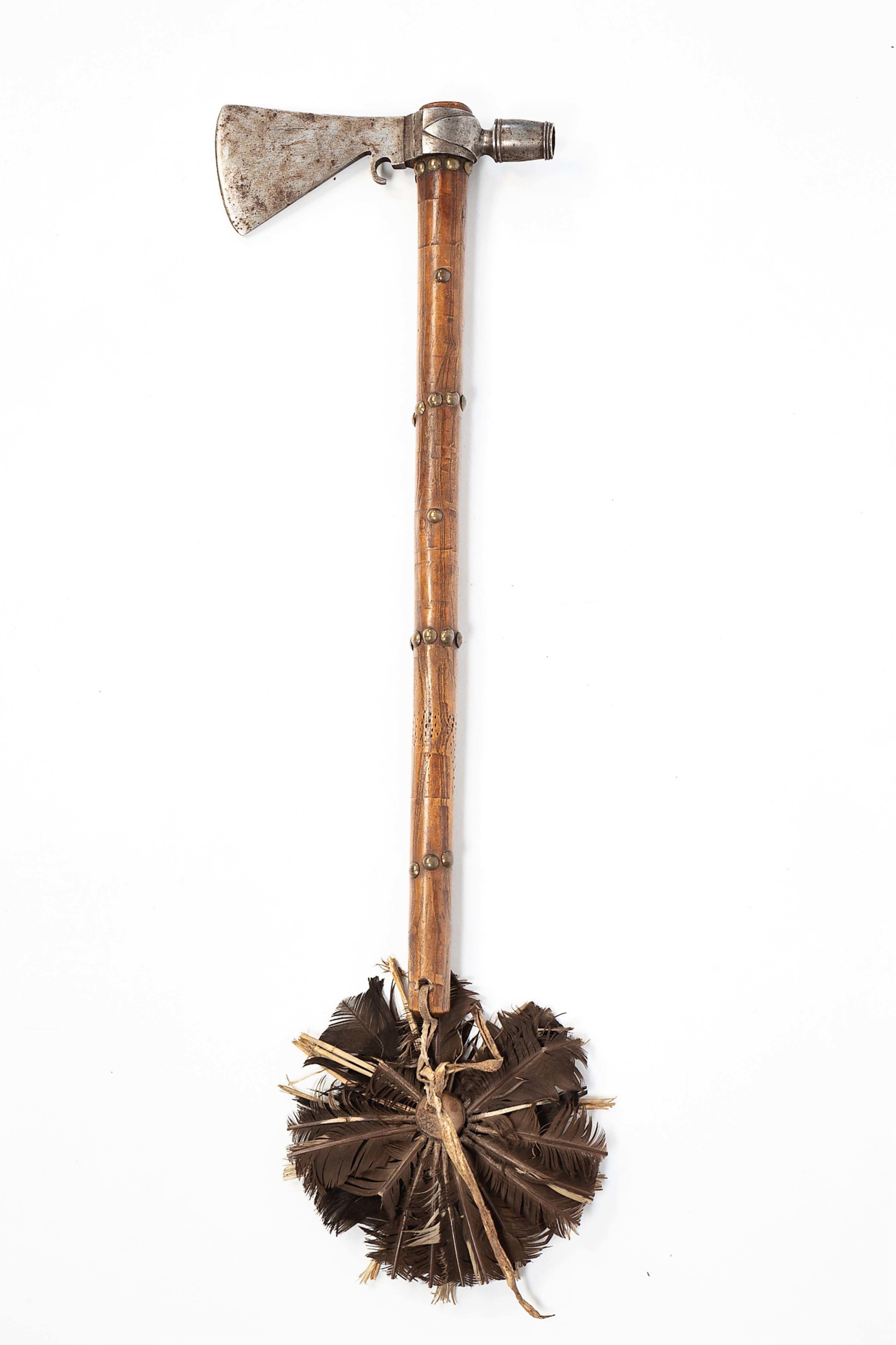
Several other pipe tomahawks from Hanna’s collection had notable results. A Plains example with a sunburst-style feather trail and an unusual hook at the rear of the blade brought $11,070, a Western example that had pierced bee and batwing silhouettes on its head finished for $9,840 and a Sioux or Crow example with an extra long ash handle, hand-forged head and a large, possibly original, beaded trail earned $8,610.
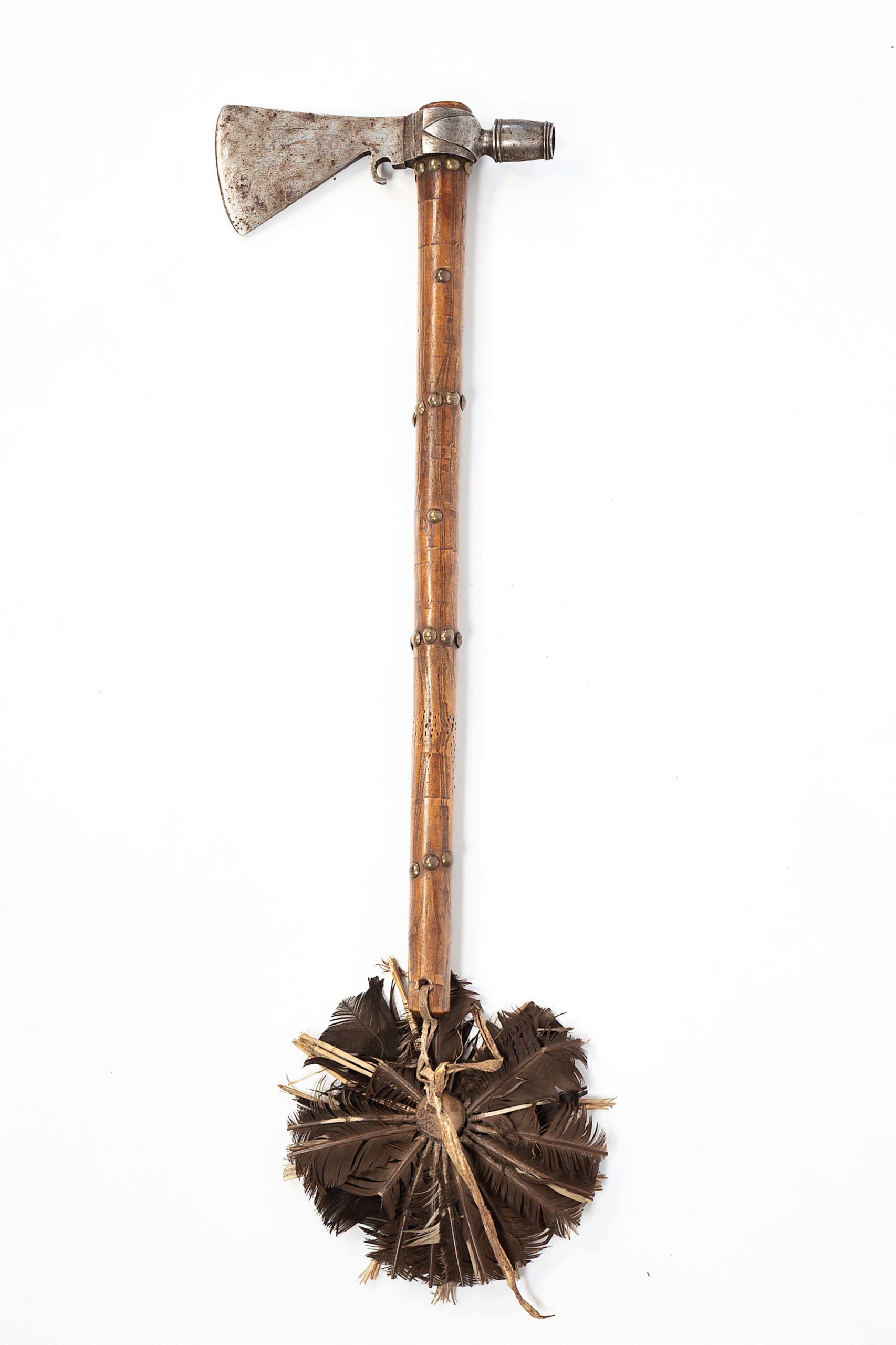
This 20-inch-long Plains pipe tomahawk had a trail of feathers arranged in a sunburst pattern, second half of the Nineteenth Century; it brought $11,070 ($6/12,000).
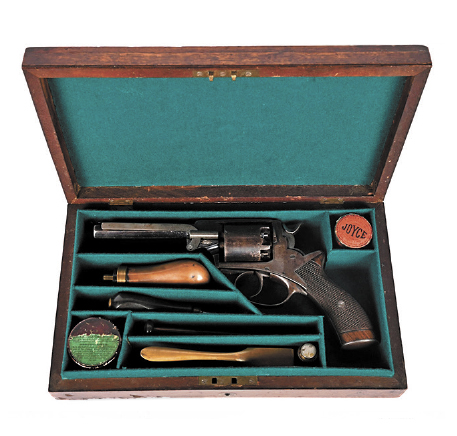
Firearms from the Hanna collection included a Winchester Model 1866 carbine that exceeded its $6,000 high estimate to realize $8,320. Manufactured in 1870, this brass lever-action rifle had tack decoration, deer skin wraps and was engraved “Luis W. Morales.” An additional stamp on the top of the barrel further identified Morales. The catalog noted that this gun was found in Nebraska, under hay in a barn that was being torn down. Two cased Colt revolvers followed, each achieving $7,995. The first to sell was a nickel-plated six-shot single-action revolver with ivory grips. From the 1876 production, the weapon sold with its original case, some ammo rounds and cleaners. Two lots later, an 1860 Army revolver engraved for the Adams Express Company and initialed “J.N.B.” found its new owner. This example had a fluted cylinder and cut barrel for shoulder stock. It sold with related accoutrements, including a powder flask and Adams Express ephemera.
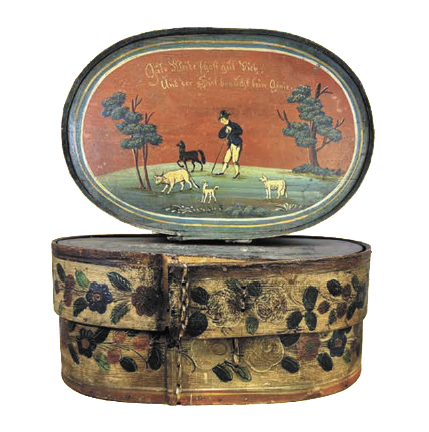
Also sold on day two was a paint-decorated dome-top box made by Heinrich Bucher, which far surpassed expectations when it achieved $12,300 on a high estimate of $5,000. Decorated with polychrome flowers on a black ground, the box had provenance to New Oxford, Penn., dealer Kelly Kinzle.
Another surprising result was the $9,840 realized for a powder horn. Engraved with the name of Stonington, Conn., resident Rufus Hill, the circa 1750s horn was further adorned with foliate designs, fish, birds, scrolls and a motivating message: “By Powder and Ball the French Will Fall.” The piece was from the collection of Tom and Lenore Karras (Geneva, Ill.) and had previously been deaccessioned from a New England museum.
On January 8-9, more of the Fisher and McClard & Segotta collections, as well as that of Dr and Mrs Ronald Wright, will be sold in Amelia Jeffers’ Winter Great Estates Auction. Additions from the Hana collection will be featured in the Winter Fabulous Finds Auction, January 29-30.
Prices quoted include the buyer’s premium as reported by the auction house. For information, www.ameliajeffers.com or 740-362-4771.