By Jessica Skwire Routhier
SHELBURNE, VT. — Context may not be everything when it comes to approaching and understanding the art of Anna Mary Robertson “Grandma” Moses, but it matters a lot. The latest contribution to the somewhat crowded field of Moses retrospectives is a studied attempt to articulate more completely the context in which her work was made and perceived in the 1940s and 1950s. Both the exhibition and the catalog take the bold step of presenting Moses’s work alongside that of her Modernist contemporaries, arguing persuasively that she was less the “naïve” autodidact she is often thought to be and more fully a participant in the construction of American Modernism.
“Grandma Moses: American Modern” is on view at Shelburne Museum through October 30 and will travel to the Bennington Museum in 2017.
By now the story of Moses’s “discovery” and rise to fame is familiar. She lived most of her life on a farm in rural Green Point, N.Y., near the Vermont border, and began painting in earnest in her seventies, after the death of her husband. In 1939, her paintings, on view in the “women’s exchange” area of a local drugstore, caught the attention of a New York-based folk art collector. In an astonishingly brief period of time she was exhibiting at the Museum of Modern Art, licensing images with Hallmark, appearing frequently on nationally televised broadcasts and becoming a household name — enough so that Spencer Tracy, in the 1945 film Adam’s Rib, could tease Katharine Hepburn that her new hat made her look “kinda like Grandma Moses.”
“To go from unknown to being name-dropped by Hollywood within the space of just a few short years,” says exhibition co-curator and Bennington Museum curator Jamie Franklin, “is pretty indicative of how much of a phenomenon she was and how quickly that happened.”
And yet it was not immediate. Franklin’s description of Moses as initially “unknown” is literal; the 1939 MoMA exhibition, in which Moses exhibited three paintings, was titled “Contemporary Unknown American Painters.” The title of her follow-up solo show at Galerie St Etienne, “What a Farm Wife Painted,” also elided her name in a way that today seems confounding, given how famous that name would soon become. A reviewer from the New York Herald Tribune, writing about the latter exhibition, was the first to call her “Grandma” Moses, and soon it had not only stuck, but was on its way to becoming one of the most recognized names in America.
Thomas Denenberg, director of Shelburne Museum and exhibition co-curator, sees that rapid rise and commodification of the “Grandma” name as part of a process by which her contributions to American art become devalued over time. “‘Grandma’ was initially a nickname that was belittling to her,” he notes, acknowledging that she herself was complicit in perpetuating its use, as it became clear that it was how the public chose to see her. Franklin agrees, noting that “her popularity made her authenticity questionable to the mainstream art world” and adding that “she and her art have struggled to retain a respectability among the very world that introduced her to the public.”
Understanding her work, then, requires stripping away that veneer of celebrity and consciously setting aside preconceived notions about little old ladies, how people learn to make art and the perceived elitism of the art world itself. Denenberg notes that the MoMA show was just one of a series of similar exhibitions the museum hosted that were “trying to create a genealogy for Modern painting” in America.
MoMA’s curators did not particularly question the primacy of European Modernism as the major influencer on American artists, but they did consciously make a case for vernacular art (so-called “folk art”) as an additional influencer, one that made American Modernism distinct. This perspective was shared, Franklin says, “by largely progressive artists, critics, curators and dealers who were looking outside the mainstream…. Moses just happened to be one of those artists.” Her early champions took her work seriously in this context, even if they understood from the start that her brightly colored village scenes and verdant landscapes would appeal and could be read — and marketed — on a purely surface level, as well.
“Grandma Moses paints like a child,” her dealer Otto Kallir said in 1948, “but like one child in a million.” It is as useful a paradigm as any for appreciating her work, and yet it, too, requires further examination. Franklin makes a compelling case that her works are compositionally sophisticated in a way that rarely draws notice. “She’s known as a ‘memory painter,’” he observes — a descriptor for a certain kind of unschooled painter who paints from their mind’s eye rather than the observed world — “but they’re not necessarily her own memories.”
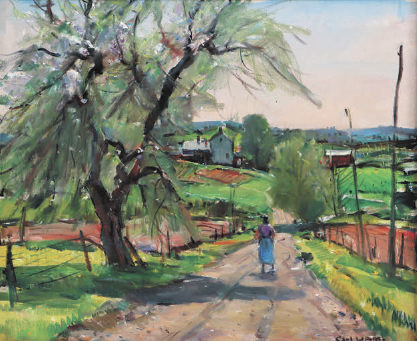
In fact, Moses was a “voracious appropriationist,” constantly combing through a massive cache of clippings that she kept in a trunk. There she found not only inspiration for her work, but also scraps of images that she reverse-engineered into specific compositional elements. She responded primarily to the visual qualities of her source material, utilizing clippings of individual figures, houses, trees and animals in ways that often have little to do with their original context.
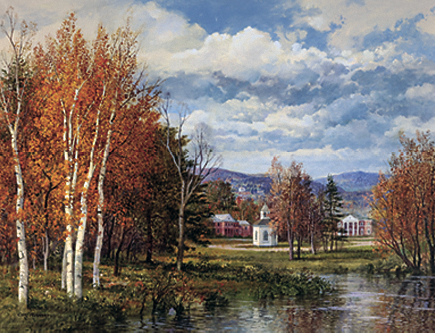
Her “Bennington” of 1945 is illustrative of her complex practice; it has the wobbly perspective of the circa 1910 fisheye photograph that inspired it, but the lush, landscape rising behind it is her own invention. The white spike of the Battle of Bennington monument was apparently something of a visual touchstone for Moses — she also included it in her 1953 historical painting of the Battle of Bennington, explaining away the anachronism: “Well, I put the monument in because it looked good, I guess.”
Bon mots like these, perhaps as much as anything, have contributed to the perception of Moses as a simple person who made simple paintings — cobbled-together, sparkle-speckled pastiches of whatever “looked good” that might as well have been assembled by a child. And yet contemporaries of Moses’s took similar approaches and articulated their philosophies in much the same way without being belittled for it. Helen Frankenthaler, who was living and painting in Bennington the same time as Moses, talked about her watershed “Mountains and Sea” as a memory painting, a rendering of a landscape experienced and internalized rather than observed. Joseph Cornell, like Moses, sifted through the ephemeral detritus of life in the Twentieth and late Nineteenth Centuries and created assemblages of images, objects and words with deep emotional and associative meanings.
“Joseph Cornell we would never say is anything but a Modernist, despite the huge sentimental streak,” adds Denenberg. “Moses we say is a folk artist because of this sentimental streak.” The point, Franklin says, is not to legitimize Moses through these associations, but simply to demonstrate that she, Frankenthaler, Cornell and other important American Modernists — including Andy Warhol, Miriam Schapiro and Hans Hoffman, also in the exhibition — “thought and created in parallel ways.”
Also bearing reassessment is the concept of Moses being a “self-taught” painter. The catalog essay by art educator and cultural historian Diana Korzenik compellingly documents the broad and populist reach of art education in post-Civil War America, which Moses benefited from. Beyond the public school art curricula mandated by state governments, Moses would also have learned from her father, who painted landscape murals on the walls of the family home, and she would have used and lived with the decorative painted furniture that is so prized by antiques collectors today.
“Grandma Moses emerged out of a culture that absolutely reified images,” notes Denenberg. Franklin also adds that Moses’s practice has compelling connections to the kind of traditional women’s arts that were beginning to receive new scholarly attention in the 1950s and beyond. Miriam Schapiro, for instance, was part of a community of feminist artists who coined the term “femmage,” a historically feminine approach to collage that bridges centuries, cultures and distinctions between “high” and “low” art. Moses’s work clearly resonates with this description and may be seen as part of that tradition.
And yet, Moses was never fully embraced by the feminist art movement nor by the Postmodernists, who freely lauded the work of other appropriationists. By the 1950s, “folk” or “naïve” or “outsider” art was seen more and more as an entirely separate category from the fine arts. Moses was relegated to one side of that invisible line. Franklin muses that this could be because, unlike other Postmodernists, she lacked irony. She painted in a kitchen apron not to be cute, but because what on earth else should she have painted in? But that apron — along with the “Grandma” sobriquet, her age, her rural milieu, her folksy common sense — contributed to the construction of a celebrity persona that Franklin sees as a kind of exoticization that does her a disservice.
She really was not that exotic, he argues; the life she lived in upstate New York was an unexceptional one for Americans in the waning of the Depression. And her paintings were not preserved in amber, museum-piece memories of the Nineteenth Century, made possible only because she was so unimaginably old — in fact, she was not yet 80 when she first exhibited in New York.
Instead, Franklin argues, Grandma Moses promoted in her paintings a kind of hopeful vision for her very real, present world. The “Grandma” part aside, Franklin relates Moses’s name to Moses the biblical figure, noting that she named her own home Mount Nebo, the place where the prophet stood to take in a view of the promised land. In the turbulent years following the Depression and World War II, Franklin says, “people wanted a sense of hope and a golden era to hold on to,” and in Moses’s paintings they found just that. Her “romanticized, rural America … may or may not have actually existed in the way she depicted it,” but it nevertheless shone through as a dream of “an idyllic promised land.”
The critics may not have known what to do with all this, but that makes it no less meaningful, in both an artistic and a cultural context.
Grandma Moses is deeply embedded in the histories of both Shelburne Museum and the Bennington Museum, which over the years have done as much as any public cultural institution to construct and deconstruct the public perception of her work. It is only fitting then, that they are the co-organizers of this groundbreaking exhibition and, with Skira-Rizzoli, co-publishers of the handsome and thought-provoking accompanying catalog, which includes essays by Denenberg, Franklin and Korzenik as well as Alexander Nemerov.
Shelburne Museum is at 6000 Shelburne Road. For further information, www.shelburnemuseum.org or 802-985-3346.
Jessica Skwire Routhier is a writer, editor and independent art historian based in South Portland, Maine.