Cooper Hewitt, Smithsonian Design Museum

“Piano rims in the rim conditioning room,” 2011 photograph by Christopher Payne, Steinway & Sons (Astoria, N.Y.). Courtesy of the artist and ©Christopher Payne/Esto.
By Andrea Valluzzo
NEW YORK CITY — As a textile curator, Susan Brown was immediately captivated by a photograph Christopher Payne shot in a Massachusetts textile mill after months of waiting for the perfect moment. What would otherwise be a nondescript factory came to life in a burst of color as slivers of hot pink wool fiber ran through a carding machine.
This photograph is one of the featured images in “Made in America: The Industrial Photography of Christopher Payne,” on view at Cooper Hewitt, Smithsonian Design Museum through September 27; it is the museum’s first large-scale photography exhibition. The exhibition not only sheds light on the design process and American inventiveness but also the interconnectedness between machines and skilled people as makers of objects working towards a shared goal.
As a museum interested in design, the Cooper-Hewitt has an impressive collection of items relating to the design process from sketches hastily drawn on the back of cocktail napkins and finished presentation drawings, to models, prototypes and final products. Seldom though does the museum get to show objects as they come into being on a factory floor.
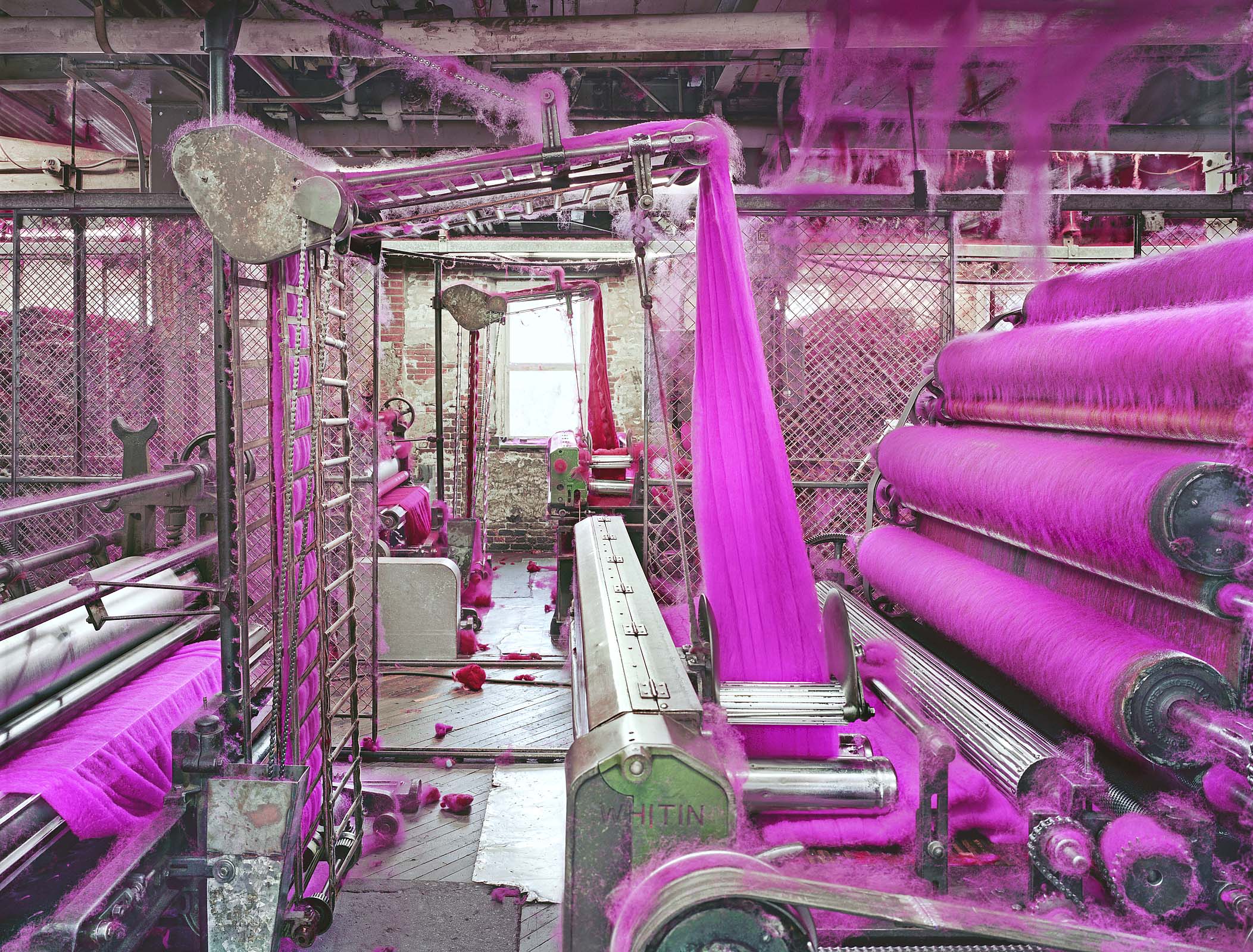
“Wool carders,” 2012 photograph by Christopher Payne, S & D Spinning Mill (Millbury, Mass.). Courtesy of the artist and ©Christopher Payne/Esto.
Planning this exhibition a few years ago after the publication of Payne’s book, Made in America: The Industrial Photography of Christopher Payne (Abram Books, 2023), Brown said the exhibition presents several opportunities. “We are all very inundated everyday with visual imagery, but Chris’s photographs are the opposite of iPhone snaps,” she said. “He is very patient and he takes a lot of time to make these images so it’s an opportunity for us to talk about color, scale, form and repetition and specifically how those things relate to mass production.”
And when the Smithsonian exhorted its member institutions to create programming with the nation’s 250th anniversary in mind, the timing could not have been better. “I had been waiting for the right moment to do something with him here at the museum,” Brown commented. “This is the perfect moment because the photographs themselves are very celebratory and really do honor the American worker.”
A love letter to American craftsmanship, the exhibition comprises 72 photographs taken over a span of nearly 15 years that show how raw materials are transformed into designed objects. Items depicted run the gamut from handmade goods to those using large-scale and modern technology. Goods from the very small — pencils, for example — to the very large — such as communications satellites — are represented as well as those made in much the same way as in the Nineteenth Century to new items embracing modern technology. “We definitely wanted to represent both ends of the spectrum from things that are almost fully handcrafted to things that are almost fully automated,” added Brown.
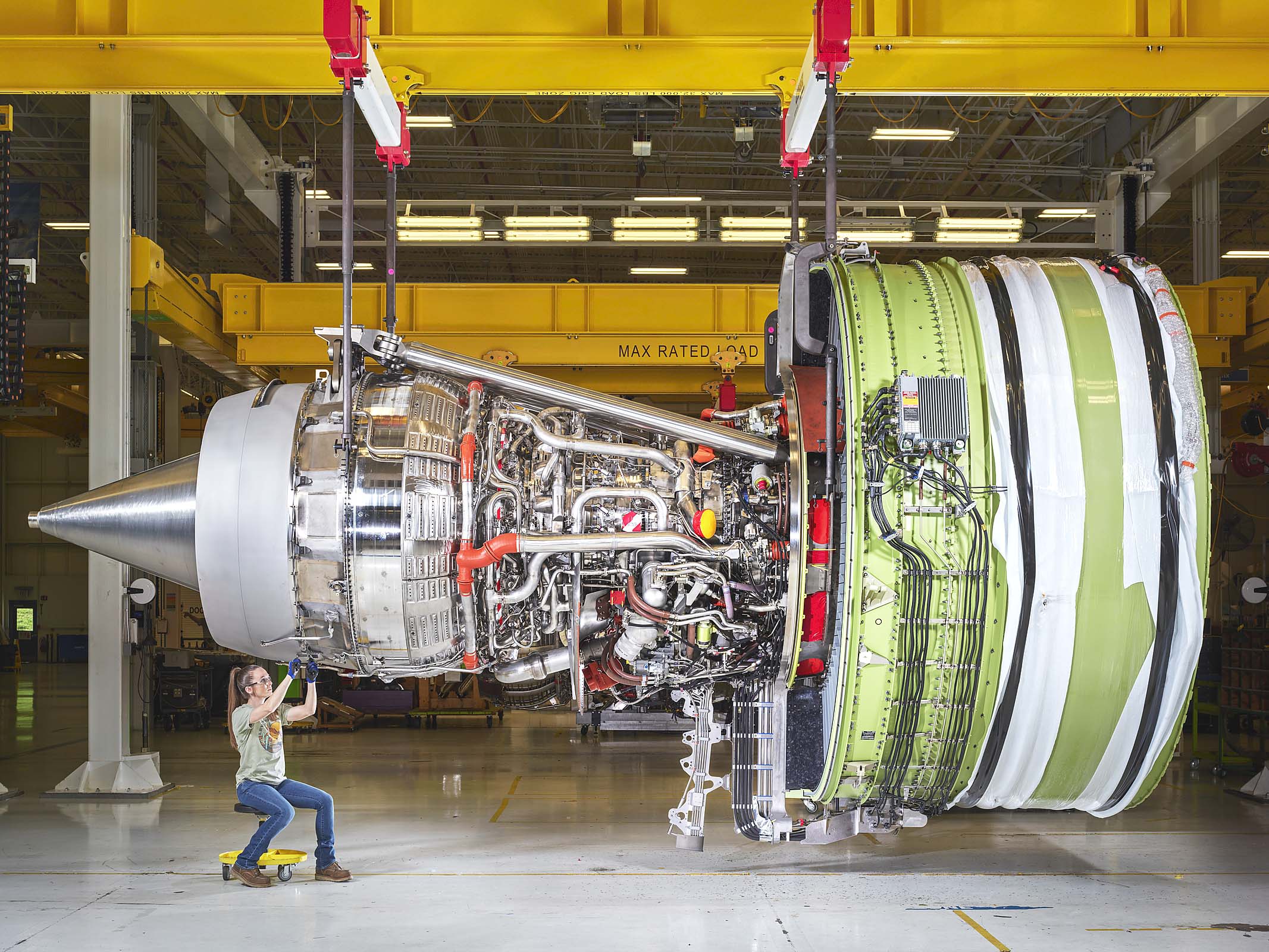
“GE90 jet engine being prepped for testing,” 2023 photograph by Christopher Payne, GE Aerospace Peebles Test Operation (Peebles, Ohio). Courtesy of the artist and ©Christopher Payne/Esto.
Trained first as an architect, Payne (b 1968) plans and composes his photographs with a keen eye towards architectural design even as he turns images of objects into art. In this ongoing passion project, Payne often spent countless hours in a factory over the course of months waiting for a key moment in the manufacturing process to capture the essence of the entire process into one photograph. Nearly 20 percent of the images in “Made in America” are new since Payne’s book was published. In prepping for the exhibition, Payne took pains to get through his bucket list, visiting factories across the United States, especially those he had been unable to access previously.
Organized thematically, “Made In America” opens with a section titled “Handcrafted Industry,” showing examples of factories that continue the tradition of handcrafted artistry. A visually striking photograph of Steinway piano rims drying in a sauna-like conditioning room in the Queens, N.Y., factory is artfully organized. To highlight the perspective, Payne had employees create a nearly-endless pattern of larger piano rims aligned with smaller ones in back. The photographer used strobe lights to accentuate the space between the rims to make them appear to be glowing. Factories change and manufacturing processes change. Payne said in an audio tour he recorded for this exhibition, noting that after his photograph, Steinway began placing braces inside the rims to keep their sides straight while in the conditioning room. “It was a technological improvement for sure, but it meant that a view like this no longer exists, and I feel lucky to have made this picture when I did,” he explained.
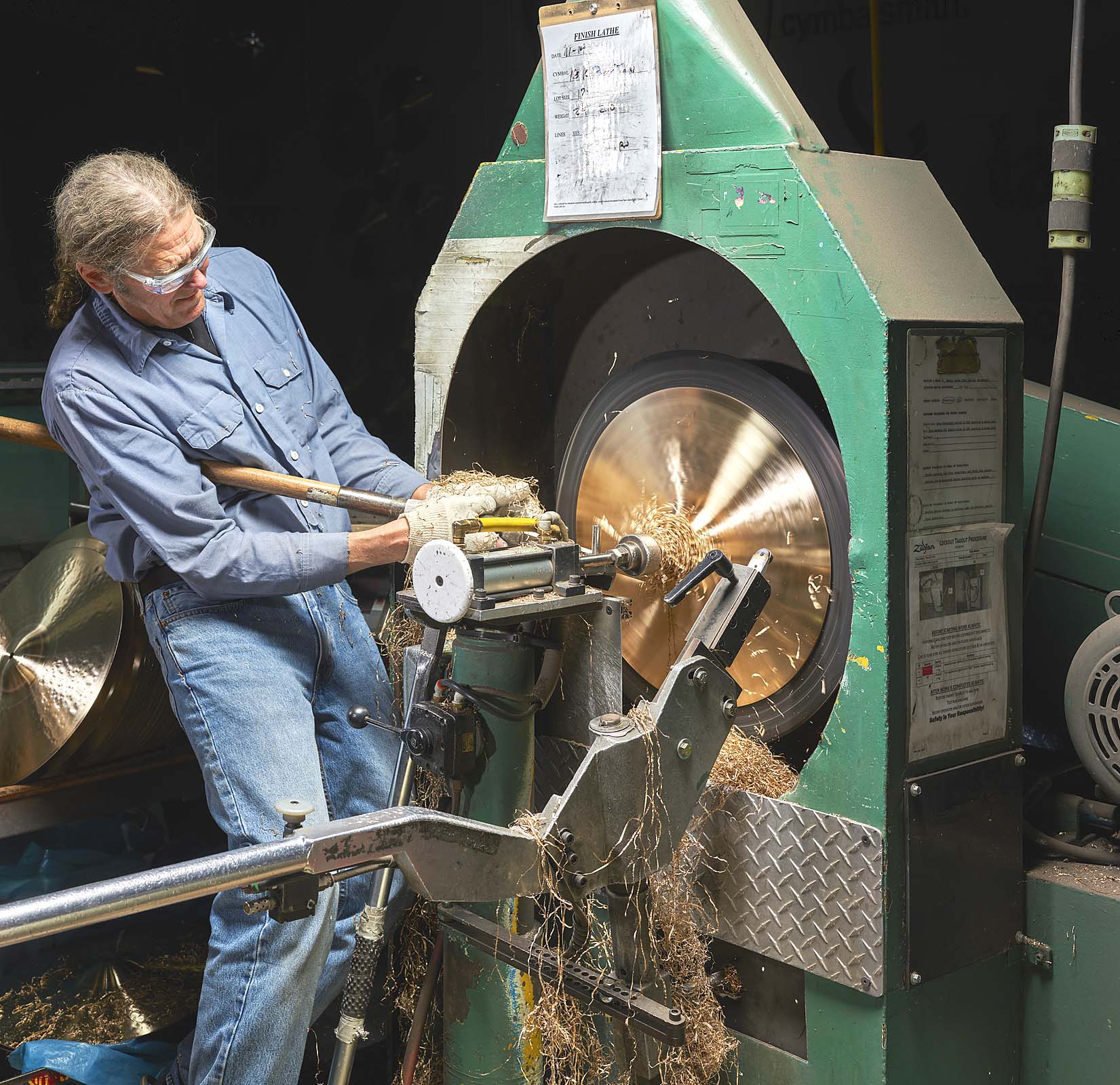
“Shaping a cymbal on a lathe,” 2024 photograph by Christopher Payne, Avedis Zildjian Factory (Norwell, Mass.). Courtesy of the artist and ©Christopher Payne/Esto.
While objects and design are at the heart of these photographs, the role of workers in creating these objects is never far from the image and in many photographs, up close and center. A photograph of Peter Nelson, who has been making cymbals for 45 years, first on a lathe, speaks to American values and the importance of artisan craftsmanship. “You see him chiseling away parts of the metal to give the cymbal its unique sound and tambour,” Brown said.
The exhibition gallery, “Production of Scale” looks at the human element in mass production and the assembly line in factories making small objects as well as massive goods like airplanes or the Magellan Telescope. While not considering himself a portrait photographer, Payne created stunning images of workers, many of which show impressive scale, with employees often dwarfed by the equipment they are pictured working on. Evincing this point is an image of mechanic Christina Akers preparing a GE90 jet engine for testing at the GE Aerospace’s Peebles (Ohio) Test Operation. Perched on a stool by the nose of the jet engine, she “looks so tiny,” as Brown stated. In the tradition of photographers like Gordon Parks, who photographed the conditions of American workers, Payne captured the marriage of mechanics and the human element as both work side by side, showing how American industry and manufacturing has evolved from its industrial past to a high-tech future.
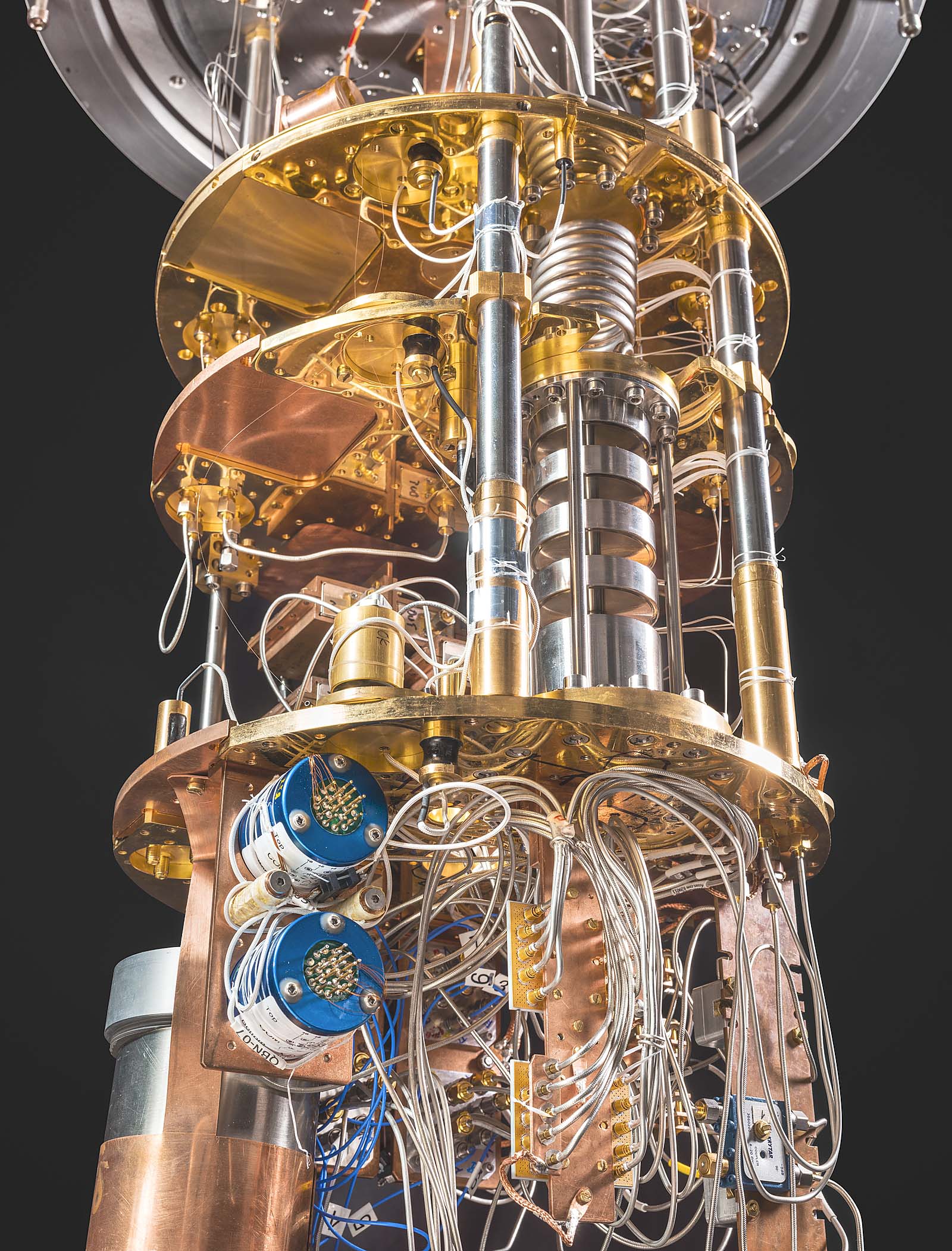
“Quantum computer,” 2017 photograph by Christopher Payne, IBM (Yorktown Heights, N.Y.). Courtesy of the artist and ©Christopher Payne/Esto.
Another gallery, which parallels Payne’s book, is called “Making the Future.” “These are images that look radically different because they are very technologically-driven factories, so they look more like the clean room of a hospital or a laboratory,” Brown noted, explaining these machines are often fully enclosed to keep dust out. Their nature created challenges for Payne to photograph their components or actions. “The images are visually quite different from what you might think of when I say the word factory but quite beautiful,” she said.
Some of the factories Payne visited are unfathomably large, with millions of square feet under one roof. “When Chris goes into these vast spaces, where you have to drive a golf cart to get around from one part to the other, he is trying to identify one process that can kind of stand in for the whole — something that really distills the essence of what that factory does or what is unique to them,” added Brown. “It’s a really beautiful way of connecting individual people to these impossibly large objects like container ships.”
Industrial photography has a particular look because the whole concept of standardized reproducible parts leads to kind of endless repetition in the factory setting, Brown explained. “There are a lot of circular forms because there are wheels and drums and gears that are moving materials around the factory,” she said, calling out such images as Payne’s photograph of Mark Tatum, an engineer at GE HealthCare in Waukesha, Wis., assembling a Discovery IQ PET/CT scanner. This painstakingly composed photo of the scanner’s inner workings also speaks to the challenges Payne faced in photographing. “At first glance, you might think you’re seeing one scanner, but it’s actually two in a row,” Payne said of this image, explaining he was not satisfied with his initial images as Tatum worked on the front portal. Everything clicked when he had Tatum move into the background. “The front scanner now looked massive because he was much smaller, and there was a depth because you could see through the portal, but it also gave it the illusion of being one giant machine. I remember wishing that the scanner was more finished with more cool stuff, but you can never control what’s happening on a factory floor and you have to make the best of the situation.”
Cooper Hewitt is at 2 East 91st Street. For more information, www.cooperhewitt.org or 212-849-2950.