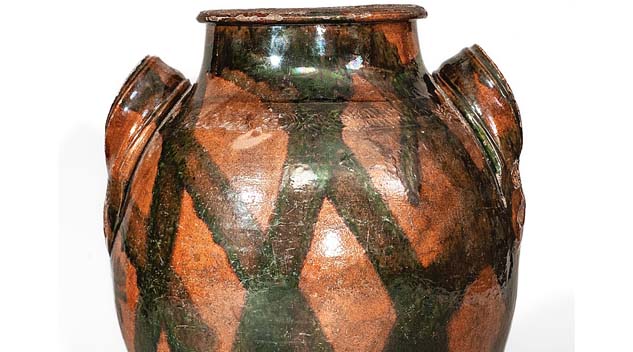
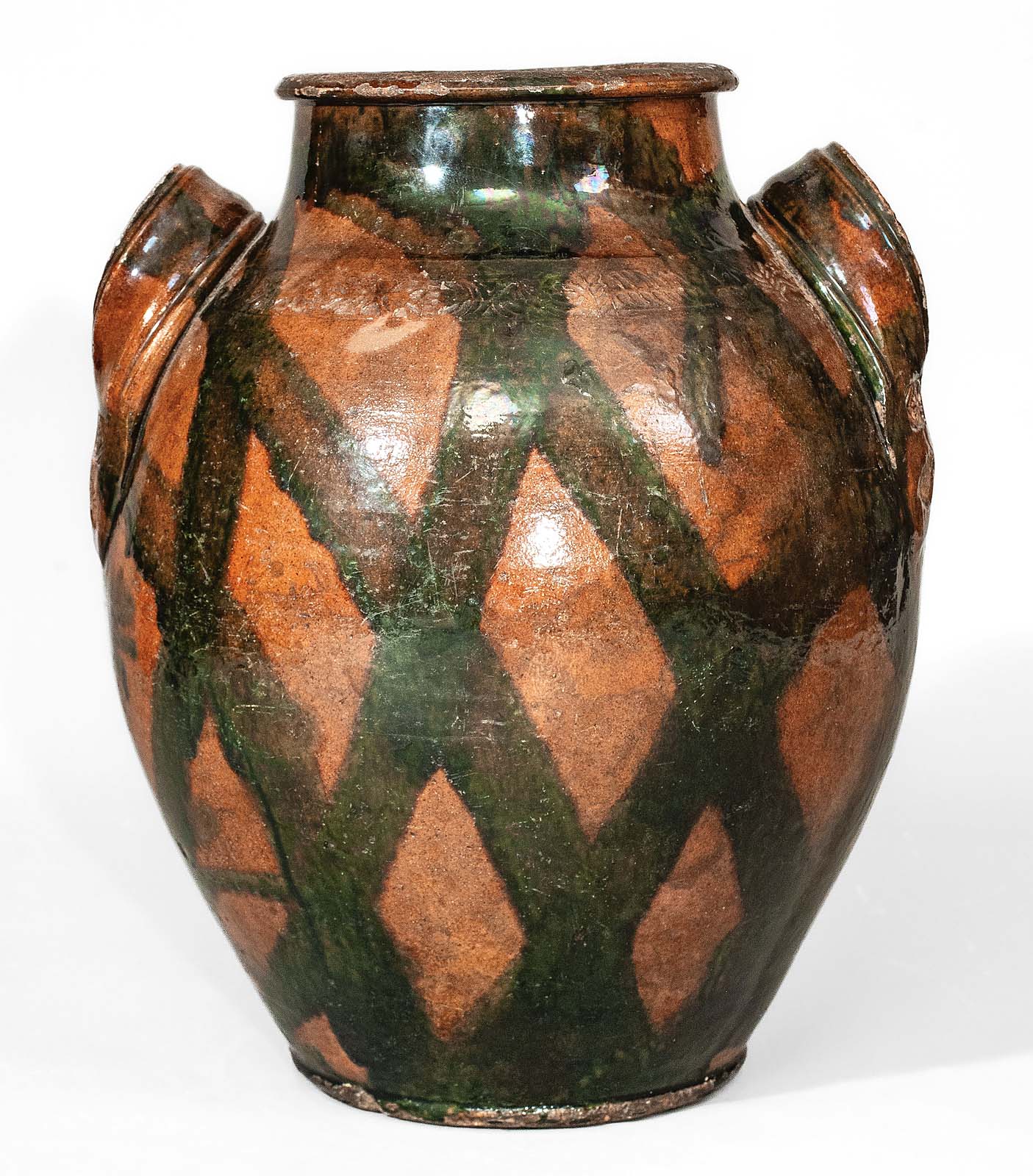
Setting an auction record price for Tennessee redware was a rare jar, attributed to the C. A. Haun Pottery, Greene County, having crosshatched copper slip. It outperformed its $15/25,000 estimate to attain $108,000.
Review by Andrea Valluzzo
SPARKS, MD. — The late renowned collector Carole Carpenter Wahler was scholarly and passionate when it came to collecting American stoneware and redware, most of which were Southern examples. Displays of beautiful and historically significant pieces filled her home and often were accompanied by copious notes of her research into these objects.
Bidders wanted part of her esteemed collection and legacy, eagerly snapping up many of her standout pieces in January 2025 when Crocker Farm offered the first part of a single-owner series devoted to her collections. That sale reached $1.34 million, and part two of the Carole Wahler collection, which was sold on January 21-31, was a white-glove sale that attained $1.497 million.
“This sale did fantastic,” said Mark Zipp, partner at Crocker Farm. “We thought our first sale was a little bit more top heavy in terms of quality, but this sale actually grossed more and really speaks to collectors and institutions wanting to own a piece of Carole’s legacy.”
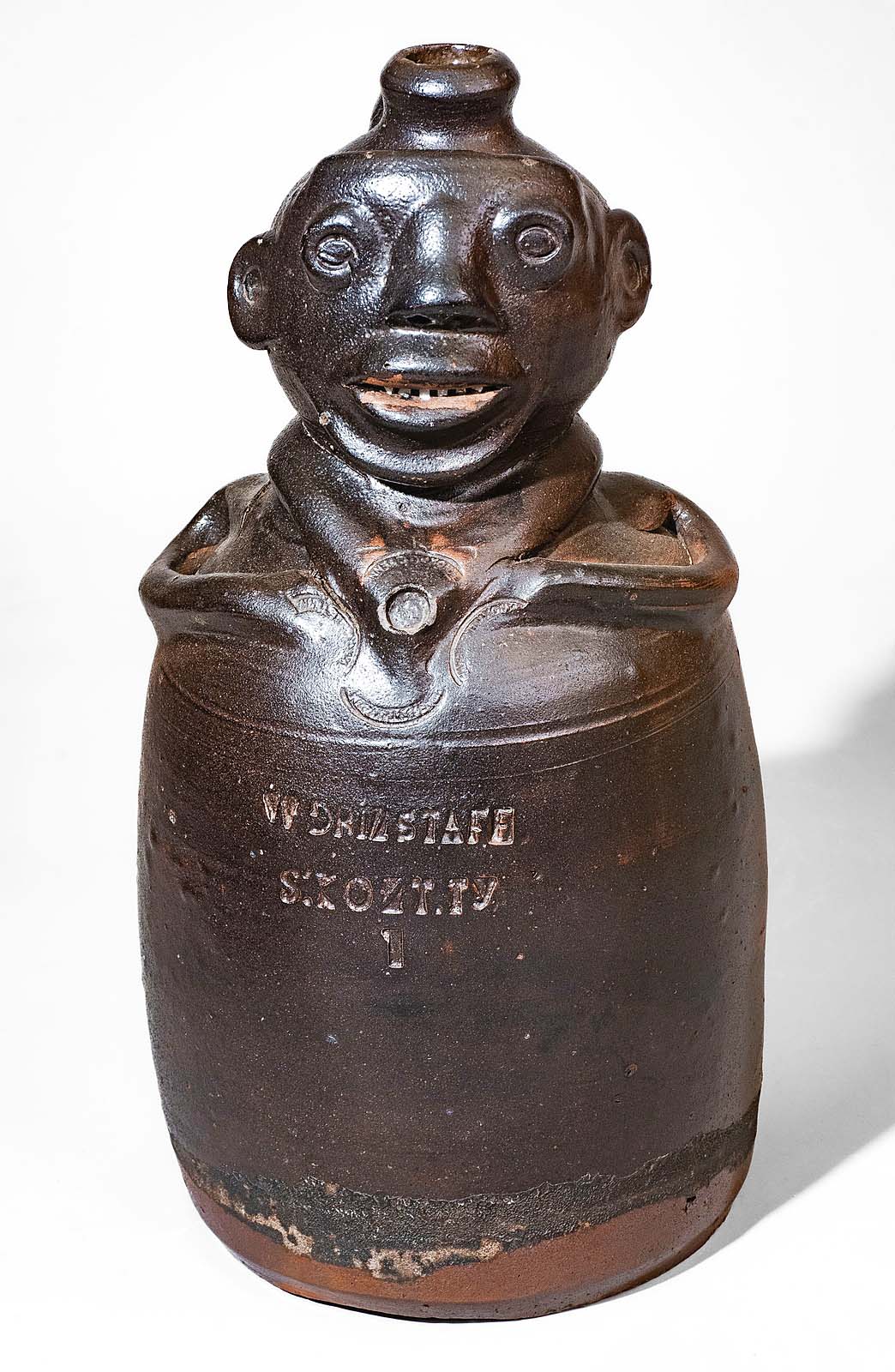
This important and probably unique glazed stoneware figural jug, 14½ inches tall, stamped “W Grinstaff / S:Kon.Ty” and “Knoxville Tenn,” more than doubled its $25/40,000 estimate to attain $102,000, setting an auction record for Tennessee stoneware. The wheel-thrown brown slip vessel was from the Grindstaff Pottery in Knoxville, Tenn., circa 1885-1895.
Asked if they held back some of the best lots for the second session, Zipp commented they had saved a few pieces but put most of the better stuff in last year’s auction. “We wanted the first sale to really convey the breadth and scope of her collecting interest in Southern pottery, not just Tennessee pottery, but pieces made through all of the Southern states. We also wanted it to convey the power of her collection, the fact that she was spending five figures routinely on items that spoke to her and that she was buying pieces that were really special, early acquisitions from the 70s and 80s before a lot of this Southern material caught fire.”
The auction house’s original intent was to do a 60-40 percent split skewed in favor of the first sale, but things worked out in the opposite manner and Zipp was nonplussed. “We were very happy with the results; both auctions had a huge breadth of potters, regions and time periods represented from the 20s all the way to the latter part of the Twentieth Century.”
“The overall sales total was a few hundred thousand over what we thought it would bring and it was a very strong sale overall,” he said of the recent sale. “So, we are very happy; it was gratifying to us and we felt like we represented the import of this collection properly and people responded.”
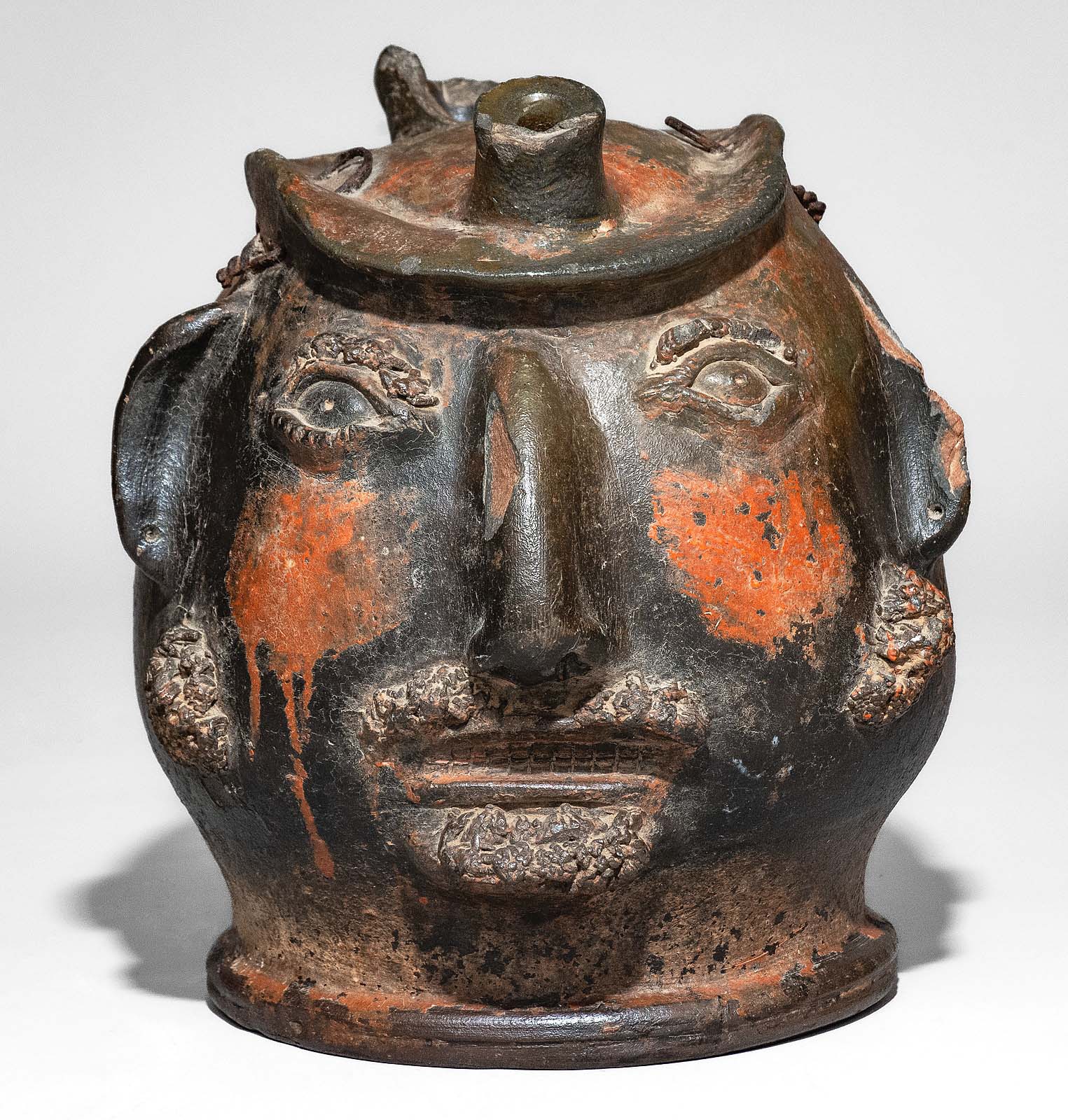
Earning $78,000 was a scare salt-glazed and painted stoneware presentation face harvest jug, inscribed “J.W. Berry” and “Made By Wm. Decker / July 9th 1892.” It was made by William Decker at the Decker Pottery, Washington County, Tenn., in 1892.
The auction immediately started on a high note with lot one, an important and probably unique glazed stoneware figural jug, 14½ inches tall, stamped “W Grinstaff / S:Kon.Ty” and “Knoxville Tenn,” that more than doubled its $25/40,000 estimate to attain $102,000, setting an auction record for Tennessee stoneware. The wheel-thrown brown slip vessel from the Grindstaff Pottery in Knoxville, Tenn., circa 1885-95, figural with a human body and a semi-ovoid body. Its spout topped the figure’s head.
The auction was primarily an online event, but for this and other lots that exceeded $10,000, Crocker Farm held a phone session for the top few bidders on January 31. Bidding largely came down to two competitors, and the jug eventually went to a Tennessee collector. Of this rare vessel’s desirability, Zipp explained, “It was a unique object so not only was it a rare face vessel — and face vessels have really increased in popularity of the last 20 years — but it was the only example known from this potter and it was an immaculate condition.” Wahler had bought the jug from the potter’s descendants so it had been off the market since the 1980s. Zipp added that even simple crocks with Grindstaff’s mark can bring a few thousand dollars. “So, to see that rare mark on a piece that is face decorated is really kind of a double whammy, if you will. It really stands as one of the best examples of Tennessee pottery known and the market really bore just how special it is.”
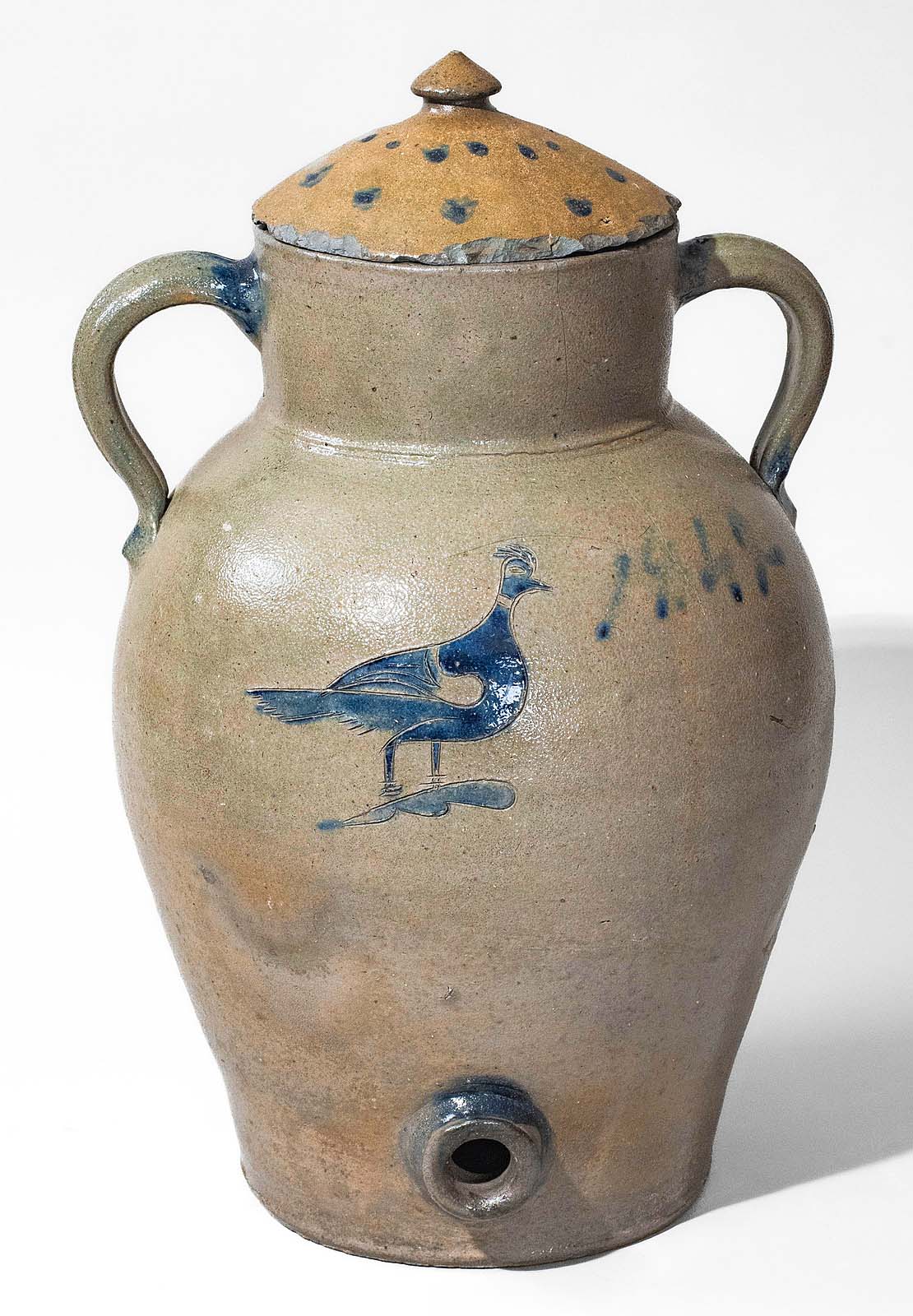
Setting an auction record price for Tennessee stoneware at $102,000 was a rare and important water cooler with incised decorations of a bird, branch and man, 1842, attributed to John Floyd at the Graves Pottery, Knox County, Tenn. Its politicized inscription read “John Tyler / Vetoes / No boddy[sic].”
Another fine example of Tennessee stoneware bringing the same price — thus tying for an auction record price for Tennessee stoneware, according to Zipp — was a rare and important water cooler with incised decorations of a bird, branch and man. Dated 1842 and inscribed “John Tyler / Vetoes / No boddy[sic],” it was attributed to John Floyd at the Graves Pottery, Knox County, Tenn. Its striking inscription, “John Tyler / Vetoes / No boddy[sic],” reveals a humorous or sarcastic side to Floyd. As tenth president of the United States, John Tyler (1790-1862) frequently used his veto power and many of his vetoes were for issued relating to the nation’s finances that were backed by the Whig Party. In her notes, Wahler suggested that this inscription may specifically refer to Tyler’s “1842 tariff vetoes.”
According to the auction catalog, this cooler was likely the most ambitiously-decorated example of incised salt-glazed stoneware known from the state of Tennessee, incorporating two different figural motifs along with its foliate design.
The highest selling lot of the auction overall also not surprisingly hailed from Tennessee as Tennessee pottery was a collecting focus for Wahler who had lived in Knoxville. Four of the top five lots in the auction and at least seven of the auction’s “top ten” had Tennessee origins or attribution.
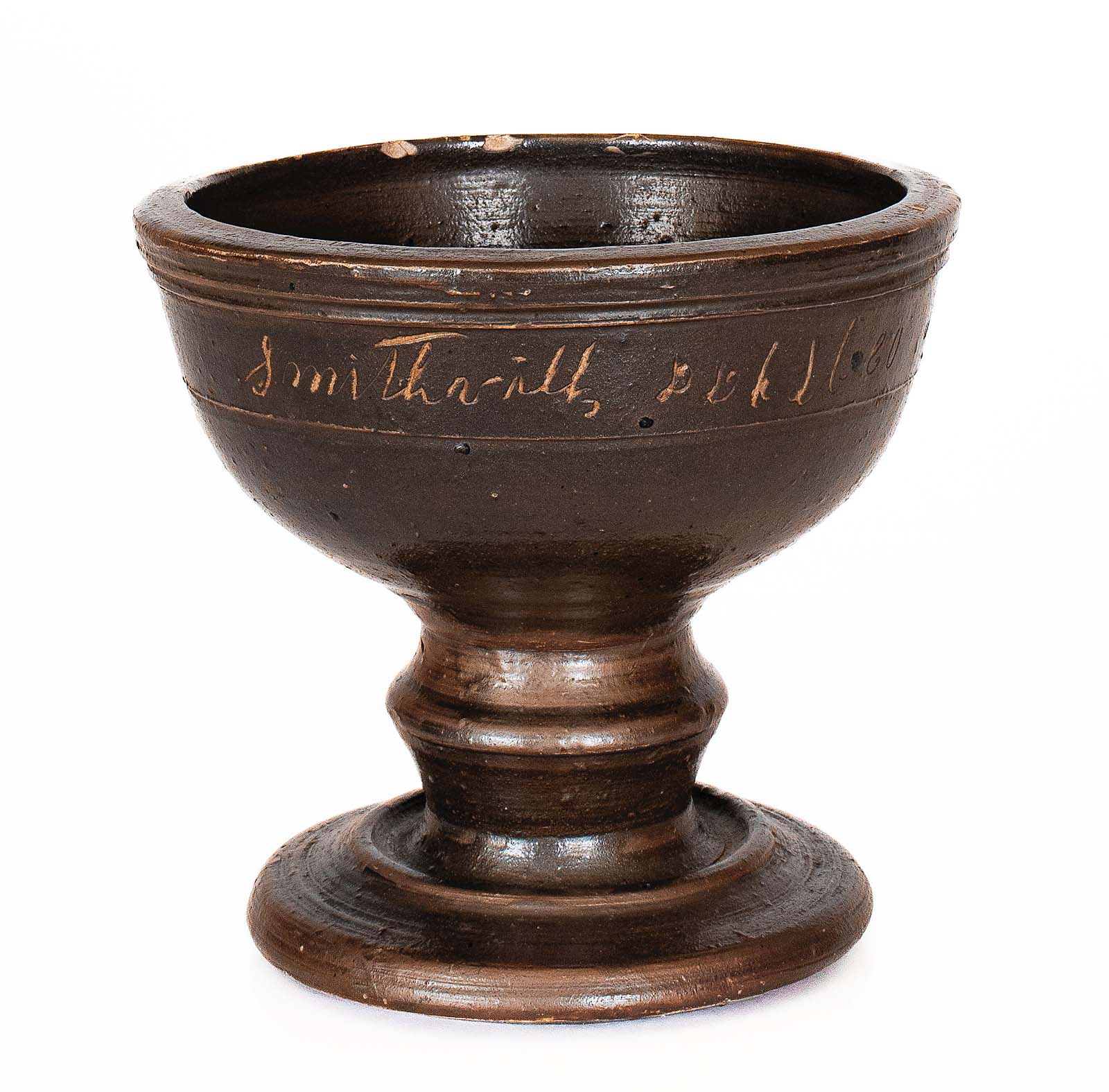
A rare glazed stoneware presentation compote, inscribed “Smithville Deklb[sic] Co Millard(?) J Dun[sic] 1889 / Miss Dunn,” Dunn Pottery, Smithville, Tenn., 1889, sold for $19,200, well over its $2/4,000 estimate.
Achieving an auction record price for Tennessee redware was a rare jar, attributed to the C. A. Haun Pottery, Greene County, having crosshatched copper slip. It outperformed its $15/25,000 estimate to attain $108,000. The circa 1840-60 ovoid jar had a footed base, tall collar with semi-rounded rim and applied strap handles with impressed geometric and floral motifs at the terminals, while the shoulder was decorated with a coggled band of stylized foliate and geometric devices. The 13-inch-tall jar’s surface was decorated with brushed copper slip in a crosshatched pattern extending from the rim to the base and around the sides, including the handles, applied under a clear lead glaze.
Christopher Alexander Haun was a Union sympathizer during the Civil War who, on November 8, 1861, participated in the burning of a Confederate railroad bridge along Lick Creek in Greene County, Tenn. The plan to burn nine bridges was reportedly supported by President Lincoln, but Haun, along with four other Union loyalist potters, were later captured, convicted of treason and hung by the Confederacy.
Even casual collectors are familiar with a certain family from Georgia with a long tradition of making face jugs, but this art form has long been alive and well in Tennessee. Earning $78,000 was a scare salt-glazed and painted stoneware presentation face harvest jug, inscribed “J.W. Berry” and “Made By Wm. Decker / July 9th 1892.” Made by William Decker at the Decker Pottery, Washington County, in 1892, this ovoid form jug was among desirable figural pieces in the sale. Having a footed base and applied tubular spouts on the front and reverse, it was decorated with a hand-modeled and applied clay face, including eyes and eyebrows with incised details, curved ears with piercings, a Roman nose with carved nostrils and a mouth with bared teeth. Also notable were the extruded clay “coleslaw” form lambchop sideburns, a mustache, beard and one of the eyebrows.
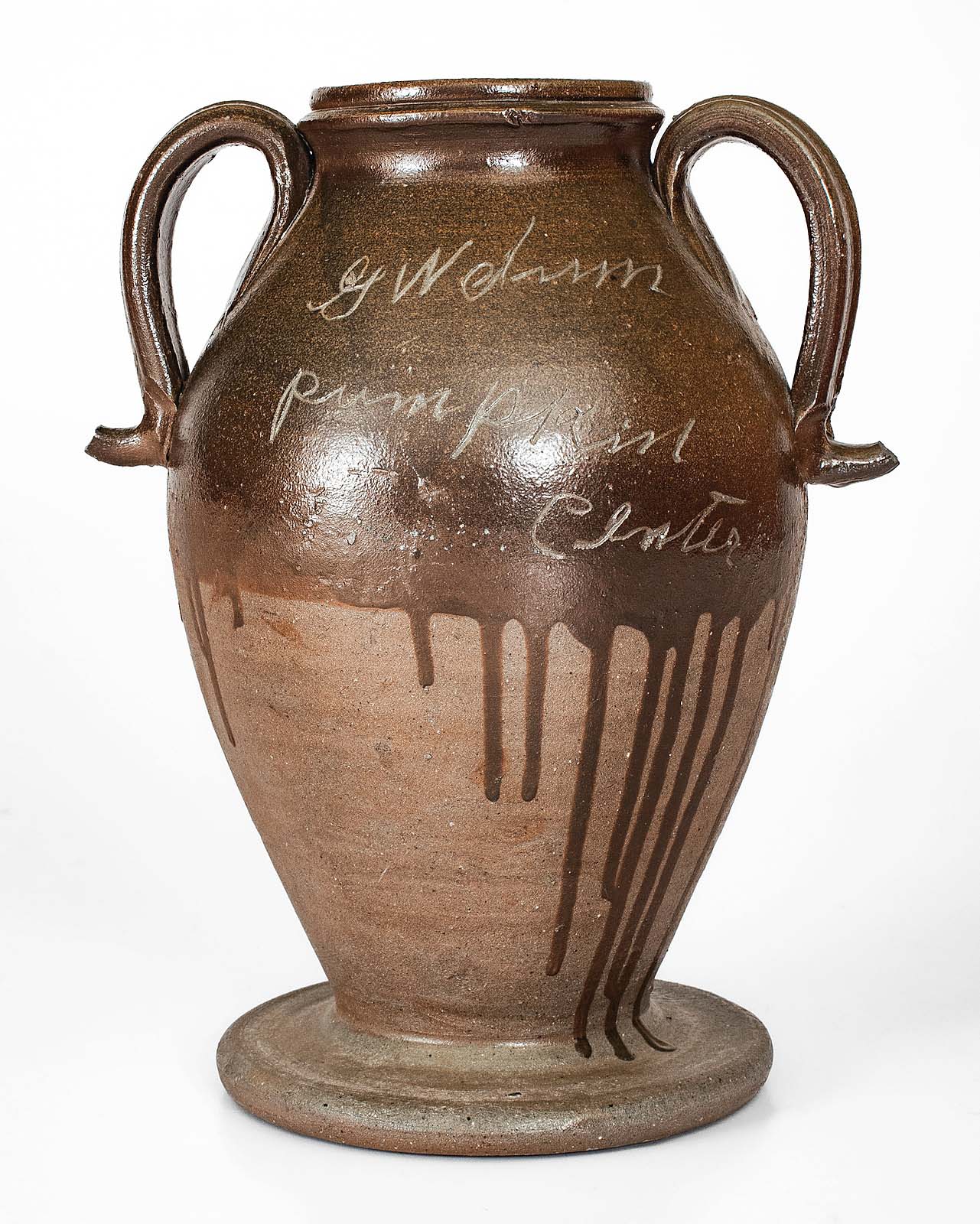
This salt-glazed stoneware vase with dipped slip decoration, inscribed “I Want you for / My Master” and “AHD,” signed “GW dunn / Pumpkin / Center,” more than tripled its $6/10,000 estimate to hit $36,000.
Other Tennessee standouts included a possibly unique salt-glazed stoneware jug with incised scalloping and wavy line decoration stamped three times “J. Mort,” Hinkle-Mort Pottery, Jefferson County, third quarter Nineteenth Century ($42,000), and a salt-glazed stoneware vase with dipped slip decoration, inscribed “I Want you for / My Master” and “AHD,” signed “GW dunn / Pumpkin / Center,” that soared over estimate to hit $36,000.
An outlier in the sale’s “top ten” from the deep South at $54,000 was a choice open-handled stoneware jar with alkaline glaze, from Edgefield District, S.C. Inscribed “Lm / Jan 12 1864 / Dave,” the ovoid jar by David Drake at Lewis Miles’ Stony Bluff Manufactory, 1864, was deeply incised and was notable as one of the potter’s final documented inscribed vessels. According to the catalog essay, only two examples are dated later, both jars made in March 1864. The jar was also rare in its thin vertical-strap handles, more commonly seen on his jugs but seldom on his jars; also the form’s narrow mouth suggested the potter may have been moving towards creating vases instead of utilitarian forms.
Another fine example, this time from Baltimore, evinced the appeal of lavish decoration, particularly figural, on stoneware. Selling for $39,000 was a cobalt-decorated stoneware face jug having a cylinder form with incised fish and bird motifs, attributed to David Parr, Jr, circa 1835. Boasting a tooled spout, it was decorated with a hand-modeled and applied clay face, including a rounded forehead, heavily-incised eyebrows, mustache and beard, and an open mouth with incised teeth. The top and reverse of jug had heavily-incised hair and the reverse also features heavily-incised decorations of a fish and bird, each paired with a sprig motif. “Among the most extravagantly-detailed stoneware face vessels known, this work is distinguished by its prolific use of incising as a decorative treatment. Its incorporation of incised fish and bird designs are otherwise unknown to us in American face vessel production, creating an object of extraordinary decorative value,” explained to catalog notes.
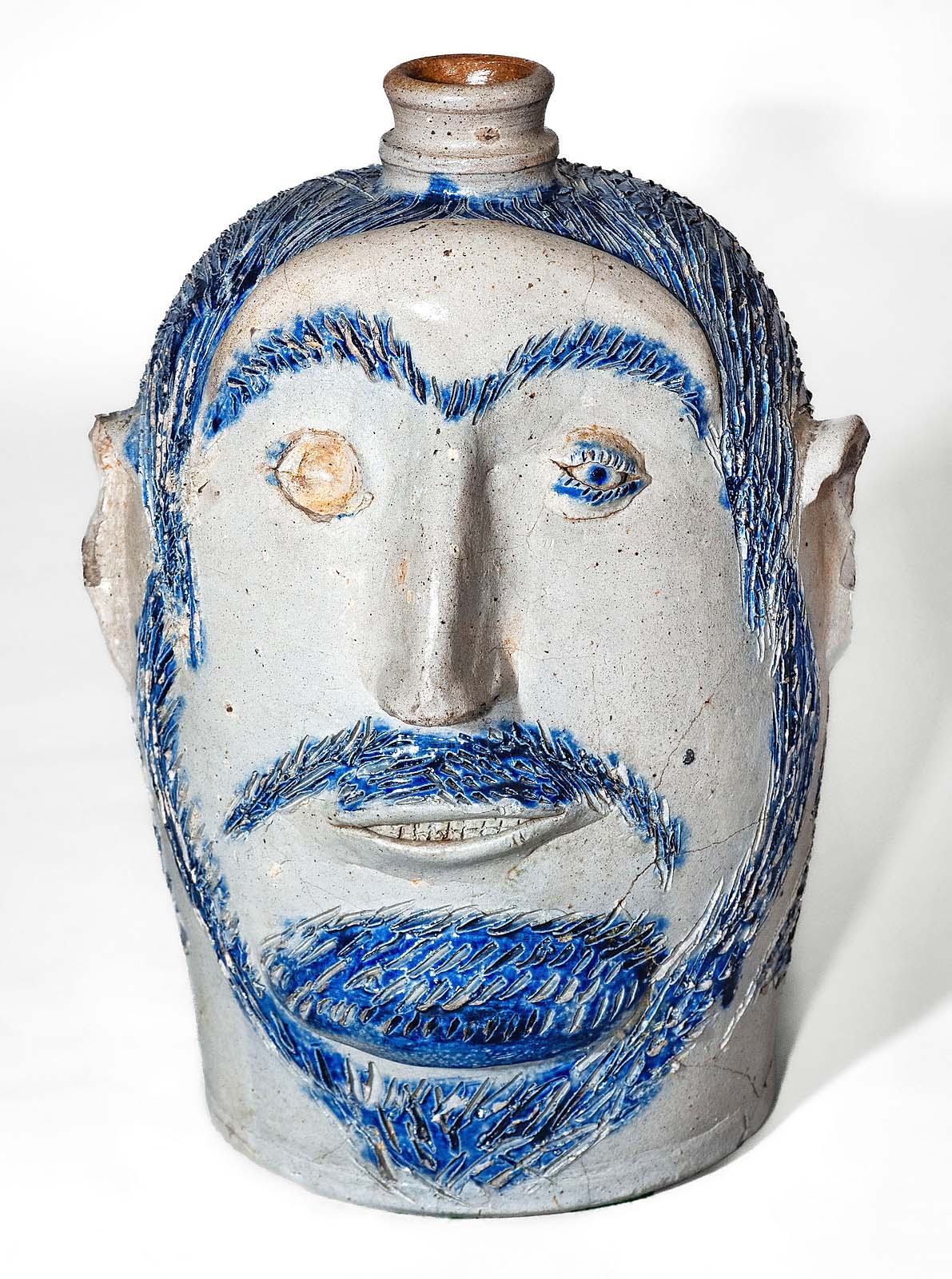
Selling for $39,000 was a cobalt-decorated stoneware face jug having a cylinder form with a man’s face with moustache and beard on the front while incised fish and bird motifs wind around the jug towards the reverse side, attributed to David Parr, Jr, circa 1835.
Most of the auction’s top lots overperformed their estimates, but Zipp said many of the “middle range” lots also did, citing a redware jar, North Carolina or eastern Tennessee, estimated at $3/5,000, that did $28,800, and a circa 1875 stoneware vase jar with lavish incised decoration, attributed to the Jacob Eichelberger Pottery, Talladega, Ala., at $26,400.
“The numbers in this sale were absolutely remarkable and there were a lot of things in that middle range that jumped to extraordinary levels,” he said.
Prices quoted include the buyer’s premium as reported by the auction house. Crocker Farm’s next auction will be April 1-10.
For information, www.crockerfarm.com or 410-472-2016.