Brenton Grom became executive director of the Webb Deane Stevens Museum (WDS) in 2023. He has long had a passion for history and historic houses, formerly working at the Delaware Historical Society and the George Read II House & Gardens. At WDS, he has enjoyed focusing on preservation and introducing new audiences to the museum, its properties and collections. We connected to learn more about current and upcoming projects.
What brought you to the Webb Deane Stevens Museum?
I’ve been here for a little over three years — an exciting three years. I had spent several years in Delaware before that, and most recently was director of the George Read II House and Gardens in Old New Castle, Del., which is not unlike Old Wethersfield, Conn., where the Webb Deane Stevens is located. It’s a very early town that was colonized by the Swedes, the Dutch and then the English. It’s where William Penn first landed in America. The George Read House is a National Historic Landmark that was built by the son of one of Delaware’s signers of the Declaration and early governors. It’s really an extraordinary and probably the best surviving example of Philadelphia’s Federal style. It has gardens from the mid Nineteenth Century and an interesting Colonial Revival history.
When the opportunity presented itself at the Webb Deane Stevens Museum, I knew about the place because one of my predecessors at the Read House going way back, Charles Lyle, had recently retired as director of the Webb Deane Stevens. I knew about the Webb Deane Stevens, and I knew about its Colonial Revival history with Wallace Nutting. All of that just made it seem like an interesting prospect.
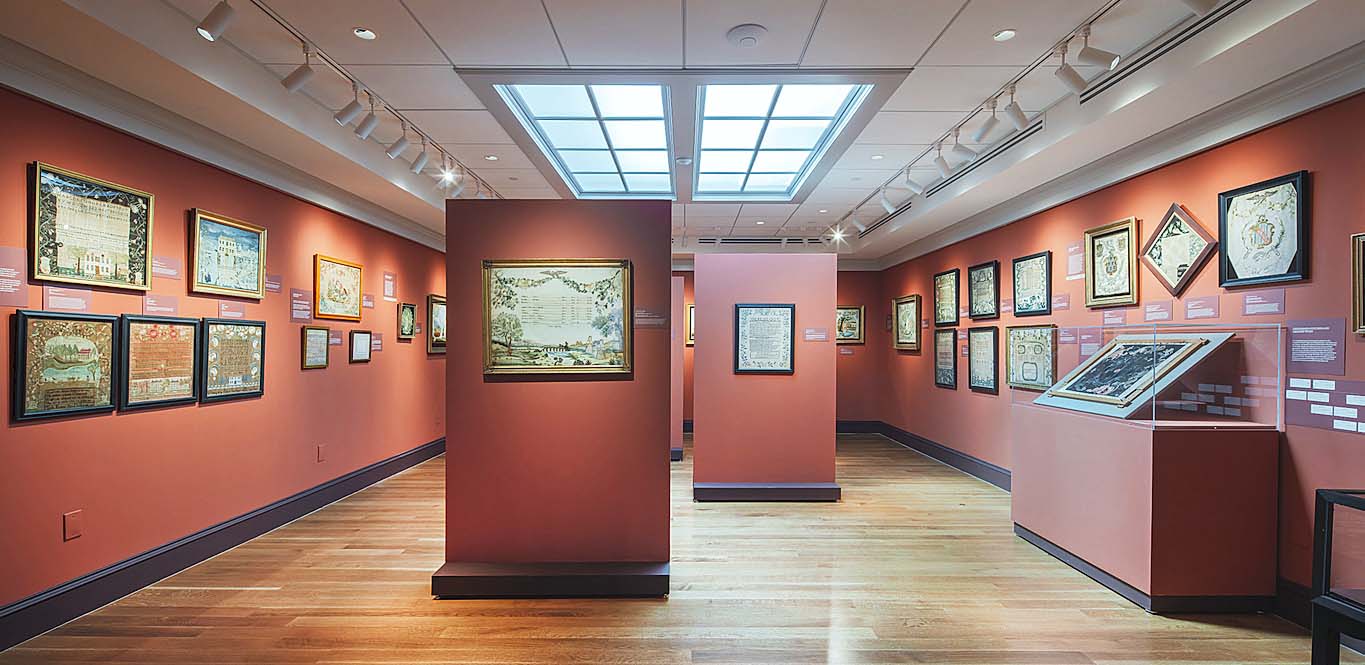
Fifty samplers and embroideries from institutional and private collections are on view through December in “American Girlhood: Needlework, Memory and the Making of a Nation” at the Webb Deane Stevens Museum, 211 Main Street, Wethersfield, Conn.
Tell us a bit about the preservation work and why it is so important.
Introducing new audiences who don’t know about the museum and the properties here is important. We have, in this country, a shortage of people skilled in historic building trades. In Connecticut, there’s a dearth of training opportunities.
We like to think of the Webb Dean Stevens Museum as kind of a laboratory. On one end of it, there’s the direct education and historic trades. We have an ongoing partnership with the American College of the Building Arts in Charleston, S.C. We’re supported in that by the Richard Hampton Jenette Foundation so we have interns who come during the summertime and work on major projects with us. But we also have workshops, lectures and other programming, and tours that bring people inside of the preservation work from the preservation science perspective. This tells people about what methods we use and why, helping them understand really intimately the materials that we’re working with and how those shape the methods.
We also go to a deeper philosophical level with it, where we talk about the ways of thinking about material culture from the past that guide us in the decision making that we have to do. There’s no such thing as a time capsule that you just open up and you time travel to the past. Instead, we have to use all kinds of observation and evidence and put it together with a historical imagination to try to understand why people in the past may have done things that they did, whether it was modifying a house or preserving some aspect of it, like the very rare flocked wallpaper that exists up in the bedchamber in the Joseph Webb house where George Washington stayed in 1781, that’s been amazingly preserved all these years.
There’s this element of human empathy that you end up practicing when you work on historic preservation. You have to be patient and make observations; you have to put yourself into somebody else’s mindset to imagine the conditions that someone was operating in, in order to make the best possible decisions about preserving and stewarding the things that other people have left behind.
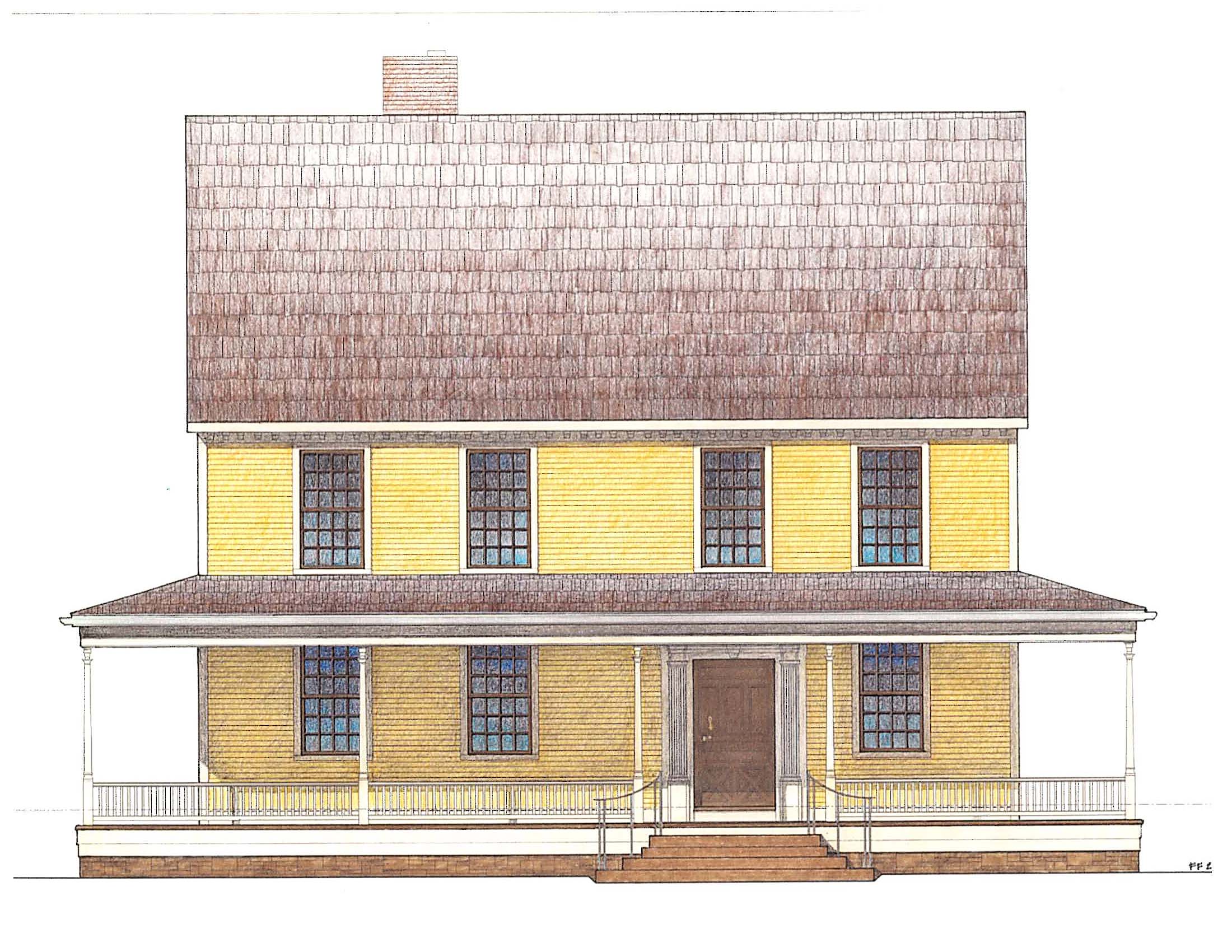
Rendering of the lost 1769-73 Silas Deane House piazza, now being reconstructed under the supervision of TR Revella-Hamilton, the Webb Deane Stevens Museum’s director of preservation & collections.
You mentioned capital projects. Any ongoing or upcoming?
We are fortunate to have money from the National Park Service and the state of Connecticut to do a lot of building envelope preservation on all three of the houses — roofs, windows, HVAC and exterior painting. There will be a bit of visible transformation in that the Isaac Stevens House (built 1789) is going to undergo paint color analysis, and the colors will change from the yellow and brown that were carryovers from a Victorian color palette to be contemporary with the period that it’s interpreted to.
The really visible and exciting thing that’s happening right now is the reconstruction of a porch on the front of the Silas Deane House. Silas Deane was a lawyer who settled in Wethersfield. He married the widow of Joseph Webb, who had a fairly successful shipping business and then became a merchant. He took that business and grew it into something quite substantial, trading across the Caribbean and the Southern colonies. He eventually became a member of Connecticut’s Assembly and then a delegate to the Continental Congress. In his second marriage, he married Elizabeth Saltonstall, granddaughter of colonial governors. He found his way up through the ranks into a diplomatic post when he was dispatched by Congress in March 1776 to Paris to negotiate on a secret mission to negotiate with the French to get them to support the American Revolution. He’s sort of forgotten because he found himself at the center of a huge political controversy when he was accused of misusing his post for personal gain. And those accusations were largely untrue, but it all spilled out into the newspapers and to the court of public opinion. So he has a really interesting story.
What hasn’t been told is the way that the architecture of the house that he built in Wethersfield is an illustration of his aspirations — his ambitions on the journey from being the son of a blacksmith to attending Yale and becoming a lawyer, merchant, politician and eventually a diplomat. This porch, which in the Eighteenth Century would have been called the piazza, was a feature Deane would have been aware of through his dealings with the Caribbean. We have lots of porches in Charleston that are still called piazzas. But this is a low, one-story porch that wraps around the front of the house. We see them in Eighteenth Century drawings of houses in Jamaica, where Deane was trading. He seems to have wanted to build a house that was distinctive that said he was a man of the British Empire, not just a man of Connecticut. So, there was a porch there. This was not clear in the mid Twentieth Century when the existing porch was taken off. It was thought to have been a Victorian addition because in Connecticut, one just didn’t really see porches like that on houses built in the early 1770s as Deane’s was. It was removed in 1965. After the house had been acquired by the museum and was under restoration, it was discovered that architectural clues suggested the porch would have been contemporary with the construction of the house. It was Abbott Lowell Cummings, the noted architectural historian who really confirmed this.
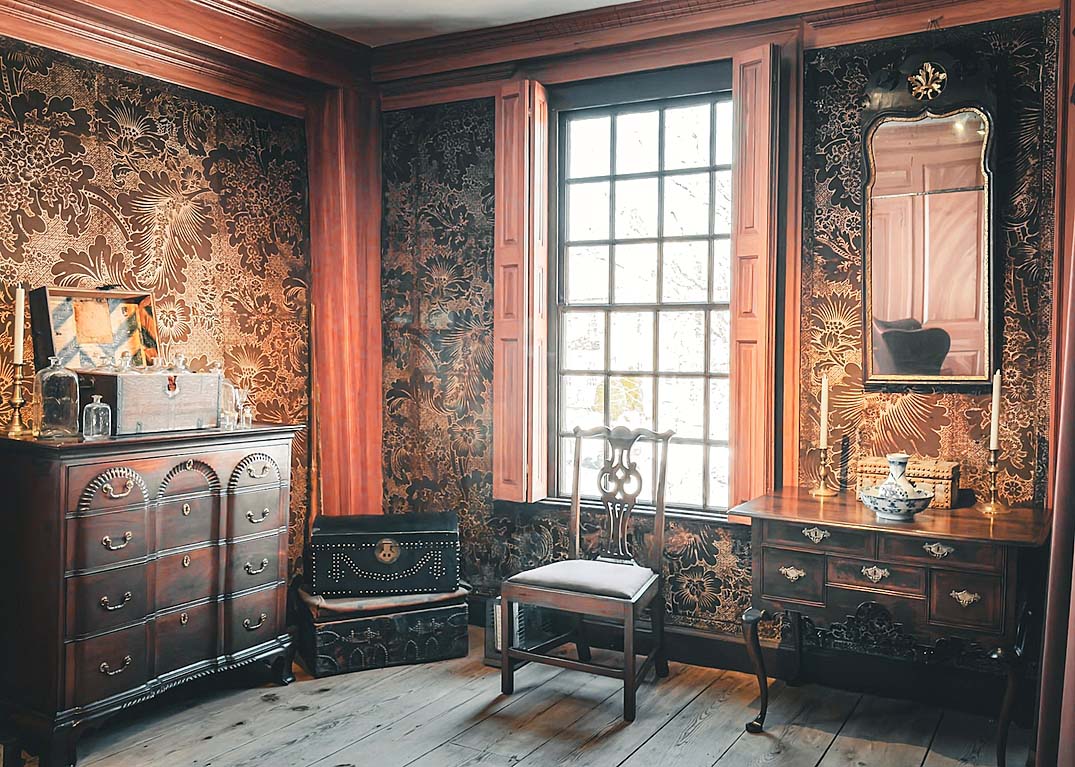
General Washington’s bedchamber in the 1752 Joseph Webb House, with rare flocked wallpaper marked during the Stamp Act of 1764-65, while Silas Deane was married to Webb’s widow.
There has been a sort of pipe dream for 60 years of reconstructing this lost piazza. For various reasons — including money and that back in the 1960s, there was no definite photographic evidence available of what the piazza would have looked like — it was put off and put off.
In the 2000s, a photograph surfaced of the original porch before it had been rebuilt in the 1890s. We now knew what the columns looked like. There was sort of a quirky, distinctive flavor to the capitals, which was perhaps a misinterpretation of published pattern books. We believe it to have been constructed by Isaac Fitch, an architect who did work around Connecticut and also is known to have done work on a house in Kingston, Jamaica. So we now know a great deal more, and through the partnership we have with the American College of the Building Arts, we have been able to put a plan in place to rebuild the porch.
It is in progress right now, and we expect it will be substantially completed later this fall, and we plan to have a dedication for it for next spring.
—Andrea Valluzzo