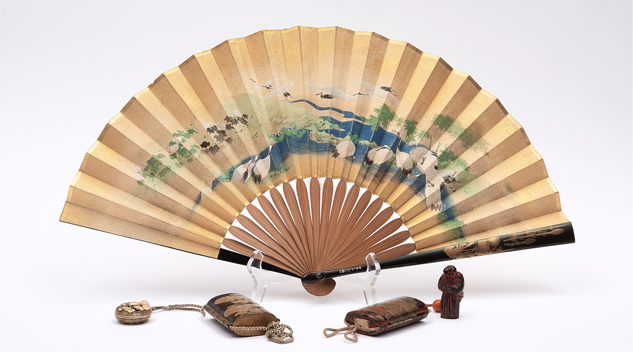
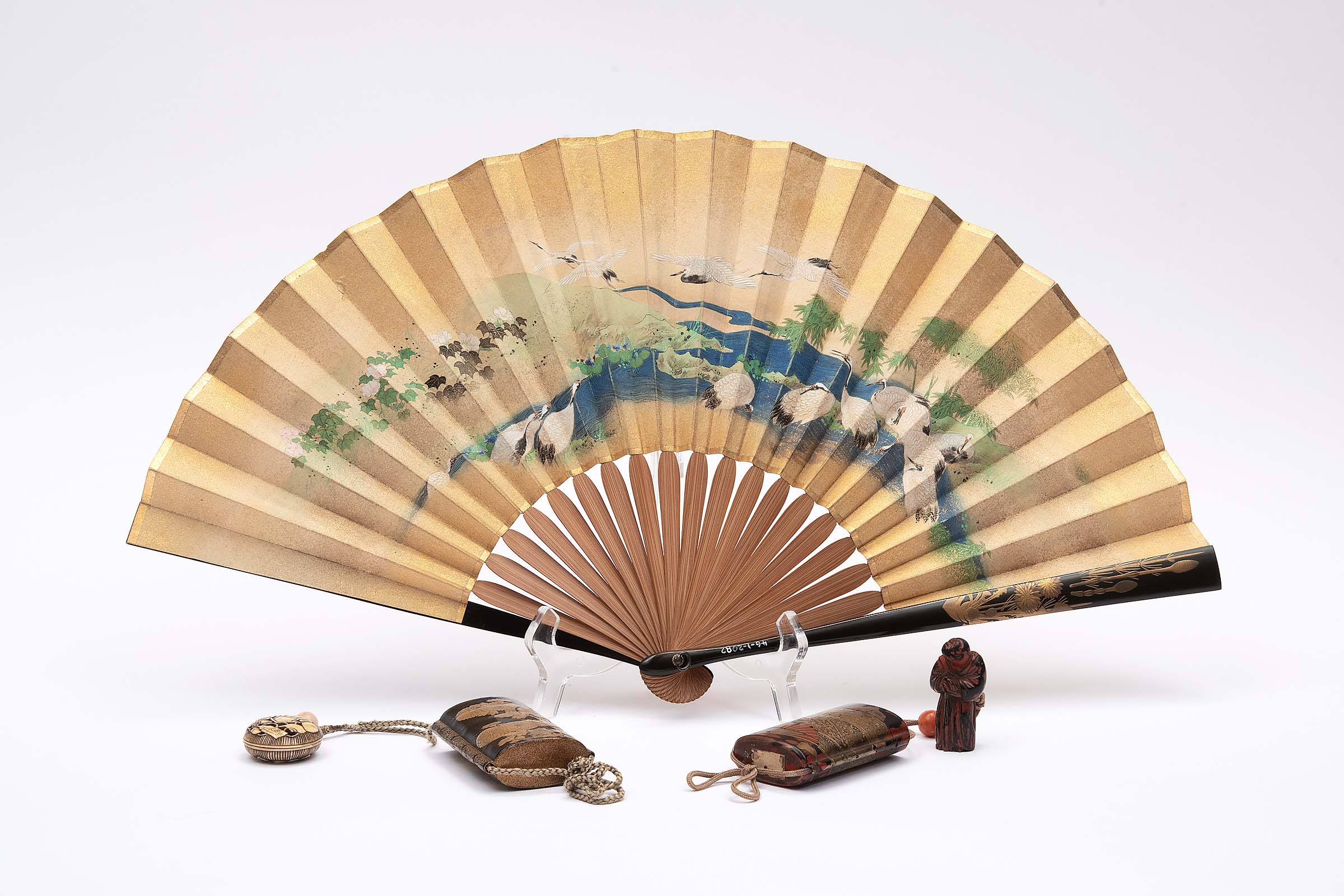
Painted fan with black lacquer guards embellished with gold floral motifs, possibly American or European made.
by Kristin Nord
FARMINGTON, CONN. — Hill-Stead Museum’s 2023 exhibition established Alfred Pope’s reputation as a leading collector of Impressionist paintings. The new exhibition “The Great Wave: Japonisme at Hill-Stead,” running through April 30, looks at the family’s multi-generational passion for many things Japanese that swept Nineteenth Century America.
A successful self-made Cleveland businessman, Pope had amassed a remarkable collection of Impressionist art during his major collecting years, 1888 through 1907, even before he and his wife, Ada, relocated to Farmington for their retirement.
Impressionism was still very new and, to most people, as Anne Higonnet wrote in Hill-Stead, A Country Place, Pope’s embrace of it was seen as “frighteningly audacious.” Yet Pope, very much a progressive man of his time, grasped intuitively what the French Impressionists were saying about middle-class Parisian society. He brought “an extraordinary eye” and “astonishing confidence” to his 19 prime collecting years, she said.
Pope’s daughter Theodate, who would become one of the first US women architects, had designed Hill-Stead’s interiors to suit her parents’ style of living: communal areas that functioned as formal reception rooms for an illustrious cadre of visiting friends. These rooms, into which Pope’s Monets, Manets and Degases were carefully nestled, feel both sumptuous and harmonious to this day.
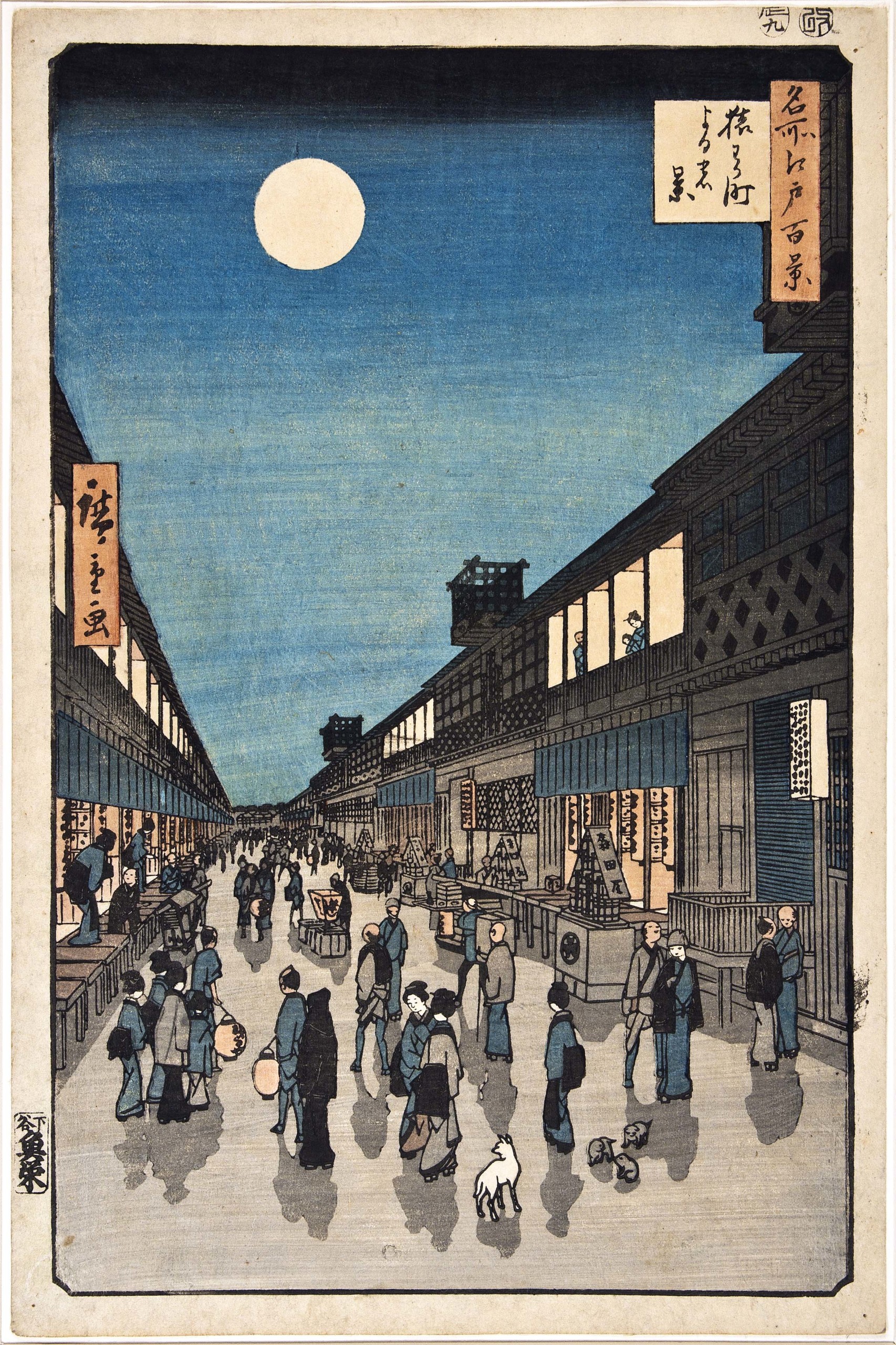
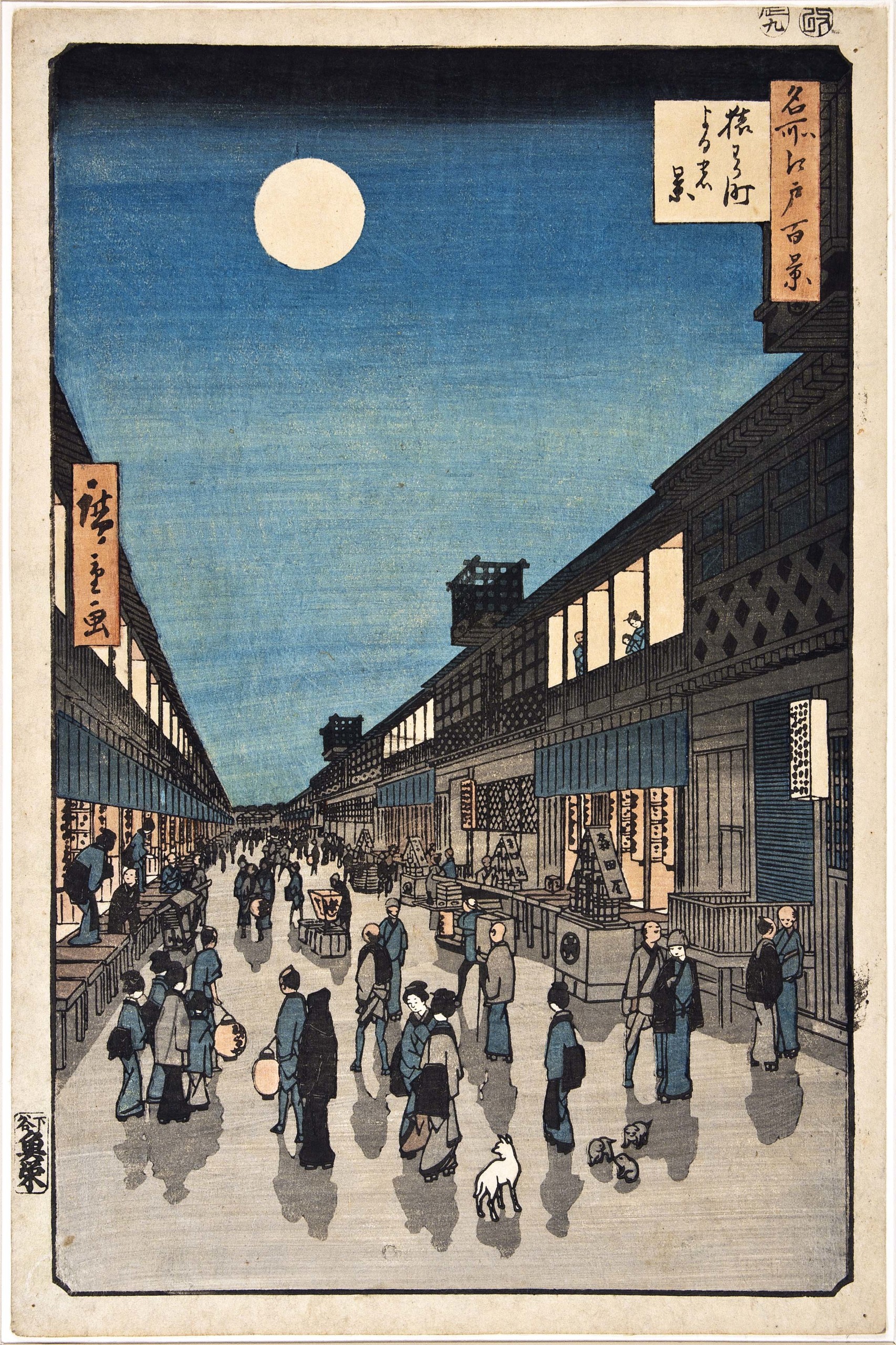
“Night View Saruwaka Street” from the series “One Hundred Famous Views of Edo” by Utagawa Hiroshige, 1856.
Some scholars have posited that Impressionism and Post-Impressionism might never have emerged had the American Commodore Matthew C. Perry not sailed into Edo Bay, Japan, armed with a squadron of Navy ships in 1853.
Perry’s arrival forced the nation to sign a treaty with the United States in 1854, granting access to two ports; commercial treaties with the United States and Europe soon followed. Nearly overnight, Japanese goods began to flood the Parisian markets.
“In the not very distant day when we shall receive envoys…from the inhabitants of Mars…to our own international expositions, these exhibits will probably not differ much from our own than do those of the Empire of Japan in the present Chicago show…the European who enters these galleries…recognizes at once a new order of things and a new world…(an) air of having come from somewhere beyond the stars,” William Walton wrote in the “Japan” chapter of Art and Architecture: The Art – Volume II, a publication for the World’s Columbian Exposition (Philadelphia: George Barrie, 1893).
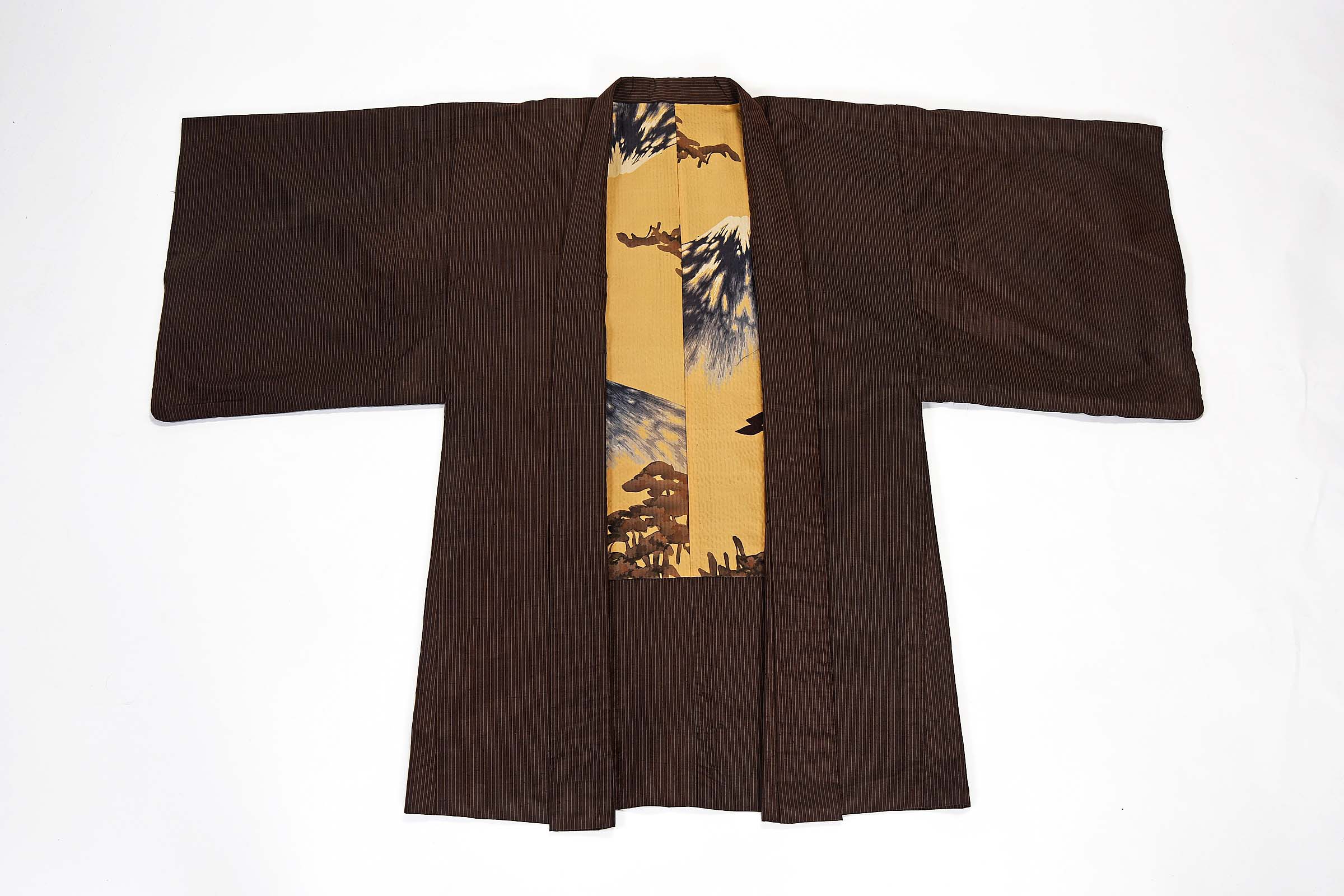
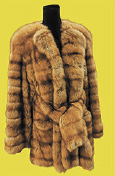
Haori, a traditional Japanese jacket worn over a kimono and resembling a shortened kimono with no overlapping front panels.
A series of well-attended expositions, first in London, then in New York City, Dublin, Munich and Paris, introduced Japanese art and objects to a curious and eager public. The 1876 Centennial Exhibition in Philadelphia drew millions of visitors and ignited an American collecting craze. Hartford, Conn., was an epicenter of wealth and influence — and its well-heeled families were soon collecting all manner of Japanese art and exotica.
Among the most coveted goods were the ukiyo-e prints, which had functioned as inexpensive advertisements for services in Edo’s Pleasure District and were selling briskly in their elevation as fine art.
Pope, too, was enchanted with the woodblock prints when he encountered Monet’s collection on a visit to Giverny. He subsequently paid $1,000 to Boussod, Valadon & Co for a collection which he later confessed he’d bought “on the spot.”
“I wanted good examples of Japanese prints — these I thought were fine — especially the examples of landscape,” he reported. From the get-go, he planned to frame and hang these prints in a reception room in Cleveland as companions to a painting by Degas that he already owned.
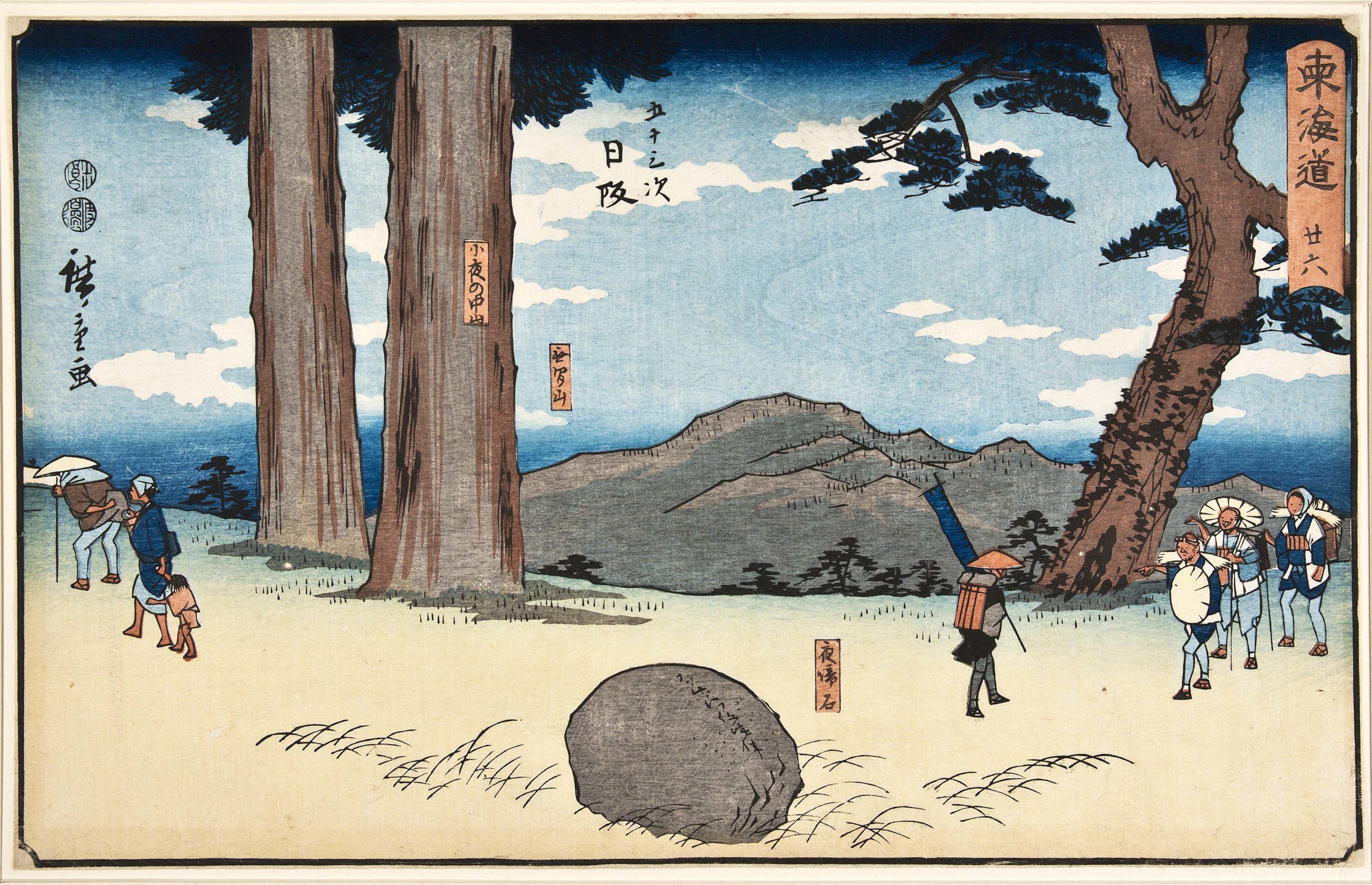
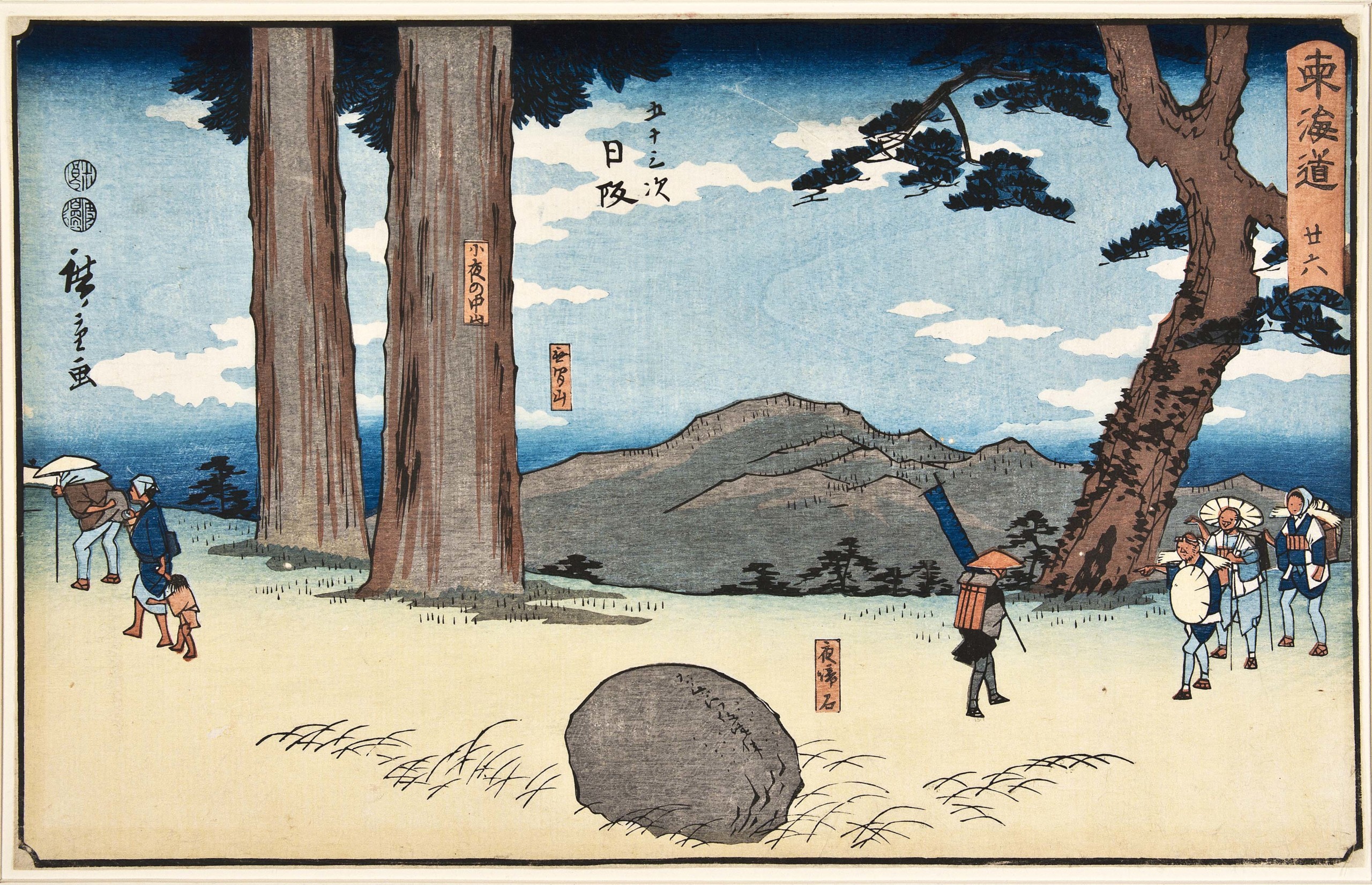
“Nissaka from the Reisho Set” of the series “Fifty-three Stations on the Tokaido Road” by Utagawa Hiroshige, circa 1830s.
His ukiyo-e collection — which never exceeded more than 20 prints and included works by Katsushika Hokusai (1700-1849), Suzuki Harunobu (1724-1770), Kitagawa Utamaro (1750-1806) and Andō Hiroshige (1797-1858) — attests to his eye for quality.
Pope’s aesthetic enthusiasms came with a commitment to study — whether dipping into the catalog that accompanied Ernest Fenollosa’s groundbreaking January 1896 exhibition “Japanese Color Prints,” or Frederick William Gookin’s Japanese Colour-Prints, a catalog that can still be found on a shelf in the Hill-Stead library. He furthered his exploration in conversations with formidable gallerists such as Siegfried Bing (1838-1905) and a number of close artist friends.
“The Great Wave: Japonisme at Hill-Stead” hopes to serve up a good dose of old-fashioned art history as it looks at the ways in which Japan’s design codes and veneration of master artisans also inspired Twentieth Century Modernists. Japanese asymmetric design, with its flattened planes and blocked color, shook up the Western art world and clearly influenced the art of such leading Impressionists as James Abbott McNeill Whistler (1834-1903), Mary Cassatt (1844-1926), Edgar Degas (1834-1917), Claude Monet (1840-1926) and Édouard Manet (1832-1883).
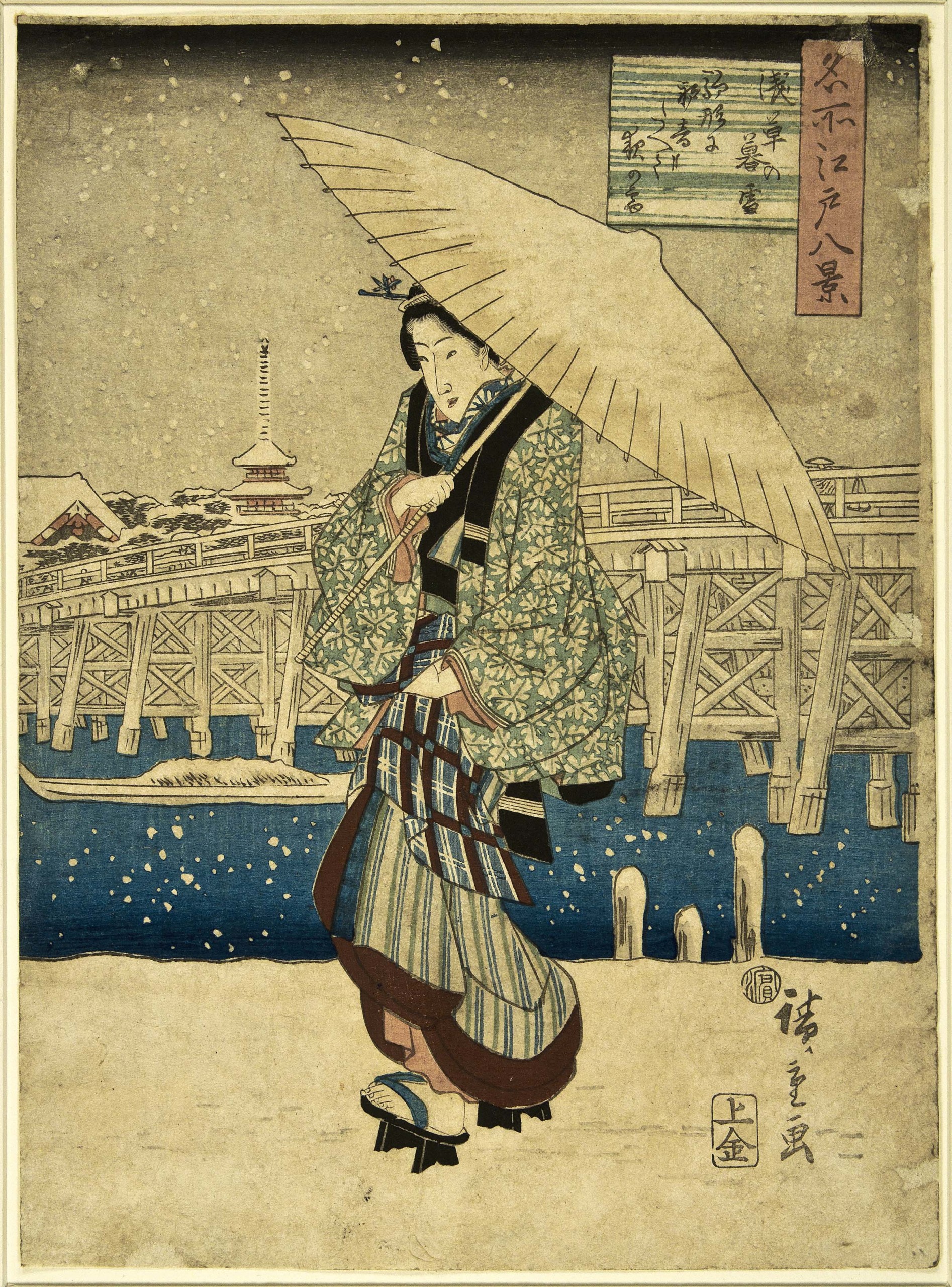
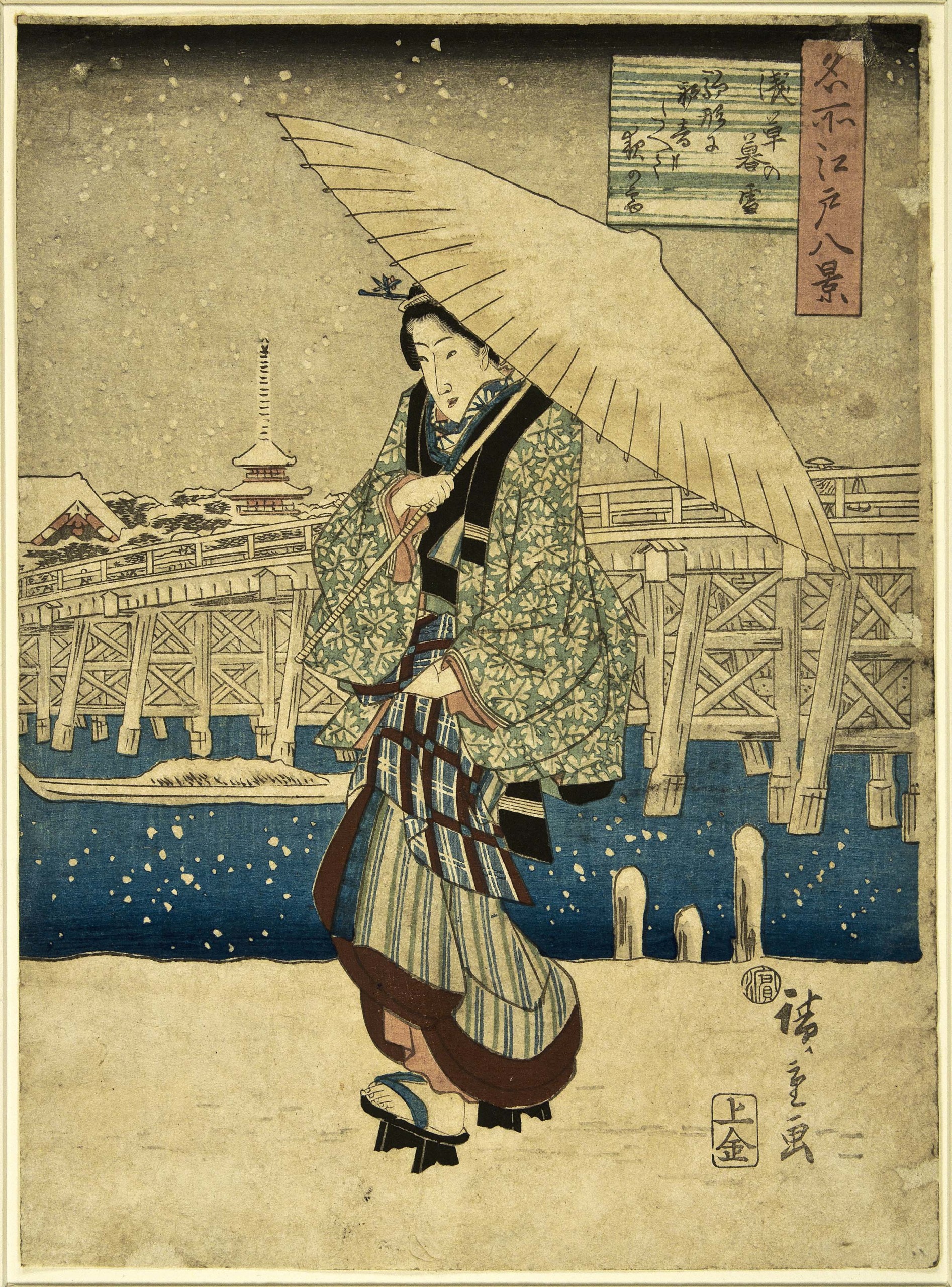
“Evening Snow at Asakusa” or “Woman with Umbrella” by Utagawa Hiroshige, from the series “Eight Views of the Environs of Edo,” Nineteenth Century.
At Hill-Stead, the Popes installed their collection in their upstairs bedroom. Ada displayed the prints in the rooms she lived in as a widow, where one finds Japanese seascapes and landscapes faded with time interspersed with depictions of select beauties of Edo’s “Floating World.“ One has to wonder if Alfred, who had been reared as a Quaker, realized that these beauties depicted were, in essence, sex slaves, or that the ukiyo-e print industry had flourished as the marketing of their day.
“There is so much we have to take educated guesses at due to lack of primary documentation,” Dr Anna M. Swinbourne, Hill-Stead’s executive director, commented recently, “but I suspect he may well have lingered in the bedroom on many a day to bask in these prints. With a slightly lower ceiling height on the second floor, it may have been somewhat easier to view them directly on the wall, and therefore not have them removed to an easel as was sometimes done with the paintings.”
As it turned out, Ada, Theodate and Theodote’s husband, John Riddle, continued to embrace Japonisme even after Alfred’s death in 1913. The Pope-Riddles brought back art and ephemera from their Asian trip in 1919. The total number of Japanese prints acquired by Alfred and his daughter “was just shy of 40 at its highest, in the late 1940s,” Melanie Bourneau, Hill-Stead’s senior curator, said.
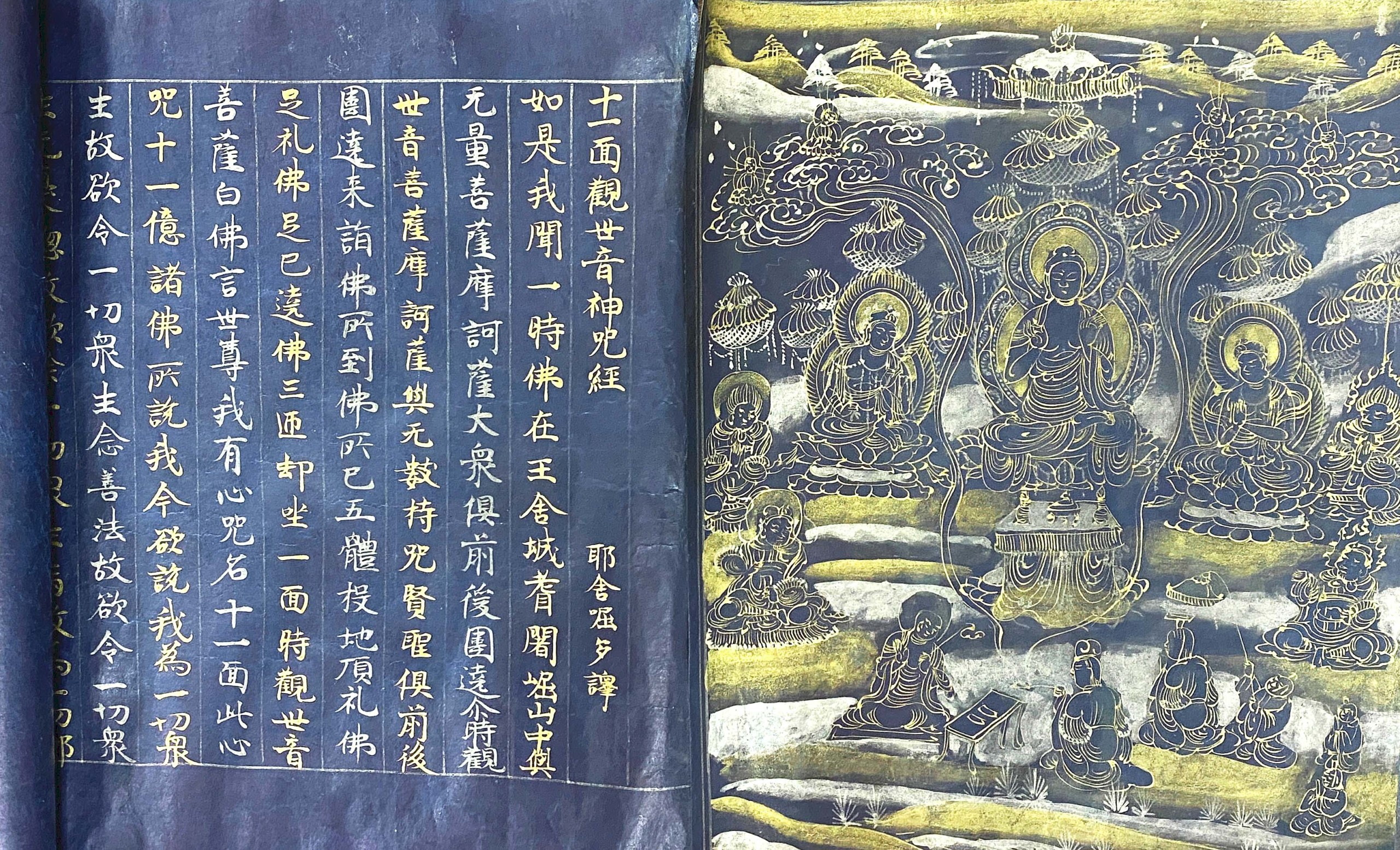
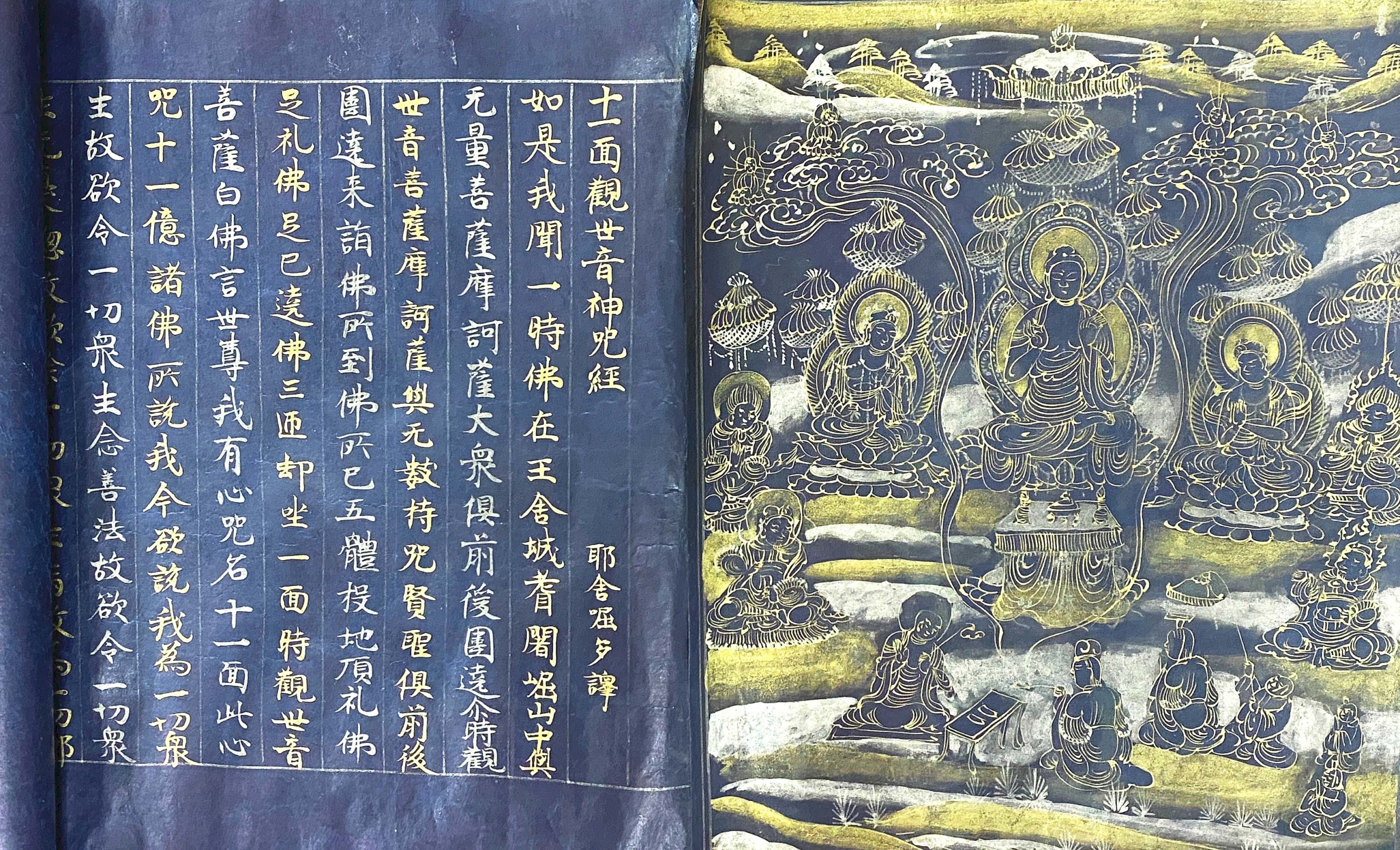
A portion of a Buddhist scroll (sutra), the Eleven-Faced Avalokitsvara Heart Dharani Sutra, from the Twelfth Century Chūsonji sutras.
To prepare for this exhibition, help was enlisted in identifying contents of Hill-Stead’s archives from art historian and Trinity College Associate art history professor Michael Hatch, who “graciously agreed to examine our collection of Japanese art…what we thought would be enjoyable, in an egg-heady scholarship kind of way, turned into a ‘wowza’ knockout experience — as he confirmed that within the Hill-Stead inventory was a rare and valuable fragment of a sutra that had been donated to the temple Todaiji, in Nara in 744,” said Swinbourne. “Fire had damaged these scrolls, and the surviving sections are known today as the Nigatsudō Burned Sutras. Now, thanks to Michael, we know that this scroll will be a star of our exhibition.”
At the time the couple had traveled to Japan, Theodate had become a serious student of Spiritualism, a pursuit that put her in the company of leading thinkers of her time. In her own life, she had lost loved ones prematurely and was a rare survivor from the torpedoing of the Lusitania, a British luxury ocean liner sunk by a German U-boat on May 7, 1915, during World War I. Her traveling companion and fellow spiritualist Edwin Friend was among the 1,198 who perished.
“When combined with Theodate’s long and intense fascination with the history and diversity of religions in the world, Spiritualism and psychical research, the presence of these scrolls suggests her Japonisme had a different dimension.
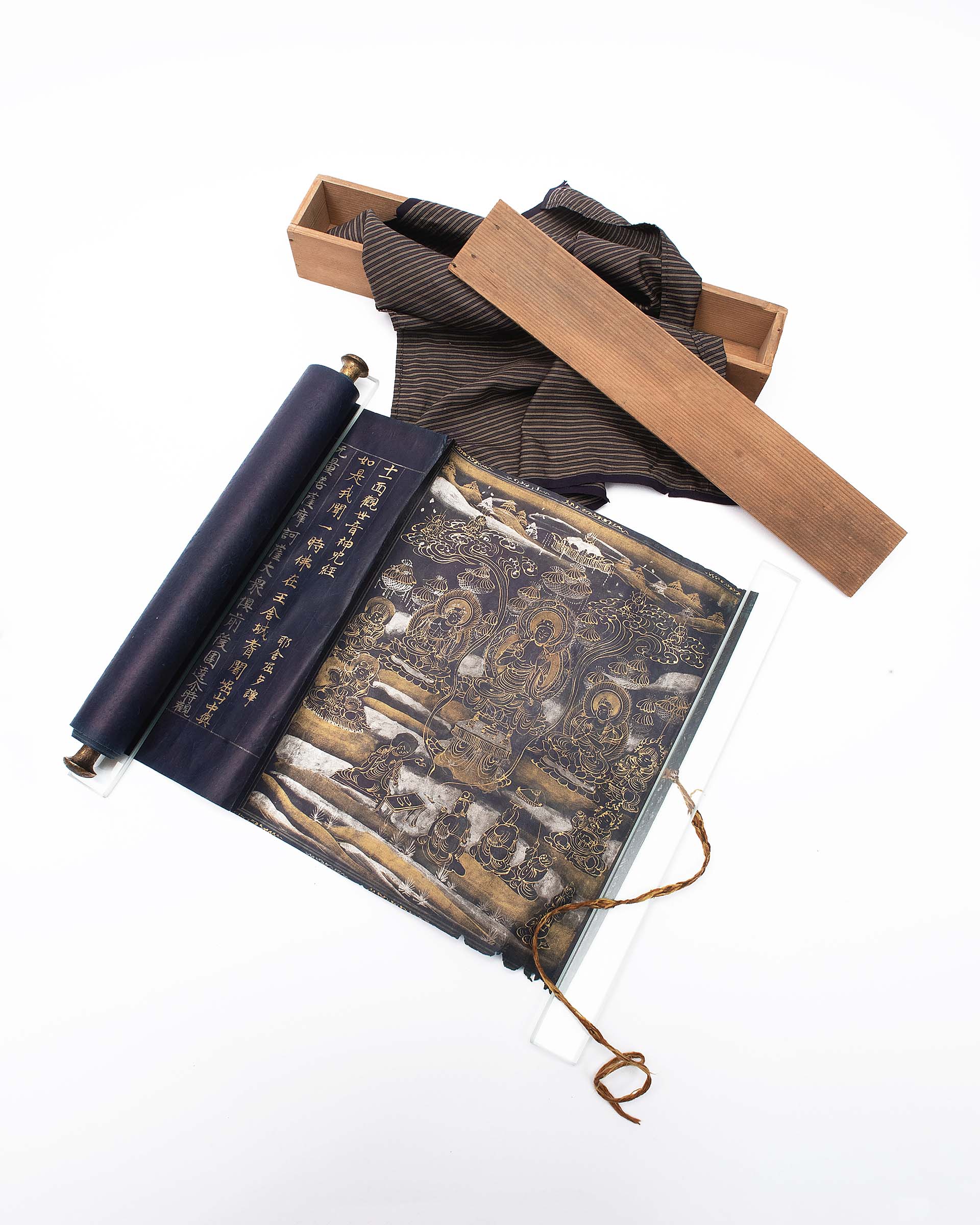
Twelfth Century Chūsonji Buddhist scroll (sutra) with its original storage box and silk wrapper, from the time of its acquisition in Kyoto, in 1919.
“Having studied and discussed Buddhism with John La Farge and even having traveled to many of the same spiritually charged places, Theodate was following in the wake of these American japonistes, but she was also, perhaps, finding a healing connection to these damaged but cherished objects,” Melanie Bourbeau, Hill-Stead’s senior curator, wrote in an essay for the exhibition’s accompanying catalog.
“While we have not been able to definitively link every object listed on the receipt with a collection item, we do know that Theodate and John purchased exemplary Japanese artwork from the world-renowned art dealer Yamanaka & Company in Kyoto. Within the list are silk brocades, five prints of Hokusai and two handscrolls labeled as ‘Buddhist scripture’ one of which has been identified as the rare fragment of the Flower Garland Sutra that survived a 1667 fire.”
Put in context, Bourbeau said, “We position Alfred among the larger group of American collectors acquiring between 1889 and 1930, in the company of John La Farge, Julian Alden Weir and William Franklin Gookin, a Chicagoan who left the world of banking at the age of 49 to become a Japanese print consultant.” (Another obvious kindred spirit was Charles Lang Freer, who shared Pope’s aesthetic spiritualism and delight in connoisseurship. His collection would become the basis of the Freer Museum of Asian Art at the Smithsonian Institution.)
In a letter home to her mother, Theodate confessed, “Everything is so strange and bewildering here that I do not yet know how to describe it — I think I must let the postcards speak for themselves…”
Japan had proved “drastically different” from the world she had known — and yet it too, was changing. The global world was spinning, and along with it, the art world.
Hill-Stead Museum is at 35 Mountain Road. For more information, 860-677-4787 or www.hillstead.org.