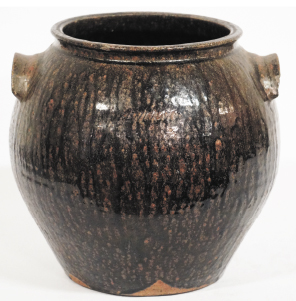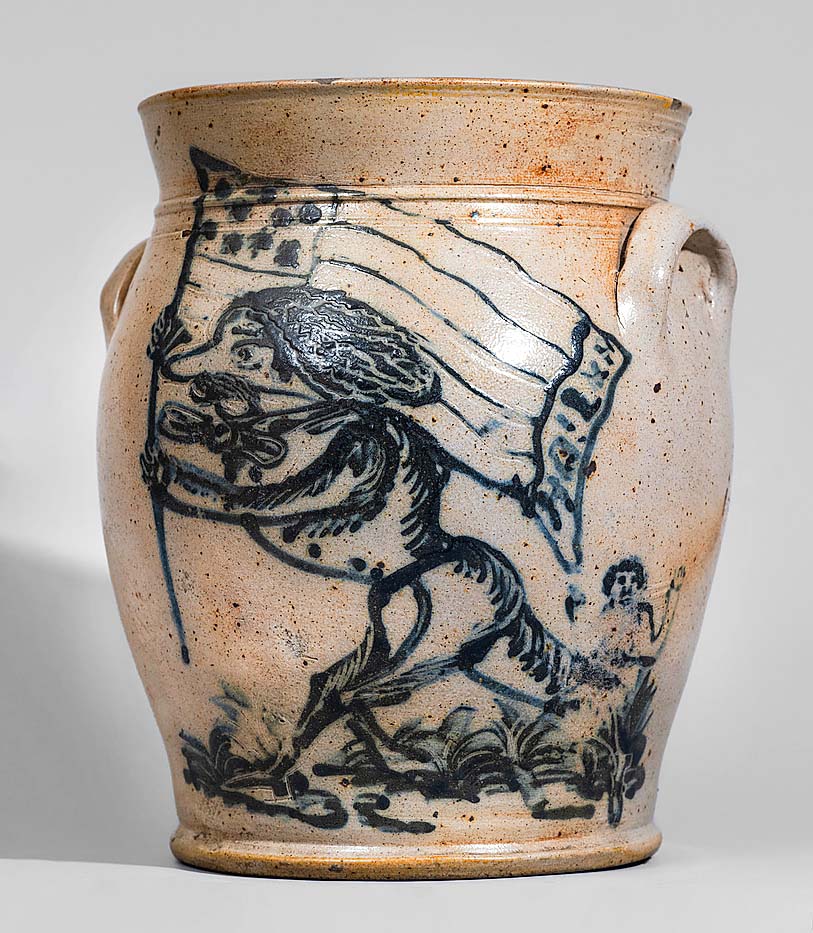
The auction’s top lot was this circa 1861 jar known as “The Patriot Jar.” Standing 9¾ inches tall, it was raised to $312,000 ($50/75,000).
Review by Carly Timpson
SPARKS, MD. — Showcasing “American grit, ingenuity and creativity…spanning from early post-colonial America to the Twentieth Century,” Crocker Farm’s America 250 auction July 22-August 1 presented more than 400 lots of stoneware, redware and other American pottery. Firm partner Mark Zipp reported strong numbers overall with just one lot passing, bringing the sale total to $1.717 million. “Our estimate was somewhere around $600,000 on the low end to $1 million on the high end, so going more than $500[thousand] over is really good.”
Given the strength of American imagery presented among these lots, it is no surprise that the auction welcomed some new bidders who perhaps were not previously collectors of stoneware. “We have a good number of Americana and political collectors that already have that cross-over, but the patriotic items, like the jar marked ‘Union for Ever,’ did draw in new people,” Zipp reported. “We want to see the market continue to grow and increase, and to see more people getting into this. We know the market is strong and it is exciting to see. I’d say over the last ten years or so we have really been bridging that gap between folk art collectors who are getting into stoneware or pottery.”
Crocker Farm wasted no time to exhibit this cross-over, and the most apparent example came from the auction’s very first lot: “The Patriot Jar.” This Civil War era jar, likely from New Jersey, had a large-scale, bold cobalt decoration of a man carrying an American flag. “It was really wonderful American imagery. We wanted this America 250 sale to represent the fervor of patriotism and the spirit of America, an this was the perfect lot number one,” Zipp noted. To further the Americana connection, the jar’s image was related to a 1861 cartoon with similar design elements, showing a patriot and (mounted) flag standing in front of cowering Confederates soldiers.
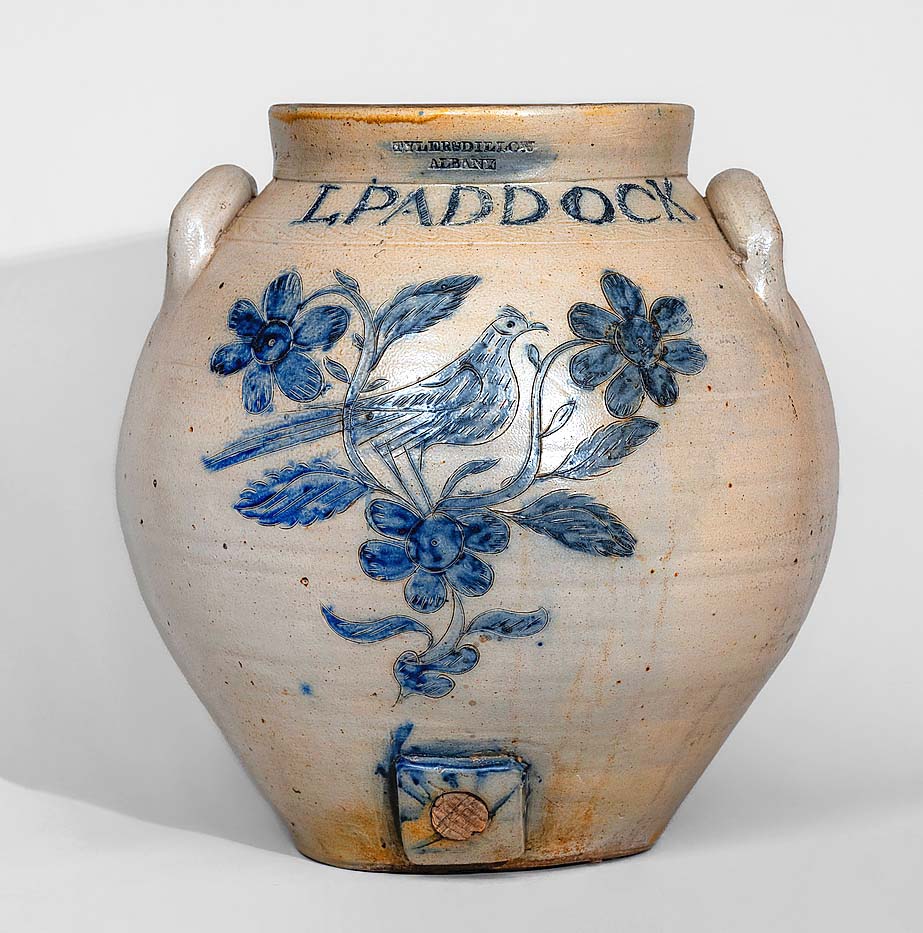
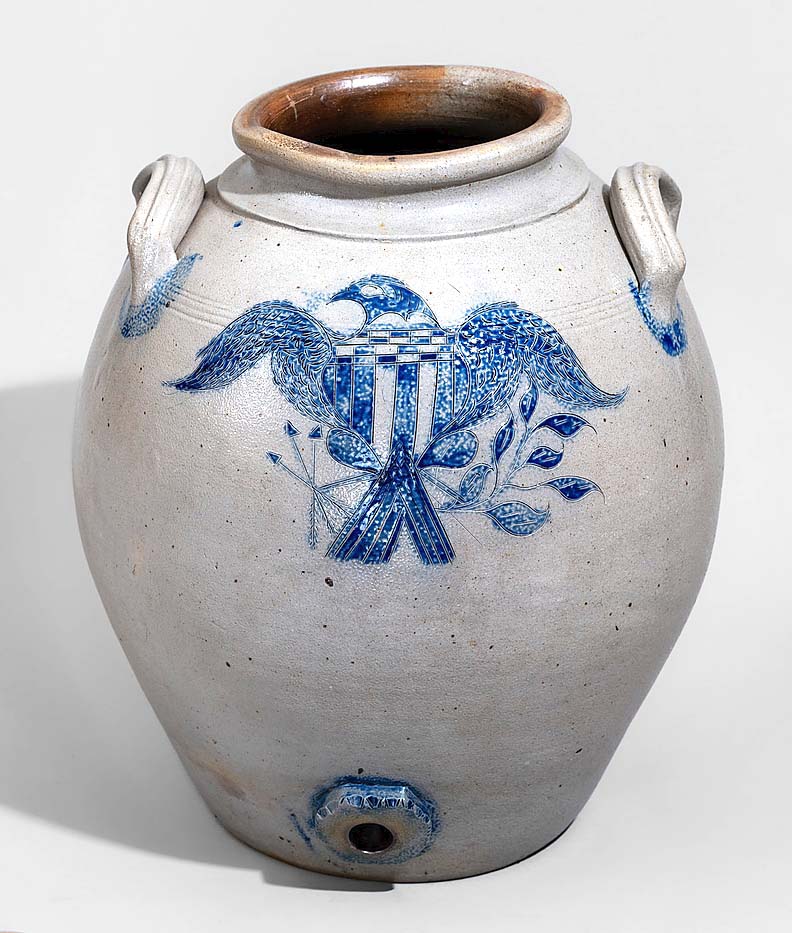
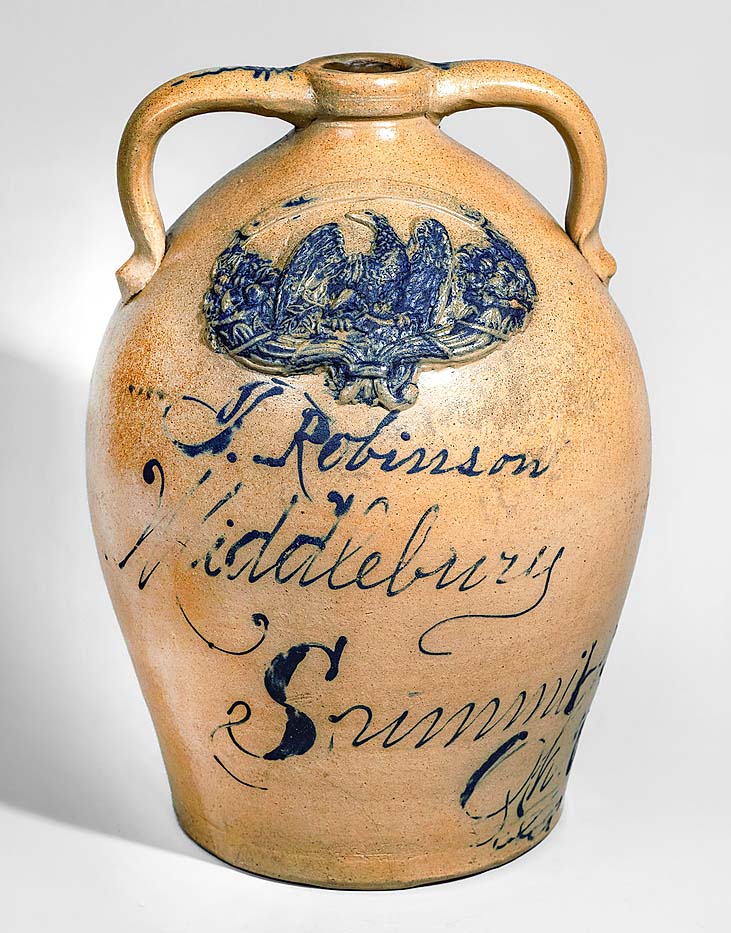
Stamped “Tyler & Dillon / Albany,” this 17-inch-tall New York State presentation water cooler was made circa 1825-34 for Loveland Paddock; it brought $84,000 ($30/50,000).
“There was spirited bidding all the way into the six-figure range; it wasn’t just a two-man race,” Zipp shared. Ultimately, the piece sold — to a folk art collector, who was new to Crocker Farm — for $312,000, which Zipp said was “a ptop-five price for any example of early, Nineteenth Century, American salt-glazed stoneware.” He added, “We’re very happy with that result; it bodes well for the market and shows that Americana keeps rising in the ranks.”
Bringing $84,000 was a Tyler & Dillon (Albany, N.Y.) presentation water cooler marked for “L. Paddock.” The recipient of this circa 1825-34 piece was Loveland Paddock, an entrepreneur from Watertown, N.Y., who is best known for opening that Paddock Arcade, the oldest continuously operated shopping mall in the US, according to the catalog notes. The entry continues, “The Paddock cooler’s extravagant decoration, imposing size, robust form and historical significance place it among the most important ceramic pieces from the city of Albany, one of the country’s great epicenters of stoneware production.”
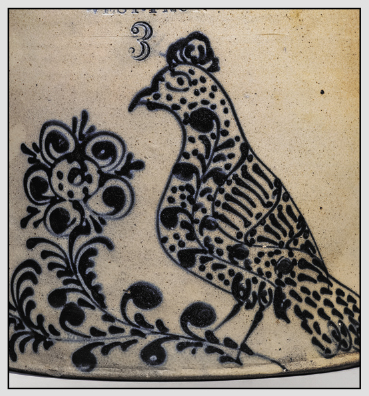
Deer are desirable motifs to find on stoneware pieces, so it is no surprise that a fresh-to-the-market “double-deer” crock from J. & E. Norton rose to $72,000. Made by the Bennington, Vt., company circa 1855, the six-gallon crock featured a cobalt illustration of a doe reclining on a hill, just behind a standing stag. Contributing to the crock’s success was the “outstanding size” of the vessel itself (13¾ inches tall with an equal diameter) as well as the image (11 inches tall by 17 inches long) and the intense color, which may be the finest Crocker Farm has seen on a piece by this maker.
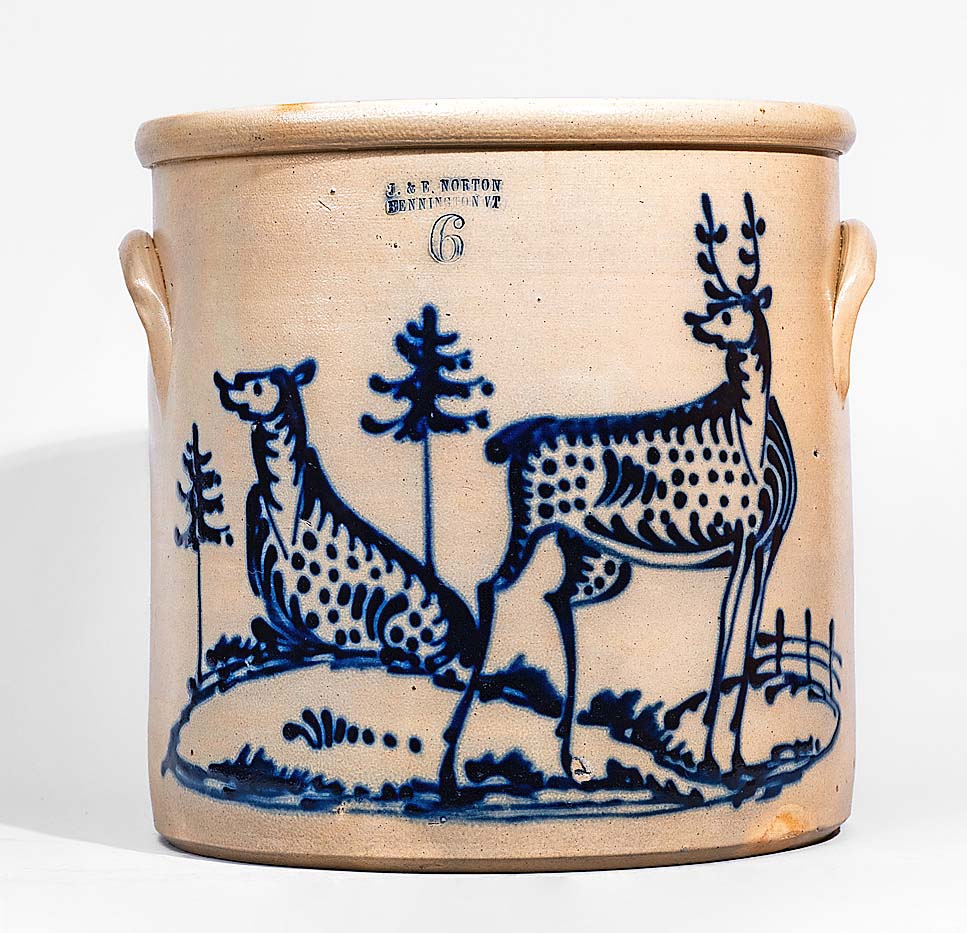
Fresh to the market having been unknown to the larger collecting community until just weeks before the auction, this J. & E. Norton six-gallon double deer crock, 13¾ inches tall, 13¾ inches in diameter, descended in a New England family and is “arguably the finest example of stoneware showcasing a deer design that [Crocker Farm has] offered.” As such, it was bid to $72,000 ($30/50,000).
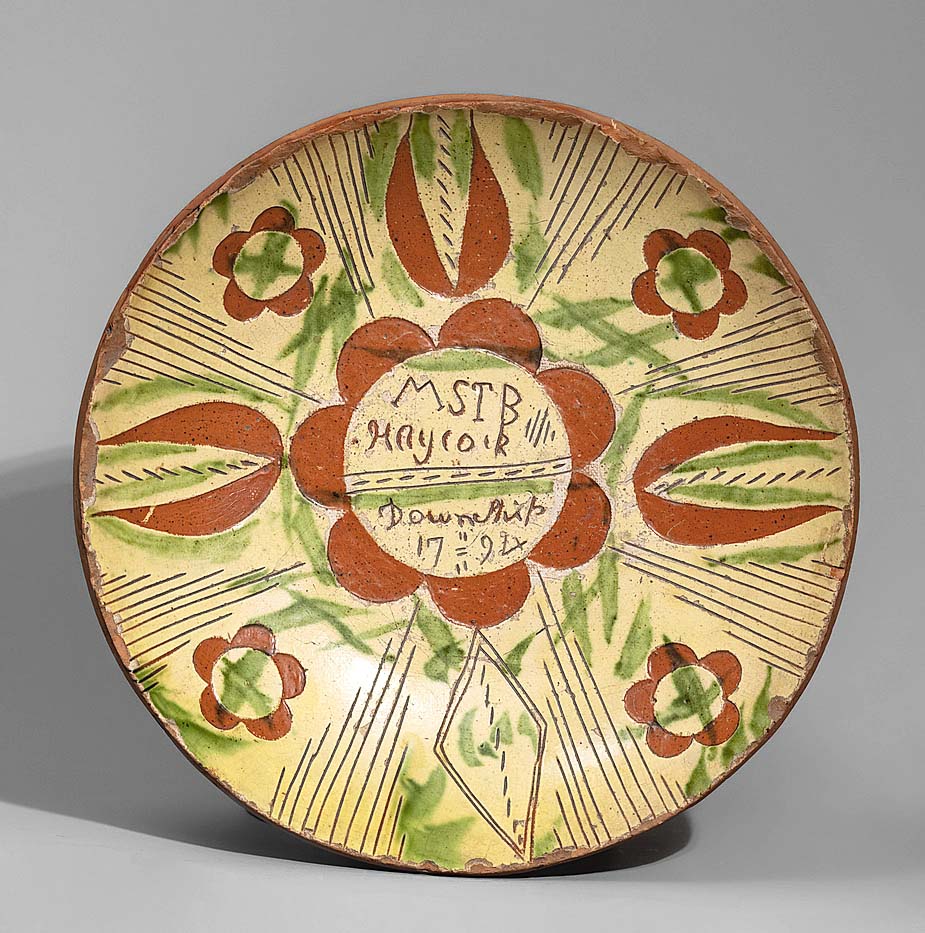
The combination of rarity and historical significance helped a redware plate by Michael Stoneback more than double its high estimate to achieve $66,000 and lead offerings of that media. Stoneback, who lived and worked in Haycock Township, Bucks County, Penn., is known to be a foundational figure in the education of Conrad Mumbauer (1761-1845), who, along with John Monday, went on to establish a well-known pottery nearby. This example, made in 1794, had sgraffito floral motifs and elaborate copper slip decoration and was signed “MSTB / Haycock / Downship [sic] / 1794.” As the auction catalog explained, “This plate, bearing the initials ‘MTSB’ for Michael Stoneback, survives as the only signed or even documentable example of redware produced at the Stoneback pottery and is possibly the earliest dated example of Haycock Township redware known.”
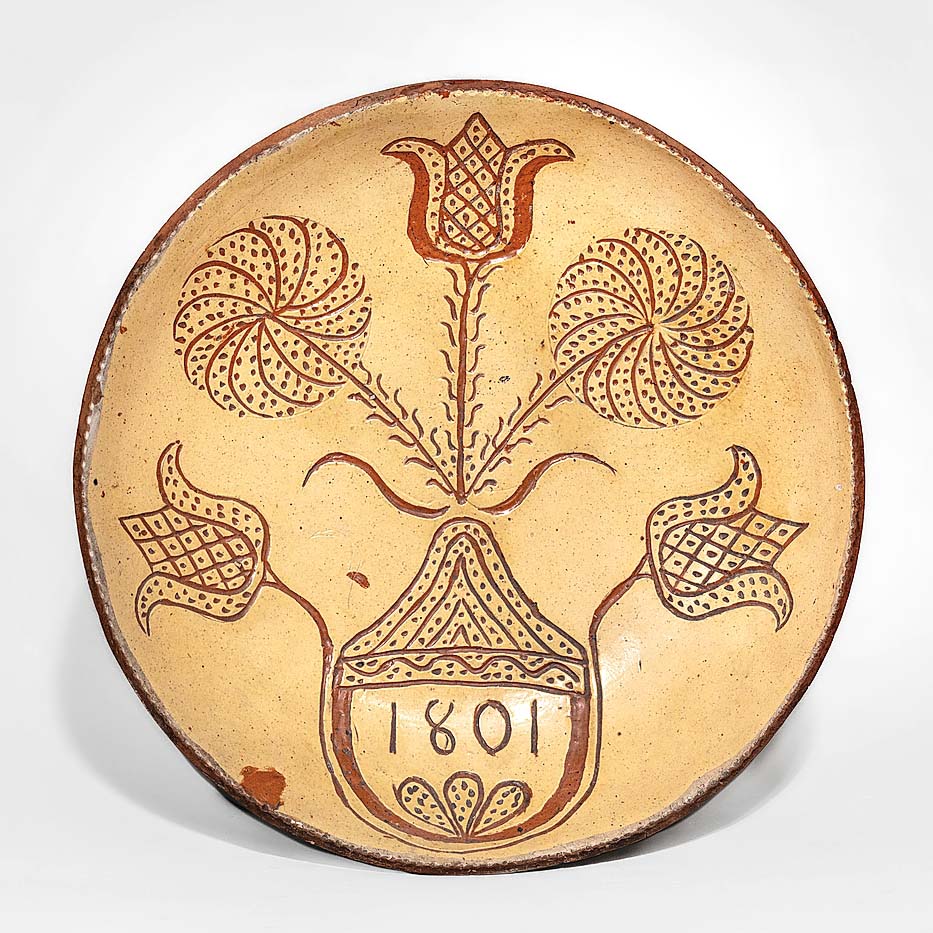
Fittingly, the Stoneback plate was immediately followed, in lot order and in price, by an example attributed to the Mumbauer Pottery. Dated 1801, this redware charger was crafted within the early years of the Pottery’s operation and its sgraffito design of a stippled and crosshatched flowers in a stylized urn represent the birth of the potter’s hallmark style. It also more than doubled its high estimate and went out at $51,000.
Other notable pieces in the auction included a redware cruet signed by John Bell, Sr, of Waynesboro, Penn. Zipp explained, “It was a very clean, beautiful example of Bell’s work, basically untouched, a rare form, had really appealing glaze…But the kicker was the hand-incised signature on the bottom. You’ll see stamps with his name, but having it hand-signed really elevated it.” Recently surfaced in Pennsylvania, it brought $25,200.
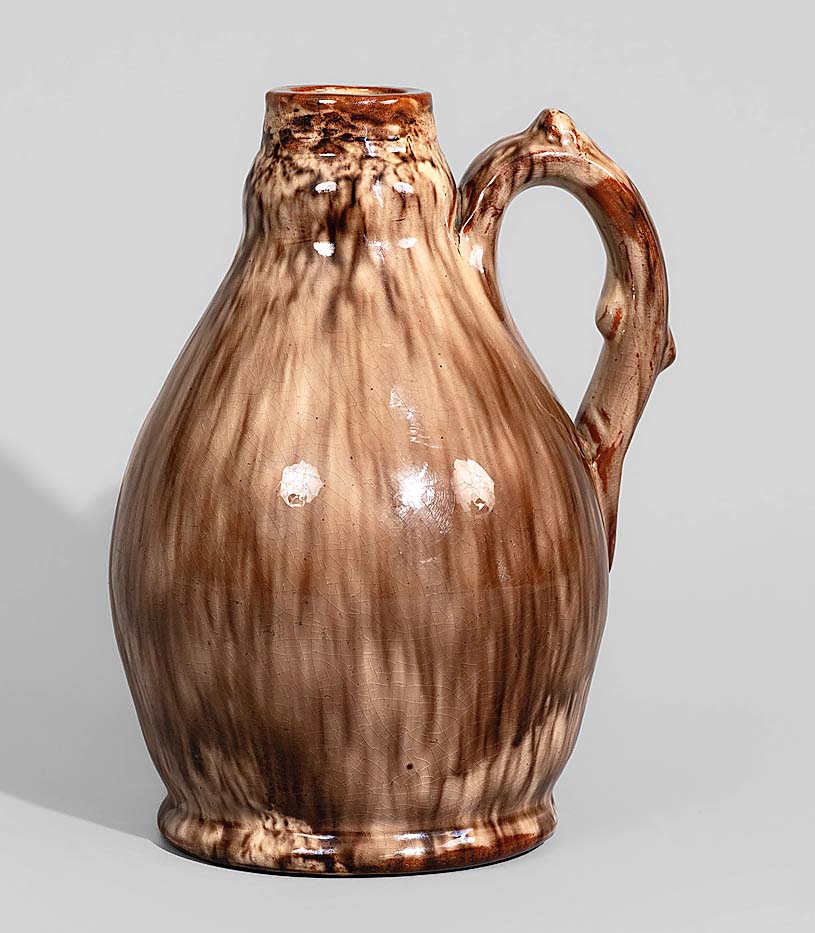
The hand-inscribed signature of John Bell, Sr, added to this 7½-inch-tall cruet’s already appealing unusual form. Made on June 2, 1877, it was bid to $25,200 ($3/5,000).
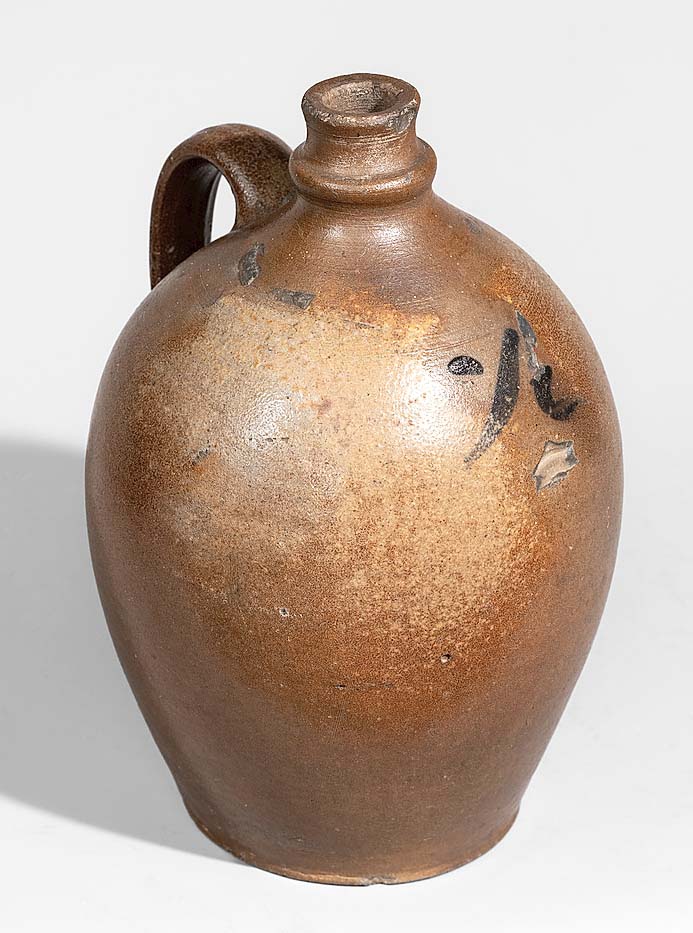
Though there was no tangible proof, the possibility of a Richard Randolph jug having been connected to Thomas Jefferson was enough for fans of American history. The Richard Randolph Pottery (Four Mile Creek, Henrico County, Va.) advertised making “Soda, cyder and beer bottles,” and Jefferson was a customer. In 1814, Jefferson wrote to Randolph from Monticello with the request, “Will you be so good as to send me two gross of your beer jugs; the one gross to be quart jugs, and the other pottles do.” The half-gallon jug in this auction, made between 1813 and 1821, is comparable to those that Jefferson was buying. Ceramics dealer Rob Hunter, bidding on behalf of collectors William and Susan Mariner, was the winner of this pottle, taking it for $20,400 — a far cry from its $800 high estimate. Hunter and the Mariners were also the winners of a miniature presentation jug attributed to Nicholas Van Wickle of Howell Township, Monmouth County, N.J., circa 1825 ($39,000), and a late Eighteenth Century handled redware jar from North Carolina, possibly by J.C. Cox, Randolph County, which Crocker Farm reported as “the earliest example of North Carolina redware that we have offered that was produced outside of the Moravian and St Asaph’s traditions” ($4,800).
Prices quoted include the buyer’s premium as reported by the auction house. For information, www.crockerfarm.com or 410-472-2016.