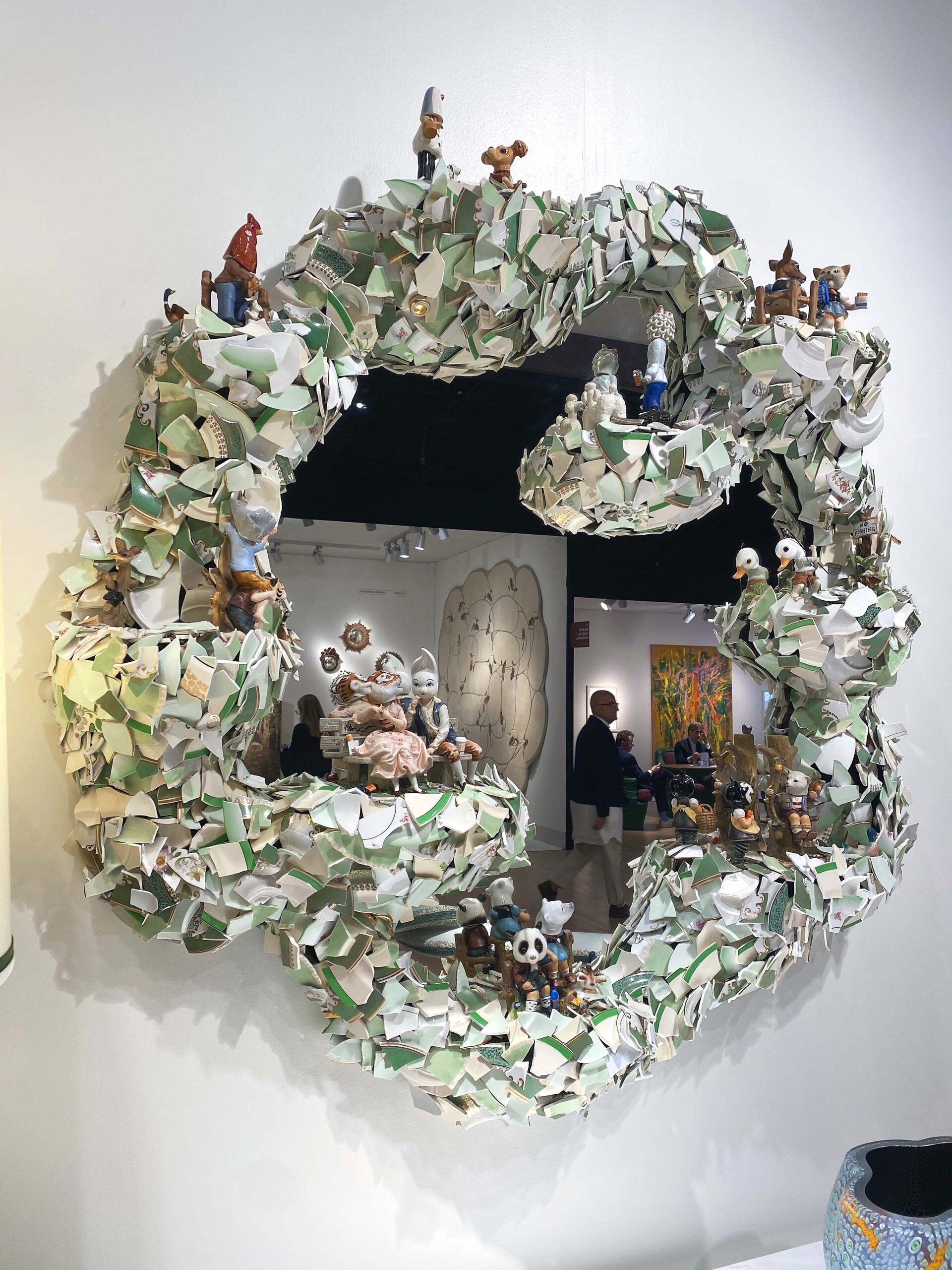
“A Sunday Afternoon on Connaught Waters,” assembled from found ceramic objects by Barnaby Barford, represented by David Gill Gallery, London.
Review & Onisite Photos by Z.G. Burnett
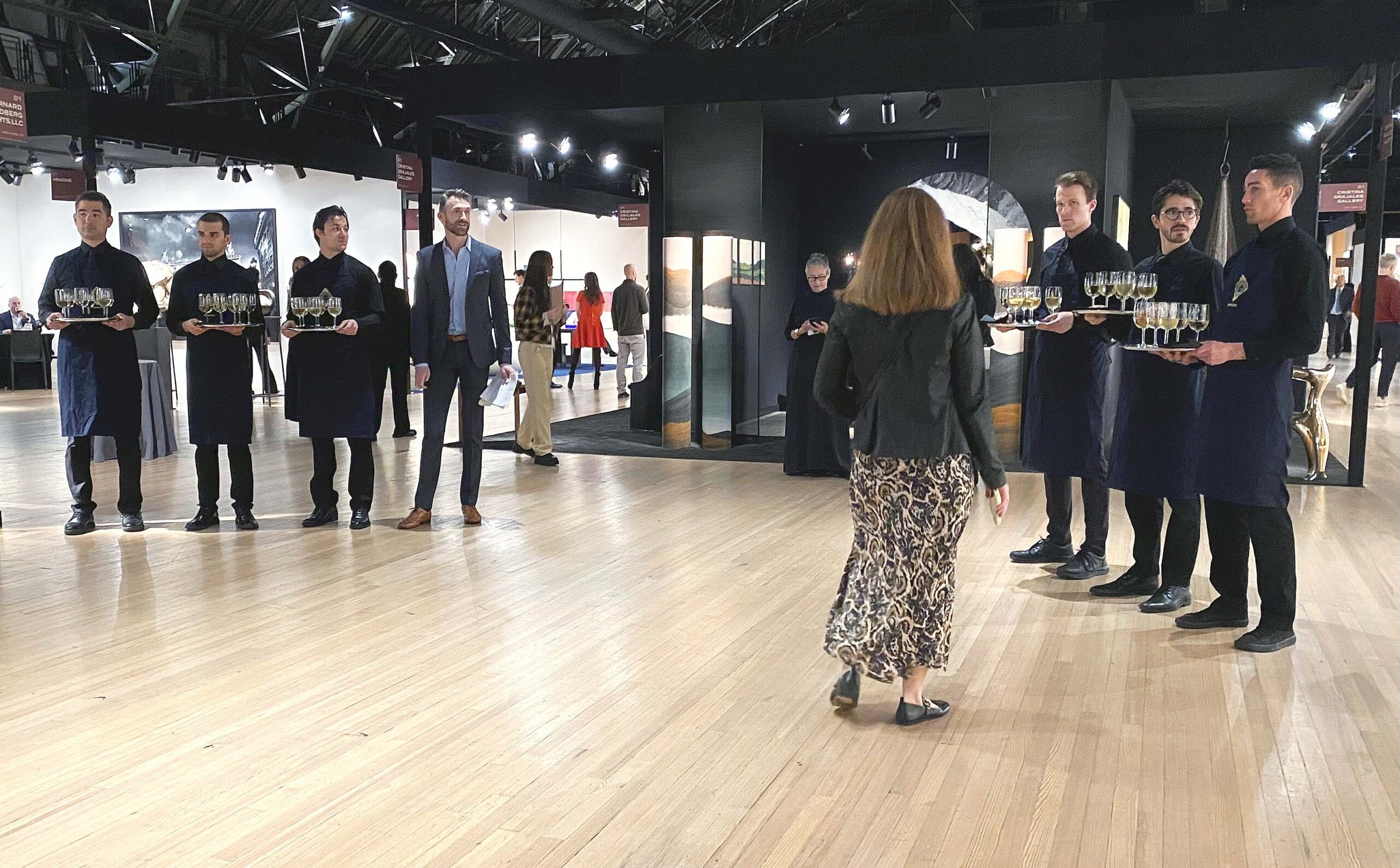
NEW YORK CITY — Salon Art + Design, produced by Sanford L. Smith + Associates, celebrated its 15th edition by welcoming nearly 3,300 attendees to its preview night at the Park Avenue Armory on November 4. The fair was open to the public November 5-8, attracting visitors throughout the weekend. More than 50 exhibitors from the United States and abroad spread across the Armory’s massive Drill Hall, many of them creating entire worlds of design within their booths.
Particulars are rarely divulged at Salon, though many reported lively sales and strong responses on opening night. Heller Gallery commented that it was an “exciting opening event filled with collectors and curators as well as the design curious.”
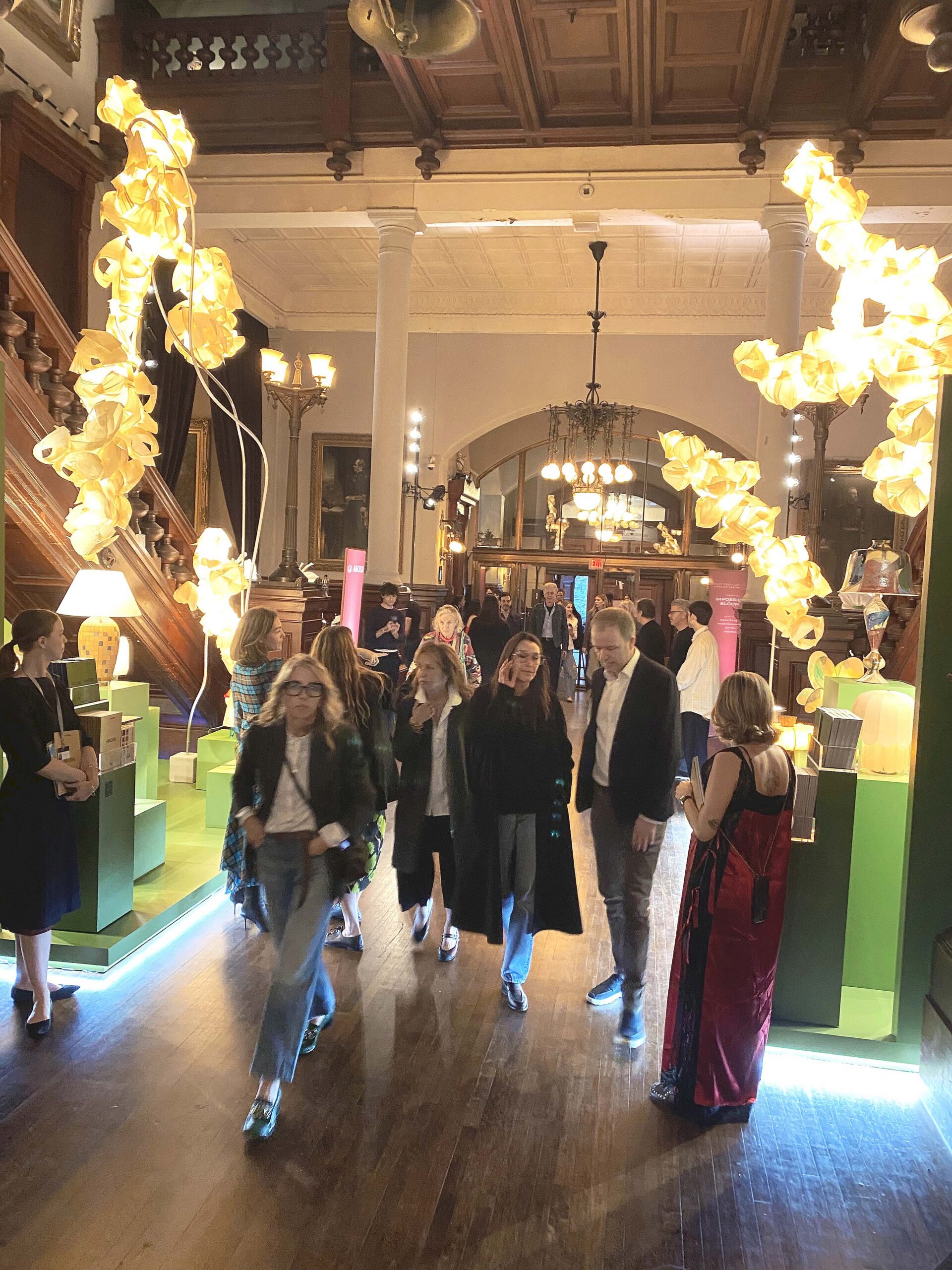
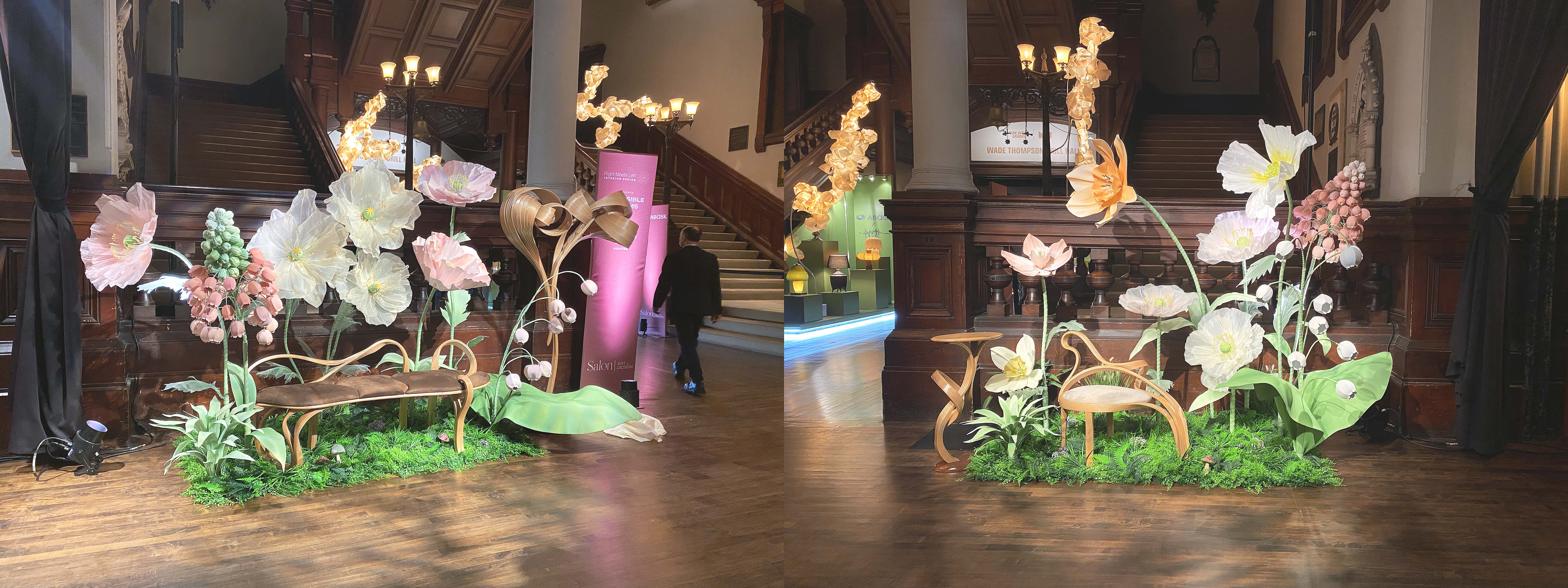
Miami-based Maison Mischief and Errez Design transcended a traditional exhibition space with their “Club Venus” installation, composed entirely of objects from their catalog. Instead of occupying one of the fair’s booths, the installation seemed to grow organically from the Armory’s floor. The pieces of art and furniture were arranged to create separate spaces that encouraged customers to immerse themselves within “Club Venus” and interact with the objects. Four “Aria” screens made from Venetian plaster were essential to this experience, as were the undulating satin screens created by Ukrainian artist Gayane “Gaya” Arushanian for the installation. Arushanian “explores balance and hidden systems in painting and sculpture,” and dyed the satin by drawing it through a body of water with pigment floating on top. This process was performed in the swimming pool of Katie and Ruben Gutierrez, owners of Maison Mischief and Errez Design.
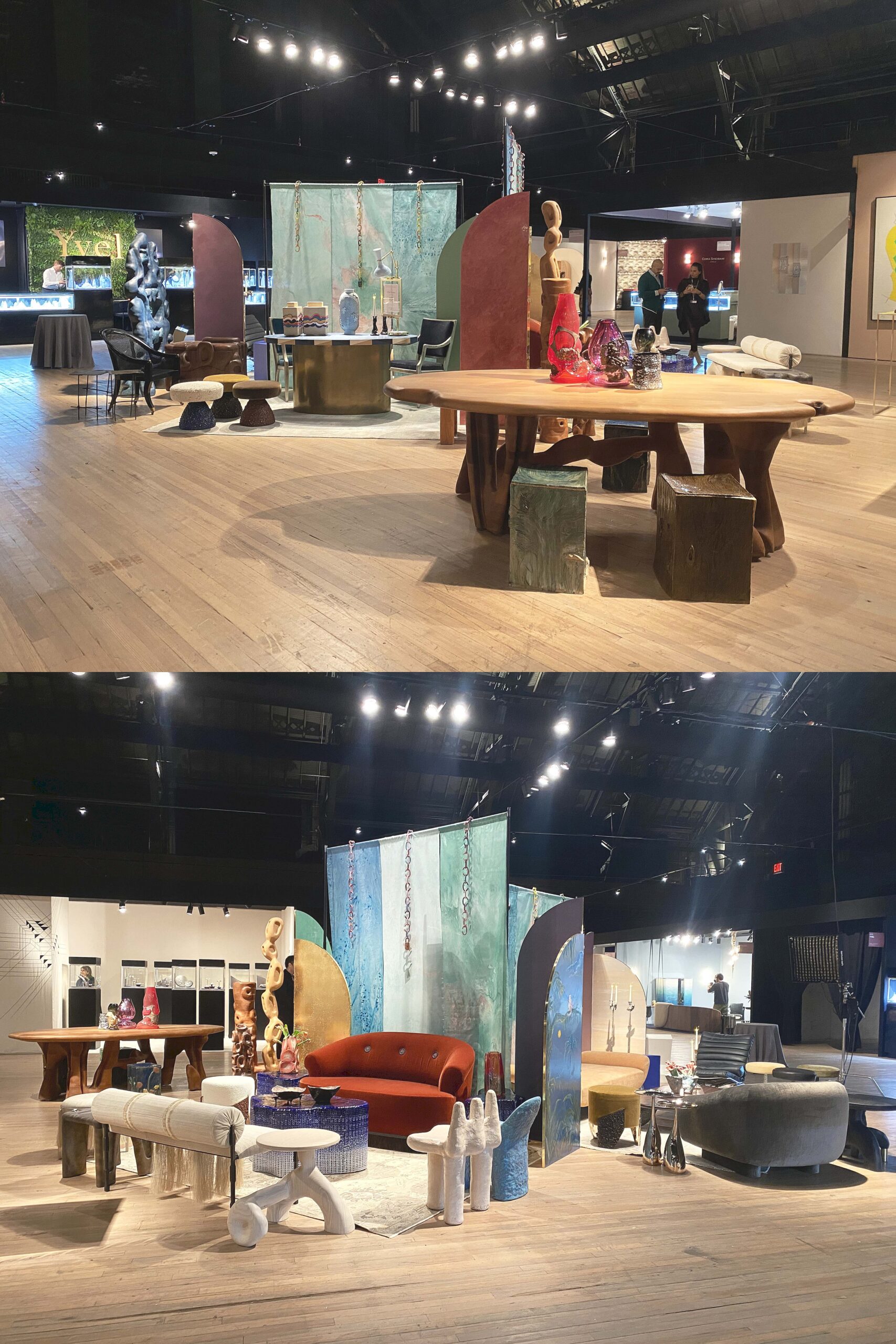
Two views of “Club Venus,” an installation designed by Maison Mischief and Errez Design, Miami, that created its own multi-chambered booth in the center of Salon.
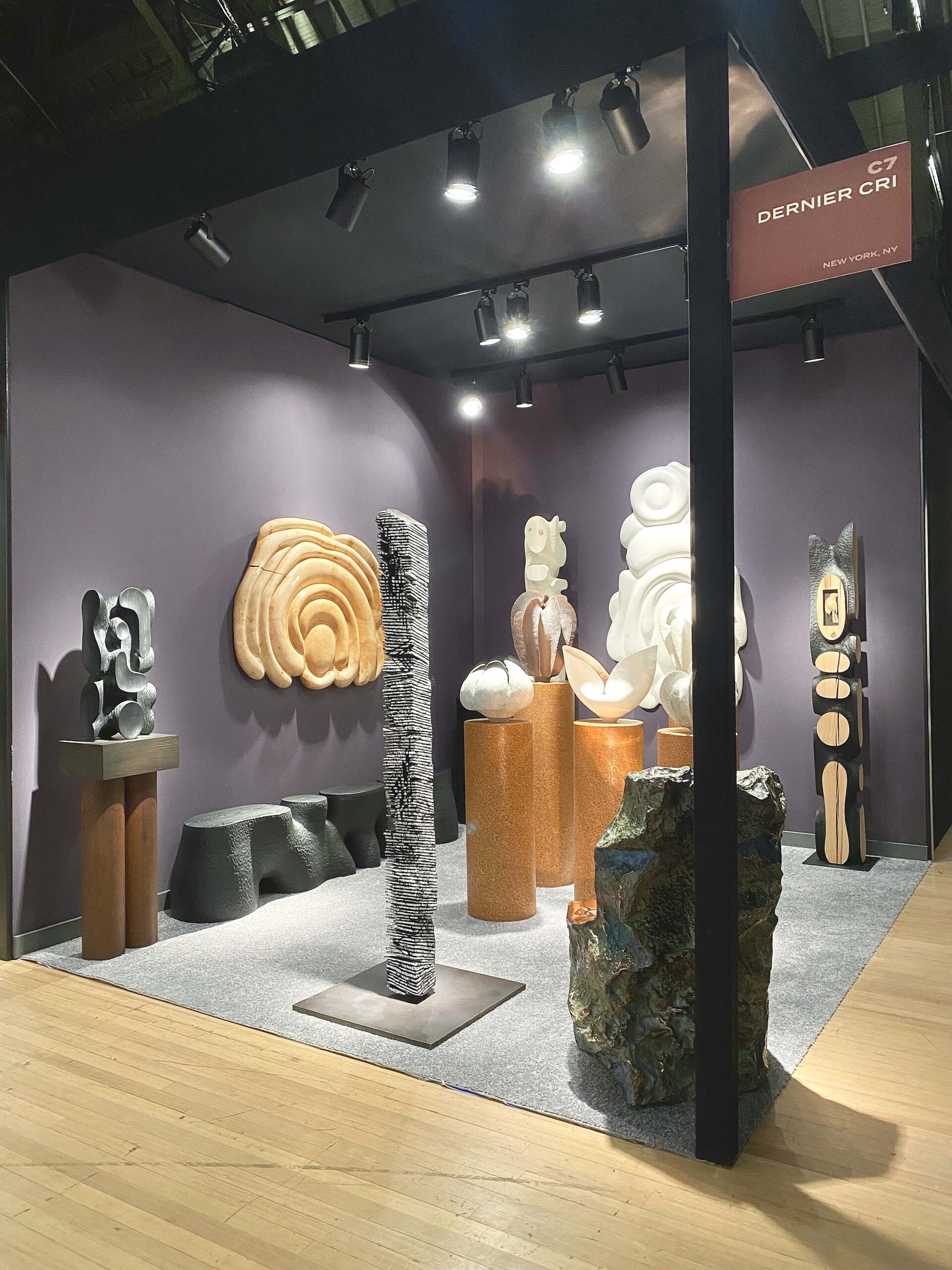
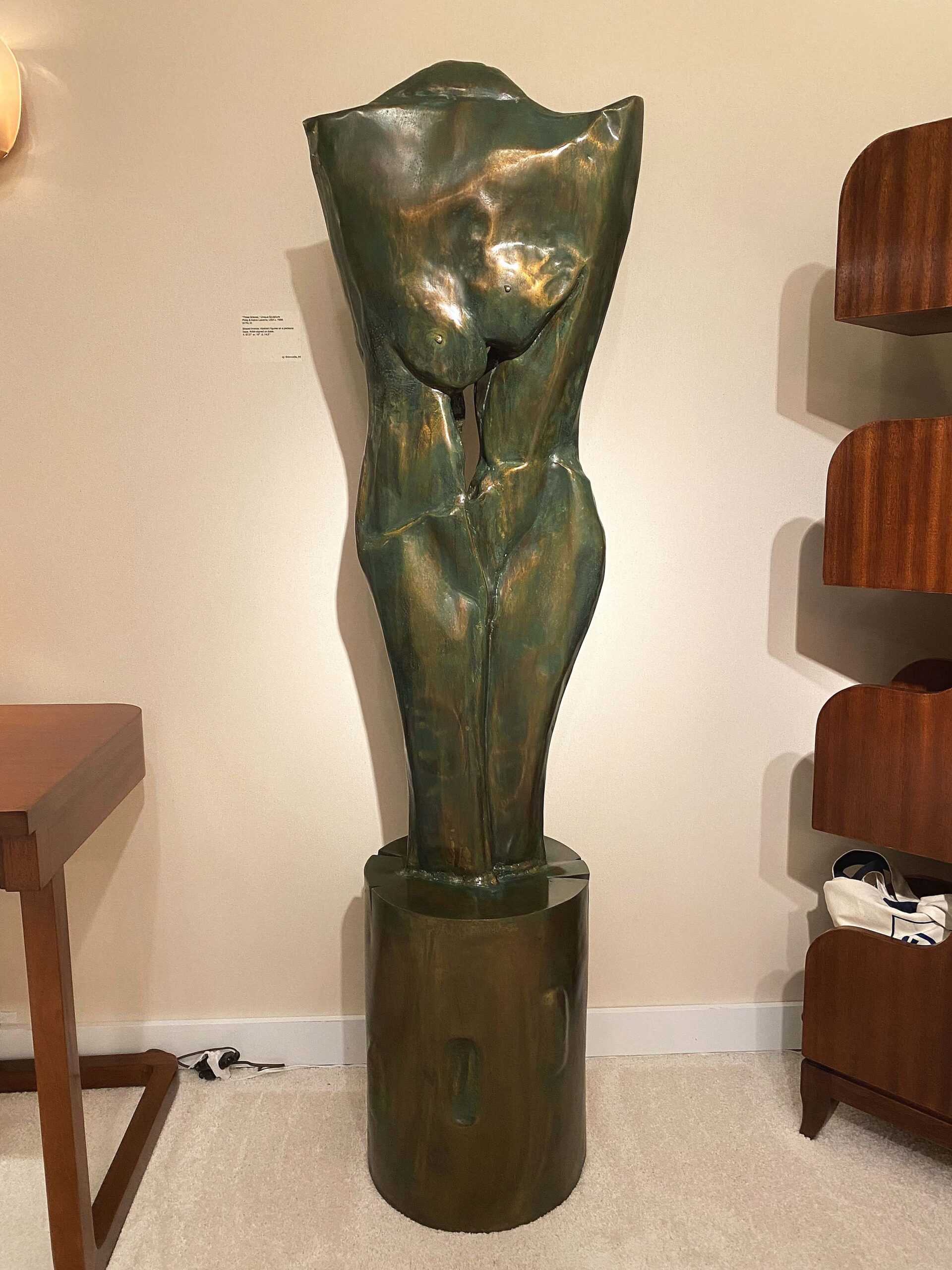
Nearby, Dernier Cri, New York City, made its Salon debut with a similarly imaginative space constructed by the sculptures on display. The gallery opened in January 2026 under the direction of Michael McGraw, who also owns the design communications firm McGraw PR and has been working in the field for more than 25 years. In its booth, four artists were represented by Dernier Cri, all sculptors with cohesive but unique styles. These new and recent works were by Casey Johnson, Todd Marshard, Frank Carfaro (of Frank + Hank) and Marius Ritiu, some created specifically for the fair. Both Johnson and Marshard have been the subjects of Dernier Cri solo exhibitions, and the sinuous forms of Johnson’s smoothly carved wood and shaped stone wall sculptures reflected Marshard’s ceramics, which are inspired by the natural formations of the Aegean Sea on the Greek island of Paros, his adopted home. Carfaro’s and Ritiu’s creations were sharper but no less organic. Carfaro’s “Onwards + Upwards” was a cut tower of Blue Sky granite and silver leaf, facing Ritiu’s “Hot Seat From Space,” a chair fashioned from hand-hammered copper as though it had just fallen through the atmosphere. With all four elements in attendance, Dernier Cri reported a successful first fair.
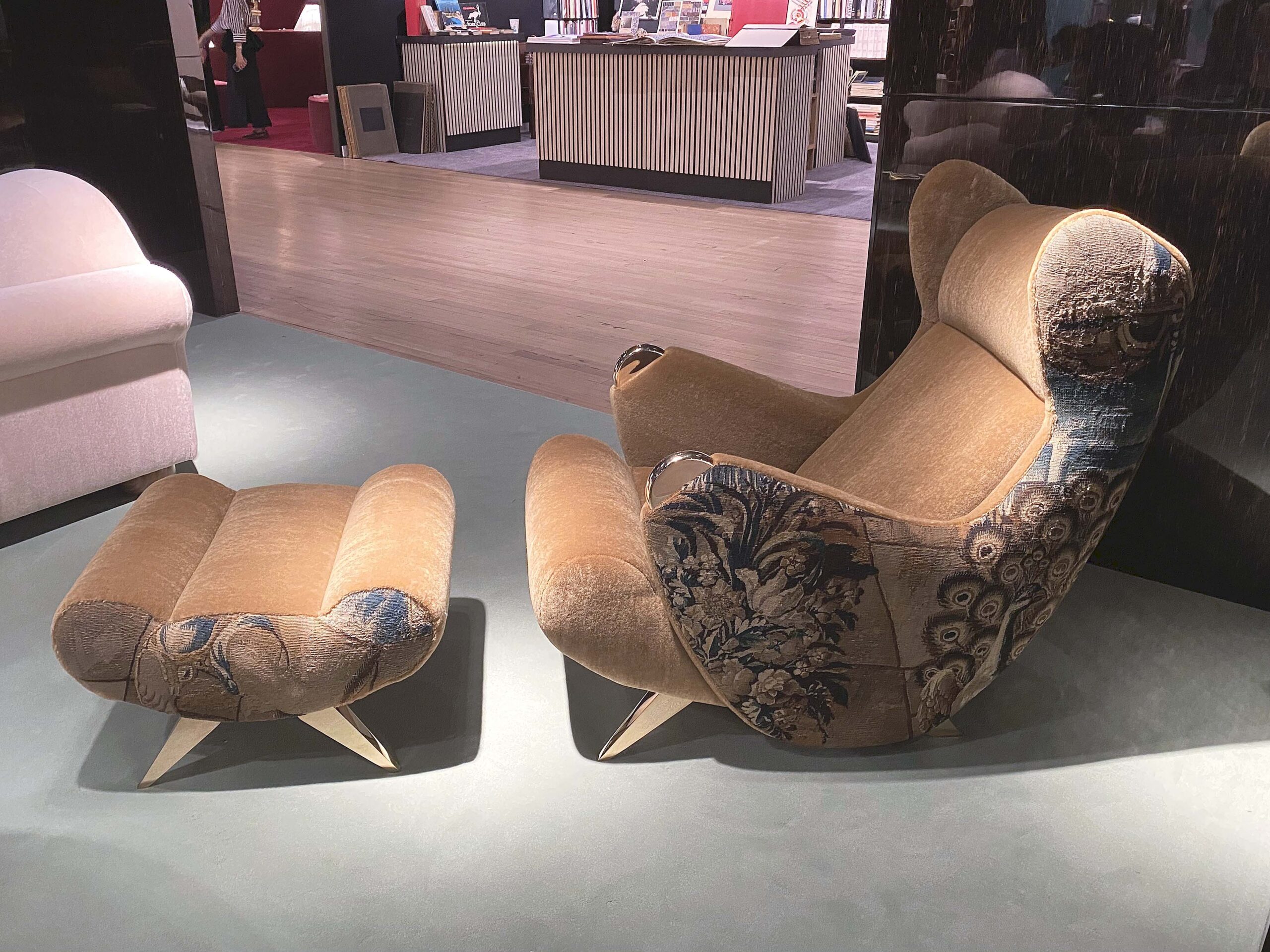
Sten Studio from Mexico City, Mexico, presented its new Entretiempos collection, a series of lamps inspired by 1960s and 1970s design made from composites of translucent stone. The pleated lampshades of the collection’s referenced era were a direct inspiration, but instead of neatly folded paper, the carved shades and fluid shapes of their bases belie their solid materials. “This material contradiction lies at the center of the collection,” the gallerist explained. “Stone carries millions of years of geological history, while the forms reference a moment in which design was looking enthusiastically toward what might come next.” Entretiempos translates into a liminal moment suspended in time, “between what has happened and what is yet to come.” The lamps were displayed against lush burgundy velvet to accentuate the light radiating from within the lamps, drawing one in to view the natural colors and striations of each individual stone.
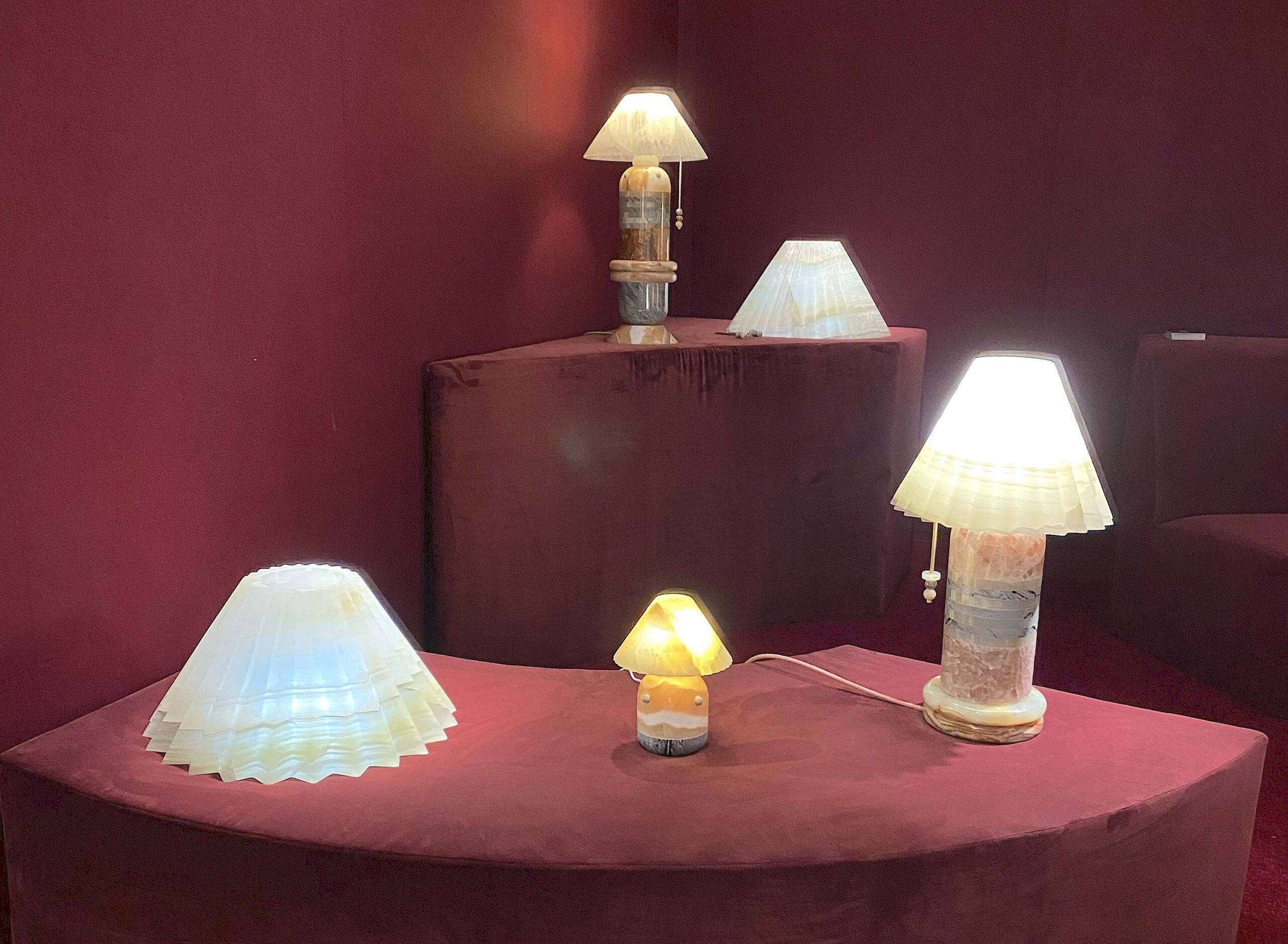
Sten Studio presented Entretiempos, a collection of lamps and shades carved from stone compositions such as onyx, marble and travertine in “playful” shapes inspired by 1960s and 1970s design. Mexico City.
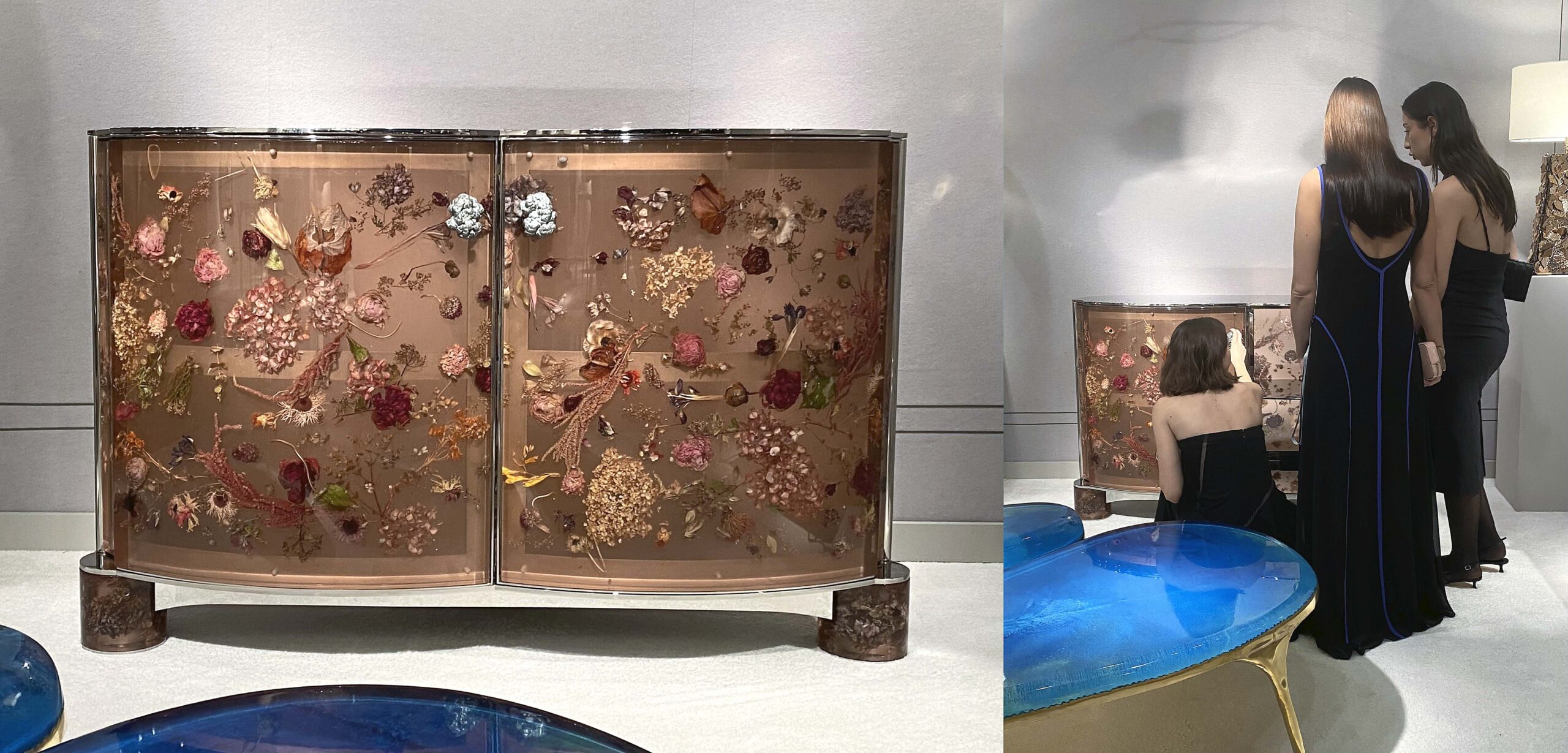
Bringing the natural world into the domestic sphere was a shared theme among many exhibitors, and few pieces embodied the theme so literally as a cabinet by Marcin Rusak. Presented in the booth of Twenty First Gallery, New York City, Rusak’s “Flora Herbarium Amber 152” was framed with stainless steel supporting curved resin panels and feet, each preserving real “flower and foliage inclusions” for the rest of time. Rusak comes from a family of flower growers in his native Poland, and this signature technique of suspending plants in his work makes each piece a singular object. This example was one of an edition of eight numbered pieces and four artist’s proofs. It attracted much attention throughout the weekend.
Nouveau-Rococo style was also prevalent at Salon, no doubt fueled by the current appetite for “whimsy.” David Gill Gallery, London, met this demand with Barnaby Barford’s mirror titled “A Sunday Afternoon on Connaught Waters.” Decorated entirely with found ceramic objects, the majority of the wood mirror frame is covered with shards of green and white crockery reminiscent of coquillage, a technique popular in the Eighteenth and early Nineteenth Centuries used to decorate interior surfaces entirely with natural shells. Small platforms built into the mirror hold small assemblage figurines either in conversation with each other or in wistful contemplation. Measuring about 52 inches tall, the mirror had a glass surface space that was the only distraction from becoming absorbed in Bradford’s pastiches.
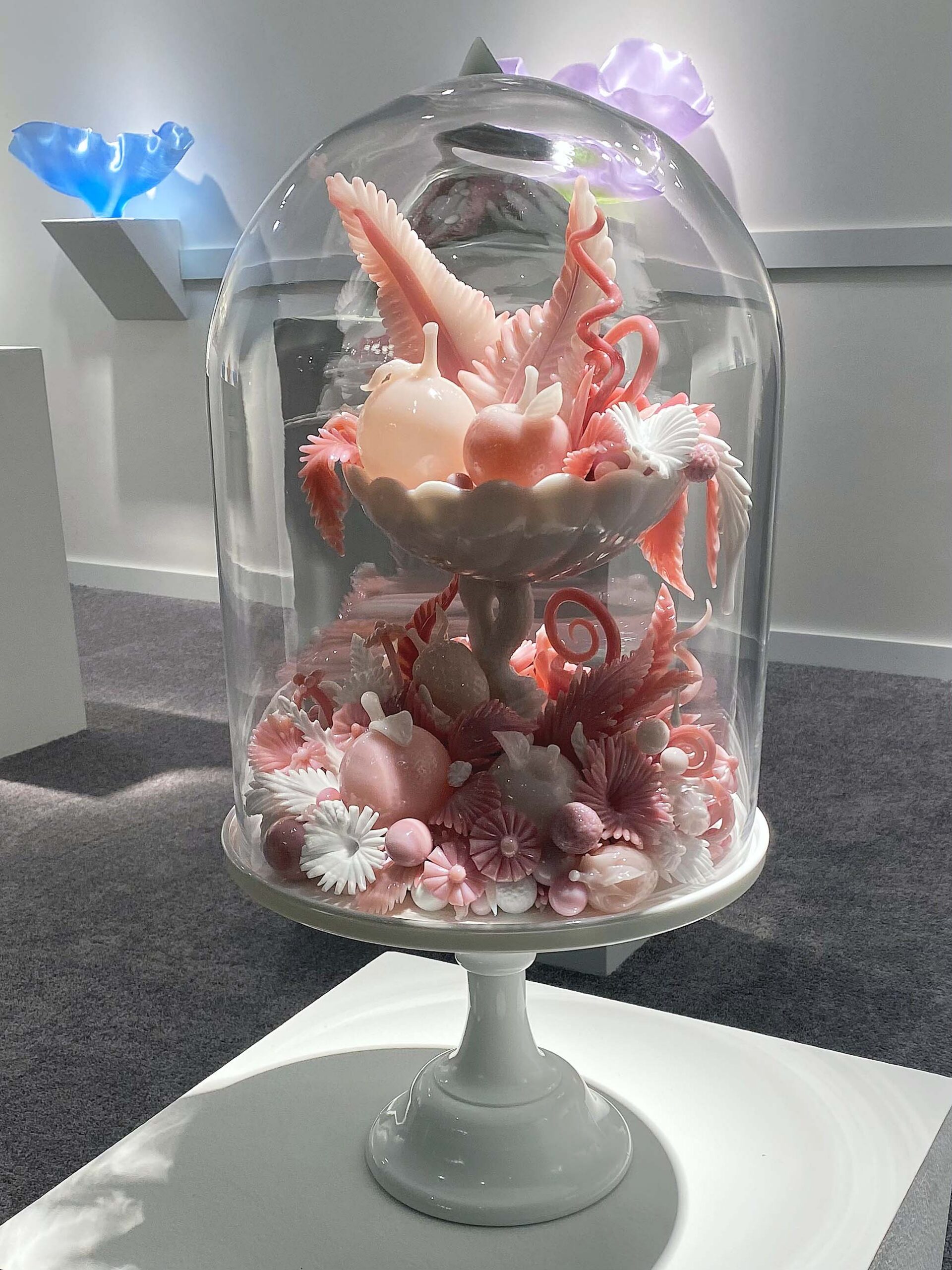
“Rosaline and Milk with Fruit and Fronds” by Amber Cowan, who exclusively uses upcycled vintage and antique American glass for her fanciful sculptures. Heller Gallery, New York City.
For those who craved more of this decorative flavor, Heller Gallery, New York City, brought a number of glass sculptures by Amber Cowan, all presented like forbidden cakes beneath glass domes. Based in Philadelphia, Cowan also uses vintage and antique glass in her intricate dioramas and is partial to defunct American glass makers such as Fenton and Imperial Glass. Her process includes flameworking, hot-sculpting and finally glassblowing to shape industrial glassware into enticing fruits and flowers, surrounded by delicate tendrils. One of these, titled “Rosaline and Milk with Fruit and Fronds,” utilized rosaline and opaque milk glass, both of which are no longer in production. Cowan’s work is held at the Corning Museum of Glass, N.Y., alongside many examples of the glass she personally sources and reuses.
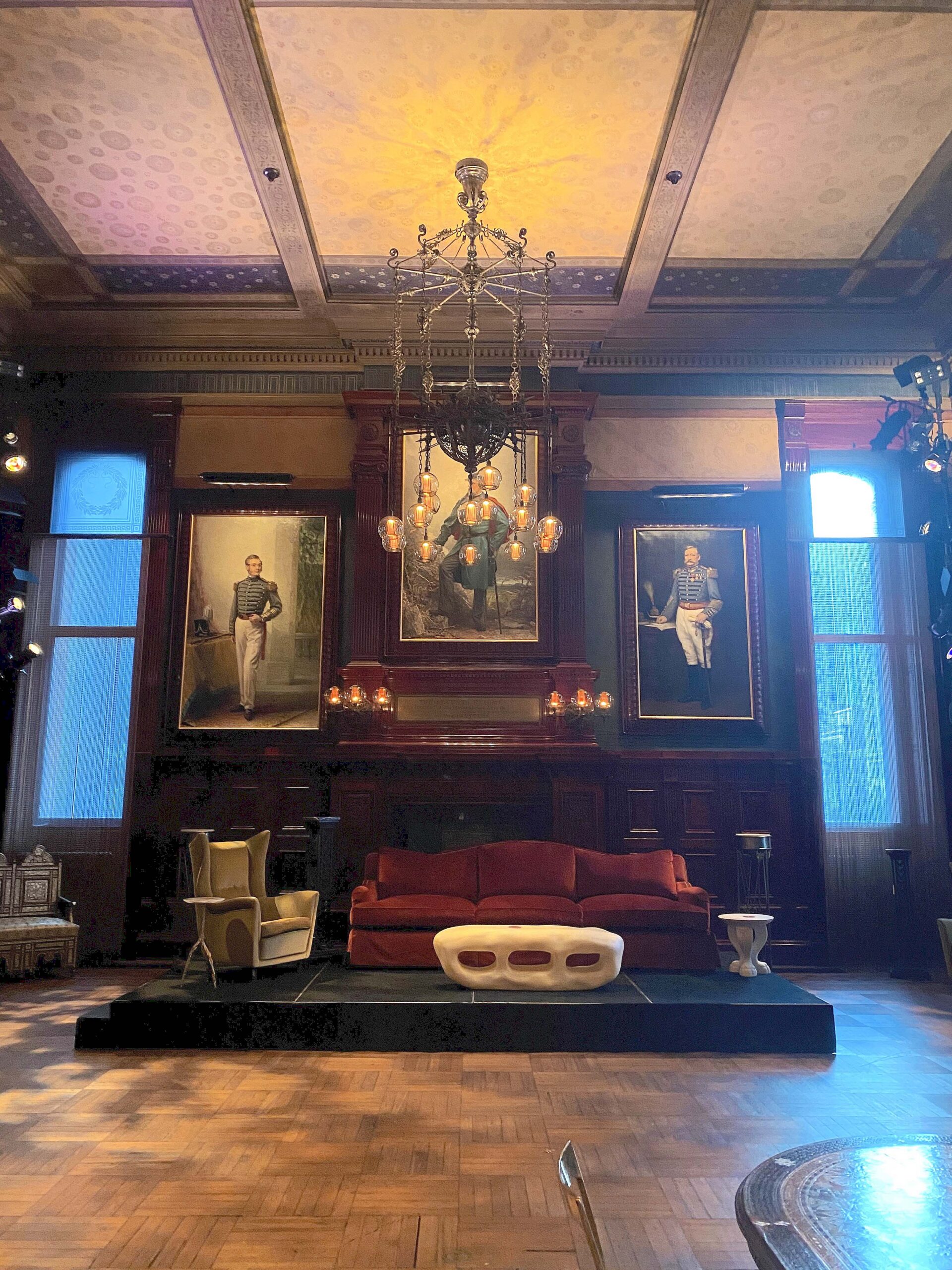
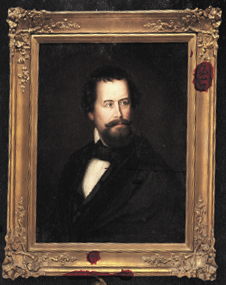
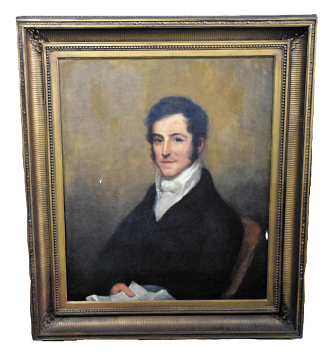
Though the majority of Salon exhibitors deal in contemporary art and decorative arts, galleries like Colnaghi and Carlo Bella delivered antique pieces amongst the custom furnishings of Studio Valle de Valle, all based in New York City. One of their gems was James Hamilton Shegogue’s resplendent 1840 portrait of Edward Seguin. A celebrated English opera singer who emigrated to North America, Seguin formed a troupe of singers that traveled across the continent to perform their repertoire. He was particularly renowned in Montreal, where he was formally received by the Huron-Wendat Nation at Jeune-Lorette near Quebec City and recognized with an honorary chiefdom. This was not a casual bestowal but a gesture of diplomatic respect for an important non-Indigenous cultural icon. Despite his theatrical career, Seguin’s traditional attire in the portrait was not a costume, but garments he was entitled to wear as a Huron-Wendat chief.

This portrait of Edward Seguin, also known as “Wach-n-wachn,” meaning “The Great Diver,” was commissioned in celebration of his honorary chiefdom from the Huron-Wendat Nation in 1840. Colnaghi and Carlo Bella, New York City.
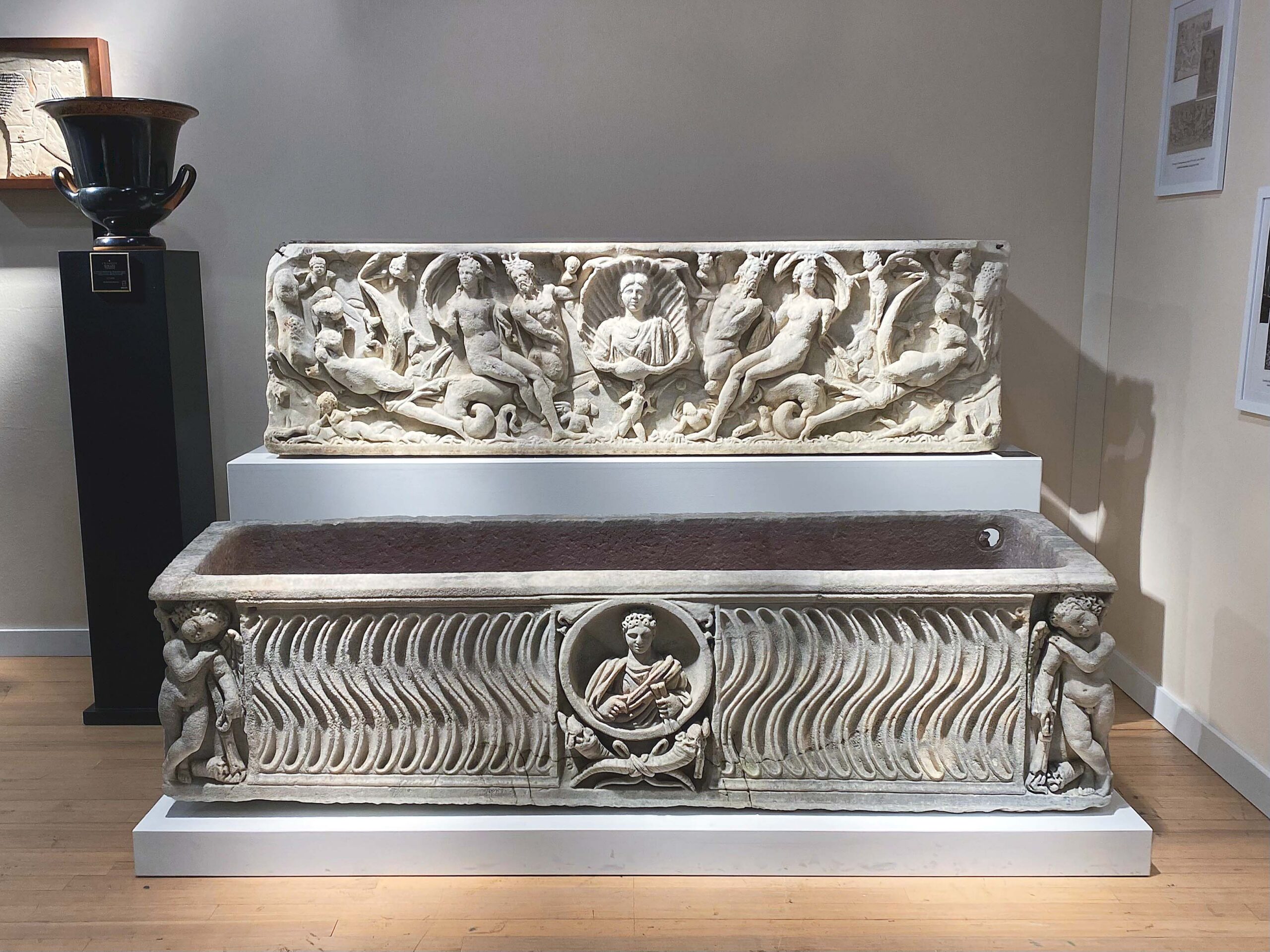
Even the most cutting edge of fairs sometimes host surprises from eras long past. Phoenix Ancient Art, New York City and Geneva, was one of a few antiquities dealers at Salon. In their booth was an artifact that would shock Bostonian customers before they read its description. Heiress and art collector Isabella Stewart Gardner stated in her will that the contents of her Fenway Court mansion could not be sold, moved or rearranged in any way. Should this happen, the entire collection would be donated to Harvard College. How then, did a Roman strigilated sarcophagus, circa 300-400 CE, once belonging to Gardner arrive in Phoenix’s booth? Gallery director Alexander Gherardi explained that this object was not from Fenway Court, but from another residence in nearby Brookline, Mass. The bust likely once depicted a man but was recarved to represent a woman, which might have been a deciding detail that solidified its acquisition into “Mrs Jack’s” collection.
Salon Art + Design at the Park Avenue Armory occurs biannually. The date of the spring edition to be announced. For information, www.thesalonny.com.