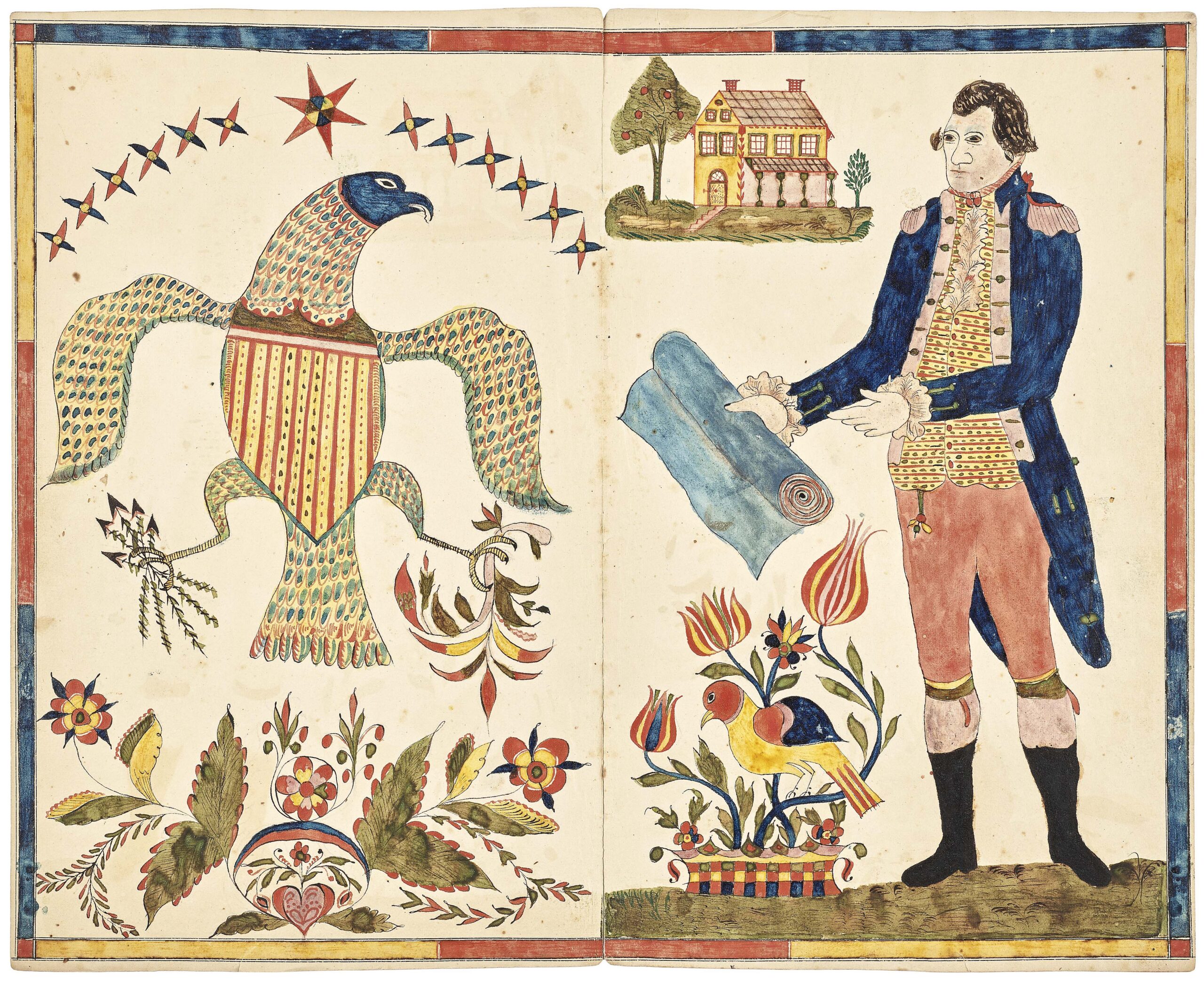
Tying for top-lot status was this Pennsylvania ink and watercolor patriotic double-page fraktur bookplate, attributed to Samuel Shultz, depicting George Washington holding a rolled document, probably the Declaration of Independence. Coming out of a collection where it had been for over 60 years, it attained $226,600 ($15/25,000).
Review by Andrea Valluzzo
DOWINGTOWN, PENN. — Collectors’ appetite for Americana showed no bounds at Pook & Pook Auctions’ fall Americana Auction October 1-2. With more than 800 lots, there was something for all tastes, from lavishly-decorated painted furniture to exuberant and colorful fraktur, as well as works by highly sought-after makers like Wilhelm Schimmel, Samuel Gottschall, William Matthew Prior and more. The auction was 97 percent sold and attained $2.84 million in sales across the two days, nearly $700,000 overs its high estimate.
“What an incredible two days!” quipped Jamie Shearer, vice president, appraiser and auctioneer. “The response to our October 1-2 Americana sale was nothing short of phenomenal. Collectors from across the country came ready to compete, and the energy and spirited bidding were evident from beginning to end. Great material, backed by aggressive marketing and presented to the right audience, produced exceptional results. This sale was a powerful reminder that when truly great Americana comes to market, collectors respond — and they respond enthusiastically.”
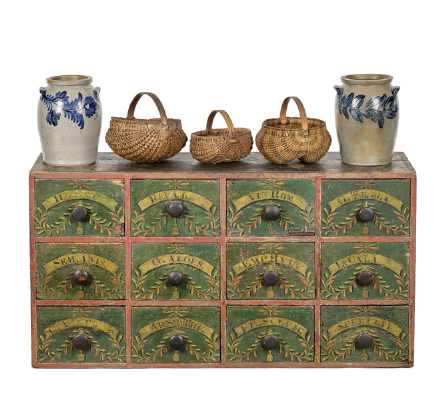
Kicking off the sale on a high note was the first lot across the block, a Johannes Mayer-signed Mahantongo Valley, Penn., paint-decorated chest of drawers, which went on to tie for top-lot status when it fetched $226,600, well over its $80/$120,000 estimate. Closely related chests can be found in the collections of the American Folk Art Museum and Winterthur.
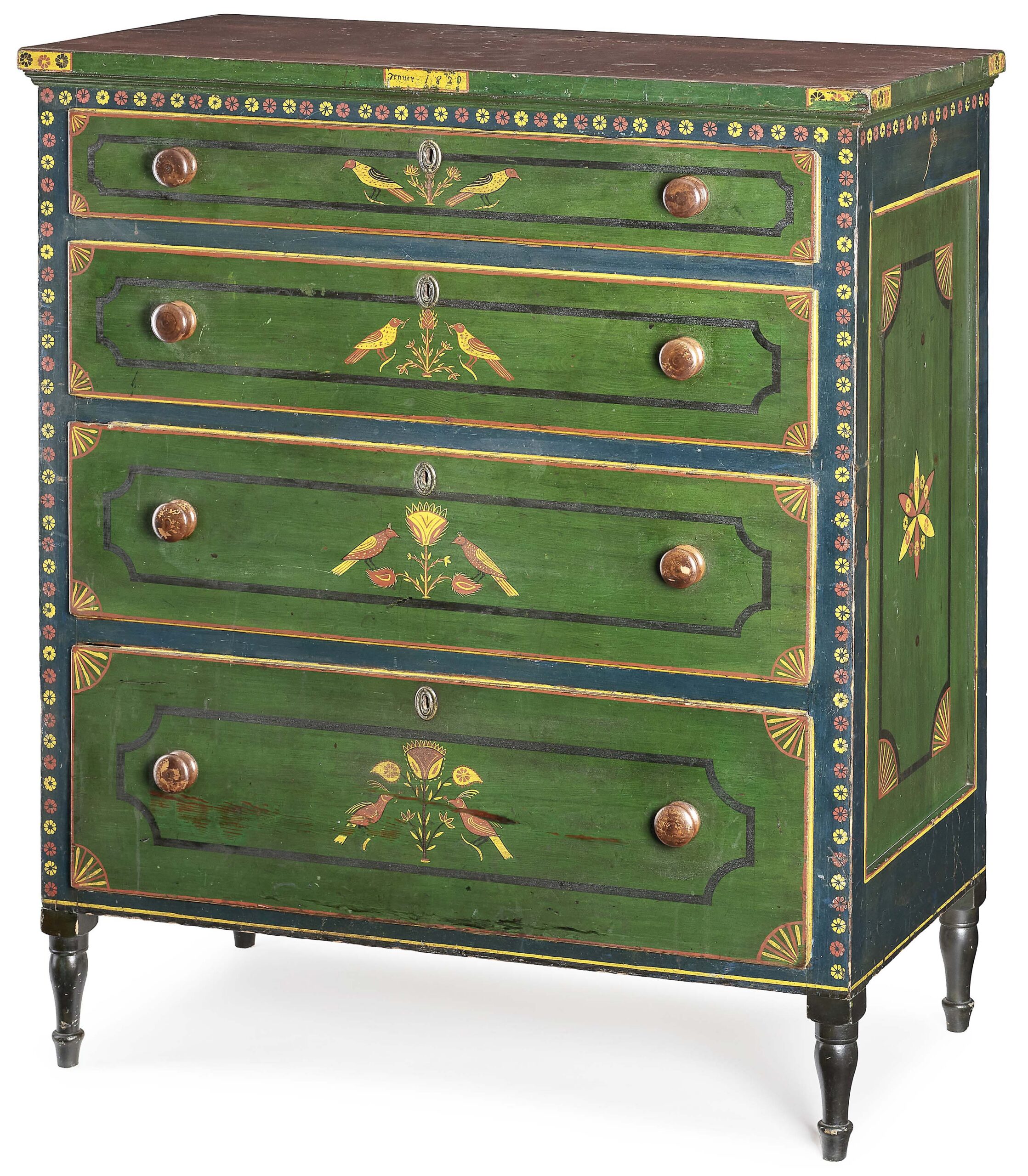
The first lot across the block went on to become one of the two top lots in the sale. This signed Johannes Mayer, Mahantongo Valley, Penn., paint-decorated chest of drawers realized $226,600 ($80/$120,000).
“This chest really had everything going for it,” Shearer declared. “Great Pennsylvania painted furniture is always highly sought after, but this chest offered something truly extraordinary… Twice signed by Johannes Mayer and dated January 1829, it is the only known signed and dated example from the Mahantongo Valley region. That documentation, combined with the remarkable paint decoration attributed to Isaac Stiehly, exceptional form and extreme rarity, created the kind of opportunity serious collectors recognize may not come again.”
“When an object checks that many boxes — rarity, surface, provenance, historical importance and visual appeal — the estimate can quickly become irrelevant. Multiple determined bidders understood exactly what they were looking at, and the price result reflects just how important this chest is within the field of Pennsylvania German painted furniture,” he added.
The bidding itself was particularly exciting. The chest ultimately sold for $226,600 to a relatively new Pook & Pook client bidding online, who was pushed all the way by a determined longtime collector who was understandably disappointed to come up one bid short, Shearer said.
Selling for the same price the next day, about halfway through the auction session, was a Pennsylvania ink and watercolor patriotic double-page fraktur bookplate that seriously outperformed its $15/25,000 estimate. The early Nineteenth Century piece, attributed to Samuel Shultz, depicted George Washington holding a rolled document, likely the Declaration of Independence.
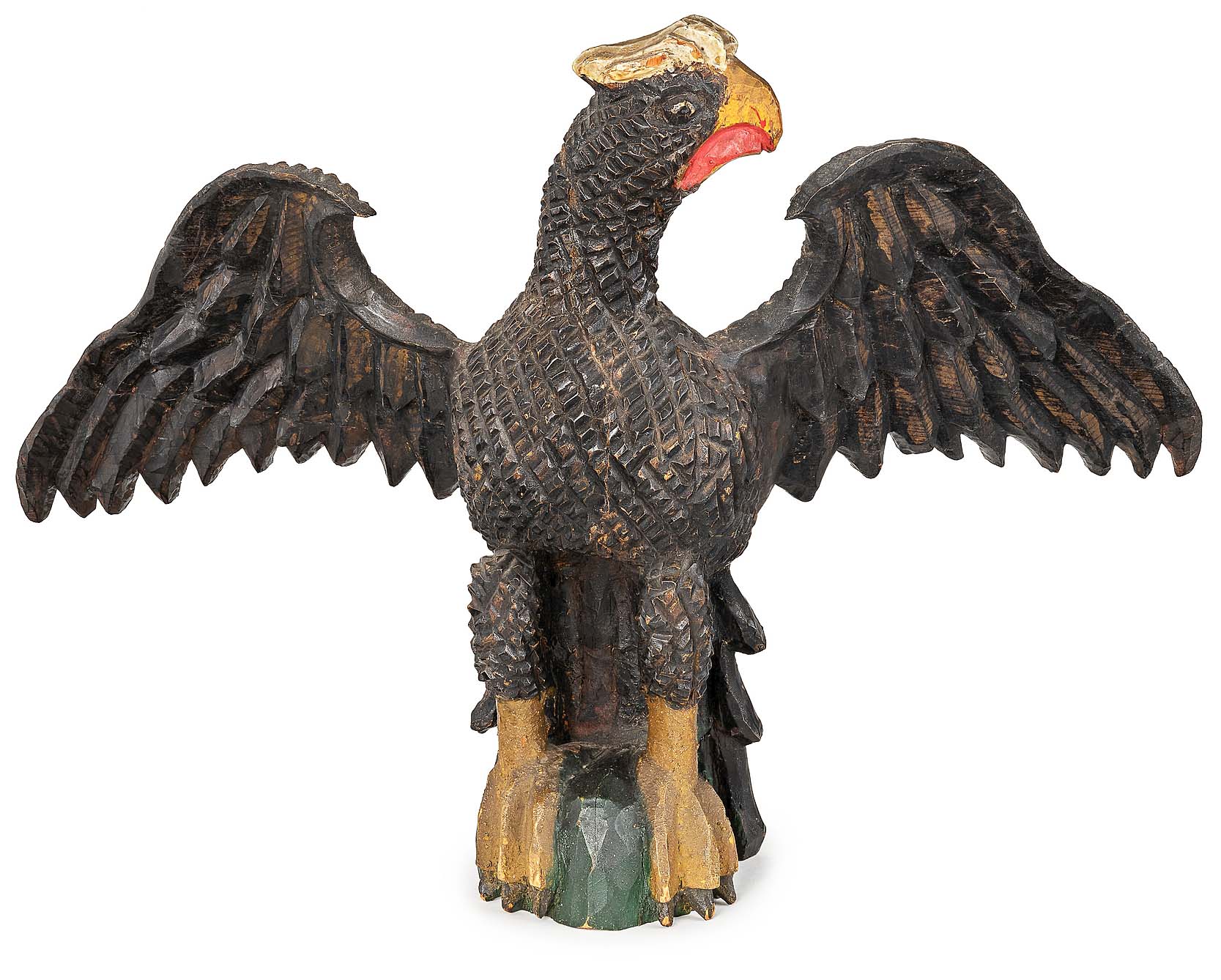
Two Wilhelm Schimmel large carved and painted spread wing eagles crossed the block. This pictured 14½-by-21-inch example brought $24,130, retaining its original black surface with white head feathers ($24/34,000), while the other eagle, a few inches smaller, brought $20,320 ($20/30,000).
“Some discoveries stop you in your tracks, and lot 606 [the fraktur] was one of those moments for me,” Shearer commented. “During my first visit to the consignor in Philadelphia, I knew there were some wonderful things in the collection. What I didn’t know was that I was about to open a simple manila folder and find something that would leave me completely speechless. I sat there for probably ten minutes just taking it all in — the vibrant colors, the imagery, the history and the remarkable state of preservation. I had goosebumps. After more than 40 years in this business, it takes something pretty special to create that kind of reaction.”
That same sense of discovery ultimately carried through to the auction room as the fraktur soared over its estimate. “The $226,600 result was extraordinary, but so was the object. I knew the moment I opened the folder that I was looking at something special. The bidders clearly felt the same way,” he shared. “Some things are simply meant to be remembered. Lot 606 — and the moment it was rediscovered — will certainly be one of them.”
This fraktur brought together some of the most compelling imagery found in early Pennsylvania German folk art. George Washington, holding a rolled document likely representing the Declaration of Independence, faced a spread-wing American eagle beneath an arch of 13 stars, he explained. “Add the homestead, tulips, bird, heart and wonderfully vibrant decoration, and you have a work that is not only historically significant but visually extraordinary.”
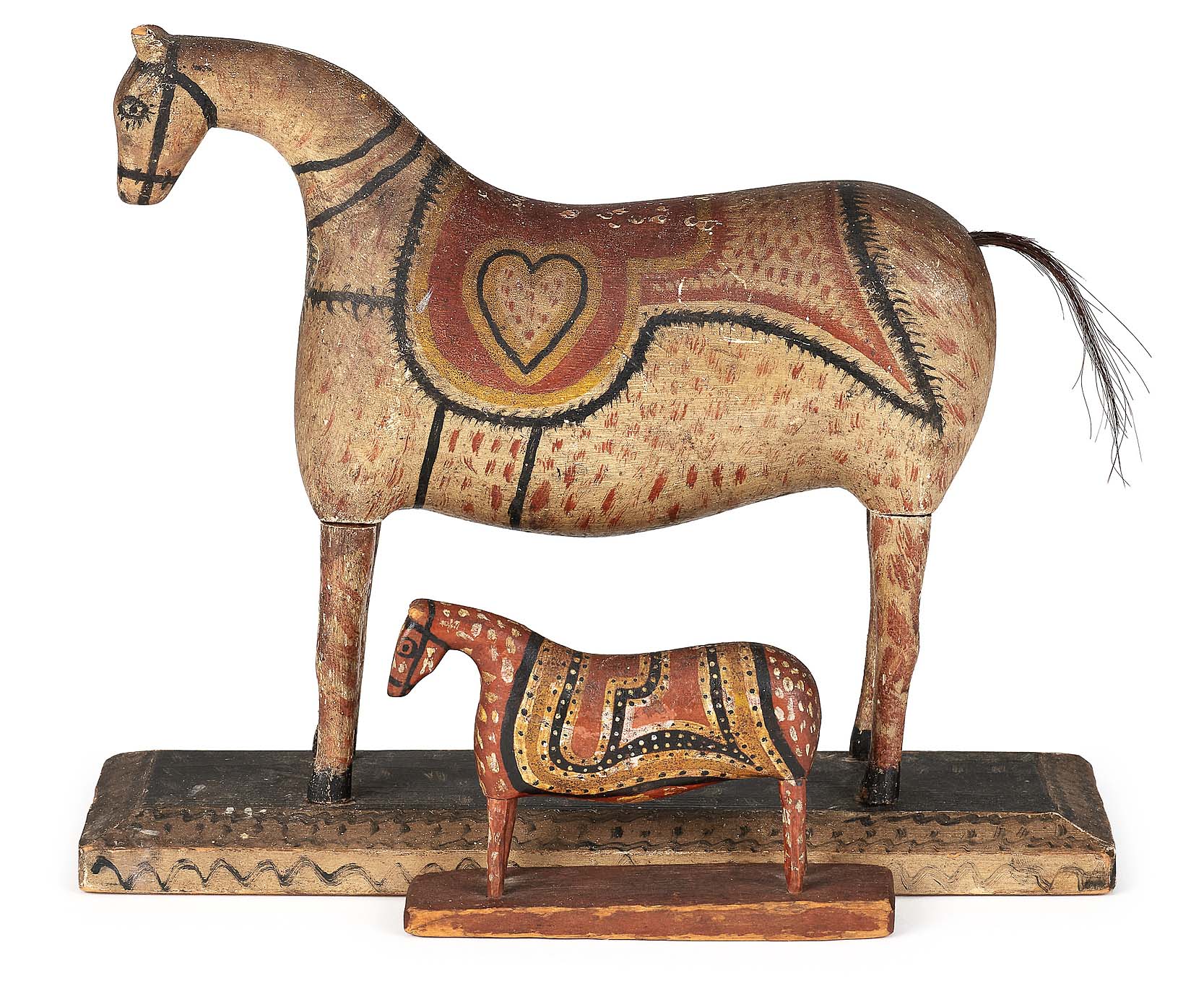
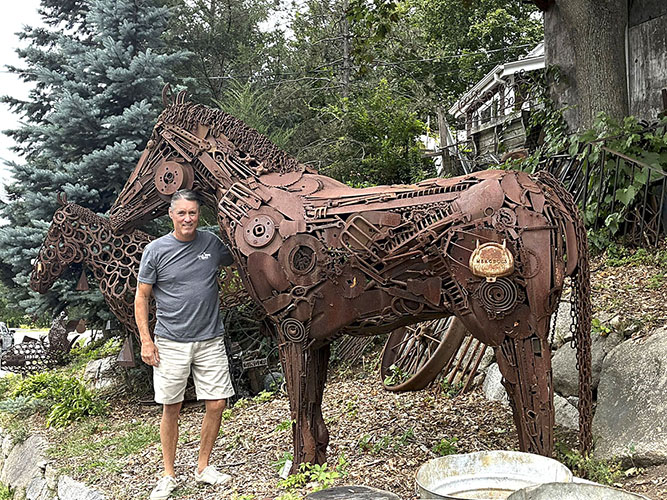
Regional standouts included this pair of carved and polychrome painted horses by George Robert Lawton, Sr, having speckled hides and the larger with a heart-decorated saddle, which brought $53,340 ($12/18,000).
Then there was the provenance. The fraktur came from the William Penn Shop, part of a Philadelphia and Reading, Penn., antiques-dealing family whose roots date to 1892. It had descended through generations of that family and remained off the market and essentially unseen by the public for more than 60 years. Collectors weren’t offered something that had recirculated through the marketplace again and again — they had the opportunity to compete for a genuine rediscovery.
“That combination of rarity, artistry, patriotic imagery, remarkable condition, provenance and absolute freshness to the market is almost impossible to duplicate,” Shearer explained. “When several serious collectors recognize that they may never have another opportunity to own something comparable, estimates and previous auction records can quickly become secondary.”
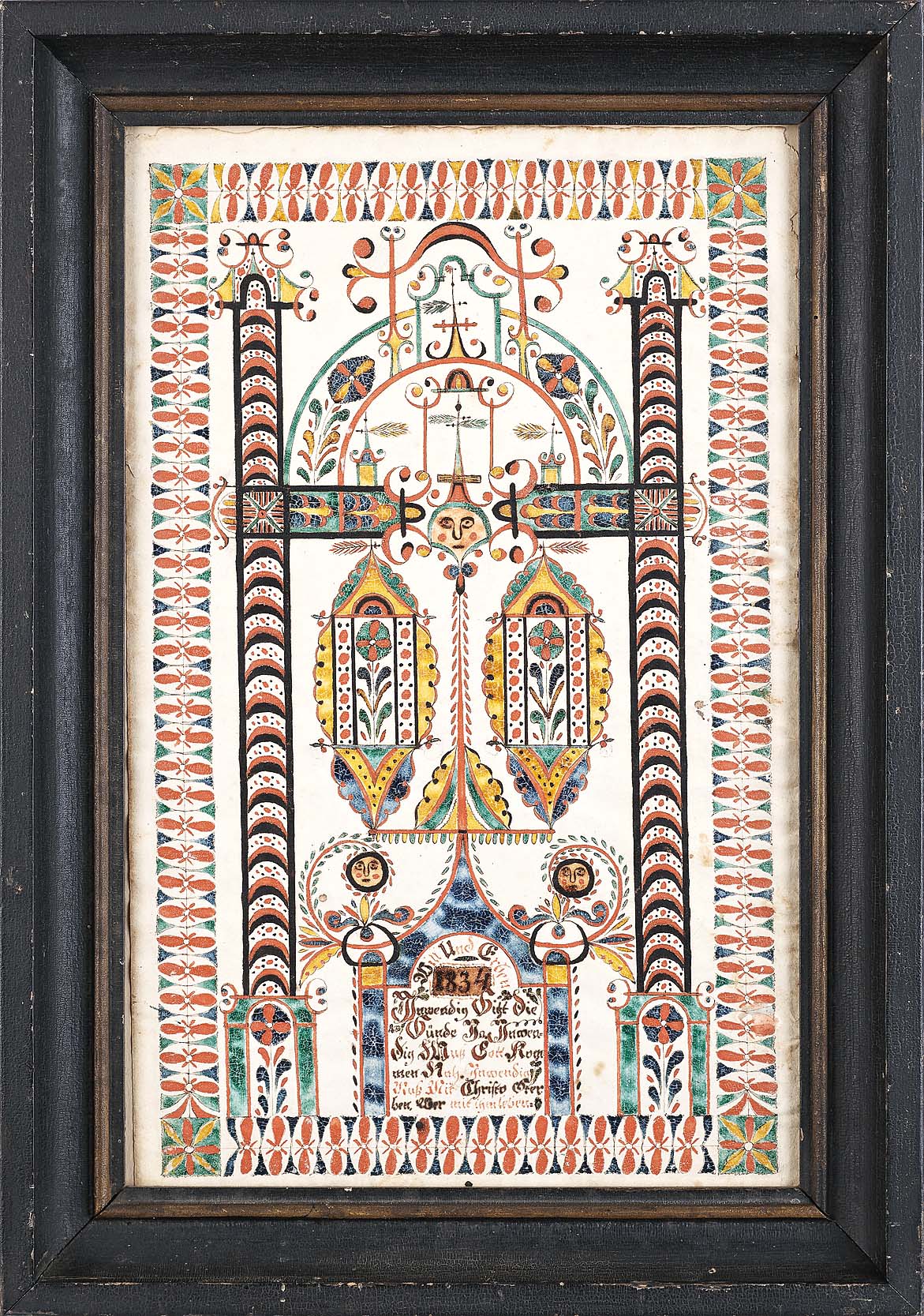
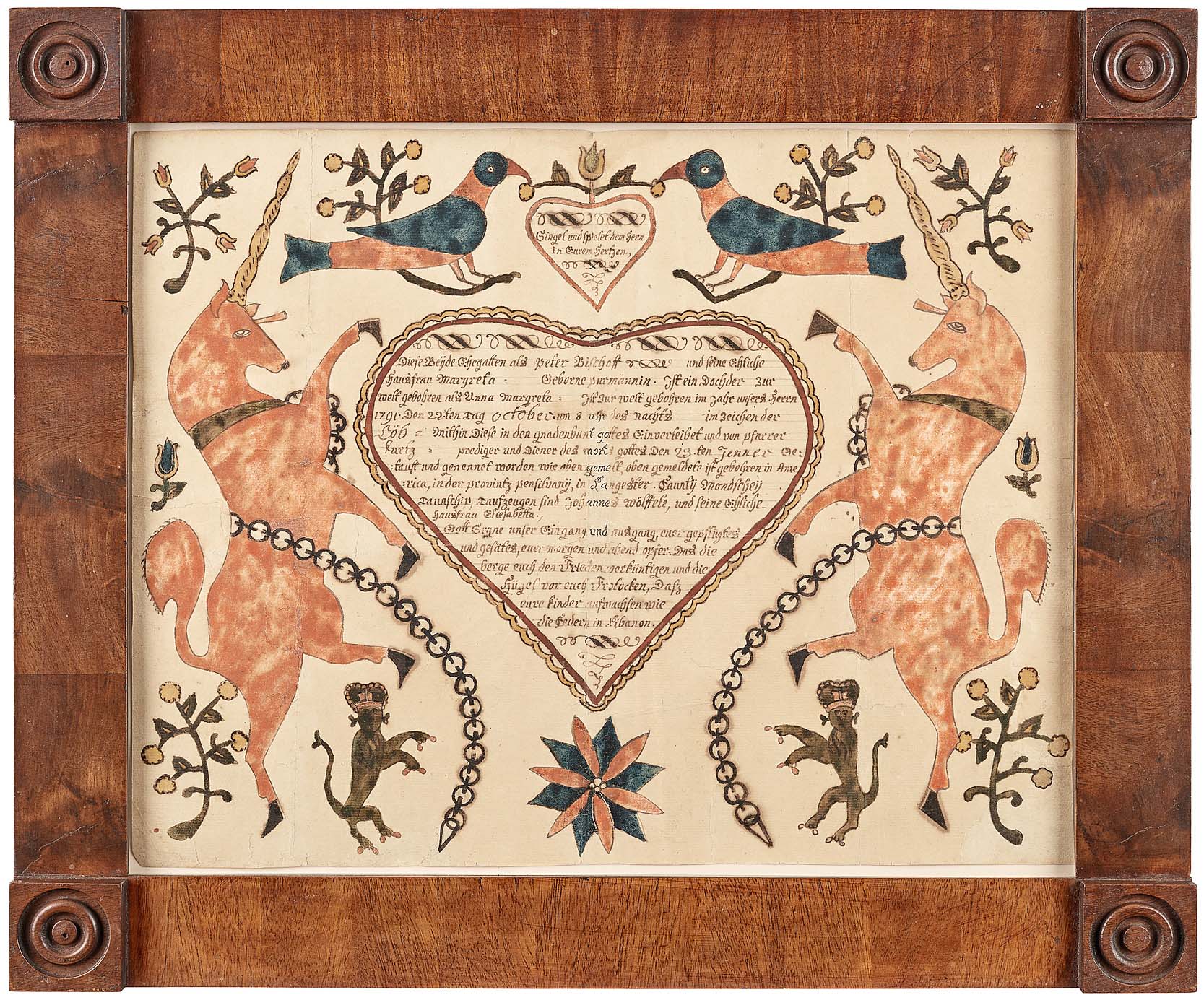
The fraktur ultimately sold through the trade bidding on behalf of a private client, with a museum bidding online as the determined underbidder. “The strength of the fraktur market was evident throughout the sale and certainly wasn’t limited to the extraordinary $226,600 result,” he said. “Another notable result came when a rare 1834 ink and watercolor fraktur by Samuel Gottschall of Montgomery County, Penn., soared to $101,600.
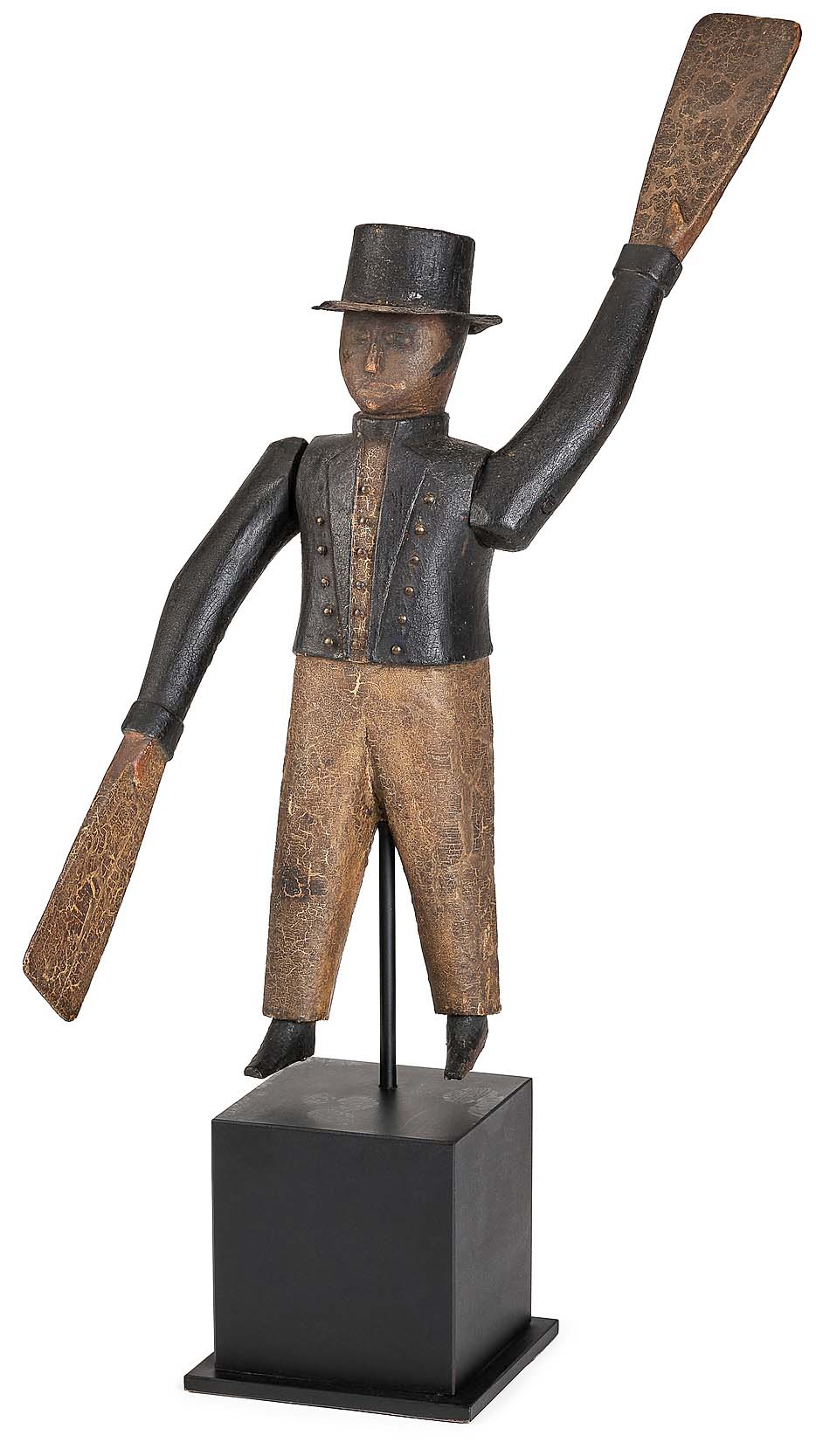
Pennsylvania material is of course always highly desirable with Pook & Pook bidders, but standouts from other regions included a lot of two carved and painted pine horses, retaining their original polychrome, by George Robert Lawton, Sr (Rhode Island) that made $53,340, as well as a New England carved and painted sailor whirligig that sold for $43,180.
Prices quoted include the buyer’s premium as reported by the auction house. Pook & Pook’s next cataloged auction of Americana will be January 20. For information, www.pookandpook.com or 610-269-4040.