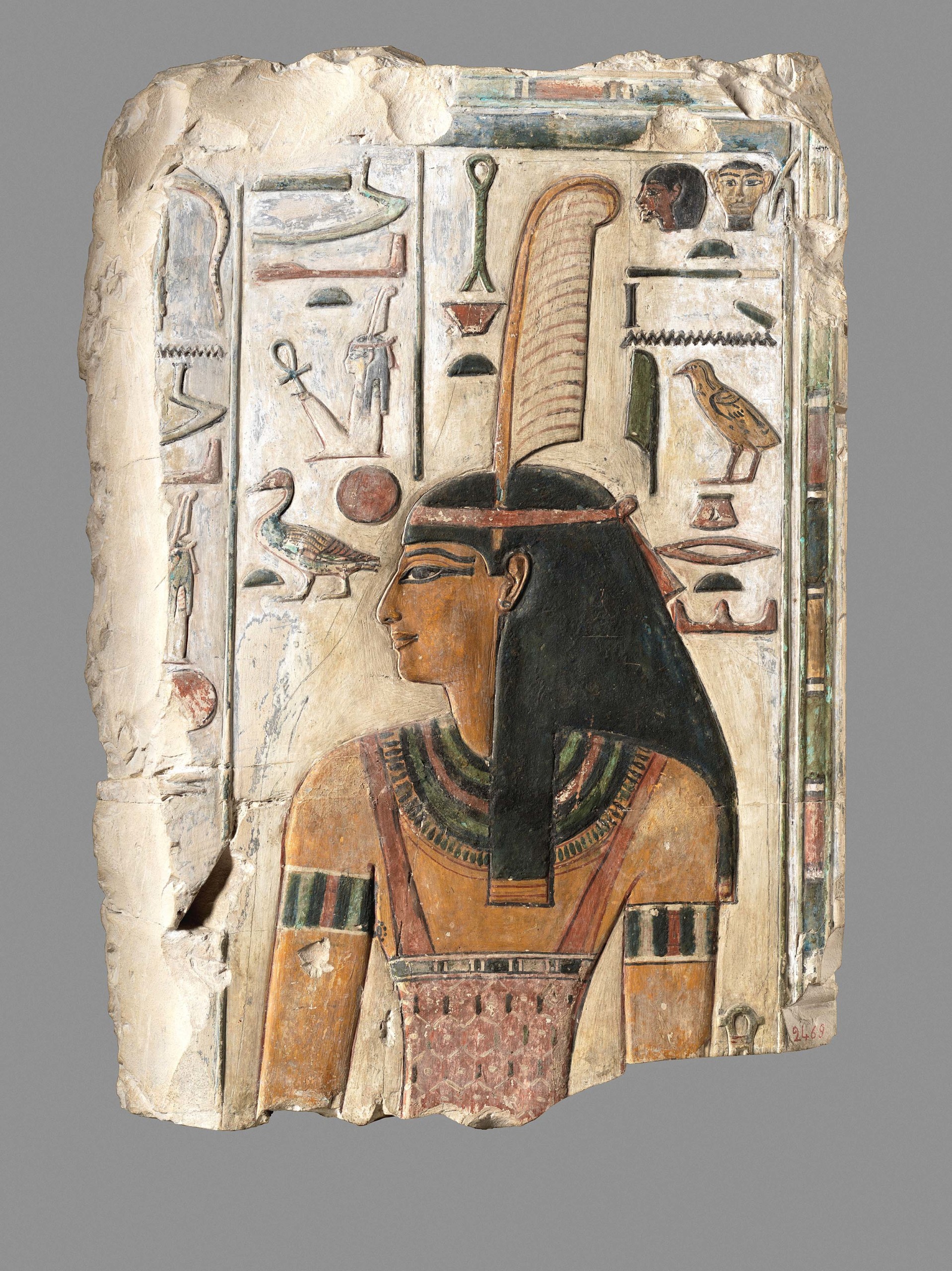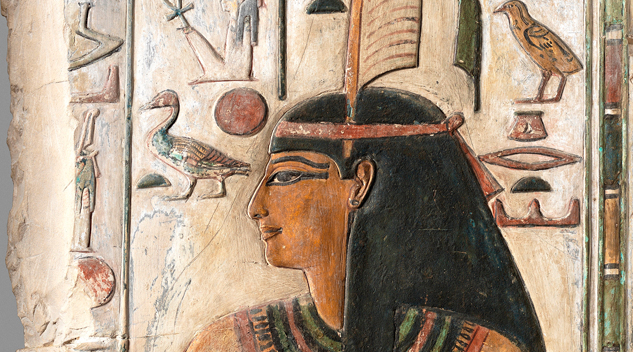
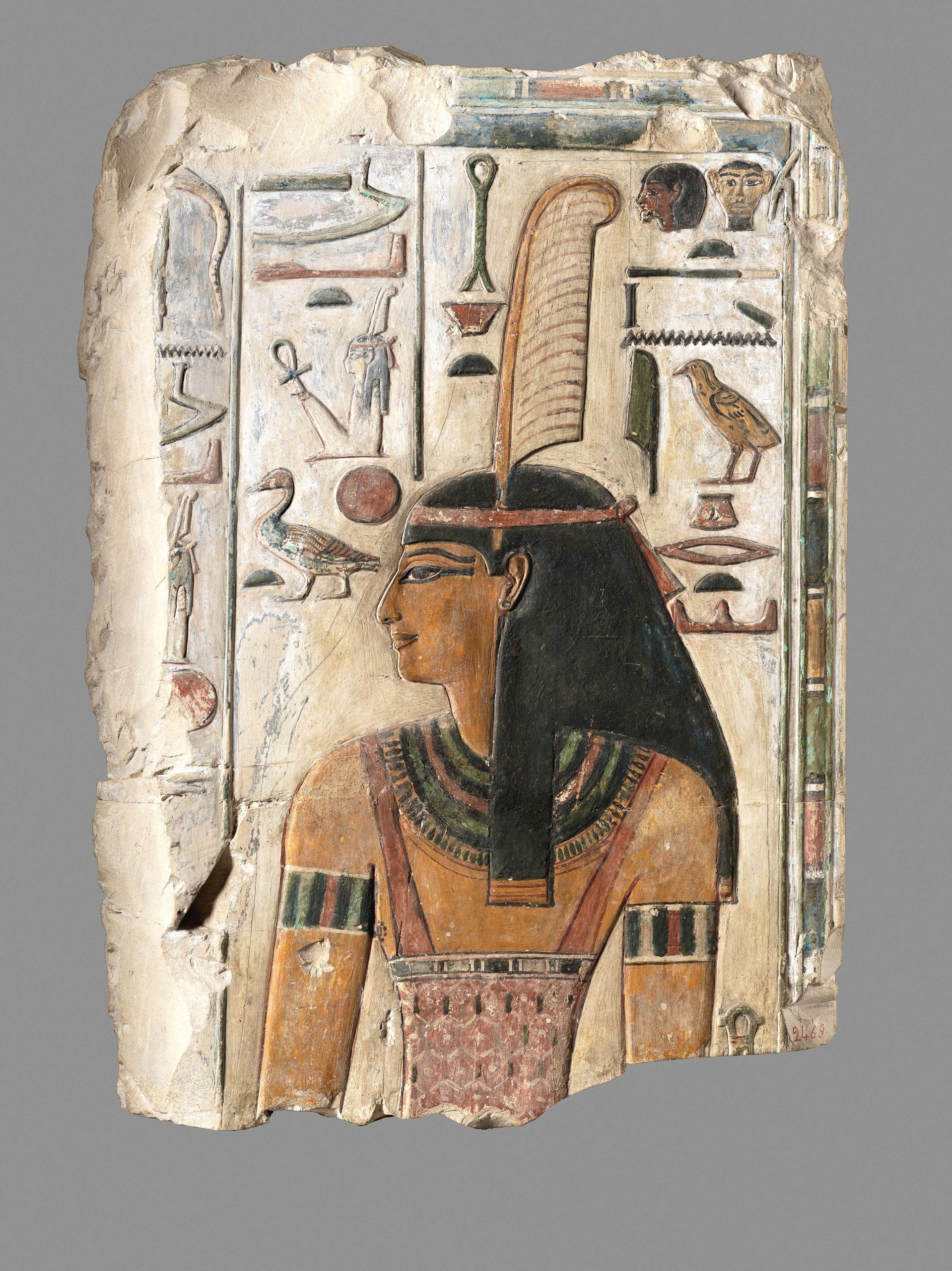
Relief of the Goddess Maat, circa 1294-1279 BCE, stone, limestone, paint. Museo Archeologico Nazionale di Firenze, Florence (2469). Photo by Anna-Marie Kellen. © The Metropolitan Museum of Art.
By James D. Balestrieri
NEW YORK CITY — There is typically some sort of parity between the scope of the artifacts and the historical record in ancient cultures. It is not at all unusual for the traces of once-thriving cultures that had been assimilated into others to be reduced to scattered objects and inscriptions in languages we have yet to decipher. In a recent piece in these pages, for example, I had occasion to examine Ancient Thrace. I quickly learned that as a culture in the shadow of powerful Greece, the pulse of Thrace oscillated between vassal state and rebellious colony. Rarely did Thrace get a breath to develop its own identity.
This is not the case with “Ancient Egypt.” Artifacts of dynastic Egypt range from pyramids to fragments of papyrus. The iconography of the culture, at least since excavations began, some hundreds of years ago, has entered the global sphere. So much so, in fact, that visual style turns and returns to “Egyptian Revival” every 20 years or so, about as often as Hollywood decides that it’s time once again to make movies featuring mummies and they hit screens large and small like ancient, recurring curses. Lest we forget, in 1986, a song by The Bangles taught us to “Walk like an Egyptian.” We see hieroglyphs and sandstone passages in underground temples, watch heroes in white tunics fight animal-headed gods and monsters while they woo slender women in form-fitting gowns with arm cuffs and diadems adorned with asps and cobras — Cleopatra springs to mind — and somehow, we think we know Ancient Egypt.
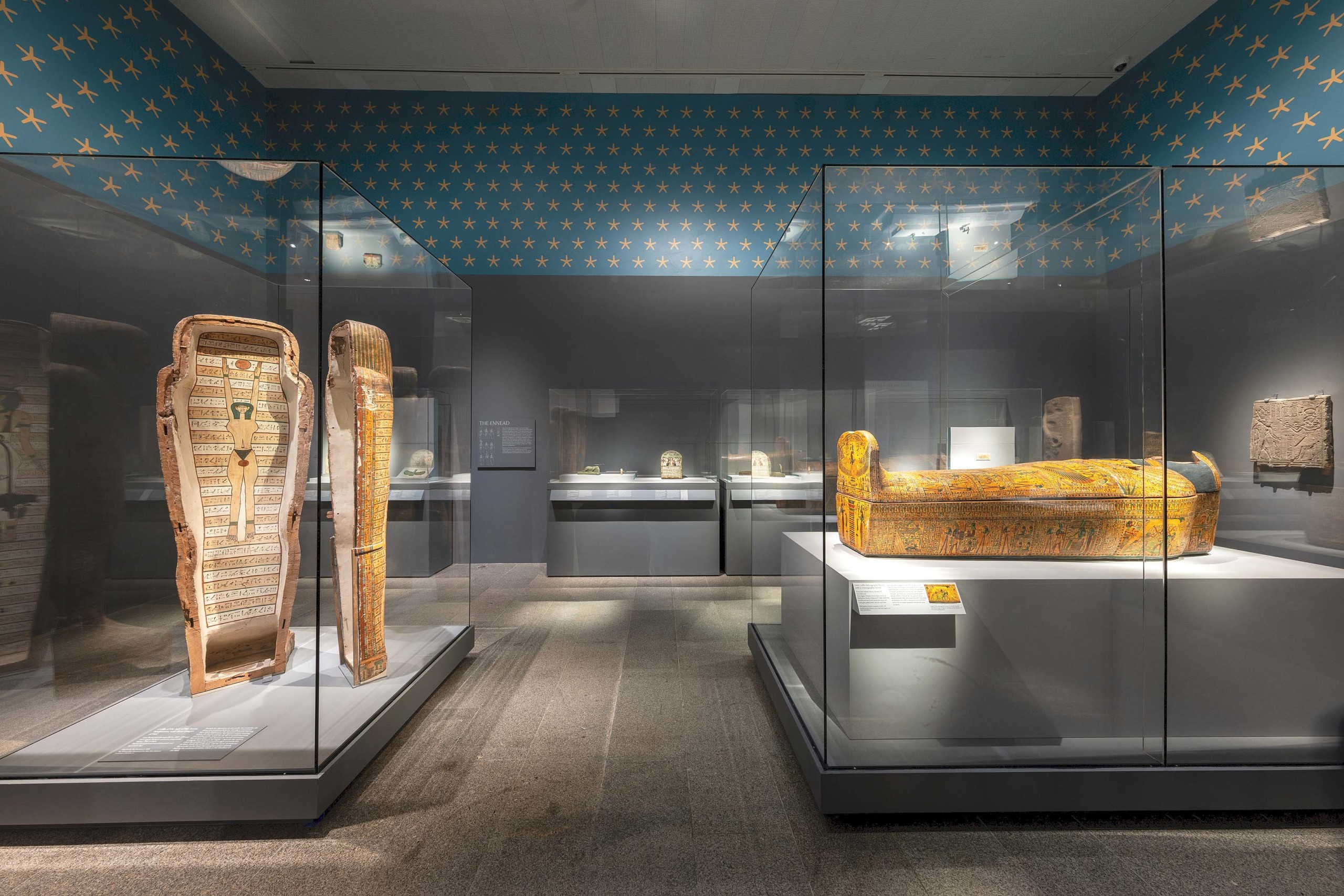
The first thing you learn as you move through “Divine Egypt,” the new exhibition at the Metropolitan Museum of Art, is just how little we know about dynastic Egypt, especially the vibrant, fluid, ever-evolving spiritual life of the people and culture that rose some 8,000 years ago and lasted for nearly 6,000 years, 3,000 of which are deemed Pharaonic. “Divine Egypt” is a survey of the vast material record of the pantheon of the gods of Egypt; it also offers a comprehensive look at what we know, we what surmise and what we don’t — and perhaps can’t ever — know about the relationship between belief and practice, between the abstract ideas behind Egyptian cosmology and the rituals of daily life. Serving as a survey of the proliferation of gods, it also sketches the state of play in Egyptian studies and does so in a comprehensive and lively manner.
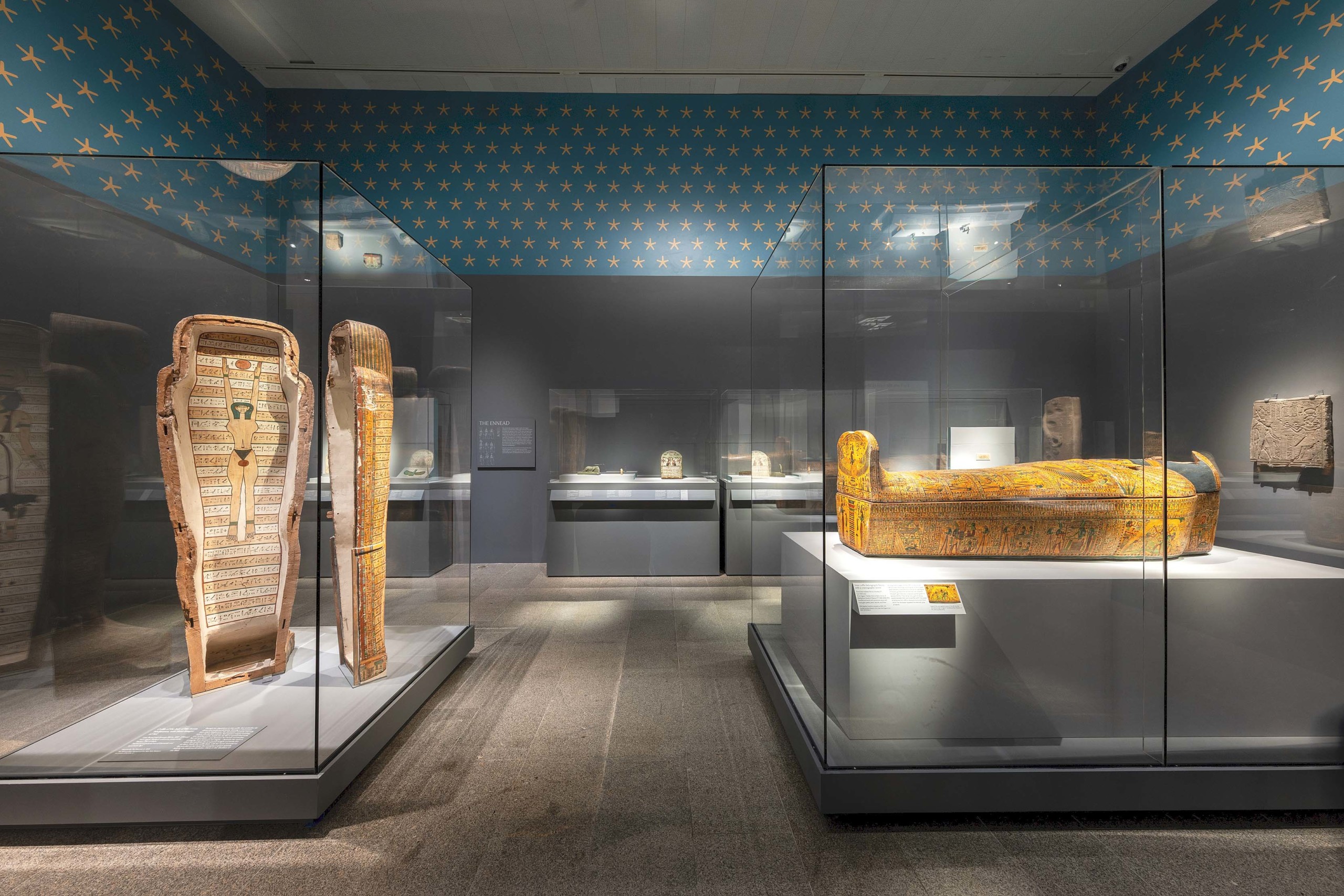
Installation view of “Divine Egypt,” on view until January 19 at The Metropolitan Museum of Art. Photo by Anna-Marie Kellen, courtesy of The Met.
For the Egyptians, gods often combined and shared attributes and forms; boundaries between this world and the next, between the natural and the supernatural, were porous. At times, it seems that the Egyptians adopted a pragmatic attitude towards the gods; at others, they seem to have kept the gods at an aloof, esoteric distance.
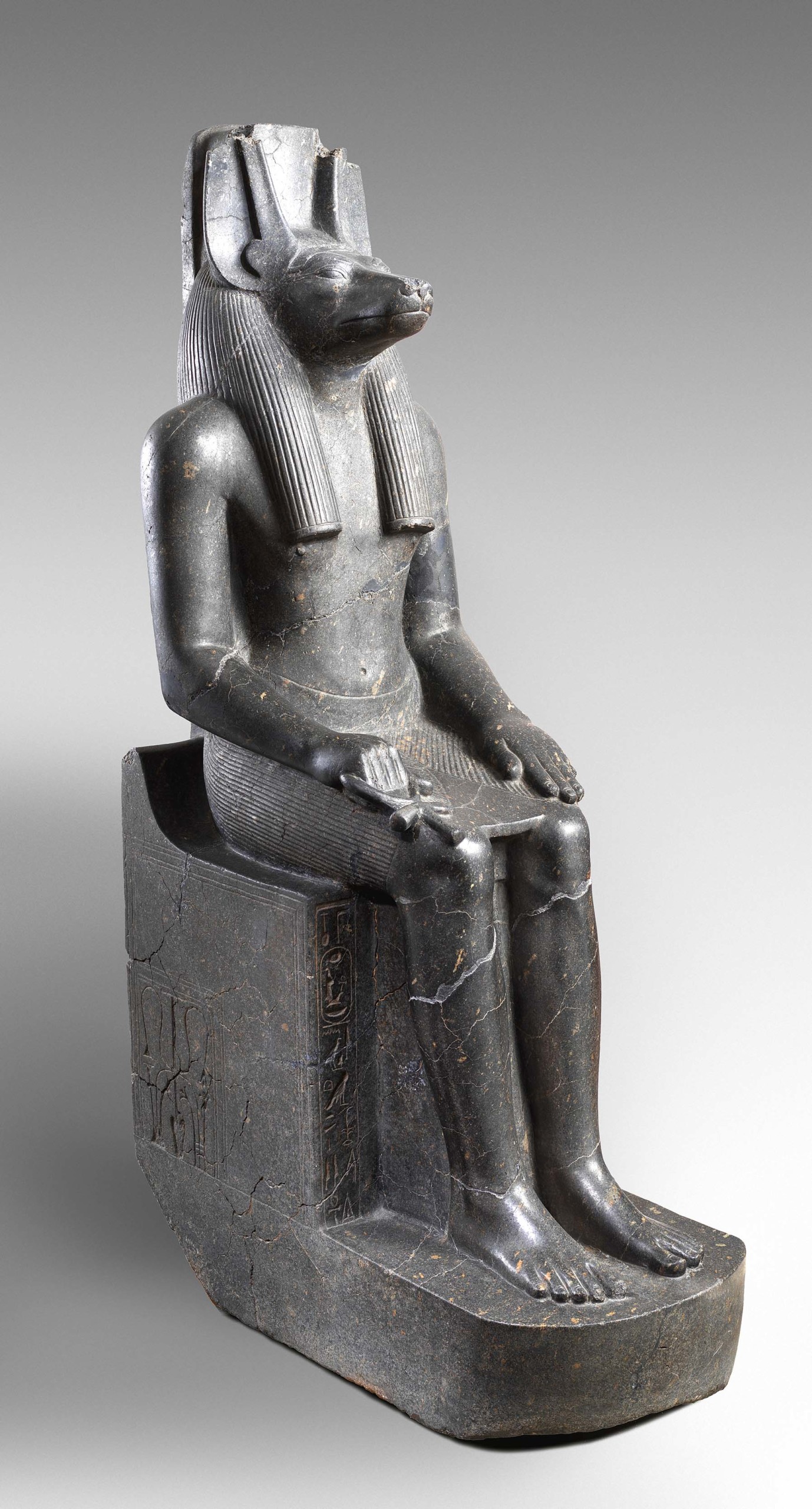
“Divine Egypt” is divided into five sections. “Expressing the Divine” discusses Hathor a Horus, a crucial goddess and god that nevertheless took numerous forms. “Ruling the Cosmos” centers on Re, the sun god — god of gods, but only in a way — as well as other deities, Maat, Thoth, Seth and Neit, who maintained order in the universe. “Creating the World” focuses on the Ennead, the first nine gods who comprise the Egyptian origin myth, as well as Ptah, Min, Khnum and Sobek, who contribute their own generative energies. “Coping with Life” shifts us from royalty “to the broader population, presenting gods who came to be integrated into people’s daily lives (such as Isis) and others (hippo goddesses and Bes-images) not initially found in the state temples.” Finally, “Overcoming Death” brings viewers to stories we know — dimly — from Hollywood’s dalliances with Ancient Egypt while offering some surprises from gods whose names we know, like Osiris and Anubis.
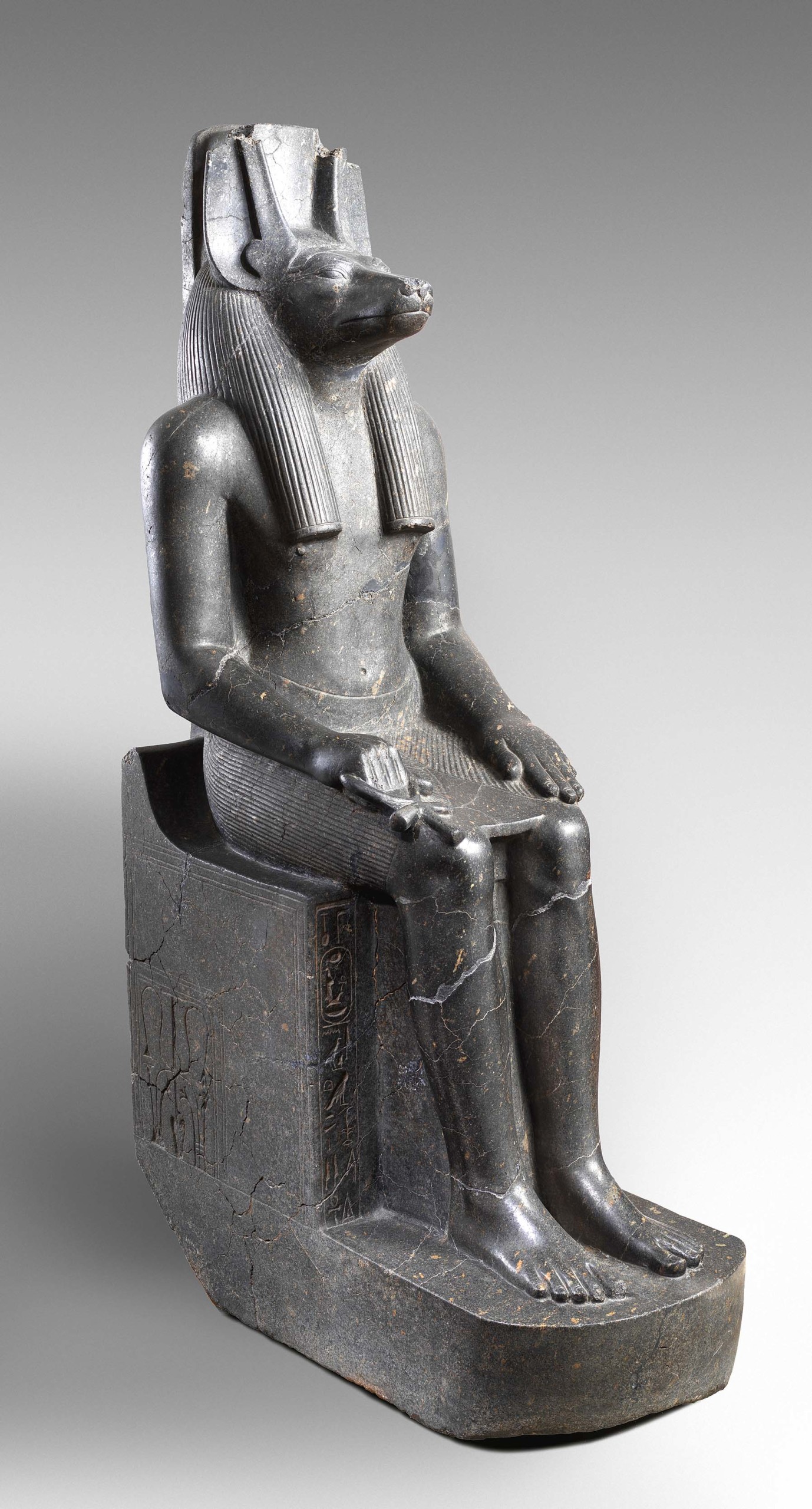
Statue of Anubis, circa 1390-1352 BCE, diorite. Ny Carlsberg Glyptotek, Copenhagen (ÆIN 33). Photo by Anna-Marie Kellen. © The Metropolitan Museum of Art.
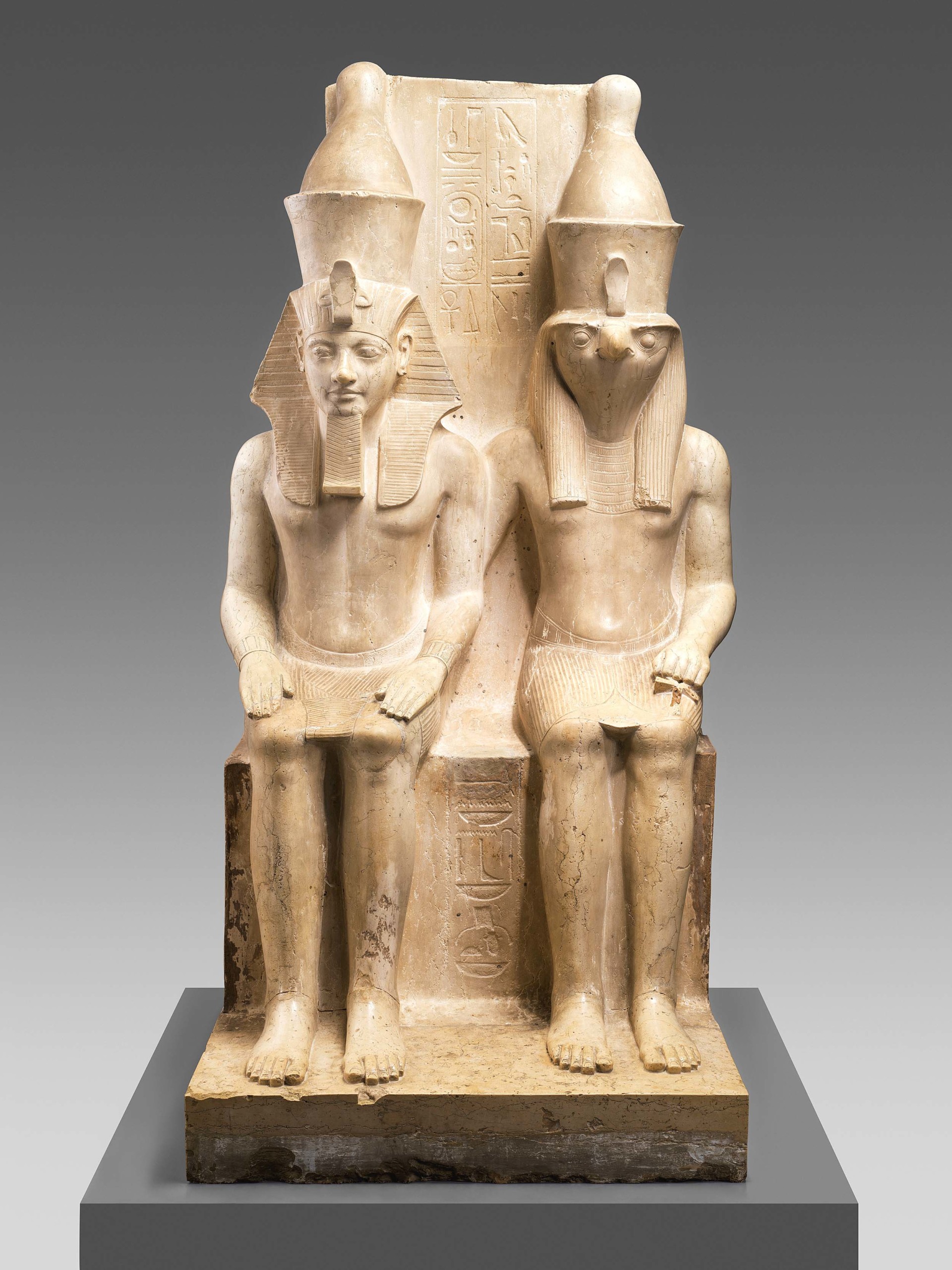
Because the afterlife, in general, was seen as a congenial version of this life, lived in an elsewhere of sorts, the deceased, especially members of the aristocratic families, required all sorts of items, luggage for their travels, as it were, as well as foodstuffs for the journey and the life beyond. In the many temples that arose across Egypt, the gods themselves required likenesses in stone, gold and lapis lazuli. Religion, therefore, was a major industry in Pharaonic Egypt, keeping farmers and artisans busy year-round. Horus, as an example, began as a falcon god, a sky deity whose “role quickly expanded, however, to include kingship and the rule of Egypt during a mythical past.” In imagery, he appears as a falcon and, whenever he performs human tasks, as a falcon-headed man. Later, he materializes with a double crown, symbolizing a unified Egypt. Then, Horus is abstracted into first, a pair of eyes, then as a single eye, becoming one of the most recognizable of all Egyptian symbols and hieroglyphs. Even this, however, reflects part of the story of Horus, in which he contends for the throne of his father, Osiris, with Seth. At one point, Seth blinds Horus, though Horus’s eyes are eventually restored. The eye of Horus, then, emerges as an emblem of renewal, restoration and protection. Local versions of Horus also emerge, including Horus of Edfu, who is depicted as a winged sun disk with two flanking uraeus, cobras rearing to strike. The evolution and variety of Horus forms surely kept craftsmen across Egypt very busy, though, for us, profusion leads to confusion, or, as is true in most cases, an admission that we just don’t know what was meant by the myriad versions of Horus and the other Egyptian deities. To make things even more difficult, consider Seth, the antagonist of Horus, who is typically portrayed with the head of an animal that somewhat resembles a coyote with a slender drooping nose. In some stories, he murders Osiris and retreats to lord over the deserts when Horus defeats him; in others, he is portrayed as the ally of Horus in the fight to unite Egypt. Perhaps all gods in transactional religions are situational; perhaps every religion needs figures of ambiguity to exhibit the range of human frailty and liberality.
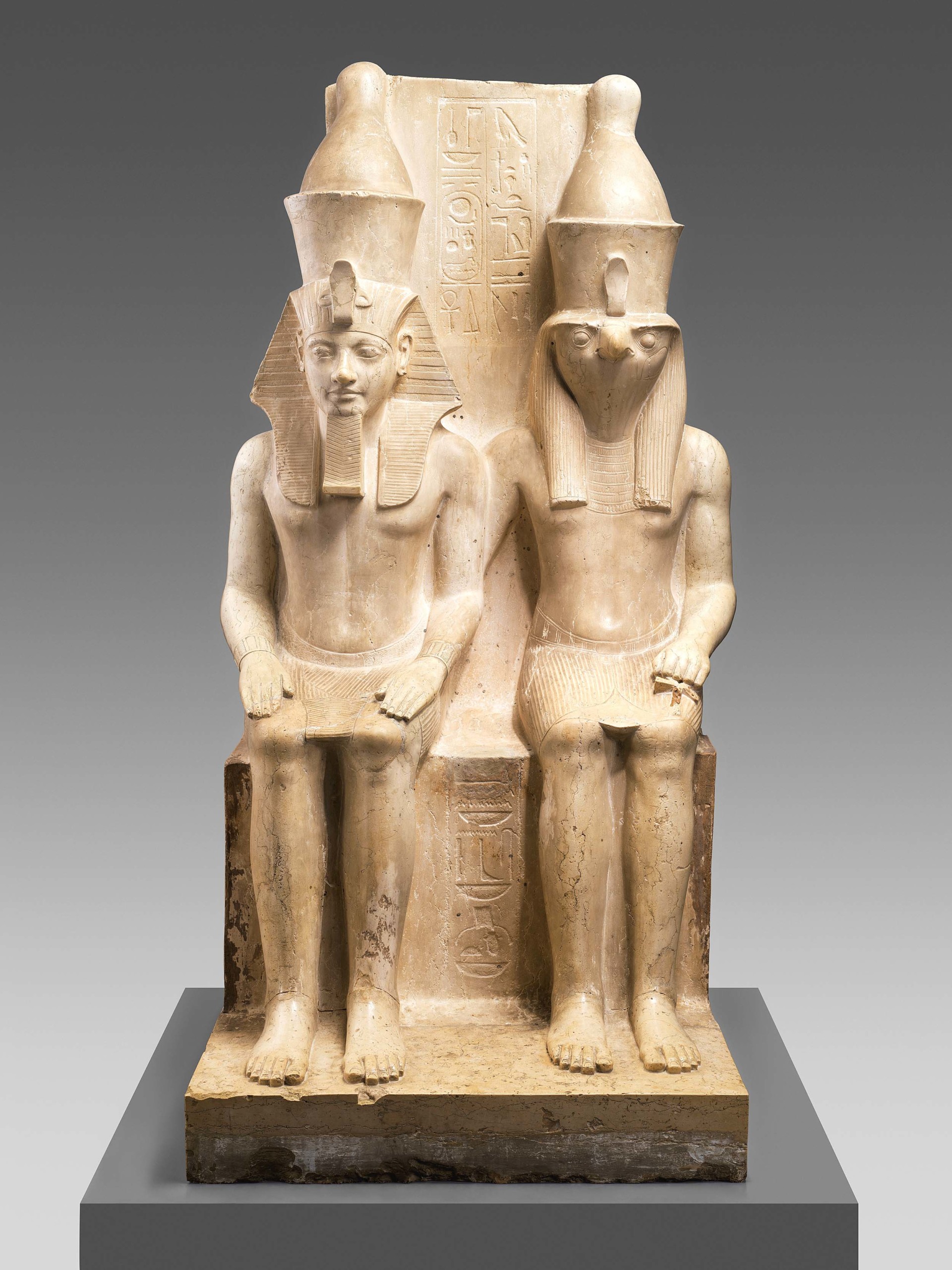
Statue group of the god Horus and the king Horemheb, circa 1323-1295 BCE, stone, limestone. Kunsthistorisches Museum, Vienna, Egyptian and Near Eastern Collection (AE INV 8301). Photo by Anna-Marie Kellen. © The Metropolitan Museum of Art.
The gods themselves required daily propitiation in temples devoted to them. Priests generally performed appropriate rituals thrice daily, often including full meals and offerings of food, especially the bread and beer that were the stuff and staff of Egyptian life. By the time of the mid-New Kingdom (circa 1300 BCE), processional boats with veiled and unveiled effigies of gods — that had long been part of festivals in the cities — began to be carried in portable boats through the towns and villages of Egypt. The practical side of this, of course, was that allowing access to a far greater number of people bound the people to the gods, and, by extension, to the kings who were their relatives and acted as their representatives in this plane of existence. Even the practice of “feeding the gods” had its practical aspect, as a text of Thutmose III attests: “after the . . . god is satisfied with his offering, a lot of offerings, supplied with everything . . . shall be issued to the lay priests of the temple of my father Amon in Karnak.”
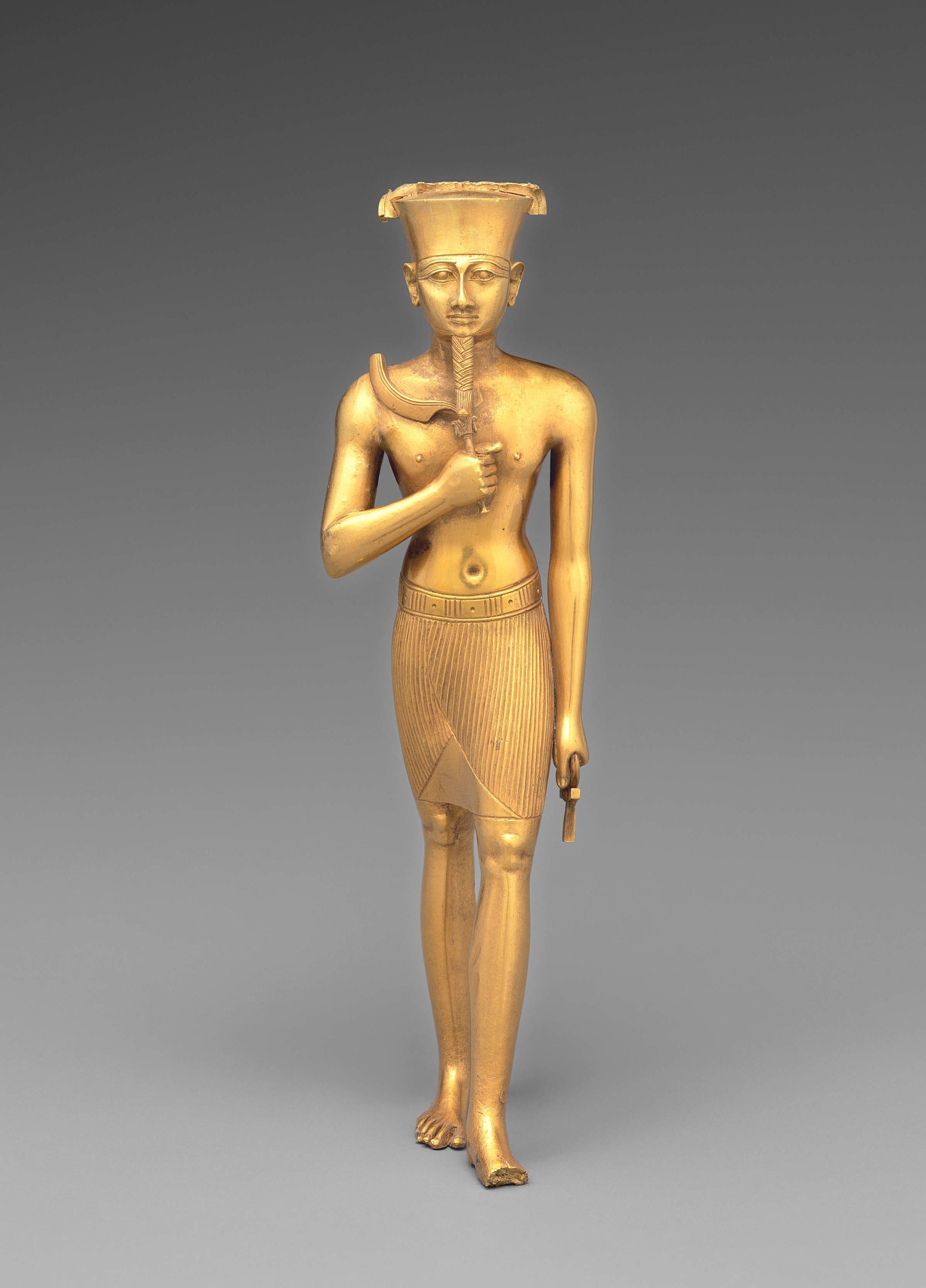
The scholarly catalog that accompanies the exhibition has, at its heart, a fine glossary of Egyptian iconography — one that ought to be shared with schools and prized by every armchair raider of lost arks. The section on crowns is of particular interest, as it goes to the core of the relationship between deity and kingship. The eight different styles in Egyptian art are distinct: the Red Crown, the White Crown, the White Crown with Two Curled Feathers, the Double Crown, the Tatenen Crown, the Atef Crown, the Hemhem Crown and the Amun Crown. Each is distinct from one another, but — and this is the salient fact — “The majority of identifiable divine images from this time depict divine beings in animal form, but as gods acquired human and hybrid shapes, royal regalia, including crowns, were assigned to deities whose manifestations overlapped with specific roles of the king, such as ruler of Upper or Lower Egypt.” In other words, a kind of crown developed as royal regalia; then, when it caught on, it was assigned to a deity whose identity matched some role or need of the king. This, dear reader, is as fine an example of practical power in action as anything you might find in Machiavelli.
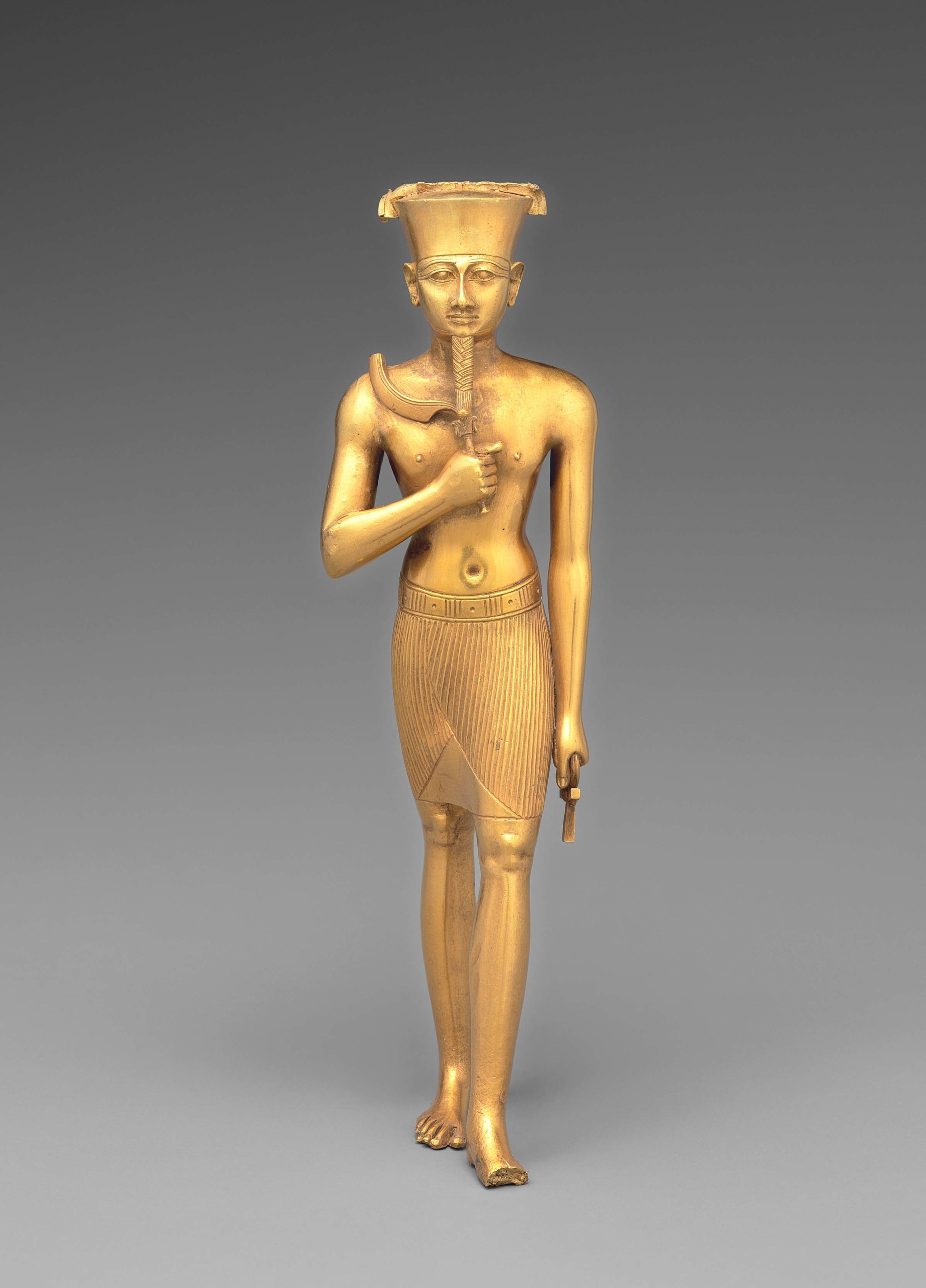
Statuette of Amun, circa 945-712 BCE, gold. The Metropolitan Museum of Art, New York City, Edward S. Harkness Gift, 1926 (26.7.1412). Photo by Anna-Marie Kellen. © The Metropolitan Museum of Art.
As far as esoteric gods go, no Egyptian deity is perhaps more unique and distant from our understanding than the goddess Maat, who stands, ostensibly, for order, and “right.” Despite this, the tenets of Maat were “seldom invoked when they might have been most expected. Egyptian kings, for example, quashed rebellions without framing them as threats to Maat, and they embarked on wars against Egypt’s enemies without casting them as agents of chaos or as bearers of isfet (injustice or wrongdoing), often mentioned as Maat’s antonym.” Maat, as we understand her, is very old, perhaps as old as the Egyptian notion of the cosmos itself. She carries the loop-headed cross, or ankh, symbolic of “life,” yet does not often intervene in the affairs of the world. An Egyptian king must possess the qualities of Maat but must also protect Maat. The sun god, Re, is said to feed on Maat. With her image reduced to the feather she commonly wears in her hair, she seems to embody truth, especially spoken truth, as an abstract philosophical principle rather than as a full-fledged god.
It’s precisely because we know so little that Ancient Egypt has taken up so much room in the imagery of our minds. We start with mummies and the golden mask of the young King Tut, head to Antony and Cleopatra, take a detour into Moses and Exodus and project back from there, assuming an unchanging, monolithic culture characterized by pyramids whose presence leaves us in awe and whose construction still somewhat baffles us. The profusion of objects and the copies of copies of copies they have inspired make these assumptions even easier. What these objects meant to the Egyptians, however, is another matter. Dazzling treasures with hazy or absent meanings are blank papyri, ripe for the misunderstandings of appropriation. If “Divine Egypt” can redress even some of this, peeling back our prevailing myths about Ancient Egypt and revealing the truths of Ancient Egyptian spirituality, it will be an unqualified success. One hopes it will lead to other, similar investigations down the road.
“Divine Egypt” is on view at the Metropolitan Museum of Art, 1000 Fifth Avenue, through January 19. For more information, www.metmuseum.org or 212-535-7710.