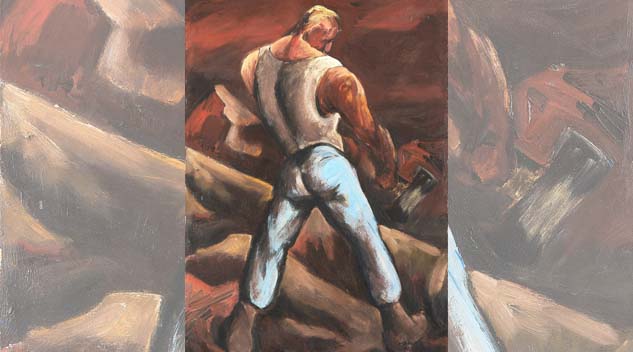
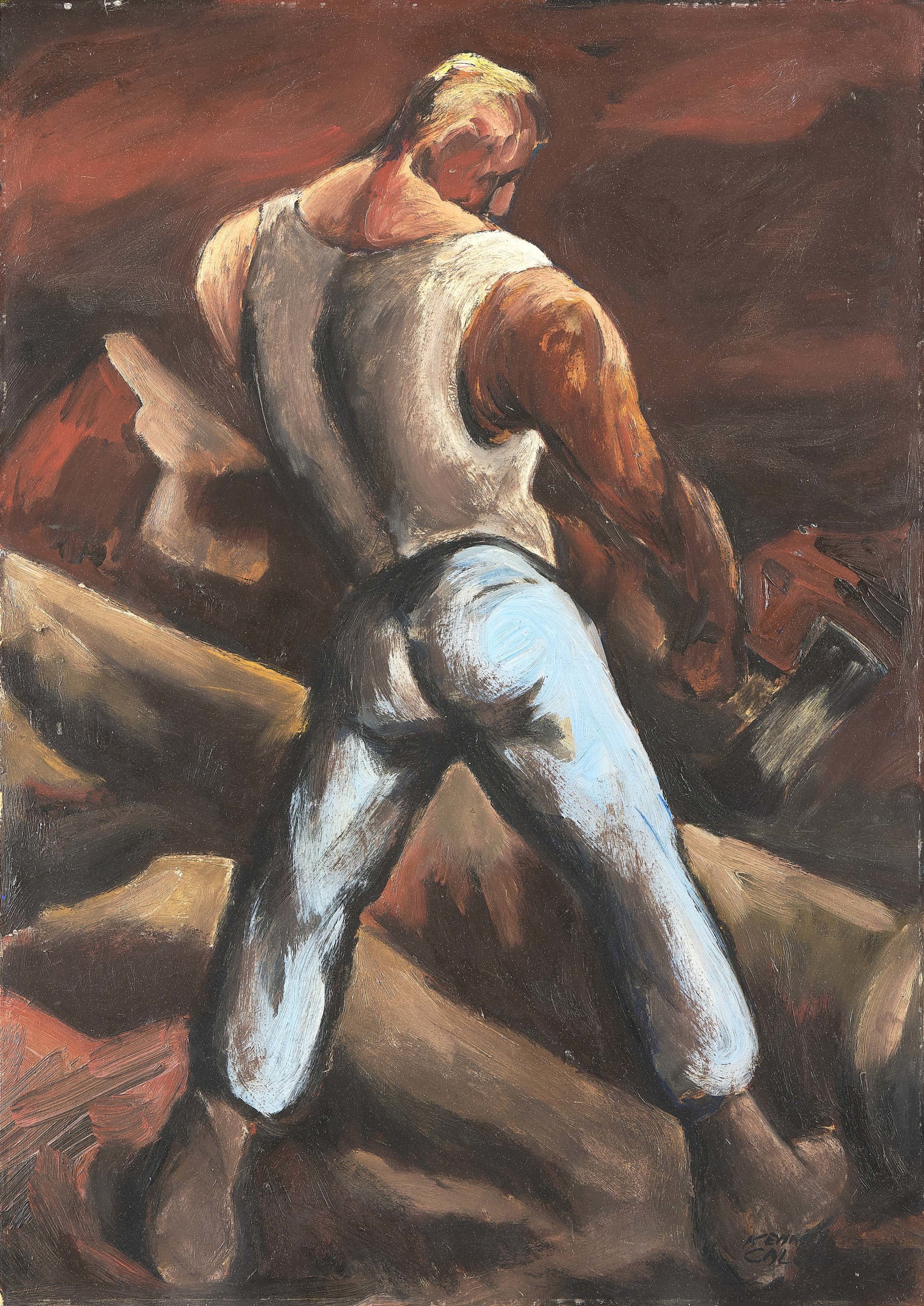
“Feller” by Kenneth Callahan (American, 1905-1986), 1934, oil painting, 31⅛ by 22 inches. Seattle Art Museum, Eugene Fuller Memorial Collection, 40.51, © Estate of Kenneth Callahan. Photo: Scott Leen.
By Kay Koeninger
SEATTLE — When Pacific Northwest modernism is mentioned, art aficionados might only think of the Abstract Expressionist artists Morris Gaves, Mark Tobey and Kenneth Callahan. When their work became nationally known in the early 1950s, it was often described as “mysterious,” “mystical” and “nature bound.” A new, comprehensive exhibition at the Seattle Art Museum, on view through August 2, curated by Theresa Papanikolas, the Ann M. Barwick curator of American Art, shows that these stereotypes are lacking.
Focusing on the Puget Sound region, with some nods to Eastern Washington and Oregon, “Beyond Mysticism: The Modern Northwest” makes the convincing case for a more complex view of the many “modernisms” that flourished in the area before and during the height of the Abstract Expressionist movement.
Seattle had a diverse and sophisticated arts community long before the 1950s. The Seattle Art Museum opened in 1933 and there were high-level photography and printmaking groups that were flourishing. In addition, Seattle was home to the Cornish School of Allied Arts (now Cornish College of the Arts), the School of Painting and Design and the Henry Art Gallery at the University of Washington and the Group of Twelve, a group of progressive artists active in the 1930s that promoted national artistic trends.
The population of Seattle greatly expanded beginning with the Klondike Gold Rush of 1892. Because of its complex geography of steep hills and tidelands, the city arose through a massive transformation of the landscape, unmatched by any other urban area in the United States. So… lots of machines and men working; perfect subject matter for the 1930s Social Realists. Many of these artists also participated in the publicly funded WPA art projects of the time and they are well-represented in the exhibition.
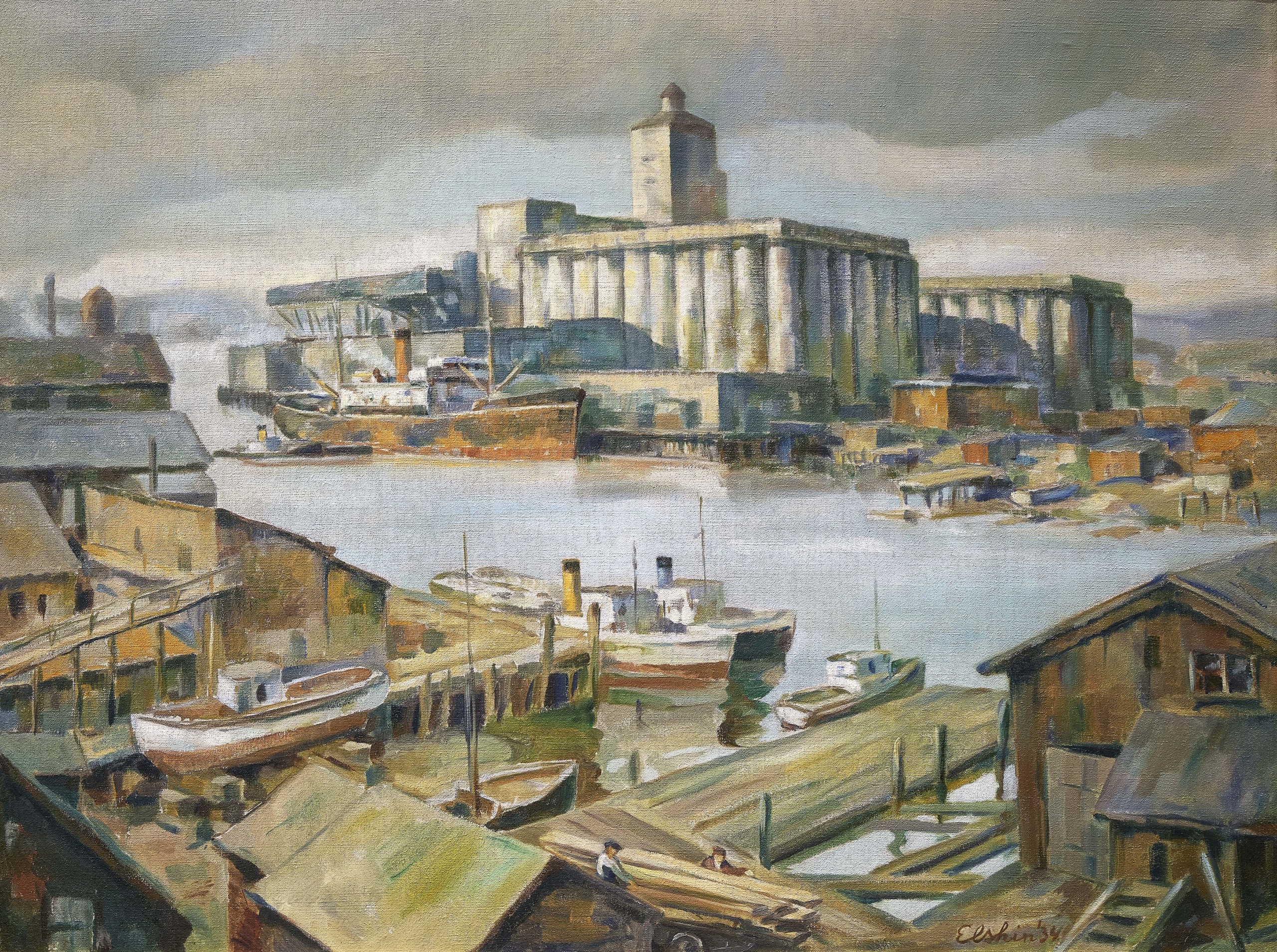
“Mill” by Jacob Elshin (American, 1892-1976), 1934, oil on canvas, 29 by 38 inches. Seattle Art Museum, Public Works of Art Project, Washington State, 34.138. © Jacob Elshin.Photo: Scott Leen.
Jacob Elshin (1892-1976) and Z. Vanessa Helder (1904-1968) produced views of factories and other industrial buildings that echo the concerns of American Precisionist artists like Charles Sheeler. Helder, in particular, focused on the major building project of Grand Coulee dam in Eastern Washington in the late 1930s-early 1940s. She was the only woman allowed to have access to the site and produced a large series of watercolors that dramatically document the building of the massive dam as well as the finished edifice. And, unlike Sheeler, she included men working in several of her works. Helder is well-represented with numerous works in the exhibition, demonstrating the further contribution of women artists to the Precisionist movement.
Industrial projects like Grand Coulee Dam ignited another period of population growth for the entire state of Washington, including Seattle. Yvonne Twining Humber (1904-2004) portrayed the streets and architecture of new neighborhoods. Her “Suburban Street,” 1940, combines Edward Hopper-like emptiness with some quirky architectural touches á la Charles Burchfield. Fay Chong’s (1912-1973) watercolor “Yesler Housing Project,” circa 1942, documents government-subsidized workers’ housing using touches of Chinese painting traditions.
Photographic contributions to Seattle modernism are represented by the work of Albert Smith, Sr (1916-2008), who focused on the Black entertainment industry in lively black and white photographs. He is represented by such works as “Jazz Trio on Stage at the Basil Street Club, March 24, 1945,” and “Hazel Scott at the Piano at the Civic Auditorium, Seattle, October 1947.” In the Hazel Scott photograph, the performer’s light-colored dress makes her appear to glow in contrast to the dark background.
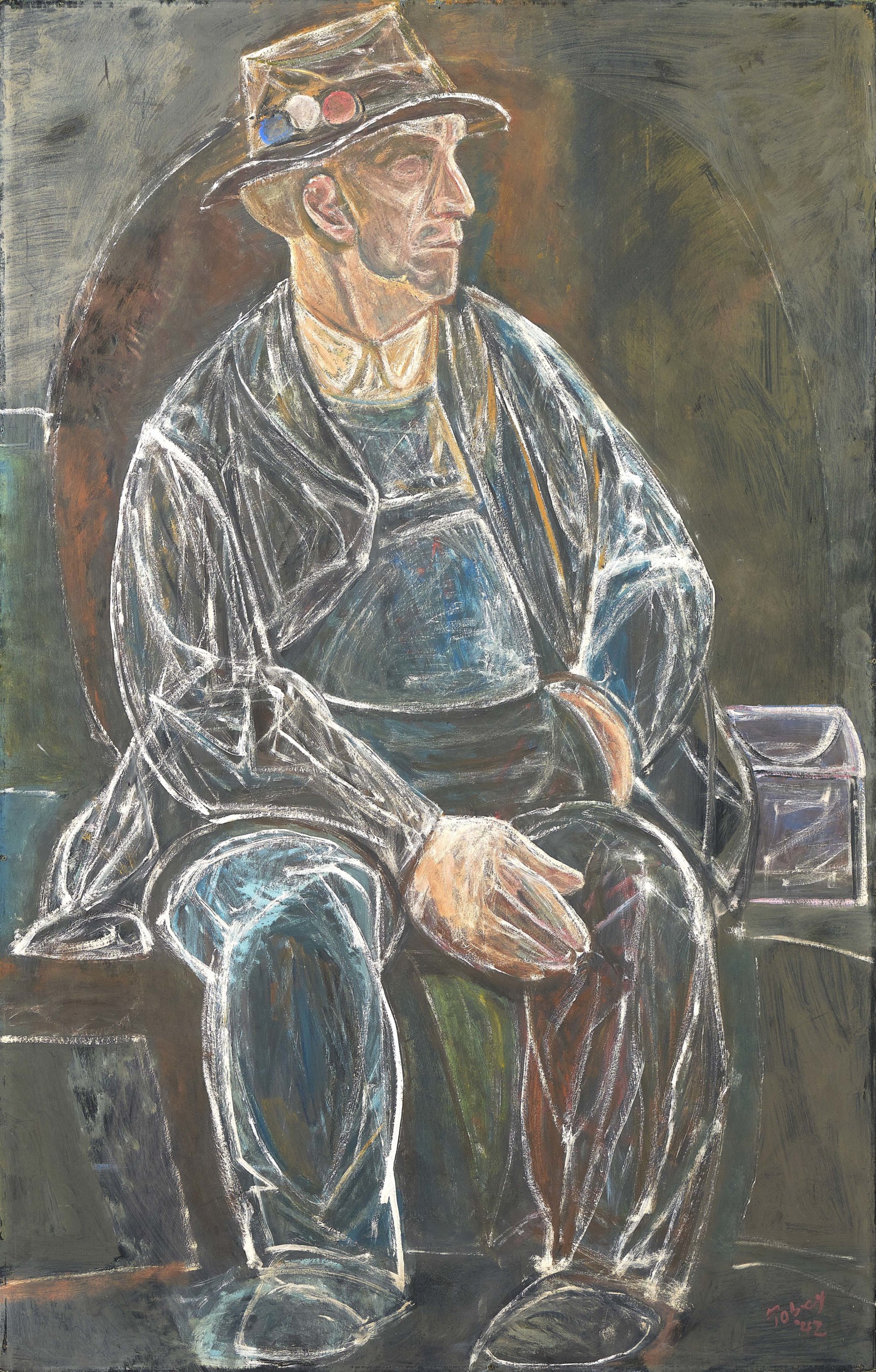
“Working Man” by Mark Tobey (American, 1890-1976), 1942, gouache on board, 43½ by 27½ inches. Seattle Art Museum, Eugene Fuller Memorial Collection, 42.33, © Mark Tobey / Seattle Art Museum. Photo: Scott Leen.
Pike Place Market, a large public market in downtown Seattle, is still an iconic symbol of the city. In the early 1940s, Mark Tobey (1890-1976) extensively sketched there, focusing on the working men who used the Market as an alternative space, as he stated, “[away from] their furnished rooms and random hotels.” One such subject is pictured in Tobey’s “Working Man,” 1942, a monochrome gouache showing a man at rest, yet engaged in looking at the activities at the market.
Many workers were employed as lumberjacks in the giant timber industry in the Northwest, and they were a topic for many artists. Kenneth Callahan celebrated the WPA-style brawny, idealized lumberjack in his “Feller,” 1934. But in contrast to WPA dictates, he also honestly portrayed the dangers of physical labor in his “The Accident,” 1939, which shows an injured worker (possibly a miner) being helped by his companion. Callahan’s openness to all aspects of physical labor can be traced to his previous study abroad with the “founding fathers” of the Mexican mural movement: Orosco, Rivera and Tamayo.
Callahan also focused on the destruction of the environment caused by the timber industry. This interest can be read in part by his personal experience as a fire lookout in the Cascade Mountains and seeing old-growth logging on the Olympic Peninsula. His oil on board painting “Northwest Landscape,” 1934, is bright and colorful, but is marred by the ragged, felled trees in the foreground. Callahan also addressed environmental concerns caused by the building of railroads into timberlands in his “Logging Rail Road Construction,” 1937.
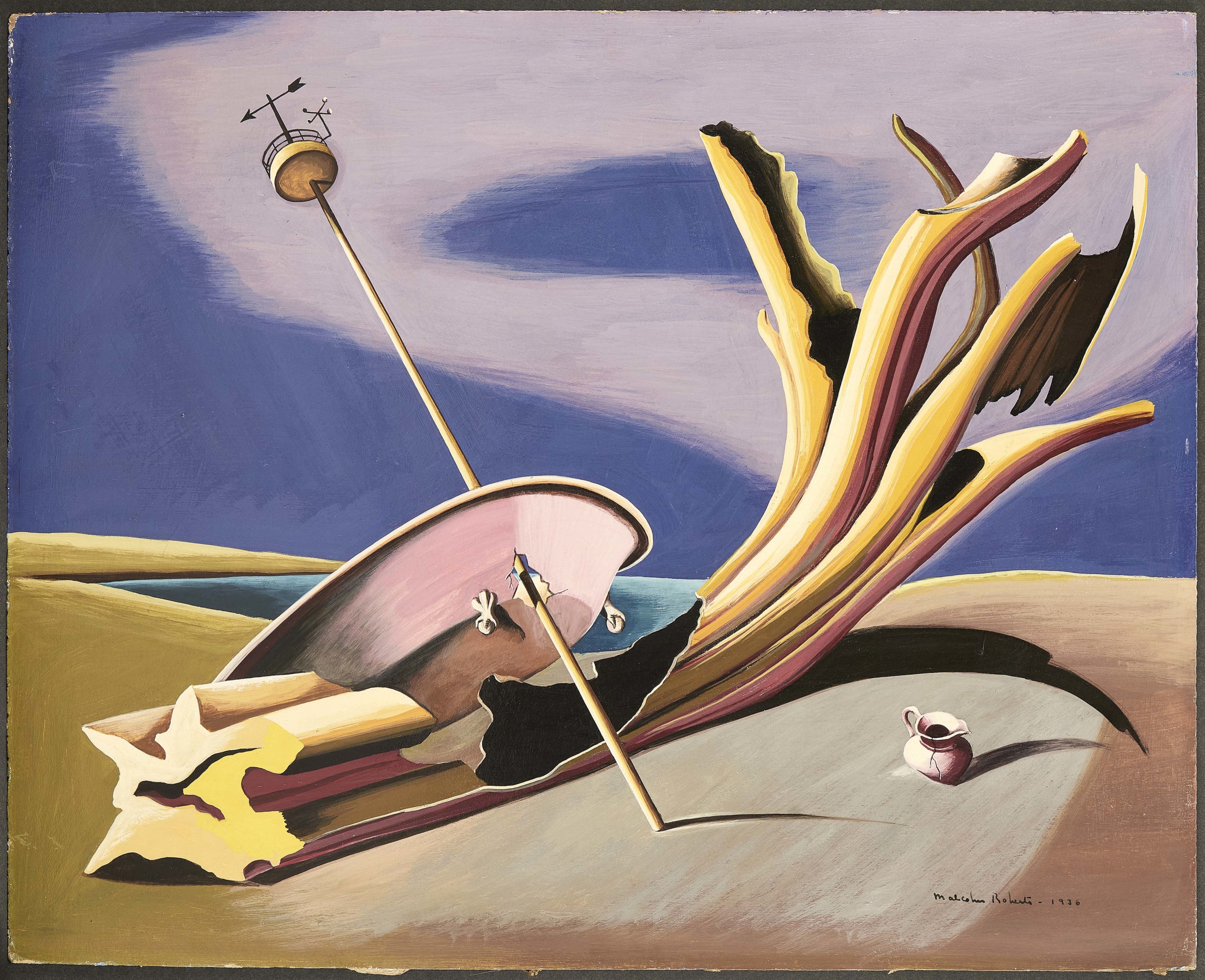
“Drift No.2” by Malcolm M. Roberts (American, 1913-1990), 1936, Tempera on board, 25½ by 20⅝ inches. Seattle Art Museum, Eugene Fuller Memorial Collection, 37.103. © Malcolm M. Roberts. Photo: Scott Leen.
An eye-opening section of the exhibition focuses on the under-explored fact that many Northwest artists embraced Surrealism, which arose in the aftermath of World War I and became well known in the United States in the 1930s. A complex movement that began among writers, it manifested itself in visual art in two different ways: in semi-realistic “dreamscapes” or in abstract and nonobjective art. Both branches were focused on the subconscious, the anti-rational and individual emotional expression. One of the first Northwest artists to embrace Surrealism was Malcolm M. Roberts (1913-1990). His paintings show a debt to Dalí but contain Northwest elements such as sailboats and driftwood, as in his “Drift No. 2,” 1936, tempera on board. Louis Bunce (1907-1983), based in Portland, often included architecture in his work, as in “Structure #10,” 1939. Its linear and strict perspectival quality recalls de Chirico. Morris Graves (1910-2001) includes terrifying flayed animal forms in his “Departure via Cedron,” 1936. In the Hebrew language, cedron means “to be dark,” and refers to the large ravine east of Jerusalem.
The final section of the exhibition examines a crucial element in the art of the Northwest, one that has been downplayed or even ignored in the past. This is the important contribution made by the traditions of both Asian and Native American art. Chinese calligraphy and Japanese sumi-e paintings with their gestural characteristics were an important influence due to the large Asian community in the Northwest. Tobey studied both Chinese calligraphy and Japanese sumi-e painting and also traveled to China and Japan. His study and travel are demonstrated in several minimalist, calligraphic works in the exhibition, including his “Space Ritual No. 18, 1957,” sumi ink on wove paper mounted on board.
A notable fusion took place when Japanese-American artists in the Northwest explored minimalist Japanese aesthetics within an abstract midcentury framework, as in George Tsutakawa’s (1910-1997) painting “The Ascent,” 1950.
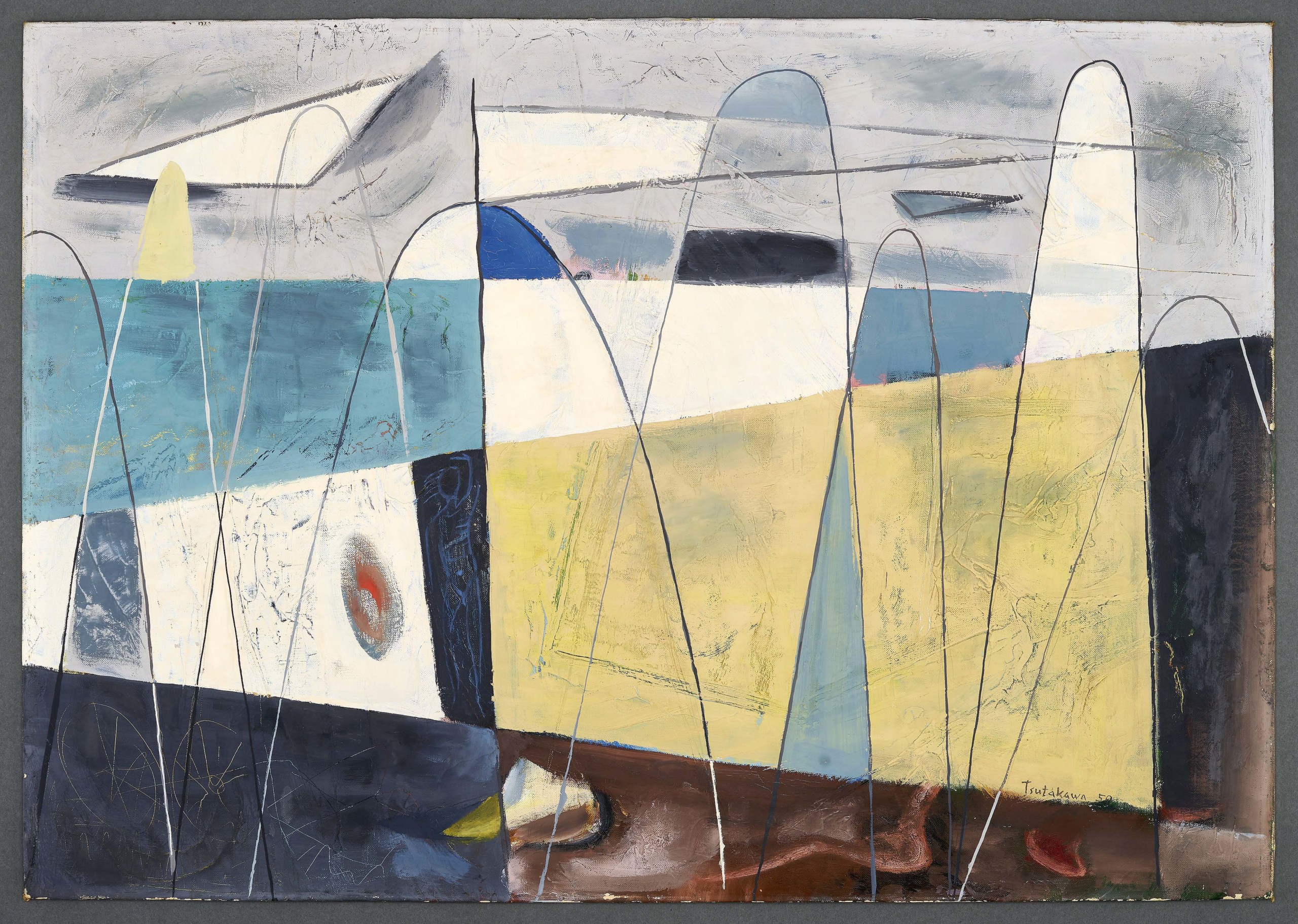
“The Ascent” by George Tsutakawa (American, 1910-1997), 1950, oil on canvas board, 21 by 30 inches. Gift of Mr and Mrs Dwight E. Robinson, 54.153. Photo: Scott Leen.
One of the most appealing aspects of this fusion is also seen in Tsutakawa’s wooden sculpture series called “Obos,” dating from the late 1950s-early 1960s. They trace their inspiration to the ritual stone stacks found in Japanese temples and in the Himalayas.
The Native American influence on the Northwest Coast has been even more overlooked than the Asian contribution. Many Northwest artists were interested in Native American art and were collectors. However, they often did not understand the complexity of the art made by Native American cultures and often regarded it in a generalized way. They also over-romanticized the art, tying it to nature and “primitive” qualities. It is fitting that the exhibition closes with a survey of the work of the Ute artist Julius “Land Elk” Twohy (1902-1986) who was active as a WPA mural artist and printmaker. His prints uniquely combine Native American motifs with abstract conventions, as in his lithograph “Tom Toms and Drum,” 1939.
The scope of this exhibition is powerful. One of its strengths is that it is not restricted to painting, but also includes drawing, printmaking, photography and sculpture. Its message is that modernism in the Northwest was not a monolith — it contained many complex modernisms within it. This argument is grounded not only by the works in the exhibition but also in a scholarly and lavishly illustrated catalogue.
The Seattle Art Museum is at 1300 First Street. For information, www.seattleartmuseum.org or 206-654-3210.