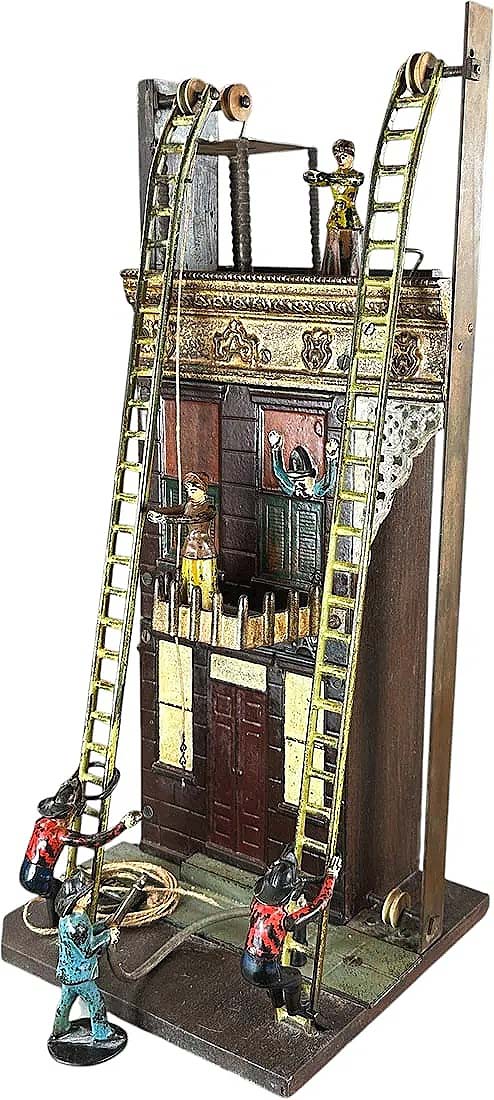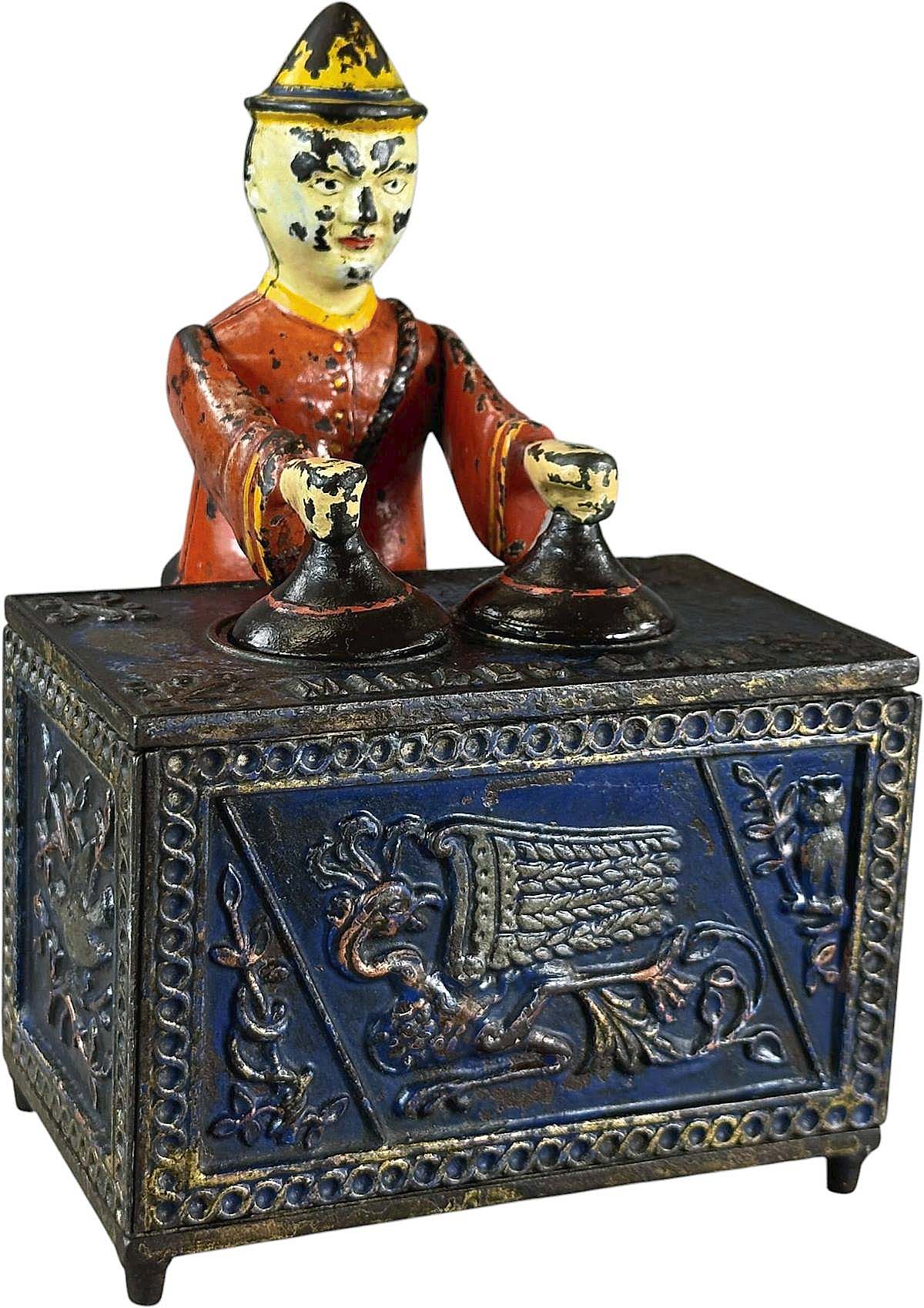
The top lot was this Kyser & Rex blue-table Mikado mechanical bank, Bob Booth collection, circa 1886, one of only a few known. It attained $38,400 ($25/40,000).
Review by Andrea Valluzzo
VINELAND, N.J. — To Dr Robert Booth, who passed away earlier this year, mechanical banks were a form of folk art: important and elegant, yet not pretentious enough to stick on a shelf to be admired only from afar.
Michael Bertoia, the president and auctioneer at Bertoia Auctions who lives in Haddonfield, N.J., the same town where Booth lived before settling in Pennsylvania, said Booth was unlike some collectors of high-end cast iron mechanical banks in that he would use his and was happy to demonstrate how the banks worked to fellow collectors as well as children in the neighborhood.
“Bob Booth viewed early mechanical banks as a form of Americana, and that was the lens at which he looked at mechanical banks, as opposed to as a bank collector or even as a toy collector,” Bertoia explained. “…they were a form of Americana: they were figural, they were colorful and they also spoke to a point of history in this country. As such, he also had a tolerance for patina, maybe that beyond some of the really devoted and focused mechanical bank collectors would have.”
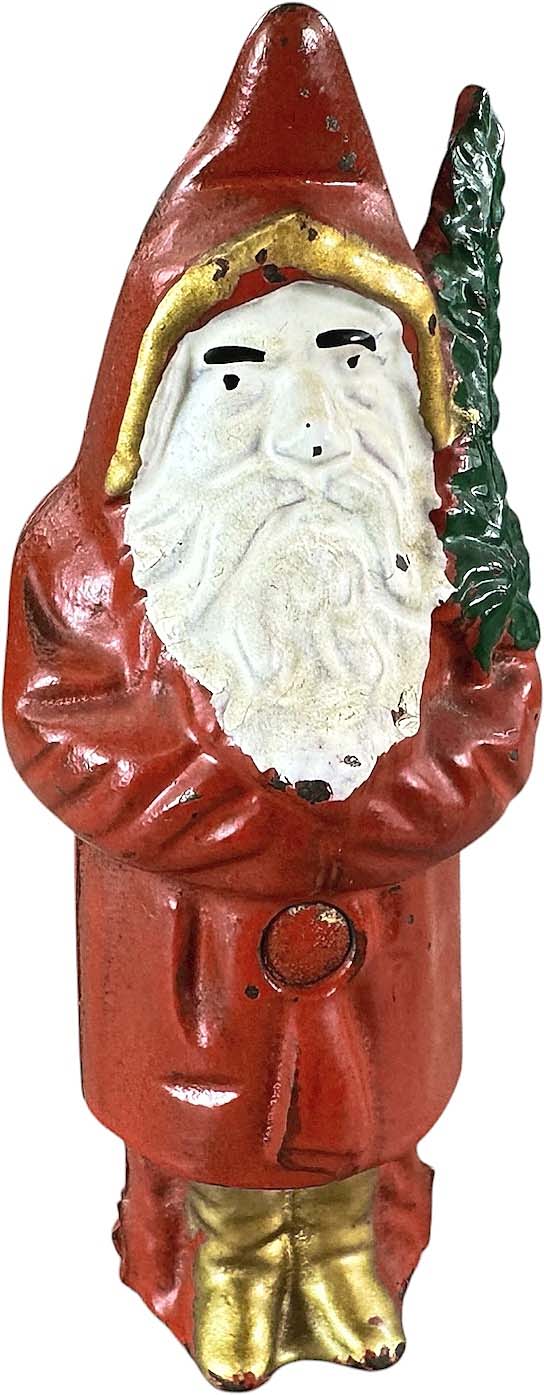
This Hubley Santa still bank, which hardly showed any handling wear or evidence of use, sold for $3,300 ($1,2/2,000).
Bertoia continued, “He used his banks, which is very unordinary for five-figure mechanical bank collectors to do. But he used the banks, and he enjoyed actually demonstrating the banks.”
“Sidebar real quick: I live in Haddonfield and one of my neighbors, who’s my age, was talking to me about the business in general, asking what I do. I mentioned ‘mechanical banks,’ and they actually knew what I was talking about. Back in the 80s or 90s, when they were kids, their parents brought them to an open house for a house in the neighborhood that was being sold by a doctor who was moving to Pennsylvania. And they walked into the house, and there was a room full of mechanical banks.”
“And this fellow, Dr Booth, who was selling the house, was gracious enough to take the time to actually demonstrate some of the mechanical banks to these kids, who now, three or four decades later, still remember mechanical banks and have an affinity for them themselves,” Bertoia added.
Proving that it truly is a small world after all, or that serendipity is real, that conversation occurred a week after Bertoia Auctions sold more than 70 mechanical banks from Booth’s collection in its September 25 Cast Iron sale, along with cast iron toys from the collections of Tony LaSala and Ira Bernstein, along with the doorstop collection of Bob Brady, and Max Berry’s collection of Charlie Reynolds banks. The auction totaled more than $515,000, resulting in several happy consignors.
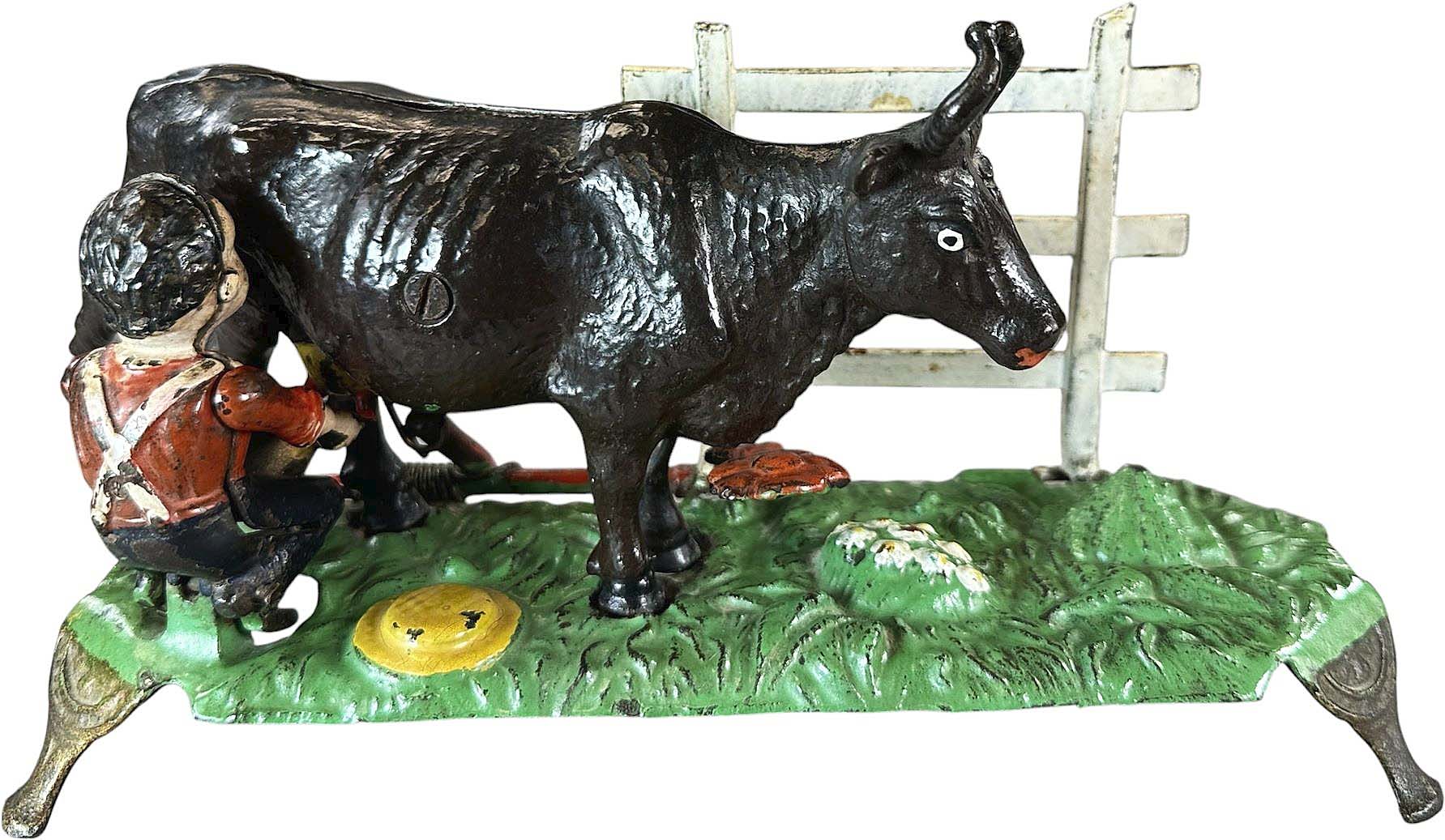
This J&E Stevens Milking Cow mechanical bank, a scarce thin base version, sold for $12,000 ($5/8,000).
“I’m very pleased with the sales overall throughout the course of the day and throughout the different categories,” Bertoia said of the auction results overall. “I’ve spoken with several collectors who are very pleased to have gotten treasure from the Booth collection. Additionally, we had cast iron automobile toys from Ira Bernstein and Tony LaSala, and there were some pleasant surprises there. So collectors came strong for that category.”
The top lot overall was an uncommon example of the circa 1866 Mikado mechanical bank by Kyser & Rex, Philadelphia, which sold for $38,400. This was followed by a scarce mechanical Alphabet Man (or Yankee Schoolmaster), which was part-toy and part Nineteenth Century schoolmaster’s educational aid; it brought $20,400.
This rare blue-table version was one of only a few known of the bank that exhibited an interesting action: When one placed a coin under the right hat and turned the bank’s rear crank, the illusionist would raise and lower the cones, causing the coin to “magically” disappear and reappear under the left cone before disappearing into the bank. The $38,400 selling price was within its estimate range.
“The Mikado is an extremely rare mechanical bank. There may be are a dozen in existence,” Bertoia said. “It’s a really complex bank. Just from the workings of it and the operation of it; it has multiple movements. I’m sure it was an expensive bank to produce in the first place, and they probably didn’t sell nearly as many of those as they had some of their simpler banks.”
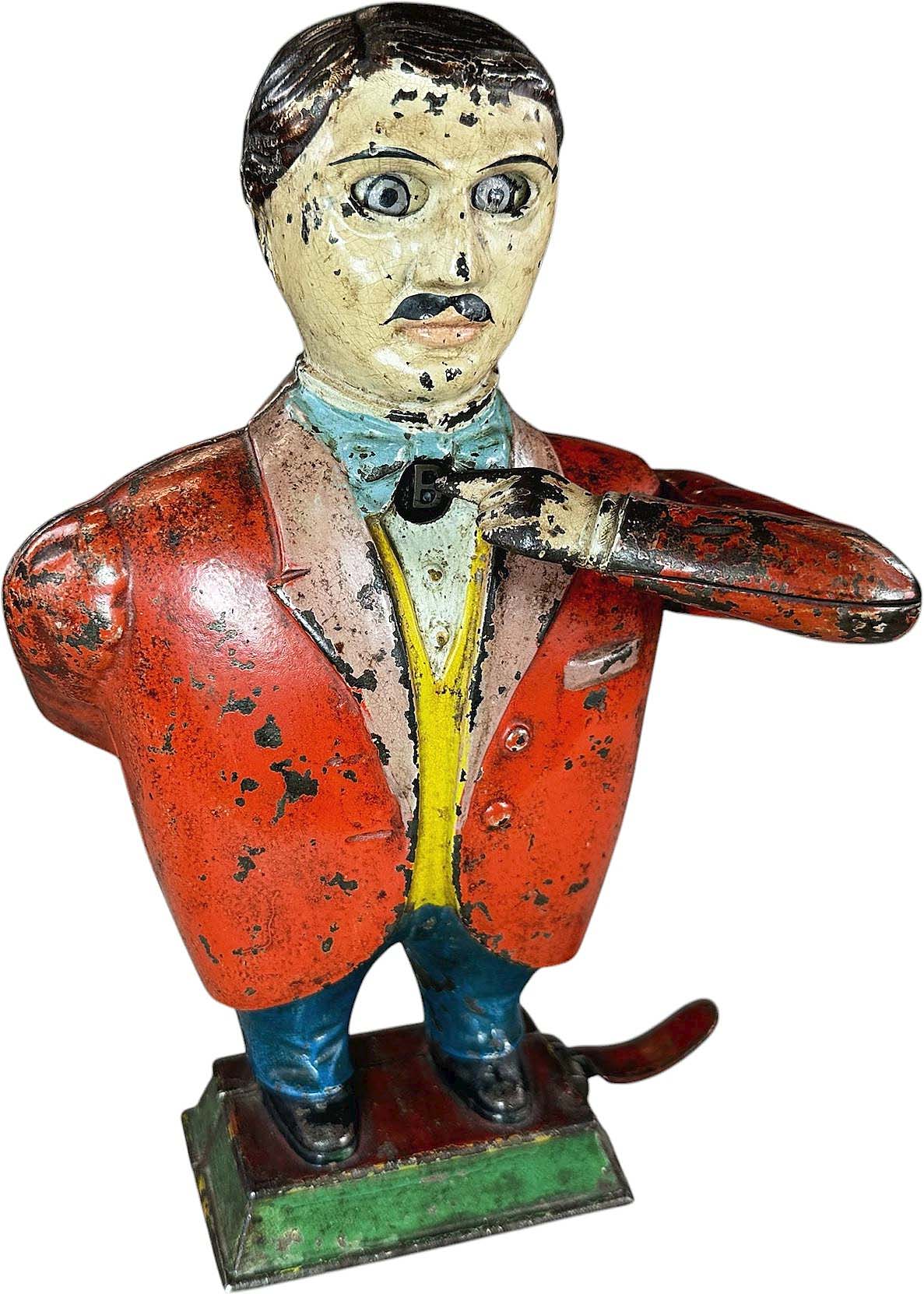
This cast iron Alphabet Man (or, The Yankee Schoolmaster), manufacturer unknown, had an appealing folk art look. It sold for $20,400 ($8/12,000).
The bank is quite the statement piece and likely a centerpiece of any collection, as it has a large shelf presence. “It has a really cool mechanism and rarity, so you’ve got a few nice ingredients there. And as far as a mechanical bank collection goes, it’s a very attractive bank. Then mechanically, it’s a very fun and interesting bank with the coin deposits.”
The mechanical Alphabet Man/Yankee Schoolmaster toy was designed in such a way that it also had a powerful folk art presence. There has long been a debate about whether the Alphabet Man was created as a toy or a Nineteenth Century schoolmaster’s educational aid. Pressing the lever caused the finely dressed gentleman to point to his chest, which was embedded with a revolving alphabet wheel. Against a high estimate of $12,000, the rare example offered earned “extra credit,” selling for $20,400.
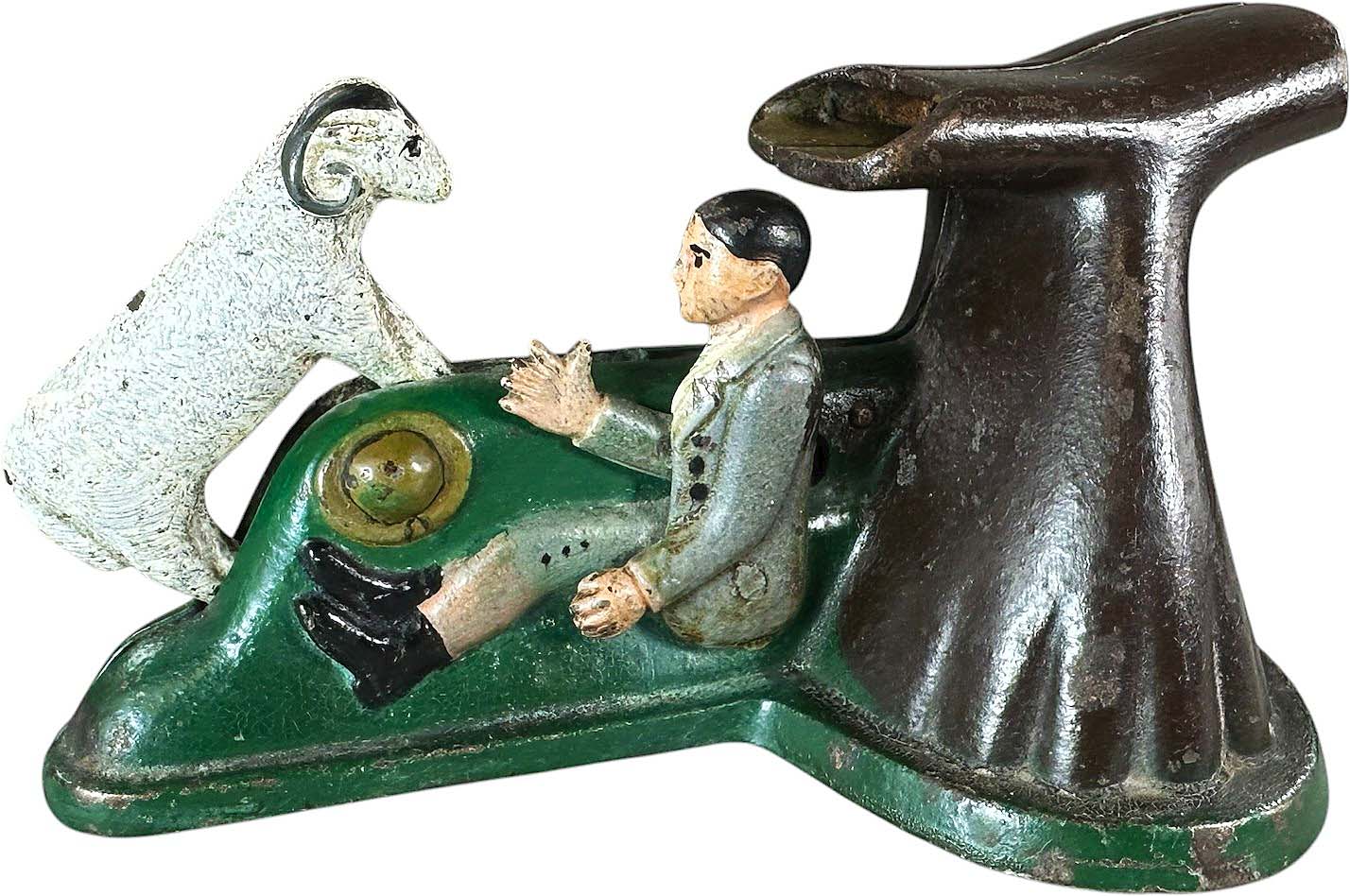
The Butting Ram — Man Thumbs Up was the only mechanical bank model ever produced by Wagner & Zwiebel Manufacturing of Wisconsin. Few exist in any condition, and it would be a challenge to find another as nice as the example entered in the auction. It was presented in all-original condition and boasted a strong pedigree from having been part of the Booth collection. It rose to $14,400 against an $8,000 high estimate.
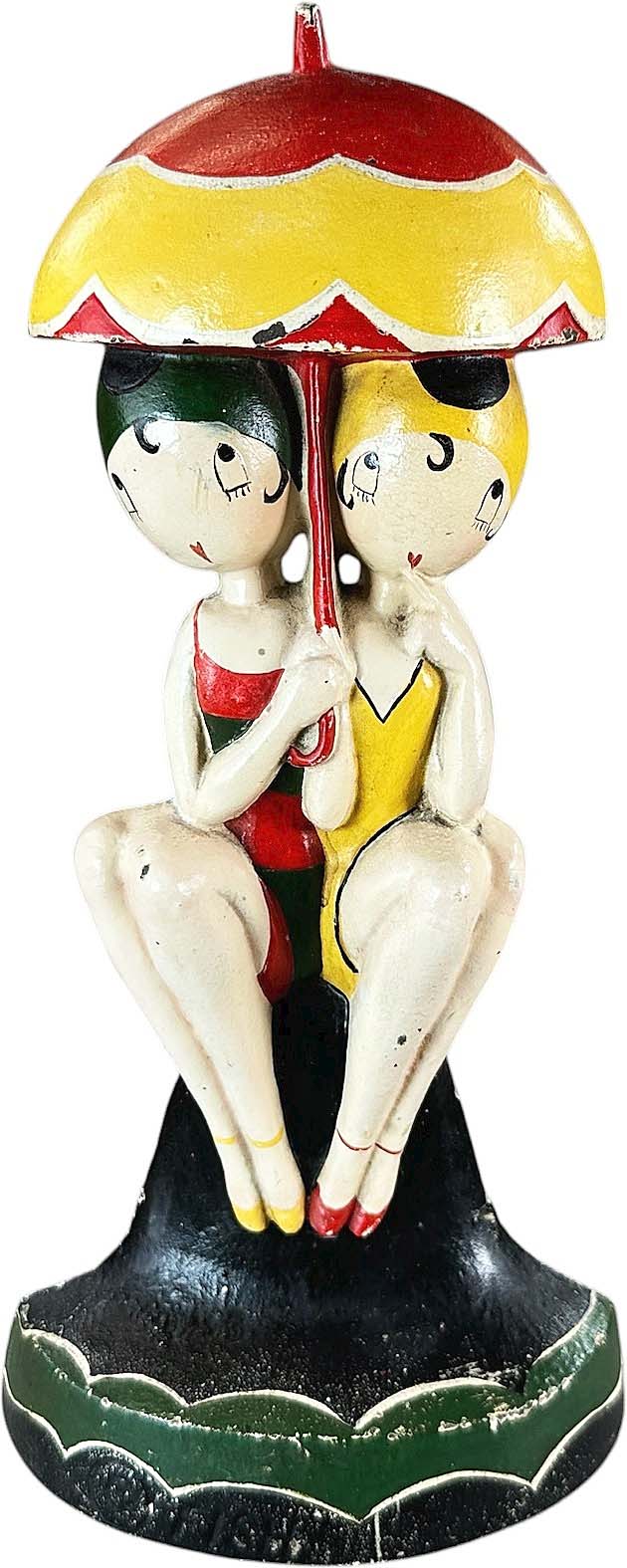
Hubley Manufacturing (Lancaster, Penn.) doorstops were a big hit with bidders. A few of the top-selling lots from the Bob Brady collection were from this category, including a Bathing Beauties doorstop, one of a series of six designed and signed “© FISH 250.” Featuring a popular Art Deco design depicting two young ladies in bathing gear sharing a parasol, the 11½-inche-tall was in near mint condition and sold for more than double its high estimate at $3,900.
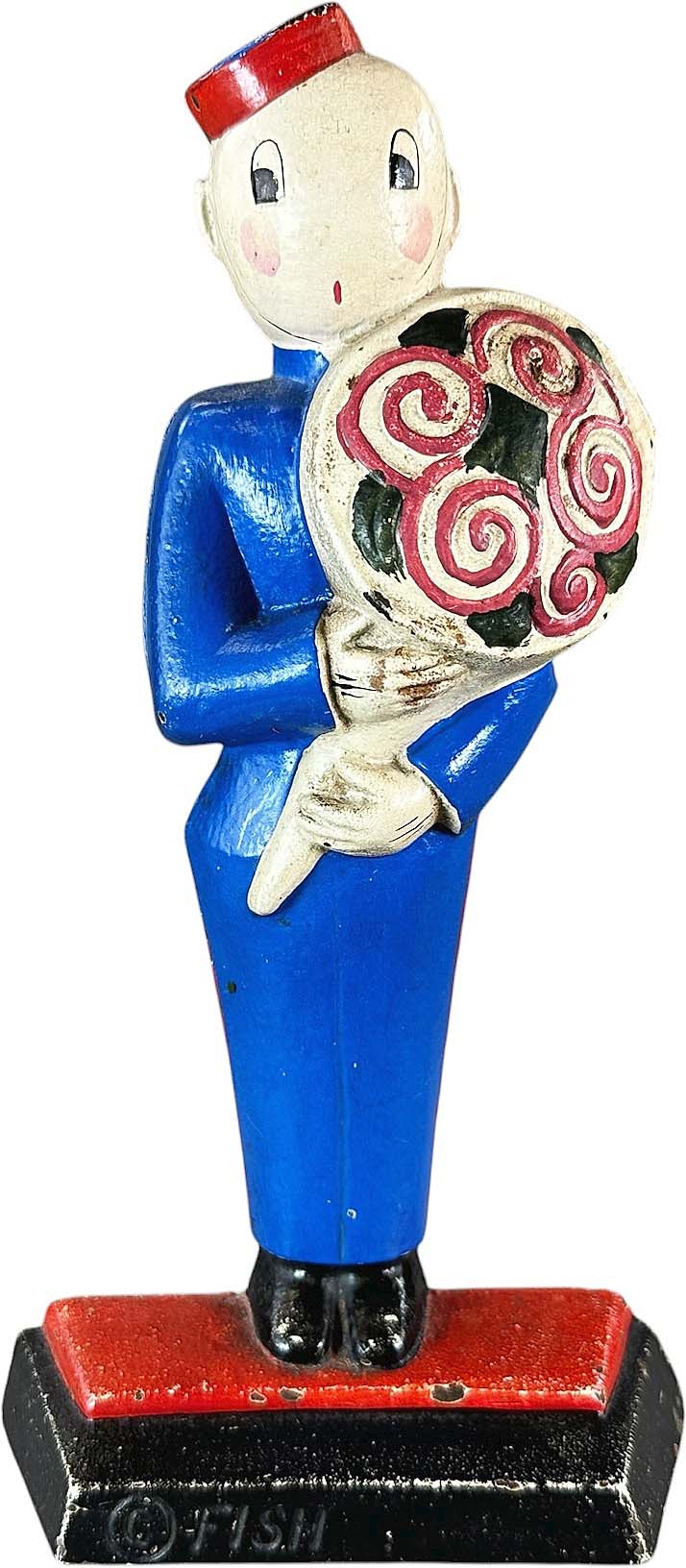
This Hubley Messenger Boy doorstop, one of a series of six designed, realized $3,600 ($1,2/1,800).
A Hubley Messenger Boy doorstop, one of a series of six designed and with classic Art Deco molding, depicted a boy holding bouquet of flowers on a red and black base, 10 inches tall, in near mint condition. It doubled high estimate to achieve $3,600.
Also, from Hubley, but not a doorstop, was a Santa still bank, Booth collection, a choice example that hardly showed any handling wear or evidence of use. The 6-inch-tall bank, in near mint condition, came to auction with a modest $1,2/2,000 estimate, but ended up changing hands for $3,300.
A small Uncle Sam mechanical bank, one of only 99 produced in 1970 by the Sears, Roebuck & Company Research & Engineering Department as a limited-edition special presentation piece for members of a campaign committee, swept past the $400 high estimate to finish at $3,600. This example, ex Max Berry collection, just 10½ inches tall, was #60 of the 99 produced. It was marked “60 99 1970” and was in near mint condition.
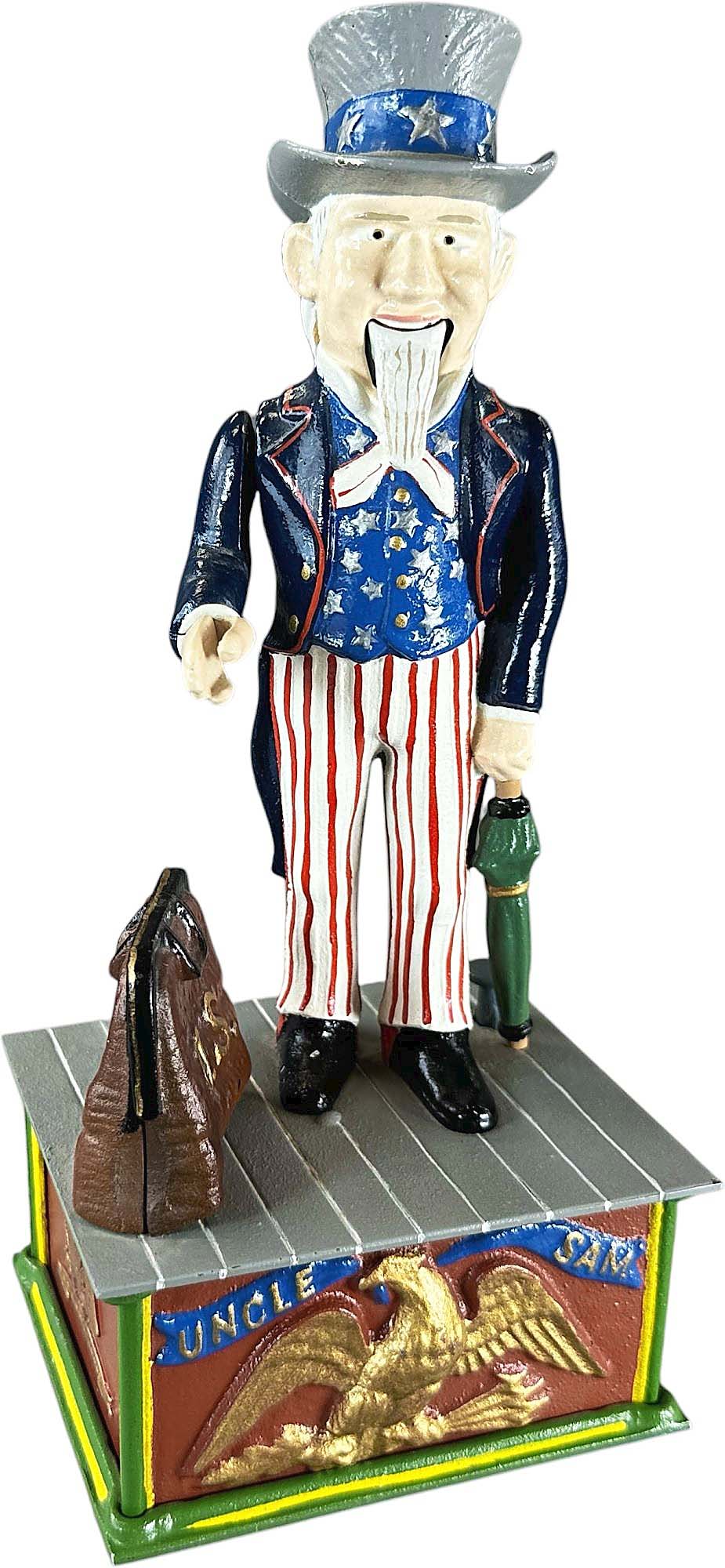
Estimated at a mere $200/400, this Uncle Sam mechanical bank, one of 99 produced in 1970 by the Sears, Roebuck & Company Research & Engineering Department as a limited-edition presentation piece for members of a campaign committee, made $3,600.
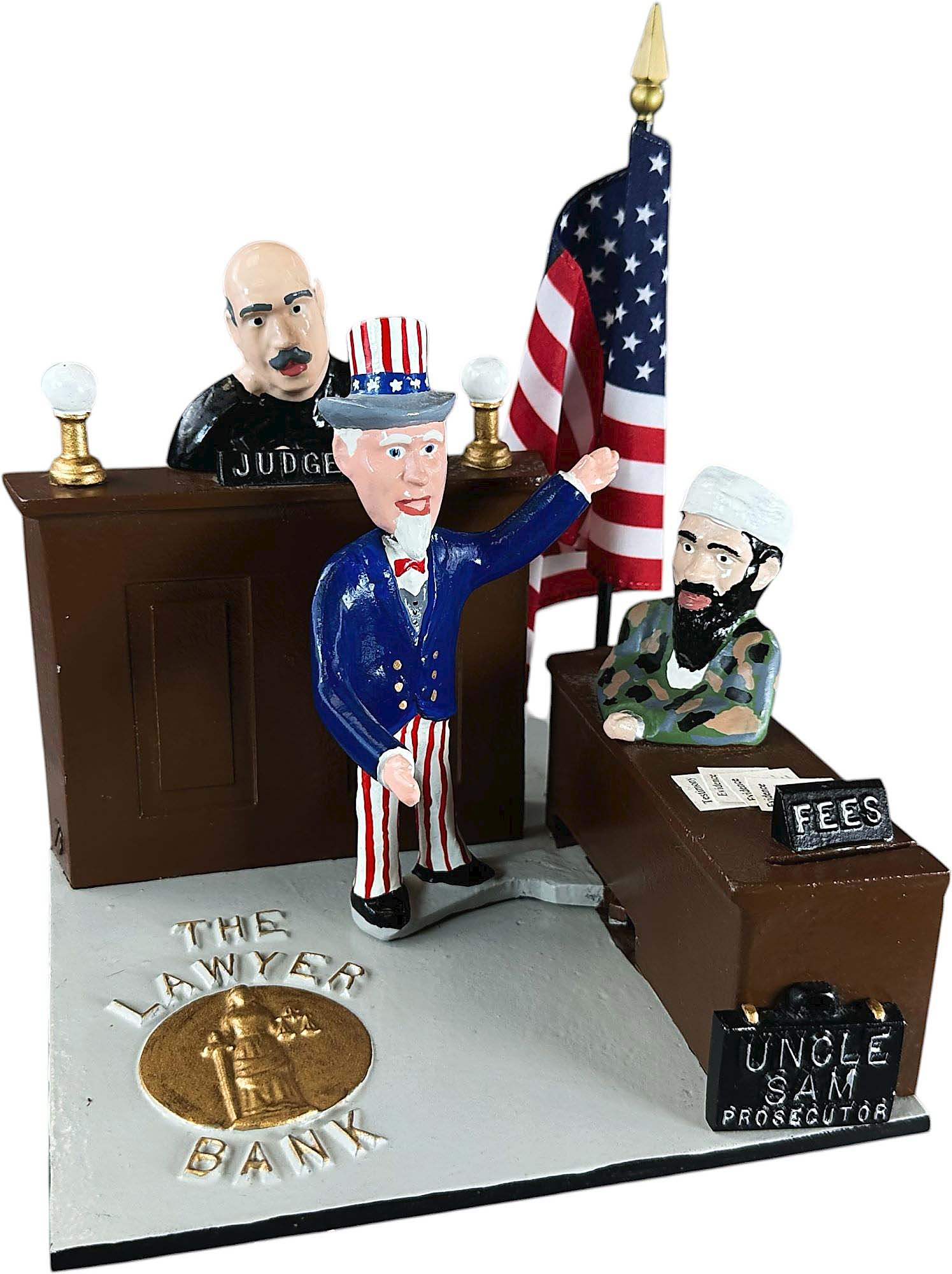
A Reynolds Uncle Sam Lawyer mechanical bank, a pre-production model from 2003 and one of only two made, topped its $2,000 high estimate with a final price of $3,000. The bank was 7½ inches long and in near mint condition.
“We had Max Barry’s Charlie Reynolds banks, which is its own subculture within mechanical bank collecting and I actually had a number of collectors who I spoke with before the auction who were surprised by how many Charlie Reynolds banks Max Berry had,” Bertoia said. “Max had had one of the larger representations to come to auction at one time of Charlie Reynolds mechanical banks.”
Reynolds was a shop teacher who used to teach his students about mechanical banks. “I only found this out after the sale,” Bertoia added, noting that there were two banks in the auction that looked just like the Charlie Reynolds banks but they didn’t have his name, signature or his stamps on them. “Come to find out, those are actually two banks that his students had made in the shop class. And that’s why they’re in Charlie Reynolds’ style, but they really are one-offs — essentially folk art to me, because you had some untrained student who created it, almost like an Outsider art thing. They were cool.”
When Bertoia took Berry’s collection originally, he didn’t know if he wanted to sell the collection as one lot, one collection or break it apart. “The banks did very well, and Max was thrilled. I don’t think he had any expectation to get that kind of result that he did.”
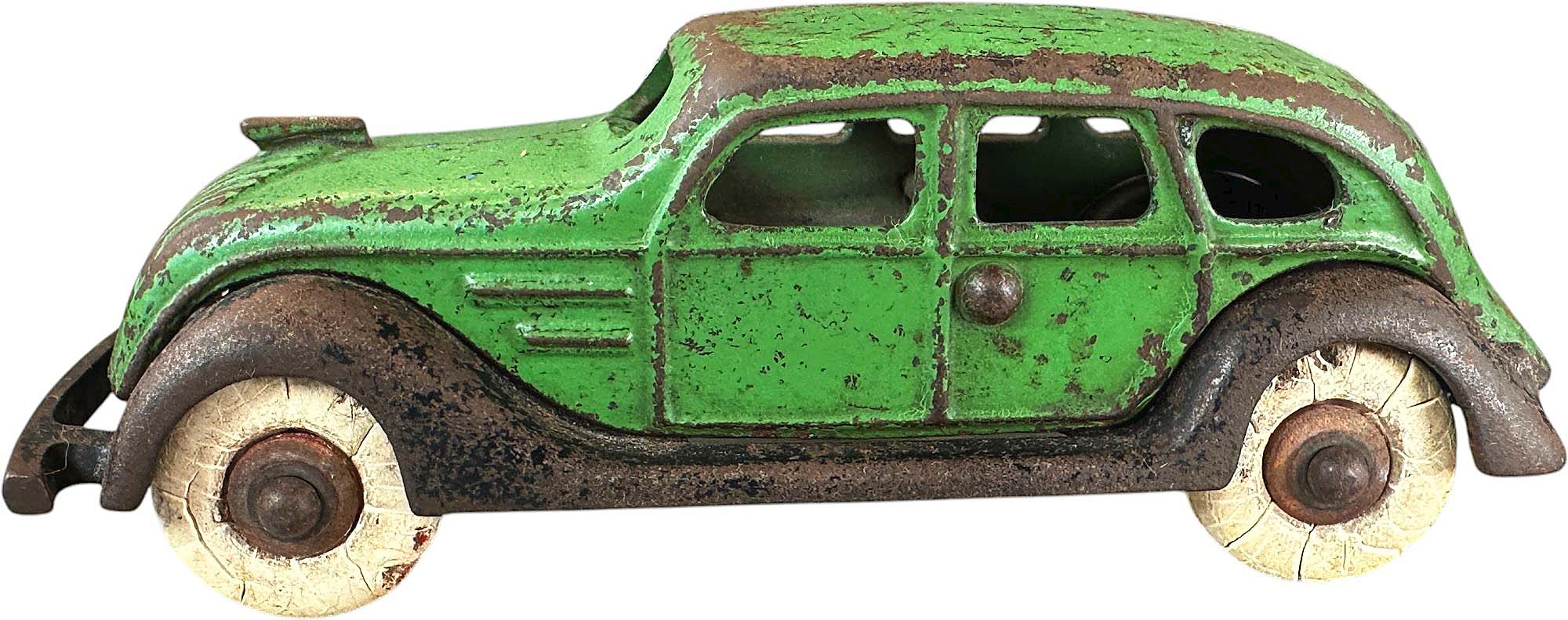
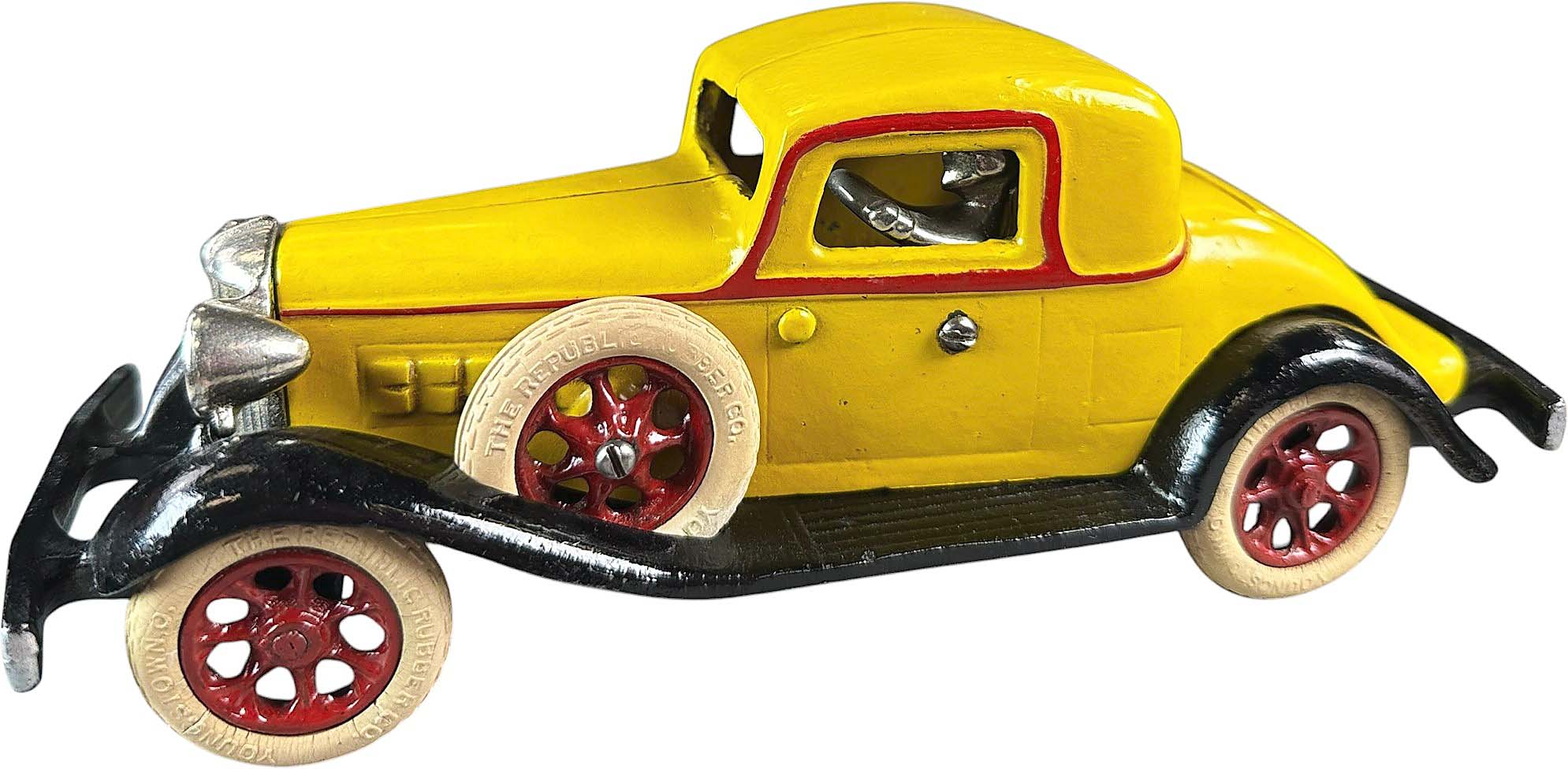
In the toy cars category, an Arcade REO Royale Coupe, 9 inches in length and in pristine condition, sped away for $3,600 against a $2,000 high estimate. Leading the LaSala collection was a rare Kenton 1934 Chrysler Airflow, 5½ inches long and in very good condition, which found a new home for $2,700, surpassing the $1,000 high estimate.
Prices quoted include the buyer’s premium as reported by the auction house. Bertoia Auctions will hold its Collectibles Sale October 23. For information www.bertoiaauctions.com or 856-692-1881.