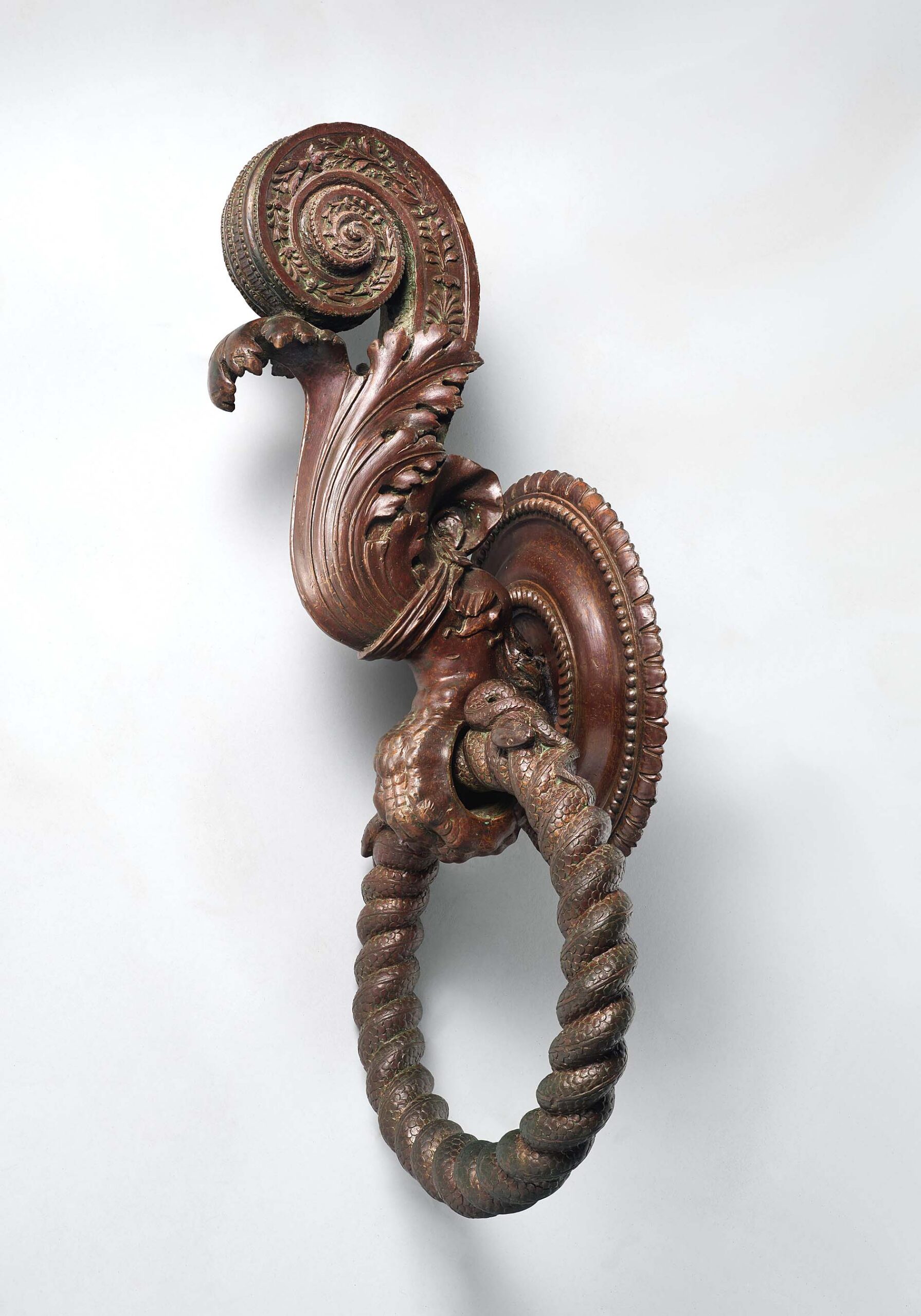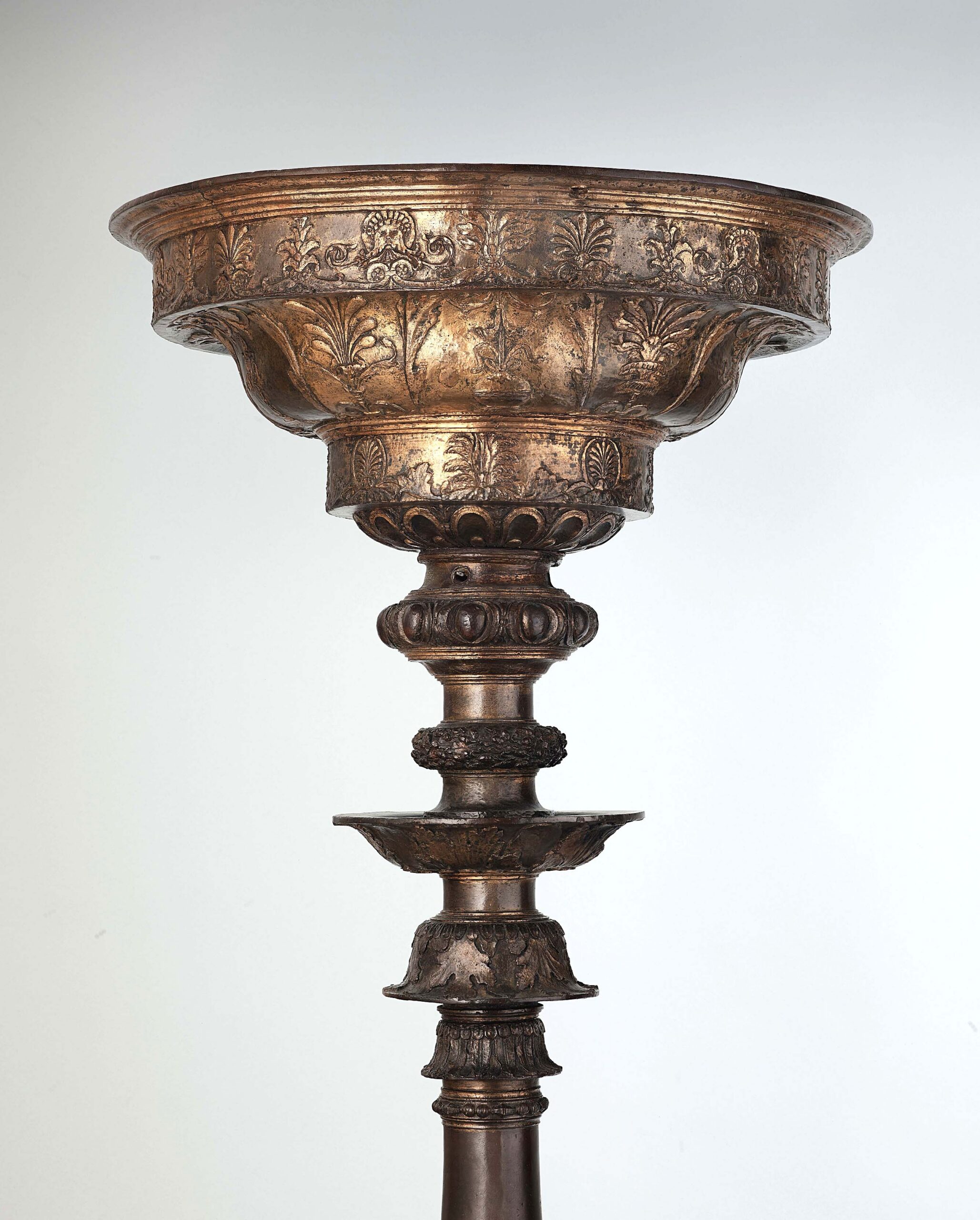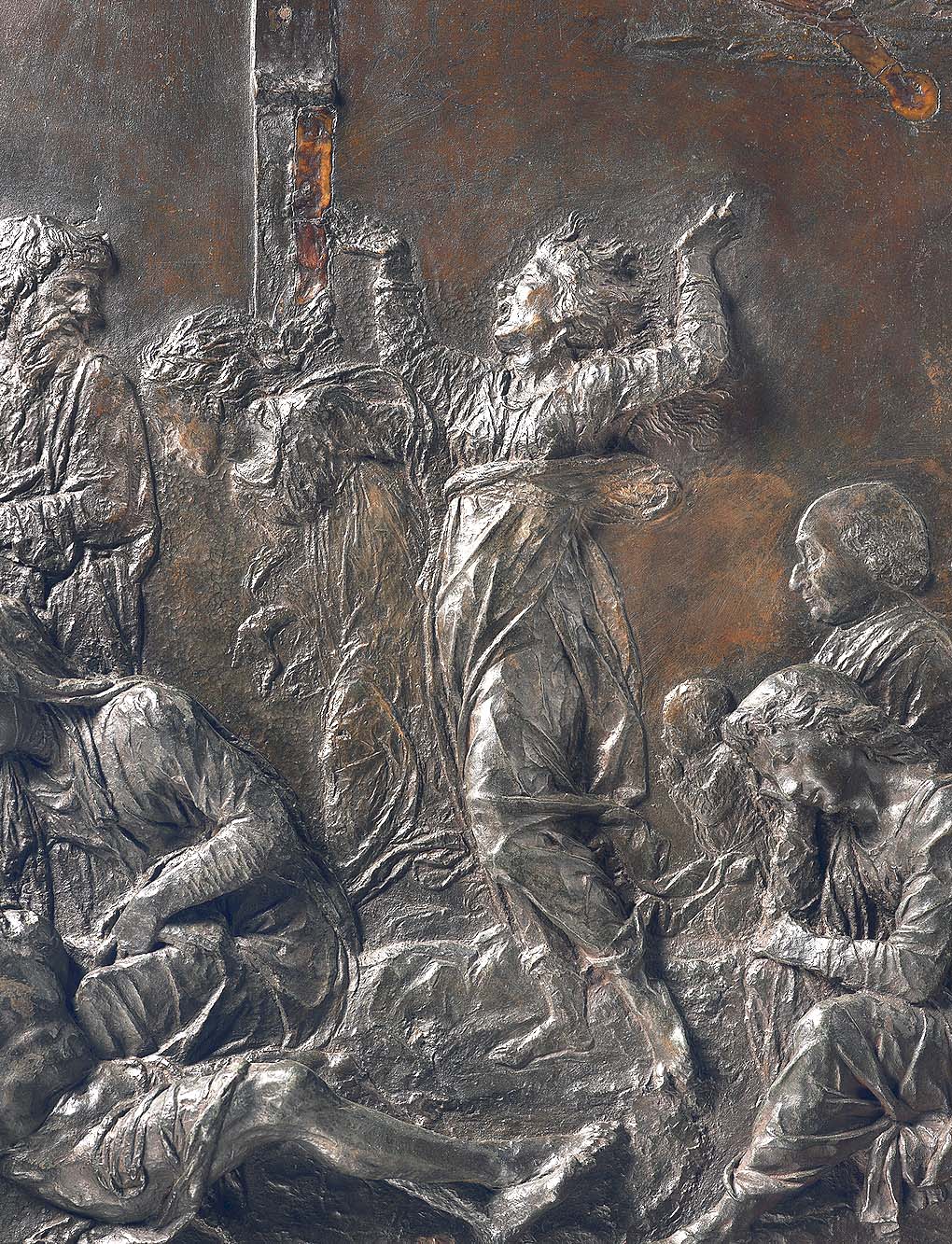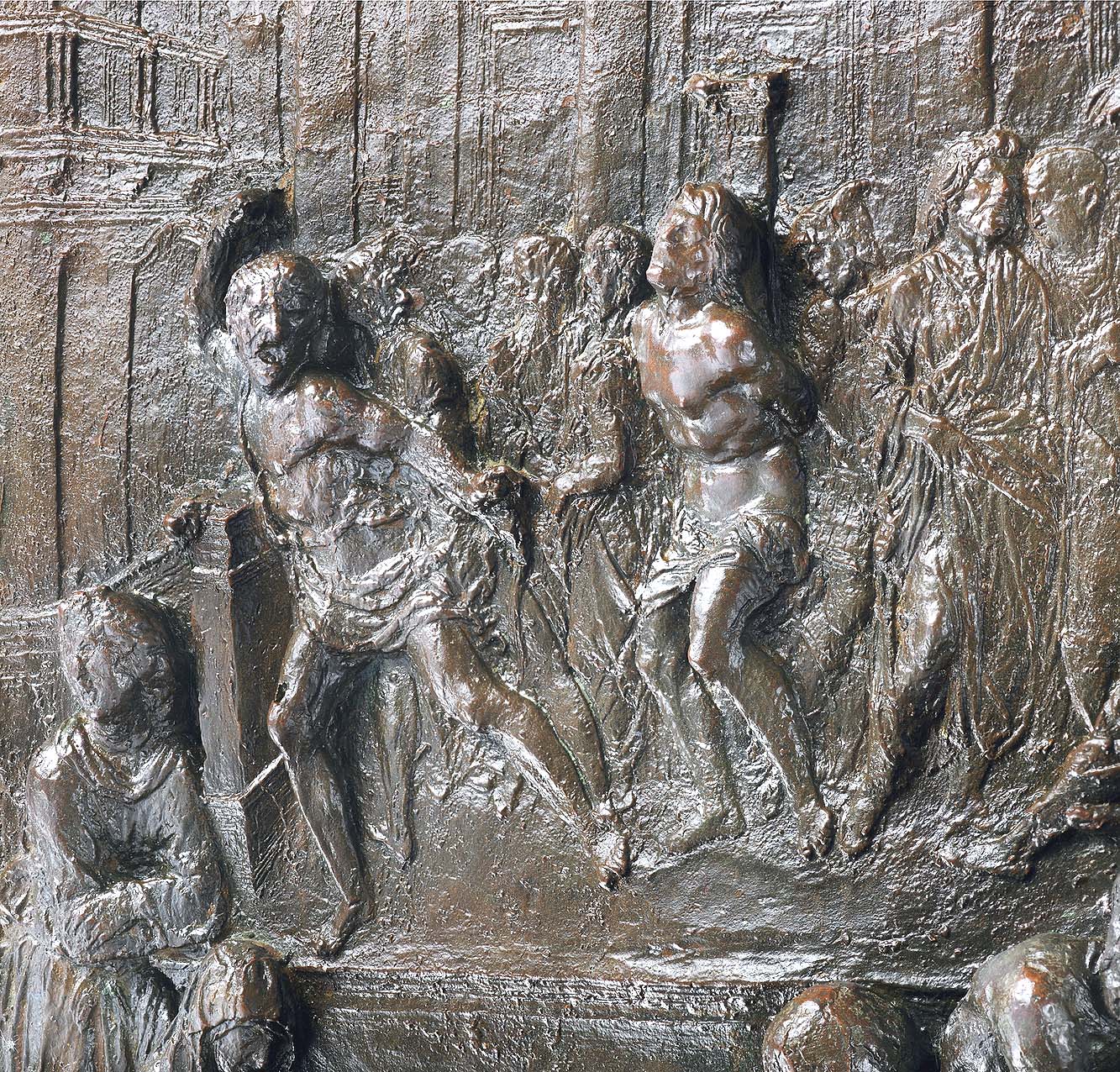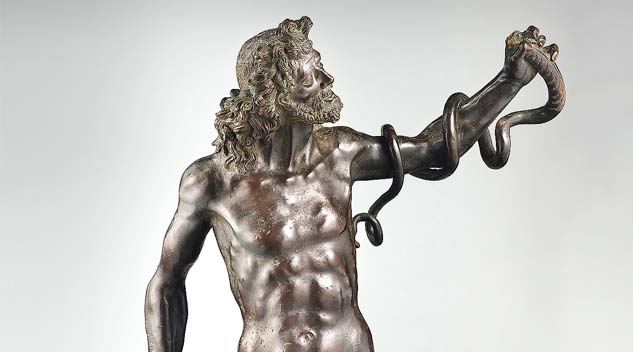
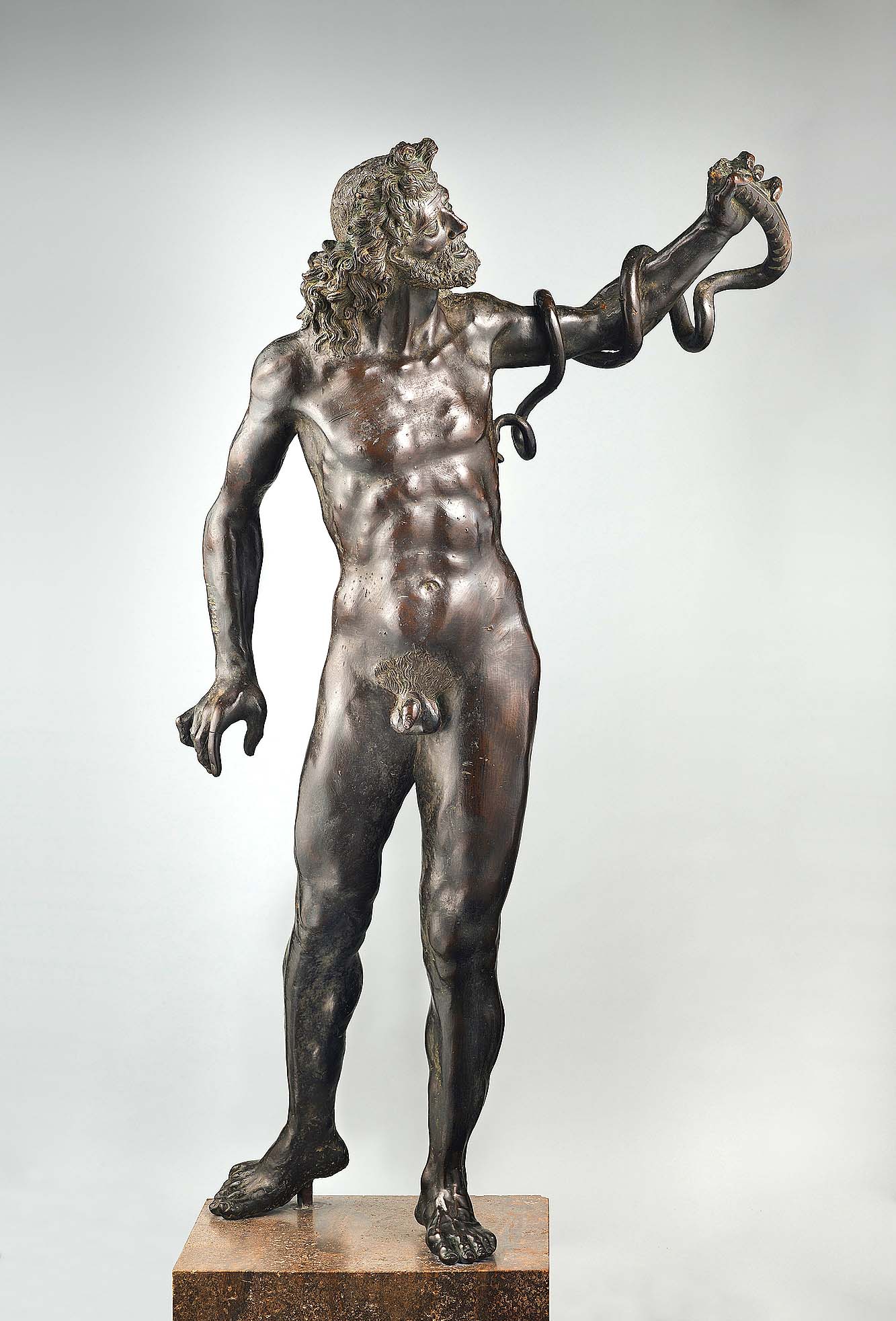
“Hercules Fighting Achelous” by Giovanni di maestro Stefano (Siena, circa 1444-1502) and collaborator, 1489-90, quaternary alloy, approximately 44⅔ by 25⅜ by 16⅓ inches, 250 pounds. Skulpturensammlung, Dresden.
By James D. Balestrieri
NEW YORK CITY — To employ a metallurgical metaphor, when you refine the exquisite base metals, that is, the ideas in “Siena: The Art of Bronze, 1450-1500,” in the crucible of your eye and mind, the theme that pours, red-hot, into a new mold, is quite strong: Of all of the many artistic media, bronze is, by far, the most political. In the introduction to the exhibition’s accompanying catalog, Giulio Dalvit, associate curator at The Frick Collection, makes this clear: “…same expertise that produced a statue produced a bell, and the same knowledge that produced a bell produced a cannon. The founder who understood how metal must move to hold a saint in perfect stillness also understood how it must be shaped to hurl fire across a battlefield; the bronze that rang out over a city at dawn, in its always wholly individual tone, was cousin to the bronze that shook its walls at siege. In the Fifteenth Century workshops, art and artillery were not adjacent fields but the same field, practiced by the same people. By its very nature, bronze casting is a collaborative act that defeats the myth of the solitary genius.”
On view at The Frick Collection through January 18, this exhibition finds in Renaissance Siena, Italy — a city that, even then, lay in the long shadow, and sometimes in the long reach of Florence, just 40 miles away — an aesthetic in which artistic design and casting technology was as much or more a product of exchange as of rivalry. To my particular eye, Sienese bronzes strain, just a bit, back towards the medieval and forwards towards the baroque, but you can study the images on these pages, and, with luck, the bronzes themselves in the exhibition, and decide for yourself.
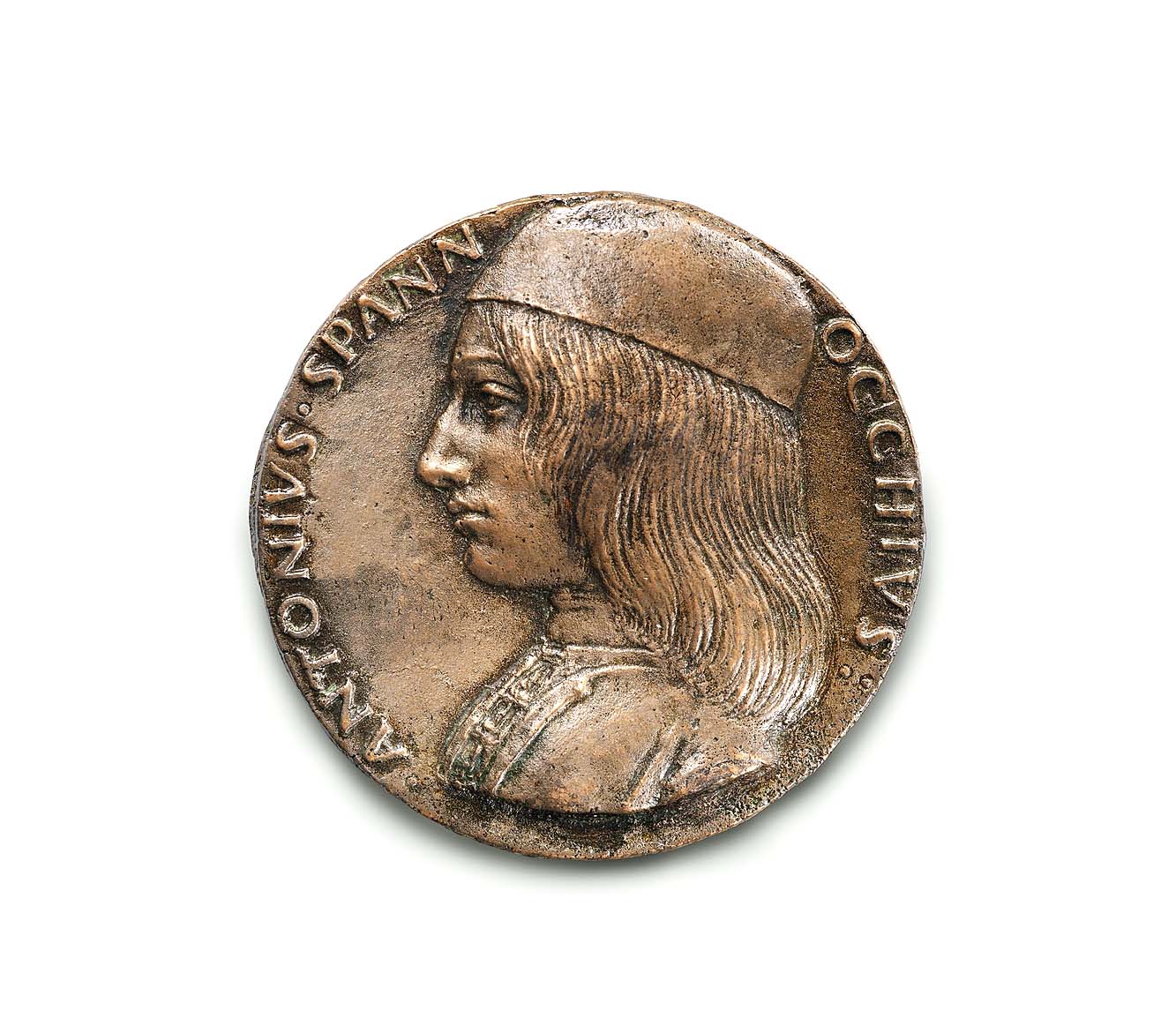
“Antonio Spannocchi” by Francesco di Giorgio (Siena, 1439-Vignano, 1501), “A Salamander Nestling in a Bonfire” is on reverse (not shown), 1490s (possibly 1494), high-tin bronze. Museo Civico, Siena.
The exhibition comprises nearly 40 works — statues, reliefs, candelabra, medals and more — by some of the greatest sculptors of the era, including Donatello, Vecchietta, Francesco di Giorgio and Giovanni di Stefano. Many of these objects have never before been outside of Italy; even fewer have been seen in the United States.
Part of the technical and political challenges Siena bronzeworkers faced was its cost. The metals themselves were expensive and the process was intricate and time-consuming, requiring trained metalworkers whose understanding of chemistry and physics sometimes seemed — and still does — like alchemy. Fashioning saints, or bells, or cannons, was a choice; many great bronzes have found themselves back in the crucible, melted down to shape weapons of war.
Donatello, of course, is the most familiar of the artists represented in the exhibition, largely, perhaps, because he is Florentine. He and his work are of great interest because he lived and worked in Siena from 1457-1461.
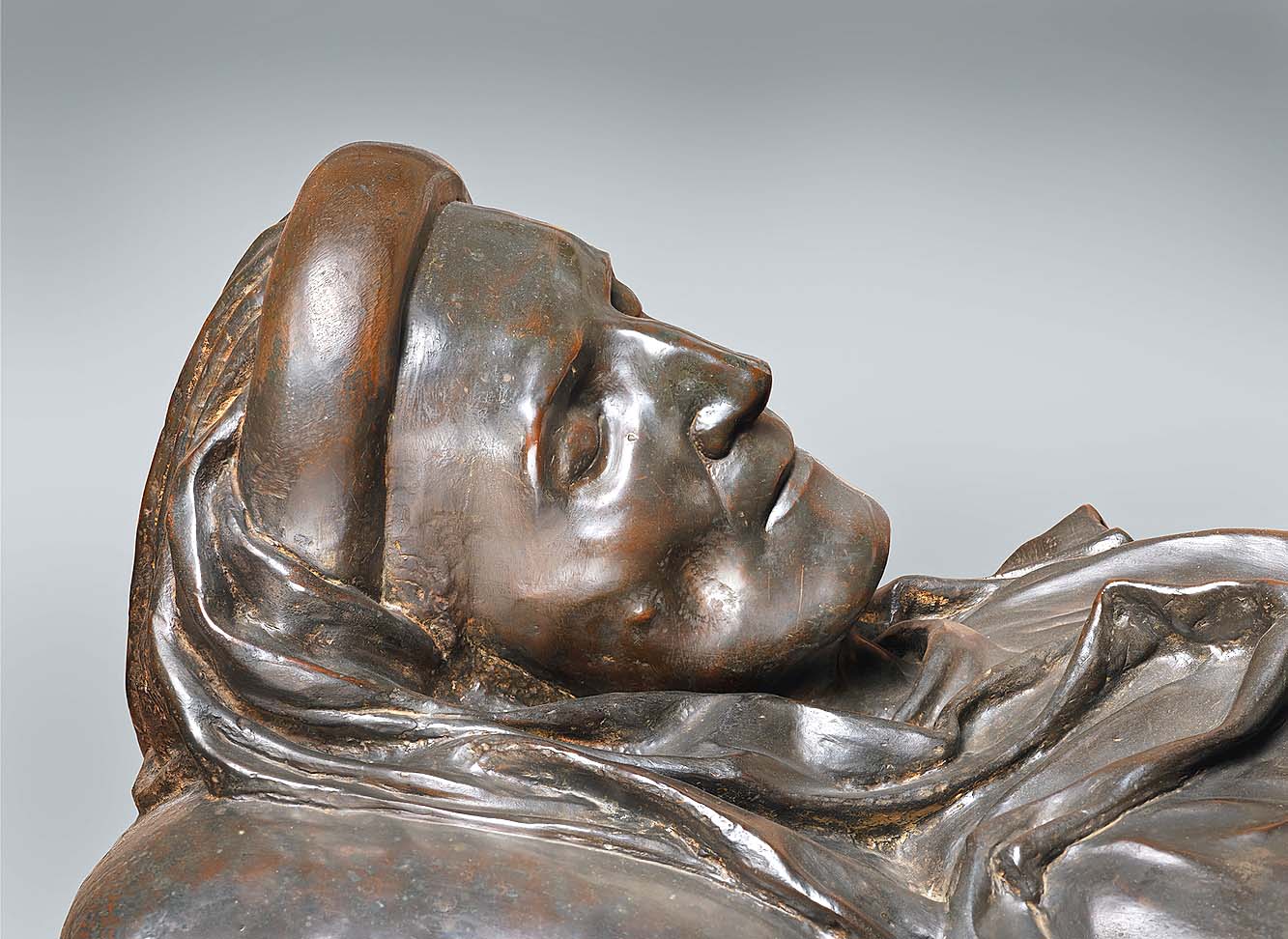
“Gisant of Mariano Sozzini the Elder” (detail) by Vecchietta (Siena, 1410-1480) or Francesco di Giorgio (Siena, 1439-Vignano, 1501), late 1460s or early 1490s, low-tin bronze, elevated arsenic, approximately 18⅔ by 63 by 11⅞ inches, two pieces slotted together, approximately 410 pounds. Museo Nazionale del Bargello, Florence.
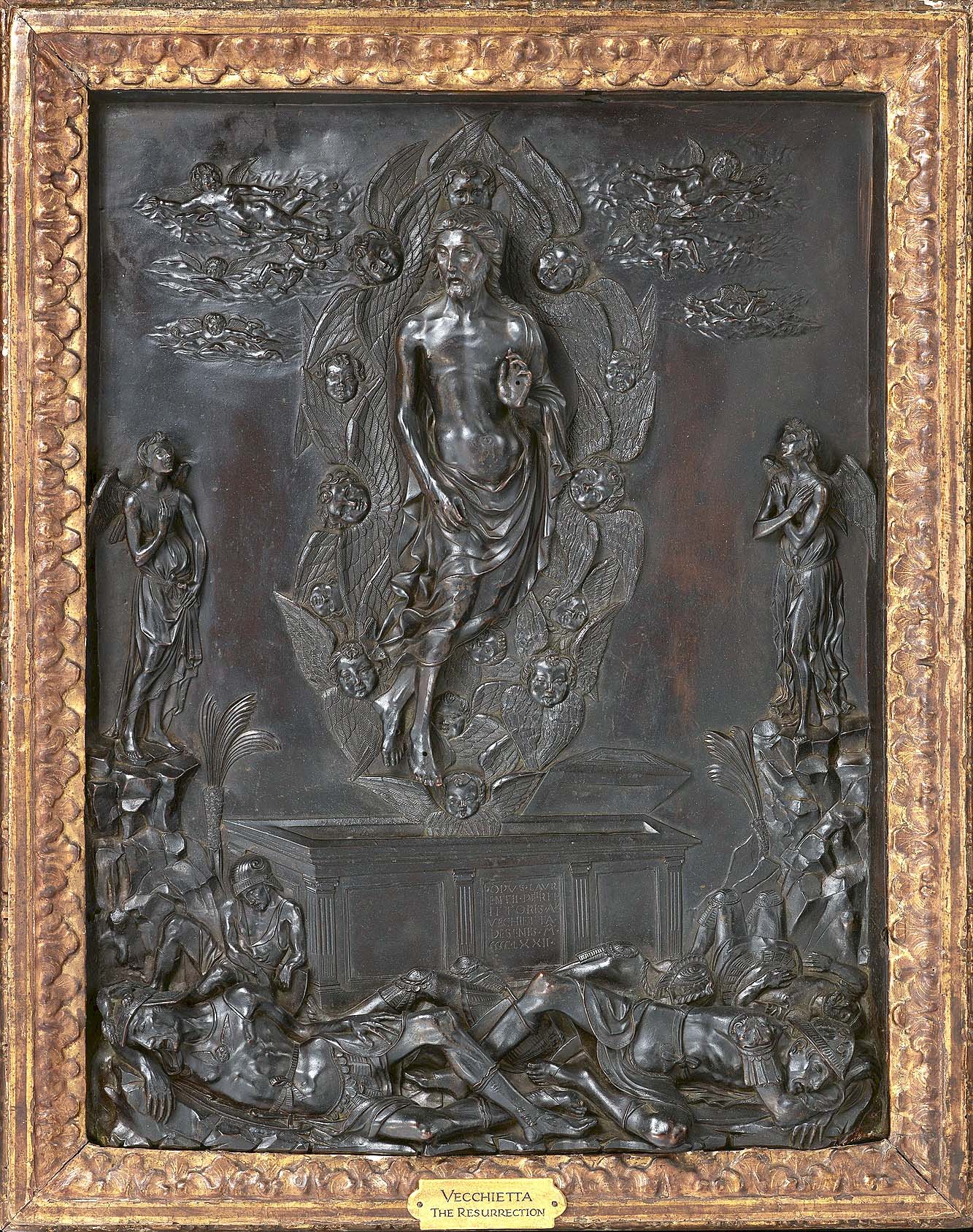
It might be more instructive, then, to begin with a Siena native, Vecchietta (1410-1480) who had a long life and career. Vechietta was a painter, goldsmith and architect, but came relatively late to bronze. That he took visual cues and inspiration from Donatello’s sojourn in Siena is of interest. That by 1472, the year his relief the “Resurrection of Christ” was executed, he had fully assimilated them and transformed them, making them his own, is undisputed. Deliberately repudiating classical perspective, the angels encircling Christ and the guards sprawled at the base of the tomb seem almost emblematically arranged, as in medieval sculpture. And yet the ornateness of the angels in the clouds, and the artful, angular and detailed realism of the slumbering guards somehow moves towards the baroque. Add the negative spaces and the elongated body and limbs of Christ, and the mathematical irrationality of the work, a nod to divinity’s disregard for earthly geometry, almost makes me feel that I am looking at El Greco before El Greco. As Dalvit writes in the catalog entry, the “Resurrection” is as “removed as possible from Donatello’s stiacciato technique and from the material coarseness of his bronzes… [it’s] a manifesto of a different approach to bronze casting, one that prides itself on its jewel-like quality and its sculpturality,” yet another link — an foreshadow, perhaps — of the baroque future of European bronze.
I was looking forward to the catalog chapter on Donatello (circa 1386-1466). What I read upended my expectations and proved far more intriguing, a word I use deliberately because Donatello’s time in Siena (1457-61) was a time of unusual intrigue and outright strife between Siena and Florence — and Donatello was caught in the middle of it. Accordingly, the chapter on Donatello is replete with commissions that never came to fruition, accusations of bills unpaid and artistic frustrations galore as factions that favored Florence and factions that championed Siena variously controlled the budget for public art.
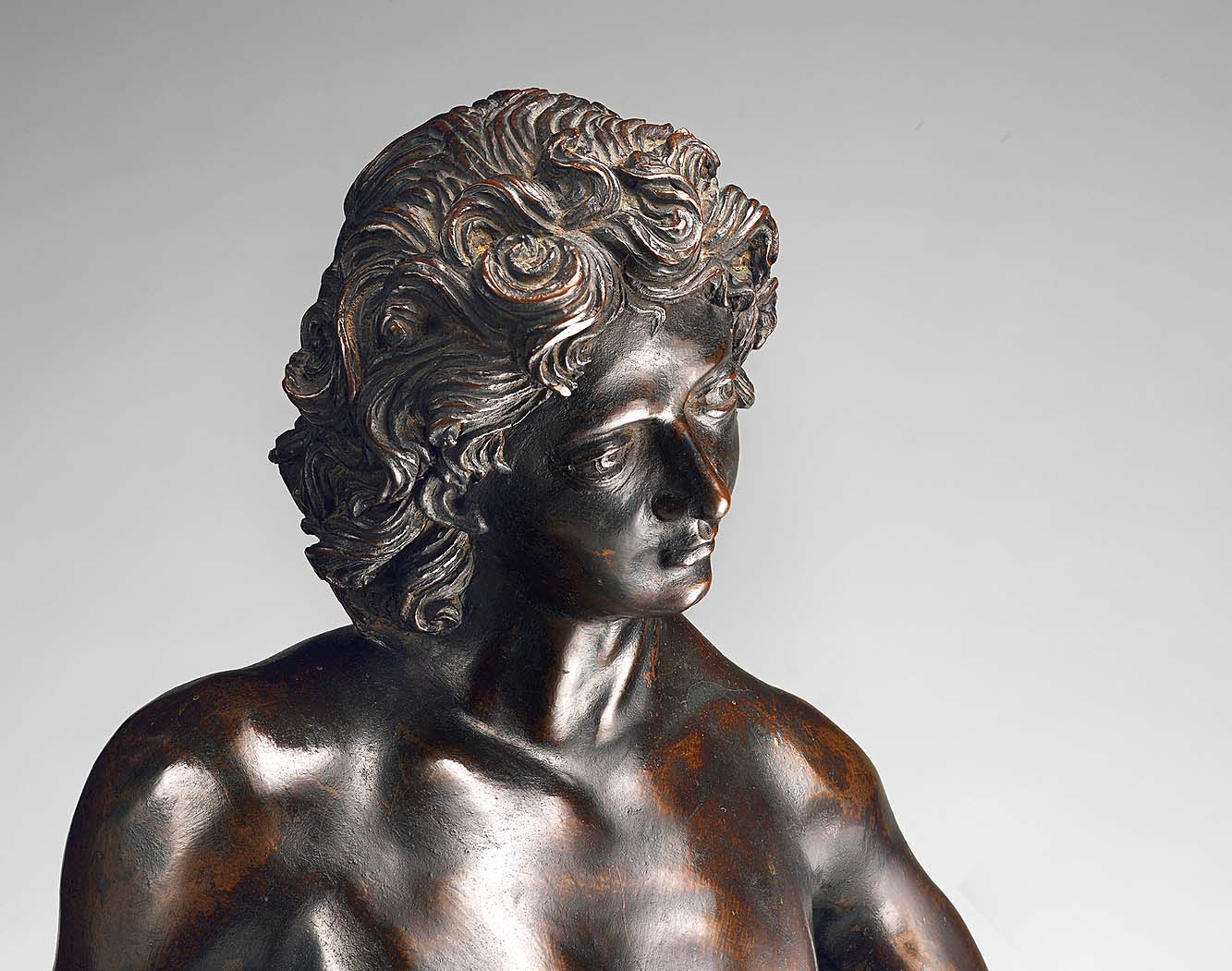
“David with the Head of Goliath” (detail), attributed to Giovanni di maestro Stefano (Siena, circa 1444-1502), circa 1490s, low-tin bronze. The Frick Collection, New York.
“Tomb Slab of Giovanni di Bartolomeo Pecci, Bishop of Grosseto and Istia d’Ombrone,” cast circa 1452 (though the dating is the subject of reappraisal) resides in the Cathedral of Santa Maria Assunta in Siena. Though worn over time, the relief, quite shallow, retains its vitality (a strange word considering the subject, but one you will find has some meaning in the analysis of the work).
Dalvit writes that famed art historian Erwin Panofsky saw in the tomb slab, “a paradox in the figure’s construction: the upper body read as horizontal, the lower as vertical — an impossibility captured in the earliest documents about the tomb, which describe it both as a ‘statue’ and as a ‘bronze panel sculpted in bronze…’ The bishop appears simultaneously as corpse on earth and resurrected body in heaven, compressing death, memory and the promise of resurrection in a single image.”
In the tomb slab the earthly and the celestial have an uneasy, even clashing relationship — each shadows the other. In the arts, the shadow of economic reality often falls on our aesthetic dreams. Donatello may well have cast this dichotomy in bronze.
The striking of commemorative medals in bronze and other metals was a hallmark of Sienese metalwork — and Renaissance metalwork in general. This served a number of purposes: as a diplomatic tools containing subtle and not-so-subtle messages, and, as seems likely, as marketing tools — similar to prints — for the many competing workshops.
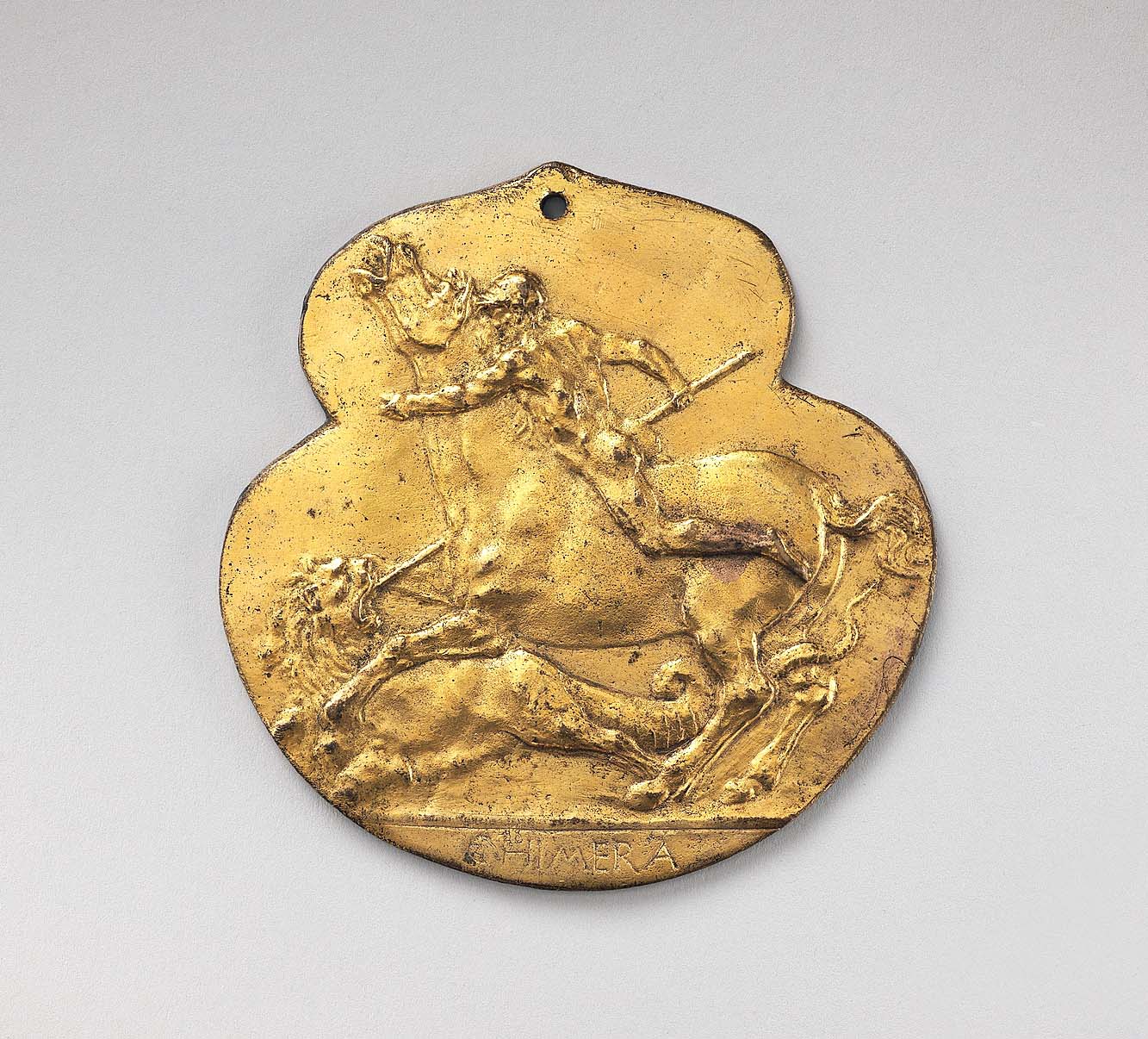
“Bellerophon and the Chimera” by Francesco di Giorgio (Siena, 1439-Vignano, 1501), 1470s, medium-zinc brass, gilded on the front, approximately 3¾ by 3⅔ inches, 6.73 ounces. Staatliche Museen zu Berlin, Skulpturensammlung und Museum für Byzantinische Kunst.
“Bellerophon and the Chimera” by Francesco di Giorgio Martini (1439-1501) demonstrates the artist’s understanding of classical motifs, superb craftsmanship, and also shows the skill required to gild a zinc brass planchet. With the somewhat odd inscription: “Chimera,” the intention of the figure on the obverse, Federico da Montefeltro (1422-1482), di Giorgio’s patron, becomes ominous.
According to the catalog, “[T]he word chimera, unlike Bellerophon, lends itself to a poignant double meaning in that a chimera, in vernacular Italian, is both the monster and an unlikely dream, a vain or idle fancy. As such, the plaquette can be understood as a subtle reflection on the nature of enmity. Alternatively, but less likely, it could be read as ‘chi m’erra’ (who wrongs me), perhaps indicating the deadly fate of one’s enemy.”
Seemingly created with an unknown collaborator circa 1489-90, the serpent in “Hercules Fighting Achelous” by Giovanni di maestro Stefano (1443-circa 1502) has been classified as representing Aesculapius, the god of medicine who appears to this day on the staff of Asclepius or caduceus that signifies healing or Laocoön, a Trojan priest in mythology beset by serpents at Apollo’s behest because of his transgressions, including warning the Trojans against the treachery of the Trojan horse. The story scholars have settled on is one in which Hercules tames Achelous, a river god. The river is diverted, creating new fertile lands, and the water of Achelous metamorphoses into the water that would have been mixed with wine. The pose of the bronze refers directly to the “Apollo Belvedere,” unearthed in 1488, and the satiny finish seems designed to replicate the reflective properties of the original marble and to foreshadow, once again, the sculpture of the baroque period and beyond.
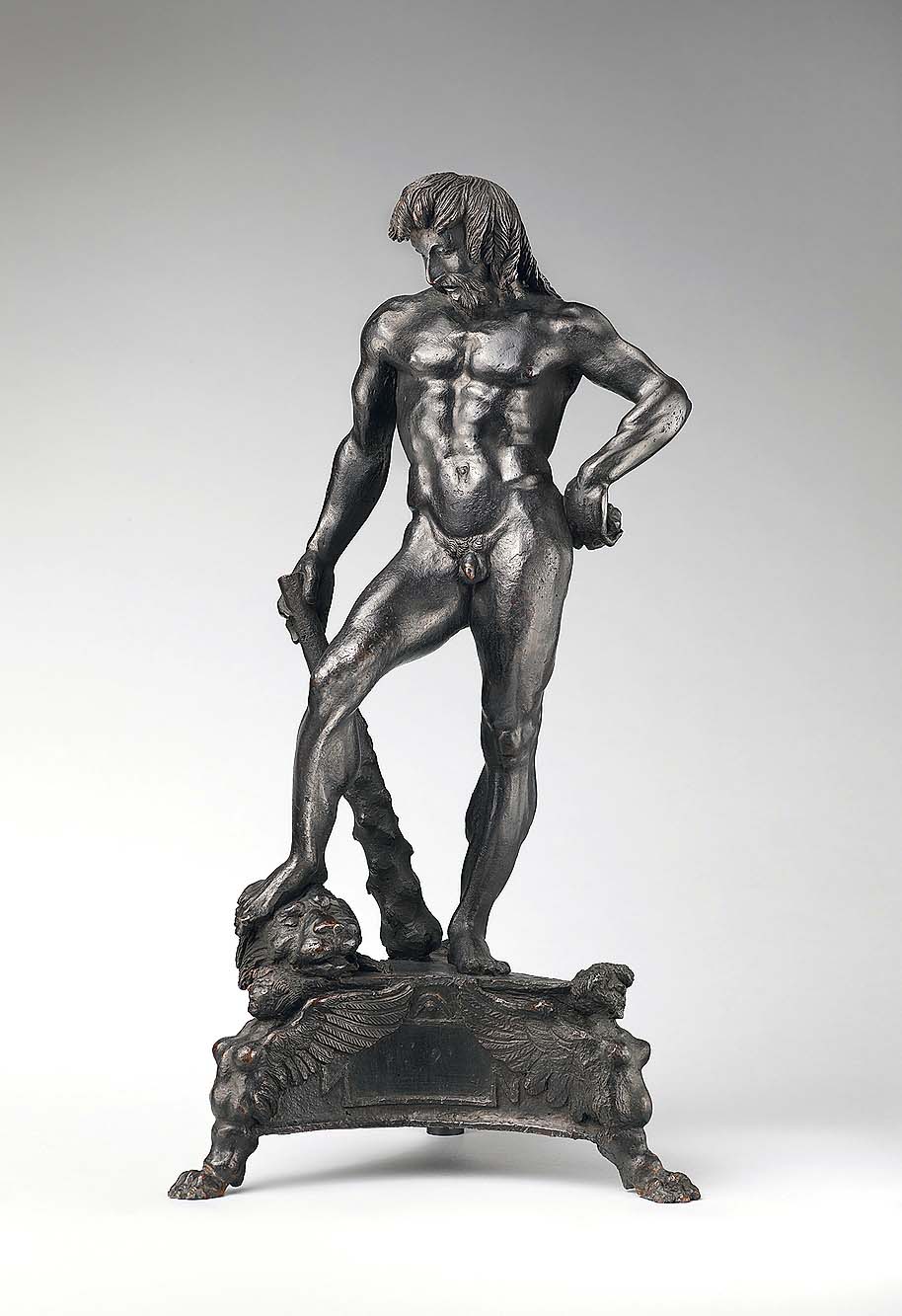
“Hercules Triumphant over the Nemean Lion,” attributed to Francesco di Giorgio (Siena, 1439-Vignano, 1501), late 1480s (?), quaternary alloy, elevated antimony, approximately 15⅝ by 8⅛ by 7 inches, 17.6 pounds. Staatliche Museen zu Berlin, Skulpturensammlung und Museum für Byzantinische Kunst.
In life as in geography, big brothers don’t like to admit to learning anything from their younger siblings. Renaissance Florence and Siena stand as cases in point. I know what it is to live in the shadow of a big-shouldered polis: Chicago, in my case, whose inhabitants sometimes refer to Milwaukee as “Chicago North.” Our cities have never come to blows as Siena and Florence did; we come close when the Brewers play the Cubs, yet despite our many differences — the arts not the least of these — the story of the movement of people and ideas between Milwaukee and Chicago, like that of Siena and Florence, is fluid and productive.
Casting bronze casts its own shadows — artistic, ecclesiastic and political. A great bronze, whether of a saint, a bell or a cannon, reveals its form, and, by extension, its meaning, as much through the shadows it casts as through light it reflects. In the end, perhaps, “Siena: The Art of Bronze, 1450-1500,” reminds us that art is not divorced from the time of its making, that its making is often, if not always, more complex than we think, and that the shadows artworks cast are sundials of their own time and place, as are ours.
The Frick is at 1 East 70th Street. For information, www.frick.org or 212-288-0700.