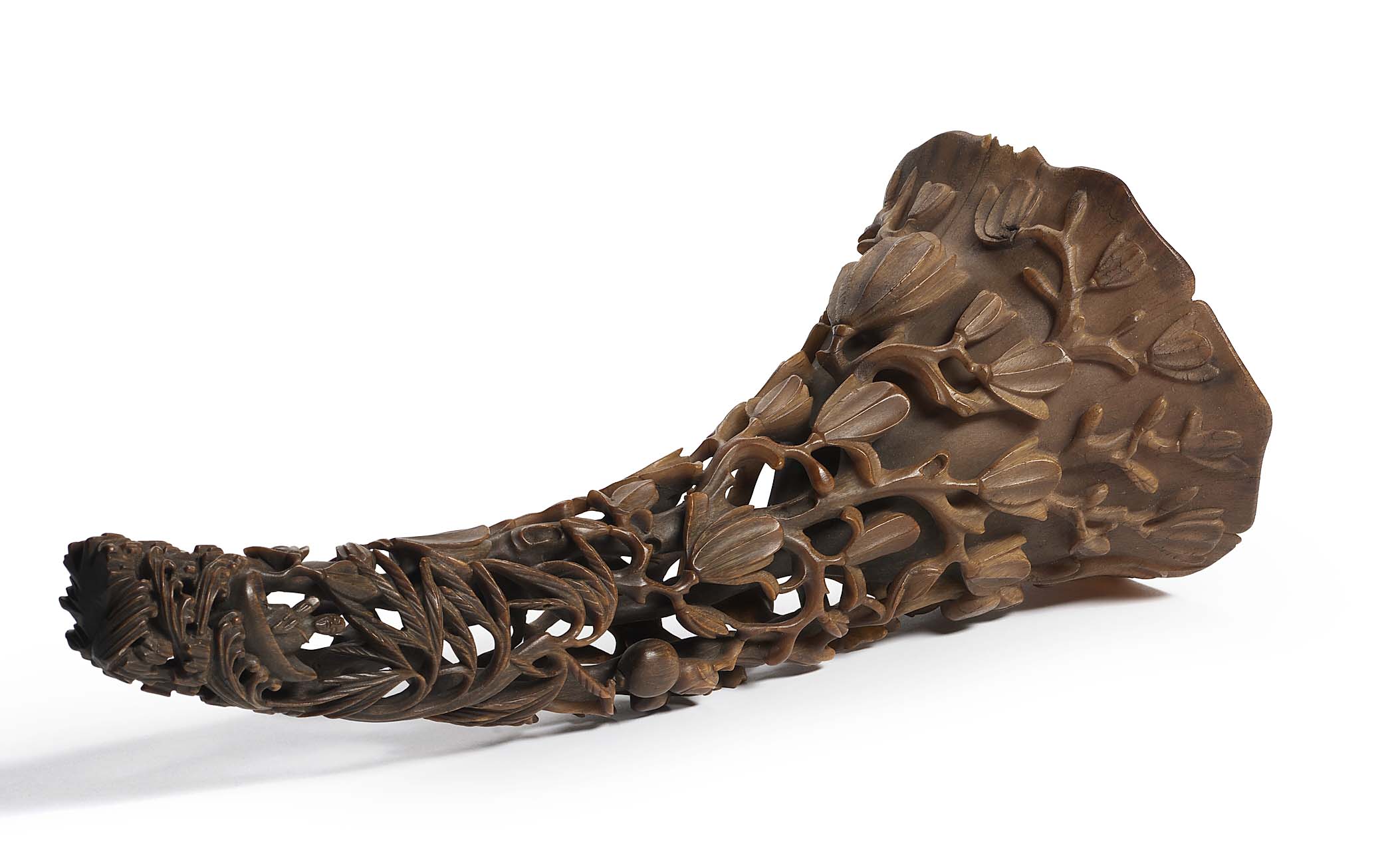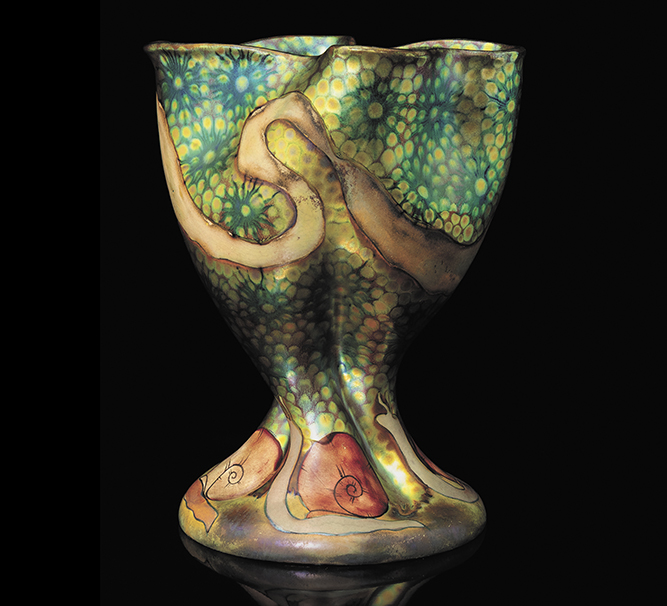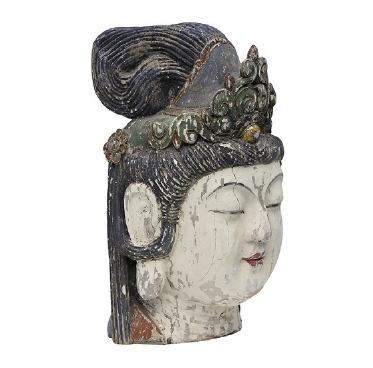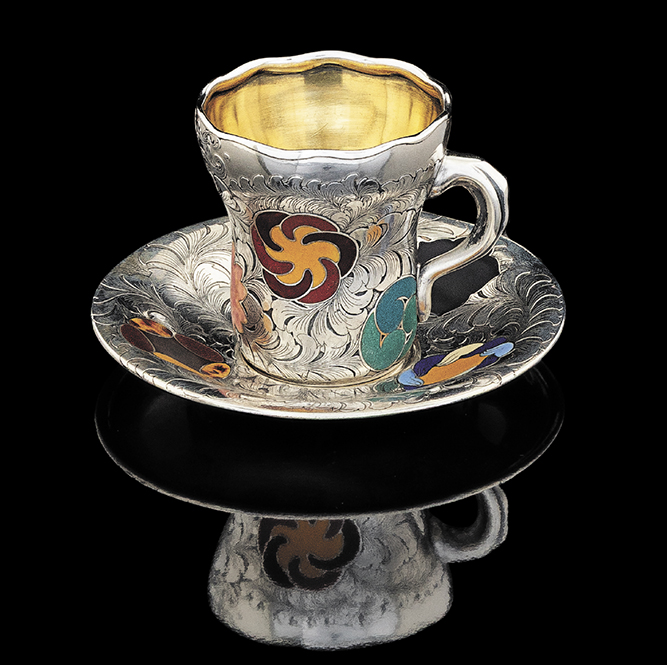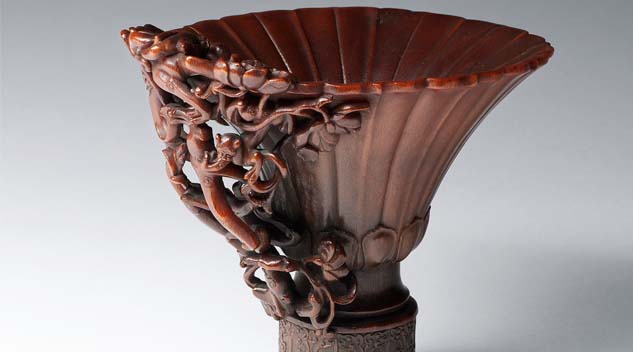
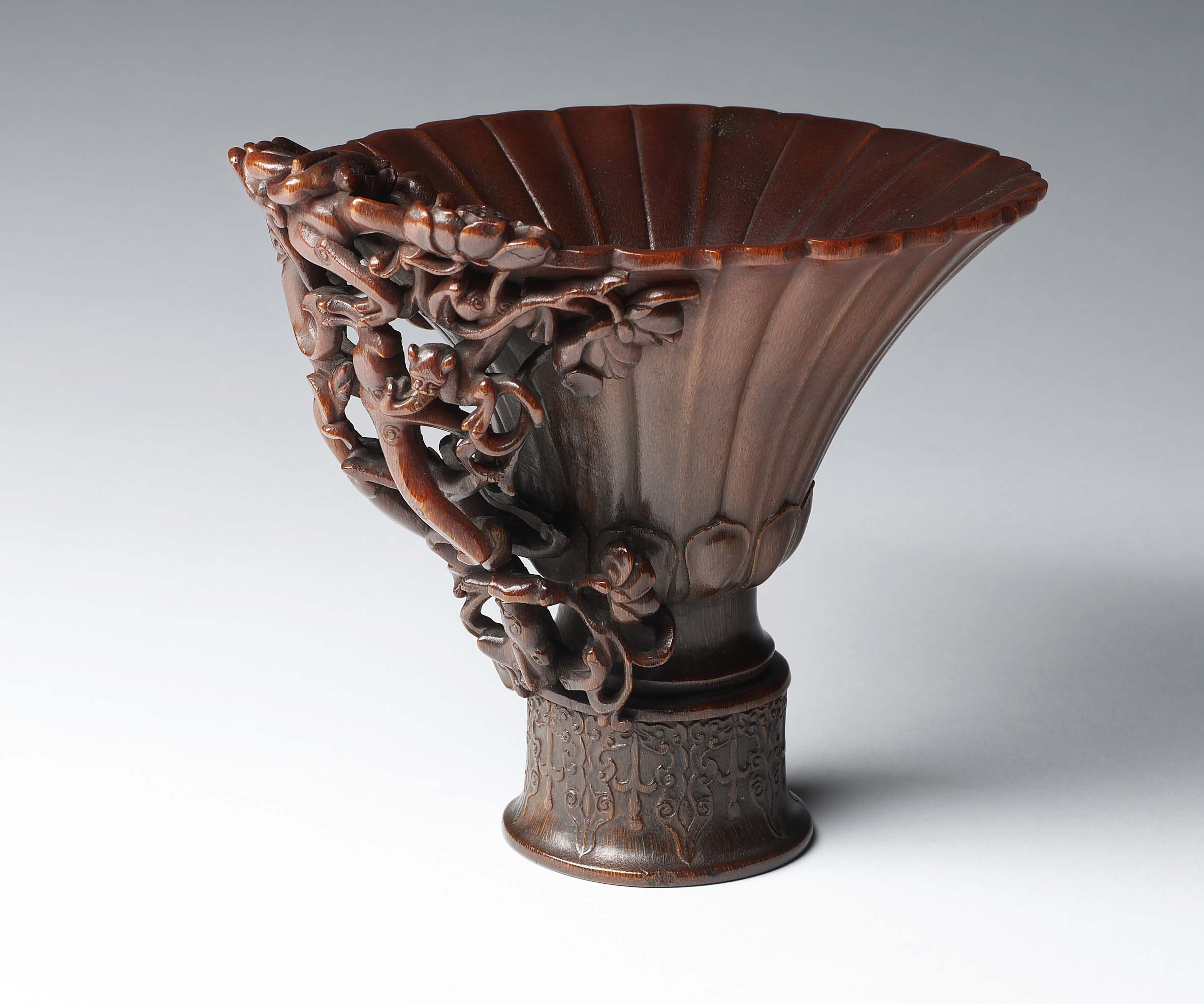
Rhinoceros horn cup, Chinese, Seventeenth Century, 4¾ by 5-13/16 inches. 72.9.
By Kristin Nord
BALTIMORE — For thousands of years, exotic animal parts have been transformed into extraordinary objects for the very rich. In “Luxury & Loss: Feather, Shell, Tusk, Horn,” an exhibition on view through January 24 at the Walters Art Museum, we get a dazzling glimpse at the range of objects that were so coveted during the Gilded Age.
The exhibition draws upon both William Walters’ and his son, Henry’s, collections of Asian, European, American and African art, as well as private and institutional loans. About half of the 94 works are elephant ivories, with other objects made from kingfisher feathers, tortoiseshell, coral, whale baleen, bone, hide and rhinoceros horn.
Aline B. Saarinen, in her book, The Proud Possessors, noted that “The strategic change in American collecting and taste came with the new economic era that began in the 80s. The increasing population, the exploitation of natural resources and the whole expanding economy created enormous fortunes and released men from physical labor into the pursuits and professions of a leisure class. Searching for a stage-set, or reacting against the new America, the new very rich looked naturally to Europe and began hankering to re-create Europe here,” she wrote.
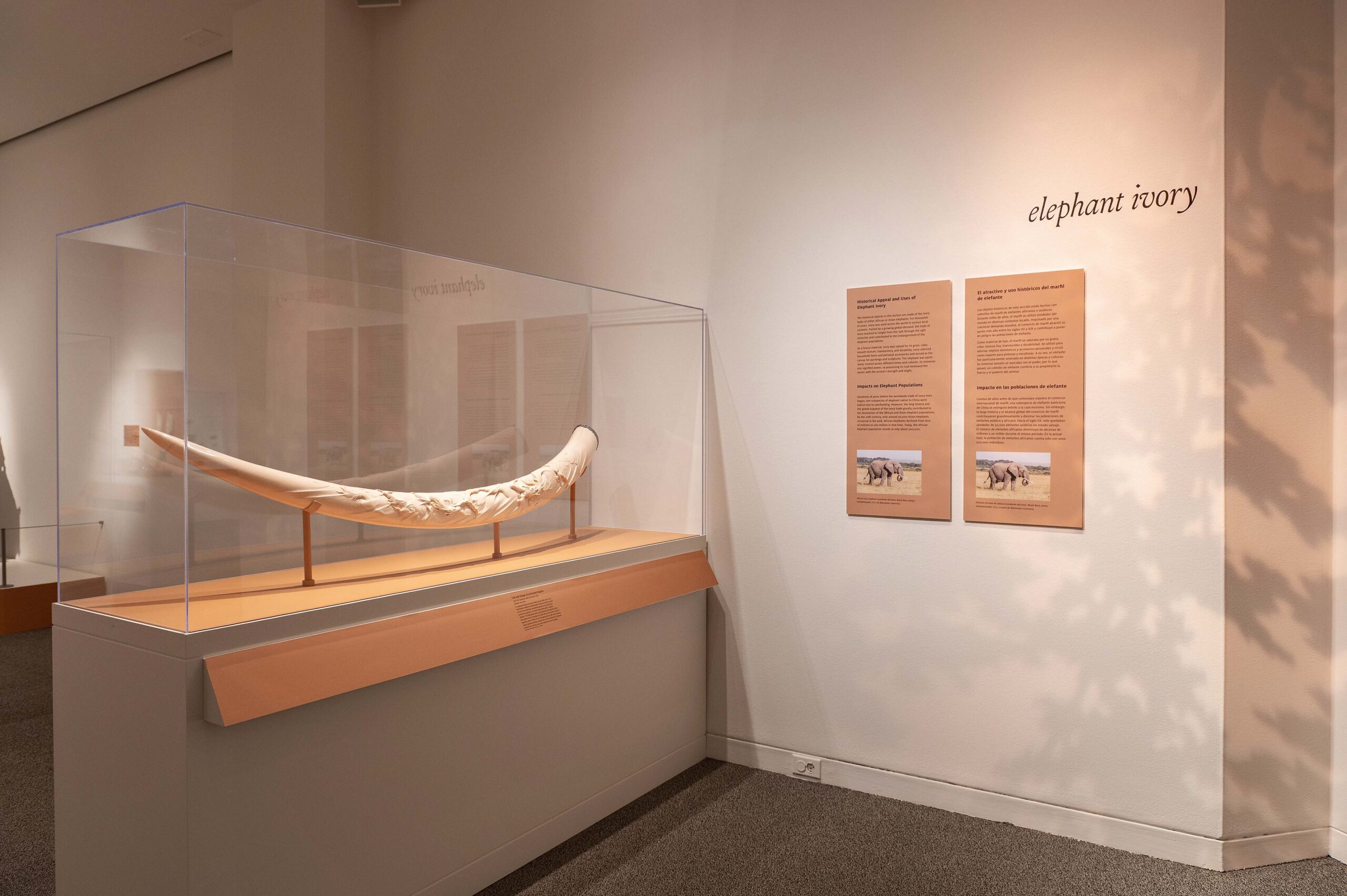
An installation view of the exhibition includes this elephant ivory tusk that was carved with confronted dragons and had a silver cap.
William R. Johnston, author of the definitive William and Henry Walters: The Reticent Collectors, touches on the family traits that kept the family somewhat under the radar in comparison to other major collectors such as Isabella Gardner Stewart or J.P. Morgan, two marquee collectors of their time. For one thing, Johnston wrote, William Walters was as a self-made individual of modest beginnings and little formal education who soared, Horatio Alger-like, “through grit, determination and a flair for business,” He amassed his fortune in the highly competitive field of railroad financing — and yet, as a Southern sympathizer, had chosen to sit out the Civil War in Paris. His son was a beneficiary of his father’s investment in his education but later expanded upon his father’s business ventures and his art collection in great leaps and bounds.
“As a true philanthropist,” Johnston said, of Henry, “without revealing his identity, he extended his generosity to various causes, most often those pertaining to art appreciation, education and health. And quite possibility it was in his desire for anonymity and his wide support of various causes that the full story of his holdings has yet to be told,” Johnston wrote. In that regard, a similar comparison can be made to Catharine Lorillard Wolfe, an exceedingly wealthy New Yorker, and the sole female founder of the Metropolitan Museum of Art, whose philanthropic gifts were widespread and today remain largely unknown — with the exception being the Art Club in her name, established in 1896 to provide aid, counsel and exhibition opportunities to young female artists in New York City.
By the 1870s, after returning from Europe, as William’s fortunes and collection grew, he began the practice of opening his house to visitors to see his growing art collection, charging an admission fee, the proceeds of which were to benefit the Association for the Improvement in the Condition of the Poor.
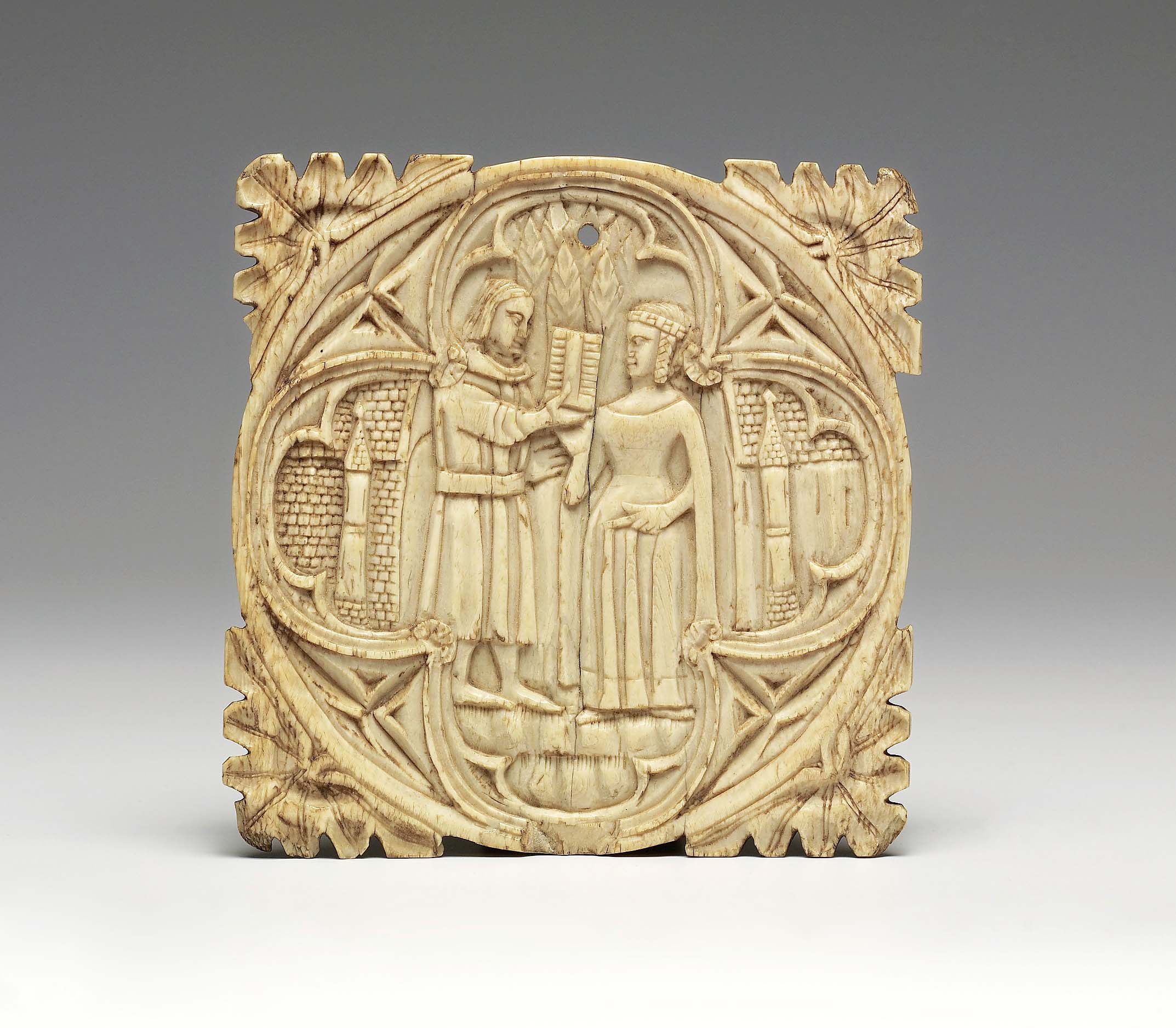
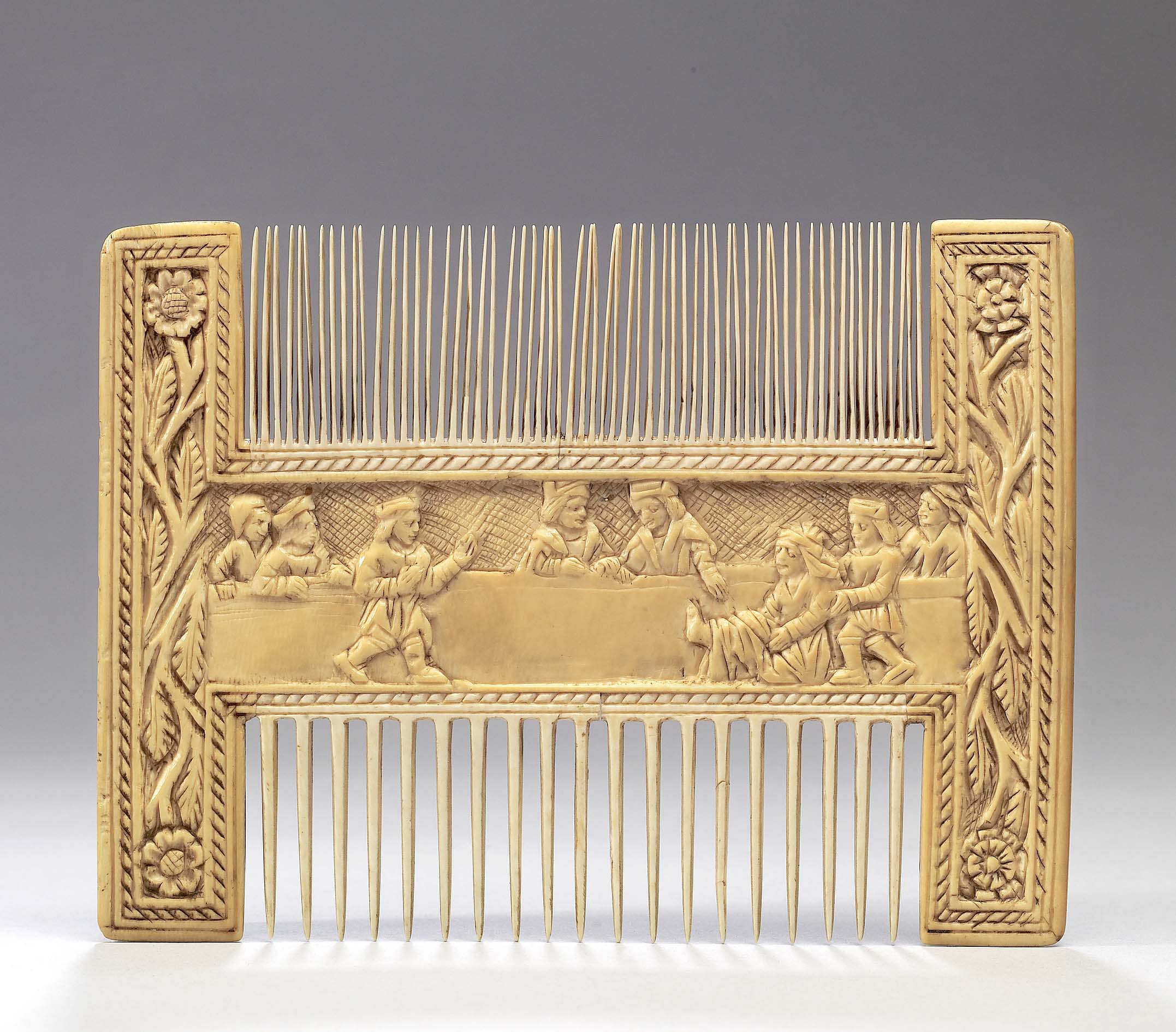
Mirror Case with the Gift of the Comb, 1390-1400, Italian, elephant ivory, 3-13/16 by 3-11/16 by 5/16 inches. Acquired by Henry Walters, 1903. 71.269.
William opened his picture gallery in 1884 and died ten years later, in 1894. After his father’s death, Henry went on what amounted to a massive spending spree, building upon his father’s original inventory in a masterful transformation that would make it one of the most important small museums in North America.
The Walters Art Gallery was established in 1934 “for the benefit of the public.” In 2000, it was renamed the Walters Art Museum, a change that reflected the museum’s role as a major public cultural institution. The museum’s original collection and now three of the museum’s five buildings are owned by the city of Baltimore and stewarded by the Walters.
Today, some 36,000 art objects are housed in five historic buildings, from Nineteenth Century paintings of French country and city life to Ethiopian icons, richly illuminated Qurans and Gospel books, ancient Roman sarcophagi and images of the Buddha.
The two collectors shared passion for Asian art and were obviously taken by the dazzling objects that are now showcased in the current exhibition.
“Neither William T. nor Henry Walters traveled to East Asia; their exposure to East Asian art through the Nineteenth Century was primarily through the artworks displayed at the world’s fairs and international expositions,” said Dany Chan, the museum’s associate curator of Asian art and the curator of this exhibition. “Additionally, the two engaged dealers based in New York and Paris for East Asian artworks. For Islamic art, they also worked with dealers based in the Islamic world, such as in Cairo.”
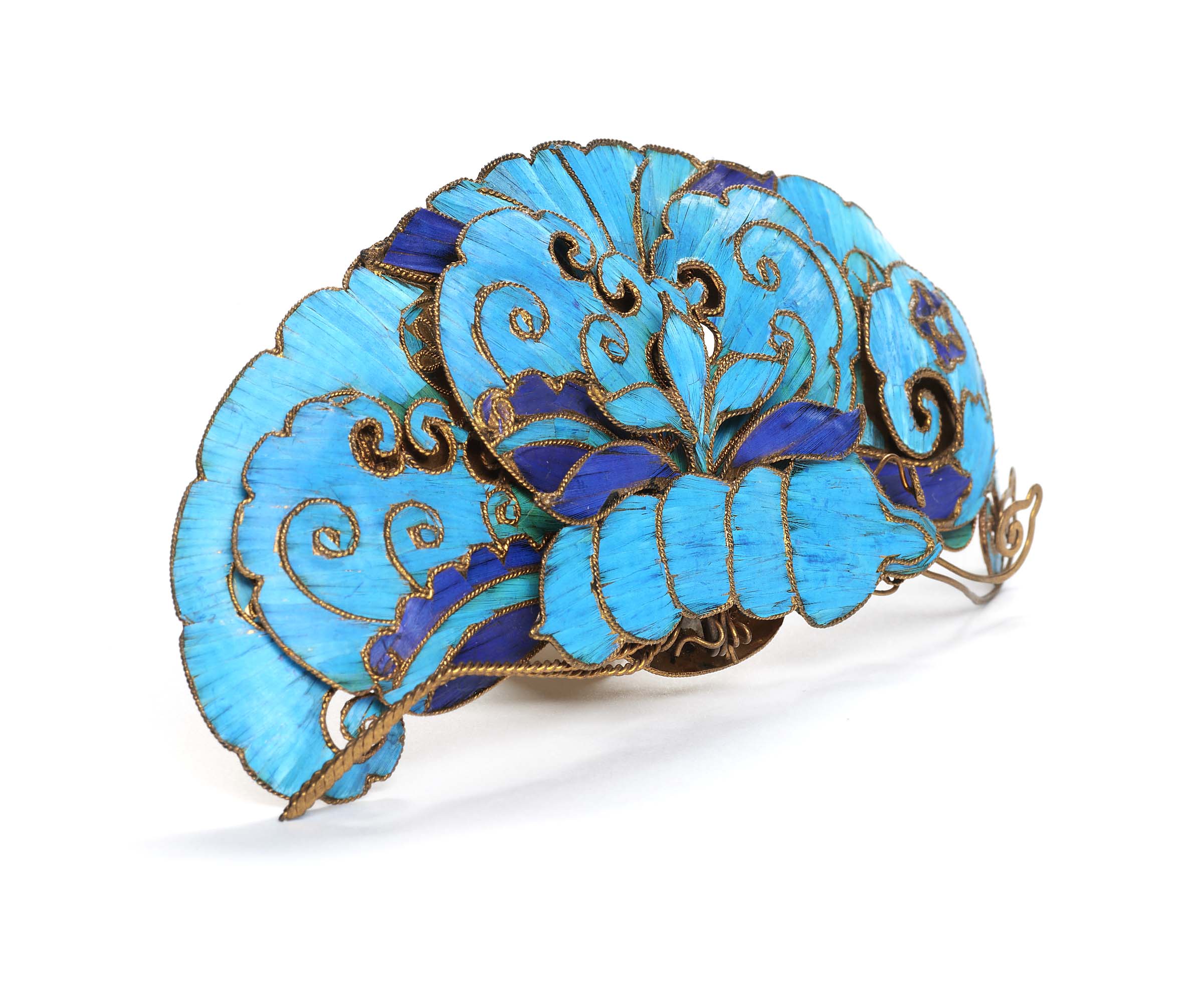
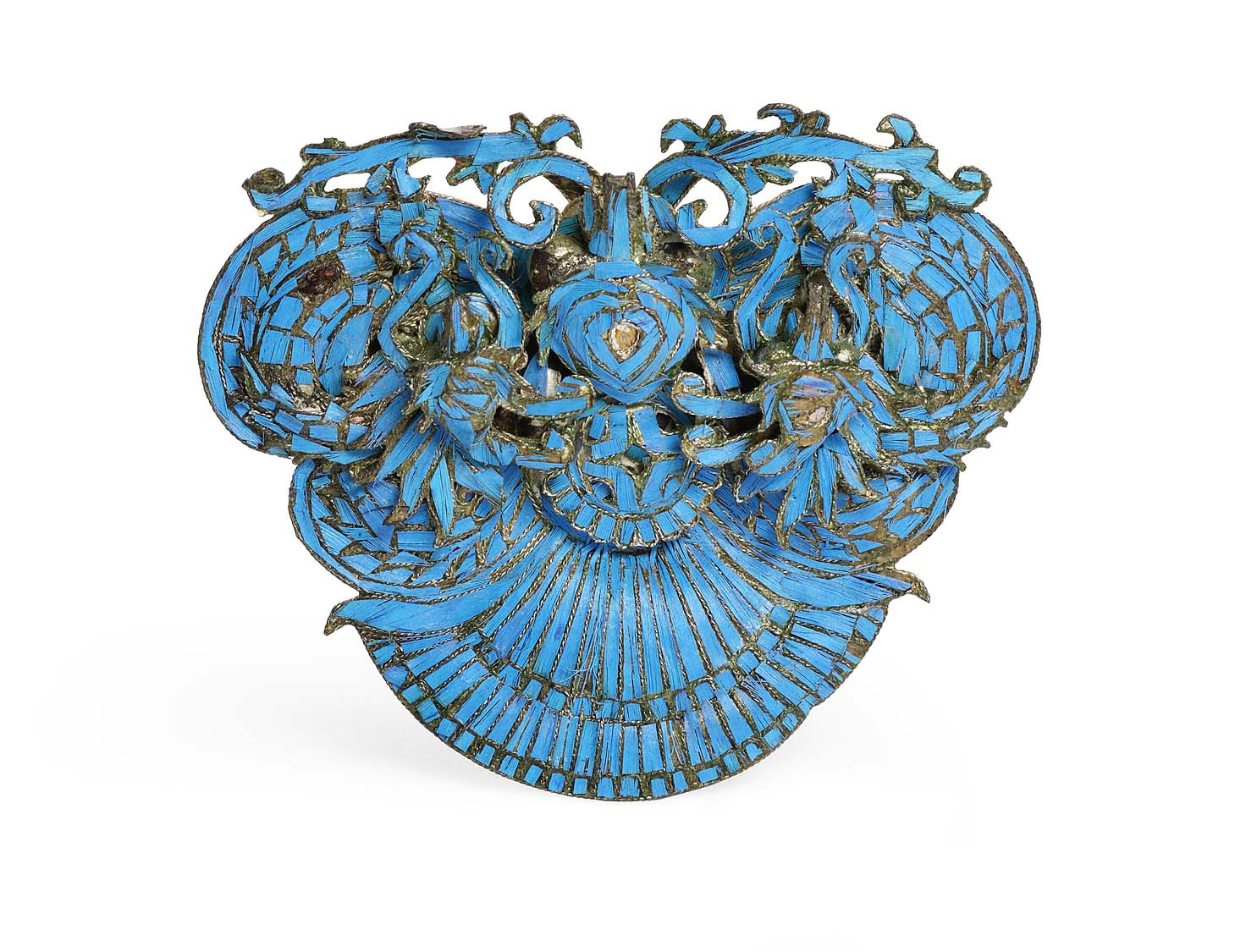
Hair ornament, Chinese, 1800-1900, kingfisher feathers and gilded copper alloy, 1⅞ by 3 13/16 by 11/16 inches. Gift of Miss Ina B. Paul, 1963. 86.14.
During the Gilded Age, natural resources were seemingly there for the taking, and Chan, when asked, said there is no known documentation in the museum archives on whether father or son wrestled with ethical questions surrounding the profligate slaughter of these exotic creatures.
As a luxury material, ivory was valued for its grain, color, smooth texture, translucency and durability. In high demand from the Fifteenth through the Nineteenth Centuries, it was used in all manner of luxury goods, from household items and personal accessories to canvases for painting. France had emerged in the Thirteenth Century as a notable center for ivory carving, and Nineteenth Century industrialization in Europe and North America furthered opportunities for commercial trade. One can imagine Henry Walters’ eagerness to snap up a Chinese cabinet decorated with inlaid ivory, or why a carved tusk with scenes of African life would appeal to him as a prestige souvenir. And what collector of means could resist the sculpture of a spiny lobster, crafted from separate ivory pieces that enable the object to flex and move? (The spiny lobster is still a luxury seafood in Japan, a staple at New Year’s celebrations, and is seen as an embodiment of good fortune.)
“I wouldn’t necessarily say that they specifically sought out carved ivory — Japanese ivory objects, for example, were available for export and acquisition at the various world’s fairs that the Walters attended,” Chan commented. “However, ivory was indeed important to Japan at this time. For Japanese leaders during the Meiji period (1868-1912), ivory represented modernity. World leaders of the time had increased access to raw materials and established factories that could mass-produce ivory goods that were traded within a global network. The Meiji government participated by distinguishing their ivory goods with an emphasis on handicraft and decoration rooted in Japanese culture. With access to the global ivory trade and increasing supply, Japanese artisans created ivory artworks that were displayed at world fairs and exported around the globe.”
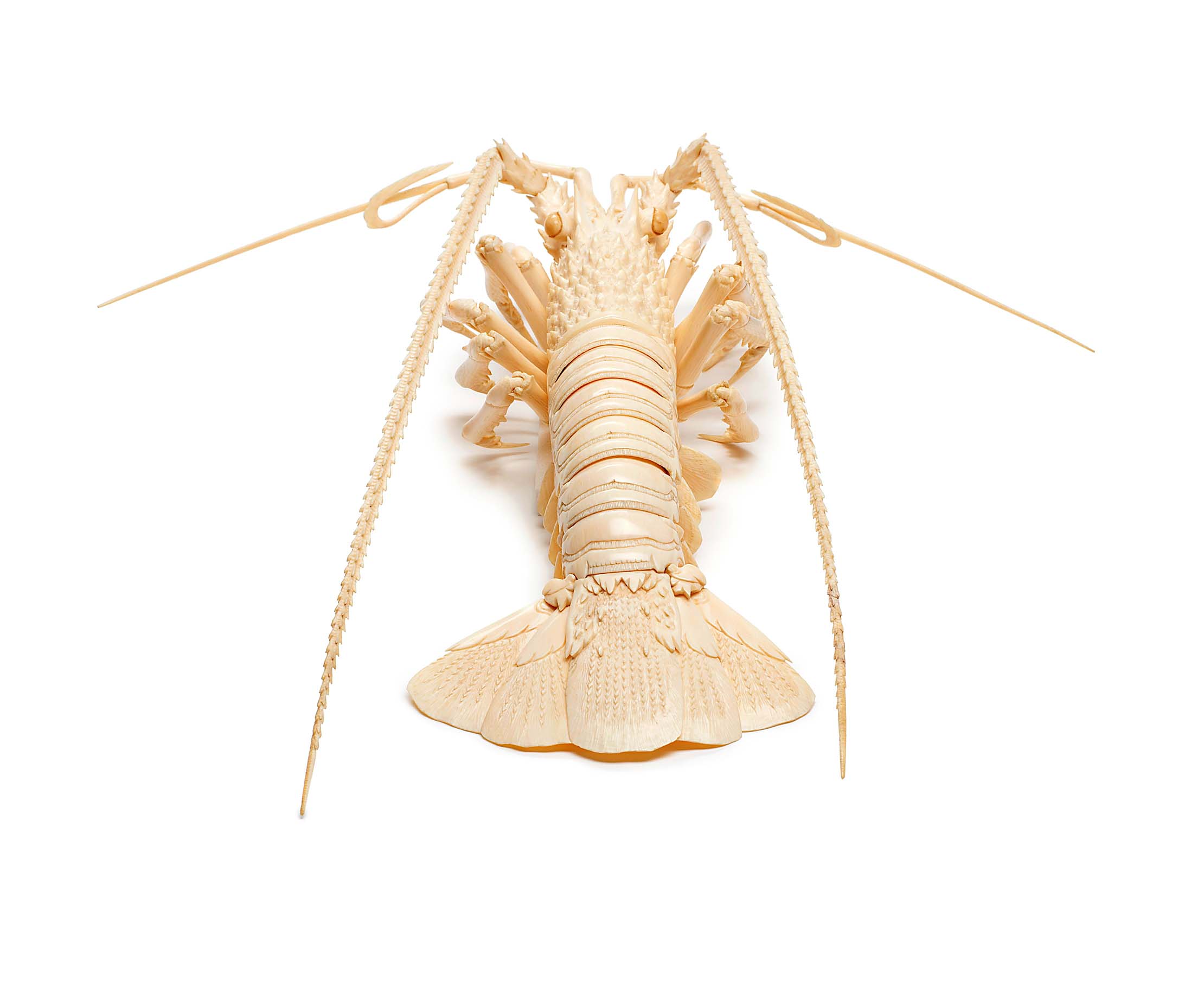
Spiny lobster, Japanese, second half Nineteenth Century, elephant ivory, 2-15/16 by 8-9/16 by 13-9/16 inches overall. Gift of Ambassador and Mrs William J. Sebald, 1976. 1976.76.55.
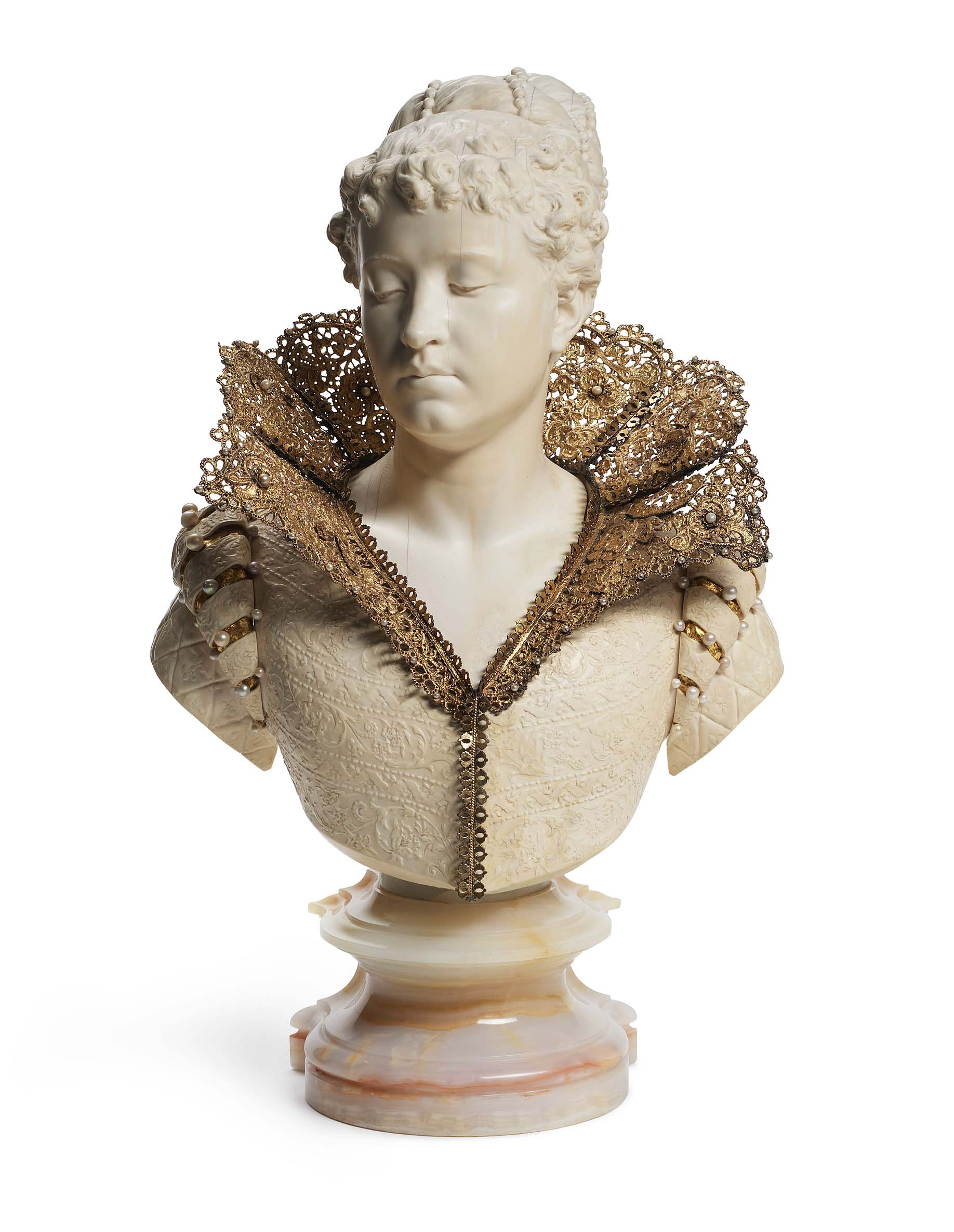
Among the ivory objects on display is a decorative bust of a Florentine woman, crafted by the French artist Augustin Jean Moreau-Vauthier (1831-1893), a Chinese brisé fan and a mammoth ivory goblet with royal portraits, carved from a tusk believed to have come from Siberia. In the US, ivory sourced from Africa and imported in thin sheets from England became a highly popular canvas for miniature portraits.
Carved rhinoceros horn was valued not only for its patterning and translucency but — in Chinese and Vietnamese cultures, in particular — for its purported medicinal properties. Historically, traded horn came from two species — Javan rhino and Sumatran rhino, both of which are critically endangered today. Three drinking vessels are displayed, one of which is carved, with elaborate piercing scrollwork, into the shape of a flower. A traditional round shield from the Beja culture, a nomadic people of Eastern Sudan, made of hippopotamus or rhinoceros hide, underscores yet another of the material’s multiple uses. The Convention on International Trade in Endangered Species (CITES) issued a ban on international commercial trade of rhinoceros horn in 1977.
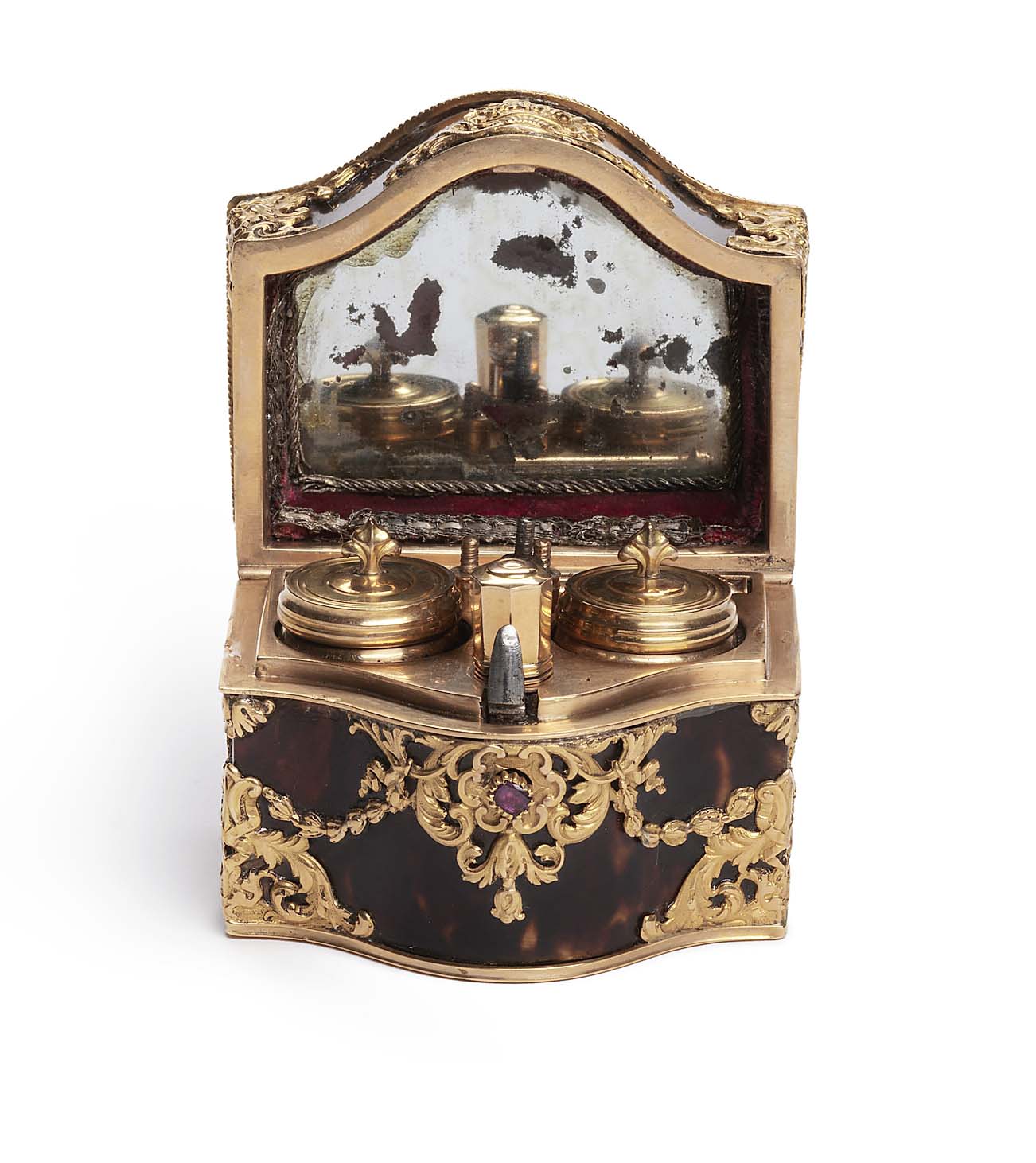
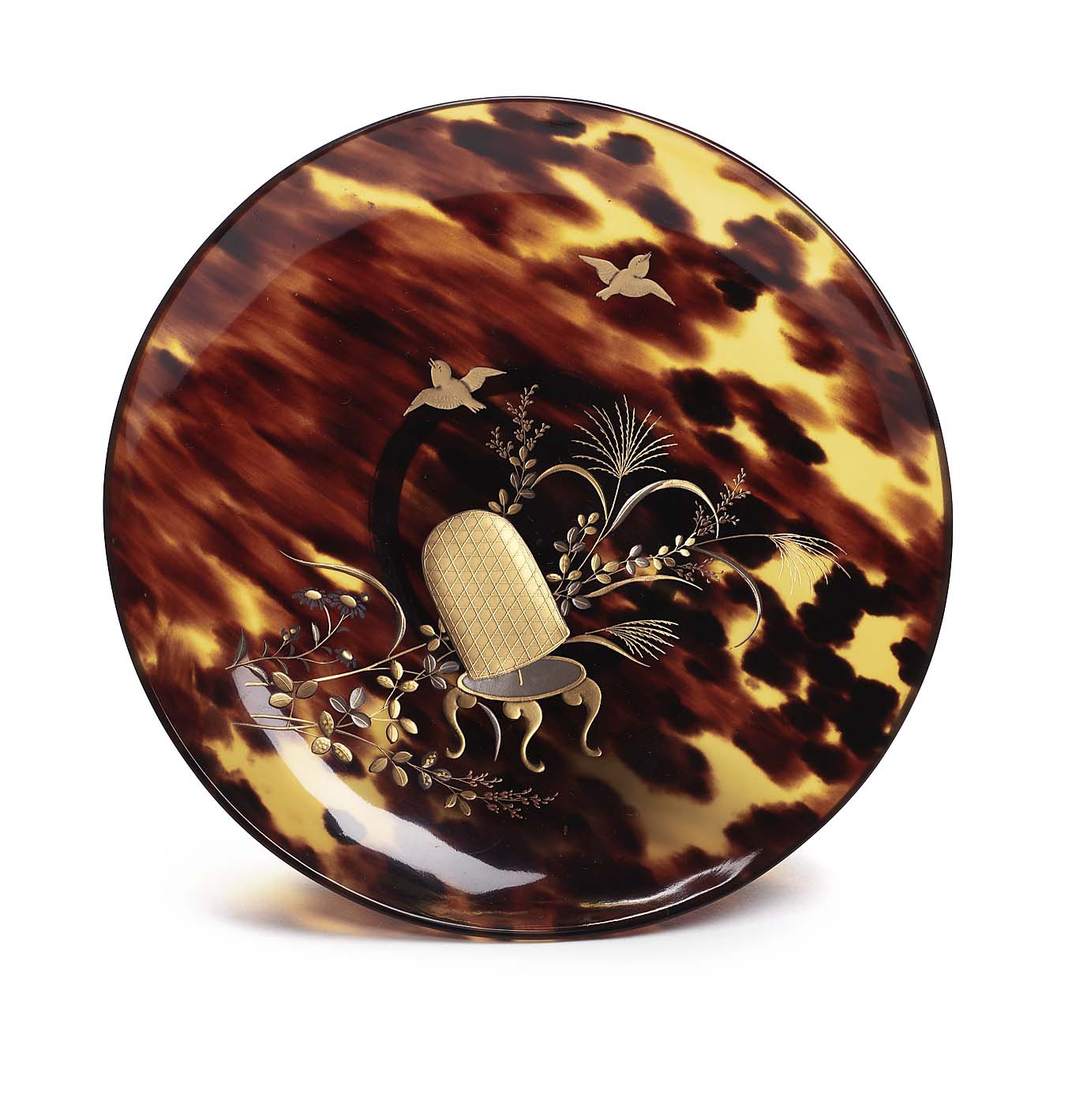
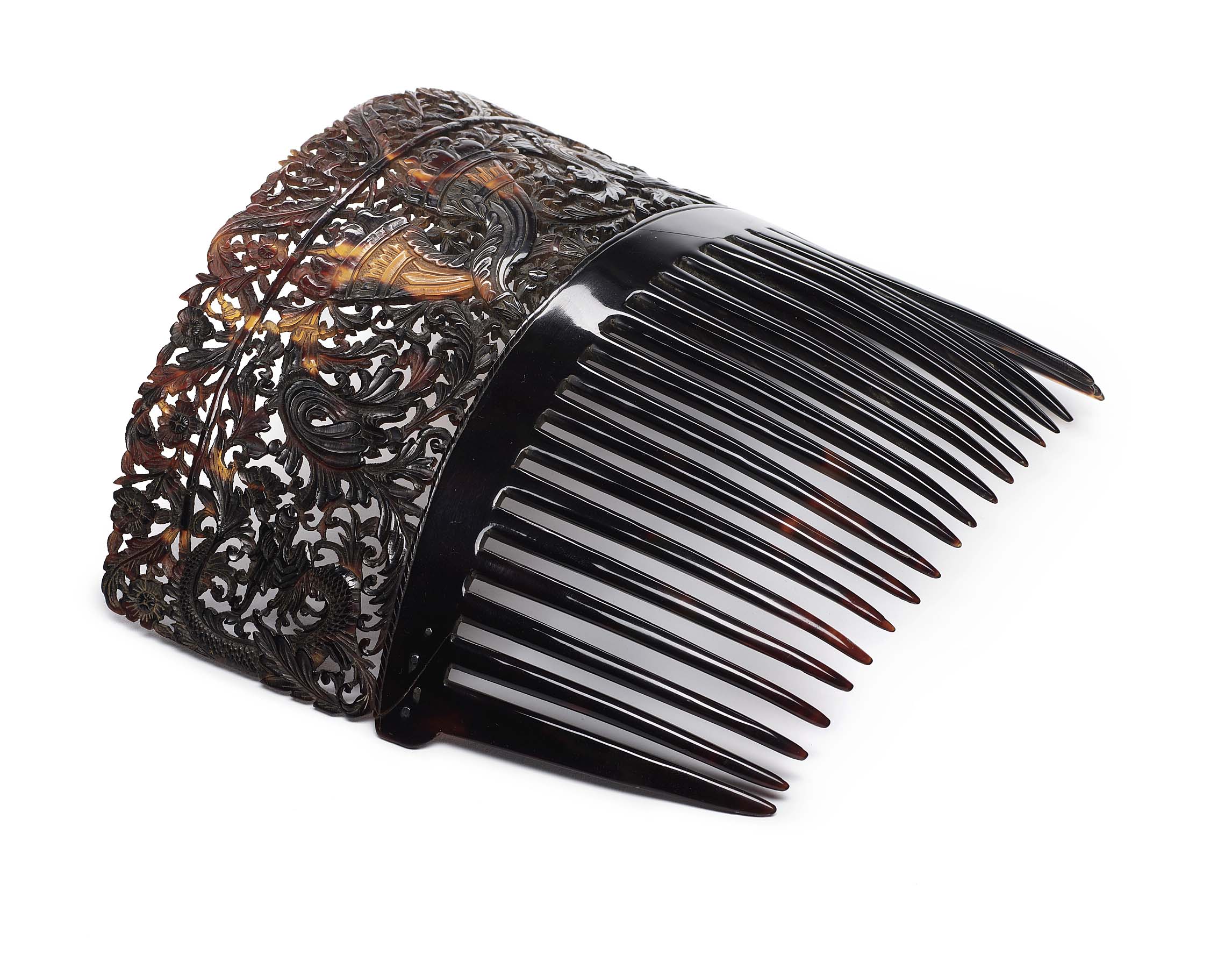
Tortoiseshell was malleable and versatile and highly desirable — and it was transformed into hair combs, bowls, sake cups and even furniture veneers. Chan notes in wall text that It was estimated some nine million hawksbill turtles passed through the channels of global trade during the Nineteenth and Twentieth Centuries alone. Craftsmen found endless inspiration for art objects made from the plates extracted from the hawksbill turtle. An exquisite German writing case, a pair of ornamental hair combs from China and a cabinet of tortoiseshell inlaid into brass by French artist André-Charles Boulle (1642-1732) attest to the technical virtuosity that went into making these objects — furniture inlays, household objects, instruments, jewelry and/or a plethora of accessories suggest the material’s popularity and appeal.
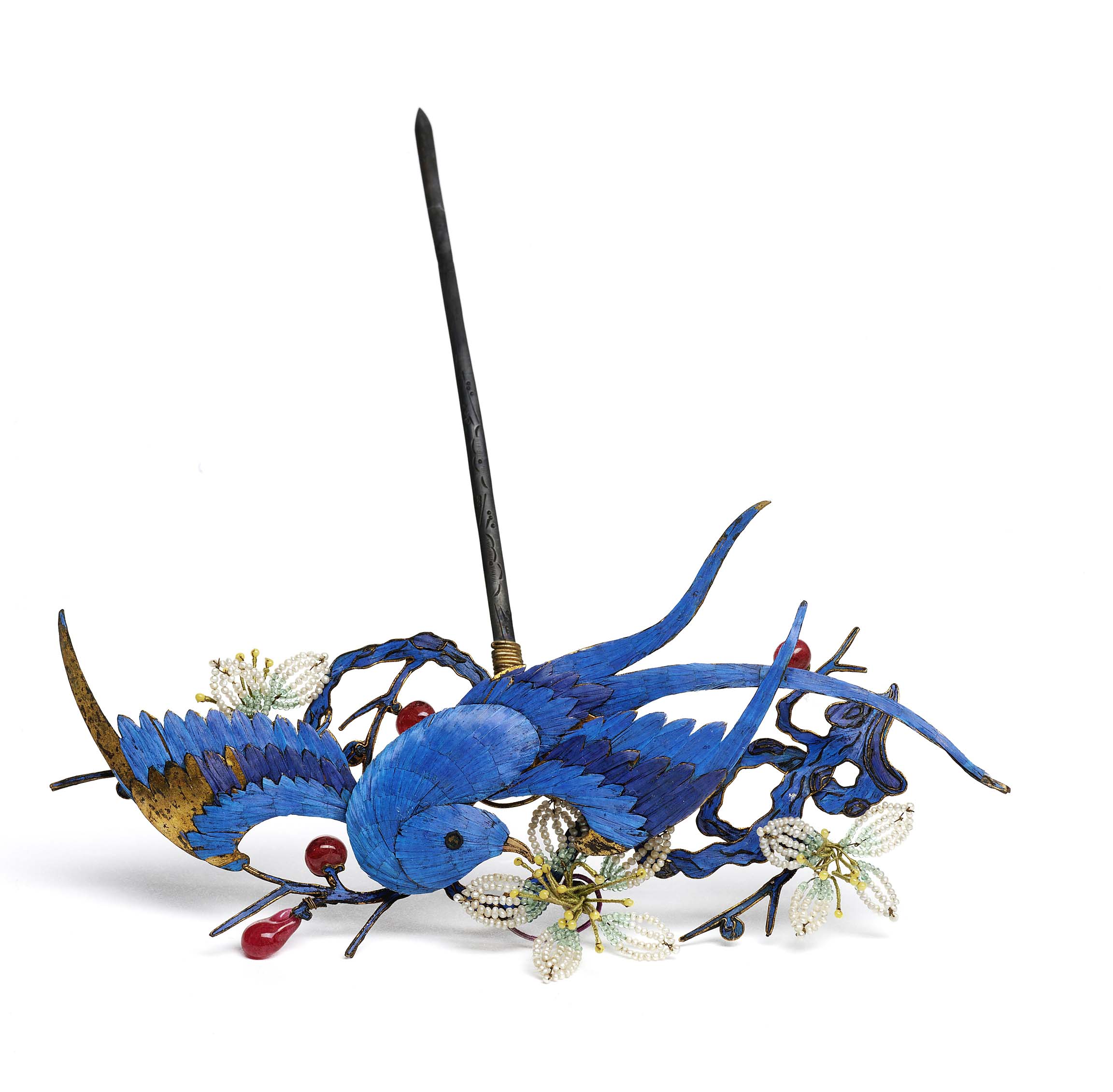
Hair ornament, Chinese, Nineteenth Century, kingfisher feathers, gilded silver, silk, pearls, glass and rubies, 5-11/16 by 5-1/16 by 1⅜ inches with stem; 2⅜ inches tall without stem. Acquired by Henry Walters, 1907. 86.1.
Two headdresses made with highly prized kingfisher feathers and further embellished with pearls and semi-precious stones are on view — one was believed to have been worn by the Empress Dowager Cixi (1835-1908). Each exceptional piece called for hundreds of feathers culled from the tiny birds. The kingfisher’s allure lies not only in its rarity: This bird is distinguished by brilliant feathers produced through biopigmentation (color determined by diet) and its iridescence, which is experienced by the naked eye on as a spectrum that moves from indigo to cerulean. It was near extinction in 1989 when the Chinese government implemented bans to protect the bird; it became a “National Class II protected animal, a protection that provides strict state management, oversight and priority conservation.
“What did luxury look like in the past?” Chan asked rhetorically. “Historically, the powerful and the wealthy desired these animal materials for their beauty, exclusivity, exoticism and more. Although banned from commercial trade since the Twentieth Century, the materials from these four animals continue to be coveted in some form.”
Indeed, alarms were going off by the late Nineteenth and early Twentieth Century, prompting former US president Theodore Roosevelt, in an article in Scribner’s Magazine, to take up the cause. He wrote, “it would be a veritable and most tragic calamity if the lordly elephants, the giant among existing four-footed creatures, should be permitted to vanish from the face of the earth.”
Mabel Osgood Wright, a formidable conservationist in Fairfield, Conn., would rise up against the culling of thousands of birds for fashion, and she established the Connecticut Audubon Society in 1896 and was instrumental in re-establishing the National Audubon Society.
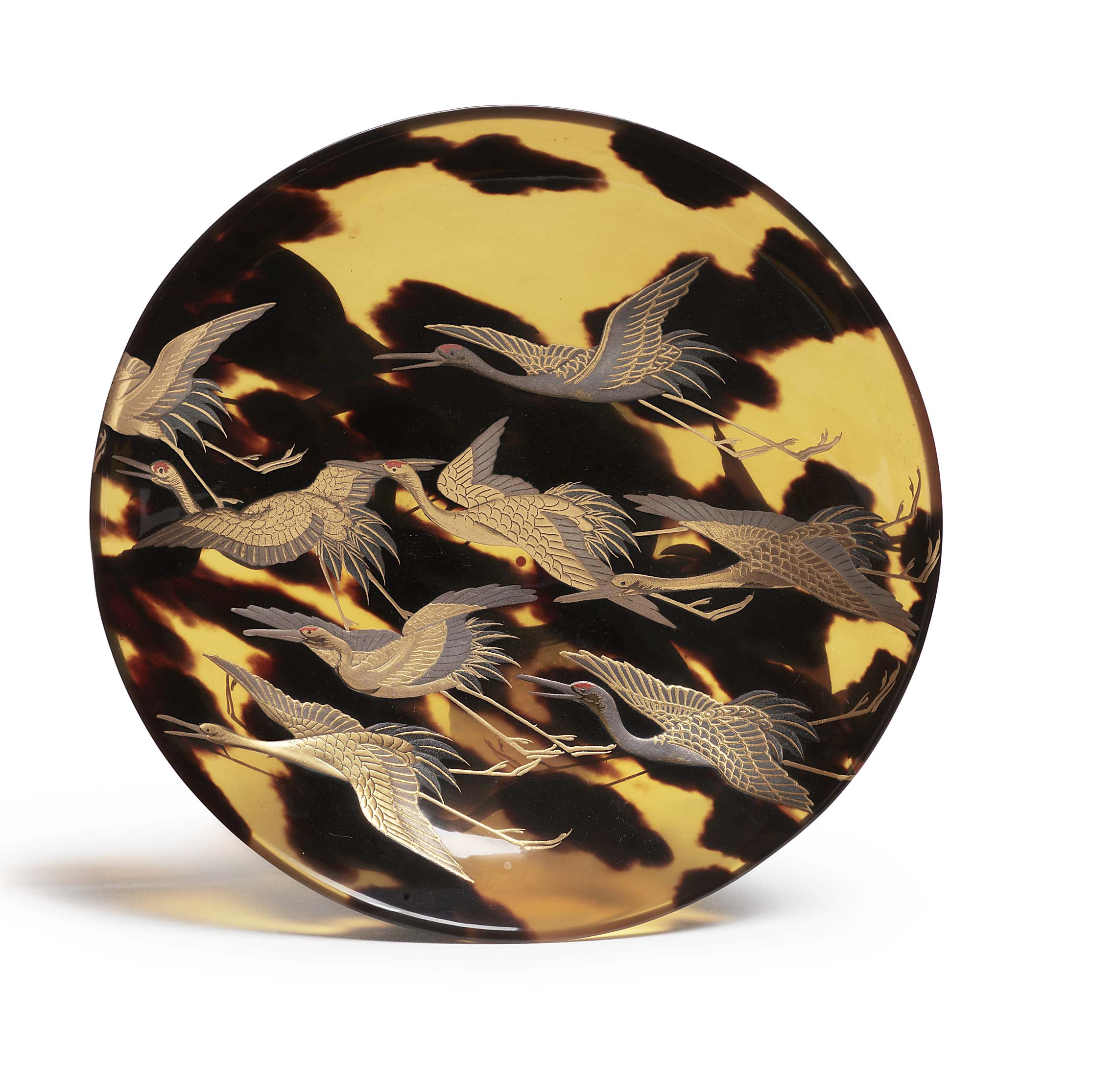
Flying cranes, Japanese, tortoiseshell and lacquer, 1 inch tall with a 3⅝-inch diameter. Acquired by William T. Walters, 1876 (?). 72.12.
Also, combining her knowledge as a naturalist with a pioneering vision for managed landscape that could serve migratory songbirds, she designed and built the Birdcraft Sanctuary in her town in 1914. Despite the Sanctuary’s close proximity to I-95, songbirds have been refueling along this migratory route ever since.
Chan steers us to the work of contemporary artists who suggest we might address ongoing threats to wildlife in varied ways: Jenny Kendler advocates for human intervention on behalf of the African elephant in her “Music for Elephants,” a work produced on an antique player piano with ivory keys, with a score produced by an algorithm that predicts when elephants could become extinct. Vietnamese artist Tuan Andrew Nguyen conjures a conversation between the spirits of two now-extinct creatures, who speak through time to urge the human world reset its balance with nature; Kate McGuire’s “Ravish” sculpture reanimates feathers she has gathered after molting season from roosters, magpies and even crows. Yet another contemporary artist, Amy Boone-McCreesh makes art with faux tortoiseshell designs in “Scarcity and Surplus.”
An audio installation in the exhibition features prominent conservationists — Gina Takaoka of Project Toad Ferry, Sarah Greenberg of the Oyster Recovery Partnership, Joe Corcoran of the Baltimore Bird Club and turtle biologist Steve Kimble of Towson University, who are engaged in education and advocacy efforts that amount to acts of truth and reconciliation. As citizens, we are facing the after-effects of the environments we have created: our landscapes fractured by logging and commercial agriculture, the ongoing effects of climate change and global warming. We will continue to wrestle with issues we expand development beyond our town and cities and roads.
“The breadth and depth of the Walters Art Museum’s collections from Asia, Europe, America and Africa is remarkable, and as is the beauty and artistry of the works,” Chan said. “At the same time we have come to understand more clearly the environmental impact. And ultimately, we explore with contemporary Baltimore-area environmentalists what gives them hope, despite the challenges in our fragile present and uncertain future.”
The Walters Art Museum is at 600 North Charles Street. For information, www.thewalters.org or 410-547-9000.