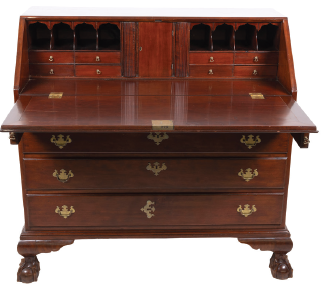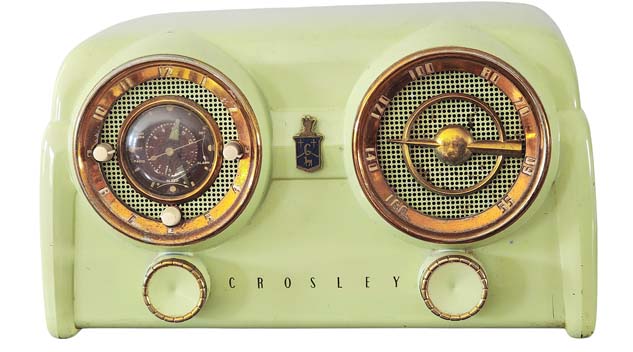
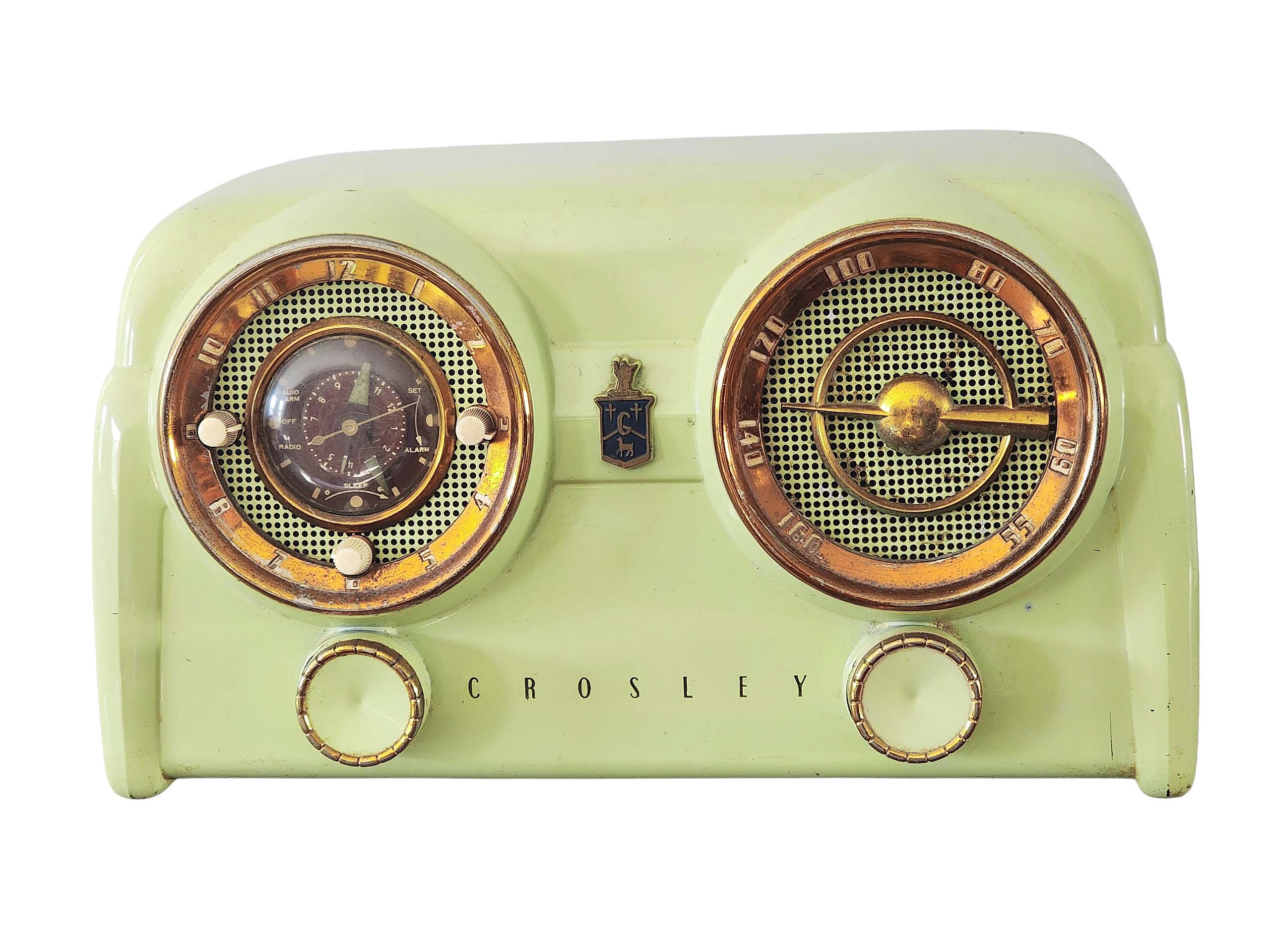
Crosley radio, Cincinnati, circa 1952, Bakelite. Private collection. Image courtesy Andrew Richmond.
By James D. Balestrieri
LANCASTER, OHIO — When I was a student, studying playwriting and theatre, my professor frequently asked us to write the following: Which five objects would the protagonist of your play take from a burning house? It was harder than it looked. At first, the answers were obvious: photo albums always topped the list. These days, the answer would be a laptop or phone that holds precious images. Or, since so much of what we treasure is stored in the cloud, would we even need to waste one of our five choices? This alone proves that while the things that contain our histories will certainly change over time, what our histories — that is, our stories — mean to us stays the same. But as we got deeper into the plays we were writing, the big five changed; they grew more idiosyncratic to the characters, meaning a great deal to them even though they would mean little, if anything, to anyone else, especially if the character were not there to tell the story of the object. But some objects, by their nature, seem to tell their own stories whether we know their precise narrative history or not. They shimmer with stories and even inspire us to create stories that swirl around and add to their luster and essential truth. And that may well be the underlying impulse that led to of “Heartland: The Stories of Ohio Through 250 Objects,” the new exhibition at the Decorative Arts Center of Ohio on view through April 26. It was designed to celebrate the role of the Buckeye state in the story of the United States as we enter our 250th year.
Curators Andrew Richmond and Holly Davis have amassed a collection that, as they put it, offers “fresh perspective on both familiar milestones and lesser-known stories.” Indeed, one might say their life’s work is antiques, Americana in particular, and a passion for scholarship. Richmond earned his master of arts in American material culture from the Winterthur Museum/University of Delaware, while Davis earned her master of library and information science from the University of Illinois. Together, they own Marietta, Ohio-based Meander Auctions, and many of the pieces that pass through their hands are products of the Ohio River Valley and Midwest.
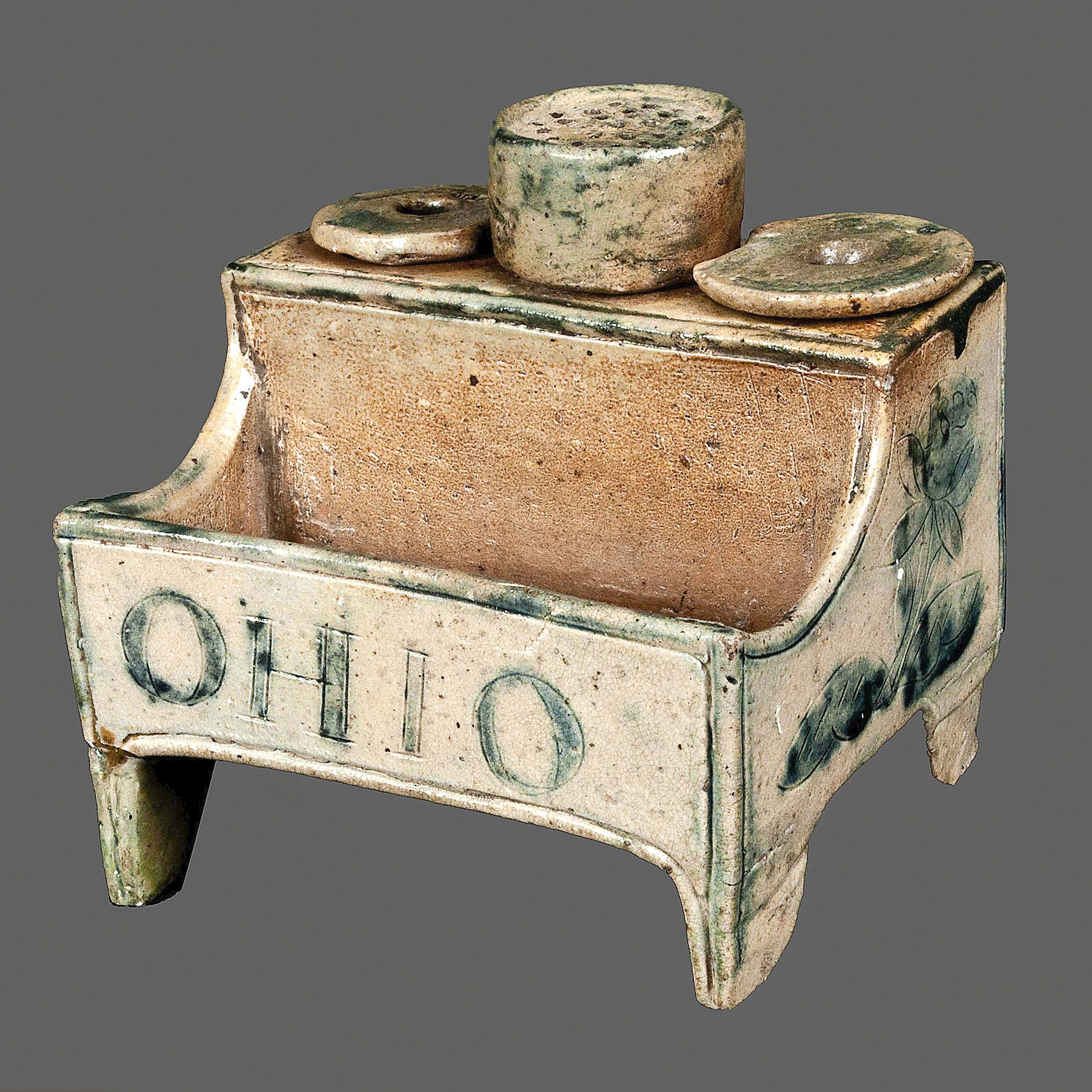
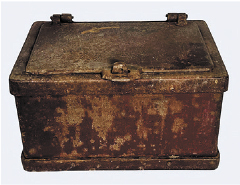
Ink stand, Ohio, dated 1829, cobalt-decorated stoneware. Private collection. Image courtesy Crocker Farm Auctions.
Richmond describes Ohio’s place in the American project: “We were a crossroads, a bellwether, a mother of presidents, a leader in flight — but we are also changing. With three major cities and vast swaths of rurality, we are extremely diverse in every sense of the word.” However, in that diversity he sees the exhibition as an opportunity for Ohioans.
“In 2025,” he goes on, “discussions of culture and history so often become quickly divisive. We hope that the breadth and diversity of objects and stories presented will allow anyone who visits to feel some connection to our shared past, because we need to feel that connection to our past, our present, our future and one another.”
The idea for the exhibition has its roots in our old adversary and longtime ally, Great Britain. Richmond and Davis have adapted the premise of a BBC radio series, The History of the World in 100 Objects. As they say, “it’s a fun way to think about our past, using objects to drive the narrative, rather than words.”
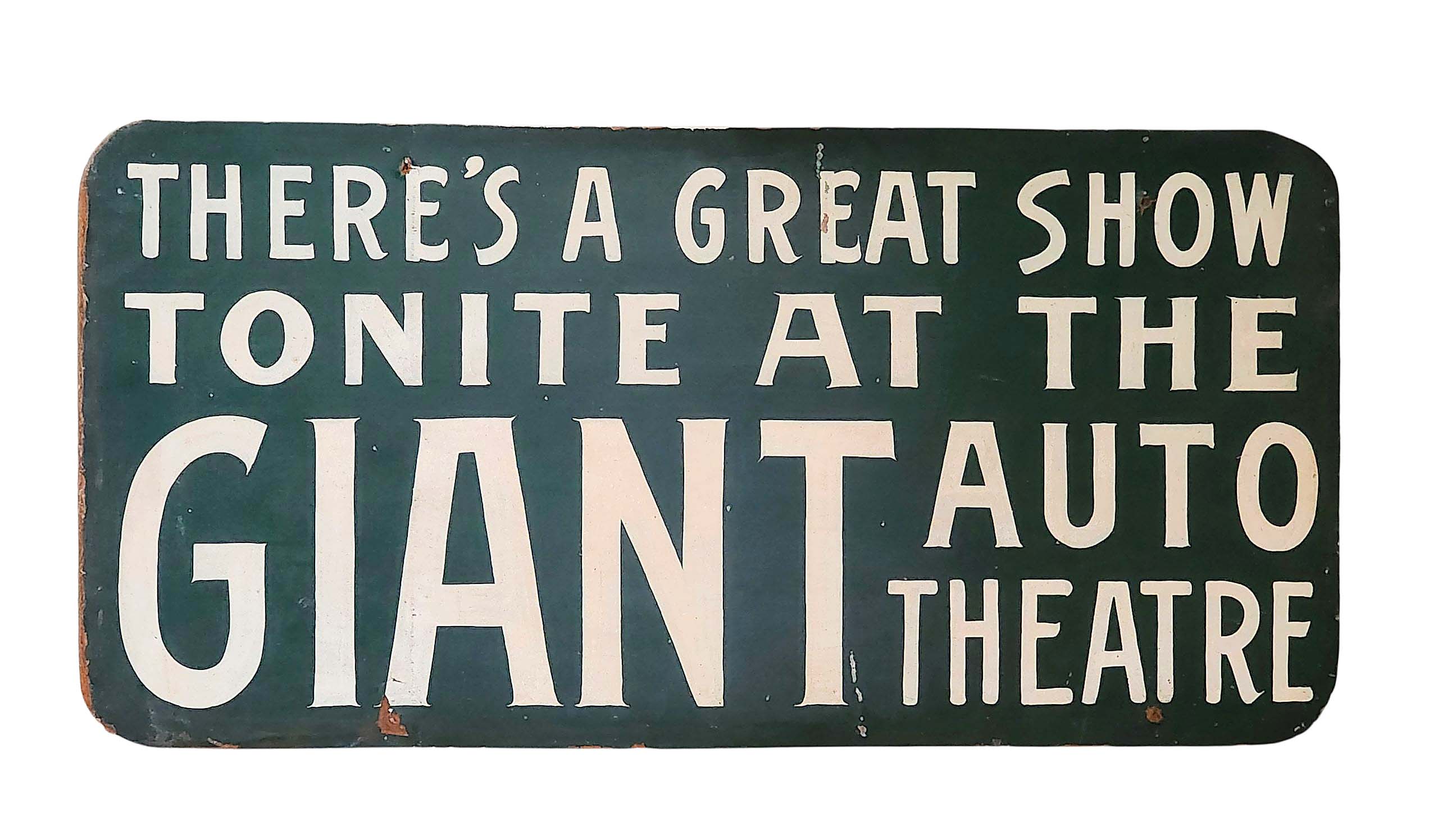
Drive-in movie theater sign, Canton, Ohio, mid Twentieth Century, painted wood. Private collection. Image courtesy Andrew Richmond.
One of the most important objects, and one with a terrific story, is also one that visitors might easily overlook: a small gray felt mouse listed simply as “Mouse Carried Aboard Friendship 7 by John Glenn.” An Ohio native, Glenn, of course, was one of the first American astronaut heroes, from the days of our Cold War space race with the Soviet Union. After retiring from NASA, Glenn would go on to serve as a distinguished United States senator and presidential candidate. Friendship 7 was the first manned spacecraft to orbit the Earth. The mouse, however, wasn’t simply “carried” by Glenn, it was placed in an equipment pouch as a practical joke between Glenn and fellow astronaut Alan Shepard, yet another NASA hero. As Glenn told it, “When I pulled the Velcro fastener that kept some of the equipment held down during launch, the first thing that came floating up out of there was a little felt mouse.” This was one of the earliest sensations of weightlessness directly observed by a human. Humor, science, a humble object elevated by circumstance. The mouse carries a symbolic weight all its own, as if it stands in for human aspiration and achievement in a vast universe.
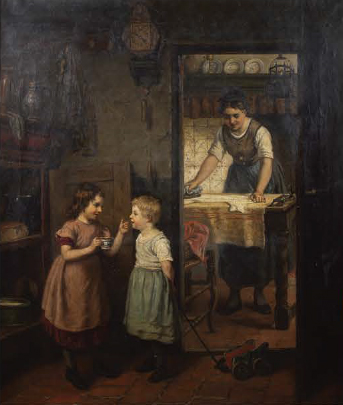
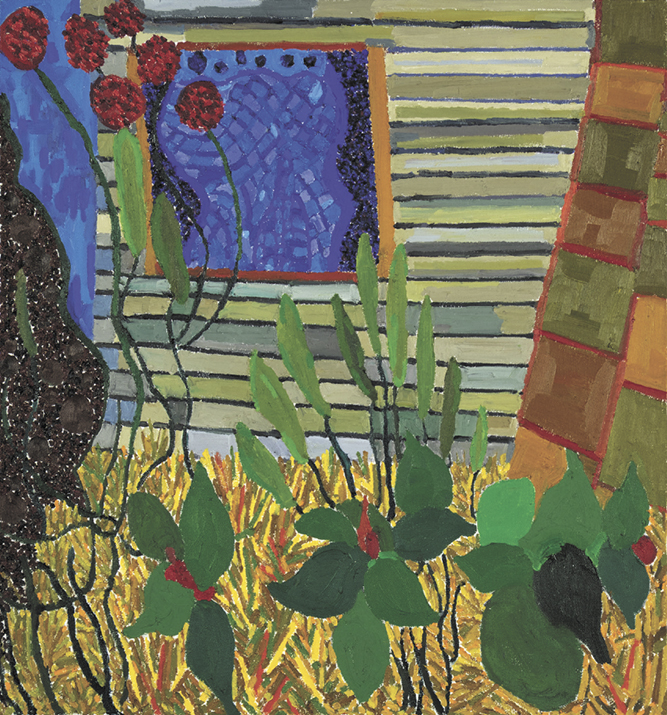
Pairs of objects in the exhibition resonate with one another. A fraktur birth certificate by the Flowering Vine Artist, eastern Ohio, dated 1812 with its text in German, and a Quaker sampler by Marie Mendhenhall, Warren County, Ohio, 1832 with its text in English, suggest, simultaneously, the diverse immigrant cultures that came to Ohio and the transformation of those cultures over time. Similarly, two paintings, “View of Marietta, Ohio” by Sala Bosworth (1805-1889), circa 1835, and “Mother’s Day” by Leuty McGuffey Manahan (1889-1977), painted in the mid Twentieth Century, present aspects of the American artistic spirit in what is perhaps a distinctly Ohio key. Bosworth is an example of the classic early Nineteenth Century American itinerant painter who made his living painting portraits and landscapes. “View of Marietta, Ohio” has some of the folk art geometry typical of such artists in a scene that exudes prosperity, abundance and order. Still, despite the high summer in the landscape, the vista is almost too perfect, and the palette suggests autumn in the red dirt of the eroded and ploughed land. At first glance, Bosworth appears to be anticipating the agricultural surreal — a century early — that would emerge in Benton, Wood, Cone and Curry, and erupt thereafter throughout the Midwest. By virtue of her self-taught naïveté — or apparent naïveté — Leuty McGuffey Manahan has been called the Grandma Moses of the Midwest, or of Ohio. However, look at “Mother’s Day” without knowing that, or anything about her, and you will note a supreme irony and sense of humor found nowhere in Grandma Moses’s New England bucolics. First, it isn’t “Mother’s Day,” the holiday, that Sunday in May when we serve our wives and mothers with earnestly but badly made waffles in bed or take her to stand in line for brunch, complete with watery mimosa. No, it’s mother’s day, her day, any day, every day, a chaos of hyperactive, proliferating children, shoes, toys and stuff everywhere, and dad arriving home to it all, smoking his pipe and looking like he’s ready for his slippers and supper. Supreme irony. Not Grandma Moses at all.
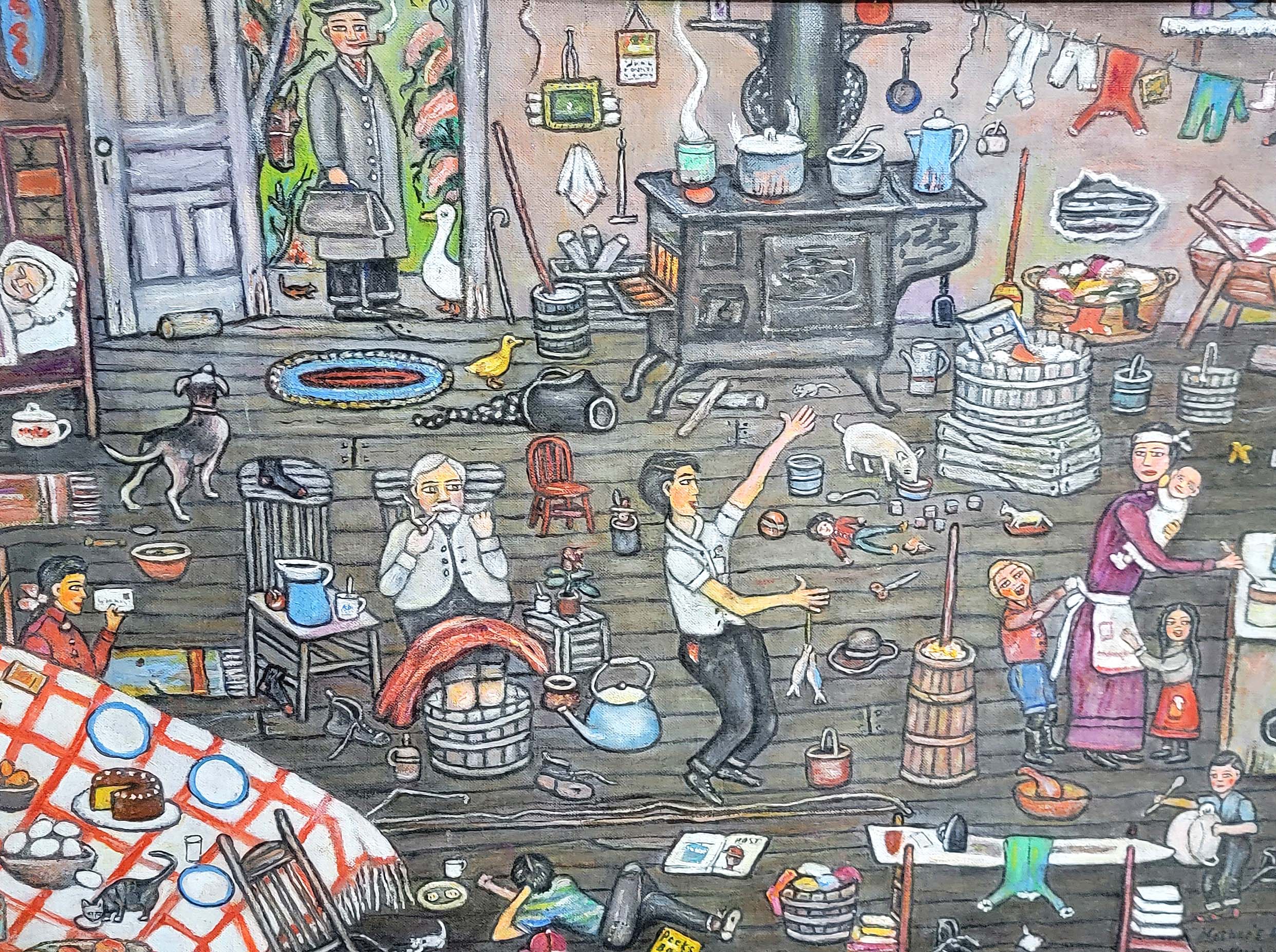
“Mother’s Day” by Leuty McGuffey Manahan (1889-1977), mid Twentieth Century, oil on artist board. Private collection. Image courtesy Andrew Richmond.
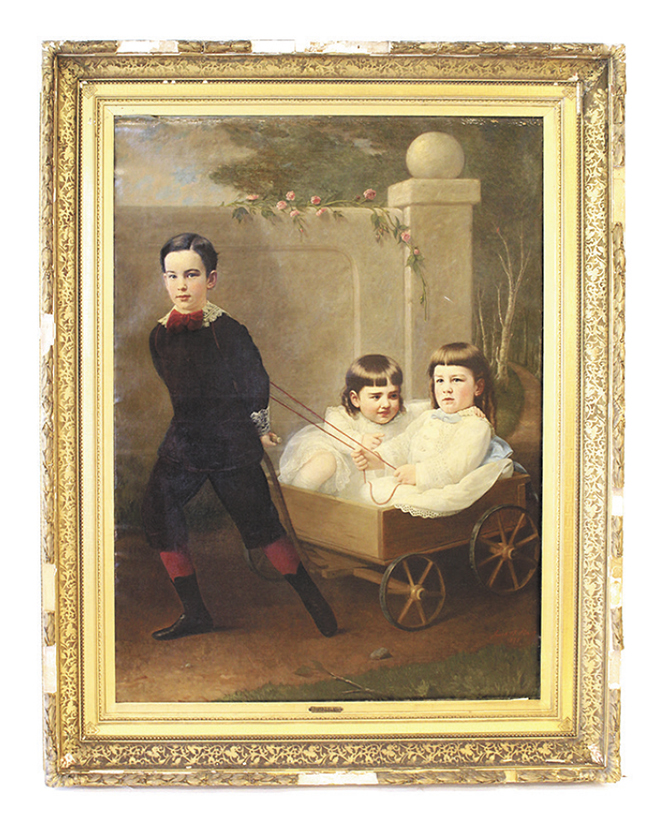
Lastly, portraits of Abolitionists Alanson Pomeroy (1805-1877) and Kezia Pope Pomeroy (1809-1893) of Strongsville, Ohio by David Brokaw (b 1812) demonstrates Ohio’s early role in the new nation’s struggle for freedom and equality. While Alanson Pomeroy looks up from a draft of a missive, Kezia holds her place in her Bible as she holds her pose for the painter. They are stern, determined people on the verge of annoyance at having to pause in their work to pose for portraits.
Fast forward to “Portion of a Mural from the Café Napolitana, Columbus, Ohio,” 2020. Time has moved on, aesthetic style in activist works has evolved from the stolid portraits of the early Nineteenth Century to the bold, muralist graphics of our era. Still, the message and the unfinished mission of America remains the same.
Three objects from the 1950s tell the story of post-World War II America, the nation at midcentury: brash, bold, big shouldered and optimistic. An art pottery ashtray with Bakelite sphere, made by the famous Cincinnati firm, Rookwood Pottery, in the 1950s imparts sleek design elements and plenty of style to smoking, a lethal practice made into the art of the pregnant pause in countless films projected onto silver screens and onto the new drive-ins, represented by a drive-in movie theater sign from Canton, Ohio, that dates from the period. At home, you might hear ads for films on a Crosley radio, also made in Cincinnati circa 1952. Bakelite forms the sphere in the ashtray and the case of the radio. A precursor of plastic, Bakelite objects, especially jewelry, are sought-after collectibles, as nostalgic as ashtrays, drive-ins and radios. They speak to a time when the future was eagerly discussed, even planned for, a future that could not be anticipated.
Richmond and Davis argue that Ohio’s story is America’s story even as America is Ohio’s story, at least for the past 250 years. The stories that arise from “Heartland: The Stories of Ohio Through 250 Objects” make an eloquent case for their argument. If Ohio were the protagonist of a play, it would be hard pressed to choose only five of them.
The Decorative Arts Center of Ohio is at 45 East Main Street. For information, www.decartsohio.com or 740-681-1423.