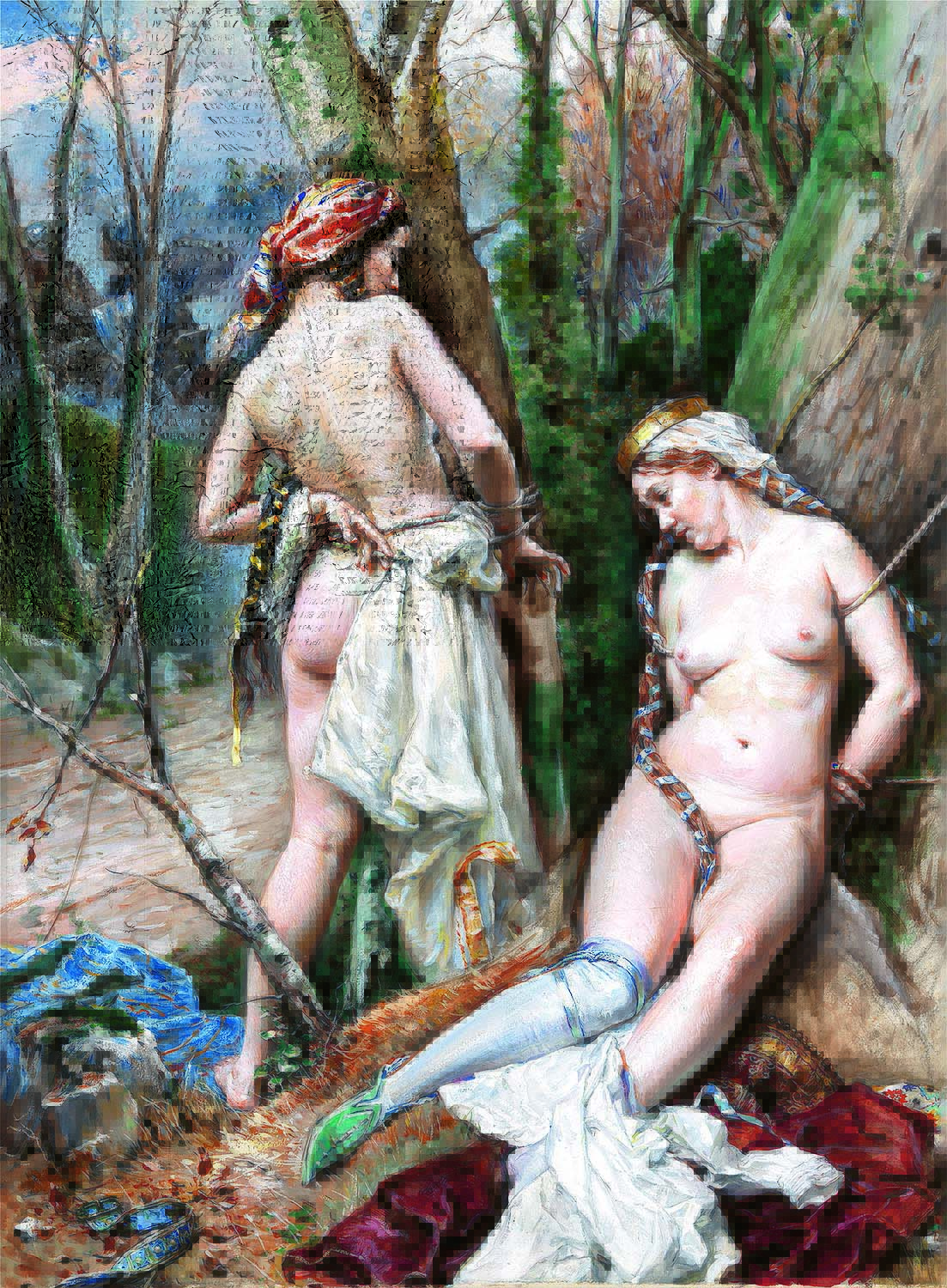
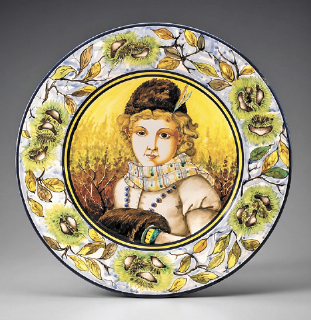
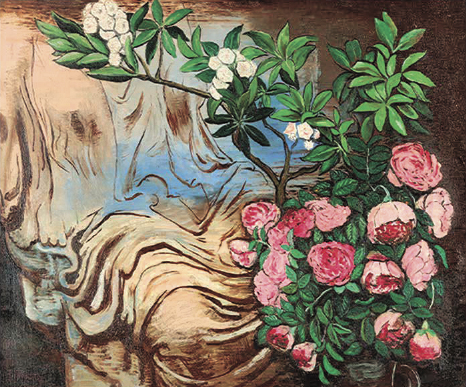
“The Beautiful Flower Girl” by Raimundo de Madrazo y Garreta, circa 1900-10, oil on canvas, approximately 36⅝ by 25¾ inches. Colección Rebosa Domínguez, Coria, Cáceres. Photo © Jorge Armestar.
By Jessica Skwire Routhier
DALLAS — Everyone knows that the art world is fickle. Some artists are celebrated in their time and all but forgotten shortly afterward; others achieve fame only after their deaths. Such misalignments between lifetime success and lasting legacies rarely have anything to do with talent, and the Nineteenth Century Spanish painter Raimundo de Madrazo (1841-1920) is a case in point. The artist’s first-ever retrospective, at the Meadows Museum at Southern Methodist University (SMU) in Dallas through June 21, shines a new light on this artist who once dazzled audiences on both sides of the Atlantic.
The exhibition was co-organized by the Meadows Museum and Fundación MAPFRE, headquartered in Madrid, but the larger project of bringing Madrazo back from obscurity is the mission of Spanish scholar and exhibition curator Amaya Alzaga Ruíz. It began 25 years ago with a French farmer and an old suitcase full of mysterious artwork. Long story short, Alzaga Ruíz soon found herself in his little French town, looking at the suitcase itself. She was able to determine that the scrawled signatures — from which the farmer had only been able to discern a “Z” — read “Madrazo,” but then it became a further challenge to distinguish this particular artist from a dizzying lineage of different Madrazos, who worked as court painters, authors, architects, art critics and directors of what would become the Museo del Prado for generations. Once she untangled the scraps of information enough to identify the suitcase artist as Raimundo de Madrazo, Alzaga Ruíz herself was ensnared, determined to piece the career of this once-prominent artist back together. Every fact in this article about Madrazo’s life and career comes directly from her research.

“Self-Portrait” by Raimundo de Madrazo y Garreta, 1901, oil on canvas, 32⅛ by 24⅝ inches. Meadows Museum, SMU, Dallas, Algur H. Meadows Collection, MM.73.01.
Raimundo de Madrazo was the talented son of the painter Federico de Madrazo, who was also his first teacher. Raimundo studied formally as a teenager at the Real Academia de Bellas Artes de San Fernando, but his work with his father, and their travels to Paris and beyond, were no less influential. It is no surprise that, barely more than 20 years old, Raimundo de Madrazo moved his artistic practice and ambitions to Paris, with his father’s encouragement.
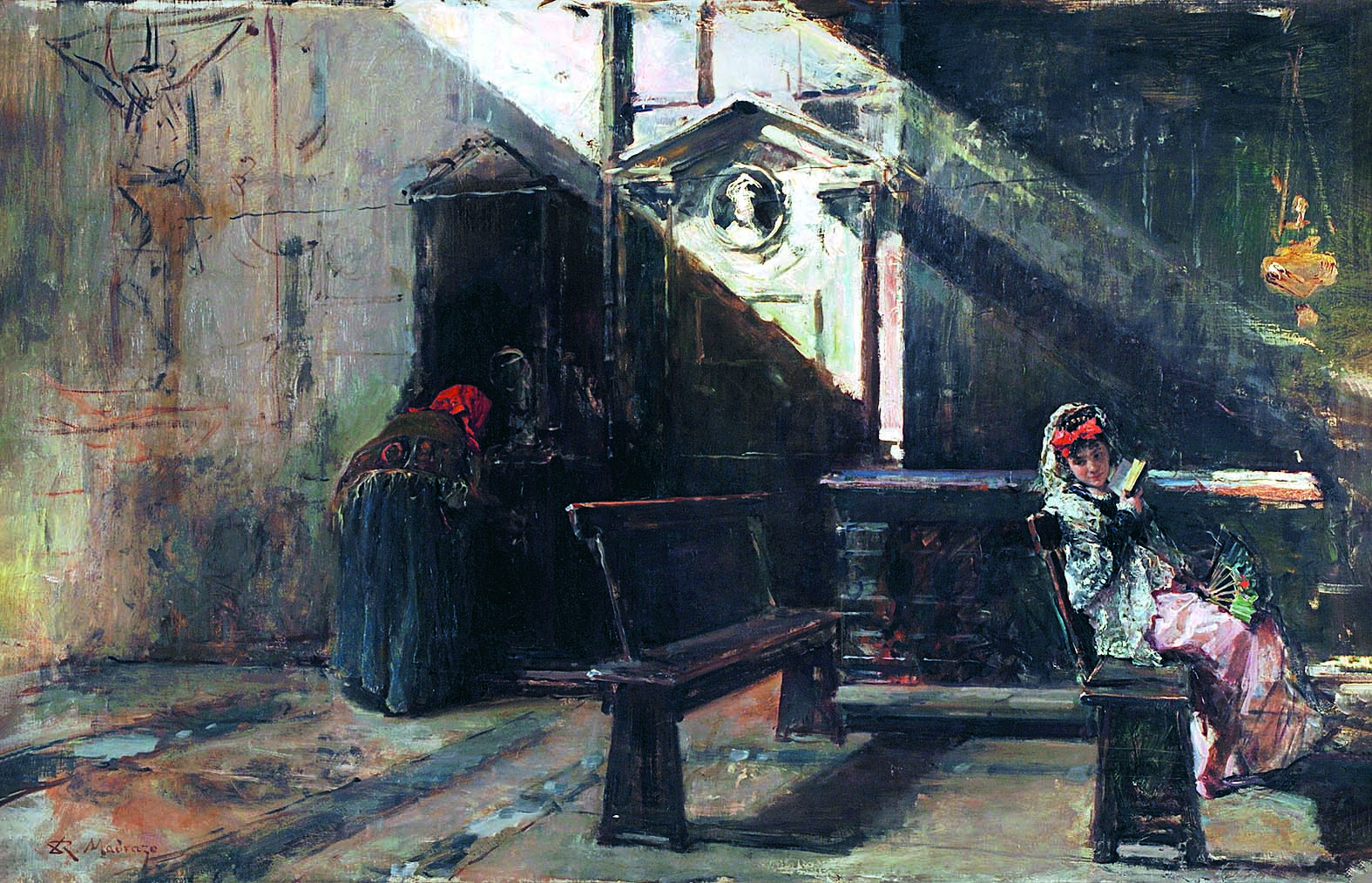
At first, he followed family tradition by producing grand salon-style histories and religious scenes: “The Transfer of the Remains of St James the Apostle to Padrón” and “The Daughters of El Cid.” But shortly after completing the latter, Madrazo made the rather sudden and irrevocable decision to leave such academic paintings behind and focus instead on genre scenes, or depictions of everyday life (“Interior of the Church of Santa Maria della Pace, Rome, the Confession” is an early example). When he announced his intentions to his father in a letter, a rift opened between them that never really closed. “I think that he was always a big disappointment to his father,” says Meadows Museum curator Patricia Manzano Rodríguez. “He definitely did not take the path that his father wanted for him.”
People today might describe Raimundo de Madrazo as a “nepo baby,” the dismissive internet slang for public figures who owe their success to famous parents. The label fits in some ways: certainly, Alzaga Ruíz acknowledges, he had every advantage in learning his craft from his father, uncles and grandfather; certainly, he benefited from name recognition in Spain and beyond. But he also had a rebellious streak. Long before the drastic change to his subjects and paint handling (compare “St James” to “The Confession,” for example), he declined to apply for a prestigious state-funded position in Spain because he felt his family had already monopolized the awards.

“Coming Out of Church (La salida de la iglesia)” by Raimundo de Madrazo y Garreta, before 1875, oil on canvas, approximately 25⅛ by 39⅜ inches. The Walters Art Museum, Baltimore. Acquired by William T. Walters, 1892, 37.48. Photo by Ariel Tabritha.
Madrazo was not alone in choosing genre over history painting, of course. His contemporaries, the Impressionists, guided by Charles Baudelaire’s influential essay of 1863, chose to be “painters of modern life.” In loosening the grip of the French salon on the future of art, they also loosened their brushstrokes, more concerned with rendering a moment than propping up an aesthetic or moral ideal. Madrazo’s decision to participate in both aspects surely came from a place of sincere artistic purpose — with perhaps a bit of filial insubordination — but it was also the right strategy for professional success, as the art market shifted to accommodate the tastes of a growing bourgeois class.
Some early transitional works apply the broken brushwork of Impressionism to church architecture, prefiguring Claude Monet’s series on the Rouen Cathedral by about 20 years. Manzano Rodríguez observes that “‘Coming Out of Church’ is one of those instances where you can see the Parisian avant-garde coming through in Madrazo’s work” — particularly on the far right side, where shadowy figures with umbrellas stumble through the gray rain. “Souvenir of the Chapel in the Alcázar in Seville” also has the jewel tones, patterning and near-abstraction that the Nabis would adopt at the fin de siècle. Perhaps his most characteristically Impressionist painting, with its landscape setting and spectral palette, is the one that he made collaboratively with his friend Mariano Fortuny, then Spain’s most famous painter. The exhibition is a rare opportunity for American audiences to see this painting, which is owned by the Prado and rarely lent.

“Constant Coquelin” by Raimundo de Madrazo y Garreta, circa 1875-78, oil on canvas, 27½ by 20⅞ inches. Private collection, Paris. © Mathieu Lombard.
But where Madrazo truly excelled was in painting women, both as the subjects of portraits and in small-scale genre scenes called tableautins, which surged in popularity in the second half of the Nineteenth Century. Madrazo’s tableautins pictured elegantly dressed women in beautifully decorated interiors, enjoying the small pleasures of affluence and leisure. In “Woman with a Parrot,” the sitter turns her head to smile warmly at her pet while strumming the guitar on her silken lap. In “Aline Masson Reading,” his favorite model — about whom we know little more than her name — sits on a fashionable caned chair, her dainty foot on a blue velvet pillow as she leans back against an elegantly appointed tea table, reading a newspaper.
When we spoke in April, Manzano Rodríguez jokingly introduced these paintings to me as “women living their best lives and doing nothing,” and talked about how their Nineteenth Century popularity has translated to the Twenty-First Century, especially among the young people who first flocked to see the show in Madrid and are now experiencing it on a college campus. “I think people right now are looking for an escape,” she explains — perhaps like Parisians of the 1870s would have been after the privations of the Siege of Paris. “This art is very easy on the eyes,” she says, while also acknowledging their complex cultural milieu: the limited sphere of women at the time, the relentless demand that they be beautiful and pure “angels of the hearth,” and the complete exclusion from their frustratingly alluring “golden jails” of all but a rarefied sphere of society.
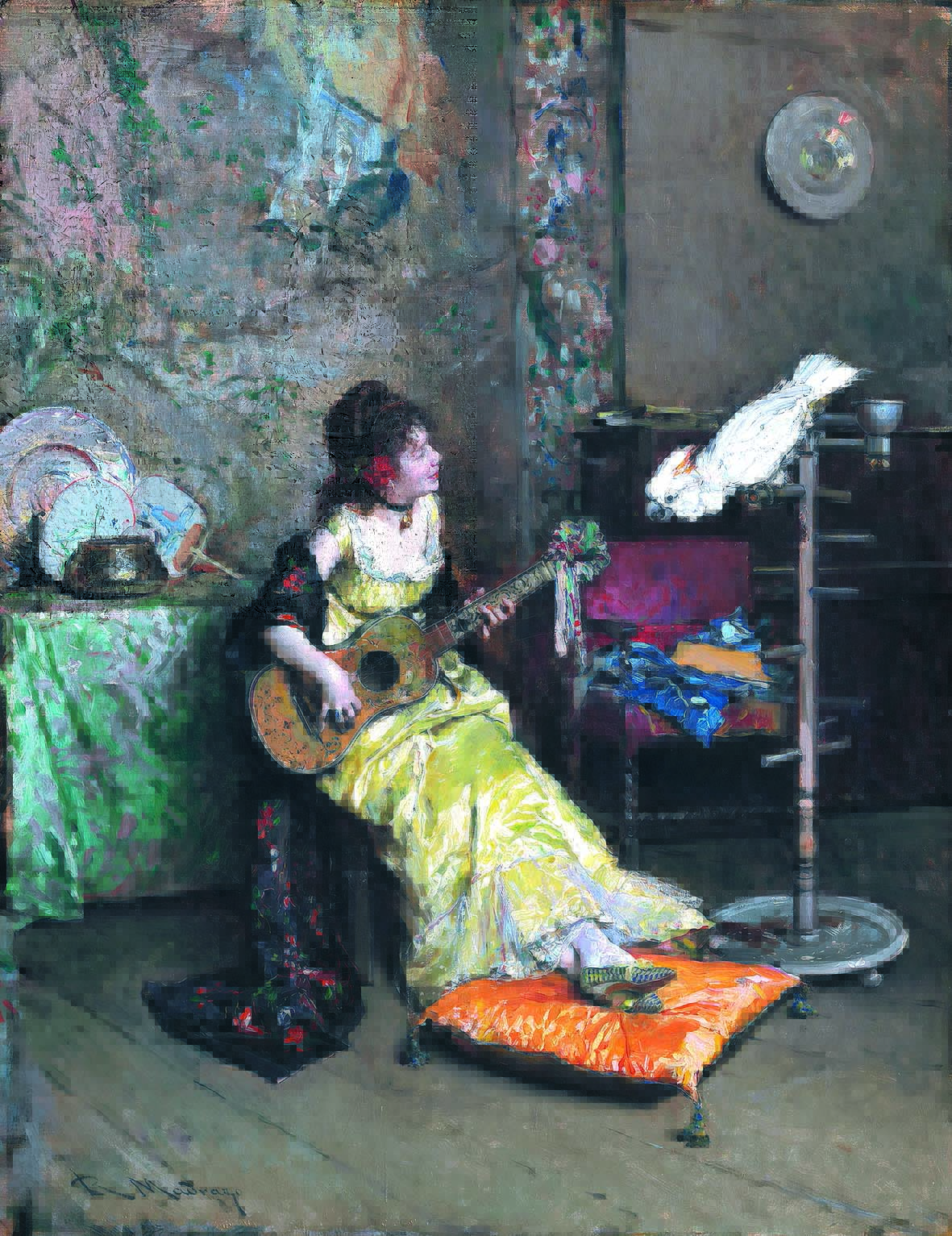
“Woman with a Parrot” by Raimundo de Madrazo y Garreta, circa 1872, oil on canvas, approximately 19⅓ by 15 inches. Clark Art Institute, Williamstown, Mass., 1955.800. Photo ©Michael Agee.
These tableautins are featured in a section of the exhibition (and catalog) called “Nonchalance,” which Alzaga Ruíz describes as “a French term for an attitude of abandonment and indolence.” But the English-language meaning works too. “I love that title because it implies you just walked into the room and they were there hanging out, like ‘Oh, I did not expect to see you there!’” Manzano Rodríguez laughs. But, she says, nothing about these paintings is actually spontaneous or accidental: “This is not a candid that you just snapped on your phone.” And yet there is a kind of phone photography that resonates with the tableautins: the output of lifestyle influencers who populate social media, sharing pictures of themselves in their aesthetically appealing “tiny houses” or camper vans or glammed-up dorm rooms. That desire to envision a perfect, intimate space for oneself — and to be privy to the perfect spaces in which other people seem to be living their own best lives — is one that Madrazo’s patrons and today’s Instagrammers share.
Madrazo’s tableautins were in such demand that he began to produce them more efficiently, in part by simplifying the settings to a largely blank background, as in “Birthday Wishes.” Some blur the line between “paintings of everyday life” and portraiture, which he was practicing at the same time, seemingly looking to emulate examples from other masters of the genre: Sir Joshua Reynolds (“The Marquise d’Hervey de Saint-Denys as the Goddess Diana”), John Singer Sargent (“Portrait of a Boy,” from the Meadows Museum’s own collection), Frans Hals (“Constant Coquelin”) and Mary Cassatt (“Portrait of Aline Masson”). His strength in portraiture led to significant interest from American audiences, where his patrons and champions William Hood Stewart and Samuel Putnam Avery helped him secure commissions from luminaries like congressman Charles Phelps Taft, among others.
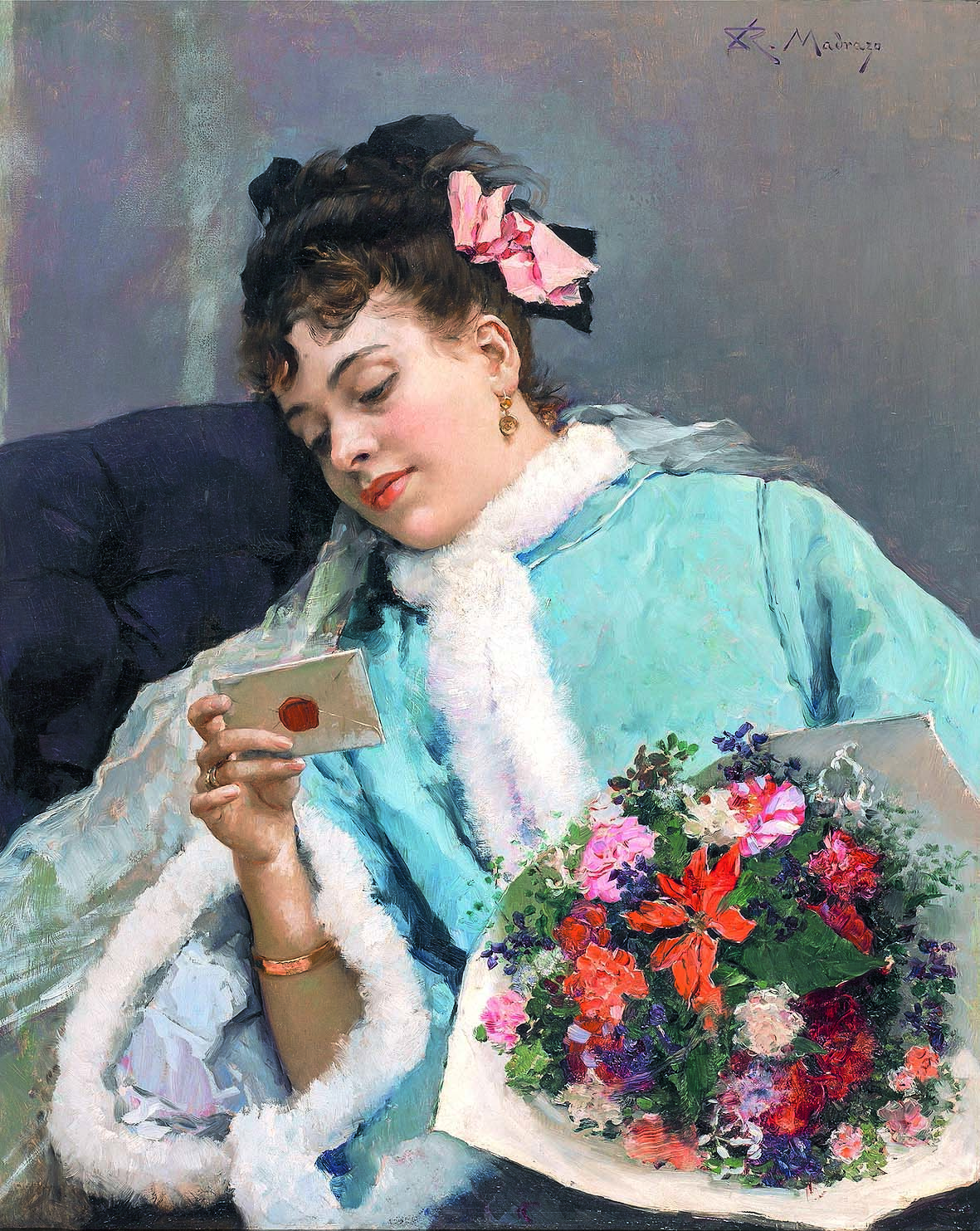
“Birthday Wishes” by Raimundo de Madrazo y Garreta, circa 1880, oil on canvas, 31⅞ by 25⅝ inches. Museo Nacional del Prado, Madrid, P006995. © Archivo Fotográfico del Museo Nacional del Prado.
In his various American sojourns, Madrazo shares some similarities with another Spanish painter of his generation, Joaquín Sorolla, about whom I wrote last year for this publication. Both artists, successful by any measure in their lifetimes, suffered the same dip in popularity after their deaths. Manzano Rodríguez observes that, after fellow Spaniard Pablo Picasso entered the scene, what Sorolla and Madrazo had embraced as the avant-garde quickly became the old guard — and further, as Spaniards, they did not fit neatly into the developing history of the origins of modernism, which came to be seen as an almost exclusively French phenomenon. Madrazo was “too French to be studied by the Spanish and too Spanish for the French to care about him.”
The successes of both artists in the United States, however, make them uniquely appealing subjects for a Texas-based museum of Spanish art. Both have been the subjects of exhibitions at the Meadows Museum (Sorolla in 2023), and both are represented in the museum’s permanent collection. A rare archival artifact at the Meadows Museum is crucial to the story of Raimundo de Madrazo that Alzago Ruíz and her collaborators continue to reconstruct: an album that Stewart and his family compiled during their various European travels, including correspondence with Madrazo and sketches of him at work. “Because we have that connection at the Meadows, it’s special to have Raimundo come to the US… and to do it in Dallas,” says Manzano Rodríguez.

“The Marquise d’Hervey de Saint-Denys as the Goddess Diana” by Raimundo de Madrazo y Garreta, 1888, oil on canvas, 52¾ by 32⅝ inches. Bequest of Mrs D’Adelsward-Pourtalès, 1934, Musée d’Orsay, Paris, 20417.
So were artists like Madrazo — who led the way in breaking from academic art but had a point beyond which they would not go — rebels or reactionaries? The debate is further complicated by Madrazo’s late-career work, largely figure studies of women in historicized Eighteenth Century dress (“The Beautiful Flower Girl”), perhaps inspired by the town of Versailles, where he retired. He also returned to large-scale history painting, leaving “The Reception of Columbus by the Catholic Monarchs” unfinished on his easel. It may have been the doggedness of this late, backward-looking work, as much as anything else, that left him off of early art historians’ rosters of movers and shakers. But, Manzano Rodríguez argues, he was no longer painting for them or for the critics in his retirement years, but for himself.
“We see him rebelling against several authorities of his during his lifetime,” she says, whether that authority was his father or the Academy or the growing hegemony of Cubism. “He tried to move the needle in the opposite direction,” she adds. “I think Raimundo was a rebel until the very end.”
The Meadows Museum is on the Southern Methodist University campus at 5900 Bishop Boulevard.
For information, www.meadowsmuseumdallas.org or 214-768-2516.