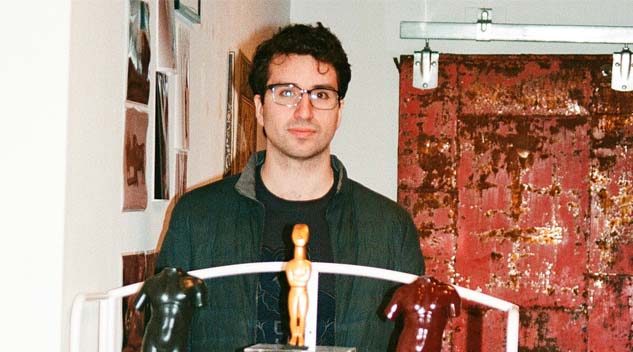
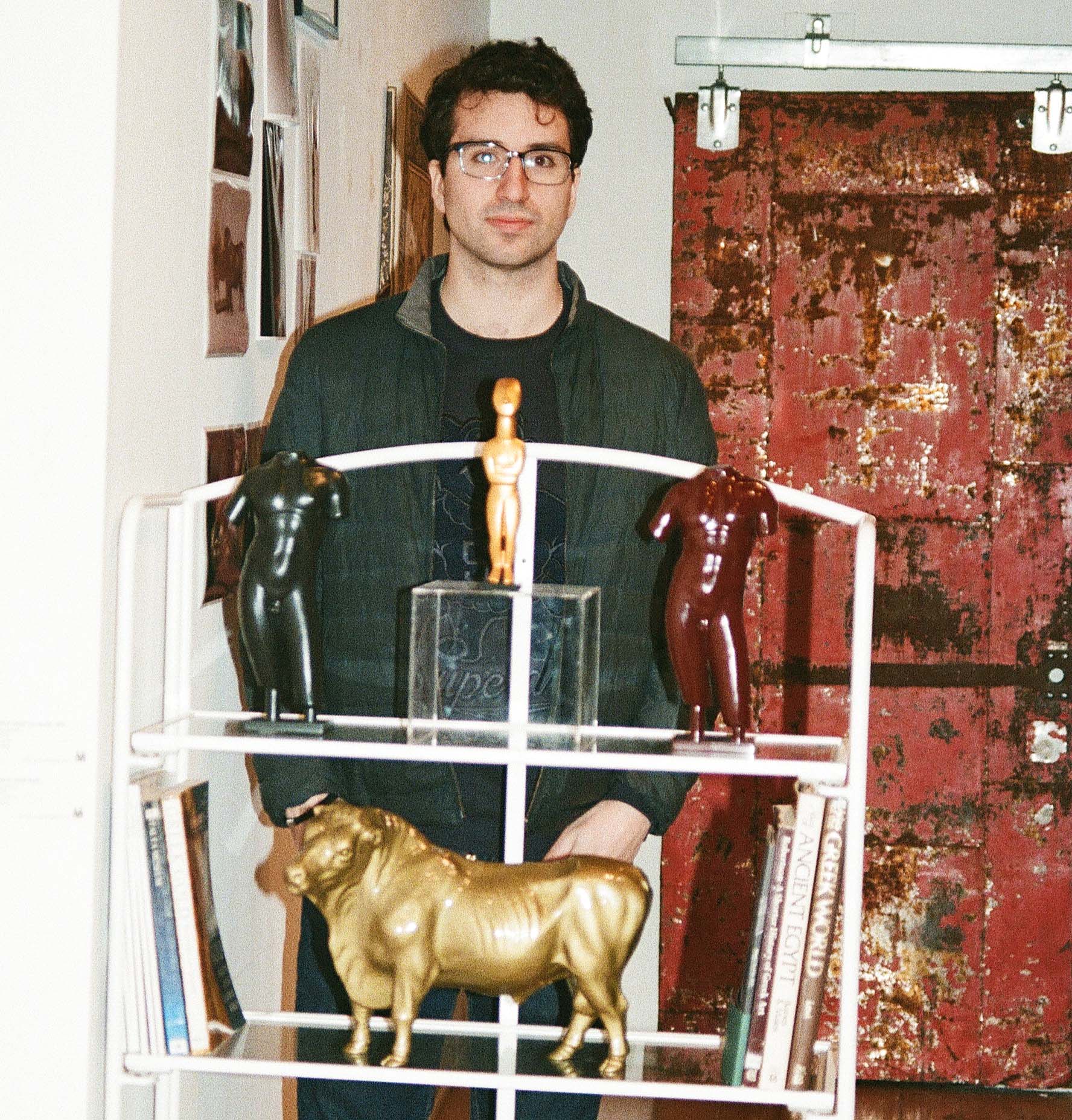
Alexander Aboutaam is the co-owner of Antico Contempo, an innovative, up-and-coming design firm that blends ancient traditions with modern technology. After meeting at The Palm Beach Show in February, we knew we had to catch up with Alexander to learn more about his company and how it fits into the world of antiques.
Can you share a bit about your own personal background?
I was born and raised in New York. My grandfather started collecting art, and then my father and uncle continued in this path as collectors and dealers. So, my brother and I have always been around it — particularly antiquities, such as Roman and ancient Greek, Egyptian — and we’ve always seen their beauty. I think when we got older, especially when we went to college in Boston together at different schools, we would go to the museums with our friends and we would, we kind of gained a further understanding of their accessibility.
While I was at Boston College, I studied economics and music. I’m also a classical pianist. I never studied design or illustration or anything like this at an academic level. It was always something through the family and something that was always just part of my life growing up.
How did you first get into the business?
Antico Contempo was started at the end of 2024 by my brother and I, and it’s been going strong since. I think it was kind of a perfect storm of events. We grew up surrounded by antiquities, and somewhere along the way that familiarity turned into a genuine fascination with the history behind these objects, the craftsmanship and the stories they carry.
Being in school in Boston accelerated that. We were constantly around museums and people our age from all different backgrounds, which gave us a more worldly appreciation for the arts and for these kinds of artifacts. That environment pushed us to ask: Why aren’t more people experiencing this? The reality is that most people don’t live near a great museum or know someone who has access to these kinds of objects, so the idea became about bringing that beauty to them directly.
That’s really the heart of what we do, and it expresses itself through multiple creative disciplines. Mosaic making is a huge part of it, rooted in ancient tradition and incredibly hands-on. We also work with 3D technology, which has opened up new ways to study, reimagine and reproduce objects with a level of precision and efficiency that simply wasn’t possible even ten years ago. Both crafts are equally central to who we are, one deeply traditional and one modern, and together they reflect exactly what Antico Contempo is about: honoring the past while finding new ways to bring it to life, to enrich the foundation of classics to bring that ancient beauty and aura into contemporary living.
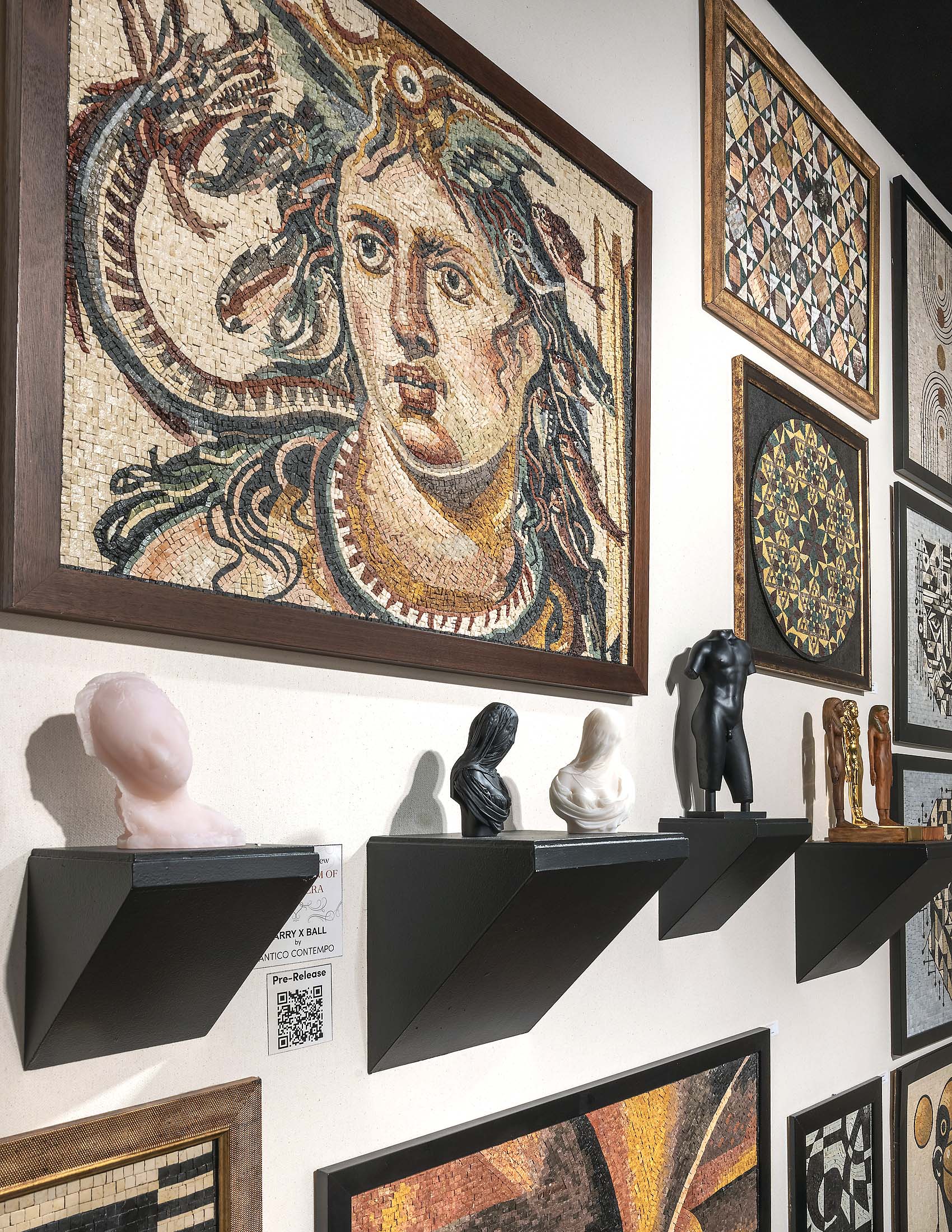
Mosaics and contempos, including pre-releases from the Phantom of the Opera series with Barry X Ball.
Can you share with our readers a little about the artworks you create?
Our contempos are the sculptures. We call them contempos, short for contemporary, and they’re inspired by authentic and historically significant artworks. We’ve worked with pieces from the third millennium BCE to pieces that were made just last year. We take these masterpieces and then we reimagine them for contemporary life.
It starts with research into the object and collaborating with anyone for approvals, for rights and things like that. Then we capture the 3D data, which gets refined and optimized. Sometimes it’s really subtle 3D work, or sometimes it’s like 20 hours of work. For example, we have one piece that depicts a dog and her babies. I must have spent 20 hours on the file. It needed a lot of work, and there are some things that wouldn’t have worked in the contemporary sense. It’s based by piece, but it’s from subtle adjustments to full transformations.
From there, you have a 3D print process, which is still not the final step. That print creates a mold, and then you can start a casting process, which ends with hand finishing with materials like stainless steel, aluminum, bronze, brass.
The mosaics follow a pretty traditional ancient technique: We source the stones from the Mediterranean, a variety of places around there. It’s usually marble, but there’s also granite, limestone and even quartz.
Before getting to the actual making of the piece is the design, which is a lot of what I do. The designs are inspired from the ancient world in a variety of different ways, but they can also be fully transformed to something that looks nothing like an ancient piece. Each stone is cut by hand and placed until you have the full picture.
Right now, a lot of what we have available are framed pieces, but we’re also doing commissions for floors and gardens and more architectural work as well, which brings a wider audience.
The prints are definitely tertiary, but we have a process for creating them. It starts with a high-quality photograph of one of our pieces or of an ancient piece and then it gets printed in high-res quality and gets framed in aluminum or wood. This is part of accessibility. The prints do well with younger audiences, which is great to see, and they provide more exposure. It’s something that’s very much worth its money, but it’s not in the same realm of the mosaics, for example, that require a lot more work and the artists doing all the details and things like that.
What is the creation process like for you?
I know the objects, some of them at least, that I wanted to start with because I’d seen them before. We get a copyright agreement — we have a legal team behind all of it — and we go from there. We always start with the physical object itself and before creating anything, we research its history and all that. On the artistic side, that research phase is really where everything begins. It informs every decision we make, from how we approach the form, to the materials we use and the techniques we bring in, whether that’s mosaic work, casting, molding or something else entirely. There’s a real intimacy to that process because you’re spending so much time with these objects and what they represent before you ever start making anything.
I often draw out my designs and go from there. Pen to paper is my favorite expression of myself, perhaps besides music, and I love to start from there. I also frequently work with 3D files on my computer, something that I never thought would be my style. The process can feel frivolous but at the end, especially when you know you have completed the sculpture’s design, the mosaic colors and so on, it is so rewarding. That is probably what keeps me coming back into the artistic side of the business.
Who and what organizations do you work with to maintain the integrity of your works?
Proper permission is always the starting point, and our copyright team makes sure that’s locked in before anything moves forward. Beyond that, the relationships we build are really what keep the integrity intact. A great example is what we’re doing right now with a new production of Phantom of the Opera in New York. We’re working with contemporary artist Barry X Ball, whose work is deeply inspired by historical figures. We reimagined some of his pieces for the set of the show, working directly with him and with the production so that everyone is in the loop and fully on board. That full cycle of transparency is really important to us.
We work with private collectors in the same way, and honestly that’s become quite a frequent part of what we do. We’re also expanding into more commission-based work with museums and institutions in the city, which has been a really exciting way to grow.
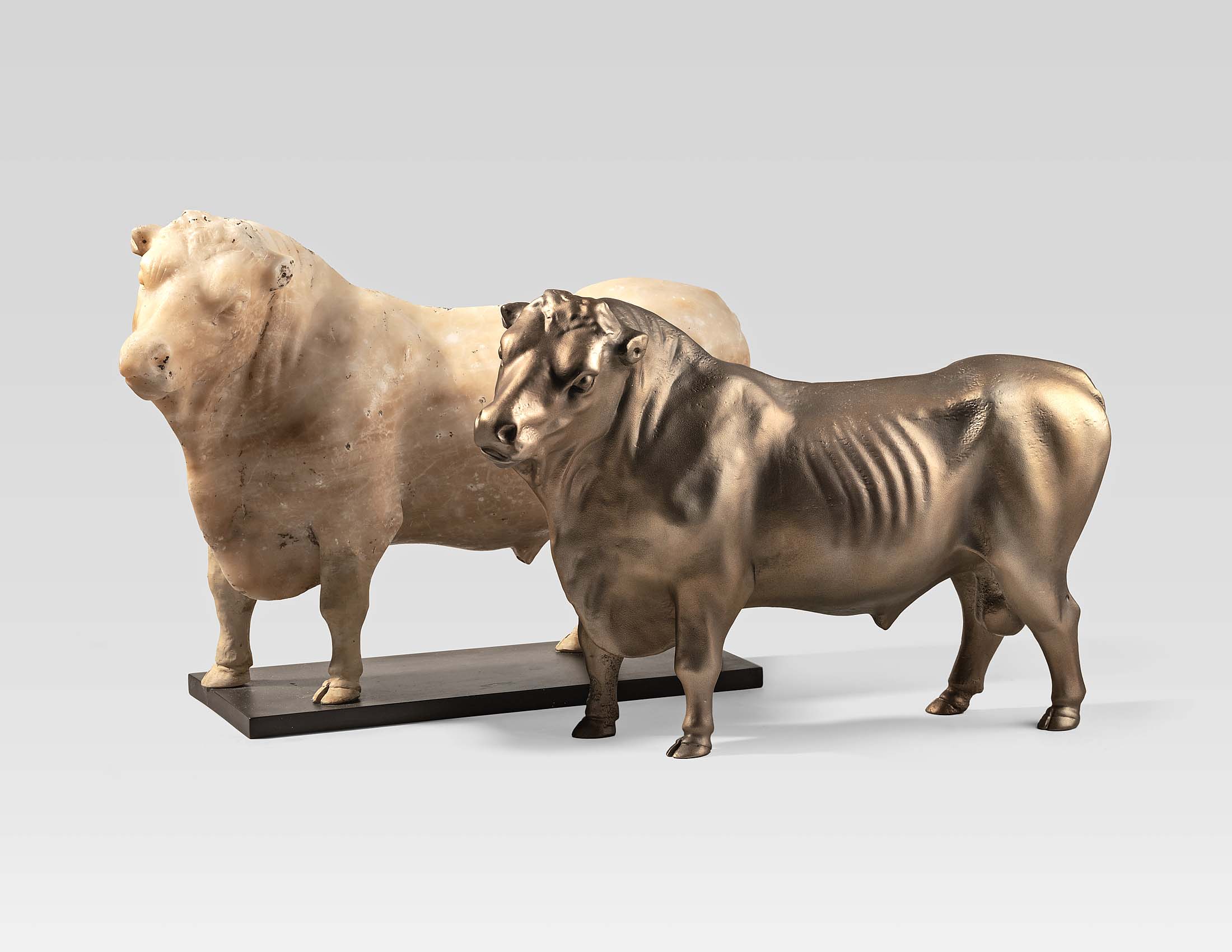
Antico Contempo’s contemporary gilded bull, 2025, and its ancient ancestor from 100 BCE-300 BCE.
What is your biggest inspiration for creating these works?
In my opinion, the further you go back, the more contemporary the pieces look. What I mean is, if you go to ancient Rome, you might have some very imperial looking pieces, like a strong bull or an eagle, a fresco or things that. You look at them and you’re like, that’s Roman or that’s Greek. It has a certain sense to it. But then, when you go back further to Cycladic civilization or Anatolia, or even older, more Bronze Age as well, you have pieces that have a simpler form, but for me, evoke more inspiration and emotion. That’s why so many of the contempos are from the Cycladic civilization, for example.
But also, for the mosaics as well. Right now I’m working on a lot of new ones, and they’re going to have much more inspiration from South Arabia, where you have these more simplified faces versus something maybe Greek, for example, where all its features are figured and it’s perfectly anatomically correct.
The older ones feel more contemporary, more sleek. Our goal is to enrich the foundation of classics, but we don’t want to limit it to what people typically think of the classics. That’s why we’re going even further back.
At The Palm Beach Show, you brought an antique figure. Is incorporating more antique items alongside your recreations something you’re expanding to?
Yes, absolutely. We brought the statuette of Osiris to Palm Beach, and I think it’s important because it creates a deeper dialogue. Having that piece there in Palm Beach, it connects us even more with the historical objects because instead of, let’s say, the painting that evokes some kind of Roman feel, this is the actual object.
And two, the Osiris we brought was bronze and it had a really beautiful aging. Over time, it’s eroded, had these dark blue azurite textures to it. So, you can look at that and then look at one of the contempos that’s in bronze or brass and you’ll think, “This piece, in 2,000 years, maybe it’ll look like this Osiris.” And maybe the Osiris will work completely differently. But it’s the material connection, because the materials haven’t actually changed that much. Of course, we have a lot of new things like resin and stainless steel, and some of the processing is different now.
I’m curious about your experience at antiques shows: Do antiques collectors respond as well as more general collectors of art and design?
I think overwhelmingly, yes.
A lot of the pieces that have been bought, and particularly at shows, are by dealers or people who are in this world already. That’s been a common theme. Also, people will look at it and think, you know, this is really great, maybe we can do it with one of my pieces. Although we haven’t initiated that fully with anyone yet, it’s been brought up several times and makes me think, okay, if these experienced people are so interested in it, then maybe we have a good thing going.
Also, I think that designers really love what we’re doing because sometimes they don’t want to go full antique, but they have great admiration for and they understand the beauty of these older forms. So, when we bring something that’s more contemporary with that ancient style, they really like it.
It can cast a really wide net. You have people who basically don’t know anything about this and they look at it and they’re like, “Oh, this is beautiful,” and then they hear about the history behind it and they’re like, “Wow, there’s so much history. All these different things that led to this. This is amazing.”
Then you have the people who already kind of have a great understanding or some understanding of the history who look at it and think, “Wow, I didn’t think this was…I never considered this to be a possibility.”
—Carly Timpson