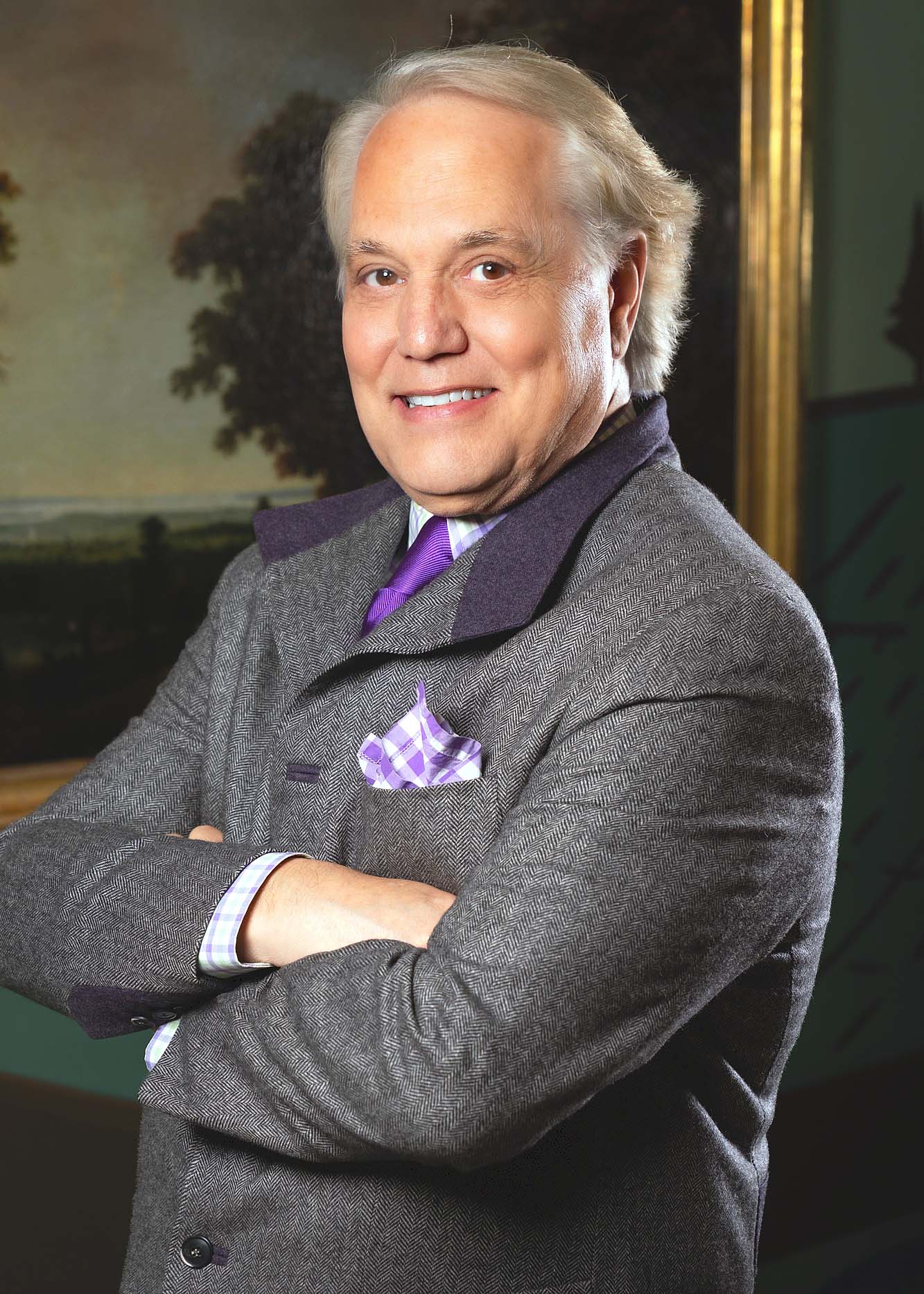
Stiles Colwill, who recently began serving as chairman of board of trustees of the Maryland Center for History and Culture (MCHC), has a background well-suited for this position and that no one else in the Center’s history has had. He was an employee when the center was the Maryland Historical Society, first starting out in 1972 as a museum research assistant. He worked his way up to becoming museum director, before leaving in 1988 to start an antique decorative and fine arts business. He kept active as a volunteer though and has served on the board for more than 25 years. He’s also a dedicated scholar on several artists, including the Peale family. He wrote Francis Guy 1760-1820, the definitive story of the American landscape painter, and co-wrote Joshua Johnson: Freeman and Early American Painter. He’s currently writing a catalogue raisonné of Johnson’s work, so we reached out to learn more about his tenure at the MHCH and his projects.
You are the only board chair at MCHC thus far to have once been an employee. Tell us how this experience informed your viewpoint as a board member and now as chair.
Well… the organization was founded in 1844, making it the oldest cultural institution in the state, and thus we are closing in on almost 200 years of our own history and collecting. I spent nearly 20 years working here and have had several multiyear terms on the board, so I’ve been here and involved for close to 50 years. The result is I know the place inside out. I know what all seven of our building’s issues are and they date from the 1850s to 2002. I know all the various positions on staff and what they do and how they function, thus very little comes to me as a surprise and, honestly, it’s hard to present me with a situation that has not happened before… As a result I have hit the ground running … I just get it and where everyone is coming from!
It is also great fun that when someone on the staff goes to tell me of something exciting that’s being given, my frequent reaction is, “Well that’s fabulous; it will exhibit so well with … and relates to…” I name an object or document in the collection and often it comes as a surprise to the curator or librarian who may only have five or six years under their belts, and they have not recalled or perhaps never seen what I am talking about. After all, we do have over some seven million items in the combined collections of our museum, library and manuscripts collection.
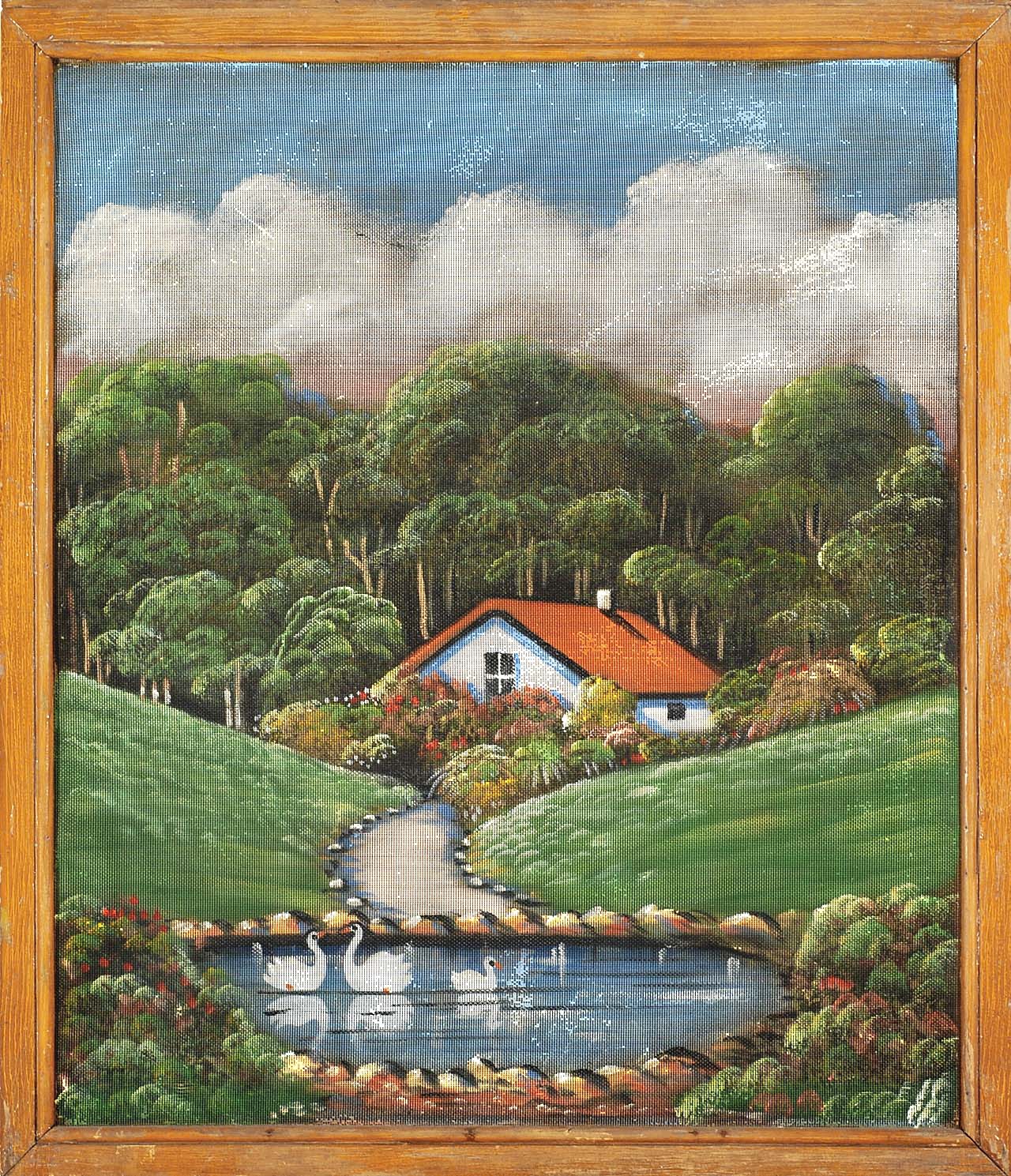
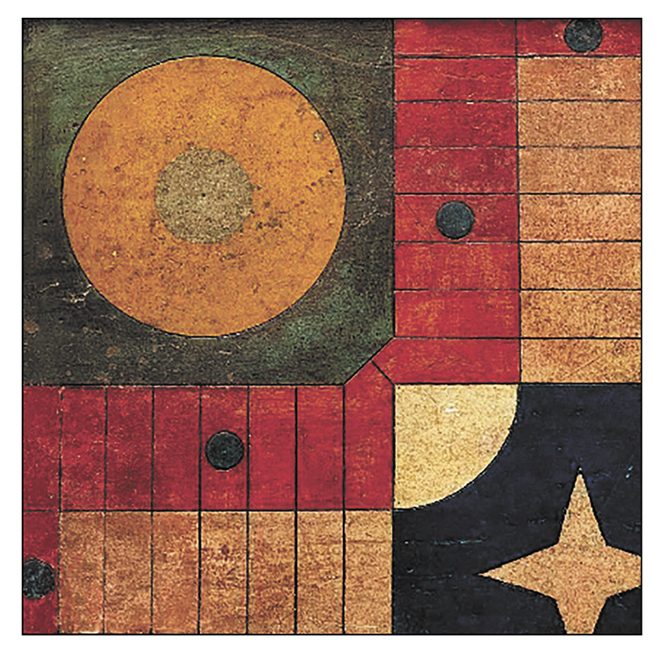
This painted screen, “Red Bungalow,” by William Oktavec was acquired for the MCHC collections by Stiles Colwill, who has promoted the exhibition “Baltimore Painted Screens” ever since. Gift of Richard Oktavec; image courtesy of the Maryland Center for History and Culture.
What originally drew you to the Center back when it was the Maryland Historical Society?
That’s a great question and being very honest, it was quite by chance. A family friend suggested I try for a summer job there; I was just 19 and had never been there before. I applied, was interviewed by the then-director Bill Filby and got the job. I was to work with the assistant curator Eugenia Calvert Holland, who had worked there nearly 30 years at that point and was the senior museum employee of only three. I cataloged the miniature portrait collection. I loved it and never left! Miss Holland was an amazing mentor and became a close and devoted friend, and she introduced me to many of her friends and associates such luminaries of the historical art world as Charles Coleman Sellers, the great Peale descendant scholar; Edgar Richardson, former director of Winterthur; Bob Stewart from the National Portrait gallery; and Albert Sack, Joe Kindig and Bernard Levy, all of furniture fame, and oh so many more… Bill Elder from the BMA and Dick Randall at the Walters were also great mentors…They all became my close friends and associates quite something for a kid not yet 20!
As Maryland’s oldest cultural institution, the Center has quite a rich history. How would you describe its strongest attributes or what it is best known for?
Absolutely no question on this: it is the collections… I often say, “Ask the collection a question, and you will be wide eyed by the answers of what we have and by the variety of items.” The MCHC collections are just incredible. To mention just a few, start with the “Star Spangled Banner” manuscript by Francis Scott Key, and you will say, “Oh, wow, you have that?” Well, yes, and a miniature portrait of Key done when he was like 14 by the artist Jean François de Vallée, along with James Hoban’s drawing for the White House from the competition to build the White House, and you likely did not even know such a competition existed. Same for the drawings for the US Capitol, including one by Thomas Jefferson. Also, the largest collection of paintings by the various members of the Peale family, more by my friend Joshua Johnson than any other institution and the Kirk silver collection acquired from the company and hundreds of studies and drawings from their archives and account books. The depth of the collections is almost unfathomable.
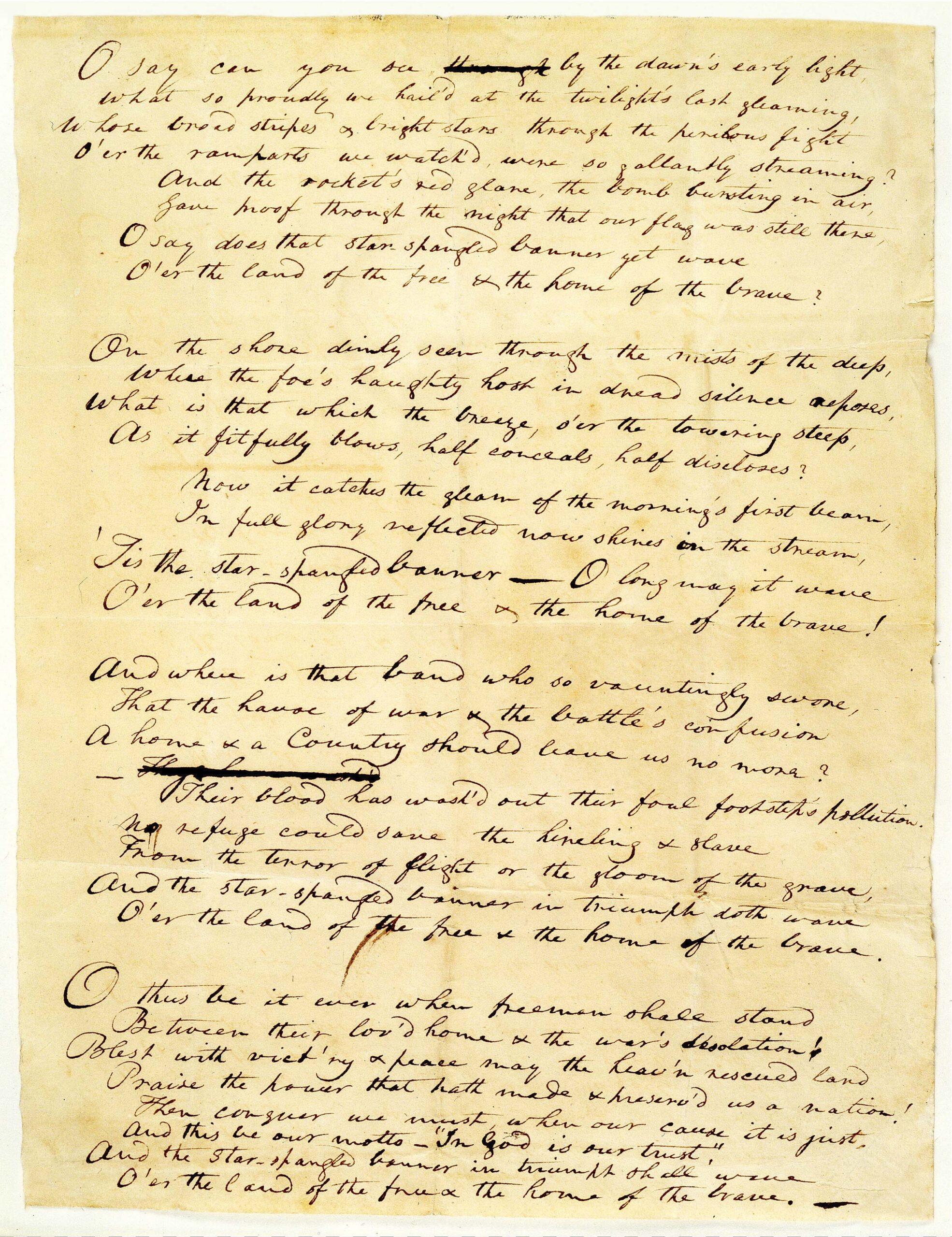
This 1814 manuscript of the “Star Spangled Banner” by Francis Scott Key, the earliest extant version, is among the many historic standouts in the collections. It was given to the Maryland Center for History and Culture’s Baldwin Research Library by Mrs Thomas C. Jenkins in memory of her husband’s mother, the late Mrs George C. Jenkins, née Catherine Key. Image courtesy of the Maryland Center for History and Culture.
What is one thing you would like people not familiar with MCHC to know?
We are here! We are easily accessible and you need to come see these amazing collections for yourself. You know that this is an especially important moment in time for institutions like ours. Being philosophical now — regardless of what side of the political spectrum you are on, museums and cultural institutions are crucial resources in our country: we offer spaces for civil discourse, where we can promote civic engagement, and one of our major functions through our wonderful programs is to help to educate our next generations. At a time when our country feels more fractured and polarized than ever, the work of MCHC becomes even more urgent in telling our stories from the past. It is only by knowing the past that we can prepare our young people to be our future leaders!
What are some of your immediate goals as board chair and what are some of the biggest challenges and opportunities facing the Center today?
Well, you know, I am an objects person, so working with our incredibly talented staff, small as it is, to get more on display. There is no point in having it if we cannot see it…so to get more of the collection on view!
Combine that with a beefed-up exhibition schedule, and I suspect, like every board chair in the country, raising money for endowment and renovations. We have amazing library collections, but the behind-the-scenes parts of it have not been upgraded in nearly a century. That modernization is a top priority and will involve a quiet capital campaign.
I also want to reactivate our incredible historic house, the Enoch Pratt House, a remarkable townhouse and a major feature of our downtown campus.
I’ll be working closely with our director Katie Caljean to make us not just a resource for our local community, but we are working hard to actively engage with it. We have a wonderful set of strategic initiatives, which are all about finding ways to not just care for our collections but to activate them for the benefit of our community and audiences, old and new. That mandate was behind the shift in our rebranding from “Society” to “Center” — we want to be a welcoming place that’s at the center of community life, and to engage with as many audiences as possible to share our wonderful collections and stories. There is much to get done!
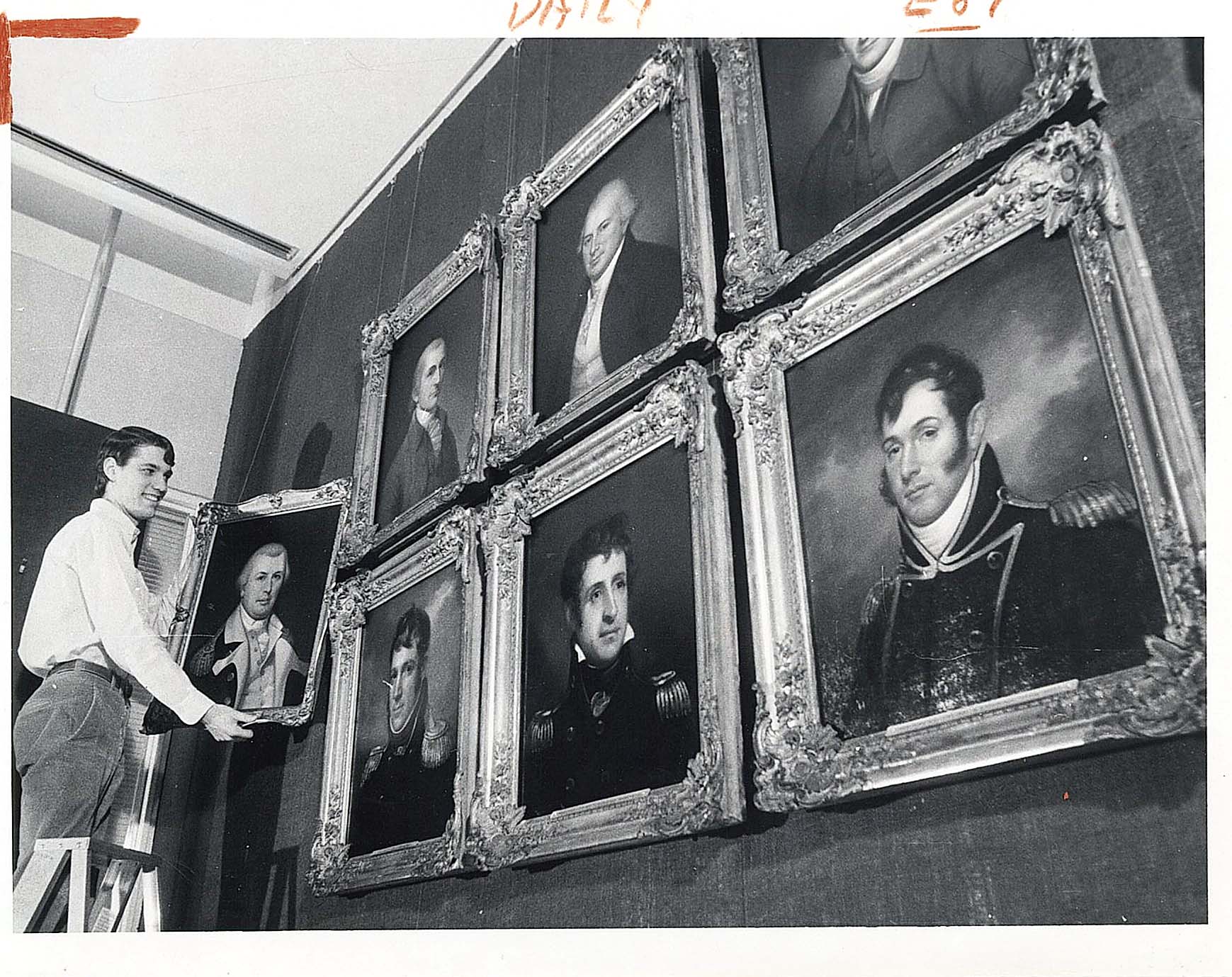
Stiles Colwill is pictured on a ladder in the spring of 1975, hanging a group of eight paintings by Rembrandt and Raphaelle Peale as part of the exhibition “Four Generations of Commissions: The Peale Collection of the Maryland Historical Society,” for which he was an assistant curator. He helped write the accompanying catalog, his first publication. Photo courtesy Baltimore Sun, William H. Mortimer photographer.
You have a strong background in museums as well as arts and antiques in general. Where do your own collecting preferences or tastes lie?
I have always loved paintings and especially portraits. My mother was a portrait painter so I may get that from her and have long said if you want to collect great American paintings and are on a limited budget … you need to be willing to live with other people’s ancestors — just collect portraits, so I have a lot of them! I’ve long been fascinated by the Peales, and my friendship with Dr Sellers influenced that. I have concentrated there and with Benjamin West and his American students (including two Peales). Lastly in paintings my great love, early American landscape paintings, particularly pre-Hudson River School, which Maryland was very strong in! Add in lots of Maryland furniture and Maryland related decorative arts…especially silver. I am teased that I have a severe case of horror vacui or fear of vacant space, so pictures are double or triple hung and no tabletop is not littered with fewer than say a dozen objects… My dear friend Bunny Williams said it’s the only home she knows that hangs pictures down low enough for the Jack Russell to see!
Tell us about the Joshua Johnson catalogue raisonné you are currently working on. What is it about this artist that speaks to you, and can you share one interesting discovery you have made in his oeuvre?
I have been studying Joshua since my first summer at the MCHC; he has always intrigued me. He was rediscovered just over 100 years ago by the early American paintings scholar Dr J. Hall Pleasants, whose papers are housed at the MCHC, and I have worked closely with them for years! I co-organized, with my friend Carolyn Weekly, then at the Abby Aldrich, the 1987 exhibition and catalog for “Joshua Johnson: Freeman and Early American Portrait Painter,” which has acted as somewhat of a catalogue raisonné since being published. Since then, I have been consulting on and keeping track of newly discovered Johnson pictures which has included advising museums, dealers and auction houses on which pictures are and are not acceptable as the work of Joshua!It is now been nearly 40 years since that catalog and exhibition, and it seems the right time to really update the work. Of the 83 listed then, several have now been questioned and two analyzed as early copies, not originals. There have been close to 30 newly acceptable paintings located. They need to be published and recorded. And then there are a number of pictures which are clearly not the work of JJ that repeatedly float through the marketplace, and they need to be critically debunked. Thus there is a need to publish a proper old-fashioned catalogue raisonné. Further, many that were still in the original families of the sitters in 1987 have now moved to public collections and that seismic shift in ownership needs to be recorded. To quote the marketplace for a moment when one sold for over a million dollars, many viewers took a new notice of his work. The MCHC is the place to do that, as we are the institution who, with Dr Pleasants, rediscovered him, and Johnson was such an important Baltimore artist. Add to that, we own several of the most important, documented pictures. To be frank, we own the largest group of his work of any museum in the country. We are, as we speak, in discussions with several major institutions across the country in hopes of making it a national traveling exhibition as well.
—Andrea Valluzzo