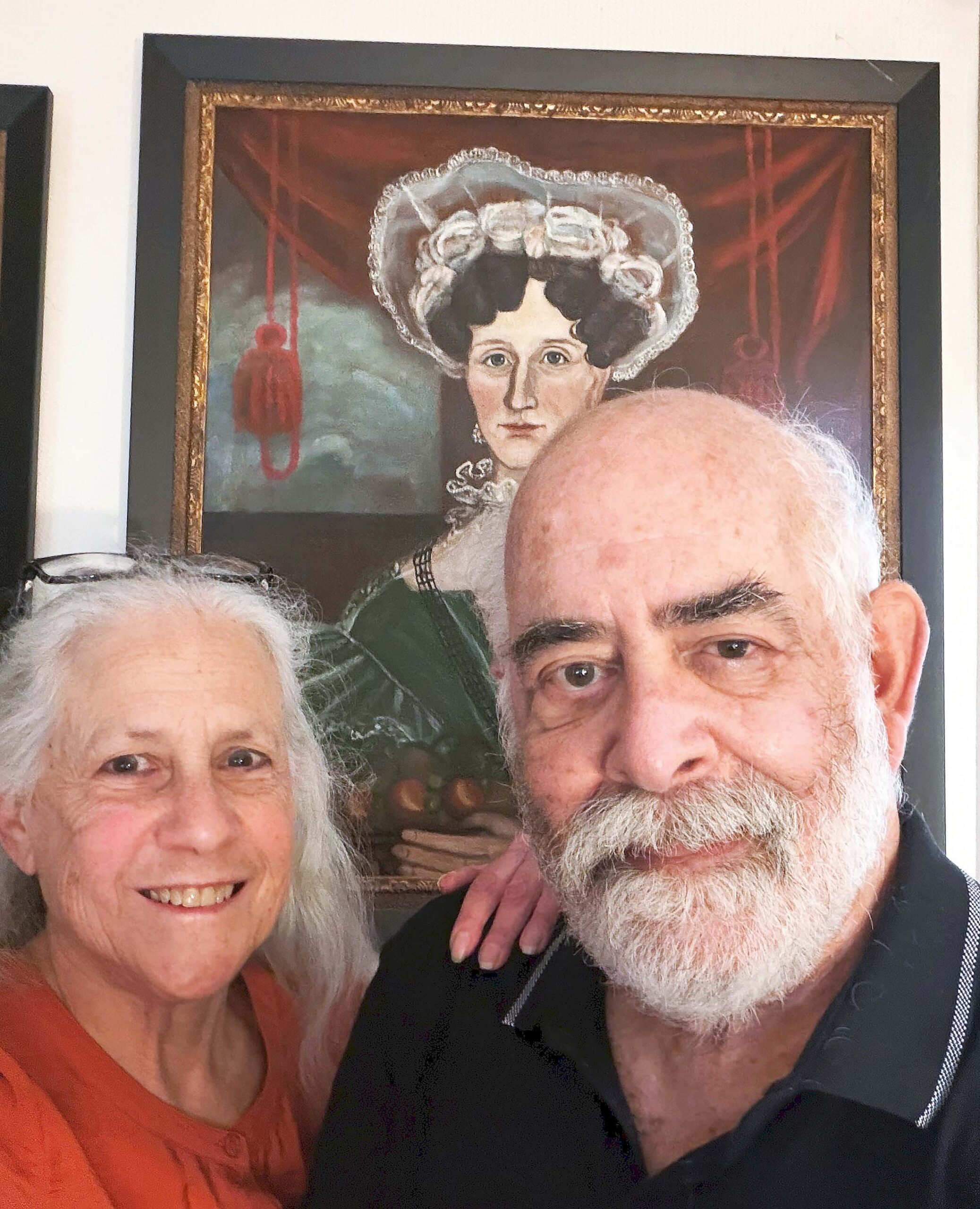
The Paynes are pictured in front of a portrait signed by Ruth Shute who they wrote about in the July/August 2021 issue of The Magazine Antiques, pp. 72-81.
Suzanne Rudnick Payne and Michael Payne earned PhD degrees in their respective science fields years ago, but their shared passion lies in researching forgotten or little-known folk art painters. They have written 26 publications over the past 23 years, mostly examining vernacular portraits from 1790-1840 from such artists as Abiah S. Warren, William Jennys, Isaac Augustus Wetherby and the Burpee-Conant Limner, an artist whose painting style had long been recognized, named after two known sitters. Their current project, which they are asking readers for a hand with, is on Asahel Powers from Springfield, Vt. New research has come to light indicating that there was more than just one Asahel Powers in the family who painted. We visited the Paynes at their New York State home to learn more about their research.
Tell us about your current research project.
Michael: This is just a case in which you keep looking at what’s been published and what hasn’t been published. Nina Fletcher Little did an article in The Magazine Antiques in 1971 and got an exhibition at Colonial Williamsburg of his work [“Asahel Powers: Painter of Vermont Faces”].
When you see the images, it always struck me as very odd that there was this dichotomy in his work. Usually when an artist develops a very concrete, very solid style and genre, they continue it, and then they gradually change. Here, you have a transition from a very folky style, very highly colored style with big areas of flat, bright color, to very competent, boring, middle-of-the-road, kind of pseudo-academic style portraits.
It’s too quick of a transition. I’ve always thought that. But it’s very important in the history of the field, meaning from Nina’s work, you got this idea — the field got this idea that you could have a portrait painter working in isolation, who all of a sudden met a couple of artists that were much more highly trained than them and changed their style. But, the transition was too quick. Too abrupt.
Anyways, it’s now 50 years later after this initial research and additional portraits and information have become available. We will present evidence that there were two artists at work, with a different Asahel Powers being the artist of the more stylized examples.
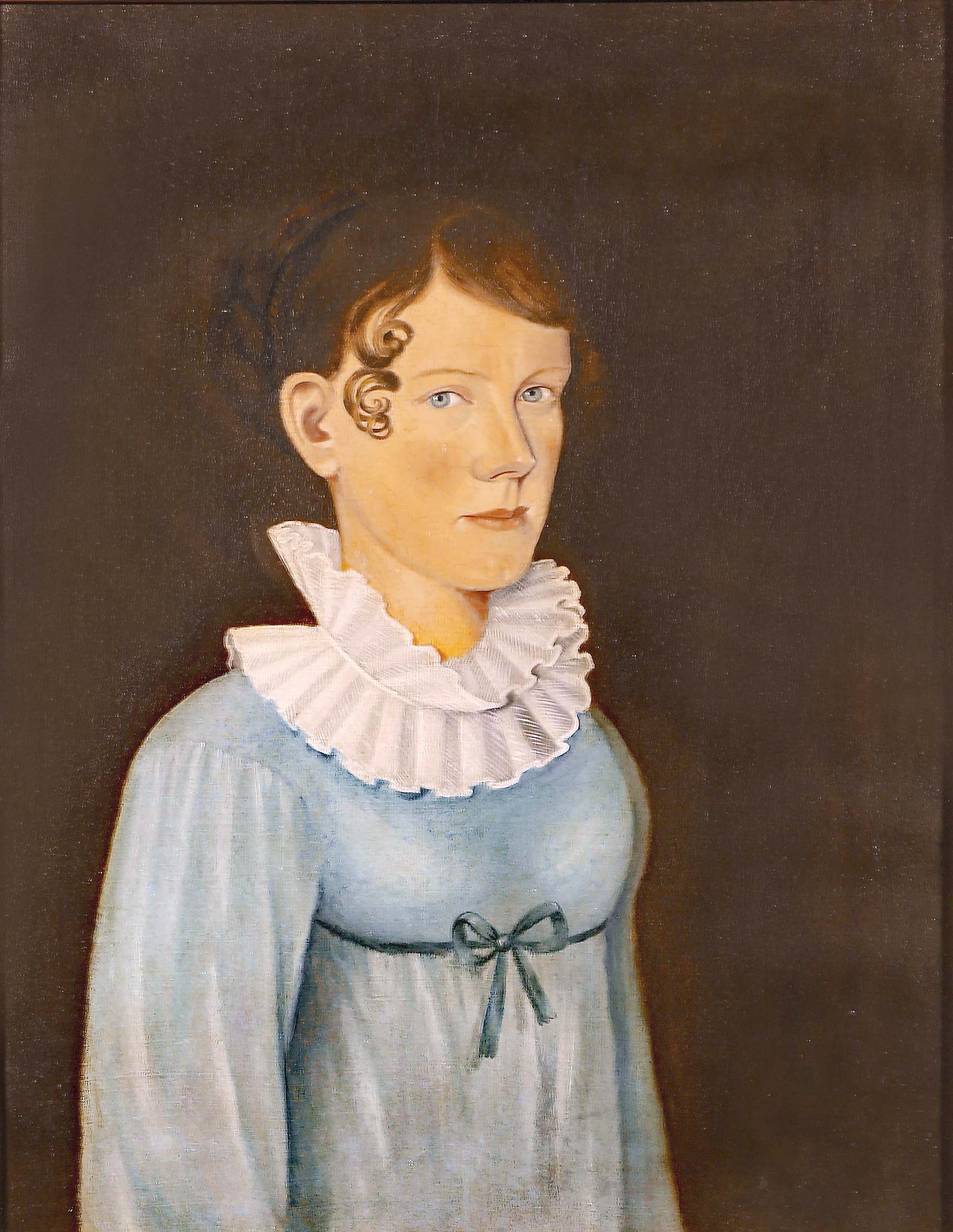
Portrait of Nancy Riley Bulkeley is attributed to Samuel Broadbent, another artist the couple is researching. Image courtesy of Nathan Liverant and Son, LLC.
When did you start the Powers project?
M: About a year ago. We already have a partial manuscript.
Suzanne: It’s exciting. I think the projects that have been most exciting is when we’ve taken an unknown artist and identified who he or she was and then revealed their biographies for the first time. That’s really been the most gratifying.
What are some challenges you face?
M: The problem often in this research is we’re dealing here with very obscure artists. And the problem is that we’re publishing in magazines where the art is quality photography, and getting enough images of that one painter is monumental. So we’ve ended up doing our own photography. We can walk into someone’s house or a museum and produce the photography. Usually the projects we start are multi-year tasks. I’ve got a lot of manuscripts that if I ever find enough images, we have an article we can publish. But finding the images can easily take a half a dozen years.
Who is another interesting artist you have also researched?
M: In the case of Susanna Paine [1792-1862], it’s that she wrote an autobiography—
S: —that was never used by the folk portrait community. It was very rare. She talks about her entire life, how she painted, where she painted, what her painting rooms were about. It’s a fascinating read. I recommend it. It’s digitized, so you can read it online.
M: She was a very powerful woman. There’s an example of her portraits upstairs.
S: She was a divorcee. She divorced her husband, which of course at the time was unheard of.
M: She divorced him because he was burning Bibles.
S: Her portraits are fabulous, especially her portraits of women. They are strong women, independent-looking women. And her men look a little wimpy. I think she was saying something.
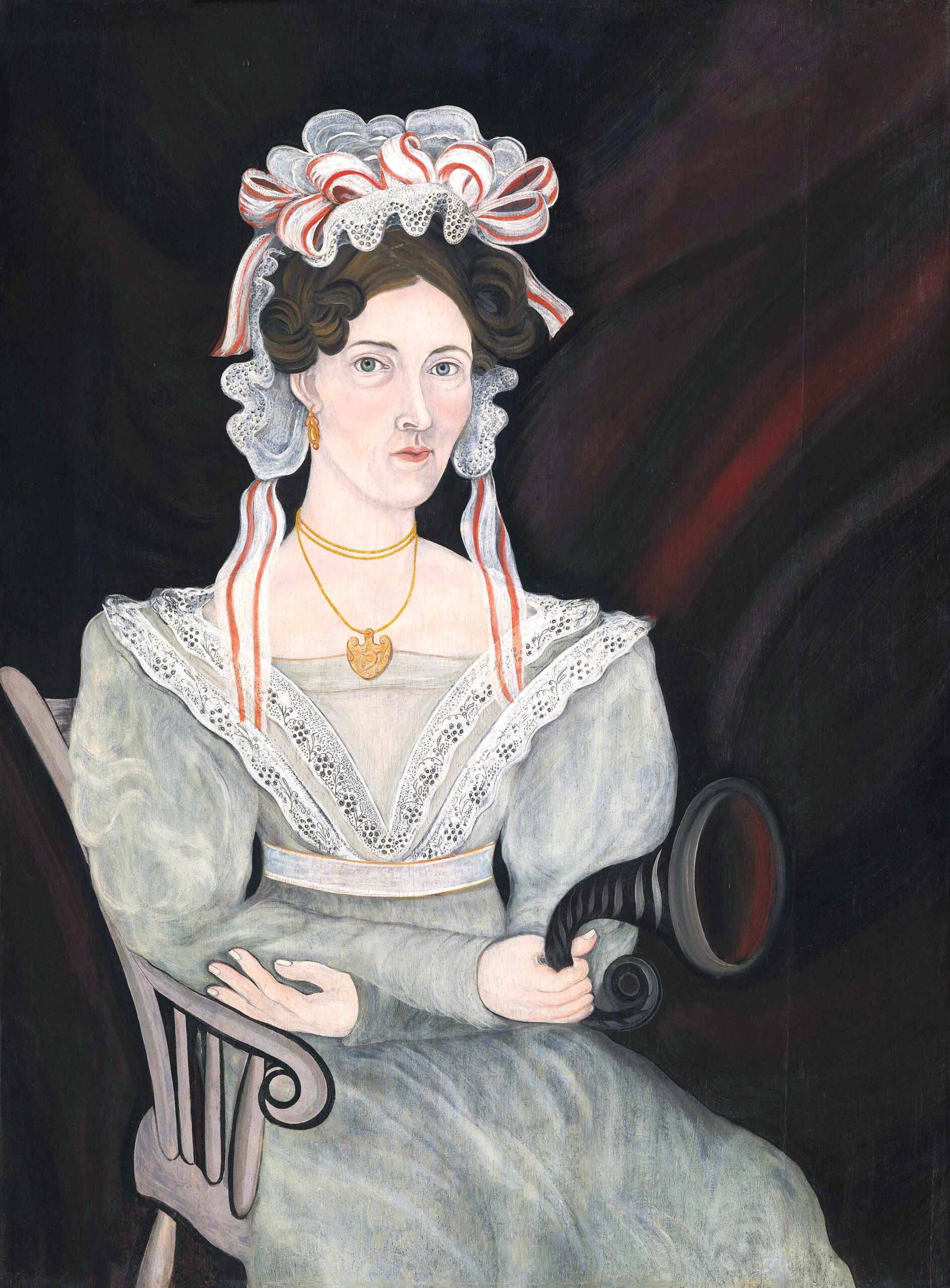
Possibly Mrs William Sheldon, attributed to Asahel Powers, oil on wood, 41 by 30½ inches. Image courtesy of The National Gallery of Art, Washington, DC, gift of Edgar William and Bernice Chrysler Garbish.
What’s one of the best information sources you’ve used in research?
S: We’ve used account books for several articles. People often kept a daybook and an account book. A daybook was just what it implies. It was the activities of the day. And then they were transferred to an account book, or some people just used an account book. But they were not strictly for accounting purposes. They would also have little notes in the margins… We use these because they were the record that the artists were keeping. And some of them really were just artists, like Isaac Weatherby, and others really were artists on the side, like Samuel Broadbent [1759-1828, who was a doctor in Wethersfield, Conn.]
M: But there was only one case where in his records, it was just for portraits. Everyone else had medical problems that he dealt with. He was primarily a physician, so the painting was just something he did on the side a little bit.
You actually found pieces of Broadbent’s account book at three different institutions?
S: Yes, it’s what we live for. We bought a portrait that we thought might be a Samuel Broadbent out of a New England auction. As we were researching Broadbent, because we thought it might be a Broadbent, we started going through our Broadbent records. We had previously written a little note to ourselves literally on a slip of paper that said that the American Antiquarian Society had acquired a daybook that included a Samuel Broadbent. We wrote: “Could this be Samuel Broadbent the artist? Check out one day.” The note went in the folder and we’d long since forgotten about it. Now we’re really interested in Samuel Broadbent and there’s a little piece of paper. And yes, it was Samuel Broadbent, the artist.
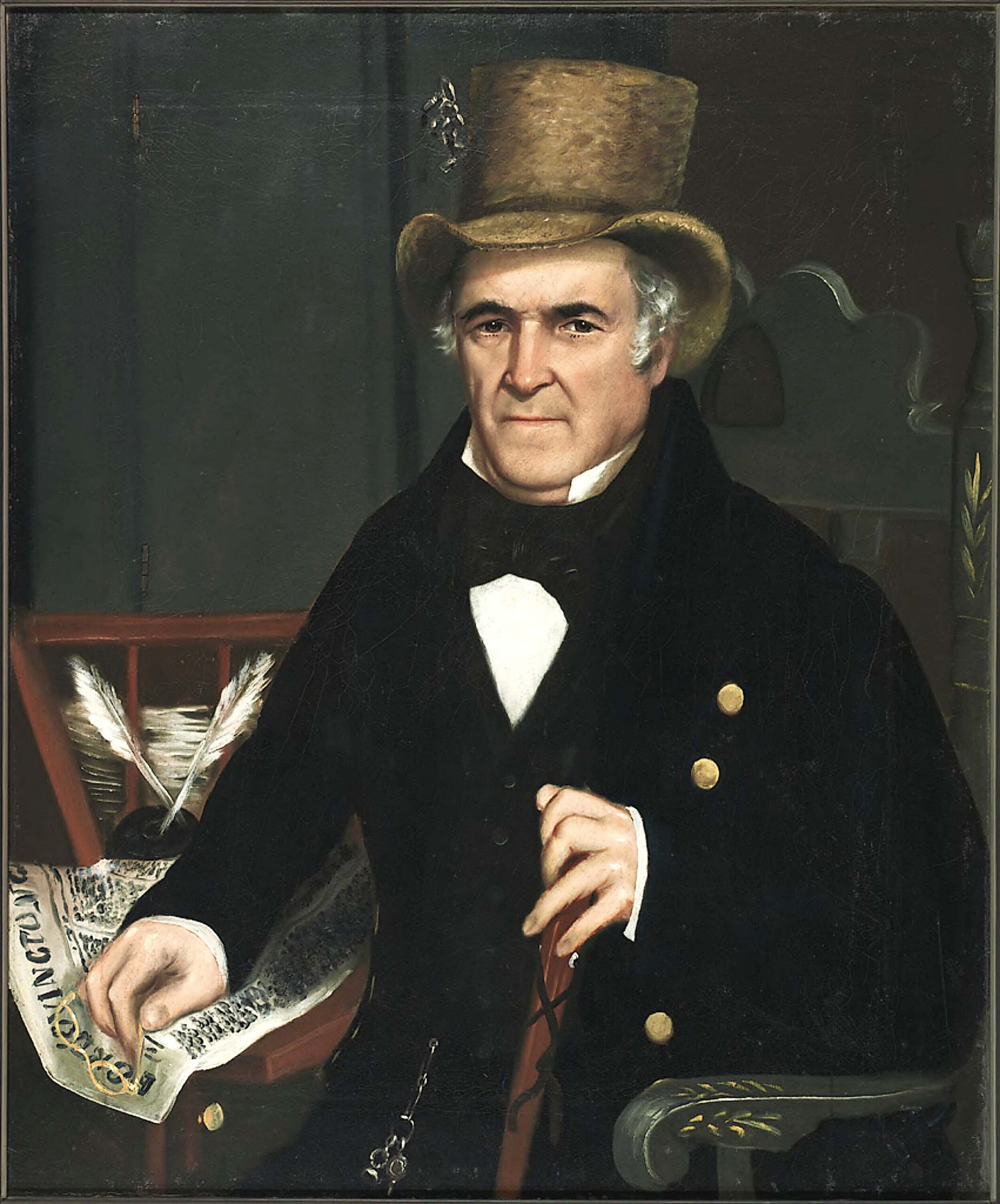
Portrait of Benjamin Clark by Asahel Powers, oil on striped ticking, 36 by 30 inches. Image courtesy of Harvard Art Museums, Fogg Museum, gift of Mr and Mrs John S. Bass.
How has your research upended the trope of the typical itinerant painter being a poor, uneducated person?
M: The materials were expensive and you had to be shown. You bought the English books. Each pigment to make oil paint had a different recipe. The first problem was getting the pigment — there were some English pigments, but they were very expensive; they could also dig out the pigment themselves. So, technical knowledge was needed to produce an oil painting.
We kind of say, “Oh, they were folk portrait painters. They didn’t have a lot of training.” Well, yes and no.
For the time, they were extraordinary. Imagine living in a world with no images of people [before photography]. I mean, we can’t even imagine it.
S: Even oil paints had to be mixed by hand. The artist had to grind the pigment and mix it with the oils. Once this was done, they were perishable, they didn’t keep. So, the technical aspects of painting were overwhelming. It wasn’t something that you just said, “I’m going to Michael’s to buy some oil paints and a canvas, and I’m going to give this a try tonight.” You really needed to have some knowledge of what you were doing.
M: And they would come into a town and set up and rent a space. Sometimes they would send flyers. Generally, just about everybody in town came to watch them paint. This was the height of technology at the time. Photography in America didn’t come until 1839, which was, of course, the death of the folk portrait painter. If you wanted to continue painting after that, you had to produce what the camera couldn’t. You had to produce “cute children.” We call it the cute children phase, and charming children is what you’re painting because you couldn’t paint just a portrait anymore. Who would want it compared to the daguerreotype?
S: It was a whole chapter in American art history.
Your respective offices are filled with manuscripts and research in different stages of progress. Will all be published one day?
M: A lot of them won’t go anywhere. A lot I started and just pressed forward with, and some of them I wrote the manuscript but we just can’t find the portraits. Who knows what will happen? We still have a couple years of life and who knows what we’ll find. It’s just become this fascinating hobby that’s kind of forced us to go off in all sorts of directions. We’re never bored.
—Andrea Valluzzo
[Editors note: The Paynes ask that anyone who owns portraits by an Asahel Powers to share images with them for a planned article to be published at [email protected] or [email protected].]