By Kate Eagen Johnson
COOPERSTOWN, N.Y. — “It is ‘a curator’s dream.’ You don’t have to guess or speculate and that’s not true of most pieces.” Independent scholar and author Robert Shaw, the guest curator of “The Instruction of Young Ladies: Arts from Private Girls’ Schools and Academies in Early America,” held up the glorious 1769 needlework coat-of-arms by Ann Grant with its intact early history as an ideal. While many works in the exhibition do not possess such strong documentation, it is still fair to say that all qualify as “dream objects.” Employing the language of the day, these wondrous specimens of feminine accomplishment wrought in silk, wool, linen, paint, ink and watercolor will astonish visitors to the Fenimore Art Museum (FAM) in Cooperstown from September 24 through December 31.
“The Instruction of Young Ladies” offers the rare opportunity to see stars of this captivating genre assembled in one location. Gems belonging to FAM and to the collector Jane Katcher are joined by jewels from Yale University Art Gallery, Maine Historical Society, Winterthur Museum and other public and private repositories. According to organizers, this is the first sizable exhibition to consider the range of visual arts taught at female seminaries and related schools. It is accompanied by a nearly 80-page, full-color catalog.
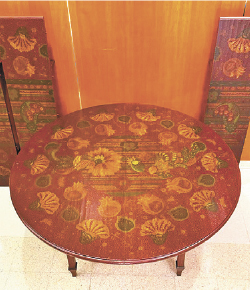
The ornamental arts objects on display include needlework pictures of the mourning, literary, religious and fanciful varieties. There are maps, still lifes, calligraphic exercises, historical depictions and moralistic scenes among the works on paper. Ladies’ reticules, fire fans and even a pretty pillow are embellished with theorem painting. Federal-era tables and boxes decorated by girls and women are also offered for viewers’ delight and edification.
Some objects can be tied to specific makers and/or schools of instruction, while other items partake of the pervasive spirit of “schoolgirl art.” Those with known origins hail from New England, Pennsylvania, New Jersey and New York.
While many of the objects date from the era when ornamental arts instruction flourished at female academies, namely 1800 to 1840, they actually span a period of two centuries. Serving as the exhibition’s chronological bookends are a circa 1670 Boston needlework picture attributed to Sarah Phillips and a friendship album of drawings compiled by New Ipswich (N.H.) Academy student Selinda Hill between 1831 and 1870.
Bob Shaw explained that the goals of the project were to bring together items illustrating the diversity of art objects made or decorated by girls and women at seminaries and to put these artifacts into the broad context of female education in America. For the small segment of American girls who could access an academic education during the early national era, tutelage in the arts was part of, and often integrated into, a broader curriculum.
Shaw is a multifaceted folk art stalwart. A former curator at the Shelburne Museum, he has organized exhibitions at the National Gallery of Art, Renwick Gallery, University of Michigan Art Museum, the New England Quilt Museum and elsewhere. This prolific writer’s recent books include American Quilts, The Democratic Art (2014); Electrified: The Art of the Contemporary Electric Guitar (2011); Bird Decoys of North America: Nature, History and Art (2010) and Amish Abstractions: Quilts from the Collection of Faith and Stephen Brown (2009).
The catalog for “The Instruction of Young Ladies” contains Shaw’s essay on the history of female academies, in which he references select objects in the exhibition, as well as an introduction to female education in early America by Dr Jane Katcher, whom Shaw termed “the driving force behind this project.”
Katcher is a retired pediatric radiologist recognized for her deep connection to expressions of childhood in American material culture, especially folk art. In Shaw’s estimation, Katcher has formed one of the broadest and most varied collections of Americana and folk art in his experience. “The quality of her collection is extraordinary and its range is extraordinary. Jane is a modest person who is interested in sharing information with and among collectors. She wants to promote an understanding of Americana and folk art because she loves it.”
Katcher’s thoughtful nature and devotion to learning is reflected in the acknowledgement which she includes at the end of her catalog essay on education: “I wandered into David Schorsch’s New York gallery in 1990, having no idea that from that early meeting would develop a most extraordinary immersion in Americana and American folk art. I am indebted to David for his generosity in sharing his remarkable wealth of knowledge and in his encouragement to study, observe and continue to ask questions.”
Katcher and Schorsch, along with Ruth Wolfe, edited the two-volume Expressions of Innocence and Eloquence: Selections from the Jane Katcher Collection of Americana with volume I published in 2006 and volume II following five years later. Shaw contributed to both volumes, including an essay on the subject of this exhibition in volume I. Volume II’s 2011 release was marked by the exhibition “Inspired Traditions: Selections from the Jane Katcher Collection of Americana” at FAM. The website at www.janekatchercollection.com continues to offer information and updates about the Katcher collection.
Faced with the formidable task of choosing which stellar examples from the pantheon of schoolgirl art would be displayed, Shaw described an approach that involved Katcher, Schorsch and FAM president and CEO Paul D’Ambrosio where “we bounced ideas off each other.” The list of 100 candidates Shaw proposed as a starting point was augmented and winnowed by the team. Their deliberate process resulted in the 50 objects showcased. “We were happy with the representation. These are top-shelf pieces which show the variety of what was produced in the schools,” reflected Shaw.
Asked to comment on a few favorites, Shaw turned to the aforementioned coat-of-arms by Ann Grant in the collection of Historic Deerfield. He observed that not only is it beautiful and pre-Revolutionary War in date, but also much is known about the object and the maker, including with whom she sought instruction and when. Surviving invoices indicate that as a young adult Grant studied fine needlework in Boston with a woman named Jannette Day. She continued taking lessons after Ann and Elizabeth Cumming took over Day’s school. They billed Grant’s account for “Black satin for Cot [sic] of Arms” on September 28, 1769, a charge which almost certainly refers to this dazzling embroidery.
Shaw also picked two works stitched by Mary Danforth of Manchester, Mass. The first is a striking ornamental sampler with a highly unusual red background. The second is a mourning picture with a monument containing the following inscription: “Sacred to the memory of Enoch H. Long / who departed / this life June 28, 1823 / Aged 6 years, 6 m.” Danforth married Rufus Long, the brother of the deceased child, in 1826. Shaw pointed to the overall design, which includes the row of people of ascending height approaching the monument and the row of willows below. Terming Danforth “an intuitive artistic genius,” Shaw observed that both works “are masterpieces to my eye.”
Other marvels in the exhibition include the 1754 creature- and flower-filled fantasy Mary King of Philadelphia embroidered on a screaming yellow silk ground, Mary Antrim’s 1807 needlework scene of a mansion with fancy fowl in the front yard and a young woman in white riding upon a white horse, and a chamber table decorated and dated January 1816 by Maine’s Rachel Lambard with its views of Netley Abbey, Limerick Castle and the rotunda and gardens at Stourhead inspired by scenic prints.
FAM’s annual Americana Symposium to be held on Saturday, October 1, will focus on topics relating to “The Instruction of Young Ladies.” Presenters include consulting curator of decorative arts at the Bowdoin College Museum Laura Sprague, ornamental artist and author Betsy Krieg Salm, collector and independent researcher Bill Gemmill and Bob Shaw.
Visual appeal rules the day in this reverie of fancy needlework, theorem painting, watercolor and ink drawing, and painted boxes and tables. Issues ripe for discussion at another time include how many girls, particularly orphans, were sent to seminaries to gain skills so that they could support themselves as teachers or as practitioners of the fine needle arts if needed. And then there is also the question why Twentieth Century curators and dealers classified art produced by girls and women in an academic setting and in an academic manner as “folk art” even as works created by boys and men at similar institutions were not routinely assigned to the same category. All this said, today’s scholars and students of schoolgirl art will not want to miss this conclave of “greatest hits.”
Beyond “The Instruction of Young Ladies” exhibition and catalog, those who love American fancy needlework and related arts have much to see and read. In regard to exhibitions, they can currently tour “Embroidery: The Language of Art,” which will run through January 8 at Winterthur Museum, Garden & Library. Relevant books published over the last years include Georgia’s Girlhood Embroidery: ‘Crowned with Glory and Immortality’ (2015) by Kathleen Staples, with essays by Dale L. Couch and Jenny Garwood; Women’s Work: Embroidery in Colonial Boston (2012) by Pamela Parmal; With Needle and Brush: Schoolgirl Embroidery from the Connecticut River Valley, 1740–1840 (2011) by Carol Huber, Stephen Huber, Susan P. Schoelwer and Amy Kurtz Lansing; Connecticut Needlework: Women, Art, and Family, 1740–1840 (2010) by Susan P. Schoelwer; and Women’s Painted Furniture, 1790–1830, American Schoolgirl Art (2010) by Betsy Kreig Salm.
FAM’s annual Americana symposium is this year planned for Saturday, October 1. Space at this free, public event is limited and reservations are recommended but not required. To reserve a space, call 607-547-1461.
Fenimore Art Museum is at 5798 State Highway 80. For information, 607-547-1400 or www.fenimoreartmuseum.org.
Kate Eagen Johnson is an expert in American decorative arts and an independent museum consultant, historian, lecturer and author.