By Rick Russack
LEXINGTON, VA. — Many folks are aware that the Reeves Center at Washington and Lee University houses an outstanding collection of Chinese export porcelain, documented in a 2003 book by Thomas V. Litzenburg Jr and Ann T. Bailey, as well as in a 1973 exhibition catalog. Less well known is the fact that the collections include Japanese, European and American wares made between 1500 and 1900, and accomplished paintings by collector Louise Herreshoff Reeves.
Louise and Euchlin Reeves, her second husband, lived in Providence, R.I. Both collected, though accumulated is perhaps the better term. In addition to ceramics, they acquired early American furniture. They bought from some of the leading dealers of the day: among them, Elinor Gordon, Philip Suval, Israel Sack, Inc, Ginsberg and Levy, and David Stockwell. After filling one house with their collections, mostly ceramics, they bought a house next door and proceeded to fill that one as well. Prompted in part by the fact that Euchlin Reeves was a 1927 graduate of its school of law, the Reeveses gave their collection to Washington and Lee in 1967, shipping more than 200 barrels of ceramics from Providence to Lexington.
The collection has grown over the years by donation and purchase, from 1,800 pieces to about 3,000. In the area of Chinese export porcelain, it has few peers. It is particularly strong in armorial wares and pieces with connections to America. Eight pieces decorated with the arms of the Society of the Cincinnati are from a large service that once belonged to George Washington. The Washington dinner service is one of the most significant sets of Chinese export porcelain made for the American market.
It was ordered in China by Samuel Shaw, one of the original members of the Society of the Cincinnati. He was also the supercargo on the Empress of China, the first American ship to sail from the newly independent United States to China in 1784. Shaw returned the following year with a 302-piece service, which was eventually divided between the Washington family and the family of Henry “Light-Horse Harry” Lee, who served with Washington during the Revolutionary War. A descendent of the Lee family gave the pieces in the Reeves Collection to the university.
The collection has 25 pieces from a large dinner service with the monogram of Paul Revere. It is believed that these pieces were part of the “imported table Sett China” recorded in Revere’s 1818 household inventory. It is not surprising that several pieces depict the Great Seal of the United States, as this was one of Mrs Reeves’ particular interests, as were pieces reflecting America’s maritime history. One wall of a main gallery is devoted to an incredible collection of 600 armorial coffee cups from the collection of the late David Sanctuary Howard, the preeminent scholar of Chinese armorial porcelains. The uniformity of the cups creates a striking display.
How Louise Reeves acquired a centerpiece of the collection, a magnificent punch bowl decorated with European and American trading centers, or hongs, in the Chinese port of Guangzhou (Canton) on the Pearl River, is the stuff of legend.
As the story goes, the late Pennsylvania dealer Elinor Gordon took the bowl with her to her first antiques show, in New York City in 1951. Gordon and her husband, Horace, had no intention of selling the bowl. Reeves saw the bowl and told Elinor Gordon that “everything in this show is for sale.” The Gordons decided to “fix the price so outrageously high that she would not pursue the matter.” When told that their asking price was $1,500, Reeves surprised them by opening her purse and taking out 15 hundred-dollar bills. Reeves is said to have carried the bowl on her lap during the train ride home to Providence. At the time, $1,500 was one of the highest prices ever paid for a Chinese export punch bowl.
Another treasure is an almost complete tea set, circa 1740–45, decorated with hand painted scenes of European merchants packing or unpacking barrels. Chinese craftsmen copied the scenes from porcelain produced at the Meissen factory. Complementing Chinese porcelain at the Reeves Center is a large Meissen charger from the famous Swan service, plus porcelain from other early European factories in Germany, Austria and France, along with creamware and pearlware from England.
Also on view are two of 24 egg cups from a 666-piece dinner, dessert and breakfast set commissioned by Mary Todd Lincoln in 1861 for the White House. The entire set cost $3,195. Lincoln drew much criticism for her extravagance while the country was at war. This set was made in France and decorated by E.V. Haughwout & Co. of New York.
Chinese production of porcelain for export began as early as the Sixteenth Century. The wares were first brought to Europe by Dutch traders. As the Dutch expanded their European market, they began to send wooden models of silver and pewter forms for the Chinese to copy. They also provided prints and drawings so that Chinese artisans might replicate Western decorative motifs. By the Eighteenth Century, the trade was well established under control of the British Honourable East India Company and until 1784 it was dominated by English traders. American traders were active after that date.
According to Chinese Export Porcelain in the Reeves Center Collection, more than 60 million pieces of porcelain were shipped from China to Europe during the Eighteenth Century. Exports to the west began to decline by the 1830s when European factories supplanted the Chinese. Howard estimates that more than 6,000 coats of arms appear on Chinese export porcelain.
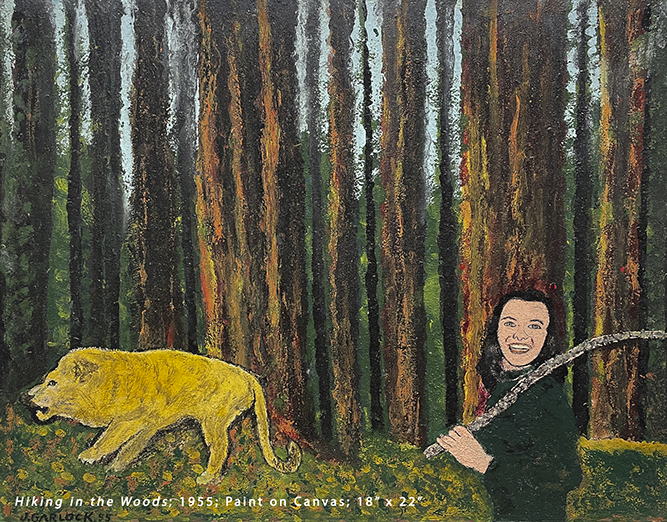
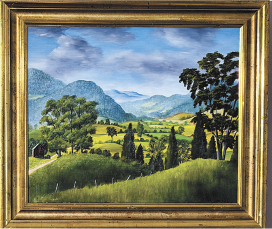
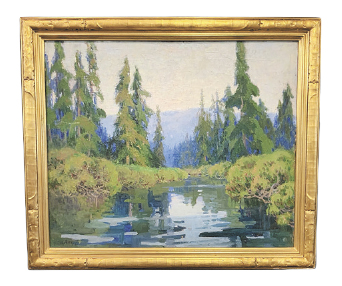
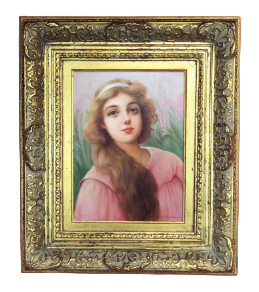
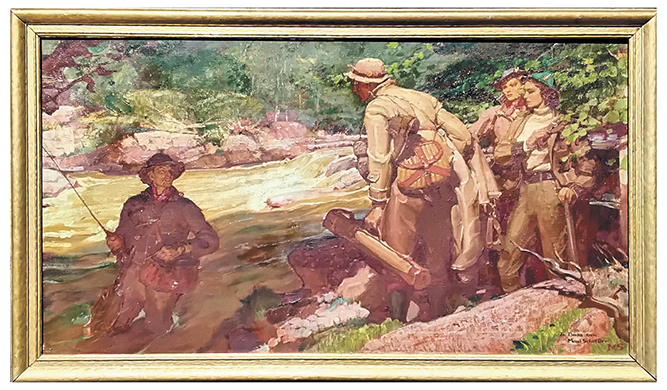
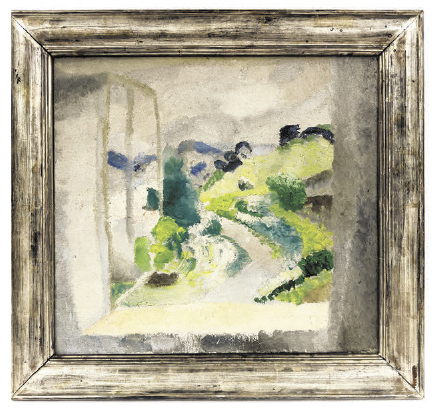
When the Reeves collection was packed for shipment to its new home at Washington and Lee, James Whitehead, then the university’s curator, instructed the moving company to also take a group of grungy picture frames from the attic of one of the houses. At that time, the university was not aware that Louise Reeves had been a painter. Quite some time after the collections were in Lexington, Whitehead opened a crate and pulled out a frame so coated with dust and grime that he thought it might contain a large, old photograph. Wrong! After unwrapping and cleaning the paintings, and after much research with the help of family members, the canvases were identified as the work of Louise Reeves, a talented and versatile artist who at the time went by Eaton, the name of her first husband.
Ron Fuchs, curator of ceramics and manager of the Reeves Center at Washington and Lee, frequently uses ceramics in classroom discussions in a variety of disciplines. A short walk from the Reeves Center, the Watson Pavilion, devoted to Japanese culture, complements the university’s programs in East Asian studies with a Japanese tea room, courses on Japanese tea and food, and a handsome collection of Japanese ceramics.
After the Civil War, Robert E. Lee became president of what was then called Washington College. His progressive views on liberal arts education were perhaps influenced by his three years as the superintendent of the United States Military Academy at West Point between 1852 and 1855. The college was renamed Washington and Lee when he died five years later. Lee’s wife, Mary, was the great-great-granddaughter of Martha Washington by her first marriage to Daniel Custis. The university is a major repository of Lee material, including hundreds of letters. The centerpiece of these holdings is the important marble “Recumbent Lee” by Edward Valentine, installed in the Lee Chapel in 1883. Lee’s office, part of the museum housed in the lower level of the chapel, is preserved much as he left it.
Also on display are a number of Civil War items and a very large orrery that Lee purchased for the astronomy department in 1867. Many consider the Lee Chapel one of the most important shrines in the former Confederate states. Lee’s favorite horse, Traveler, is buried adjacent to the chapel. Hay and apples are frequently placed on Traveler’s tomb, but, alas are consumed not by Traveler but by squirrels.
Not least among the wealth of interesting things to see at Washington and Lee is “Old George,” the larger than life wooden statue of George Washington carved by Matthew Kahle that as early as 1844 topped the university’s main building. A bronze replica now stands in its place. The original may be viewed on campus in the Leyburn Library. Washington was a major benefactor of what was originally known as Liberty Hall Academy, giving it a large donation of stock in the James River Company canal in 1796. On display in the Lee Chapel, Charles Willson Peale’s portrait depicting a young Washington as a colonel in the Virginia Regiment is also not to be missed.
For information, 540-458-8034 or www.wlu.edu.
Many thanks to Ron Fuchs for his help in preparing this article.
Rick Russack is a regular contributor to Antiques and The Arts Weekly. A history buff and retired dealer in antiquarian books, he lives in a 1760s house in New Hampshire with his rescue dog Charlie.