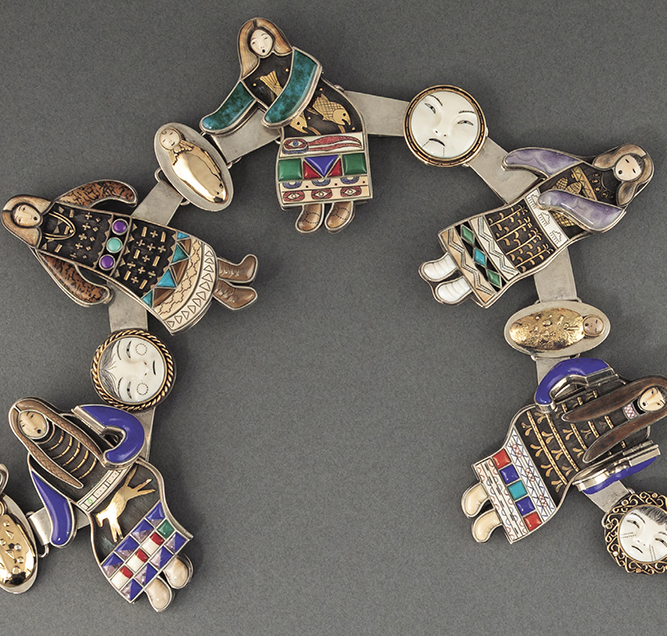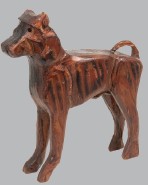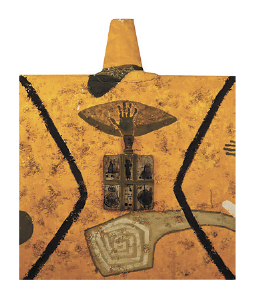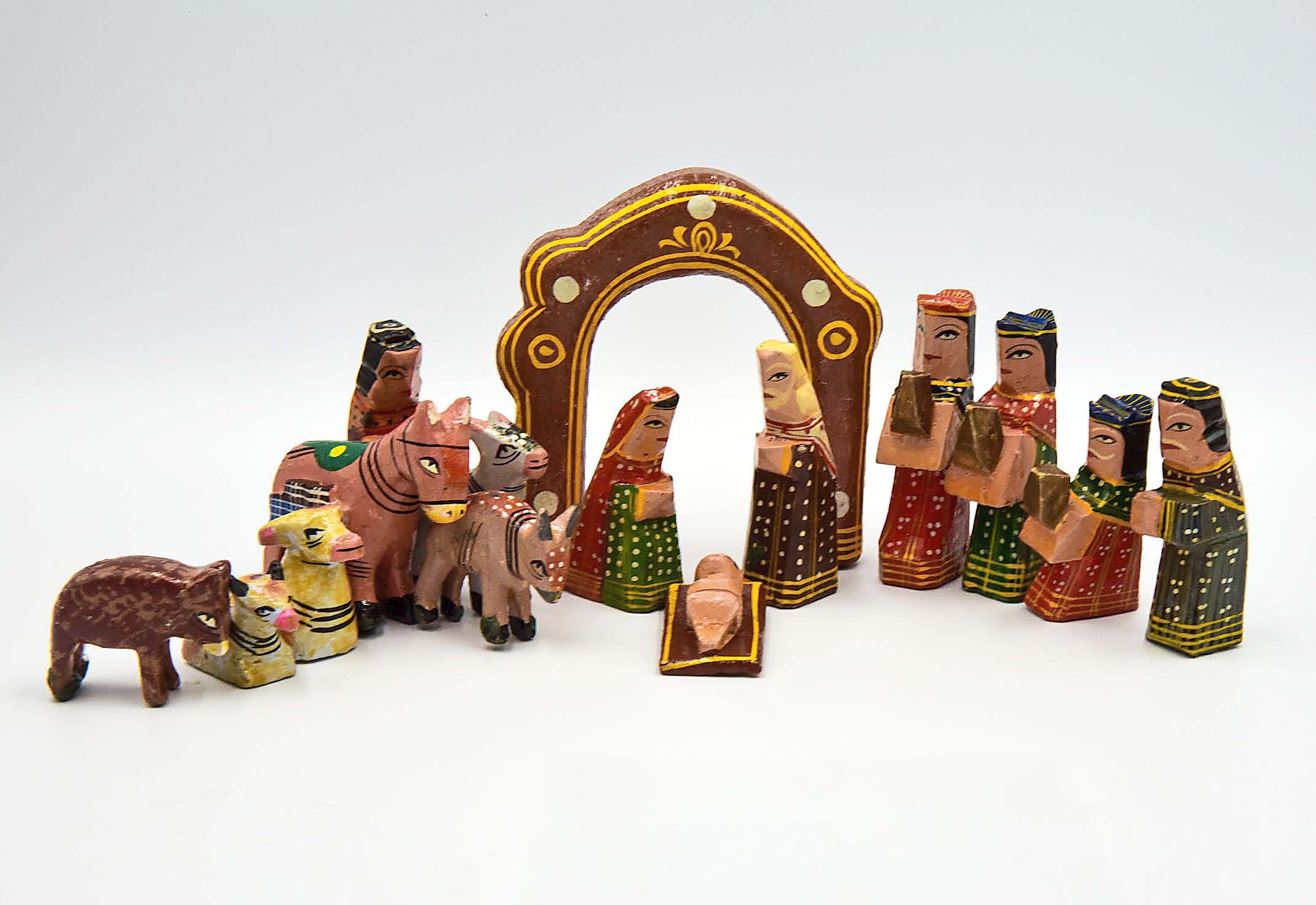
Indian “block figures,” made of hand-painted carved wood. Washington National Cathedral.
By Barbara Miller Beem
WASHINGTON, DC & FREDERICK, MD. — Long ago and not so very far away, Elmer Mumshower set about celebrating Christmas by constructing a large display in his Frederick, Md., home. Using what raw materials he could easily get his hands on, Mumshower created a miniaturized scene of an imagined landscape, one that included mountains and waterfalls, automobiles and trains. At the center of it all was a miniature crèche.
It was a sight that his daughter Beulah would never forget. “Little did I realize,” she would later recall, “that my fascination with the nativity scene was the beginning of a lifelong hobby.” And thanks to her foresight and generous spirit, thousands of visitors can once again make holiday pilgrimages to appreciate two major exhibitions of crèches.
Beulah Mumshower was born, reared and educated in the western Maryland city of Frederick. As a young woman, she enrolled at nearby Hood College, then an all-female institution. There, she studied religion, graduating as a member of the class of 1944. When Beulah married John Gustave Sommer, the couple settled in Washington, DC, where she worked as an information specialist for an office of the Pentagon, and later, as an elementary school teacher.
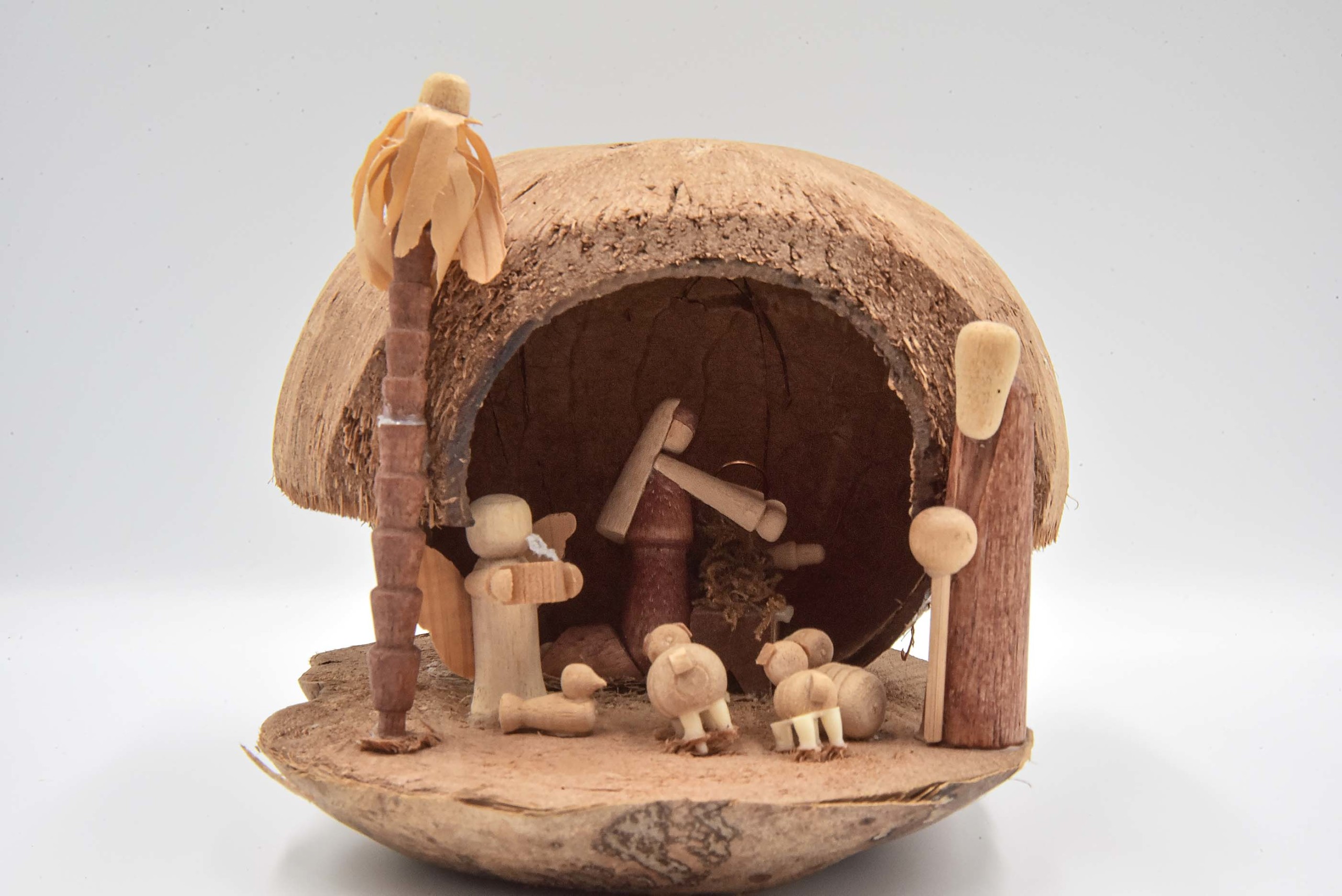
“Mele Kelikimaka!” Small pieces of wood in a hollowed-out coconut bring Christmas greetings from the “Aloha State.” Washington National Cathedral.
One year, Beulah received a Christmas gift, purchased at Garfinckel’s, once an upscale department store. More memorable than the gift was the gift wrapping: atop the present was a tiny plastic crèche scene. Reminded of her happy childhood memory, and inspired by her father’s holiday display, Beulah treasured the small trinket. Not long afterwards, while shopping in a local dime store, she came upon a bin of plastic nativity figures, priced at five cents apiece. She bought a handful of them.
As it happened, John’s career led the Sommer family (now three, with the birth of daughter Sandy), to a multi-year stay in Germany. One evening, a man came to their door, selling Hummel nativity scenes. The Sommers purchased one, thinking it would serve as a reminder of their time in Europe. On a 1960 trip to Oberammgau to see the Passion Play, they bought another small nativity scene. The seed was planted, and Beulah’s interest in crèches began to take root and blossom.
Back home in the States, the Sommer family resettled in the DC area. Beulah volunteered as a docent at the National Gallery of Art, where she was required to present gallery talks. With “The Wise Men in Legend and Art” as her topic, she integrated her interest in nativity scenes with her love of art. And, with John’s purchase of a crèche at the airport in Taipei, she crossed the line from casual buyer to serious collector.
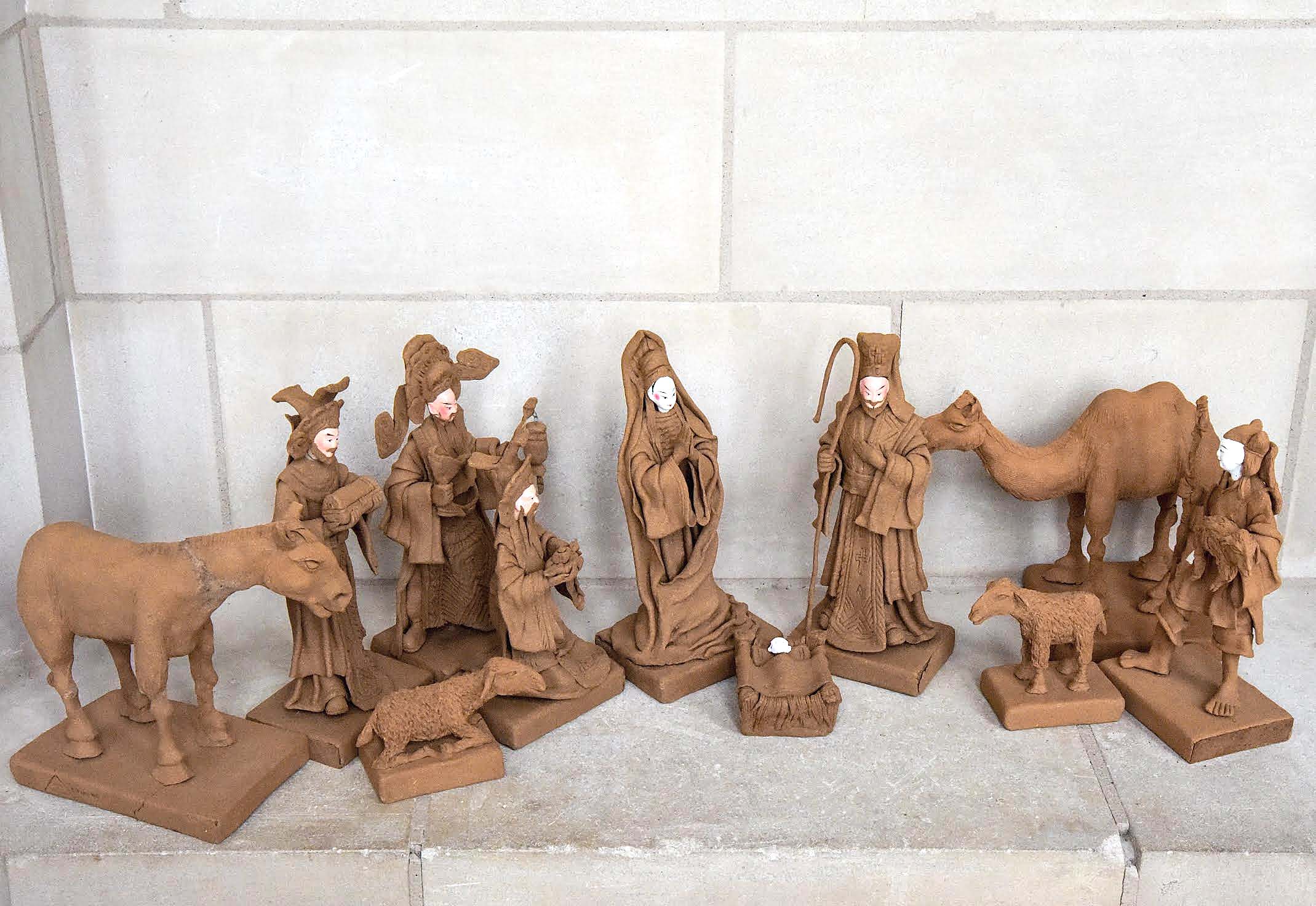
A Singaporean artist used cinnamon tree bark and painted porcelain to create this expression of faith. Washington National Cathedral.
What followed were years of purposeful curation of miniaturized scenes depicting baby Jesus in a manger. In addition to Mary and Joseph, many of these sets often included shepherds, sheep and angels, as well as wise men from the East and an array of animals. Representing a wide range of materials used by both skilled and unskilled artisans alike, her collection demonstrated that crèches were not only statements of faith but also reflections of cultural aesthetics.
Beulah’s collection soon numbered more than 700 nativity scenes from 70 different counties, varying in size and complexity, both two- and three-dimensional. Many of her acquisitions were souvenirs of her friends’ travels around the world. But on several occasions, strangers made gifts to her of their own crèches. Once, while waiting in an airport in Abidjan, Côte d’Ivoire, a stranger overheard Beulah talking about her favorite subject. The woman reached into her bag and gave Beulah a crèche that she was carrying. Then there was Felix, a driver in Pakistan, who learned of her interest and subsequently presented her with his family’s nativity scene.
With the eye of an artist and a multicultural sensitivity, Beulah recognized the significance of her extensive collection. As she once commented, “Each set reflects in some way the place where it was made.” Wishing to share with others the generosity that had been shown to her, she donated a large portion of her collection to two institutions dear to her heart.
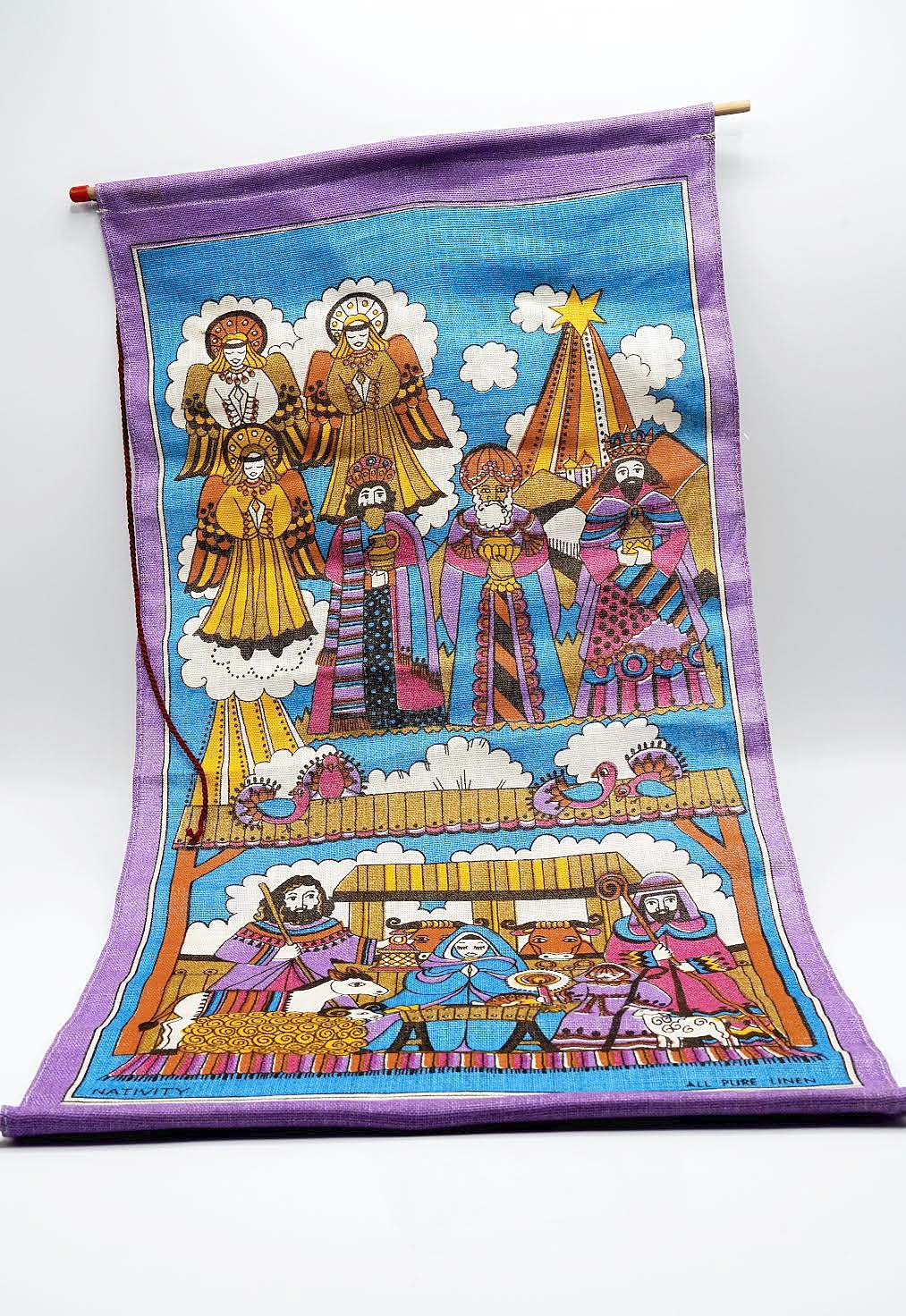
A two-dimensional depiction of the birth of Jesus, this hand-painted tea towel is from Ireland. Washington National Cathedral.
One gift began in the form of a loan to the Washington National Cathedral, where Beulah served as a volunteer aide. What was meant to be a one-time exhibition in 1994 proved to be so popular that a second exhibit was mounted. Soon it was an annual event. Sandy Sommer Fisher noted, “At one point, my mother said, ‘I have enough. I don’t need to collect everything.’” Consequently, she donated several hundred crèches to the Cathedral in 1998, with the stipulation that they be used to engage the public.
Today, Beulah’s decades-long passion for collecting crèches from around the world continues to inspire and delight holiday visitors to the Cathedral, with more than 50 crèches on display in the crypt this holiday season. Margaret Rawls, speaking for the Cathedral, confirmed that there is a “small dedicated group of crèche fans” that returns every year. In addition to “locals” from the District, Maryland and Virginia, visitors travel from all over the country and all over the world, some from as far away as China, to enjoy the exhibition, which changes every year. “Tiny sets” are among the most popular crowd pleasers, Rawls added.
Beulah also donated more than 100 crèches to her alma mater, Hood College. Beginning in 1992, the College hosted its first exhibit of crèches. Enthusiastically embraced by both the College and the greater Frederick community, it quickly became an annual holiday tradition, with at least 60 crèches displayed in the school’s library. Among the unique nativity sets included in Hood’s collection is one made in Kenya that features images of Jesus, Mary and Joseph fashioned from bottle caps and wire. Equally unusual is one created by a Brazilian artisan, whose use of painted marbles resulted in a joyous depiction of Jesus’ birth. As her daughter Sandy agreed, these examples exemplify Beulah’s interest in the story behind the crèche, recognizing the most humble works as examples of folk art.
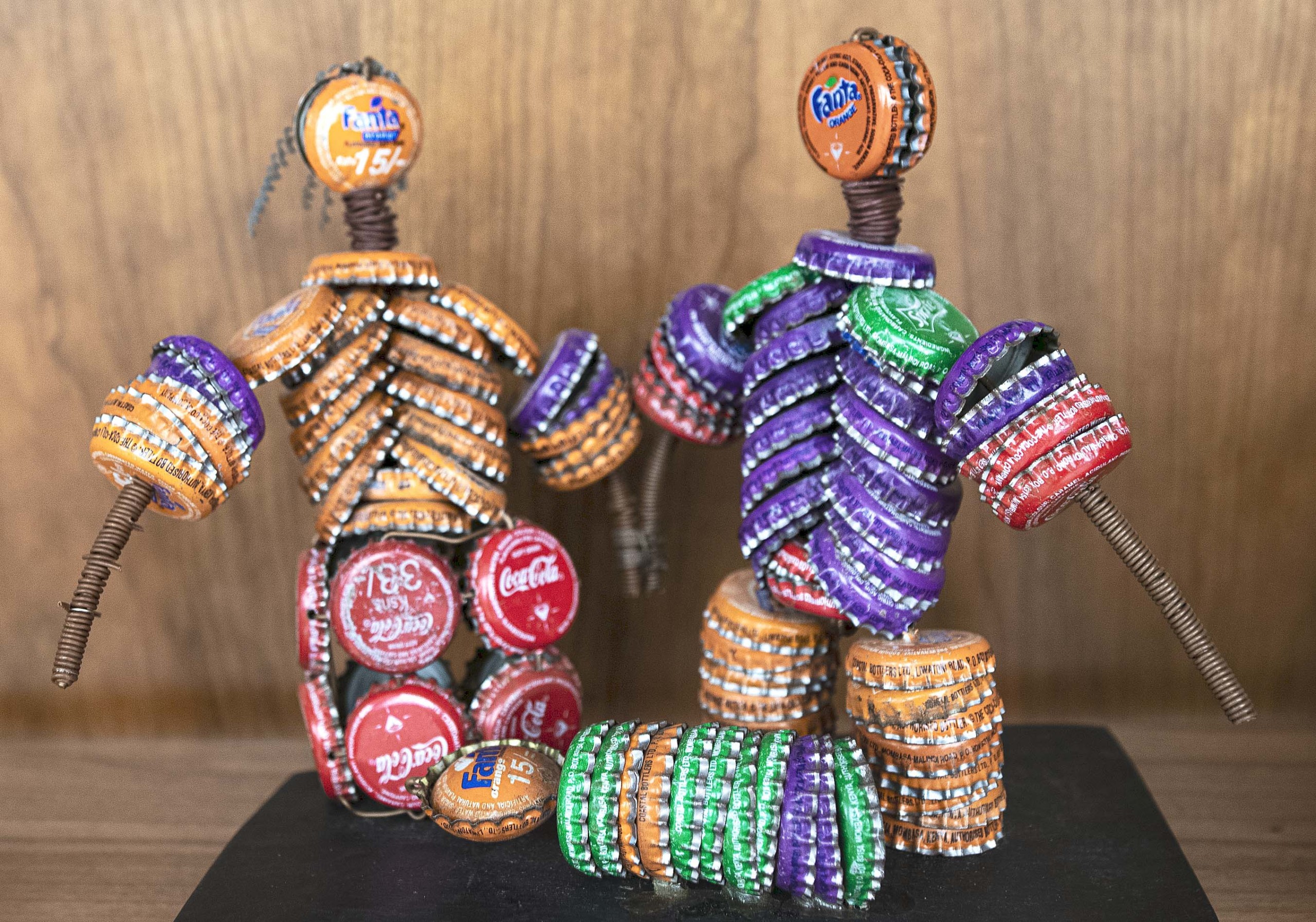
An example of the work of a Kenyan artist. Here, Jesus, Mary and Joseph were crafted using bottle caps and wire. Hood College.
Remembering her mother, Sandy called her “a remarkable woman,” one who appreciated artistic diversity and cherished the people she met through her collection. Never a hoarder, always a “professional volunteer,” Beulah had an eye for symbolism in art. At the same time, she respected the artisans who created their personal masterpieces, no matter how humble. Indeed, her crèche collection “opened up the world to her.”
In her later years, Beulah continued to enjoy moments in the spotlight, thanks to her collection. In particular, Sandy recalled with a chuckle the Christmas when her mother was featured on a nationally televised morning show. Due to the hour of the broadcast, Beulah awoke earlier than usual, shared her collection with the audience and then promptly returned to her bed as soon as the cameras had departed.
Beulah died in 2014 at the age of 91, but her legacy continues to enrich the lives and spirits of countless strangers. Even without knowing her story, they look to her collection to experience joy at Christmas, a celebration that extends beyond borders. As for Beulah, having collected nativities from around the world and shared them with the public, there was one crèche in her collection that remained hers and hers alone: the tiny gold nativity charm she wore on a bracelet.
Themed “One Church, One Family: Christians Around the World Tell the Same Story,” this year’s exhibition at the Washington National Cathedral (3101 Wisconsin Avenue Northwest) is on view through January 18. For information, www.cathedral.org.
Hood College presents its annual display in the Beneficial-Hodson Library (401 Rosemont Avenue) from December 1 to January 4. To arrange a visit, contact the archivist at [email protected]. The library and exhibition are also open, free of charge, as part of Frederick’s Museums by Candlelight on December 13, from noon to 7 pm. For information, www.visitfrederick.org.