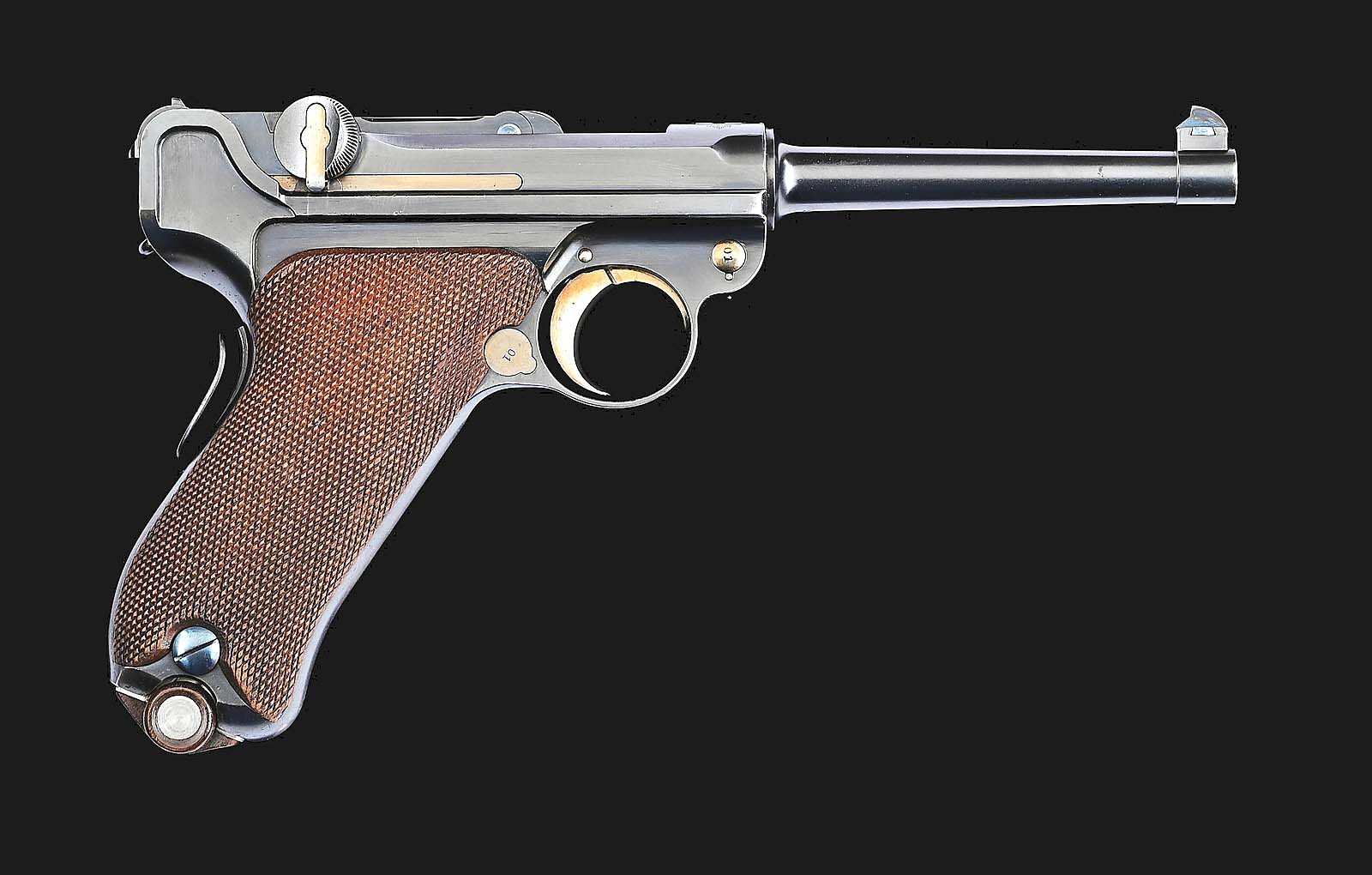
Marked “01,” this Model 1900 was the first DMW Swiss Luger. It led the auction at $307,500 ($400/600,000).
Review by Carly Timpson
DENVER, PENN. — Morphy Auctions’ three-day Firearms & Militaria sale, May 12-14, highlighted antique and collectible firearms of superior quality and historical significance, with a special selection to honor the 250th anniversary of the Revolutionary War and featuring the lifetime collections of David Grunberg and Gary Schlosstein. In total, the nearly 1,300-lot sale exceeded $8 million.
Les Jones, COO & director of marketing, noted that all bidding platforms were active during the sale and phone bidding was also very strong. In fact, he said it was one of the firm’s strongest three-day auctions. “We continue to attract a growing number of new winning bidders in all of our auctions the past couple of years,” Jones said. “We are seeing the highest percentage of first-time winning bidders ever. We are successful in attracting new buyers, which is leading to record pricing in many areas.”
As Jones noted, “Rarity and condition still rule the day,” and the auction’s top lot proved that point. Reaching the sale-high price of $307,500 was the first-ever DWM 1900 Swiss Luger semi-automatic pistol. Bearing serial number “01,” this rust-blue pistol had a 4¾-inch tapered round barrel and checkered, oil-finished walnut grips. Made in May of 1901, this example was “the very first Military Contract Luger produced and part of a 610-gun contract for Switzerland and became known as the Model 1900,” according to the catalog writeup. Ahead of the sale, Morphy representatives promoted this gun, writing, “While many military handguns are specific to their respective nations, the Luger is the ‘World’s Pistol’ and has been called the most identified and prized collectible pistol known. The pistol has a prestigious pedigree and was in the collections of both Hank Vissner and Geoff Sturgess. It represents a once-in-a-lifetime opportunity.” The gun was sold in a contemporary fitted case with original accessories.
Exceeding Morphy records for any Singer gun, this .45 ACP semi-automatic pistol, Model 1911A1, was one of 500 from an original contract and was offered publicly for the first time in this sale, where it earned $184,500 ($165/225,000).
Another rarity was a Singer Model 1911A1 .45 ACP semi-automatic pistol. Manufactured by the Singer Sewing Machine Company (Elizabeth, N.J.) in 1940, this model is considered one of the most desirable pistols among .45 automatic collectors worldwide. Just one of 500 produced from an April 1940 contract to provide personnel in Elizabethport with examples for later manufacture. However, the contract was redesignated for military issue due to the advent of World War II; as a result, this example was stamped “United States Property M1911 A1 U.S. Army.” In pristine condition — having been recently discovered and had never before offered for public sale — the gun achieved $184,500, a price that “blew out every other Singer we’ve sold by at least 50 percent,” remarked firearms cataloger & researcher Eric Wagner.
A world record result was earned by another gun with military pedigree: a Colt 1921/28 Navy Thompson machine gun with a Cutts compensator, which was taken to $130,380. The “8” on the gun’s model marking, “Model of 1928 / No 5014,” was an overstamp, and above the mark was a “U.S. Navy” stamp. The naval weapon retained its original 1928 internal parts and sold with several accessories, including a 50-round drum magazine, two tan marked “Mills” 50-round drum carriers with straps, ten 30-round stick magazines and a Kerr sling, among others. Its record result can be attributed to the unique stamping, complete accessories and the fact that “the Colt Thompson … is the most iconic of all American machine guns, and the ones with the Cutts compensator and vertical foregrip such as this one have the most recognized silhouette,” as described in the catalog.

From the Lafeyette shipment, this French Model 1774 flintlock musket was marked “U.States” and brought $39,360 ($15/40,000).
Sold as part of the Revolutionary War celebration was an important documented French Model 1774 flintlock musket from the famed Lafayette shipment. The historic musket was “profusely marked with important Revolutionary War markings indicating both its substantial use by the Continental Army and that it was one of a shipment of muskets sent clandestinely to the United States and arriving in 1777 with Lafayette.” The markings included two for “U.States,” three “US” marks and an “Lf” mark above the “Manufacture / de St. Etienne” on the lockplate. Leading Revolutionary weapons, the significant longarm, and literature related to it, sold for $39,360.
Another notable Revolutionary result was an engraved powder horn belonging to Benjamin Wille, a private in Captain James Gray’s Company in Colonel Alexander Scammell’s Third New Hampshire Regiment. Above its owner’s name, the horn was engraved with a large cartouche inscribed “Liberty And / Property: no / Stamp Act / 1777.” Engraved motifs on the body included a road with marching grenadiers, buildings, a rattlesnake, a bird and stars. More than doubling its high estimate, the powder horn was raised to $20,910.
The sale’s top sporting arm was a circa 1994 Purdey .410 over/under SLE shotgun. Engraved “Made for Ed Hinkle / Lexinoton [sic] N. CA” on the barrel and having classic Purdey rose-and-scroll details on the sidelock, the gun featured gold inlays, including the company’s name at each bar, “EH” initials along the toeline and the weapon’s serial number at the strap. Cataloged as being in outstanding condition, it was shot down for $150,000.
This circa 1994 Purdey .410 SLE shotgun retained its factory finishes throughout and led sporting arms at $150,000 ($150/250,000).
One among a group as small as approximately half a percent of all swords made, a Juyo Token is an extremely rare sword that is one of the highest ratings a Japanese sword can achieve under the NBTHK (Society for the Preservation of the Japanese Art Sword) classification system. An example made in the middle of the Nanbokucho period, approximately 1350, attributed by its features to the Ko-Yoshii school of the Bizen tradition, and specifically to the smith Sanenori, was sold for $33,210 in this auction. Its 28-inch blade was of the classic shinogi-zukuri form, with iori mune (back of the blade that is peaked with two converging surfaces) and a chu kissaki (medium tip). The prestigious blade had a faux rayskin samegawa, a contemporary saya and sold with an elaborate sword bag, the Juyo Token papers, a copy of the Juyo Zufu page and an oshigata scroll.
Prices quoted include the buyers premium as reported by the auction house. For information, www.morphyauctions.com or 877-968-8880.