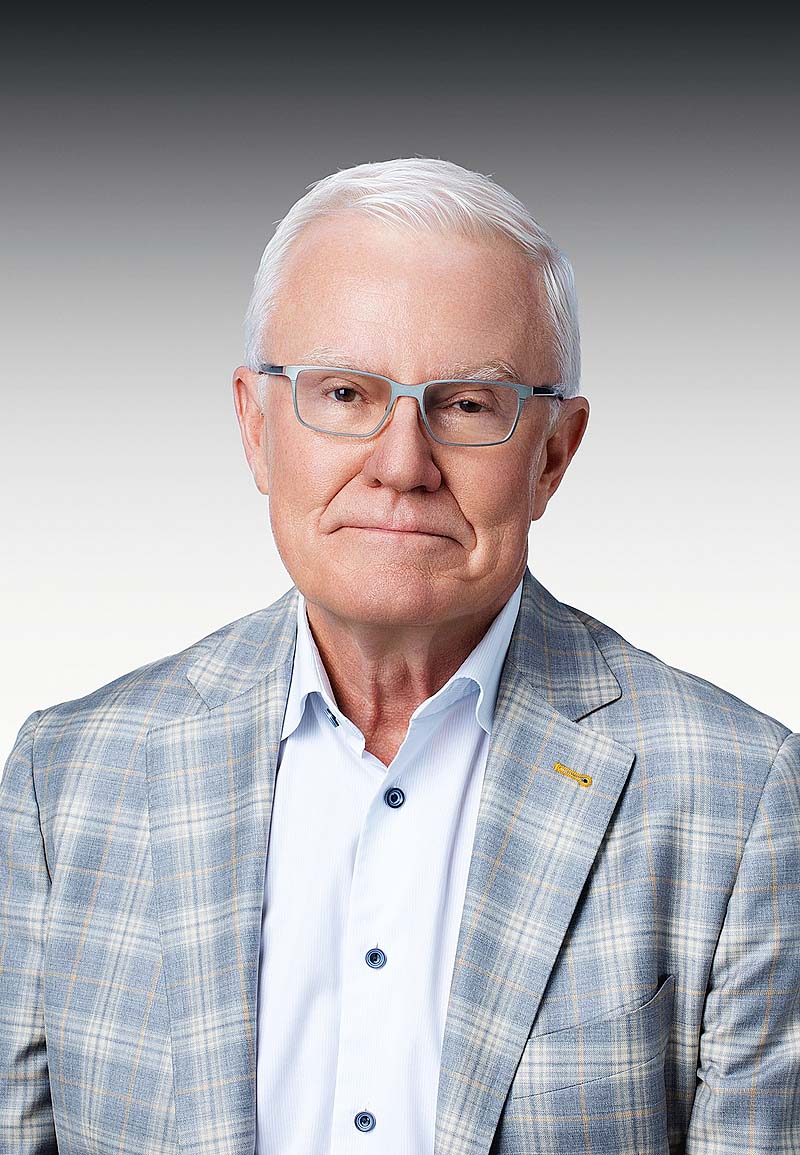
Charles Shreve, chair of the Smithsonian National Postal Museum’s Council of Philatelists and recipient of the 2019 Smithsonian Philatelic Achievement Award, has joined Heritage Auctions as its vice president in the newly re-established stamps department. More than 40 years ago, the philatelist was an early partner of Steve Ivy, Heritage’s CEO and co-chairman, at Steve Ivy Philatelic Auctions. The professional reunion marks a new era for Heritage, so we reached out to Charles to learn more about the path that brought him back here.
Congrats on the new (or reincarnated) position with Heritage! How did you find your way back to revive this department?
Steve [Ivy] got me all those years ago, in 1980, to start up stamps as one of their newest divisions — they didn’t have different divisions back then; they weren’t the big behemoth they are now in all these collectibles, but stamps seemed like a natural move. I had left Sotheby Parke Bernet in New York, back when they had a stamp division. Steve got me down here, and I worked for him for almost 13 years. At that time, he got an offer to sell the stamp division to a larger stamp company called Greg Manning, so they sold the company. As part of the contract, they were prohibited from getting back into stamps for 15 years, as a non-compete.
All these years later, Steve mused that stamps were one of his first loves. He regretted not having stamps on the masthead now where Heritage lists every possible collectible — “Pokémon Cards,” “Luxury Bags,” “Currency,” “Movie Posters,” you name it. It was obvious that “Stamps” was missing.
I kept in touch with Steve, but we had a chance meeting in New York City where we bumped into one another, had breakfast and he knew that I was thinking about leaving the Siegel firm [Robert A. Siegel Auction Galleries], so, long story short, we said, “Let’s just do it.”
What does it mean to you that the category is returning to Heritage at this time?
What Steve and Jim Halperin have done with Heritage, and with having all the other collectibles, will make stamp collecting much more accessible, transparent and easy to bid. And there’s a huge online presence with two million registered online users.
So, I’m thinking, what are the possibilities? What other stamp collections are out there that I’m unaware of that Heritage will be able to reach? And then, when we go to sell stamps, how many of these people will — besides the traditional stamp people that I know — how many of the Heritage customers will want to stick their toe in the water of buying stamps again?
A lot of people, including some stamp dealers, like to say that stamps are the past and only older people collect. I do not find that to be true at all. All the years that I consulted with Siegel, the past 14 years, I saw the inner workings of people bidding online, and it was remarkable how the new, younger people were dominating the market. Now mind you, a “younger” buyer in a stamp auction who’s spending a million dollars is not 20 years old, they’re in their 40s and 50s (but not their 70s or 80s). They’re spending a lot of money on stamps, and they enjoy it.
I’m not young enough to worry about them being buyers 30 years from now, but a lot of my clients in their 40s and 50s vaguely remember collecting stamps when they were young, and they thought it was neat. They’re looking for something to do because they’ve sent all their kids to college, and they remember the stamp collections on the top shelf of the closet, and they want to do something different and intellectual and stimulating.
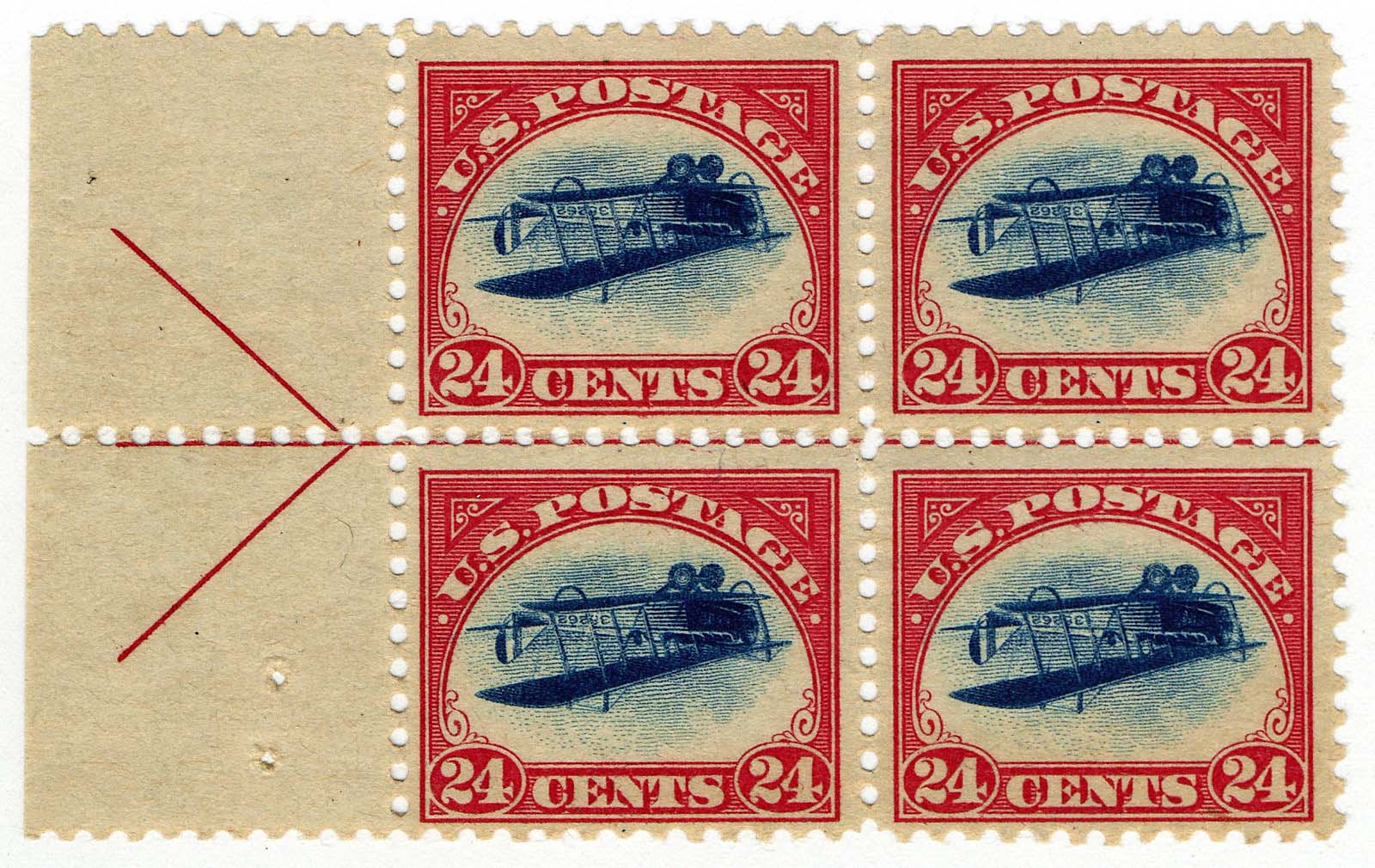
24c Curtiss Jenny inverted block of four, 1918. National Postal Museum,The William H. Gross Collection. Courtesy Smithsonian National Postal Museum, Washington, DC. One of the most iconic and recognizable stamp errors ever discovered is the 1918 24c “Inverted Jenny” air post stamp. In 1918 the Post Office issued its first air mail postage stamp, to promote the newly established air mail service. A special 24c stamp was prepared, depicting the Curtiss Jenny biplane in the center in blue, surrounded by a red frame. One sheet of 100 stamps was discovered with all of the stamps within the sheet having had the blue biplane in the center printed upside down.
The key is, you aren’t born waking up and saying, “I want to collect stamps.” You have to be exposed to it. For years and years and years, we had a feeder system — the post office — where people actually went to the post office and bought stamps. Now, the younger generation doesn’t even know how to put a stamp on an envelope, and they haven’t been in a post office ever.
As a little side note, one of the reasons why I’m so proud of and so obsessive about my participation with the Smithsonian National Postal Museum, is that we get over a million people a year in the museum, many of which are school children, and introducing them to stamps. And not one of them leaves without grabbing a handful of stamps. They’re very common stamps, but they think they’re really neat.
You’ve got to plant the seed. You need somebody like Heritage that already has the website and will show that they’re dealing in stamps. So, I like the future of it, and it’s really the marketing prowess of Heritage that intrigues me.
How has the reception been to the news that Heritage would be opening the stamps department?
It’s still so early. It’s been only a few weeks since we really made the announcement, but the reception has been extraordinarily positive. Now, some of the traditionalists in stamps say, Heritage is like this newfangled giant marketing behemoth and all that, but they don’t understand that’s what drives markets. They’re a little apprehensive about what a big company will do. But 90 percent of the comments, or more, have all been extremely positive and can’t wait to find out what’s going to be going through our doors. A lot of people say, “Finally, I have some place I want to sell my stamps through.”
What is the collecting community like? Has it embraced the internet as a form of connection like other collecting categories have?
Well, stamps is always slow to react. The stamp world is slow to react to more modern marketing techniques, and it’s taken a while for stamps to embrace social media — it’s tried, it’s sputtered.
After just the last two weeks of the mass emails that we’ve done and promotional things, and we’re just getting started. The stamp world wants to hear more about what’s going on.
I like being involved in events, too, that create a social community. Not like the old-fashioned stamp shows, but more where you invite people to high-end events and you have parties and dinners and private exhibitions and so on. For example, every two years the Smithsonian Postal Museum holds its gala. It’s one of the most sought-after events in “Stampdom.” We alternate every other year with the Club de Monte-Carlo in Monte Carlo: the Prince of Monaco puts on a high-end stamp event where many of the most important stamp collectors in the world all gather to socialize, party and have a black-tie dinner with the prince. That’s for the very high-end market.
And I’m telling you that many of the collectors — about 95 percent of my collectors are male, and their spouses or partners kind of scratch their head and go, I don’t understand that — but when they say, “Hey dear, how would you like to go to Monte Carlo and have dinner with the prince?” they find out that there are other stamp collectors and that gives them confidence of what their partner is doing and spending money and enjoying it, and they become part of this social community and they embrace it. You just have to introduce people to it.
But on a lower end, we do that too. At the Smithsonian, we have meet-and-greets and wine parties for young professionals. They come to the Postal Museum, it’s a beautiful setting, they have wine and they design their own stamps, they talk with other people. We have hundreds of young people come to those and socialize and meet one another.

Stamp Arch in the “World of Stamps” exhibition in the William H. Gross Stamp Gallery at the National Postal Museum. Image courtesy of Smithsonian’s National Postal Museum. Photo by Juan Carlos Briceño.
Can you tell us a little bit about the current state of the collecting world and market?
Right at the moment, people are driven to quality, especially the people who have spent a lot of money, they want to buy the best of the best. And the reason it gets more expensive is because there’s less and less of the best of the best. The middle market, which requires masses of people collecting, has been a bit stagnant, but I want to help recreate that. People don’t start off buying $10,000, $100,000, million-dollar stamps. They start off buying $10 stamps, $100 stamps and so on. So that marketplace needs to be revived a little bit. And I think with what we’re doing with the Smithsonian, what at Heritage and so on, attracting people, it does not have to be an expensive hobby.
There are fascinating, younger, interesting, intellectual people in Stampdom, and they just want to meet other people like that. It’s a little bit of a solitary hobby, so I want people to be more part of the social community and be at events and be online and that sort of thing.
I love the stamp business, but I think it can be even larger than what it has been — not like coins, probably… they have the advantage that they are shiny and yellow, and they have perceived value. Stamps are a little different. I find that the stamp collector is quite intellectual — they want to know more — they tend to want to know more about history and art and that sort of thing.
What is your favorite aspect of working in this field?
It’s very personal. The best part of working in this business has been the fascinating people that I’ve met around the world that I would have never have had met before, but that my professional allowed me to go around the world to international stamp shows and do business with people around the world, and the amount of trust people have put into me.
That when I go to a person’s home and they over dinner they say, “I think I want you to sell my stamps, Charles.” And they just basically hand them over to you. They don’t even ask for a contract. They just go, “Charles, I’ve seen you and we’ve done business together. And here they are.”
Of course, I give them a contract for insurance purposes and all that, but it’s been the amount of trust that people would put into me.
What’s the best way for new and younger collectors to get started? Do you have any advice for them?
The best way is to just go online and just start looking. Don’t buy yet. There are a zillion listings on eBay of stamps. Just look at them and see what attracts your eye. What is it that is interesting to you?
Also, go to the Smithsonian National Postal Museum website and learn about stamps from there. Visit the Smithsonian online; most of our collections are posted online just to see what you like.
And then my best advice is — not when you’re spending $5 on stamps or $10, you just do that for fun — but if you’re going to start spending $100 a month, $1,000 a month or whatever it is, find a trusted dealer that if you ever have a question, ask them, “Should I buy this?” “Is this something that will fit in my collection?” “Am I doing the right thing?” A good dealer will spend the time — even if he or she is not selling you anything — to answer your questions.
Every collectible has good people in it and some not so nice people. Find one that you trust and use them as a trusted advisor. They’ll spend the time with you. I can’t tell you how much time I spend on the phone or visiting with people, giving advice and then they just grow with you, and you avoid a lot of pitfalls.
What’s going on behind the scenes now to prepare for the first auction? When will that be?
I thought my first auction would be more of a sale made up of multiple consigners, but what I’m finding out is that we’ve attracted some very important collections. So, our very first sale, around the third week of January, will be what we call a single-owner sale: one man’s collection of a certain area. It’ll be a single owner sale of United States related material that people will be very impressed with.
We’re already talking about upcoming sales. Two and three might be single owner sales, but we’ll have a general sale that’s made up of multiple consignments in the spring.
—Carly Timpson